Nitrogen Supply to improve vine balanceBy: JadmikaUttam Floray
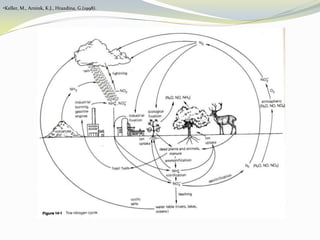
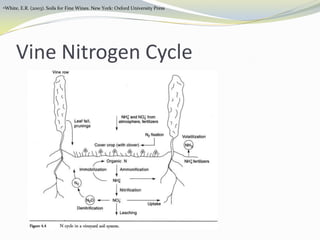
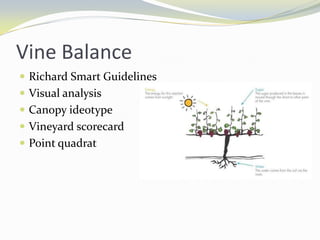
Keller, M., Arnink, K.J., Hrazdina, G.(1998).Vine Nitrogen CycleWhite, E.R. (2003). Soils for Fine Wines. New York: Oxford University PressVine BalanceRichard Smart GuidelinesVisual analysisCanopy ideotypeVineyard scorecardPoint quadrat
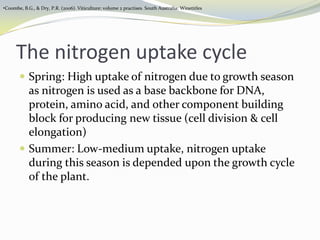
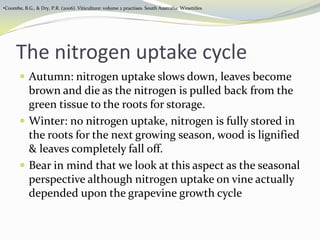
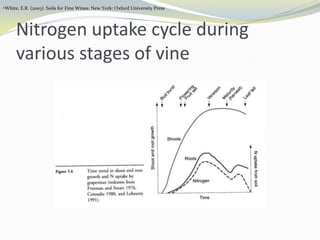
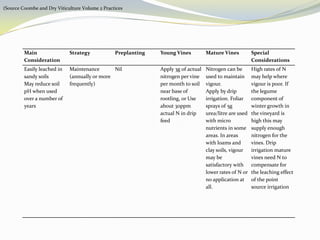
Winkler, A.J. (1962). General Viticulture. California: University of California.The nitrogen uptake cycleSpring: High uptake of nitrogen due to growth season as nitrogen is used as a base backbone for DNA, protein, amino acid, and other component building block for producing new tissue (cell division & cell elongation)Summer: Low-medium uptake, nitrogen uptake during this season is depended upon the growth cycle of the plant. Coombe, B.G., & Dry, P.R. (2006). Viticulture: volume 2 practises. South Australia: Winetitles The nitrogen uptake cycleAutumn: nitrogen uptake slows down, leaves become brown and die as the nitrogen is pulled back from the green tissue to the roots for storage.Winter: no nitrogen uptake, nitrogen is fully stored in the roots for the next growing season, wood is lignified & leaves completely fall off. Bear in mind that we look at this aspect as the seasonal perspective although nitrogen uptake on vine actually depended upon the grapevine growth cycleCoombe, B.G., & Dry, P.R. (2006). Viticulture: volume 2 practises. South Australia: Winetitles Nitrogen uptake cycle during various stages of vine White, E.R. (2003). Soils for Fine Wines. New York: Oxford University PressThe application of nitrogen fertigationWhat to apply?When? How to maximize the effect of the nitrogen fertigation?What’s the impact on the vine and environment?
(Source Coombe and Dry Viticulture Volume 2 Practices
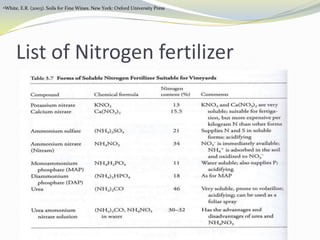
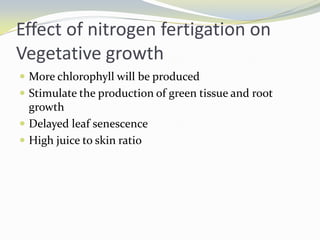
List of Nitrogen fertilizerWhite, E.R. (2003). Soils for Fine Wines. New York: Oxford University PressWhite, E.R. (2003). Soils for Fine Wines. New York: Oxford University PressEffect of nitrogen fertigation on Vegetative growthMore chlorophyll will be producedStimulate the production of green tissue and root growthDelayed leaf senescenceHigh juice to skin ratio
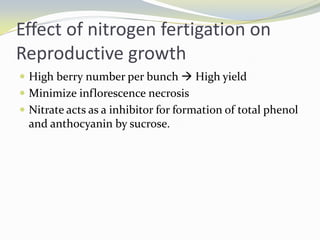
Effect of nitrogen fertigation on Reproductive growthHigh berry number per bunch  High yieldMinimize inflorescence necrosisNitrate acts as a inhibitor for formation of total phenol and anthocyanin by sucrose.
Fertigation, Retrived http://www.pacificag.co.nz/pages/54/fertigation.htmExcessive nitrogen supplyVine can become imbalance (high vigour leads to more vegetative growth).Shading causing high disease pressure.Toxic due to deposition of white amino acid salts causing severe burning in the leaves.High juice to skin ratio not suitable for red wine productionCausing bunch stem necrosis
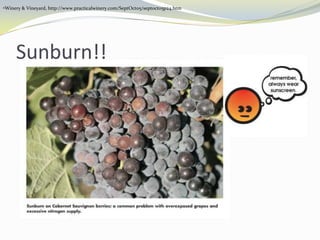
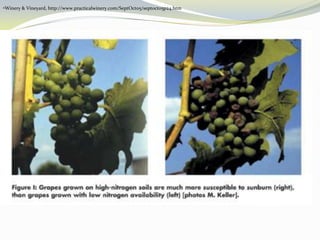
Sunburn!!Winery & Vineyard, http://www.practicalwinery.com/SeptOct05/septoct05p24.htmWinery & Vineyard, http://www.practicalwinery.com/SeptOct05/septoct05p24.htmDeficit of nitrogen supplyLow vegetative growth (vegetative growth is needed prior budburst onwards until veraison)Less photosythesis rate reaction in the plantLow in chlorophyll contentCan lead to abortion of entire inflorescenceIf accompanied by good light exposure produce anthocyanin profile that is dominant in Dp-3-glucoside.
ConclusionThe application of nitrogen need to be consider according to weather pattern, type of soil, irrigation, rootstock used, environmental issue, etcAs the impact with vine balance also need to be consider since excessive and deficit of nitrogen will effected the reproductive and vegetative growthVegetative vigour can be regulate by strategising the supply of Nitrogen to the vine.Fertigation is an important tool in application of Nutrients to the vineyard.
ReferenceCoombe, B.G., & Dry, P.R. (2006). Viticulture: volume 2 practises. South Australia: WinetitlesFertigation, Retrived 22 November 2009, from http://www.pacificag.co.nz/pages/54/fertigation.htmKeller, M., Arnink, K.J., Hrazdina, G.(1998). Interaction of nitrogen availability during bloom and light intensity during veraison. I. Effect  of grapevine growth, fruit development, and ripening. American Journal of Enology and Viticulture, 49-3, 333-339 Keller, M., Hrazdina, G.(1998). Interaction of nitrogen availability during bloom and light intensity during veraison. II. Effect  of grapevine growth, fruit development, and ripening. American Journal of Enology and Viticulture, 49-3, 341-348Keller, M., Kummer, M., Carmovasconcelos, M. (2001). Soil nitrogen utilisation for growth and gas exchange by grapevines in response to nitrogen supply and rootstock. Australian Journal of Grape and Wine Research, 7, 2-11.Keller, M., Kummer, M., Carmovasconcelos, M. (2001).Reproductive growth of grapevines in response to nitrogen supply and rootstock. Australian Journal of Grape and Wine Research, 7, 12-18.Rodriguez-Lovelle, B., Gaudillere, J.P. (2002).Carbon and nitrogen partitioning in either fruiting or non-fruiting grapevines: effects of nitrogen limitation before and after veraison. Australian Journal of Grape and Wine Research, 8, 86-94.White, E.R. (2003). Soils for Fine Wines. New York: Oxford University PressWinkler, A.J. (1962). General Viticulture. California: University of California.Winery & Vineyard, Retrived 22 November 2009, from http://www.practicalwinery.com/SeptOct05/septoct05p24.htm
Nitrogen Suppy To Improve Vine Balance

Nitrogen Suppy To Improve Vine Balance

  • 1.
    Nitrogen Supply toimprove vine balanceBy: JadmikaUttam Floray
  • 2.
    Keller, M., Arnink,K.J., Hrazdina, G.(1998).Vine Nitrogen CycleWhite, E.R. (2003). Soils for Fine Wines. New York: Oxford University PressVine BalanceRichard Smart GuidelinesVisual analysisCanopy ideotypeVineyard scorecardPoint quadrat
  • 3.
    Winkler, A.J. (1962).General Viticulture. California: University of California.The nitrogen uptake cycleSpring: High uptake of nitrogen due to growth season as nitrogen is used as a base backbone for DNA, protein, amino acid, and other component building block for producing new tissue (cell division & cell elongation)Summer: Low-medium uptake, nitrogen uptake during this season is depended upon the growth cycle of the plant. Coombe, B.G., & Dry, P.R. (2006). Viticulture: volume 2 practises. South Australia: Winetitles The nitrogen uptake cycleAutumn: nitrogen uptake slows down, leaves become brown and die as the nitrogen is pulled back from the green tissue to the roots for storage.Winter: no nitrogen uptake, nitrogen is fully stored in the roots for the next growing season, wood is lignified & leaves completely fall off. Bear in mind that we look at this aspect as the seasonal perspective although nitrogen uptake on vine actually depended upon the grapevine growth cycleCoombe, B.G., & Dry, P.R. (2006). Viticulture: volume 2 practises. South Australia: Winetitles Nitrogen uptake cycle during various stages of vine White, E.R. (2003). Soils for Fine Wines. New York: Oxford University PressThe application of nitrogen fertigationWhat to apply?When? How to maximize the effect of the nitrogen fertigation?What’s the impact on the vine and environment?
  • 4.
    (Source Coombe andDry Viticulture Volume 2 Practices
  • 5.
    List of NitrogenfertilizerWhite, E.R. (2003). Soils for Fine Wines. New York: Oxford University PressWhite, E.R. (2003). Soils for Fine Wines. New York: Oxford University PressEffect of nitrogen fertigation on Vegetative growthMore chlorophyll will be producedStimulate the production of green tissue and root growthDelayed leaf senescenceHigh juice to skin ratio
  • 6.
    Effect of nitrogenfertigation on Reproductive growthHigh berry number per bunch  High yieldMinimize inflorescence necrosisNitrate acts as a inhibitor for formation of total phenol and anthocyanin by sucrose.
  • 7.
    Fertigation, Retrived http://www.pacificag.co.nz/pages/54/fertigation.htmExcessivenitrogen supplyVine can become imbalance (high vigour leads to more vegetative growth).Shading causing high disease pressure.Toxic due to deposition of white amino acid salts causing severe burning in the leaves.High juice to skin ratio not suitable for red wine productionCausing bunch stem necrosis
  • 8.
    Sunburn!!Winery & Vineyard,http://www.practicalwinery.com/SeptOct05/septoct05p24.htmWinery & Vineyard, http://www.practicalwinery.com/SeptOct05/septoct05p24.htmDeficit of nitrogen supplyLow vegetative growth (vegetative growth is needed prior budburst onwards until veraison)Less photosythesis rate reaction in the plantLow in chlorophyll contentCan lead to abortion of entire inflorescenceIf accompanied by good light exposure produce anthocyanin profile that is dominant in Dp-3-glucoside.
  • 9.
    ConclusionThe application ofnitrogen need to be consider according to weather pattern, type of soil, irrigation, rootstock used, environmental issue, etcAs the impact with vine balance also need to be consider since excessive and deficit of nitrogen will effected the reproductive and vegetative growthVegetative vigour can be regulate by strategising the supply of Nitrogen to the vine.Fertigation is an important tool in application of Nutrients to the vineyard.
  • 10.
    ReferenceCoombe, B.G., &Dry, P.R. (2006). Viticulture: volume 2 practises. South Australia: WinetitlesFertigation, Retrived 22 November 2009, from http://www.pacificag.co.nz/pages/54/fertigation.htmKeller, M., Arnink, K.J., Hrazdina, G.(1998). Interaction of nitrogen availability during bloom and light intensity during veraison. I. Effect of grapevine growth, fruit development, and ripening. American Journal of Enology and Viticulture, 49-3, 333-339 Keller, M., Hrazdina, G.(1998). Interaction of nitrogen availability during bloom and light intensity during veraison. II. Effect of grapevine growth, fruit development, and ripening. American Journal of Enology and Viticulture, 49-3, 341-348Keller, M., Kummer, M., Carmovasconcelos, M. (2001). Soil nitrogen utilisation for growth and gas exchange by grapevines in response to nitrogen supply and rootstock. Australian Journal of Grape and Wine Research, 7, 2-11.Keller, M., Kummer, M., Carmovasconcelos, M. (2001).Reproductive growth of grapevines in response to nitrogen supply and rootstock. Australian Journal of Grape and Wine Research, 7, 12-18.Rodriguez-Lovelle, B., Gaudillere, J.P. (2002).Carbon and nitrogen partitioning in either fruiting or non-fruiting grapevines: effects of nitrogen limitation before and after veraison. Australian Journal of Grape and Wine Research, 8, 86-94.White, E.R. (2003). Soils for Fine Wines. New York: Oxford University PressWinkler, A.J. (1962). General Viticulture. California: University of California.Winery & Vineyard, Retrived 22 November 2009, from http://www.practicalwinery.com/SeptOct05/septoct05p24.htm

Editor's Notes

  • #3 N2 gas comprise 78% of earth atmosphere  can’t be utilised directly need to be reduced by nitrogen fixation pathwayBiology fixation N2  NH4 by prokaryote organism in legume can be utilised directly by other plantNH4  NO3 nitrification can be utilised directlySome of it is leach into the water table, can also denitrify to N2 back to the atmoshpereNitrate that is leach into water table go to cyclic salt producing acid rain with the help of lightning produced NH4 and NO3 channelled back to soilN2 as gaseous formed in the atmosphere can be converted to NO3- by oxidation of N2 by oxygen or ozone in the presence of lightning More information under word document, The nitrogen cycle and nitrogen fixation chapter. (Coombe, B.G., & Dry, P.R. (2006). Viticulture: volume 2 practises. South Australia: Winetitles)
  • #4 Source: Soil for fine Wines by Robert E.White
  • #5 What are the Richard Smart Guidelines?Other methods of determining vine balanceRegardless of the vine varietal, the climatic condition, soil type, and even vine that is planted in different area/country the Nitrogen uptake is almost the depending on the vine’s growth cycle
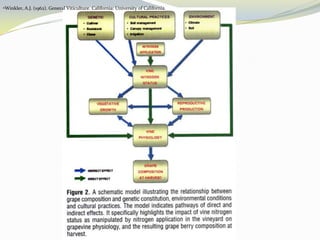
  • #6 Nitrogen status is dependent upon the environment (climate,soil) ; Cultural practises (soil management,canopy management, irrigation) ; Genetic (Cultivar, rootstock , clone). Nitrogen status can affecting the vegetative and reproductive growth of the plant which will have a huge influence on the vine physiology and the grape quality produced. Manipulation can be done by adjusting the nitrogen application.
  • #7 C:N ratio channelled higher sink/source relationship during flowering to verasion in the berry. Afterwards high sink/source in the roots. Sometimes abundant supply of nitrogen can provide competition for berry and roots growth for carbon distribution
  • #9 During bud burst to flowering nitrogen is used for the production of new tissue formation, particularly green tissue and roots growthFruit set onwards to veraison nitrogen is channelled to the berry, affecting YAN level in grapes; amino acid which probably affecting some of the aromatic compound, taste, colour in the wineVerasion onwards to maturity and harvest nitrogen is pulled back to storage for next year growth(Look under the nitrogen uptake on vine and fertigation practise in word document for detailed information)
  • #10 Nitrogen fertilizer, one of the example is Urea. Manure ,compost, using cover crop that have high rate of biomass and mowed it afterwards.The timing of the application can be range from before budburst, prior budburst, and after veraison (during root growth). But according one of the journal the timing of the application is better to be done is pre-flowering and 80% capfall. Good weather condition, not raining, before rainy season. In some low rainfall and unirrigated area, seasonal rainfall need to be utilised for helping the nitrogen move to root zoneSoil texture and characteristic. Applying N to sand type soil will be easily leach downwards make the application is not effective. Clay type soil can hold better organic matter compared to the other soil type.Light exposure to the vine with nitrogen fertigation can have an impact on the colour of the grapes especially red varieties.The type of rootstock used also play role in the nitrogen uptake to the vine. In one of the experiment, where 5BB (Vitisberlandieri x VitisripariacrosessKober 5BB), 5C (Teleki 5C), 8B (Teleki 8B), SO4 (Selection Oppenheim 4), C-3309 (V.riparia x V. rupestris cross Couderc 3309), Ru-140 (V. berlandieri x V. rupestris cross Ruggeri 140) are used to assess the impact of different rootstocks type on the nitrogen assimilation, shows that C-3309 and Ru-140 is more effective in assimilating nitrogen than V.berlandieri x V. riparia crosses. The correlation between xylem anion and cation shows that V. berlandieri x V.ripariacrosess have better ion co-transport than C-3309 and Ru-140. Different types of rootstock have different nitrogen needs, so choosing type of rootstock also important in the vineyard establishment where the nitrogen factor is already set in the soil. In some of the research shows that V.berlandieri x V. riparia is suited to low soil-N status, where C-3309 and Ru-140 need moderate supply of N for optimal performance. SO4 rootstock performs poorly at low soil N, but it reacts pretty strongly to the addition of Nitrogen.Increase the vigour, increase chlorophyll content, delay leaf senescence (reduced the rate of chlorophyll degradation after flowering), excessive N supply will cause shading due to N acts as a catalyst for photosythesis which mean more starch/sugar will be produced since starch is part of the building block for cell wall of green tissue.Can make the soil acidic overtime if added continously, it also leads to magnesium deficiency. So addition of Nitrogen to the acidic soil will need to be maintain to neutral pH afterwards. Addition of urea to alkaline soil is not effective since it lost as gaseous ammonia to atmosphere. Groundwater pollution due to nitrate leaching.
  • #11 Vine Fertilizer Requirement
  • #12 Form of Nitrogen fertilizer that can be used in the vineyards. Some info also for the nitrogen content for each fertilizer and some pro and cons of it.
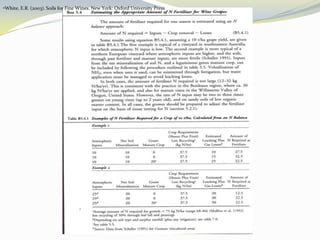
  • #13 The amount of Nitrogen fertilizer needed to be apply can also be calculated using this techniques.
  • #14 More info on the word document, The effect of nitrogen fertigation on vegetative and reproductive growth chapter
  • #15 High yield can decrease the quality of the grapes in some casesDeficiency of nitrogen, low water supply, can lead to abortion of entire inflorescence.Therefore Low exposure high nitrogen Mv-3-glucoside (red) dominant in anthocyanin profile. Good sunlight exposure low Nitrogen status Dp-3-glucoside dominant in anthocyanin profile give crimson to purple hue colour.More info on the word document, The effect of nitrogen fertigation on vegetative and reproductive growth chapter
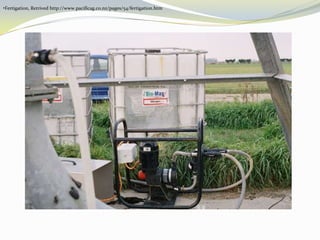
  • #16 Fertigation Tools
  • #17 N as catalyst for photosythesis which leads to more sugar and starch production. Bear in mind eventhough more sugar created, starch also created due to excessive sugar production which can lead to more green tissue growth since starch is part of the building block for green tissue cell wall. Nitrogen also acts as a backbone for amino acids, proteins, hormones, DNA, RNA production which mean excessive of nitrogen also can lead to more production of these compounds which is needed for cell expansion, and division.Moisture in the shading causing high disease incident, less ripen fruit (high in malic acid due to shading, low sugar concentration, low in colour,) High juice to skin ratio means large berry size (more dilute, not good for anthoycanin and tannin extraction)
  • #18 Image Source: Winery and Vineyard : http://www.practicalwinery.com/SeptOct05/septoct05p24.htmGrapes grown on soil with high Nitrogen content are more susceptible to Sunburn!!
  • #19 Image Source: Winery and Vineyard : http://www.practicalwinery.com/SeptOct05/septoct05p24.htm
  • #20 Nitrogen needed for growth as building block of amino acids, protein, hormones, DNA , RNADeficiency of nitrogen, low water supply, can lead to abortion of entire inflorescence.Nitrogen acts as a catalyst for photosythesis means less photosythesis if less nitrogen. Less photosythesis leads to low sugar and starch production causing unripen berry, less vegetative growth since starch acts a building block of cell wall