Value in numbers: a shared approach to measuring
usage and impact
NISO Virtual Conference
29 April 2015
JUSP and IRUS-UK
A single point of access to
COUNTER-compliant journal
usage data for 171 UK academic
libraries
Consolidates and compares
COUNTER-compliant IR usage
statistics for 82 UK HEI
Standards and interoperability
 COUNTER standard is
central to development of
both services
 Enables consistent and
comparable standards based
measurement
 M2M protocols such as
SUSHI facilitate greater
efficiencies
 Presents opportunities for
benchmarking at a national
level
Collaboration is key
• Delivering a service to the
community
• Collaboration and co-
development in conjunction
with libraries and academic
institutions
• Working with publishers to
provide enhanced customer
service
What is JUSP?
• Supports libraries by providing
a single point of access to e-
journal usage data
• Assists management of e-
journals collections to inform
evaluation and decision-
making processes
• Enables usage comparisons
and trend analysis
What’s in JUSP?
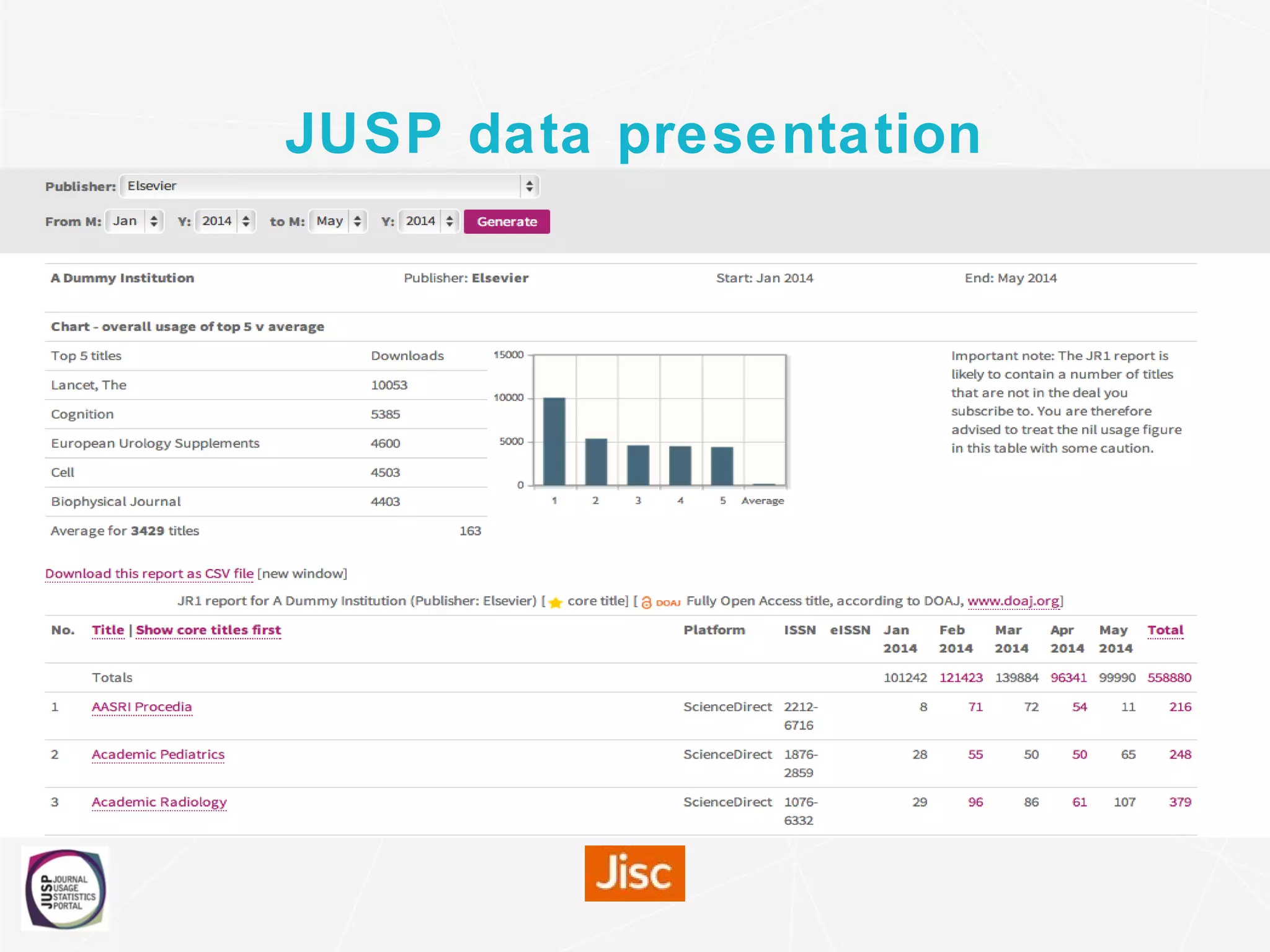
JR1 - Journal Report 1:
Number of Successful Full-Text
Article Requests by Month and
Journal
JR1a - Journal Report 1a:
Number of Successful Full-Text
Article Requests from an
Archive by Month and Journal
JR1 GOA - Number of
Successful Gold Open Access
Full-Text Article Requests by
Month and Journal
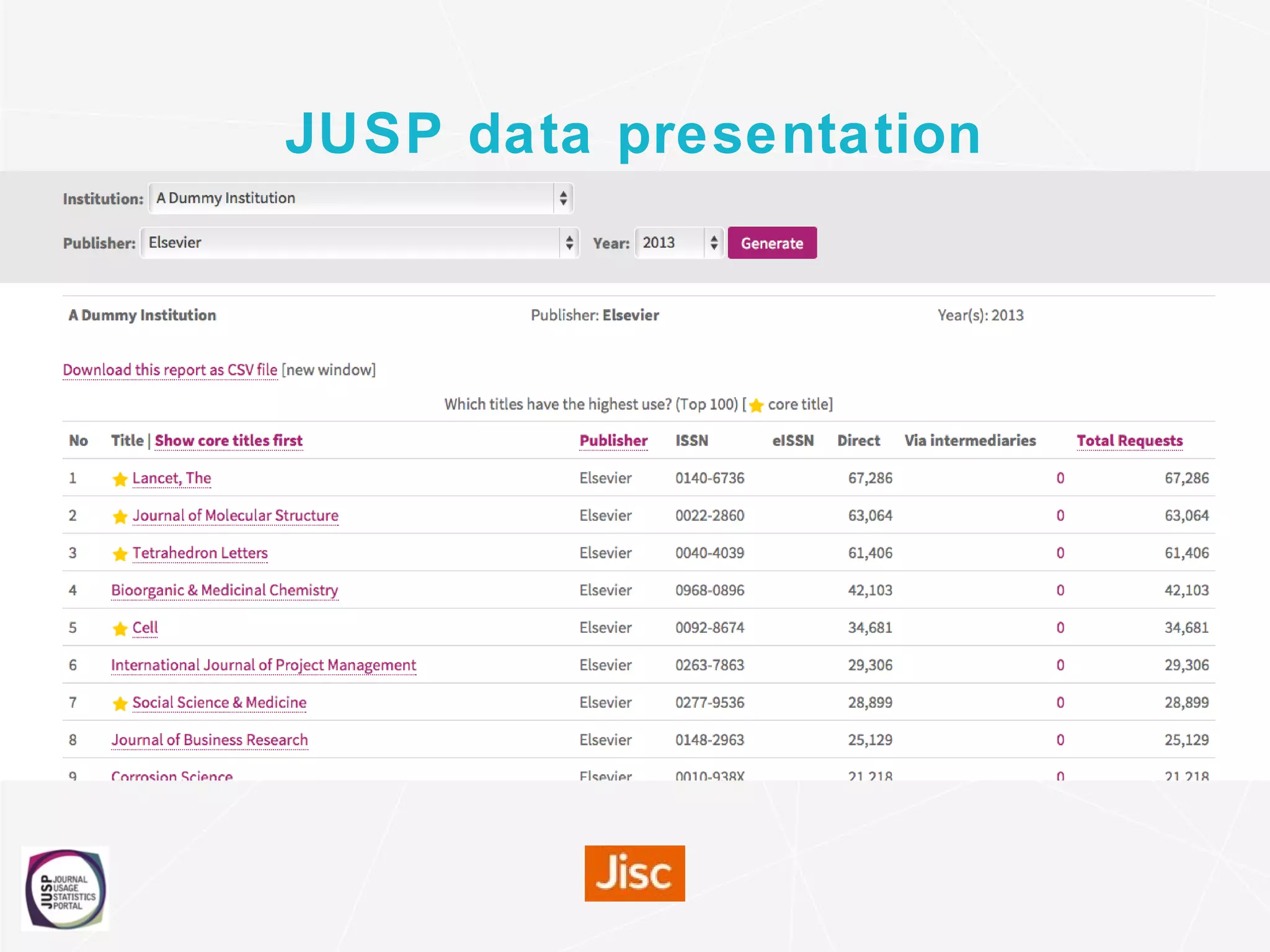
JUSP data presentation
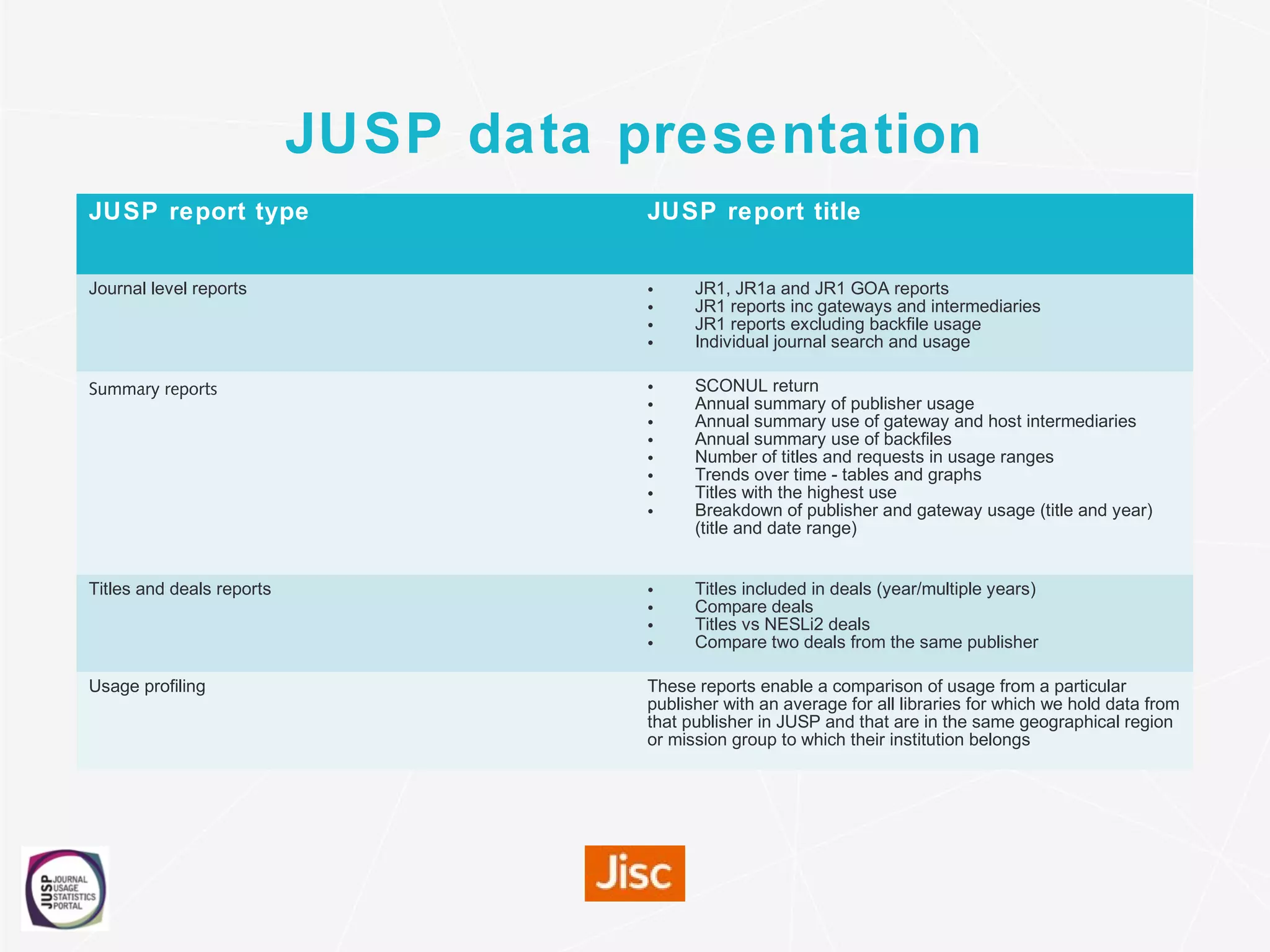
JUSP report type JUSP report title
Journal level reports • JR1, JR1a and JR1 GOA reports
• JR1 reports inc gateways and intermediaries
• JR1 reports excluding backfile usage
• Individual journal search and usage
Summary reports • SCONUL return
• Annual summary of publisher usage
• Annual summary use of gateway and host intermediaries
• Annual summary use of backfiles
• Number of titles and requests in usage ranges
• Trends over time - tables and graphs
• Titles with the highest use
• Breakdown of publisher and gateway usage (title and year)
(title and date range)
Titles and deals reports • Titles included in deals (year/multiple years)
• Compare deals
• Titles vs NESLi2 deals
• Compare two deals from the same publisher
Usage profiling These reports enable a comparison of usage from a particular
publisher with an average for all libraries for which we hold data from
that publisher in JUSP and that are in the same geographical region
or mission group to which their institution belongs
JUSP data presentation
How is JUSP used?
A number of use cases are available at: http://www.jusp.mimas.ac.uk/use-cases/
Making effective use of staff time
Assisting academic departments in understanding resource use
Collecting data for regular reporting and decision making
Informing decisions for substitutions and cancellations
Comparing usage of a particular title, package or deal with other institutions of a similar
size, in the same region or the same mission group
In conjunction with other statistical analysis tools, e.g. Ex Libris’ UStat
In combination with other services, e.g. the UK’s national shared Knowledge Base+
(KB+)
What do libraries say about JUSP?
The best thing about JUSP is:
“I can see a whole range of publisher statistics with one login.”
“It saves me time and gives me confidence that errors in usage data can be picked up
and addressed collaboratively.”
“The range of different reports can help with different aspects of ejournal collection
management”
“Very customer focused and develops in response to customer needs”
“Wouldn't be without it”
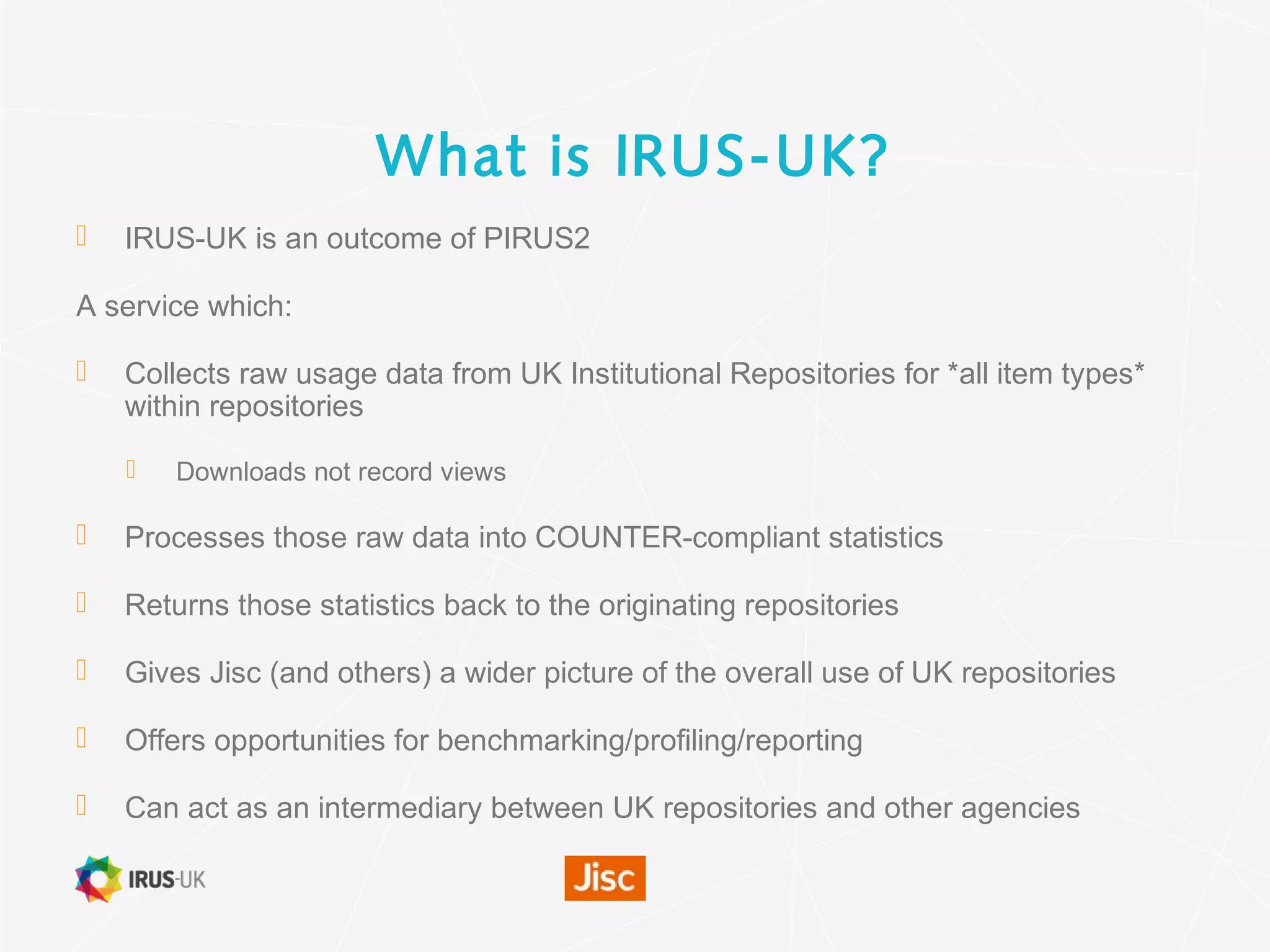
What is IRUS-UK?
 IRUS-UK is an outcome of PIRUS2
A service which:
 Collects raw usage data from UK Institutional Repositories for *all item types*
within repositories
 Downloads not record views
 Processes those raw data into COUNTER-compliant statistics
 Returns those statistics back to the originating repositories
 Gives Jisc (and others) a wider picture of the overall use of UK repositories
 Offers opportunities for benchmarking/profiling/reporting
 Can act as an intermediary between UK repositories and other agencies
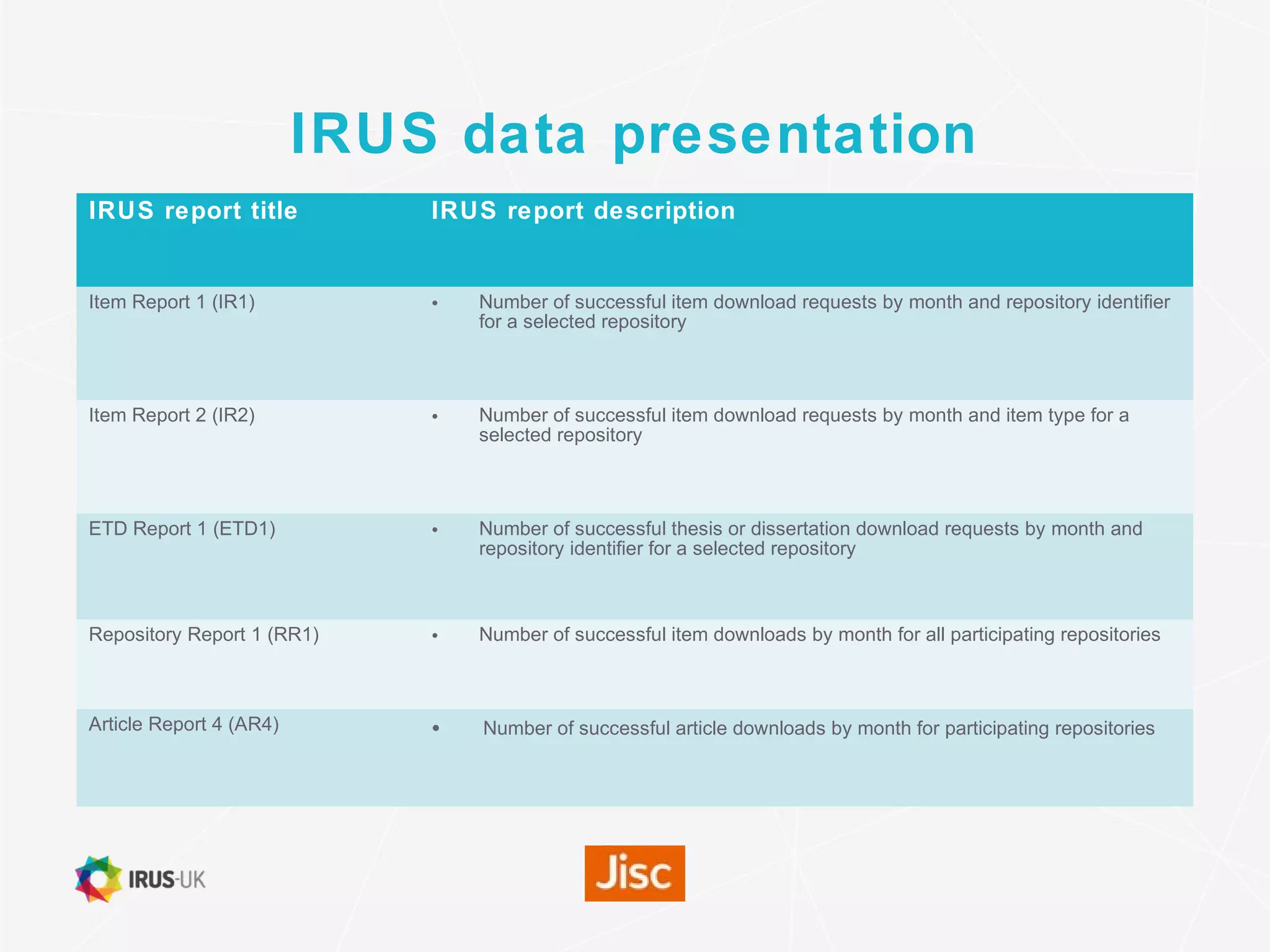
IRUS data presentation
IRUS report title IRUS report description
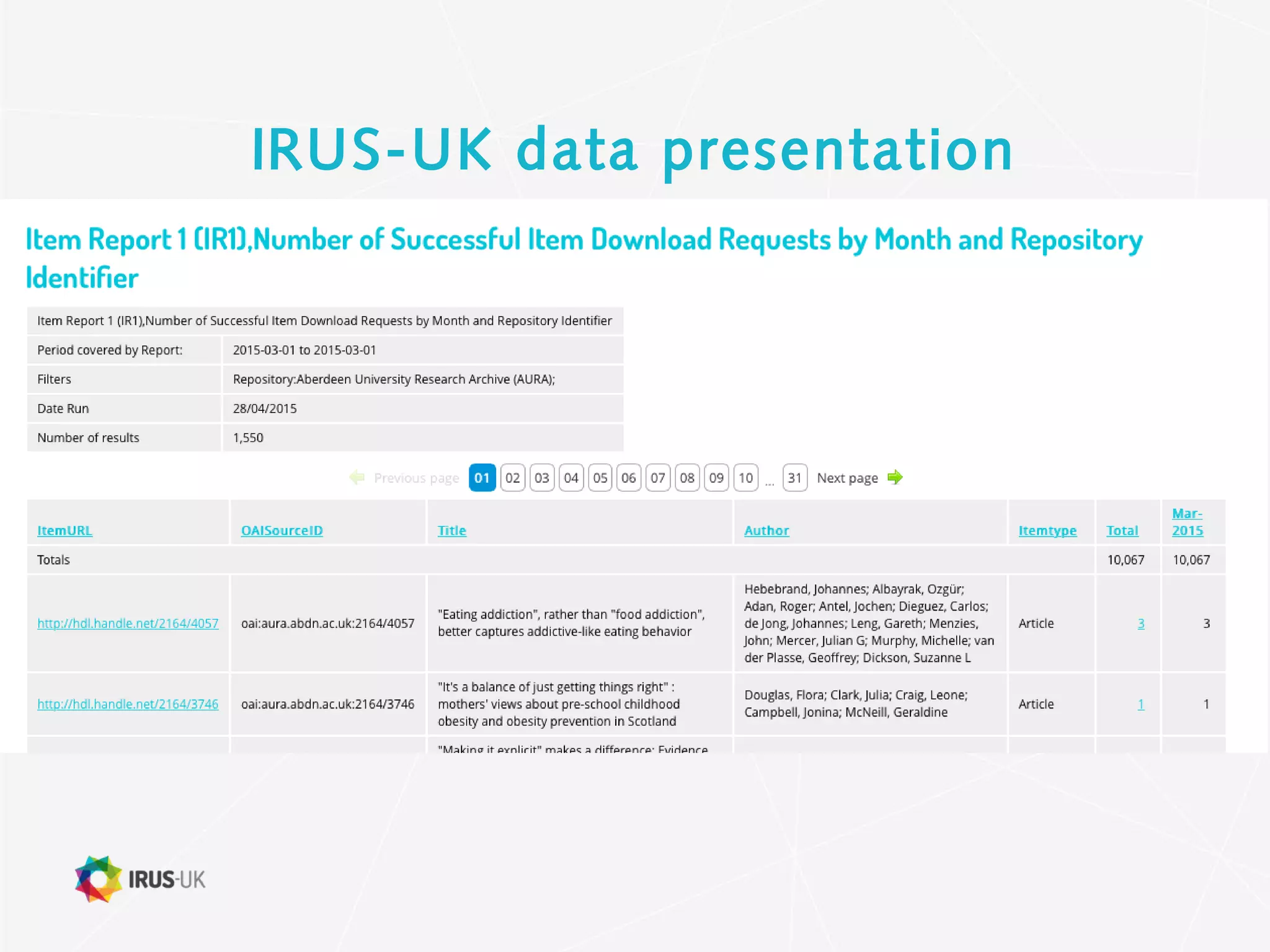
Item Report 1 (IR1) • Number of successful item download requests by month and repository identifier
for a selected repository
Item Report 2 (IR2) • Number of successful item download requests by month and item type for a
selected repository
ETD Report 1 (ETD1) • Number of successful thesis or dissertation download requests by month and
repository identifier for a selected repository
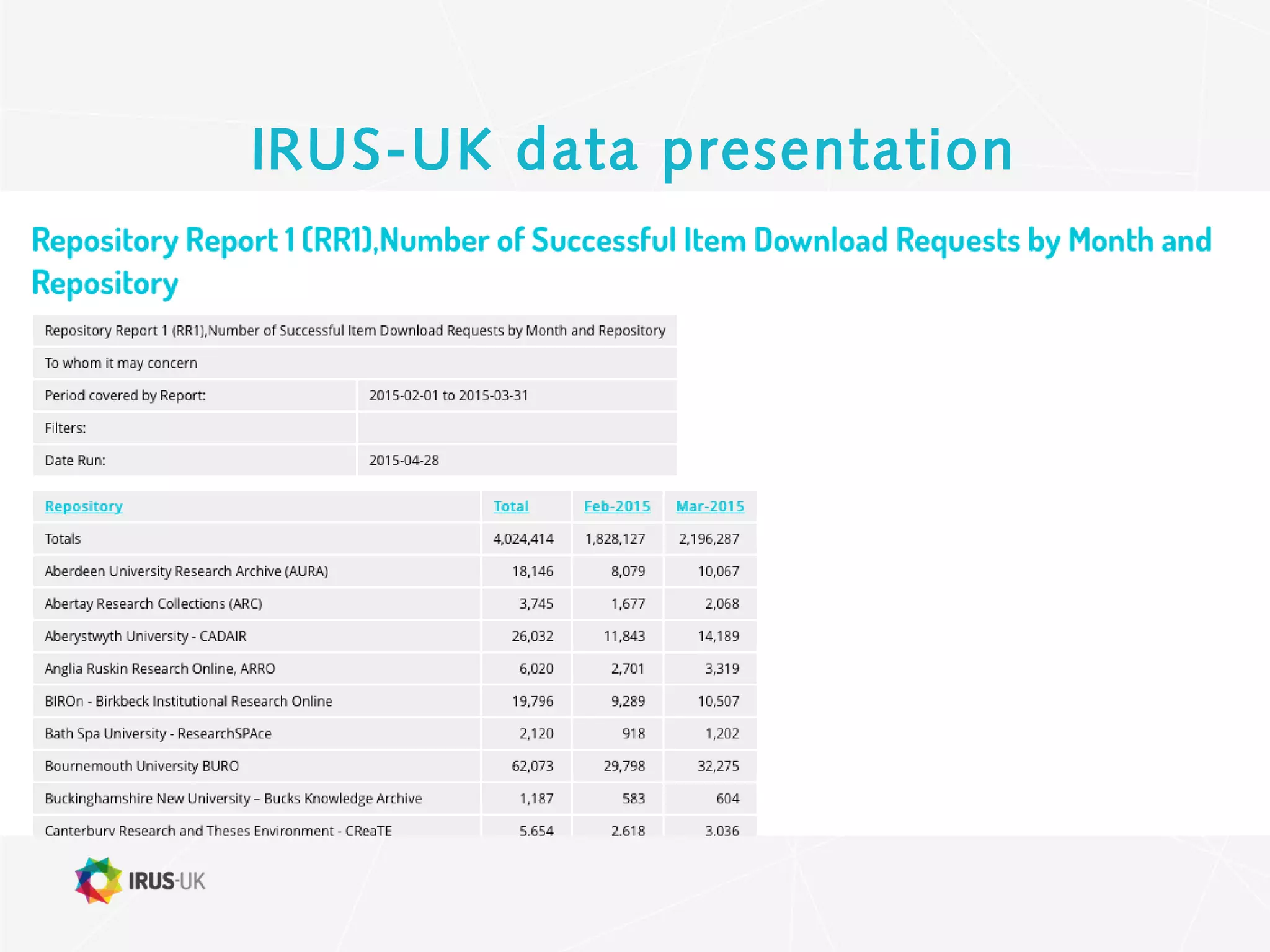
Repository Report 1 (RR1) • Number of successful item downloads by month for all participating repositories
Article Report 4 (AR4) • Number of successful article downloads by month for participating repositories
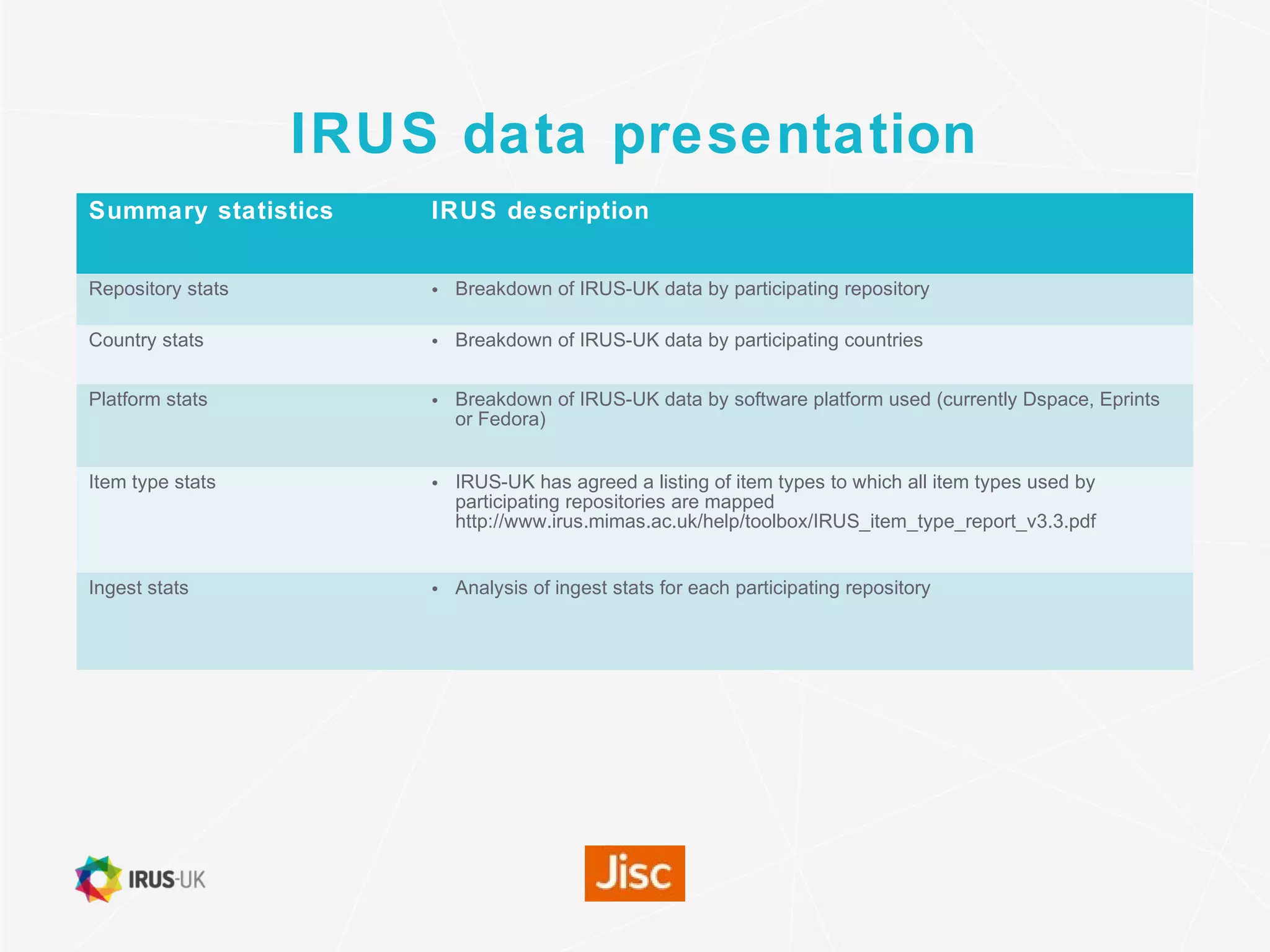
IRUS data presentation
Summary statistics IRUS description
Repository stats • Breakdown of IRUS-UK data by participating repository
Country stats • Breakdown of IRUS-UK data by participating countries
Platform stats • Breakdown of IRUS-UK data by software platform used (currently Dspace, Eprints
or Fedora)
Item type stats • IRUS-UK has agreed a listing of item types to which all item types used by
participating repositories are mapped
http://www.irus.mimas.ac.uk/help/toolbox/IRUS_item_type_report_v3.3.pdf
Ingest stats • Analysis of ingest stats for each participating repository
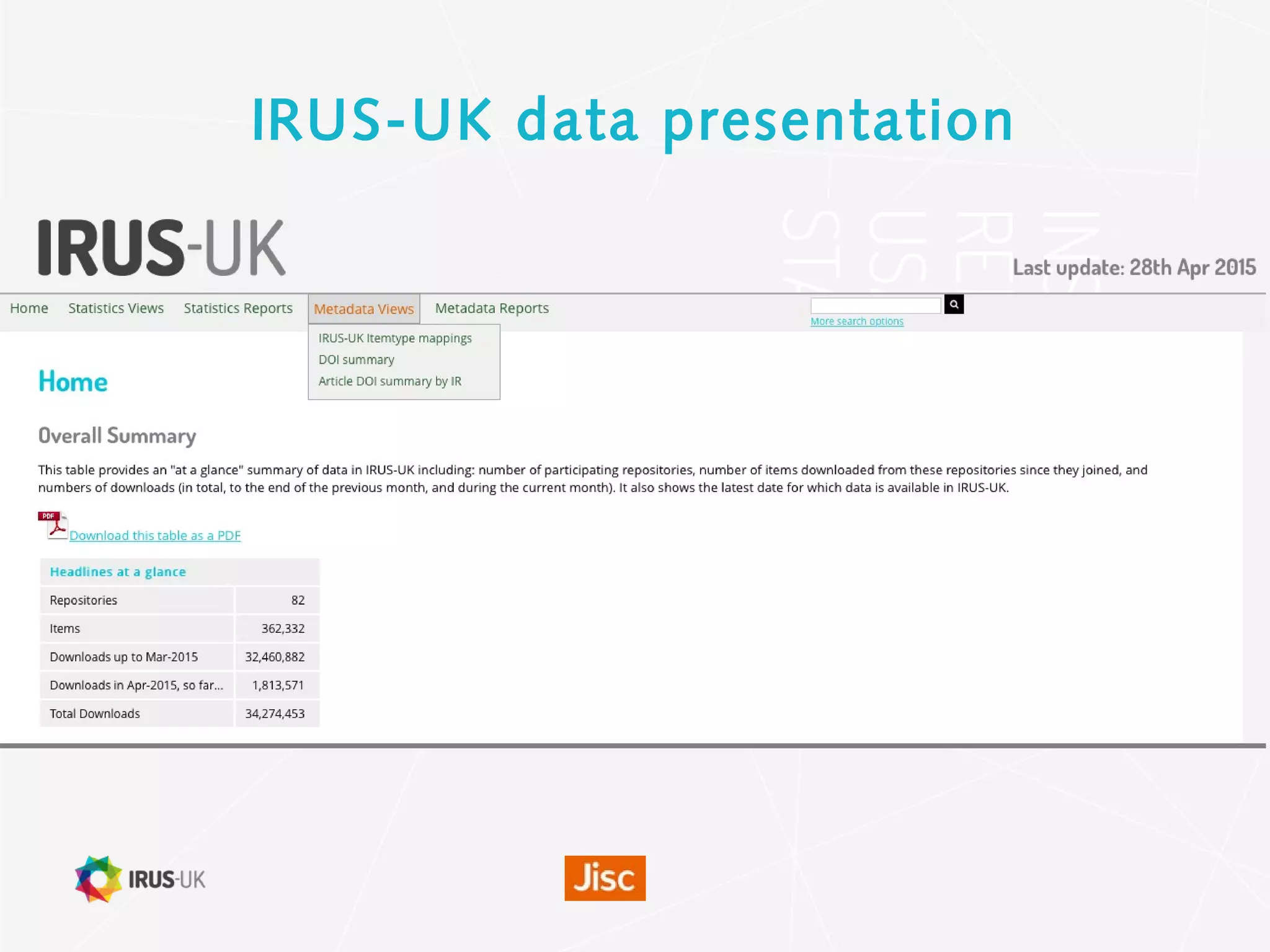
IRUS-UK data presentation
How are data gathered?
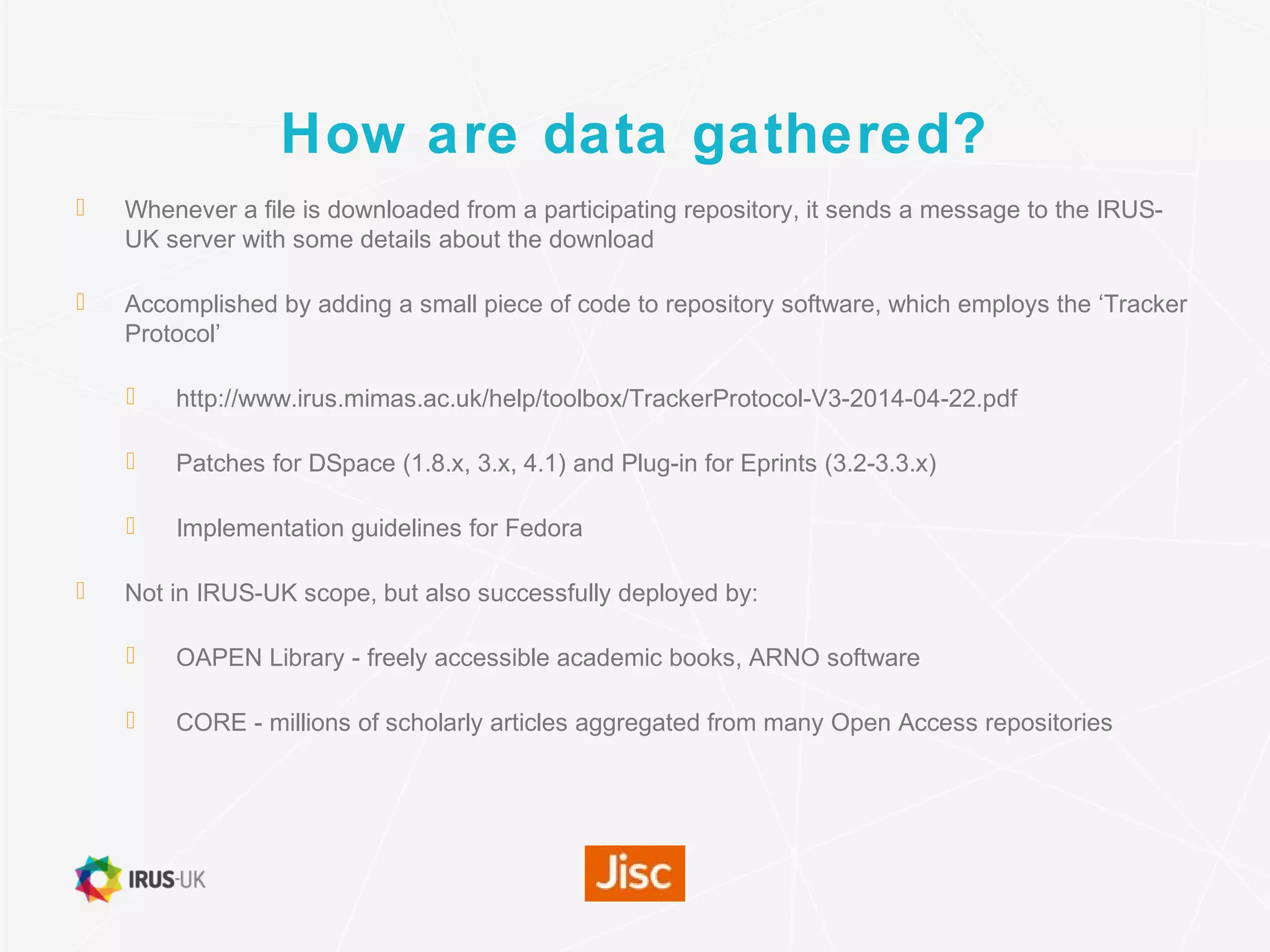
 Whenever a file is downloaded from a participating repository, it sends a message to the IRUS-
UK server with some details about the download
 Accomplished by adding a small piece of code to repository software, which employs the ‘Tracker
Protocol’
 http://www.irus.mimas.ac.uk/help/toolbox/TrackerProtocol-V3-2014-04-22.pdf
 Patches for DSpace (1.8.x, 3.x, 4.1) and Plug-in for Eprints (3.2-3.3.x)
 Implementation guidelines for Fedora
 Not in IRUS-UK scope, but also successfully deployed by:
 OAPEN Library - freely accessible academic books, ARNO software
 CORE - millions of scholarly articles aggregated from many Open Access repositories
How is IRUS used?
A number of use cases are available at: http://www.irus.mimas.ac.uk/help/support/
Standards based reliable statistics
Reporting to management
Reporting to academics/researchers
Benchmarking at a national level
Advocacy
Including statistics in your repository
What do users say about IRUS-UK?
“The set up was quick and painless”
“Consistent collection of statistics without me having to do it!”
“Provision of standards-based usage statistics that can be compared
with publisher reports, so that the visibility of open access repository
content can be highlighted.”
“It has potential to help identify problems in the metadata e.g.
incorrect DOIs.”
“High quality download stats that conform to a standard, that we
can compare to other universities for benchmarking.”
“Provides useful usage stats for librarians.”
Value of JUSP and IRUS-UK
 Consistent, comparable standards
based measurement
 Provides a UK wide picture of usage
(for JUSP this supports national
negotiations with publishers, for IRUS-
UK it demonstrates the value of open
access repositories)
 Strength in numbers, community
engagement and support encourages
COUNTER compliance
 Quality assurance
 Offers higher education institutions an
opportunity for benchmarking at a
national level
Value of JUSP and IRUS-UK outside
UK
• Knowledge sharing within the UK and with
overseas consortia
• Providing information and feedback to
bodies such as COUNTER and NISO
• SUSHI client available as free, open
source software
• Ongoing consultation with HEI
representatives and publishers
• JUSPConsult provides services
outside the UK
How do I find out more?
JUSP
http://jusp.mimas.ac.uk
IRUS-UK
http://irus.mimas.ac.uk
JUSPConsult
http://www.juspconsult.mimas.ac.uk/

Value in numbers: A Shared Approach to Measuring Usage and Impact

  • 1.
    Value in numbers:a shared approach to measuring usage and impact NISO Virtual Conference 29 April 2015
  • 2.
    JUSP and IRUS-UK Asingle point of access to COUNTER-compliant journal usage data for 171 UK academic libraries Consolidates and compares COUNTER-compliant IR usage statistics for 82 UK HEI
  • 3.
    Standards and interoperability COUNTER standard is central to development of both services  Enables consistent and comparable standards based measurement  M2M protocols such as SUSHI facilitate greater efficiencies  Presents opportunities for benchmarking at a national level
  • 4.
    Collaboration is key •Delivering a service to the community • Collaboration and co- development in conjunction with libraries and academic institutions • Working with publishers to provide enhanced customer service
  • 5.
    What is JUSP? •Supports libraries by providing a single point of access to e- journal usage data • Assists management of e- journals collections to inform evaluation and decision- making processes • Enables usage comparisons and trend analysis
  • 6.
    What’s in JUSP? JR1- Journal Report 1: Number of Successful Full-Text Article Requests by Month and Journal JR1a - Journal Report 1a: Number of Successful Full-Text Article Requests from an Archive by Month and Journal JR1 GOA - Number of Successful Gold Open Access Full-Text Article Requests by Month and Journal
  • 7.
    JUSP data presentation JUSPreport type JUSP report title Journal level reports • JR1, JR1a and JR1 GOA reports • JR1 reports inc gateways and intermediaries • JR1 reports excluding backfile usage • Individual journal search and usage Summary reports • SCONUL return • Annual summary of publisher usage • Annual summary use of gateway and host intermediaries • Annual summary use of backfiles • Number of titles and requests in usage ranges • Trends over time - tables and graphs • Titles with the highest use • Breakdown of publisher and gateway usage (title and year) (title and date range) Titles and deals reports • Titles included in deals (year/multiple years) • Compare deals • Titles vs NESLi2 deals • Compare two deals from the same publisher Usage profiling These reports enable a comparison of usage from a particular publisher with an average for all libraries for which we hold data from that publisher in JUSP and that are in the same geographical region or mission group to which their institution belongs
  • 8.
  • 9.
  • 10.
    How is JUSPused? A number of use cases are available at: http://www.jusp.mimas.ac.uk/use-cases/ Making effective use of staff time Assisting academic departments in understanding resource use Collecting data for regular reporting and decision making Informing decisions for substitutions and cancellations Comparing usage of a particular title, package or deal with other institutions of a similar size, in the same region or the same mission group In conjunction with other statistical analysis tools, e.g. Ex Libris’ UStat In combination with other services, e.g. the UK’s national shared Knowledge Base+ (KB+)
  • 11.
    What do librariessay about JUSP? The best thing about JUSP is: “I can see a whole range of publisher statistics with one login.” “It saves me time and gives me confidence that errors in usage data can be picked up and addressed collaboratively.” “The range of different reports can help with different aspects of ejournal collection management” “Very customer focused and develops in response to customer needs” “Wouldn't be without it”
  • 12.
    What is IRUS-UK? IRUS-UK is an outcome of PIRUS2 A service which:  Collects raw usage data from UK Institutional Repositories for *all item types* within repositories  Downloads not record views  Processes those raw data into COUNTER-compliant statistics  Returns those statistics back to the originating repositories  Gives Jisc (and others) a wider picture of the overall use of UK repositories  Offers opportunities for benchmarking/profiling/reporting  Can act as an intermediary between UK repositories and other agencies
  • 13.
    IRUS data presentation IRUSreport title IRUS report description Item Report 1 (IR1) • Number of successful item download requests by month and repository identifier for a selected repository Item Report 2 (IR2) • Number of successful item download requests by month and item type for a selected repository ETD Report 1 (ETD1) • Number of successful thesis or dissertation download requests by month and repository identifier for a selected repository Repository Report 1 (RR1) • Number of successful item downloads by month for all participating repositories Article Report 4 (AR4) • Number of successful article downloads by month for participating repositories
  • 14.
    IRUS data presentation Summarystatistics IRUS description Repository stats • Breakdown of IRUS-UK data by participating repository Country stats • Breakdown of IRUS-UK data by participating countries Platform stats • Breakdown of IRUS-UK data by software platform used (currently Dspace, Eprints or Fedora) Item type stats • IRUS-UK has agreed a listing of item types to which all item types used by participating repositories are mapped http://www.irus.mimas.ac.uk/help/toolbox/IRUS_item_type_report_v3.3.pdf Ingest stats • Analysis of ingest stats for each participating repository
  • 15.
  • 16.
  • 17.
  • 18.
    How are datagathered?  Whenever a file is downloaded from a participating repository, it sends a message to the IRUS- UK server with some details about the download  Accomplished by adding a small piece of code to repository software, which employs the ‘Tracker Protocol’  http://www.irus.mimas.ac.uk/help/toolbox/TrackerProtocol-V3-2014-04-22.pdf  Patches for DSpace (1.8.x, 3.x, 4.1) and Plug-in for Eprints (3.2-3.3.x)  Implementation guidelines for Fedora  Not in IRUS-UK scope, but also successfully deployed by:  OAPEN Library - freely accessible academic books, ARNO software  CORE - millions of scholarly articles aggregated from many Open Access repositories
  • 19.
    How is IRUSused? A number of use cases are available at: http://www.irus.mimas.ac.uk/help/support/ Standards based reliable statistics Reporting to management Reporting to academics/researchers Benchmarking at a national level Advocacy Including statistics in your repository
  • 20.
    What do userssay about IRUS-UK? “The set up was quick and painless” “Consistent collection of statistics without me having to do it!” “Provision of standards-based usage statistics that can be compared with publisher reports, so that the visibility of open access repository content can be highlighted.” “It has potential to help identify problems in the metadata e.g. incorrect DOIs.” “High quality download stats that conform to a standard, that we can compare to other universities for benchmarking.” “Provides useful usage stats for librarians.”
  • 21.
    Value of JUSPand IRUS-UK  Consistent, comparable standards based measurement  Provides a UK wide picture of usage (for JUSP this supports national negotiations with publishers, for IRUS- UK it demonstrates the value of open access repositories)  Strength in numbers, community engagement and support encourages COUNTER compliance  Quality assurance  Offers higher education institutions an opportunity for benchmarking at a national level
  • 22.
    Value of JUSPand IRUS-UK outside UK • Knowledge sharing within the UK and with overseas consortia • Providing information and feedback to bodies such as COUNTER and NISO • SUSHI client available as free, open source software • Ongoing consultation with HEI representatives and publishers • JUSPConsult provides services outside the UK
  • 23.
    How do Ifind out more? JUSP http://jusp.mimas.ac.uk IRUS-UK http://irus.mimas.ac.uk JUSPConsult http://www.juspconsult.mimas.ac.uk/