Does anyone use the material in your repository? 
Institutional Repository Usage Statistics (IRUS) UK
Jo Alcock
Evidence Base, Birmingham City University
July 2014
irus.mimas.ac.uk
IRUS-UK
● Funded by Jisc 
● Project Team Members:
● Mimas, The University of Manchester – Project & Service Management & Host 
● Cranfield University - Development
● Evidence Base, Birmingham City University – User Engagement & Evaluation
● Outcome of PIRUS2 (Publisher and Institutional Repository Usage Statistics) 
● http://www.cranfieldlibrary.cranfield.ac.uk/pirus2/
● Aimed to develop a global standard to enable the recording, reporting and consolidation of
online usage statistics for individual journal articles hosted by IRs, Publishers and others
● Proved it was *technically feasible*, but (initially) easier without ‘P’
● IRUS-UK: Institutional Repository Usage Statistics – UK
● Enable UK IRs to share/expose usage statistics based on a global standard – COUNTER
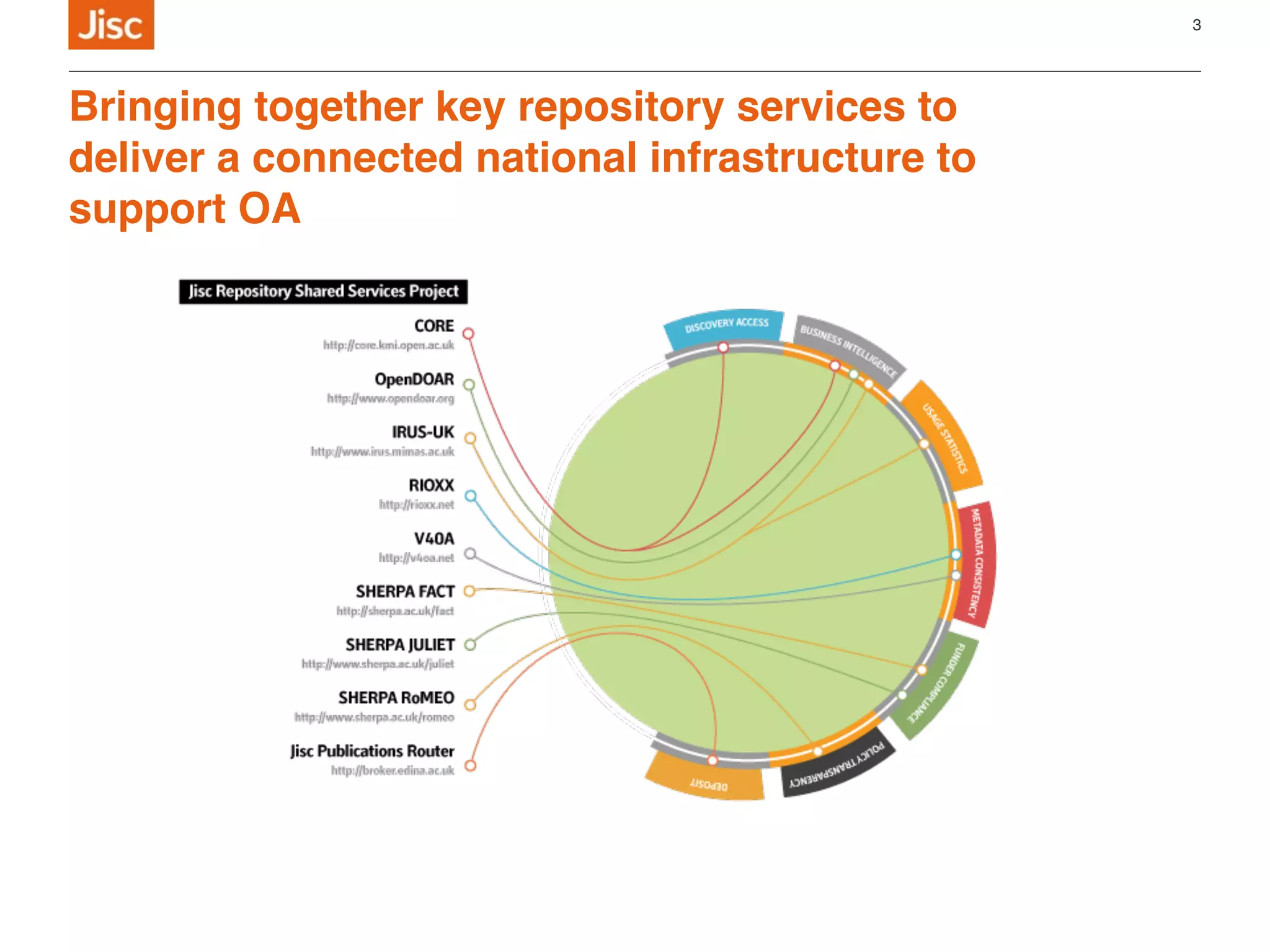
Bringing together key repository services to
deliver a connected national infrastructure to
support OA
3
Support for Integration
Repositories to implement - patches, scripts and
plug-ins produced by repository shared services.
Support is being planned via:
• Repository Support Project (RSP)
• Planning co-ordination with platform-specific
support through Eprints Services, the DSpace
community and Fedora.
4
irus.mimas.ac.uk
IRUS-UK: aims & objectives
● Collect raw usage data from UK IRs for *all item types* within repositories
● Not just articles
● Downloads not record views
● Process those raw data into COUNTER-compliant statistics
● Return those statistics back to the originating repositories for their own use
● Give Jisc (and others) a wider picture of the overall use of UK repositories
● Offer opportunities for benchmarking/profiling/reporting 
● Act as an intermediary between UK repositories and other agencies
irus.mimas.ac.uk
IRUS-UK: gathering data
● Considered 2 scenarios for gathering data
● Push: ‘Tracker’ code
● Whenever a download occurs the repository ‘pings’ the IRUS-UK server with details
about the download
● Pull: OAI-PMH harvesting
● When a download occurs the details of the event are stored on the local repository
server
● IRUS-UK periodically harvests the download data (using the OAI-PMH protocol)
● Opted for the Push method – ‘Tracker’
● Just easier - but minimise data pushed
● Patches for Dspace and Plug-in for Eprints
● Implementation guidelines for Fedora
irus.mimas.ac.uk
IRUS-UK: the ingest process
● The ingest process has been described in detail previously, see :
http://www.irus.mimas.ac.uk/news/
● The key point is to apply the COUNTER Code of Practice to filter
out robots and double clicks
● However the COUNTER Robot Exclusion list is specified only as a
*minimum requirement* – more can be done
● We’ve added additional filters to
● Remove more user agents
● Apply a simple threshold for ‘overactive’ IP addresses
● Substantially better, but we needed a more sophisticated filtering
system
irus.mimas.ac.uk
IRUS-UK: the ingest process
● ‘Information Power‘ investigation & report:
● Analysed raw data collected since July 2012
● Tested the feasibility of devising algorithms to ‘dynamically’ identify unusual usage/
robot activity
● Suspicious behaviour can’t necessarily be judged on the basis of one day’s usage
● Can be almost impossible to distinguish between genuine and non-genuine activity
● In each calendar month process logs daily
● Eliminate as much as we can with a quick, minimalist approach
● Insert statistics into a ‘Provisional Daily Stats’ table
● At the end of each month reprocess those provisional stats
● Apply more comprehensive, sophisticated filtering
● Load the restated stats into the permanent daily stats table
● Empty the provisional table ready for the next month
irus.mimas.ac.uk
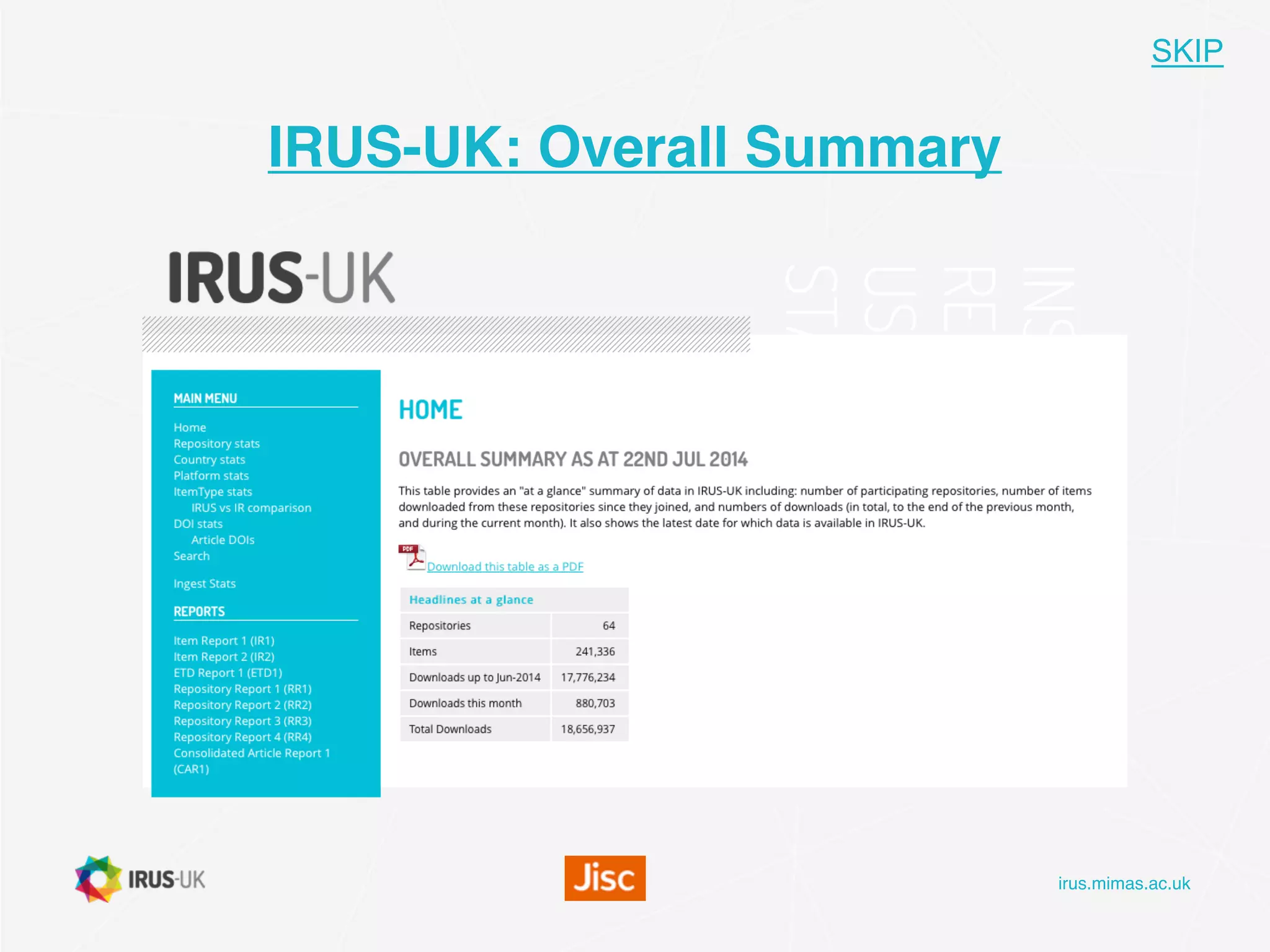
IRUS-UK: Overall Summary
SKIP
irus.mimas.ac.uk
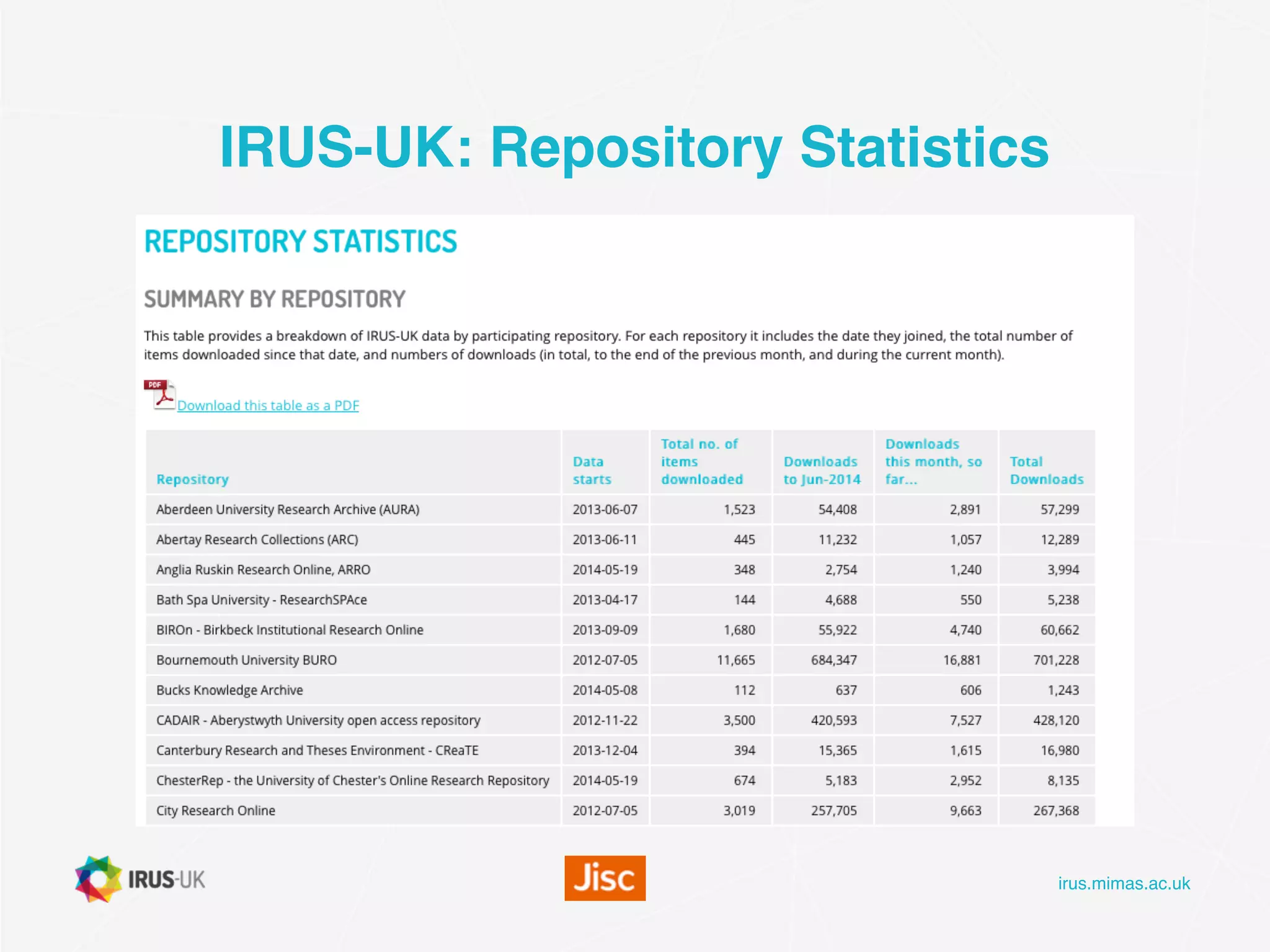
IRUS-UK: Repository Statistics
irus.mimas.ac.uk
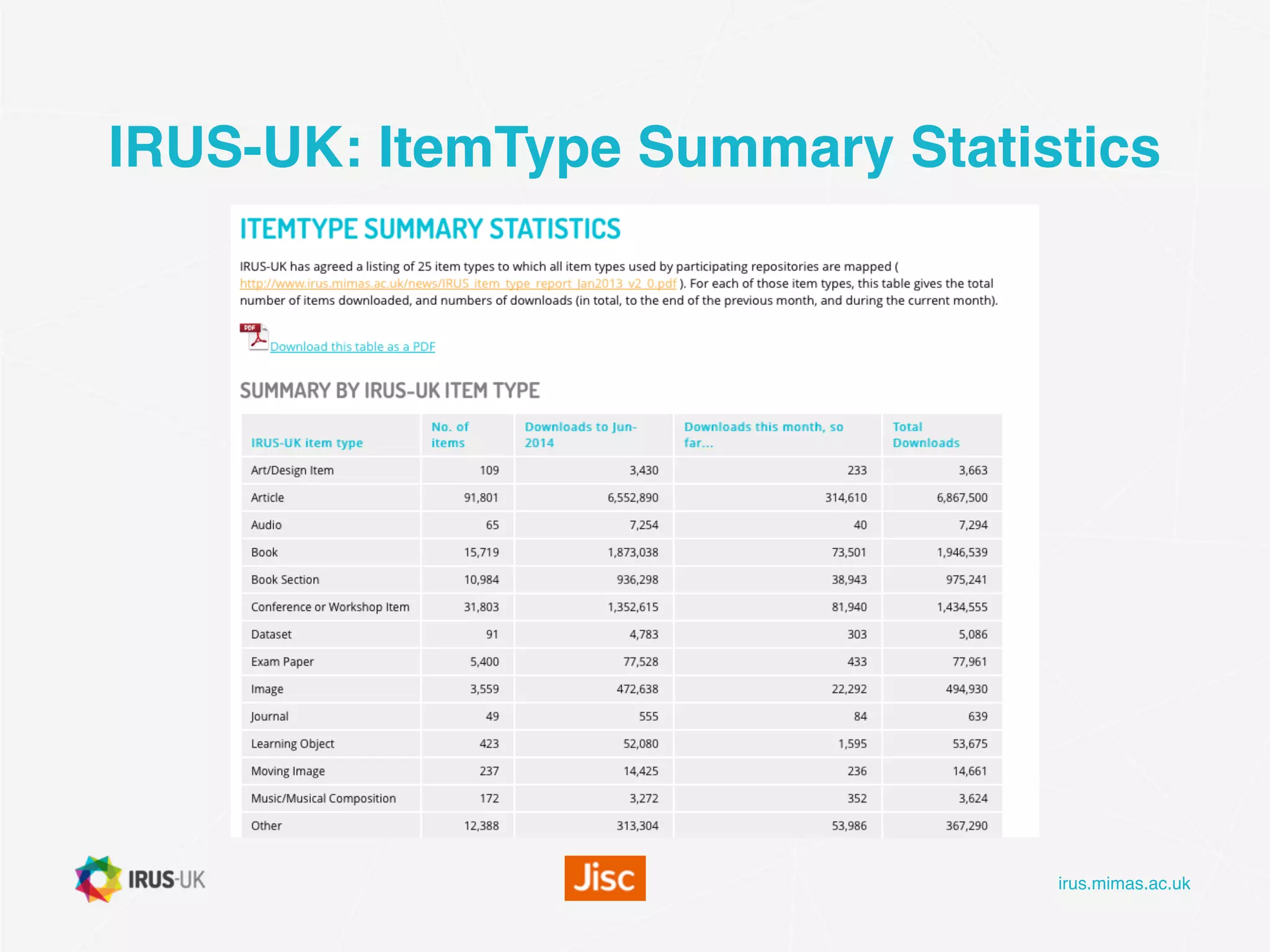
IRUS-UK: ItemType Summary Statistics
irus.mimas.ac.uk
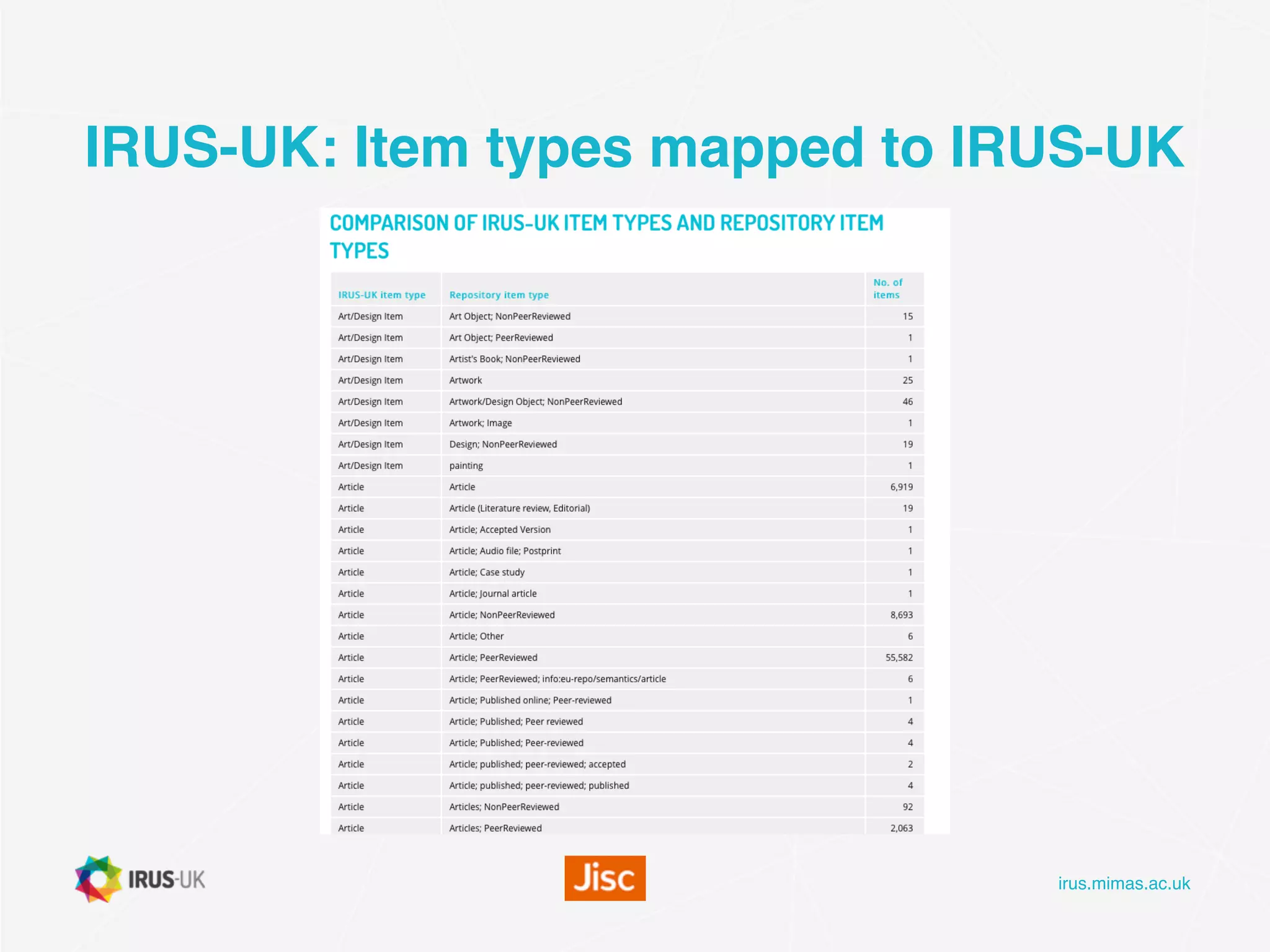
IRUS-UK: Item types mapped to IRUS-UK
irus.mimas.ac.uk
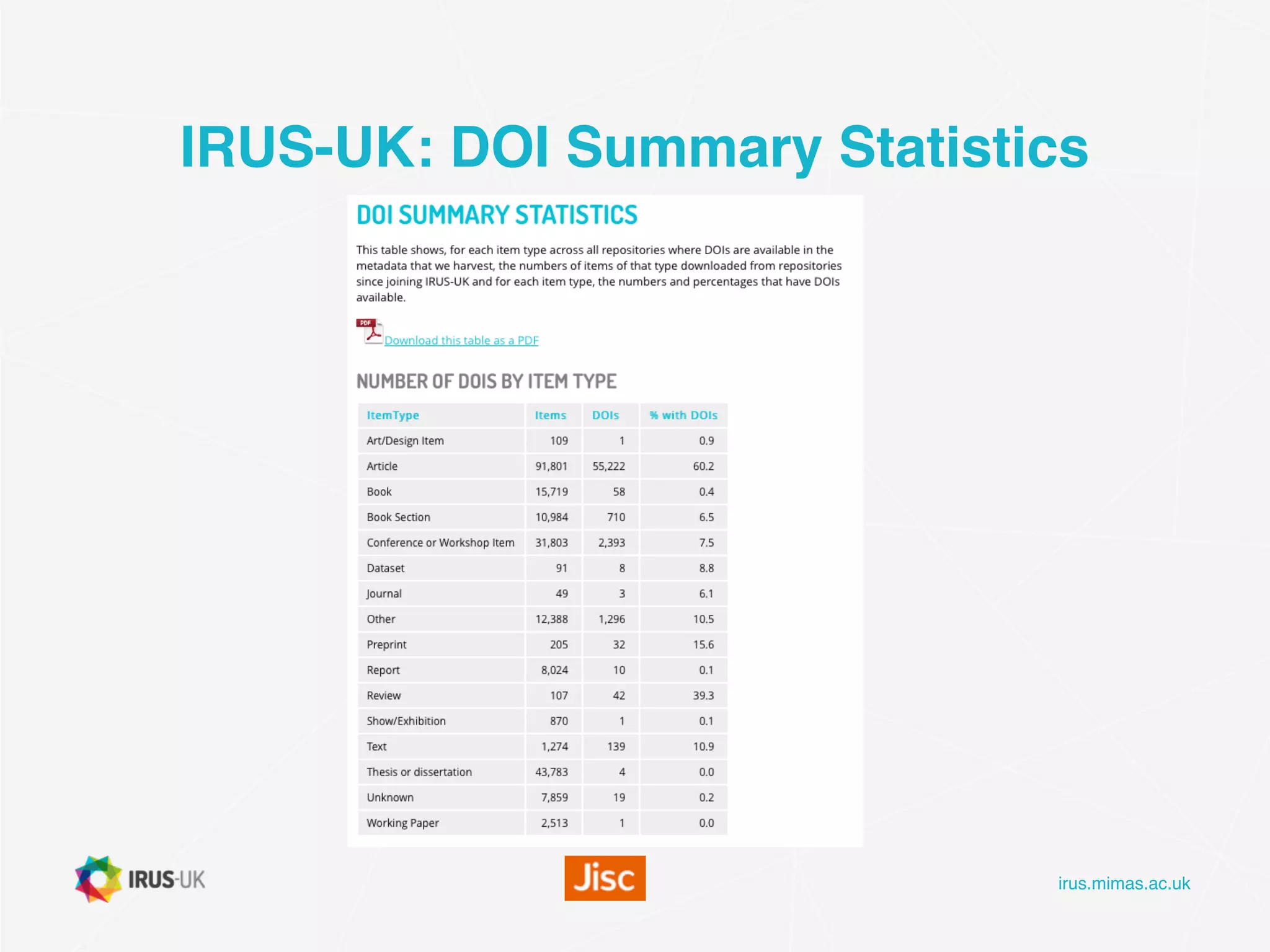
IRUS-UK: DOI Summary Statistics
irus.mimas.ac.uk
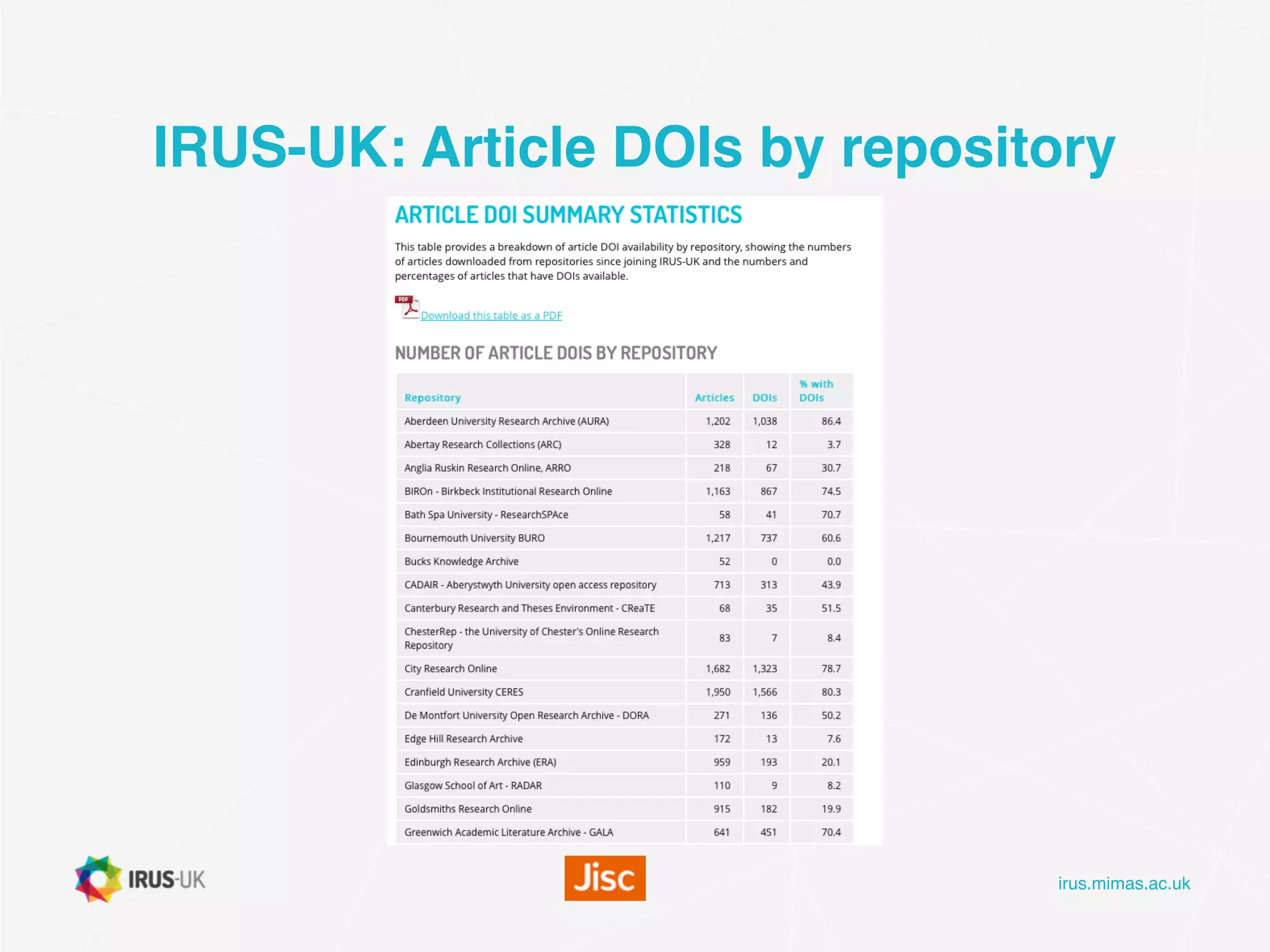
IRUS-UK: Article DOIs by repository
irus.mimas.ac.uk
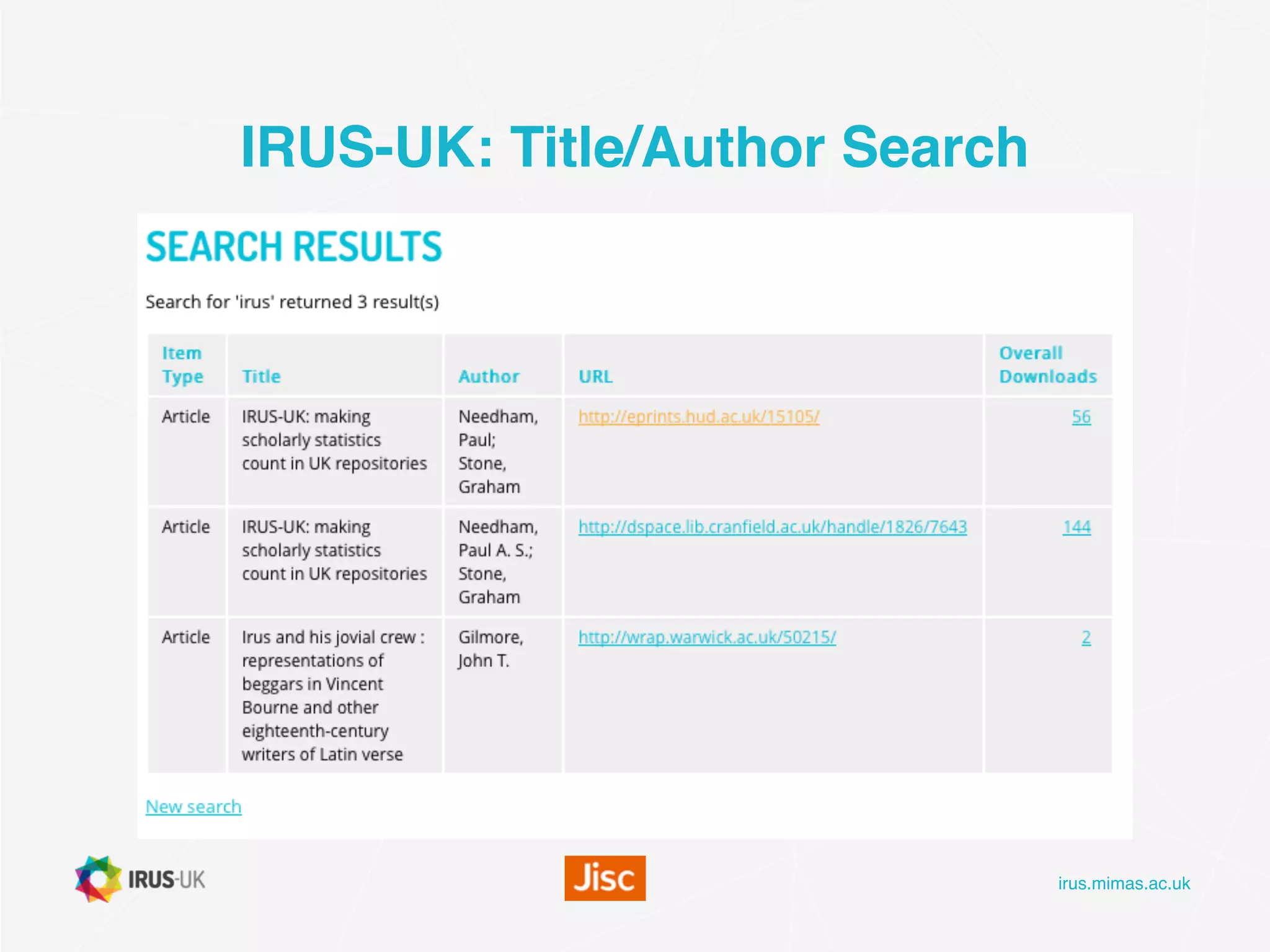
IRUS-UK: Title/Author Search
irus.mimas.ac.uk
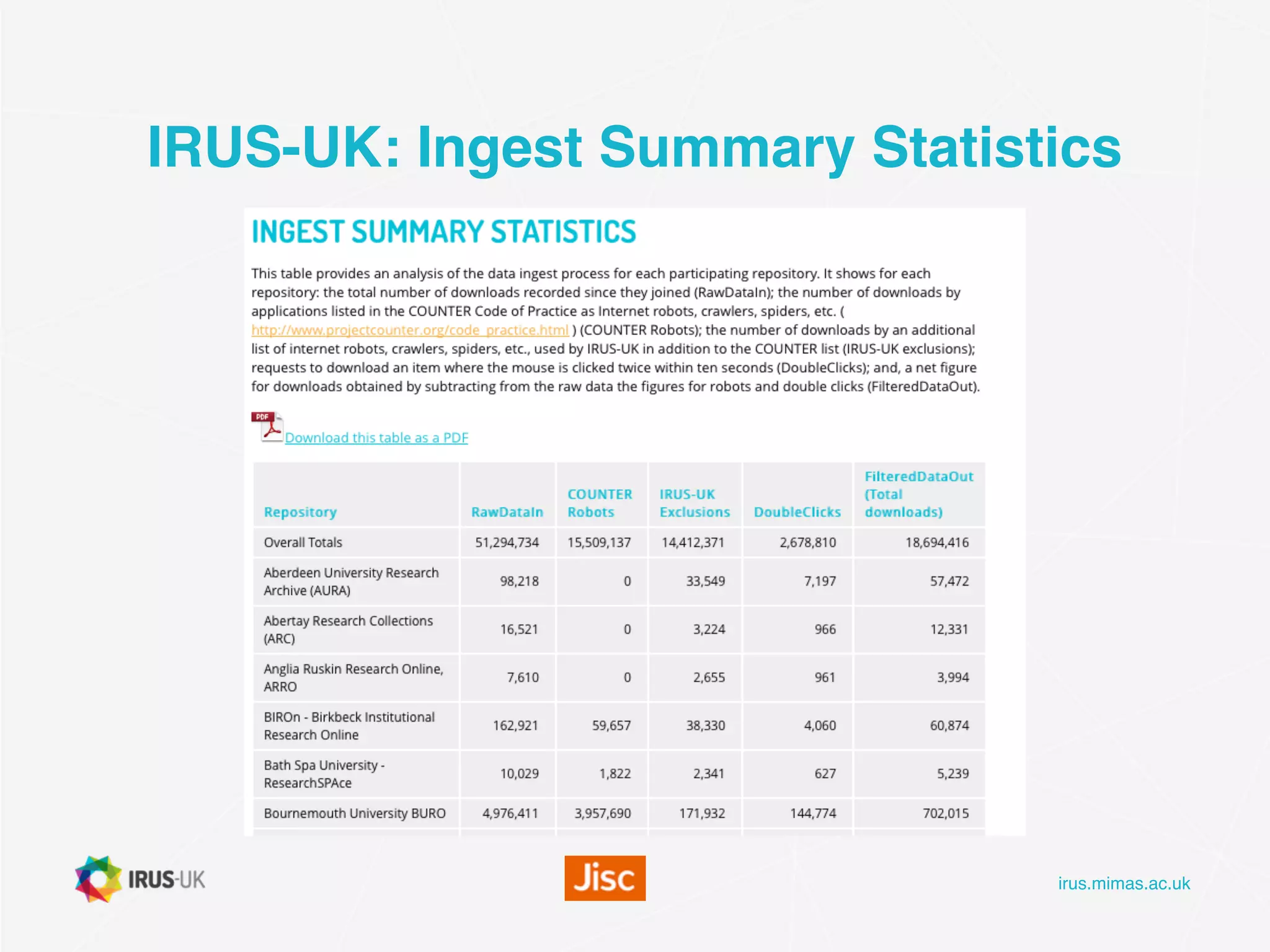
IRUS-UK: Ingest Summary Statistics
irus.mimas.ac.uk
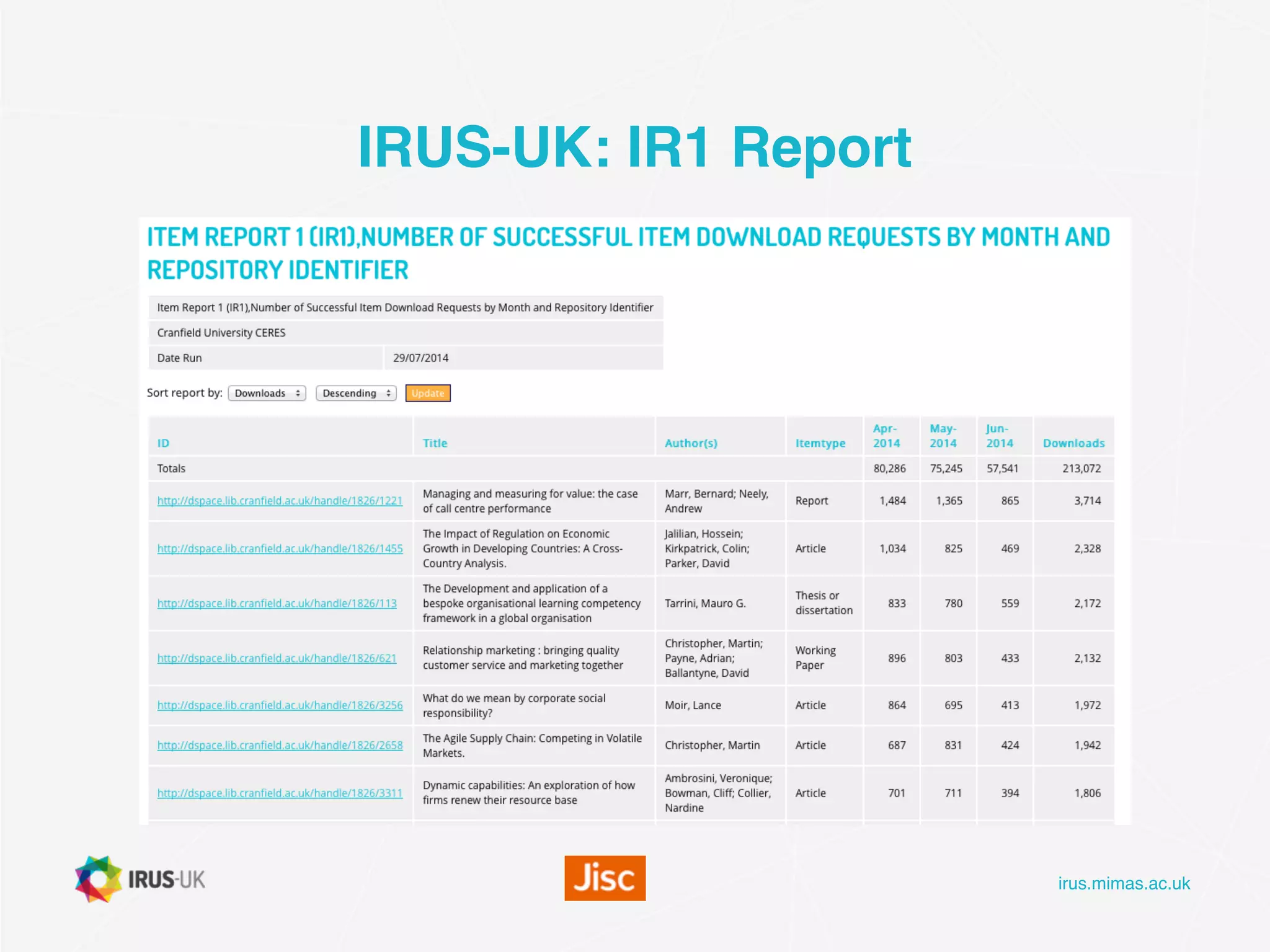
IRUS-UK: IR1 Report
irus.mimas.ac.uk
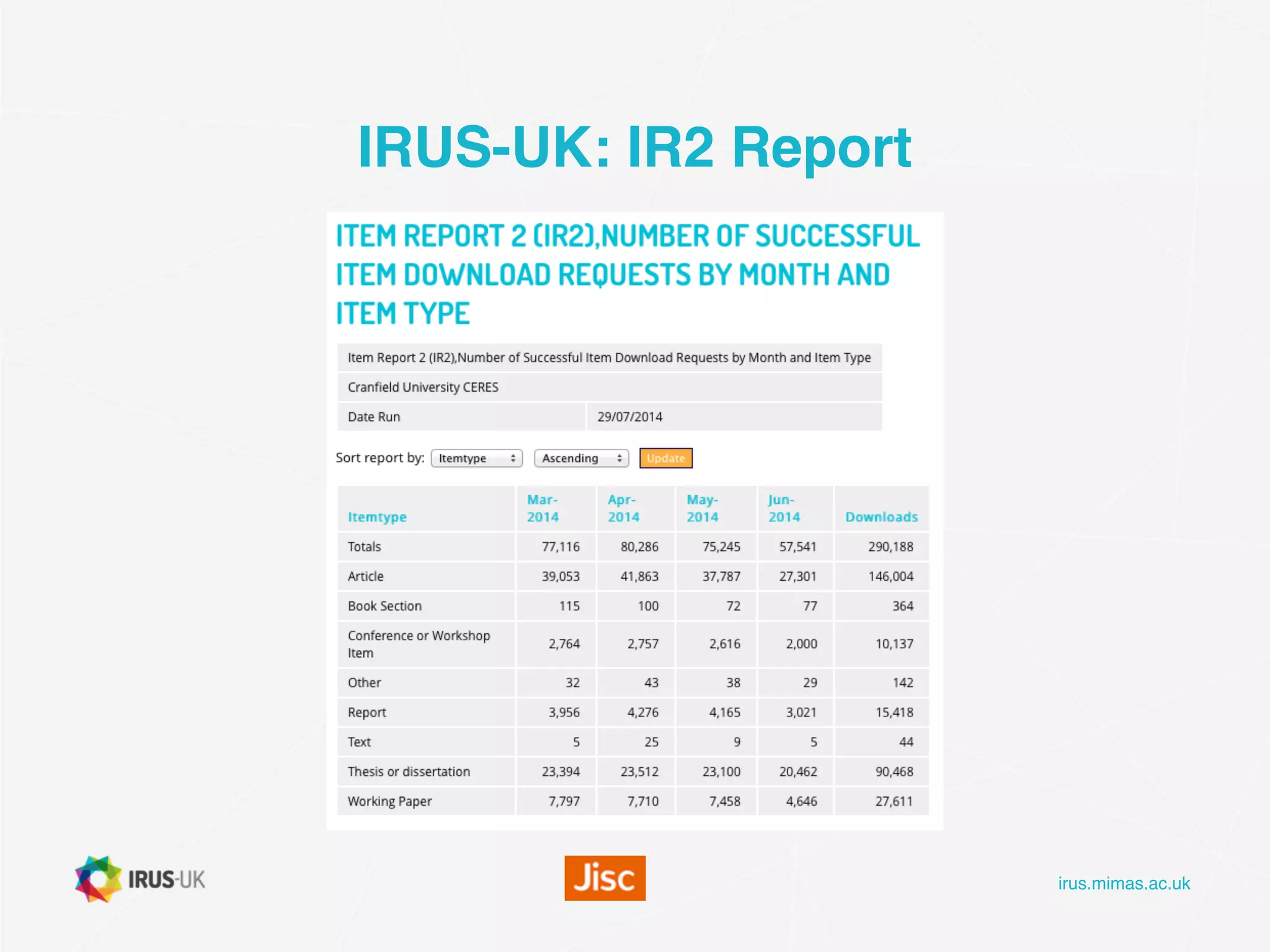
IRUS-UK: IR2 Report
irus.mimas.ac.uk
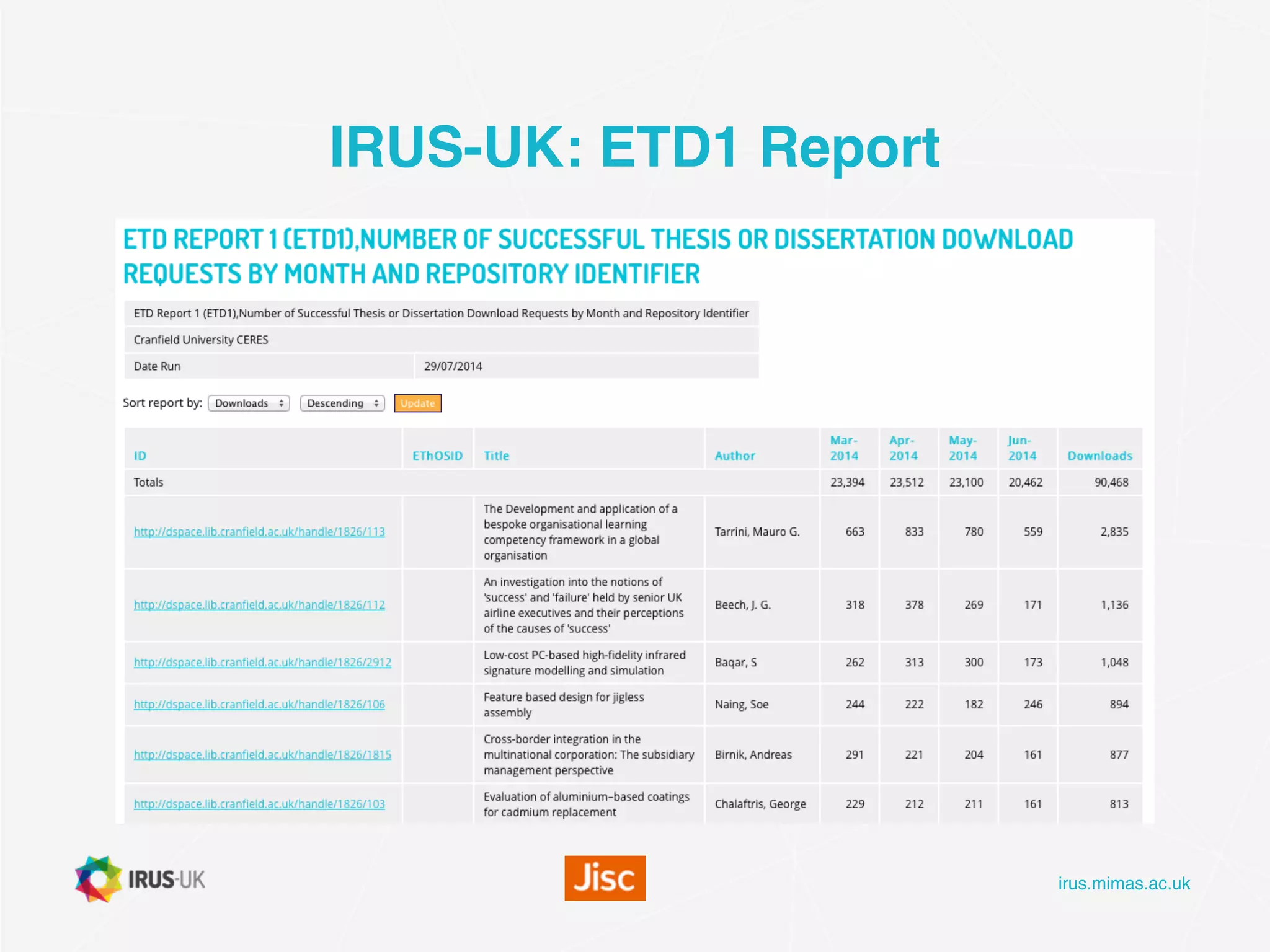
IRUS-UK: ETD1 Report
irus.mimas.ac.uk
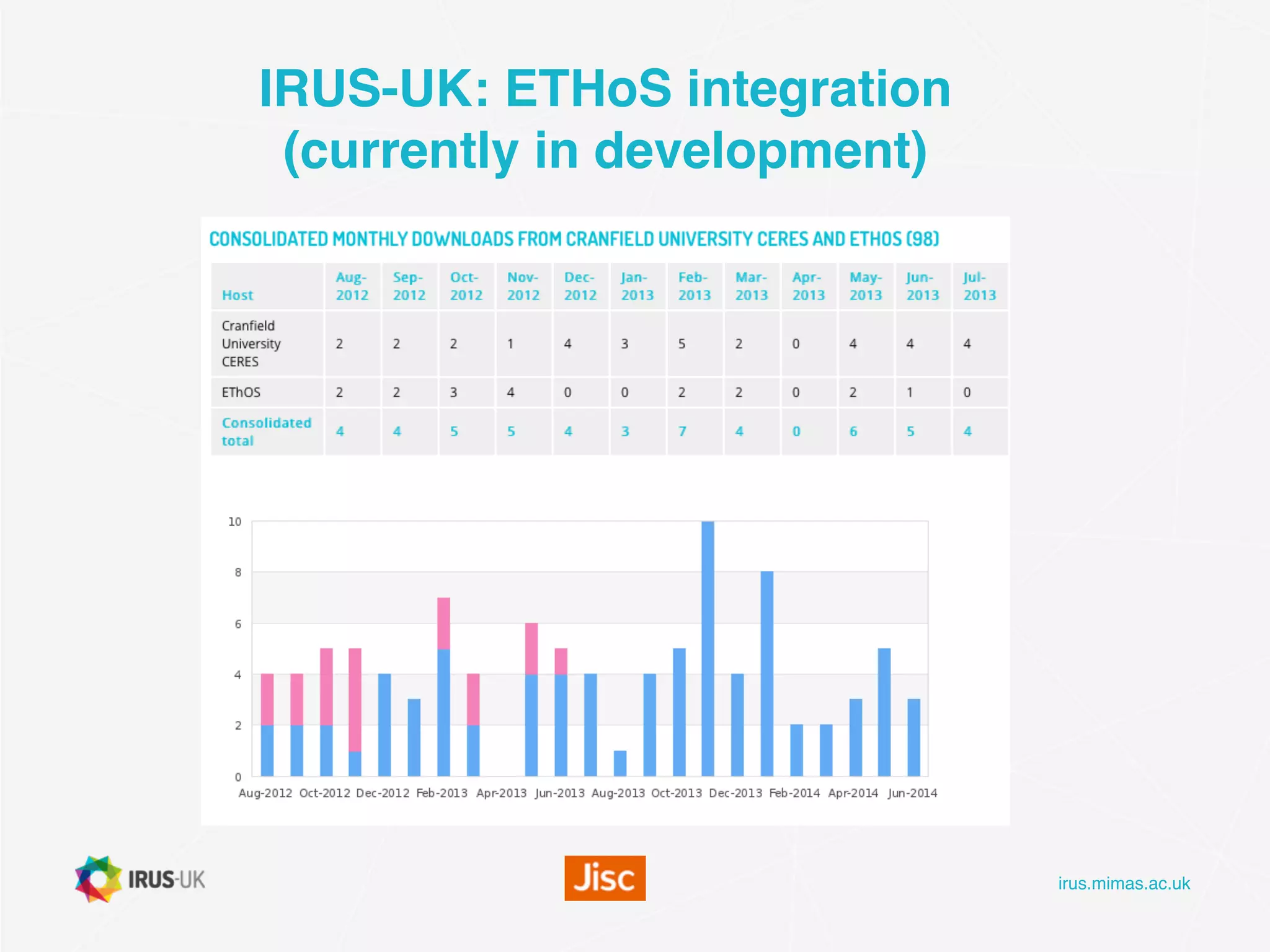
IRUS-UK: ETHoS integration 
(currently in development)
irus.mimas.ac.uk
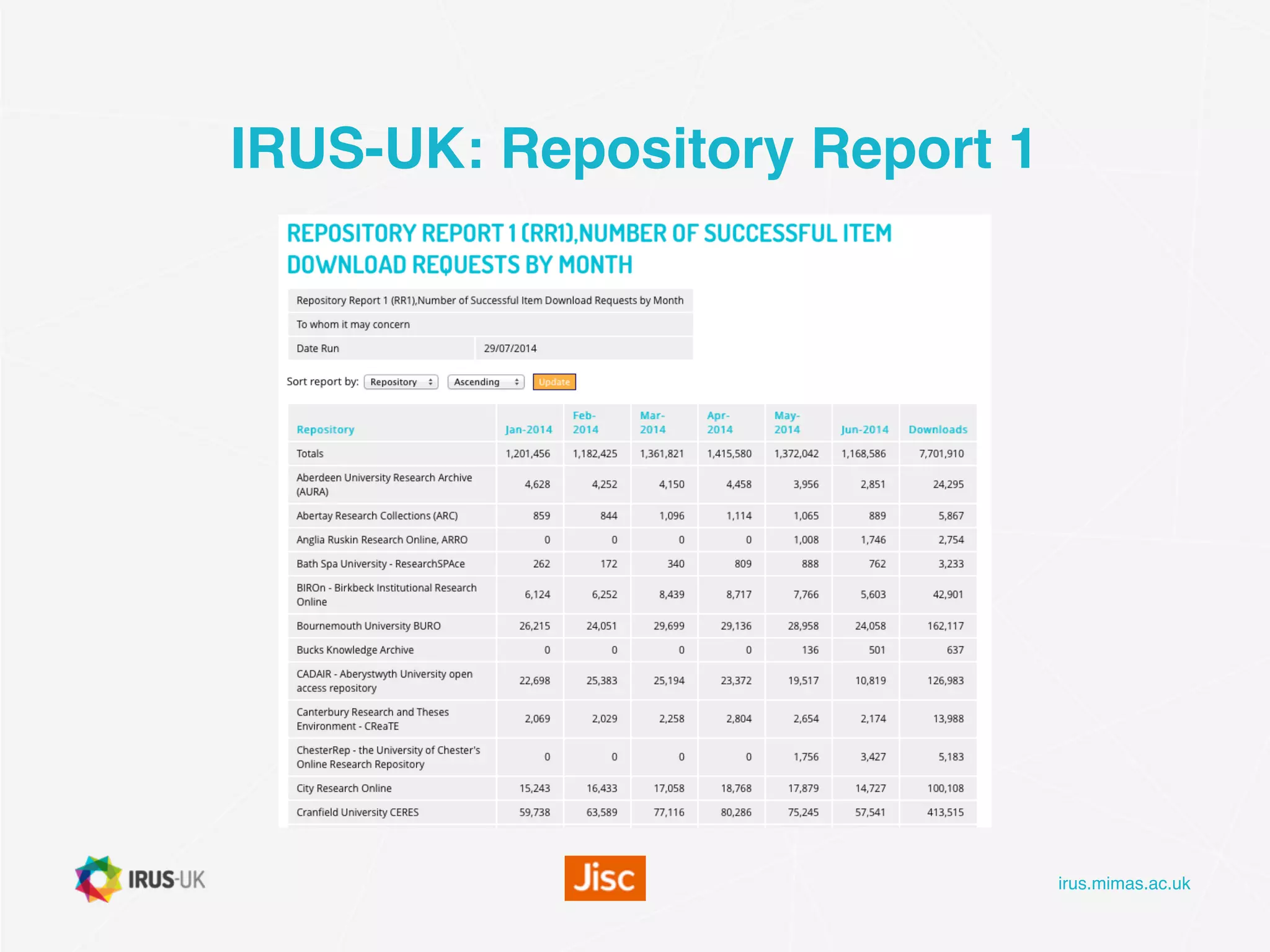
IRUS-UK: Repository Report 1
irus.mimas.ac.uk
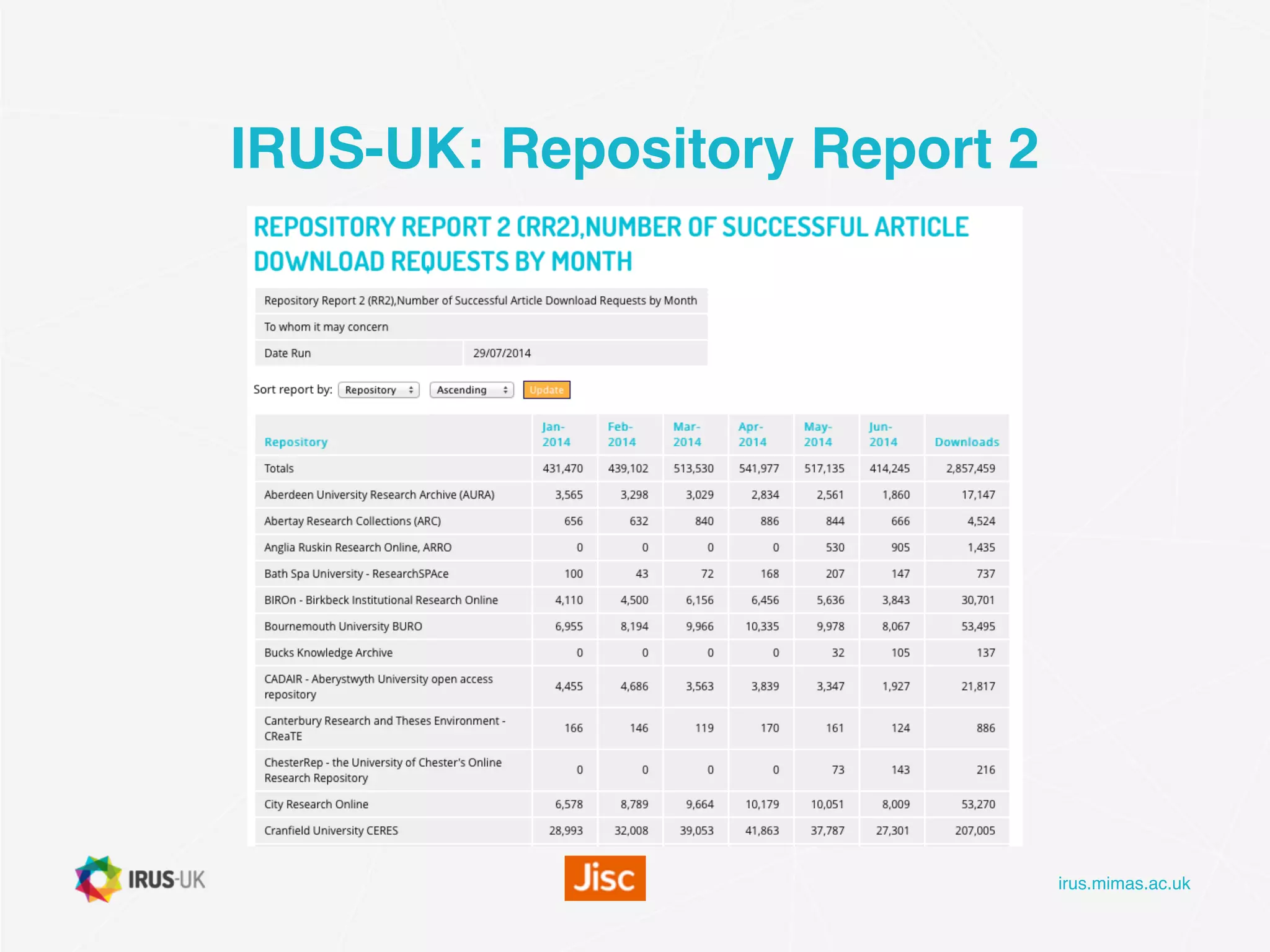
IRUS-UK: Repository Report 2
irus.mimas.ac.uk
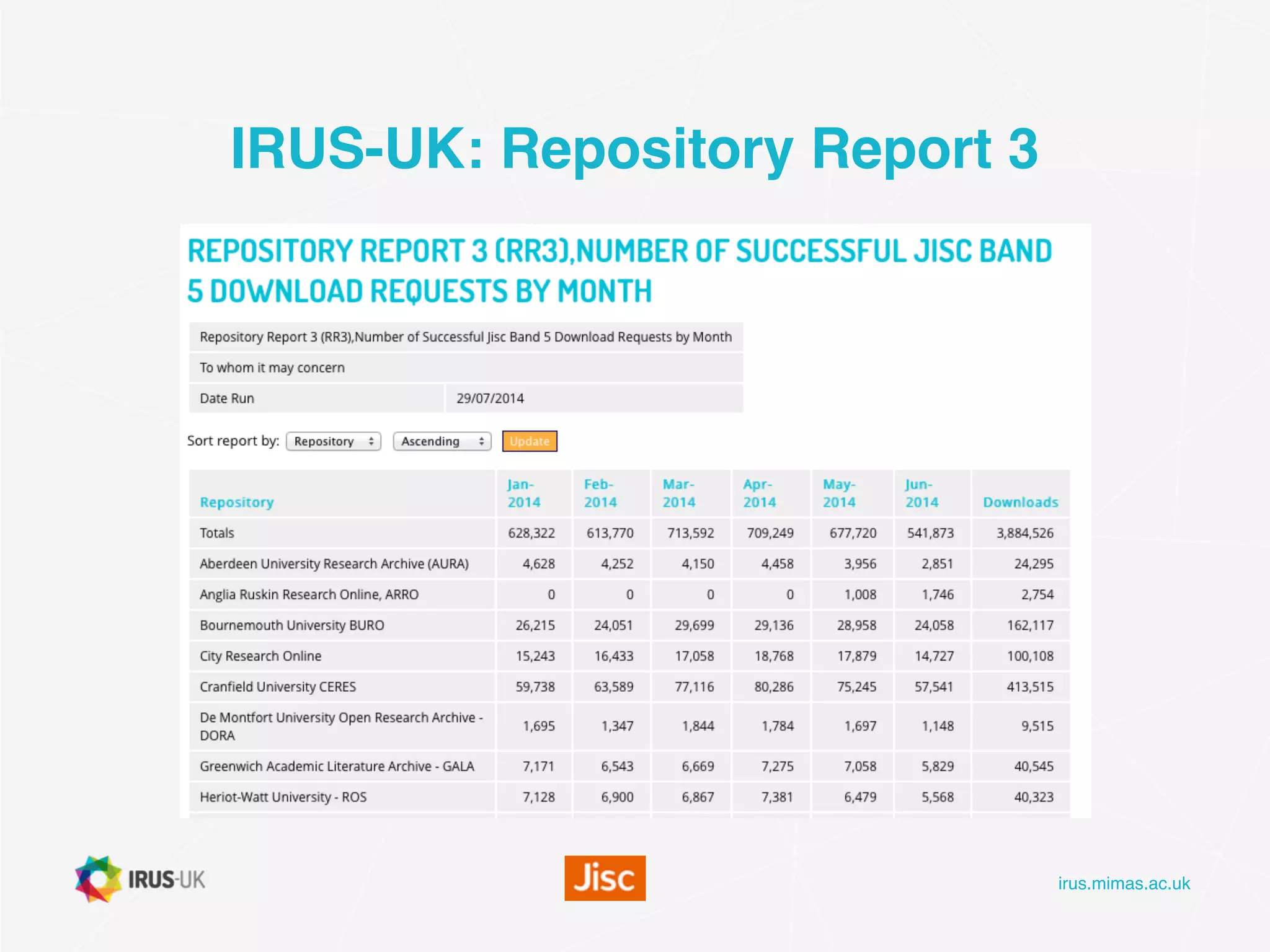
IRUS-UK: Repository Report 3
irus.mimas.ac.uk
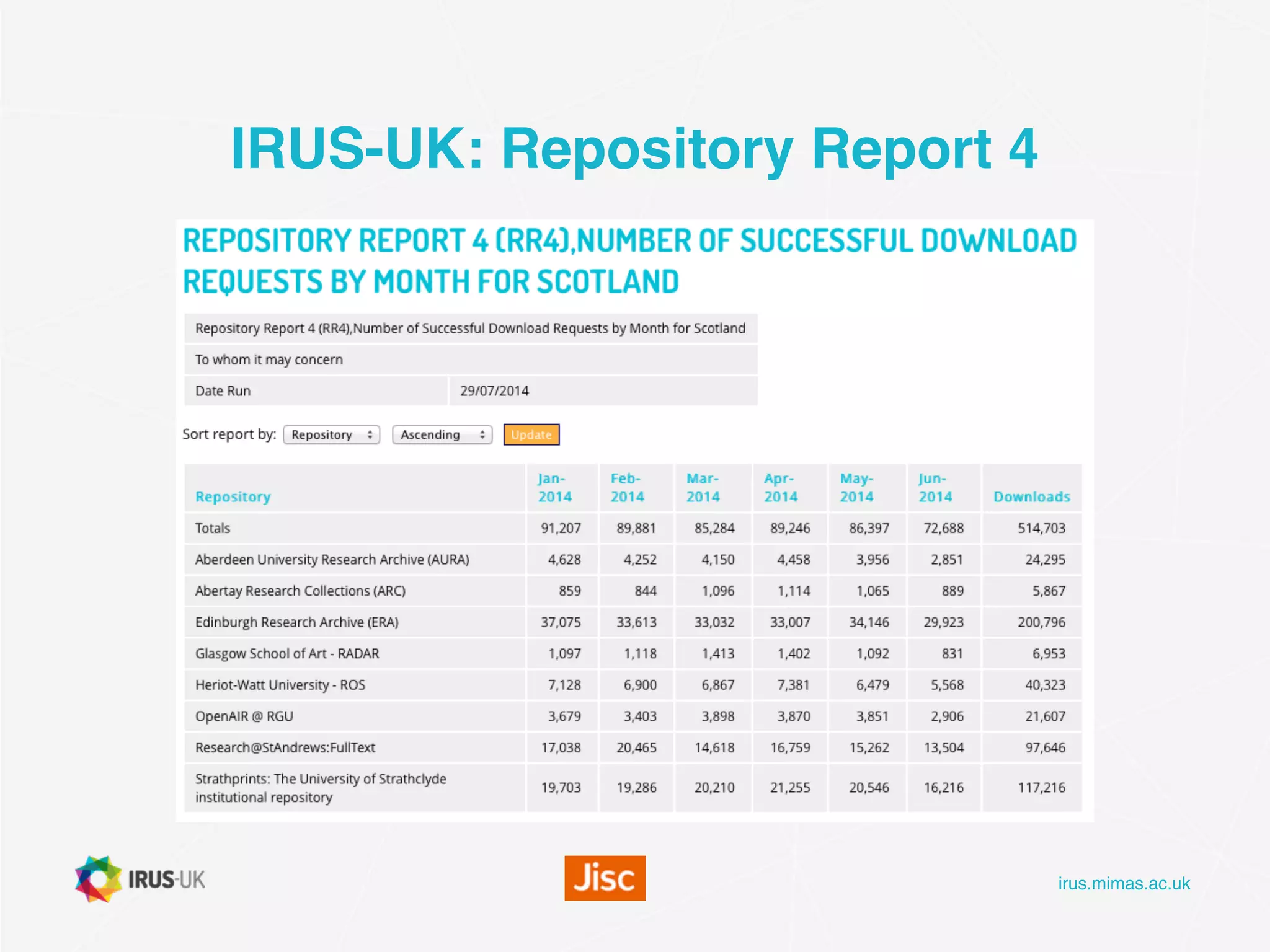
IRUS-UK: Repository Report 4
irus.mimas.ac.uk
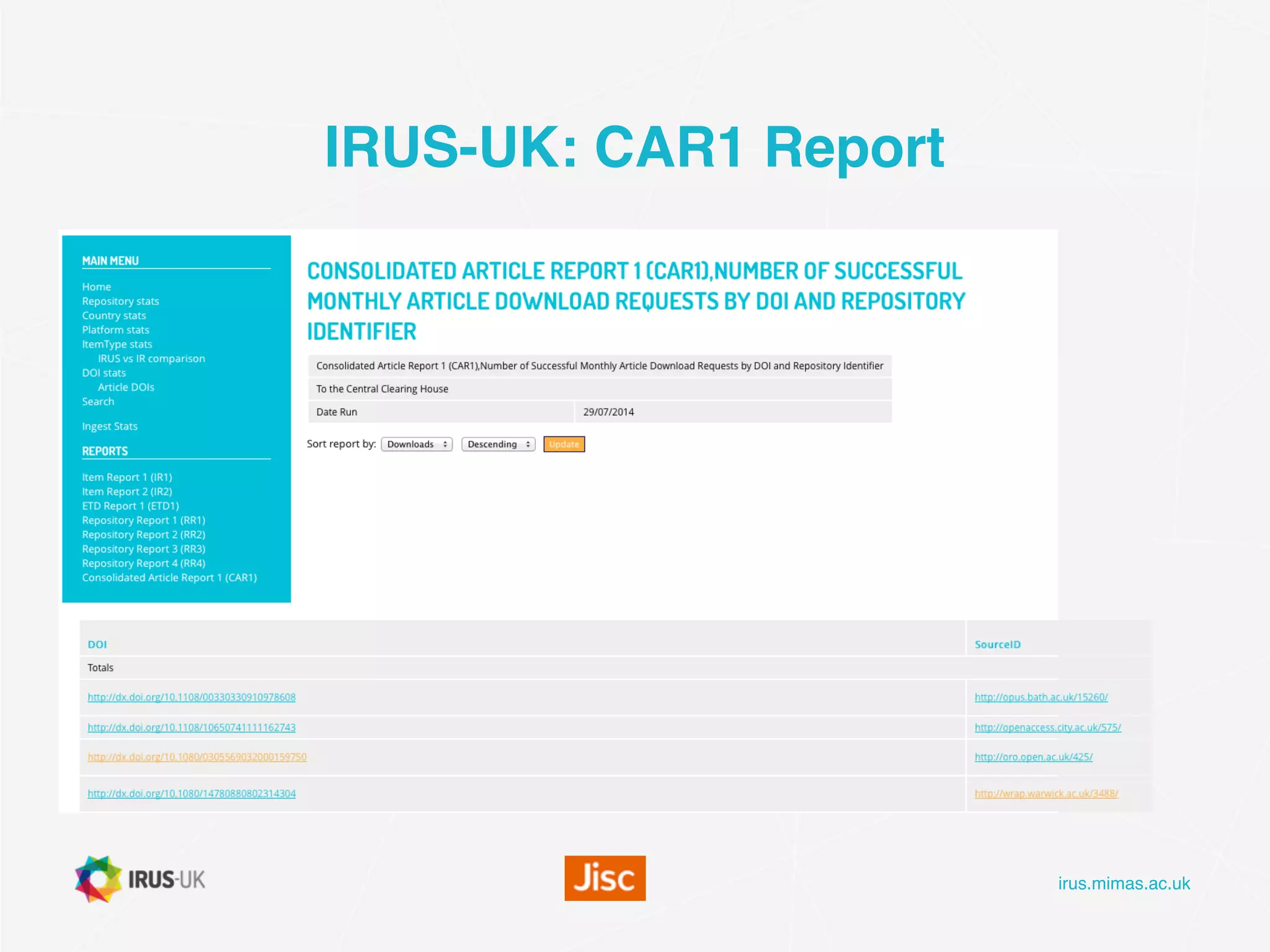
IRUS-UK: CAR1 Report
irus.mimas.ac.ukirus.mimas.ac.uk
IRUS-UK: Community engagement
● Growing number of repositories participating in IRUS-UK – currently 64 repositories
● Communication about progress and new developments via number of different
channels:
● IRUS-UK mailing list
● @IRUSNEWS Twitter account
● IRUS-UK newsletter
● IRUS-UK webinars
● Gather feedback from participating repositories via surveys and conversations
● Community Advisory Group provide feedback to the IRUS-UK project team and
inform future developments
irus.mimas.ac.ukirus.mimas.ac.uk
IRUS-UK: Added value
● From 2014 IRUS-UK user survey:
● 68% reported that IRUS-UK has improved statistical
reporting
● 66% reported that IRUS-UK saves time collecting
statistics
● 66% reported that IRUS-UK enables reporting
previously unable to do
● 83% hope to use IRUS-UK for benchmarking
irus.mimas.ac.ukirus.mimas.ac.uk
IRUS-UK: Best feature
● Reliable, authoritative statistics
● COUNTER compliant statistics
● Filtering of robots
● IR1 used for reporting to SCONUL
● Can repurpose for other reporting mechanisms and different audiences
● Ability to benchmark against others
● Comparison of download statistics across participating IRs
● Number (and range across the sector) of participating institutions
● Easy to use
● Easy to setup and use
● User friendly way to get stats
● 96% find the current user interface clear
● 96% find the current functionality clear to understand
irus.mimas.ac.ukirus.mimas.ac.uk
IRUS-UK: how to join
● If you are a UK repository:
● Contact us at irus@mimas.ac.uk to register your interest
● Answer a few questions on the type of repository you have and the version you are
running. IRUS-UK currently available for:
● DSpace
● 1.8.1, 1.8.2, 1.8.3, 3.0, 3.1, 3.2, and 4.1
● OpenRepository hosted repositories
● Eprints
● 3.2.x and 3.3.x
● Eprints Services hosted repositories
● ULCC hosted repositories
● Fedora (implementation guidelines available)
● Get advice from us on what work will be involved depending on your repository type
and version
● Implement any changes advised and then see your usage data instantly in IRUS-UK
irus.mimas.ac.uk
Contacts & Information
● If you wish to contact IRUS-UK: 
● irus@mimas.ac.uk
● @IRUSNEWS
● Project web site:
● http://irus.mimas.ac.uk/

“The set up was quick and painless, which is always a delight!”
“Consistent collection of statistics without me having to do it!”

IRUS-UK at Repository Fringe 2014

  • 1.
    Does anyone usethe material in your repository? Institutional Repository Usage Statistics (IRUS) UK Jo Alcock Evidence Base, Birmingham City University July 2014
  • 2.
    irus.mimas.ac.uk IRUS-UK ● Funded byJisc ● Project Team Members: ● Mimas, The University of Manchester – Project & Service Management & Host ● Cranfield University - Development ● Evidence Base, Birmingham City University – User Engagement & Evaluation ● Outcome of PIRUS2 (Publisher and Institutional Repository Usage Statistics) ● http://www.cranfieldlibrary.cranfield.ac.uk/pirus2/ ● Aimed to develop a global standard to enable the recording, reporting and consolidation of online usage statistics for individual journal articles hosted by IRs, Publishers and others ● Proved it was *technically feasible*, but (initially) easier without ‘P’ ● IRUS-UK: Institutional Repository Usage Statistics – UK ● Enable UK IRs to share/expose usage statistics based on a global standard – COUNTER
  • 3.
    Bringing together keyrepository services to deliver a connected national infrastructure to support OA 3
  • 4.
    Support for Integration Repositoriesto implement - patches, scripts and plug-ins produced by repository shared services. Support is being planned via: • Repository Support Project (RSP) • Planning co-ordination with platform-specific support through Eprints Services, the DSpace community and Fedora. 4
  • 5.
    irus.mimas.ac.uk IRUS-UK: aims &objectives ● Collect raw usage data from UK IRs for *all item types* within repositories ● Not just articles ● Downloads not record views ● Process those raw data into COUNTER-compliant statistics ● Return those statistics back to the originating repositories for their own use ● Give Jisc (and others) a wider picture of the overall use of UK repositories ● Offer opportunities for benchmarking/profiling/reporting ● Act as an intermediary between UK repositories and other agencies
  • 6.
    irus.mimas.ac.uk IRUS-UK: gathering data ●Considered 2 scenarios for gathering data ● Push: ‘Tracker’ code ● Whenever a download occurs the repository ‘pings’ the IRUS-UK server with details about the download ● Pull: OAI-PMH harvesting ● When a download occurs the details of the event are stored on the local repository server ● IRUS-UK periodically harvests the download data (using the OAI-PMH protocol) ● Opted for the Push method – ‘Tracker’ ● Just easier - but minimise data pushed ● Patches for Dspace and Plug-in for Eprints ● Implementation guidelines for Fedora
  • 7.
    irus.mimas.ac.uk IRUS-UK: the ingestprocess ● The ingest process has been described in detail previously, see : http://www.irus.mimas.ac.uk/news/ ● The key point is to apply the COUNTER Code of Practice to filter out robots and double clicks ● However the COUNTER Robot Exclusion list is specified only as a *minimum requirement* – more can be done ● We’ve added additional filters to ● Remove more user agents ● Apply a simple threshold for ‘overactive’ IP addresses ● Substantially better, but we needed a more sophisticated filtering system
  • 8.
    irus.mimas.ac.uk IRUS-UK: the ingestprocess ● ‘Information Power‘ investigation & report: ● Analysed raw data collected since July 2012 ● Tested the feasibility of devising algorithms to ‘dynamically’ identify unusual usage/ robot activity ● Suspicious behaviour can’t necessarily be judged on the basis of one day’s usage ● Can be almost impossible to distinguish between genuine and non-genuine activity ● In each calendar month process logs daily ● Eliminate as much as we can with a quick, minimalist approach ● Insert statistics into a ‘Provisional Daily Stats’ table ● At the end of each month reprocess those provisional stats ● Apply more comprehensive, sophisticated filtering ● Load the restated stats into the permanent daily stats table ● Empty the provisional table ready for the next month
  • 9.
  • 10.
  • 11.
  • 12.
  • 13.
  • 14.
  • 15.
  • 16.
  • 17.
  • 18.
  • 19.
  • 20.
  • 21.
  • 22.
  • 23.
  • 24.
  • 25.
  • 26.
    irus.mimas.ac.ukirus.mimas.ac.uk IRUS-UK: Community engagement ●Growing number of repositories participating in IRUS-UK – currently 64 repositories ● Communication about progress and new developments via number of different channels: ● IRUS-UK mailing list ● @IRUSNEWS Twitter account ● IRUS-UK newsletter ● IRUS-UK webinars ● Gather feedback from participating repositories via surveys and conversations ● Community Advisory Group provide feedback to the IRUS-UK project team and inform future developments
  • 27.
    irus.mimas.ac.ukirus.mimas.ac.uk IRUS-UK: Added value ●From 2014 IRUS-UK user survey: ● 68% reported that IRUS-UK has improved statistical reporting ● 66% reported that IRUS-UK saves time collecting statistics ● 66% reported that IRUS-UK enables reporting previously unable to do ● 83% hope to use IRUS-UK for benchmarking
  • 28.
    irus.mimas.ac.ukirus.mimas.ac.uk IRUS-UK: Best feature ●Reliable, authoritative statistics ● COUNTER compliant statistics ● Filtering of robots ● IR1 used for reporting to SCONUL ● Can repurpose for other reporting mechanisms and different audiences ● Ability to benchmark against others ● Comparison of download statistics across participating IRs ● Number (and range across the sector) of participating institutions ● Easy to use ● Easy to setup and use ● User friendly way to get stats ● 96% find the current user interface clear ● 96% find the current functionality clear to understand
  • 29.
    irus.mimas.ac.ukirus.mimas.ac.uk IRUS-UK: how tojoin ● If you are a UK repository: ● Contact us at irus@mimas.ac.uk to register your interest ● Answer a few questions on the type of repository you have and the version you are running. IRUS-UK currently available for: ● DSpace ● 1.8.1, 1.8.2, 1.8.3, 3.0, 3.1, 3.2, and 4.1 ● OpenRepository hosted repositories ● Eprints ● 3.2.x and 3.3.x ● Eprints Services hosted repositories ● ULCC hosted repositories ● Fedora (implementation guidelines available) ● Get advice from us on what work will be involved depending on your repository type and version ● Implement any changes advised and then see your usage data instantly in IRUS-UK
  • 30.
    irus.mimas.ac.uk Contacts & Information ●If you wish to contact IRUS-UK: ● irus@mimas.ac.uk ● @IRUSNEWS ● Project web site: ● http://irus.mimas.ac.uk/ “The set up was quick and painless, which is always a delight!” “Consistent collection of statistics without me having to do it!”