THIS DOCUMENT IS A MARKETING COMMUNICATION: It has not been prepared in accordance with legal requirements designed
to promote the independence of investment research and is also not subject to any prohibition on dealing ahead of the
dissemination of investment research.
Anna Grimaldi
Macroeconomic Analyst
Intesa Sanpaolo
anna.grimaldi@intesasanpaolo.com
Cristiana Corno
Strategist
Global Markets-Trading
cristiana.corno@bancaimi.com
GLOBAL STRATEGY
9-Mar-16
Fixed Income Special
NIRP: are more negative rates a positive?
Vìtor Constancio, ECB Vice President: “I very much hope and believe that negative deposit rates are a temporary phenomenon
worldwide and not a permanent feature of normal monetary policy.”
With the negative interest rate policy (NIRP) becoming more popular around the globe, it is worth investigating which
may be the effective lower bound (ELB) for policy rates. The ELB is perceived to be the cost of hoarding cash for
banks, households and NFCs rather than being charged to hold deposits.
To estimate the ELB for Euro area rates, we extrapolated the cost of storing gold from futures prices and derived the
cost of hoarding cash by comparing the percentage cost of storage of 1 mcube of gold and of 1 mcube of banknotes.
Based on 500-euro denomination notes, we estimate that the effective lower bound rate for Euro area interest rates
would be -1.1%; if the largest denomination note were to be the 200-euro, the effective lower bound would be as
low as -2.6%.
Yet, we doubt that the ECB would want to bring interest rates into very negative territory — to, say, at or slightly
below -1%. The effectiveness of a deposit rate cut depends heavily on its effect on market rates and on short-term
government rates, which in principle should be a positive. However, negative rates are unconventional for the
financial system. Thus, it is hard to assess in advance whether the potential further decline in lending rates will
outweigh the costs for banks, pension funds, insurances and asset managers’ profitability. The Danish experience
suggests negative rates may weigh on allocations of resources, due to legal frictions or misbehaviours, which arise
when rates are kept at -0.5% / -0.75% for an extended period.
The experience of central banks (Denmark, Sweden, Switzerland) that have operated for longer than the ECB or with
more instances of negative rates suggests that the impact of NIRP on the transmission to money markets rates thus
depends on: 1) the level of the marginal (penalty) rate imposed on excess reserves; 2) the absolute and relative
amounts of excess reserves charged at the penalty rate; 3) whether the CB can steer money market rates, or if it is the
level of excess reserves that determines the position of money market rates relative to the policy rate.
We observe a number of common features associated with low and negative interest rates regimes: 1) higher
volatility in the overnight rate, and/or 2) the curve slope (5-2, 10-2) is determined by the long end; 3) it is less sensitive
to the level of short end and thus less predictable. As a result, it is difficult to forecast the curve slope as a function of
market rates. Inflation expectations have become more relevant to explain the curve.
Markets expect the ECB to cut the deposit rate by at least 10 bps in March, and by another 10 bps by the end of the
summer. We deem it more likely that the ECB will introduce a multiple tier system, with 2/3 of excess reserves
charged at -0.30% and the remaining 1/3 at -0.55%.
A multi-tier system would be less costly for banks’ profitability and mainly for core countries’ banks, which have the
lion’s share of excess reserves. At the same time with a multi-tier scheme, money markets rates may adjust more
slowly towards the marginal deposit rate. Should this be the case, the ECB may have some extra space to buy
Government bonds in the 2019-2022 area.
2
THIS DOCUMENT IS A MARKETING COMMUNICATION: It has not been prepared in accordance with legal requirements
designed to promote the independence of investment research and is also not subject to any prohibition on dealing
ahead of the dissemination of investment research.
The rationale for negative interest rate policy (NIRP)
The Bank of Japan ZIRP (zero interest rate policy) of the 2000s seemed exceptional, up till a few years ago.
Yet, over the past four years, an increasing number of central banks around the globe trespassed the zero
bound and launched what may be regarded as a new era for monetary policy: a negative interest rate
policy (NIRP). The BOJ was the last central bank to join the NIRP club, in late January introducing a
multiple-tier deposit scheme. But, what is the rationale for moving policy rates into negative territory?
Negative nominal interest rates are unconventional. The economy at large and the payment system
operate under a zero or positive interest convention: it is generally perceived that assets and prepayments
(for taxes or cheques) yield a positive return and liabilities pay interest.
When a central bank cuts the policy rate, it normally does so to lower the burden on debtors, to reduce
investment financing costs for firms, and to alter households’ time preferences for consumption versus
savings. However, what ultimately matters is not the nominal interest rate, but the real interest rate.
Negative real rates are not unusual. When real rates are negative, the net interest that a debtor pays
implies that the cost of servicing debt is declining, and thus deleveraging for highly indebted societies is
more manageable. But, if inflation is low and expected to fall further, it is hard to imagine how real rates
can decline when nominal rates are already at zero. One of the options a central bank can resort to is
cutting nominal rates into negative territory. Whether the negative interest rate regime will have an
impact on real rates ultimately depends on whether the cut in the policy rate is transmitted onto money
markets rates and financial conditions at large, and whether the inflation component of nominal rates
makes a larger contribution. The idea here is that a lower price is always effective in stimulating spending
— be this via consumption or investment.
How low can rates go? We doubt that the ECB can go below -1%
Switching to a negative interest rate regime does not mean that an effective lower bound on interest
rates no longer exists. It is commonly believed that the effective lower bound is determined by the cost of
hoarding cash for households, corporates and financial institutions, rather than using electronic money.
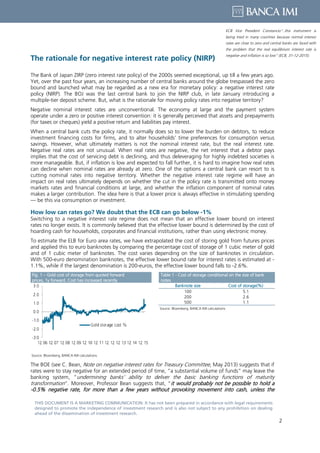
To estimate the ELB for Euro area rates, we have extrapolated the cost of storing gold from futures prices
and applied this to euro banknotes by comparing the percentage cost of storage of 1 cubic meter of gold
and of 1 cubic meter of banknotes. The cost varies depending on the size of banknotes in circulation.
With 500-euro denomination banknotes, the effective lower bound rate for interest rates is estimated at -
1.1%, while if the largest denomination is 200-euros, the effective lower bound falls to -2.6%.
Fig. 1 – Gold cost of storage from quoted forward
prices, 1y forward. Cost has increased recently
Table 1 - Cost of storage conditional on the size of bank
notes
Banknote size Cost of storage(%)
100 5.1
200 2.6
500 1.1
Source: Bloomberg, BANCA IMI calculations
The BOE (see C. Bean, Note on negative interest rates for Treasury Committee, May 2013) suggests that if
rates were to stay negative for an extended period of time, “a substantial volume of funds” may leave the
banking system, “undermining banks’ ability to deliver the basic banking functions of maturity
transformation”. Moreover, Professor Bean suggests that, “it would probably not be possible to hold a
-0.5% negative rate, for more than a few years without provoking movement into cash, unless the
ECB Vice President Constancio”..this instrument is
being tried in many countries because normal interest
rates are close to zero and central banks are faced with
the problem that the real equilibrium interest rate is
negative and inflation is so low” (ECB, 31-12-2015).
3
THIS DOCUMENT IS A MARKETING COMMUNICATION: It has not been prepared in accordance with legal requirements
designed to promote the independence of investment research and is also not subject to any prohibition on dealing
ahead of the dissemination of investment research.
convertibility of bank reserves into cash is restricted in some way”. One way to circumvent the risk of a
large amount of money moving out of the banking system would be to eliminate the effective lower
bound (ELB). This could be done by: 1) taxing the currency, as was first suggested by Gesell (1932) and
more recently by Buiter (2003) and Ilgmann (2011); 2) abolishing paper currency (Rogoff, 2014), which
would have the ethical advantage of taxing illicit activities; and/or 3) setting an exchange rate between
paper currency and electronic (or bank) money. Electronic money, taxed on the source, would be the
numeraire and the paper currency would steadily depreciate (Kimball, 2015).
How can negative rates potentially transmit to the economy?
Before going into a cost/benefit analysis of negative interest rate policy, it is worth doing a quick refresher
of how a central bank normally transmits the monetary policy impact through setting its key signalling
rate or the policy rate. Generally, a central bank supplies an amount of liquidity through refinancing
operations that allows credit institutions to fulfil their liquidity needs at a price that is in line with the
central bank’s signalled policy intentions. In normal times, the central bank decides how much liquidity to
inject into the system in order to steer market rates
1
. The central bank generally sets a ceiling (lending
rate) and a floor (deposit rate) for its policy rate which is applied on overnight facilities. Thus, the central
bank transmits the monetary policy impulse by steering money markets rates through liquidity rationing at
its repo operations. This is how things operate in normal times. But, there are exceptions. 1) One is when
the interest rate is used to control the exchange rate and thus the CB sacrifices the interest rate targeting
to exchange rate targeting. 2) Another is the ECB’s full allotment regime in open market refinancing
operations (OMOs). Since October 2008, the ECB let MFIs endogenously determine the desired liquidity at
a given price. Since then, the deposit rate has been the benchmark rate for money markets and it is excess
liquidity
2
in the system that determines the position of the overnight rate (Eonia) relative to the depo rate.
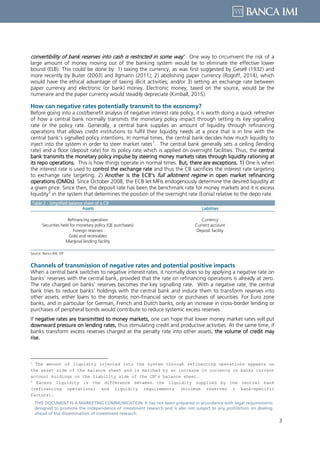
Table 2 - Simplified balance sheet of a CB
Assets Liabilities
Refinancing operation Currency
Securities held for monetary policy (QE purchases) Current account
Foreign reserves Deposit facility
Gold and receivables
Marginal lending facility
Source: Banca IMI, ISP
Channels of transmission of negative rates and potential positive impacts
When a central bank switches to negative interest rates, it normally does so by applying a negative rate on
banks’ reserves with the central bank, provided that the rate on refinancing operations is already at zero.
The rate charged on banks’ reserves becomes the key signalling rate. With a negative rate, the central
bank tries to reduce banks’ holdings with the central bank and induce them to transform reserves into
other assets, either loans to the domestic non-financial sector or purchases of securities. For Euro zone
banks, and in particular for German, French and Dutch banks, only an increase in cross-border lending or
purchases of peripheral bonds would contribute to reduce systemic excess reserves.
If negative rates are transmitted to money markets, one can hope that lower money market rates will put
downward pressure on lending rates, thus stimulating credit and productive activities. At the same time, if
banks transform excess reserves charged at the penalty rate into other assets, the volume of credit may
rise.
1
The amount of liquidity injected into the system through refinancing operations appears on
the asset side of the balance sheet and is matched by an increase in currency or banks current
account holdings on the liability side of the CB’s balance sheet.
2
Excess liquidity is the difference between the liquidity supplied by the central bank
(refinancing operations) and liquidity requirements (minimum reserves + bank-specific
factors).
4
THIS DOCUMENT IS A MARKETING COMMUNICATION: It has not been prepared in accordance with legal requirements
designed to promote the independence of investment research and is also not subject to any prohibition on dealing
ahead of the dissemination of investment research.
If banks decide to move out on the credit curve and buy riskier assets relative to holding reserves with a
central bank at a negative return, a portfolio rebalancing may occur. Thus, a central bank may want to
check how much credit risk premium is left to be exploited. With risk premium falling, the cost of capital
should fall too, with a positive impact on funding conditions for economic agents. At the same time,
lower rates along the maturity spectrum may alter households’ time preferences and induce them to
spend more.
Another potential channel of transmission may be the signalling effect, if the move into negative rates is
perceived as a commitment from the central bank to meet its inflation target. Thus, the measure may
contribute to reducing overall uncertainty, together with easing financial conditions and encouraging
spending decisions.
The exchange rate channel is potentially relevant if negative rates are successful in halting capital inflows.
Denmark and Switzerland have so far been successful in stabilising the exchange rate against the euro.
But, it seems that the marginal benefits in terms of exchange rate stabilisation are decreasing. Moreover,
on a global scale, engaging a currency war by cutting rates into more negative territory is equivalent to a
zero sum game.
The potential costs of switching to a NIRP regime
But when deciding to cut rates into negative or more negative territory, costs should not be
underestimated. Negative rates generally have a negative effect on banks’ profitability, as they tend to
erode net interest margins. ECB executive board member Benoît Coeuré described the mechanism
through which negative rates may affect banks’ profitability: as policy rates fall into negative territory,
money market rates should fall too, putting pressure on lending rates. But, the banks are unlikely to pass
negative rates on to deposits of households and non-financial corporates. ECB board member Coeuré
illustrated the mechanism quite effectively: “banks’ lending rates fall linearly but their funding costs are
non-linear – as interest rates on retail deposits are sticky – which puts a squeeze on net interest margins”.
For households in particular, it should be easy to switch from deposits to cash if they are charged to hold
money with the banks. For non-financial corporates, it is more difficult to switch out of bank accounts if
the remuneration turns negative. Indeed, the experience of Denmark and Sweden confirms that rates on
non-financial corporates’ deposits fall more than the rate on household deposits. The impact on banks’
profitability of negative rates will also depend on how much the cost of market funding falls, with market
rates and credit spreads adjusting to negative rates. In the its January 2016 Economic Bulletin (see Recent
developments in the composition and cost of bank funding in the euro area, pp. 26-41), the ECB
concludes that the monetary policy measures adopted since 2012 have contributed to reduce the cost of
wholesale funding. In the Euro area, it is possible that the cost of market funding will increase, as the new
regulatory regime and the coming into force of the BRRD (Banks’ resolution directive) may initially put
pressure on the cost of funding. The ECB notes that, “the reduction in the risk of further systemic crises
will lead to a more stable banking system and robust transmission mechanism”. The ECB drawing from ad
hoc questions from the April and October 2015 Bank Lending surveys notes that, “the APP, together with
negative rates on excess reserves, is likely to lead to lower unit margins but these effects are so far partly
offset by the capital gains on securities held by banks”. Moreover, the impact of negative rates on banks’
profitability will also depend on the loan structure (on the share of fixed rate loans as a percentage of the
total), on the impact of negative rates on lending volumes, and credit quality improvements (lower default
rates associated with lower interest charges).
Negative rates can potentially] put pressure on pension, insurance funds and asset managers, which may
find it hard to meet the guaranteed returned on their liabilities in a regime of declining short- and longer-
term returns. Moreover, there could be perverse effects on money market funds, with managers finding it
hard to provide investors with liquidity and capital preservation in a falling returns environment. The
Danish experience suggests, however, that money markets can pass through the negative rates without
massive disruptions in the market.
Also, negative interest rates may result in legal and operational challenges. With rates staying in negative
territory for an extended period of time, there might be a need to redesign contracts to deal with the
issue of the payment of interest on debt securities. Societies tend to operate under positive interest rate
5
THIS DOCUMENT IS A MARKETING COMMUNICATION: It has not been prepared in accordance with legal requirements
designed to promote the independence of investment research and is also not subject to any prohibition on dealing
ahead of the dissemination of investment research.
conventions. For example, people can prepay tax obligations paying zero interest while they would be
charged a negative interest rate on their current account holdings. Together with the convention that all
prepayments of debt carry a zero interest rate, creditors generally have the option to decide when to
collect a debt. But in a negative interest rate regime, creditors may want to collect debt slowly in order to
avoid the negative interest charge during the time the obligation actually comes to maturity. For example,
if you receive a cheque, you may want to leave it undeposited for as long as possible with possible costs
for the cheque writer (unplanned overdraft costs). The lower interest rates fall into negative territory and
the longer they stay there, the more likely that legal distortions and economic frictions become
quantitatively relevant. In the case of the United States, Garbade and McAndrews (2012) found that with
money markets rates at -0.5% for an extended period of time there could be innovations to circumvent
negative interest rates. Such innovations could include the creation of new institutions to store cash.
Last but not least, negative interest rates could send the wrong signal and be interpreted as a sign that a
central bank has no other means of meeting its inflation target. The risk is that as nominal rates fall into
negative rate[territory], volatility increases and medium- to longer-term inflation expectations fall too.
Thus, in conclusion, there is ample uncertainty on whether negative interest rate policy can contribute to
a reduction in lending rates and credit spreads, or stimulate credit availability, growth and inflation. At the
same time, a negative interest rate policy carries more risk regarding financial stability, legal friction and
resource allocations than can be prima facie understood, Following a gradual approach in order to let the
system adjust to the new policy regime may be desirable, and it is indeed the approach the ECB has
followed so far. Indeed, ECB Vice President Constancio on December 31 2015 stated that “I very much
hope and believe that negative deposit rates are a temporary phenomenon worldwide and not a
permanent feature of normal monetary policy.”
Other central bank experiences with negative rates
As NIRP policies are a relatively new tool, and provided that the transmission to the economy depends on
the pass-through of the rate cut to money market rates and on term and risk premiums, we have looked
at the experiences of the Danish, Swiss and Swedish central banks, which have more experience
operating with negative rates than the ECB, to understand whether the way a central bank implements
the negative interest rate regime had different implications for the transmission onto money markets and
banks profitability. Indeed, ECB board member Coeuré said (02/03/2016) that the “ECB is carefully
studying the schemes used in other jurisdictions to mitigate possible adverse effects for the bank’s lending
channel”.
The Danish experience. Denmark’s was the first central bank to cut the rate on the certificate of deposits
into negative territory in July 2012 (to -0.20%), with the decision taken solely based on the consideration
of maintaining Denmark’s fixed exchange rate regime of 7.46 kroner/1.0 euro with a fluctuation band of
+/- 2.25 percent. The rate on certificates of deposit was lowered to as low as -0.75% in February 2015
and then raised to -0.65% this past January. The discount rate has always been left at zero. Thus, the
certificate of deposit rate has become the key signalling rate. The certificate of deposit rate is applied on
reserves in excess of a common current account limit. Reserves up to the common current account limit
are charged at zero interest. Only if the systemic reserves exceed the common limit will individual banks’
reserves in excess of 0.75% of an institution’s deposit base be converted into certificates of deposit
charged at -0.65%. The cap on current accounts has been increased to protect banks’ profitability from
DKR 37bn to DKR 173bn and are now back at DKR 31.4bn. The liquidity reallocation effect in Denmark
has been virtually non-existent, as the central bank left the rate on current accounts at zero. As a result,
banks shifted reserves from the deposit facility to current accounts.
6
THIS DOCUMENT IS A MARKETING COMMUNICATION: It has not been prepared in accordance with legal requirements
designed to promote the independence of investment research and is also not subject to any prohibition on dealing
ahead of the dissemination of investment research.
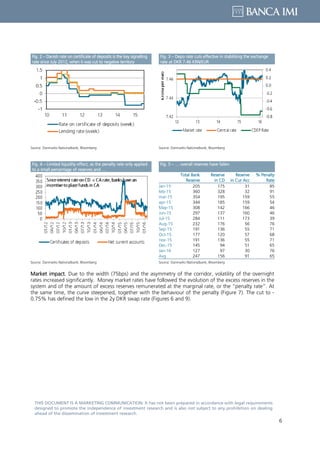
Fig. 2 – Danish rate on certificate of deposits is the key signalling
rate since July 2012, when it was cut to negative territory
Fig. 3 – Depo rate cuts effective in stabilising the exchange
rate at DKR 7.46 KRN/EUR
Source: Danmarks Nationalbank, Bloomberg Source: Danmarks Nationalbank, Bloomberg
Fig. 4 – Limited liquidity effect, as the penalty rate only applied
to a small percentage of reserves and …
Fig. 5 – … overall reserves have fallen
Total Bank
Reserve
Reserve
in CD
Reserve
in Cur Acc
% Penalty
Rate
Jan-15 205 175 31 85
feb-15 360 328 32 91
mar-15 354 195 159 55
apr-15 344 185 159 54
May-15 308 142 166 46
Jun-15 297 137 160 46
Jul-15 284 111 173 39
Aug-15 232 176 56 76
Sep-15 191 136 55 71
Oct-15 177 120 57 68
nov-15 191 136 55 71
Dec-15 145 94 51 65
Jan-16 127 97 30 76
Avg 247 156 91 65
Source: Danmarks Nationalbank, Bloomberg Source: Danmarks Nationalbank, Bloomberg
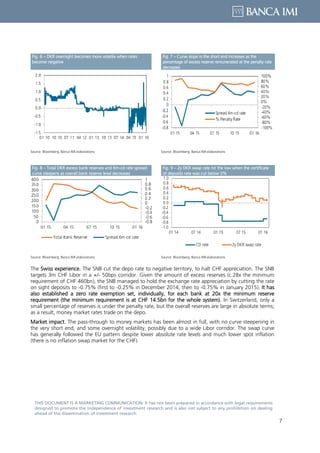
Market impact. Due to the width (75bps) and the asymmetry of the corridor, volatility of the overnight
rates increased significantly. Money market rates have followed the evolution of the excess reserves in the
system and of the amount of excess reserves remunerated at the marginal rate, or the “penalty rate”. At
the same time, the curve steepened, together with the behaviour of the penalty (Figure 7). The cut to -
0.75% has defined the low in the 2y DKR swap rate (Figures 6 and 9).
7
THIS DOCUMENT IS A MARKETING COMMUNICATION: It has not been prepared in accordance with legal requirements
designed to promote the independence of investment research and is also not subject to any prohibition on dealing
ahead of the dissemination of investment research.
Fig. 6 – DKR overnight becomes more volatile when rates
become negative
Fig. 7 – Curve slope in the short end increases as the
percentage of excess reserve remunerated at the penalty rate
decreases
Source: Bloomberg, Banca IMI elaborations Source: Bloomberg, Banca IMI elaborations
Fig. 8 – Total DKR excess bank reserves and 6m-cd rate spread:
curve steepens as overall bank reserve level decreases
Fig. 9 – 2y DKR swap rate hit the low when the certificate
of deposits rate was cut below 0%
Source: Bloomberg, Banca IMI elaborations Source: Bloomberg, Banca IMI elaborations
The Swiss experience. The SNB cut the depo rate to negative territory, to halt CHF appreciation. The SNB
targets 3m CHF Libor in a +/- 50bps corridor. Given the amount of excess reserves (c.28x the minimum
requirement of CHF 460bn), the SNB managed to hold the exchange rate appreciation by cutting the rate
on sight deposits to -0.75% (first to -0.25% in December 2014, then to -0.75% in January 2015). It has
also established a zero rate exemption set, individually, for each bank at 20x the minimum reserve
requirement (the minimum requirement is at CHF 14.5bn for the whole system). In Switzerland, only a
small percentage of reserves is under the penalty rate, but the overall reserves are large in absolute terms;
as a result, money market rates trade on the depo.
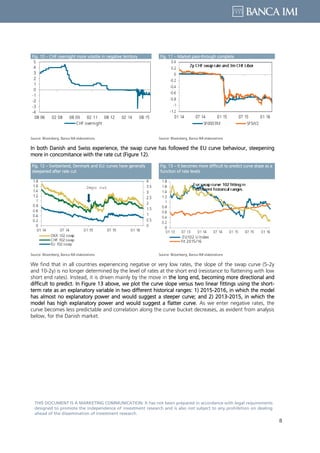
Market impact. The pass-through to money markets has been almost in full, with no curve steepening in
the very short end, and some overnight volatility, possibly due to a wide Libor corridor. The swap curve
has generally followed the EU pattern despite lower absolute rate levels and much lower spot inflation
(there is no inflation swap market for the CHF).
8
THIS DOCUMENT IS A MARKETING COMMUNICATION: It has not been prepared in accordance with legal requirements
designed to promote the independence of investment research and is also not subject to any prohibition on dealing
ahead of the dissemination of investment research.
Fig. 10 – CHF overnight more volatile in negative territory Fig. 11 – Market pass-through complete
Source: Bloomberg, Banca IMI elaborations Source: Bloomberg, Banca IMI elaborations
In both Danish and Swiss experience, the swap curve has followed the EU curve behaviour, steepening
more in concomitance with the rate cut (Figure 12).
Fig. 12 – Switzerland, Denmark and EU: curves have generally
steepened after rate cut
Fig. 13 – It becomes more difficult to predict curve slope as a
function of rate levels
Source: Bloomberg, Banca IMI elaborations Source: Bloomberg, Banca IMI elaborations
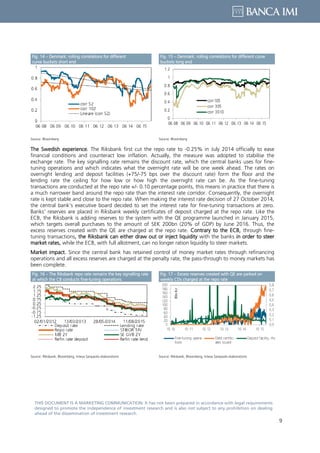
We find that in all countries experiencing negative or very low rates, the slope of the swap curve (5-2y
and 10-2y) is no longer determined by the level of rates at the short end (resistance to flattening with low
short end rates). Instead, it is driven mainly by the move in the long end, becoming more directional and
difficult to predict. In Figure 13 above, we plot the curve slope versus two linear fittings using the short-
term rate as an explanatory variable in two different historical ranges: 1) 2015-2016, in which the model
has almost no explanatory power and would suggest a steeper curve; and 2) 2013-2015, in which the
model has high explanatory power and would suggest a flatter curve. As we enter negative rates, the
curve becomes less predictable and correlation along the curve bucket decreases, as evident from analysis
below, for the Danish market.
Depo cut
9
THIS DOCUMENT IS A MARKETING COMMUNICATION: It has not been prepared in accordance with legal requirements
designed to promote the independence of investment research and is also not subject to any prohibition on dealing
ahead of the dissemination of investment research.
Fig. 14 – Denmark: rolling correlations for different
curve buckets short end
Fig. 15 – Denmark: rolling correlations for different curve
buckets long end
Source: Bloomberg Source: Bloomberg
The Swedish experience. The Riksbank first cut the repo rate to -0.25% in July 2014 officially to ease
financial conditions and counteract low inflation. Actually, the measure was adopted to stabilise the
exchange rate. The key signalling rate remains the discount rate, which the central banks uses for fine-
tuning operations and which indicates what the overnight rate will be one week ahead. The rates on
overnight lending and deposit facilities (+75/-75 bps over the discount rate) form the floor and the
lending rate the ceiling for how low or how high the overnight rate can be. As the fine-tuning
transactions are conducted at the repo rate +/- 0.10 percentage points, this means in practice that there is
a much narrower band around the repo rate than the interest rate corridor. Consequently, the overnight
rate is kept stable and close to the repo rate. When making the interest rate decision of 27 October 2014,
the central bank’s executive board decided to set the interest rate for fine-tuning transactions at zero.
Banks’ reserves are placed in Riksbank weekly certificates of deposit charged at the repo rate. Like the
ECB, the Riksbank is adding reserves to the system with the QE programme launched in January 2015,
which targets overall purchases to the amount of SEK 200bn (20% of GDP) by June 2016. Thus, the
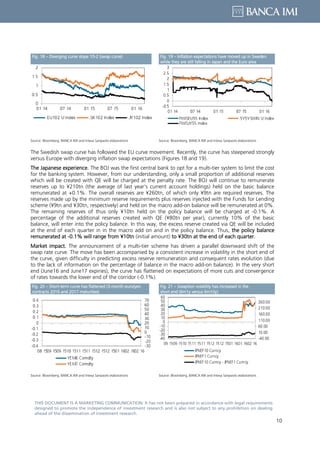
excess reserves created with the QE are charged at the repo rate. Contrary to the ECB, through fine-
tuning transactions, the Riksbank can either draw out or inject liquidity with the banks in order to steer
market rates, while the ECB, with full allotment, can no longer ration liquidity to steer markets.
Market impact. Since the central bank has retained control of money market rates through refinancing
operations and all excess reserves are charged at the penalty rate, the pass-through to money markets has
been complete.
Fig. 16 – The Riksbank repo rate remains the key signalling rate
at which the CB conducts fine-tuning operations
Fig. 17 – Excess reserves created with QE are parked on
weekly CDs charged at the repo rate
Source: Riksbank, Bloomberg, Intesa Sanpaolo elaborations Source: Riksbank, Bloomberg, Intesa Sanpaolo elaborations
10
THIS DOCUMENT IS A MARKETING COMMUNICATION: It has not been prepared in accordance with legal requirements
designed to promote the independence of investment research and is also not subject to any prohibition on dealing
ahead of the dissemination of investment research.
Fig. 18 – Diverging curve slope 10-2 (swap curve) Fig. 19 – Inflation expectations have moved up in Sweden
while they are still falling in Japan and the Euro area
Source: Bloomberg, BANCA IMI and Intesa Sanpaolo elaborations Source: Bloomberg, BANCA IMI and Intesa Sanpaolo elaborations
The Swedish swap curve has followed the EU curve movement. Recently, the curve has steepened strongly
versus Europe with diverging inflation swap expectations (Figures 18 and 19).
The Japanese experience. The BOJ was the first central bank to opt for a multi-tier system to limit the cost
for the banking system. However, from our understanding, only a small proportion of additional reserves
which will be created with QE will be charged at the penalty rate. The BOJ will continue to remunerate
reserves up to ¥210tn (the average of last year’s current account holdings) held on the basic balance
remunerated at +0.1%. The overall reserves are ¥260tn, of which only ¥9tn are required reserves. The
reserves made up by the minimum reserve requirements plus reserves injected with the Funds for Lending
scheme (¥9tn and ¥30tn, respectively) and held on the macro add-on balance will be remunerated at 0%.
The remaining reserves of thus only ¥10tn held on the policy balance will be charged at -0.1%. A
percentage of the additional reserves created with QE (¥80tn per year), currently 10% of the basic
balance, will enter into the policy balance. In this way, the excess reserve created via QE will be included
at the end of each quarter in in the macro add on and in the policy balance. Thus, the policy balance
remunerated at -0.1% will range from ¥10tn (initial amount) to ¥30tn at the end of each quarter.
Market impact. The announcement of a multi-tier scheme has driven a parallel downward shift of the
swap rate curve. The move has been accompanied by a consistent increase in volatility in the short end of
the curve, given difficulty in predicting excess reserve remuneration and consequent rates evolution (due
to the lack of information on the percentage of balance in the macro add-on balance). In the very short
end (June16 and June17 expiries), the curve has flattened on expectations of more cuts and convergence
of rates towards the lower end of the corridor (-0.1%).
Fig. 20 – Short-term curve has flattened (3-month euro/yen
contracts 2016 and 2017 maturities)
Fig. 21 – Swaption volatility has increased in the
short end (6m1y versus 6m10y)
Source: Bloomberg, BANCA IMI and Intesa Sanpaolo elaborations Source: Bloomberg, BANCA IMI and Intesa Sanpaolo elaborations
11
THIS DOCUMENT IS A MARKETING COMMUNICATION: It has not been prepared in accordance with legal requirements
designed to promote the independence of investment research and is also not subject to any prohibition on dealing
ahead of the dissemination of investment research.
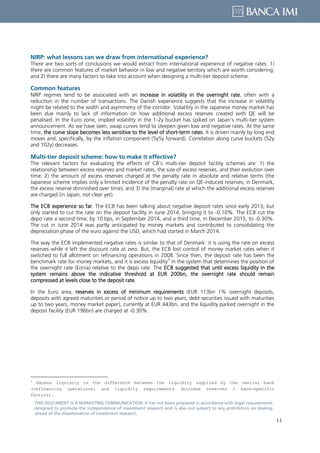
NIRP: what lessons can we draw from international experience?
There are two sorts of conclusions we would extract from international experience of negative rates: 1)
there are common features of market behavior in low and negative territory which are worth considering;
and 2) there are many factors to take into account when designing a multi-tier deposit scheme.
Common features
NIRP regimes tend to be associated with an increase in volatility in the overnight rate, often with a
reduction in the number of transactions. The Danish experience suggests that the increase in volatility
might be related to the width and asymmetry of the corridor. Volatility in the Japanese money market has
been due mainly to lack of information on how additional excess reserves created with QE will be
penalised. In the Euro zone, implied volatility in the 1-2y bucket has spiked on Japan’s multi-tier system
announcement. As we have seen, swap curves tend to steepen given low and negative rates. At the same
time, the curve slope becomes less sensitive to the level of short-term rates. It is driven mainly by long end
moves and, specifically, by the inflation component (5y5y forward). Correlation along curve buckets (52y
and 102y) decreases.
Multi-tier deposit scheme: how to make it effective?
The relevant factors for evaluating the effects of CB’s multi-tier deposit facility schemes are: 1) the
relationship between excess reserves and market rates, the size of excess reserves, and their evolution over
time; 2) the amount of excess reserves charged at the penalty rate in absolute and relative terms (the
Japanese scheme implies only a limited incidence of the penalty rate on QE-induced reserves; in Denmark,
the excess reserve diminished over time); and 3) the (marginal) rate at which the additional excess reserves
are charged (in Japan, not clear yet).
The ECB experience so far. The ECB has been talking about negative deposit rates since early 2013, but
only started to cut the rate on the deposit facility in June 2014, bringing it to -0.10%. The ECB cut the
depo rate a second time, by 10 bps, in September 2014, and a third time, in December 2015, to -0.30%.
The cut in June 2014 was partly anticipated by money markets and contributed to consolidating the
depreciation phase of the euro against the USD, which had started in March 2014.
The way the ECB implemented negative rates is similar to that of Denmark: it is using the rate on excess
reserves while it left the discount rate at zero. But, the ECB lost control of money market rates when it
switched to full allotment on refinancing operations in 2008. Since then, the deposit rate has been the
benchmark rate for money markets, and it is excess liquidity
3
in the system that determines the position of
the overnight rate (Eonia) relative to the depo rate. The ECB suggested that until excess liquidity in the
system remains above the indicative threshold at EUR 200bn, the overnight rate should remain
compressed at levels close to the deposit rate.
In the Euro area, reserves in excess of minimum requirements (EUR 113bn 1% overnight deposits,
deposits with agreed maturities or period of notice up to two years, debt securities issued with maturities
up to two years, money market paper), currently at EUR 443bn, and the liquidity parked overnight in the
deposit facility (EUR 196bn) are charged at -0.30%.
3
Excess liquidity is the difference between the liquidity supplied by the central bank
(refinancing operations) and liquidity requirements (minimum reserves + bank-specific
factors).
12
THIS DOCUMENT IS A MARKETING COMMUNICATION: It has not been prepared in accordance with legal requirements
designed to promote the independence of investment research and is also not subject to any prohibition on dealing
ahead of the dissemination of investment research.
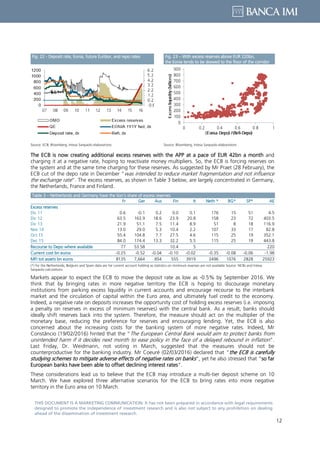
Fig. 22 - Deposit rate, Eonia, future Euribor, and repo rates Fig. 23 – With excess reserves above EUR 220bn,
the Eonia tends to be skewed to the floor of the corridor
Source: ECB; Bloomberg, Intesa Sanpaolo elaborations Source: Bloomberg, Intesa Sanpaolo elaborations
The ECB is now creating additional excess reserves with the APP at a pace of EUR 42bn a month and
charging it at a negative rate, hoping to reactivate money multipliers. So, the ECB is forcing reserves on
the system and at the same time charging for these reserves. As suggested by Mr Praet (28 February), the
ECB cut of the depo rate in December “was intended to reduce market fragmentation and not influence
the exchange rate”. The excess reserves, as shown in Table 3 below, are largely concentrated in Germany,
the Netherlands, France and Finland.
Table 3 – Netherlands and Germany have the lion’s share of excess reserves
Fr Ger Aus Fin It Neth * BG* SP* AE
Excess reserves
Dic 11 0.6 -0.1 0.2 0.0 0.1 176 15 51 4.5
Dic 12 63.5 163.9 18.6 23.9 20.8 158 23 72 403.5
Dic 13 21.9 51.1 7.5 11.4 8.9 51 8 18 116.9
Nov 14 13.0 29.0 5.3 10.4 2.2 107 33 17 82.8
Oct 15 55.4 104.8 7.7 27.5 4.6 115 25 19 352.1
Dec 15 84.0 174.4 13.3 32.2 5.5 115 25 19 443.8
Recourse to Depo where available 77 53.58 10.4 5 220
Current cost bn euros -0.25 -0.52 -0.04 -0.10 -0.02 -0.35 -0.08 -0.06 -1.98
MFI tot assets bn euros 8135 7,664 854 555 3919 2496 1076 2828 25923
(*) for the Netherlands, Belgium and Spain data are for current account holding as statistics on minimum reserves are not available Source: NCBs and Intesa
Sanpaolo calculations
Markets appear to expect the ECB to move the deposit rate as low as -0.5% by September 2016. We
think that by bringing rates in more negative territory the ECB is hoping to discourage monetary
institutions from parking excess liquidity in current accounts and encourage recourse to the interbank
market and the circulation of capital within the Euro area, and ultimately fuel credit to the economy.
Indeed, a negative rate on deposits increases the opportunity cost of holding excess reserves (i.e. imposing
a penalty on reserves in excess of minimum reserves) with the central bank. As a result, banks should
ideally shift reserves back into the system. Therefore, the measure should act on the multiplier of the
monetary base, reducing the preference for reserves and encouraging lending. Yet, the ECB is also
concerned about the increasing costs for the banking system of more negative rates. Indeed, Mr
Constâncio (19/02/2016) hinted that the “The European Central Bank would aim to protect banks from
unintended harm if it decides next month to ease policy in the face of a delayed rebound in inflation”.
Last Friday, Dr. Weidmann, not voting in March, suggested that the measures should not be
counterproductive for the banking industry. Mr Coeuré (02/03/2016) declared that “the ECB is carefully
studying schemes to mitigate adverse effects of negative rates on banks”, yet he also stressed that “so far
European banks have been able to offset declining interest rates”.
These considerations lead us to believe that the ECB may introduce a multi-tier deposit scheme on 10
March. We have explored three alternative scenarios for the ECB to bring rates into more negative
territory in the Euro area on 10 March.
13
THIS DOCUMENT IS A MARKETING COMMUNICATION: It has not been prepared in accordance with legal requirements
designed to promote the independence of investment research and is also not subject to any prohibition on dealing
ahead of the dissemination of investment research.
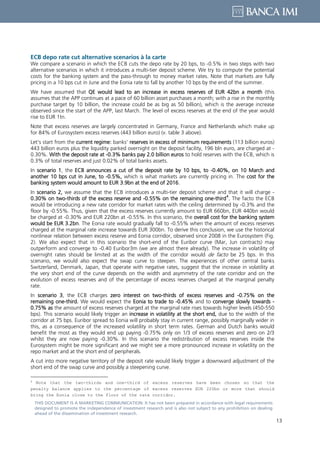
ECB depo rate cut alternative scenarios à la carte
We compare a scenario in which the ECB cuts the depo rate by 20 bps, to -0.5% in two steps with two
alternative scenarios in which it introduces a multi-tier deposit scheme. We try to compute the potential
costs for the banking system and the pass-through to money market rates. Note that markets are fully
pricing in a 10 bps cut in June and the Eonia rate to fall by another 10 bps by the end of the summer.
We have assumed that QE would lead to an increase in excess reserves of EUR 42bn a month (this
assumes that the APP continues at a pace of 60 billion asset purchases a month; with a rise in the monthly
purchase target by 10 billion, the increase could be as big as 50 billion), which is the average increase
observed since the start of the APP, last March. The level of excess reserves at the end of the year would
rise to EUR 1tn.
Note that excess reserves are largely concentrated in Germany, France and Netherlands which make up
for 84% of Eurosystem excess reserves (443 billion euro) (v. table 3 above).
Let’s start from the current regime: banks’ reserves in excess of minimum requirements (113 billion euros)
443 billion euros plus the liquidity parked overnight on the deposit facility, 196 bln euro, are charged at -
0.30%. With the deposit rate at -0.3% banks pay 2.0 billion euros to hold reserves with the ECB, which is
0.3% of total reserves and just 0.02% of total banks assets.
In scenario 1, the ECB announces a cut of the deposit rate by 10 bps, to -0.40%, on 10 March and
another 10 bps cut in June, to -0.5%, which is what markets are currently pricing in. The cost for the
banking system would amount to EUR 3.9bn at the end of 2016.
In scenario 2, we assume that the ECB introduces a multi-tier deposit scheme and that it will charge -
0.30% on two-thirds of the excess reserve and -0.55% on the remaining one-third
4
. The facto the ECB
would be introducing a new rate corridor for market rates with the ceiling determined by -0.3% and the
floor by -0.55%. Thus, given that the excess reserves currently amount to EUR 660bn, EUR 440bn would
be charged at -0.30% and EUR 220bn at -0.55%. In this scenario, the overall cost for the banking system
would be EUR 3.2bn. The Eonia rate would gradually fall to -0.55% when the amount of excess reserves
charged at the marginal rate increase towards EUR 300bn. To derive this conclusion, we use the historical
nonlinear relation between excess reserve and Eonia corridor, observed since 2008 in the Eurosystem (Fig.
2). We also expect that in this scenario the short-end of the Euribor curve (Mar, Jun contracts) may
outperform and converge to -0.40 Euribor3m (we are almost there already). The increase in volatility of
overnight rates should be limited at as the width of the corridor would de facto be 25 bps. In this
scenario, we would also expect the swap curve to steepen. The experiences of other central banks
Switzerland, Denmark, Japan, that operate with negative rates, suggest that the increase in volatility at
the very short end of the curve depends on the width and asymmetry of the rate corridor and on the
evolution of excess reserves and of the percentage of excess reserves charged at the marginal penalty
rate.
In scenario 3, the ECB charges zero interest on two-thirds of excess reserves and -0.75% on the
remaining one-third. We would expect the Eonia to trade to -0.45% and to converge slowly towards -
0.75% as the amount of excess reserves charged at the marginal rate rises towards higher levels (450-550
bps). This scenario would likely trigger an increase in volatility at the short end, due to the width of the
corridor at 75 bps. Euribor spread to Eonia will probably stay in current range, possibly marginally wider in
this, as a consequence of the increased volatility in short term rates. German and Dutch banks would
benefit the most as they would end up paying -0.75% only on 1/3 of excess reserves and zero on 2/3
whilst they are now paying -0.30%. In this scenario the redistribution of excess reserves inside the
Eurosystem might be more significant and we might see a more pronounced increase in volatility on the
repo market and at the short end of peripherals.
A cut into more negative territory of the deposit rate would likely trigger a downward adjustment of the
short end of the swap curve and possibly a steepening curve.
4
Note that the two-thirds and one-third of excess reserves have been chosen so that the
penalty balance applies to the percentage of excess reserves EUR 220bn or more that should
bring the Eonia close to the floor of the rate corridor.
14
THIS DOCUMENT IS A MARKETING COMMUNICATION: It has not been prepared in accordance with legal requirements
designed to promote the independence of investment research and is also not subject to any prohibition on dealing
ahead of the dissemination of investment research.
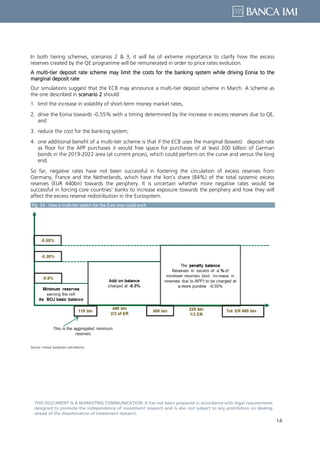
In both tiering schemes, scenarios 2 & 3, it will be of extreme importance to clarify how the excess
reserves created by the QE programme will be remunerated in order to price rates evolution.
A multi-tier deposit rate scheme may limit the costs for the banking system while driving Eonia to the
marginal deposit rate
Our simulations suggest that the ECB may announce a multi-tier deposit scheme in March. A scheme as
the one described in scenario 2 should:
1. limit the increase in volatility of short-term money market rates,
2. drive the Eonia towards -0.55% with a timing determined by the increase in excess reserves due to QE,
and
3. reduce the cost for the banking system;
4. one additional benefit of a multi-tier scheme is that if the ECB uses the marginal (lowest) deposit rate
as floor for the APP purchases it would free space for purchases of at least 200 billion of German
bonds in the 2019-2022 area (at current prices), which could perform on the curve and versus the long
end.
So far, negative rates have not been successful in fostering the circulation of excess reserves from
Germany, France and the Netherlands, which have the lion’s share (84%) of the total systemic excess
reserves (EUR 440bn) towards the periphery. It is uncertain whether more negative rates would be
successful in forcing core countries’ banks to increase exposure towards the periphery and how they will
affect the excess reserve redistribution in the Eurosystem.
Fig. 24 - How a multi-tier system for the Euro area could work
Source: Intesa Sanpaolo calculations
Disclaimer
This marketing communication has been prepared by the Trading Strategist department and is distributed by Banca IMI, a bank
belonging to the Intesa Sanpaolo Banking Group which is authorized to carry out investment services in Italy and is regulated by the Bank
of Italy and Consob.
The information contained in this document:
• constitutes a marketing communication and, as such, it has not been prepared in accordance with the legal requirements
designed to promote the independence of investment research and is not subject to any prohibition on dealing ahead of the
dissemination of investment research;
• may differ from the recommendations prepared by financial analysts of the Direzione Studi e Ricerche of Intesa Sanpaolo and
distributed by Banca IMI.
The information contained herein does not constitute investment research within in the meaning of applicable regulatory rules in EU, or a
solicitation or invitation, or investment advice, and does not purport to offer legal, tax or any other advice. Neither the Intesa Sanpaolo
Banking Group, nor any officer, representative or employee thereof accepts any liability (for negligence or otherwise) for any direct or
consequential losses arising from any use of information including, without limitation, the reliance on any such information contained in
this communication.
The information and views contained in this communication are based on sources believed to be reliable and in good faith. No
representation or warranty is made as to their accuracy or correctness. The views, forecasts and estimates contained in this communication
reflect the personal view of the author as of the date of its publication. The views may differ from those of others within the Intesa
Sanpaolo Banking Group.
All prices and rates included herein are shown for indication only and should not be relied upon to re-evaluate any positions held by any
recipient of this document. For specific quotations, please contact your Banca IMI usual contact. There is no guarantee that the future
results or any other future events will be consistent with the views, forecasts and estimates contained in this communication. Furthermore,
any information included herein is subject to change by the author after the date of its publication without any notice by Banca IMI to the
person to whom this communication has been distributed.
Information about the basic elements and the methodology used for the purposes of evaluation are available on the website at
https://www.bancaimi.com/bancaimi/Banca-IMI-Global-Strategy-reports.html#GlobalCreditOverview
This document is intended for distribution in Italy and in the Member States of the European Union only to professional clients and
eligible counterparties, as defined in the MiFID Directive 2004/39/EC, either as a printed document and/or electronic form.
Trading Strategist Certification
The Trading Strategist who prepared this report, and whose names and roles appear on the first page, certify that:
1. The views expressed on companies mentioned herein accurately reflect independent, fair and balanced personal views;
2. No direct or indirect compensation has been or will be received in exchange for any views expressed.
Other information
Neither the Trading Strategist nor any member of the Trading Strategist’s household has a financial interest in the securities.
Conflicts of interest
Banca IMI S.p.A. and the other companies belonging to Intesa Sanpaolo Banking Group (jointly, the "Intesa Sanpaolo Group") provide all
services in the lending and securities industry, carrying out in particular – through its companies in possession of the necessary
authorizations, where required – investment banking, corporate finance and finance and investment activities – through merchant
banking activities and proprietary trading - financial advisory, investment research and financial analysis or other forms of general
recommendation regarding transactions on financial instruments, securities issuance, placement activities, reception and transmission of
orders, execution of orders for clients and dealing for own account in financial instruments, portfolio management, including the
management of collective investment schemes and the management of multilateral trading facilities.
The Intesa Sanpaolo Banking Group is involved in a wide range of commercial and investment banking and other activities (including
investment management, sales and trading of securities related activities) out of which may from time to time arise an interest in the
issuers and in the financial instruments, including related financial instruments, or transactions referred to in this communication. Such
interests may include i) having, at any time, significant directional positions, long or short, trading activity which could be also contrary to
the views expressed herein; ii) holding financial instruments under pledge; iii) trading, on behalf of themselves or of their clients, the
financial instruments, including related financial instruments, or financial instruments whose value is dependent upon, or is linked to, the
financial instruments, issuers, parameters or indices referred to herein; iv) granting loans to companies whose securities are discussed
herein; v) holding significant shareholdings and possibly appointing board members and/or other corporate bodies member, and
participating in shareholders’ agreements; vi) providing banking, credit or other financial services to the issuers of the financial
instruments referred to herein, including their controlling companies or other companies belonging to the issuer’s group. Banca IMI may
act in the capacity of sponsor, specialist, listing partner, market maker, corporate broking and/or liquidity provider or in any other similar
capacity with regard to the financial instruments, including related financial instruments, referred to herein.
In consideration of the above, Banca IMI S.p.A. states that has adopted written guidelines “Modello di Organizzazione, Gestione e
Controllo” pursuant to Legislative Decree June 8, 2001 n. 231 (available at the Intesa Sanpaolo website, webpage
http://www.group.intesasanpaolo.com/scriptIsir0/si09/governance/ita_wp_governance.jsp, along with a summary sheet, webpage
https://www.bancaimi.com/en/bancaimi/chisiamo/documentazione/mifid.) setting forth practices and procedures, in accordance with
applicable regulations by the competent Italian authorities and best international practice, including those known as Chinese Walls, to
restrict the flow of information, namely inside and/or confidential information, to prevent misuse of such information and to prevent any
conflicts of interest may adversely affect the interests of the customer in accordance with current regulations.
Furthermore, in relation to the government securities potentially mentioned within this marketing communication, we disclose that Banca
IMI S.p.A. acts as market maker in the wholesale markets for the government securities of the main European countries and also acts as
Government Bond Specialist, or comparable assignment, for the government securities issued by the Republic of Italy, by the Federal
Republic of Germany, by the Hellenic Republic, by the European Stability Mechanism and by the European Financial Stability Facility.
This communication is for exclusive use by the person to whom has been distributed by Banca IMI and may not be reproduced or
redistributed, directly or indirectly, to any other person or published, fully or partially, for any reason whatsoever, without the prior
written consent of Banca IMI. The copyright and any other intellectual rights on data, information, opinions and estimates referred to
herein belong to the Intesa Sanpaolo Banking Group, unless otherwise stated. Such data, information, opinions and estimates may not be
fully or partially distributed or reproduced in any form, and by any means, without the prior written consent of Banca IMI.
Any recipient of this communication is required to comply with the above requirements.

Nirp

  • 1.
    THIS DOCUMENT ISA MARKETING COMMUNICATION: It has not been prepared in accordance with legal requirements designed to promote the independence of investment research and is also not subject to any prohibition on dealing ahead of the dissemination of investment research. Anna Grimaldi Macroeconomic Analyst Intesa Sanpaolo anna.grimaldi@intesasanpaolo.com Cristiana Corno Strategist Global Markets-Trading cristiana.corno@bancaimi.com GLOBAL STRATEGY 9-Mar-16 Fixed Income Special NIRP: are more negative rates a positive? Vìtor Constancio, ECB Vice President: “I very much hope and believe that negative deposit rates are a temporary phenomenon worldwide and not a permanent feature of normal monetary policy.” With the negative interest rate policy (NIRP) becoming more popular around the globe, it is worth investigating which may be the effective lower bound (ELB) for policy rates. The ELB is perceived to be the cost of hoarding cash for banks, households and NFCs rather than being charged to hold deposits. To estimate the ELB for Euro area rates, we extrapolated the cost of storing gold from futures prices and derived the cost of hoarding cash by comparing the percentage cost of storage of 1 mcube of gold and of 1 mcube of banknotes. Based on 500-euro denomination notes, we estimate that the effective lower bound rate for Euro area interest rates would be -1.1%; if the largest denomination note were to be the 200-euro, the effective lower bound would be as low as -2.6%. Yet, we doubt that the ECB would want to bring interest rates into very negative territory — to, say, at or slightly below -1%. The effectiveness of a deposit rate cut depends heavily on its effect on market rates and on short-term government rates, which in principle should be a positive. However, negative rates are unconventional for the financial system. Thus, it is hard to assess in advance whether the potential further decline in lending rates will outweigh the costs for banks, pension funds, insurances and asset managers’ profitability. The Danish experience suggests negative rates may weigh on allocations of resources, due to legal frictions or misbehaviours, which arise when rates are kept at -0.5% / -0.75% for an extended period. The experience of central banks (Denmark, Sweden, Switzerland) that have operated for longer than the ECB or with more instances of negative rates suggests that the impact of NIRP on the transmission to money markets rates thus depends on: 1) the level of the marginal (penalty) rate imposed on excess reserves; 2) the absolute and relative amounts of excess reserves charged at the penalty rate; 3) whether the CB can steer money market rates, or if it is the level of excess reserves that determines the position of money market rates relative to the policy rate. We observe a number of common features associated with low and negative interest rates regimes: 1) higher volatility in the overnight rate, and/or 2) the curve slope (5-2, 10-2) is determined by the long end; 3) it is less sensitive to the level of short end and thus less predictable. As a result, it is difficult to forecast the curve slope as a function of market rates. Inflation expectations have become more relevant to explain the curve. Markets expect the ECB to cut the deposit rate by at least 10 bps in March, and by another 10 bps by the end of the summer. We deem it more likely that the ECB will introduce a multiple tier system, with 2/3 of excess reserves charged at -0.30% and the remaining 1/3 at -0.55%. A multi-tier system would be less costly for banks’ profitability and mainly for core countries’ banks, which have the lion’s share of excess reserves. At the same time with a multi-tier scheme, money markets rates may adjust more slowly towards the marginal deposit rate. Should this be the case, the ECB may have some extra space to buy Government bonds in the 2019-2022 area.
  • 2.
    2 THIS DOCUMENT ISA MARKETING COMMUNICATION: It has not been prepared in accordance with legal requirements designed to promote the independence of investment research and is also not subject to any prohibition on dealing ahead of the dissemination of investment research. The rationale for negative interest rate policy (NIRP) The Bank of Japan ZIRP (zero interest rate policy) of the 2000s seemed exceptional, up till a few years ago. Yet, over the past four years, an increasing number of central banks around the globe trespassed the zero bound and launched what may be regarded as a new era for monetary policy: a negative interest rate policy (NIRP). The BOJ was the last central bank to join the NIRP club, in late January introducing a multiple-tier deposit scheme. But, what is the rationale for moving policy rates into negative territory? Negative nominal interest rates are unconventional. The economy at large and the payment system operate under a zero or positive interest convention: it is generally perceived that assets and prepayments (for taxes or cheques) yield a positive return and liabilities pay interest. When a central bank cuts the policy rate, it normally does so to lower the burden on debtors, to reduce investment financing costs for firms, and to alter households’ time preferences for consumption versus savings. However, what ultimately matters is not the nominal interest rate, but the real interest rate. Negative real rates are not unusual. When real rates are negative, the net interest that a debtor pays implies that the cost of servicing debt is declining, and thus deleveraging for highly indebted societies is more manageable. But, if inflation is low and expected to fall further, it is hard to imagine how real rates can decline when nominal rates are already at zero. One of the options a central bank can resort to is cutting nominal rates into negative territory. Whether the negative interest rate regime will have an impact on real rates ultimately depends on whether the cut in the policy rate is transmitted onto money markets rates and financial conditions at large, and whether the inflation component of nominal rates makes a larger contribution. The idea here is that a lower price is always effective in stimulating spending — be this via consumption or investment. How low can rates go? We doubt that the ECB can go below -1% Switching to a negative interest rate regime does not mean that an effective lower bound on interest rates no longer exists. It is commonly believed that the effective lower bound is determined by the cost of hoarding cash for households, corporates and financial institutions, rather than using electronic money. To estimate the ELB for Euro area rates, we have extrapolated the cost of storing gold from futures prices and applied this to euro banknotes by comparing the percentage cost of storage of 1 cubic meter of gold and of 1 cubic meter of banknotes. The cost varies depending on the size of banknotes in circulation. With 500-euro denomination banknotes, the effective lower bound rate for interest rates is estimated at - 1.1%, while if the largest denomination is 200-euros, the effective lower bound falls to -2.6%. Fig. 1 – Gold cost of storage from quoted forward prices, 1y forward. Cost has increased recently Table 1 - Cost of storage conditional on the size of bank notes Banknote size Cost of storage(%) 100 5.1 200 2.6 500 1.1 Source: Bloomberg, BANCA IMI calculations Source: Bloomberg, BANCA IMI calculations The BOE (see C. Bean, Note on negative interest rates for Treasury Committee, May 2013) suggests that if rates were to stay negative for an extended period of time, “a substantial volume of funds” may leave the banking system, “undermining banks’ ability to deliver the basic banking functions of maturity transformation”. Moreover, Professor Bean suggests that, “it would probably not be possible to hold a -0.5% negative rate, for more than a few years without provoking movement into cash, unless the ECB Vice President Constancio”..this instrument is being tried in many countries because normal interest rates are close to zero and central banks are faced with the problem that the real equilibrium interest rate is negative and inflation is so low” (ECB, 31-12-2015).
  • 3.
    3 THIS DOCUMENT ISA MARKETING COMMUNICATION: It has not been prepared in accordance with legal requirements designed to promote the independence of investment research and is also not subject to any prohibition on dealing ahead of the dissemination of investment research. convertibility of bank reserves into cash is restricted in some way”. One way to circumvent the risk of a large amount of money moving out of the banking system would be to eliminate the effective lower bound (ELB). This could be done by: 1) taxing the currency, as was first suggested by Gesell (1932) and more recently by Buiter (2003) and Ilgmann (2011); 2) abolishing paper currency (Rogoff, 2014), which would have the ethical advantage of taxing illicit activities; and/or 3) setting an exchange rate between paper currency and electronic (or bank) money. Electronic money, taxed on the source, would be the numeraire and the paper currency would steadily depreciate (Kimball, 2015). How can negative rates potentially transmit to the economy? Before going into a cost/benefit analysis of negative interest rate policy, it is worth doing a quick refresher of how a central bank normally transmits the monetary policy impact through setting its key signalling rate or the policy rate. Generally, a central bank supplies an amount of liquidity through refinancing operations that allows credit institutions to fulfil their liquidity needs at a price that is in line with the central bank’s signalled policy intentions. In normal times, the central bank decides how much liquidity to inject into the system in order to steer market rates 1 . The central bank generally sets a ceiling (lending rate) and a floor (deposit rate) for its policy rate which is applied on overnight facilities. Thus, the central bank transmits the monetary policy impulse by steering money markets rates through liquidity rationing at its repo operations. This is how things operate in normal times. But, there are exceptions. 1) One is when the interest rate is used to control the exchange rate and thus the CB sacrifices the interest rate targeting to exchange rate targeting. 2) Another is the ECB’s full allotment regime in open market refinancing operations (OMOs). Since October 2008, the ECB let MFIs endogenously determine the desired liquidity at a given price. Since then, the deposit rate has been the benchmark rate for money markets and it is excess liquidity 2 in the system that determines the position of the overnight rate (Eonia) relative to the depo rate. Table 2 - Simplified balance sheet of a CB Assets Liabilities Refinancing operation Currency Securities held for monetary policy (QE purchases) Current account Foreign reserves Deposit facility Gold and receivables Marginal lending facility Source: Banca IMI, ISP Channels of transmission of negative rates and potential positive impacts When a central bank switches to negative interest rates, it normally does so by applying a negative rate on banks’ reserves with the central bank, provided that the rate on refinancing operations is already at zero. The rate charged on banks’ reserves becomes the key signalling rate. With a negative rate, the central bank tries to reduce banks’ holdings with the central bank and induce them to transform reserves into other assets, either loans to the domestic non-financial sector or purchases of securities. For Euro zone banks, and in particular for German, French and Dutch banks, only an increase in cross-border lending or purchases of peripheral bonds would contribute to reduce systemic excess reserves. If negative rates are transmitted to money markets, one can hope that lower money market rates will put downward pressure on lending rates, thus stimulating credit and productive activities. At the same time, if banks transform excess reserves charged at the penalty rate into other assets, the volume of credit may rise. 1 The amount of liquidity injected into the system through refinancing operations appears on the asset side of the balance sheet and is matched by an increase in currency or banks current account holdings on the liability side of the CB’s balance sheet. 2 Excess liquidity is the difference between the liquidity supplied by the central bank (refinancing operations) and liquidity requirements (minimum reserves + bank-specific factors).
  • 4.
    4 THIS DOCUMENT ISA MARKETING COMMUNICATION: It has not been prepared in accordance with legal requirements designed to promote the independence of investment research and is also not subject to any prohibition on dealing ahead of the dissemination of investment research. If banks decide to move out on the credit curve and buy riskier assets relative to holding reserves with a central bank at a negative return, a portfolio rebalancing may occur. Thus, a central bank may want to check how much credit risk premium is left to be exploited. With risk premium falling, the cost of capital should fall too, with a positive impact on funding conditions for economic agents. At the same time, lower rates along the maturity spectrum may alter households’ time preferences and induce them to spend more. Another potential channel of transmission may be the signalling effect, if the move into negative rates is perceived as a commitment from the central bank to meet its inflation target. Thus, the measure may contribute to reducing overall uncertainty, together with easing financial conditions and encouraging spending decisions. The exchange rate channel is potentially relevant if negative rates are successful in halting capital inflows. Denmark and Switzerland have so far been successful in stabilising the exchange rate against the euro. But, it seems that the marginal benefits in terms of exchange rate stabilisation are decreasing. Moreover, on a global scale, engaging a currency war by cutting rates into more negative territory is equivalent to a zero sum game. The potential costs of switching to a NIRP regime But when deciding to cut rates into negative or more negative territory, costs should not be underestimated. Negative rates generally have a negative effect on banks’ profitability, as they tend to erode net interest margins. ECB executive board member Benoît Coeuré described the mechanism through which negative rates may affect banks’ profitability: as policy rates fall into negative territory, money market rates should fall too, putting pressure on lending rates. But, the banks are unlikely to pass negative rates on to deposits of households and non-financial corporates. ECB board member Coeuré illustrated the mechanism quite effectively: “banks’ lending rates fall linearly but their funding costs are non-linear – as interest rates on retail deposits are sticky – which puts a squeeze on net interest margins”. For households in particular, it should be easy to switch from deposits to cash if they are charged to hold money with the banks. For non-financial corporates, it is more difficult to switch out of bank accounts if the remuneration turns negative. Indeed, the experience of Denmark and Sweden confirms that rates on non-financial corporates’ deposits fall more than the rate on household deposits. The impact on banks’ profitability of negative rates will also depend on how much the cost of market funding falls, with market rates and credit spreads adjusting to negative rates. In the its January 2016 Economic Bulletin (see Recent developments in the composition and cost of bank funding in the euro area, pp. 26-41), the ECB concludes that the monetary policy measures adopted since 2012 have contributed to reduce the cost of wholesale funding. In the Euro area, it is possible that the cost of market funding will increase, as the new regulatory regime and the coming into force of the BRRD (Banks’ resolution directive) may initially put pressure on the cost of funding. The ECB notes that, “the reduction in the risk of further systemic crises will lead to a more stable banking system and robust transmission mechanism”. The ECB drawing from ad hoc questions from the April and October 2015 Bank Lending surveys notes that, “the APP, together with negative rates on excess reserves, is likely to lead to lower unit margins but these effects are so far partly offset by the capital gains on securities held by banks”. Moreover, the impact of negative rates on banks’ profitability will also depend on the loan structure (on the share of fixed rate loans as a percentage of the total), on the impact of negative rates on lending volumes, and credit quality improvements (lower default rates associated with lower interest charges). Negative rates can potentially] put pressure on pension, insurance funds and asset managers, which may find it hard to meet the guaranteed returned on their liabilities in a regime of declining short- and longer- term returns. Moreover, there could be perverse effects on money market funds, with managers finding it hard to provide investors with liquidity and capital preservation in a falling returns environment. The Danish experience suggests, however, that money markets can pass through the negative rates without massive disruptions in the market. Also, negative interest rates may result in legal and operational challenges. With rates staying in negative territory for an extended period of time, there might be a need to redesign contracts to deal with the issue of the payment of interest on debt securities. Societies tend to operate under positive interest rate
  • 5.
    5 THIS DOCUMENT ISA MARKETING COMMUNICATION: It has not been prepared in accordance with legal requirements designed to promote the independence of investment research and is also not subject to any prohibition on dealing ahead of the dissemination of investment research. conventions. For example, people can prepay tax obligations paying zero interest while they would be charged a negative interest rate on their current account holdings. Together with the convention that all prepayments of debt carry a zero interest rate, creditors generally have the option to decide when to collect a debt. But in a negative interest rate regime, creditors may want to collect debt slowly in order to avoid the negative interest charge during the time the obligation actually comes to maturity. For example, if you receive a cheque, you may want to leave it undeposited for as long as possible with possible costs for the cheque writer (unplanned overdraft costs). The lower interest rates fall into negative territory and the longer they stay there, the more likely that legal distortions and economic frictions become quantitatively relevant. In the case of the United States, Garbade and McAndrews (2012) found that with money markets rates at -0.5% for an extended period of time there could be innovations to circumvent negative interest rates. Such innovations could include the creation of new institutions to store cash. Last but not least, negative interest rates could send the wrong signal and be interpreted as a sign that a central bank has no other means of meeting its inflation target. The risk is that as nominal rates fall into negative rate[territory], volatility increases and medium- to longer-term inflation expectations fall too. Thus, in conclusion, there is ample uncertainty on whether negative interest rate policy can contribute to a reduction in lending rates and credit spreads, or stimulate credit availability, growth and inflation. At the same time, a negative interest rate policy carries more risk regarding financial stability, legal friction and resource allocations than can be prima facie understood, Following a gradual approach in order to let the system adjust to the new policy regime may be desirable, and it is indeed the approach the ECB has followed so far. Indeed, ECB Vice President Constancio on December 31 2015 stated that “I very much hope and believe that negative deposit rates are a temporary phenomenon worldwide and not a permanent feature of normal monetary policy.” Other central bank experiences with negative rates As NIRP policies are a relatively new tool, and provided that the transmission to the economy depends on the pass-through of the rate cut to money market rates and on term and risk premiums, we have looked at the experiences of the Danish, Swiss and Swedish central banks, which have more experience operating with negative rates than the ECB, to understand whether the way a central bank implements the negative interest rate regime had different implications for the transmission onto money markets and banks profitability. Indeed, ECB board member Coeuré said (02/03/2016) that the “ECB is carefully studying the schemes used in other jurisdictions to mitigate possible adverse effects for the bank’s lending channel”. The Danish experience. Denmark’s was the first central bank to cut the rate on the certificate of deposits into negative territory in July 2012 (to -0.20%), with the decision taken solely based on the consideration of maintaining Denmark’s fixed exchange rate regime of 7.46 kroner/1.0 euro with a fluctuation band of +/- 2.25 percent. The rate on certificates of deposit was lowered to as low as -0.75% in February 2015 and then raised to -0.65% this past January. The discount rate has always been left at zero. Thus, the certificate of deposit rate has become the key signalling rate. The certificate of deposit rate is applied on reserves in excess of a common current account limit. Reserves up to the common current account limit are charged at zero interest. Only if the systemic reserves exceed the common limit will individual banks’ reserves in excess of 0.75% of an institution’s deposit base be converted into certificates of deposit charged at -0.65%. The cap on current accounts has been increased to protect banks’ profitability from DKR 37bn to DKR 173bn and are now back at DKR 31.4bn. The liquidity reallocation effect in Denmark has been virtually non-existent, as the central bank left the rate on current accounts at zero. As a result, banks shifted reserves from the deposit facility to current accounts.
  • 6.
    6 THIS DOCUMENT ISA MARKETING COMMUNICATION: It has not been prepared in accordance with legal requirements designed to promote the independence of investment research and is also not subject to any prohibition on dealing ahead of the dissemination of investment research. Fig. 2 – Danish rate on certificate of deposits is the key signalling rate since July 2012, when it was cut to negative territory Fig. 3 – Depo rate cuts effective in stabilising the exchange rate at DKR 7.46 KRN/EUR Source: Danmarks Nationalbank, Bloomberg Source: Danmarks Nationalbank, Bloomberg Fig. 4 – Limited liquidity effect, as the penalty rate only applied to a small percentage of reserves and … Fig. 5 – … overall reserves have fallen Total Bank Reserve Reserve in CD Reserve in Cur Acc % Penalty Rate Jan-15 205 175 31 85 feb-15 360 328 32 91 mar-15 354 195 159 55 apr-15 344 185 159 54 May-15 308 142 166 46 Jun-15 297 137 160 46 Jul-15 284 111 173 39 Aug-15 232 176 56 76 Sep-15 191 136 55 71 Oct-15 177 120 57 68 nov-15 191 136 55 71 Dec-15 145 94 51 65 Jan-16 127 97 30 76 Avg 247 156 91 65 Source: Danmarks Nationalbank, Bloomberg Source: Danmarks Nationalbank, Bloomberg Market impact. Due to the width (75bps) and the asymmetry of the corridor, volatility of the overnight rates increased significantly. Money market rates have followed the evolution of the excess reserves in the system and of the amount of excess reserves remunerated at the marginal rate, or the “penalty rate”. At the same time, the curve steepened, together with the behaviour of the penalty (Figure 7). The cut to - 0.75% has defined the low in the 2y DKR swap rate (Figures 6 and 9).
  • 7.
    7 THIS DOCUMENT ISA MARKETING COMMUNICATION: It has not been prepared in accordance with legal requirements designed to promote the independence of investment research and is also not subject to any prohibition on dealing ahead of the dissemination of investment research. Fig. 6 – DKR overnight becomes more volatile when rates become negative Fig. 7 – Curve slope in the short end increases as the percentage of excess reserve remunerated at the penalty rate decreases Source: Bloomberg, Banca IMI elaborations Source: Bloomberg, Banca IMI elaborations Fig. 8 – Total DKR excess bank reserves and 6m-cd rate spread: curve steepens as overall bank reserve level decreases Fig. 9 – 2y DKR swap rate hit the low when the certificate of deposits rate was cut below 0% Source: Bloomberg, Banca IMI elaborations Source: Bloomberg, Banca IMI elaborations The Swiss experience. The SNB cut the depo rate to negative territory, to halt CHF appreciation. The SNB targets 3m CHF Libor in a +/- 50bps corridor. Given the amount of excess reserves (c.28x the minimum requirement of CHF 460bn), the SNB managed to hold the exchange rate appreciation by cutting the rate on sight deposits to -0.75% (first to -0.25% in December 2014, then to -0.75% in January 2015). It has also established a zero rate exemption set, individually, for each bank at 20x the minimum reserve requirement (the minimum requirement is at CHF 14.5bn for the whole system). In Switzerland, only a small percentage of reserves is under the penalty rate, but the overall reserves are large in absolute terms; as a result, money market rates trade on the depo. Market impact. The pass-through to money markets has been almost in full, with no curve steepening in the very short end, and some overnight volatility, possibly due to a wide Libor corridor. The swap curve has generally followed the EU pattern despite lower absolute rate levels and much lower spot inflation (there is no inflation swap market for the CHF).
  • 8.
    8 THIS DOCUMENT ISA MARKETING COMMUNICATION: It has not been prepared in accordance with legal requirements designed to promote the independence of investment research and is also not subject to any prohibition on dealing ahead of the dissemination of investment research. Fig. 10 – CHF overnight more volatile in negative territory Fig. 11 – Market pass-through complete Source: Bloomberg, Banca IMI elaborations Source: Bloomberg, Banca IMI elaborations In both Danish and Swiss experience, the swap curve has followed the EU curve behaviour, steepening more in concomitance with the rate cut (Figure 12). Fig. 12 – Switzerland, Denmark and EU: curves have generally steepened after rate cut Fig. 13 – It becomes more difficult to predict curve slope as a function of rate levels Source: Bloomberg, Banca IMI elaborations Source: Bloomberg, Banca IMI elaborations We find that in all countries experiencing negative or very low rates, the slope of the swap curve (5-2y and 10-2y) is no longer determined by the level of rates at the short end (resistance to flattening with low short end rates). Instead, it is driven mainly by the move in the long end, becoming more directional and difficult to predict. In Figure 13 above, we plot the curve slope versus two linear fittings using the short- term rate as an explanatory variable in two different historical ranges: 1) 2015-2016, in which the model has almost no explanatory power and would suggest a steeper curve; and 2) 2013-2015, in which the model has high explanatory power and would suggest a flatter curve. As we enter negative rates, the curve becomes less predictable and correlation along the curve bucket decreases, as evident from analysis below, for the Danish market. Depo cut
  • 9.
    9 THIS DOCUMENT ISA MARKETING COMMUNICATION: It has not been prepared in accordance with legal requirements designed to promote the independence of investment research and is also not subject to any prohibition on dealing ahead of the dissemination of investment research. Fig. 14 – Denmark: rolling correlations for different curve buckets short end Fig. 15 – Denmark: rolling correlations for different curve buckets long end Source: Bloomberg Source: Bloomberg The Swedish experience. The Riksbank first cut the repo rate to -0.25% in July 2014 officially to ease financial conditions and counteract low inflation. Actually, the measure was adopted to stabilise the exchange rate. The key signalling rate remains the discount rate, which the central banks uses for fine- tuning operations and which indicates what the overnight rate will be one week ahead. The rates on overnight lending and deposit facilities (+75/-75 bps over the discount rate) form the floor and the lending rate the ceiling for how low or how high the overnight rate can be. As the fine-tuning transactions are conducted at the repo rate +/- 0.10 percentage points, this means in practice that there is a much narrower band around the repo rate than the interest rate corridor. Consequently, the overnight rate is kept stable and close to the repo rate. When making the interest rate decision of 27 October 2014, the central bank’s executive board decided to set the interest rate for fine-tuning transactions at zero. Banks’ reserves are placed in Riksbank weekly certificates of deposit charged at the repo rate. Like the ECB, the Riksbank is adding reserves to the system with the QE programme launched in January 2015, which targets overall purchases to the amount of SEK 200bn (20% of GDP) by June 2016. Thus, the excess reserves created with the QE are charged at the repo rate. Contrary to the ECB, through fine- tuning transactions, the Riksbank can either draw out or inject liquidity with the banks in order to steer market rates, while the ECB, with full allotment, can no longer ration liquidity to steer markets. Market impact. Since the central bank has retained control of money market rates through refinancing operations and all excess reserves are charged at the penalty rate, the pass-through to money markets has been complete. Fig. 16 – The Riksbank repo rate remains the key signalling rate at which the CB conducts fine-tuning operations Fig. 17 – Excess reserves created with QE are parked on weekly CDs charged at the repo rate Source: Riksbank, Bloomberg, Intesa Sanpaolo elaborations Source: Riksbank, Bloomberg, Intesa Sanpaolo elaborations
  • 10.
    10 THIS DOCUMENT ISA MARKETING COMMUNICATION: It has not been prepared in accordance with legal requirements designed to promote the independence of investment research and is also not subject to any prohibition on dealing ahead of the dissemination of investment research. Fig. 18 – Diverging curve slope 10-2 (swap curve) Fig. 19 – Inflation expectations have moved up in Sweden while they are still falling in Japan and the Euro area Source: Bloomberg, BANCA IMI and Intesa Sanpaolo elaborations Source: Bloomberg, BANCA IMI and Intesa Sanpaolo elaborations The Swedish swap curve has followed the EU curve movement. Recently, the curve has steepened strongly versus Europe with diverging inflation swap expectations (Figures 18 and 19). The Japanese experience. The BOJ was the first central bank to opt for a multi-tier system to limit the cost for the banking system. However, from our understanding, only a small proportion of additional reserves which will be created with QE will be charged at the penalty rate. The BOJ will continue to remunerate reserves up to ¥210tn (the average of last year’s current account holdings) held on the basic balance remunerated at +0.1%. The overall reserves are ¥260tn, of which only ¥9tn are required reserves. The reserves made up by the minimum reserve requirements plus reserves injected with the Funds for Lending scheme (¥9tn and ¥30tn, respectively) and held on the macro add-on balance will be remunerated at 0%. The remaining reserves of thus only ¥10tn held on the policy balance will be charged at -0.1%. A percentage of the additional reserves created with QE (¥80tn per year), currently 10% of the basic balance, will enter into the policy balance. In this way, the excess reserve created via QE will be included at the end of each quarter in in the macro add on and in the policy balance. Thus, the policy balance remunerated at -0.1% will range from ¥10tn (initial amount) to ¥30tn at the end of each quarter. Market impact. The announcement of a multi-tier scheme has driven a parallel downward shift of the swap rate curve. The move has been accompanied by a consistent increase in volatility in the short end of the curve, given difficulty in predicting excess reserve remuneration and consequent rates evolution (due to the lack of information on the percentage of balance in the macro add-on balance). In the very short end (June16 and June17 expiries), the curve has flattened on expectations of more cuts and convergence of rates towards the lower end of the corridor (-0.1%). Fig. 20 – Short-term curve has flattened (3-month euro/yen contracts 2016 and 2017 maturities) Fig. 21 – Swaption volatility has increased in the short end (6m1y versus 6m10y) Source: Bloomberg, BANCA IMI and Intesa Sanpaolo elaborations Source: Bloomberg, BANCA IMI and Intesa Sanpaolo elaborations
  • 11.
    11 THIS DOCUMENT ISA MARKETING COMMUNICATION: It has not been prepared in accordance with legal requirements designed to promote the independence of investment research and is also not subject to any prohibition on dealing ahead of the dissemination of investment research. NIRP: what lessons can we draw from international experience? There are two sorts of conclusions we would extract from international experience of negative rates: 1) there are common features of market behavior in low and negative territory which are worth considering; and 2) there are many factors to take into account when designing a multi-tier deposit scheme. Common features NIRP regimes tend to be associated with an increase in volatility in the overnight rate, often with a reduction in the number of transactions. The Danish experience suggests that the increase in volatility might be related to the width and asymmetry of the corridor. Volatility in the Japanese money market has been due mainly to lack of information on how additional excess reserves created with QE will be penalised. In the Euro zone, implied volatility in the 1-2y bucket has spiked on Japan’s multi-tier system announcement. As we have seen, swap curves tend to steepen given low and negative rates. At the same time, the curve slope becomes less sensitive to the level of short-term rates. It is driven mainly by long end moves and, specifically, by the inflation component (5y5y forward). Correlation along curve buckets (52y and 102y) decreases. Multi-tier deposit scheme: how to make it effective? The relevant factors for evaluating the effects of CB’s multi-tier deposit facility schemes are: 1) the relationship between excess reserves and market rates, the size of excess reserves, and their evolution over time; 2) the amount of excess reserves charged at the penalty rate in absolute and relative terms (the Japanese scheme implies only a limited incidence of the penalty rate on QE-induced reserves; in Denmark, the excess reserve diminished over time); and 3) the (marginal) rate at which the additional excess reserves are charged (in Japan, not clear yet). The ECB experience so far. The ECB has been talking about negative deposit rates since early 2013, but only started to cut the rate on the deposit facility in June 2014, bringing it to -0.10%. The ECB cut the depo rate a second time, by 10 bps, in September 2014, and a third time, in December 2015, to -0.30%. The cut in June 2014 was partly anticipated by money markets and contributed to consolidating the depreciation phase of the euro against the USD, which had started in March 2014. The way the ECB implemented negative rates is similar to that of Denmark: it is using the rate on excess reserves while it left the discount rate at zero. But, the ECB lost control of money market rates when it switched to full allotment on refinancing operations in 2008. Since then, the deposit rate has been the benchmark rate for money markets, and it is excess liquidity 3 in the system that determines the position of the overnight rate (Eonia) relative to the depo rate. The ECB suggested that until excess liquidity in the system remains above the indicative threshold at EUR 200bn, the overnight rate should remain compressed at levels close to the deposit rate. In the Euro area, reserves in excess of minimum requirements (EUR 113bn 1% overnight deposits, deposits with agreed maturities or period of notice up to two years, debt securities issued with maturities up to two years, money market paper), currently at EUR 443bn, and the liquidity parked overnight in the deposit facility (EUR 196bn) are charged at -0.30%. 3 Excess liquidity is the difference between the liquidity supplied by the central bank (refinancing operations) and liquidity requirements (minimum reserves + bank-specific factors).
  • 12.
    12 THIS DOCUMENT ISA MARKETING COMMUNICATION: It has not been prepared in accordance with legal requirements designed to promote the independence of investment research and is also not subject to any prohibition on dealing ahead of the dissemination of investment research. Fig. 22 - Deposit rate, Eonia, future Euribor, and repo rates Fig. 23 – With excess reserves above EUR 220bn, the Eonia tends to be skewed to the floor of the corridor Source: ECB; Bloomberg, Intesa Sanpaolo elaborations Source: Bloomberg, Intesa Sanpaolo elaborations The ECB is now creating additional excess reserves with the APP at a pace of EUR 42bn a month and charging it at a negative rate, hoping to reactivate money multipliers. So, the ECB is forcing reserves on the system and at the same time charging for these reserves. As suggested by Mr Praet (28 February), the ECB cut of the depo rate in December “was intended to reduce market fragmentation and not influence the exchange rate”. The excess reserves, as shown in Table 3 below, are largely concentrated in Germany, the Netherlands, France and Finland. Table 3 – Netherlands and Germany have the lion’s share of excess reserves Fr Ger Aus Fin It Neth * BG* SP* AE Excess reserves Dic 11 0.6 -0.1 0.2 0.0 0.1 176 15 51 4.5 Dic 12 63.5 163.9 18.6 23.9 20.8 158 23 72 403.5 Dic 13 21.9 51.1 7.5 11.4 8.9 51 8 18 116.9 Nov 14 13.0 29.0 5.3 10.4 2.2 107 33 17 82.8 Oct 15 55.4 104.8 7.7 27.5 4.6 115 25 19 352.1 Dec 15 84.0 174.4 13.3 32.2 5.5 115 25 19 443.8 Recourse to Depo where available 77 53.58 10.4 5 220 Current cost bn euros -0.25 -0.52 -0.04 -0.10 -0.02 -0.35 -0.08 -0.06 -1.98 MFI tot assets bn euros 8135 7,664 854 555 3919 2496 1076 2828 25923 (*) for the Netherlands, Belgium and Spain data are for current account holding as statistics on minimum reserves are not available Source: NCBs and Intesa Sanpaolo calculations Markets appear to expect the ECB to move the deposit rate as low as -0.5% by September 2016. We think that by bringing rates in more negative territory the ECB is hoping to discourage monetary institutions from parking excess liquidity in current accounts and encourage recourse to the interbank market and the circulation of capital within the Euro area, and ultimately fuel credit to the economy. Indeed, a negative rate on deposits increases the opportunity cost of holding excess reserves (i.e. imposing a penalty on reserves in excess of minimum reserves) with the central bank. As a result, banks should ideally shift reserves back into the system. Therefore, the measure should act on the multiplier of the monetary base, reducing the preference for reserves and encouraging lending. Yet, the ECB is also concerned about the increasing costs for the banking system of more negative rates. Indeed, Mr Constâncio (19/02/2016) hinted that the “The European Central Bank would aim to protect banks from unintended harm if it decides next month to ease policy in the face of a delayed rebound in inflation”. Last Friday, Dr. Weidmann, not voting in March, suggested that the measures should not be counterproductive for the banking industry. Mr Coeuré (02/03/2016) declared that “the ECB is carefully studying schemes to mitigate adverse effects of negative rates on banks”, yet he also stressed that “so far European banks have been able to offset declining interest rates”. These considerations lead us to believe that the ECB may introduce a multi-tier deposit scheme on 10 March. We have explored three alternative scenarios for the ECB to bring rates into more negative territory in the Euro area on 10 March.
  • 13.
    13 THIS DOCUMENT ISA MARKETING COMMUNICATION: It has not been prepared in accordance with legal requirements designed to promote the independence of investment research and is also not subject to any prohibition on dealing ahead of the dissemination of investment research. ECB depo rate cut alternative scenarios à la carte We compare a scenario in which the ECB cuts the depo rate by 20 bps, to -0.5% in two steps with two alternative scenarios in which it introduces a multi-tier deposit scheme. We try to compute the potential costs for the banking system and the pass-through to money market rates. Note that markets are fully pricing in a 10 bps cut in June and the Eonia rate to fall by another 10 bps by the end of the summer. We have assumed that QE would lead to an increase in excess reserves of EUR 42bn a month (this assumes that the APP continues at a pace of 60 billion asset purchases a month; with a rise in the monthly purchase target by 10 billion, the increase could be as big as 50 billion), which is the average increase observed since the start of the APP, last March. The level of excess reserves at the end of the year would rise to EUR 1tn. Note that excess reserves are largely concentrated in Germany, France and Netherlands which make up for 84% of Eurosystem excess reserves (443 billion euro) (v. table 3 above). Let’s start from the current regime: banks’ reserves in excess of minimum requirements (113 billion euros) 443 billion euros plus the liquidity parked overnight on the deposit facility, 196 bln euro, are charged at - 0.30%. With the deposit rate at -0.3% banks pay 2.0 billion euros to hold reserves with the ECB, which is 0.3% of total reserves and just 0.02% of total banks assets. In scenario 1, the ECB announces a cut of the deposit rate by 10 bps, to -0.40%, on 10 March and another 10 bps cut in June, to -0.5%, which is what markets are currently pricing in. The cost for the banking system would amount to EUR 3.9bn at the end of 2016. In scenario 2, we assume that the ECB introduces a multi-tier deposit scheme and that it will charge - 0.30% on two-thirds of the excess reserve and -0.55% on the remaining one-third 4 . The facto the ECB would be introducing a new rate corridor for market rates with the ceiling determined by -0.3% and the floor by -0.55%. Thus, given that the excess reserves currently amount to EUR 660bn, EUR 440bn would be charged at -0.30% and EUR 220bn at -0.55%. In this scenario, the overall cost for the banking system would be EUR 3.2bn. The Eonia rate would gradually fall to -0.55% when the amount of excess reserves charged at the marginal rate increase towards EUR 300bn. To derive this conclusion, we use the historical nonlinear relation between excess reserve and Eonia corridor, observed since 2008 in the Eurosystem (Fig. 2). We also expect that in this scenario the short-end of the Euribor curve (Mar, Jun contracts) may outperform and converge to -0.40 Euribor3m (we are almost there already). The increase in volatility of overnight rates should be limited at as the width of the corridor would de facto be 25 bps. In this scenario, we would also expect the swap curve to steepen. The experiences of other central banks Switzerland, Denmark, Japan, that operate with negative rates, suggest that the increase in volatility at the very short end of the curve depends on the width and asymmetry of the rate corridor and on the evolution of excess reserves and of the percentage of excess reserves charged at the marginal penalty rate. In scenario 3, the ECB charges zero interest on two-thirds of excess reserves and -0.75% on the remaining one-third. We would expect the Eonia to trade to -0.45% and to converge slowly towards - 0.75% as the amount of excess reserves charged at the marginal rate rises towards higher levels (450-550 bps). This scenario would likely trigger an increase in volatility at the short end, due to the width of the corridor at 75 bps. Euribor spread to Eonia will probably stay in current range, possibly marginally wider in this, as a consequence of the increased volatility in short term rates. German and Dutch banks would benefit the most as they would end up paying -0.75% only on 1/3 of excess reserves and zero on 2/3 whilst they are now paying -0.30%. In this scenario the redistribution of excess reserves inside the Eurosystem might be more significant and we might see a more pronounced increase in volatility on the repo market and at the short end of peripherals. A cut into more negative territory of the deposit rate would likely trigger a downward adjustment of the short end of the swap curve and possibly a steepening curve. 4 Note that the two-thirds and one-third of excess reserves have been chosen so that the penalty balance applies to the percentage of excess reserves EUR 220bn or more that should bring the Eonia close to the floor of the rate corridor.
  • 14.
    14 THIS DOCUMENT ISA MARKETING COMMUNICATION: It has not been prepared in accordance with legal requirements designed to promote the independence of investment research and is also not subject to any prohibition on dealing ahead of the dissemination of investment research. In both tiering schemes, scenarios 2 & 3, it will be of extreme importance to clarify how the excess reserves created by the QE programme will be remunerated in order to price rates evolution. A multi-tier deposit rate scheme may limit the costs for the banking system while driving Eonia to the marginal deposit rate Our simulations suggest that the ECB may announce a multi-tier deposit scheme in March. A scheme as the one described in scenario 2 should: 1. limit the increase in volatility of short-term money market rates, 2. drive the Eonia towards -0.55% with a timing determined by the increase in excess reserves due to QE, and 3. reduce the cost for the banking system; 4. one additional benefit of a multi-tier scheme is that if the ECB uses the marginal (lowest) deposit rate as floor for the APP purchases it would free space for purchases of at least 200 billion of German bonds in the 2019-2022 area (at current prices), which could perform on the curve and versus the long end. So far, negative rates have not been successful in fostering the circulation of excess reserves from Germany, France and the Netherlands, which have the lion’s share (84%) of the total systemic excess reserves (EUR 440bn) towards the periphery. It is uncertain whether more negative rates would be successful in forcing core countries’ banks to increase exposure towards the periphery and how they will affect the excess reserve redistribution in the Eurosystem. Fig. 24 - How a multi-tier system for the Euro area could work Source: Intesa Sanpaolo calculations
  • 15.
    Disclaimer This marketing communicationhas been prepared by the Trading Strategist department and is distributed by Banca IMI, a bank belonging to the Intesa Sanpaolo Banking Group which is authorized to carry out investment services in Italy and is regulated by the Bank of Italy and Consob. The information contained in this document: • constitutes a marketing communication and, as such, it has not been prepared in accordance with the legal requirements designed to promote the independence of investment research and is not subject to any prohibition on dealing ahead of the dissemination of investment research; • may differ from the recommendations prepared by financial analysts of the Direzione Studi e Ricerche of Intesa Sanpaolo and distributed by Banca IMI. The information contained herein does not constitute investment research within in the meaning of applicable regulatory rules in EU, or a solicitation or invitation, or investment advice, and does not purport to offer legal, tax or any other advice. Neither the Intesa Sanpaolo Banking Group, nor any officer, representative or employee thereof accepts any liability (for negligence or otherwise) for any direct or consequential losses arising from any use of information including, without limitation, the reliance on any such information contained in this communication. The information and views contained in this communication are based on sources believed to be reliable and in good faith. No representation or warranty is made as to their accuracy or correctness. The views, forecasts and estimates contained in this communication reflect the personal view of the author as of the date of its publication. The views may differ from those of others within the Intesa Sanpaolo Banking Group. All prices and rates included herein are shown for indication only and should not be relied upon to re-evaluate any positions held by any recipient of this document. For specific quotations, please contact your Banca IMI usual contact. There is no guarantee that the future results or any other future events will be consistent with the views, forecasts and estimates contained in this communication. Furthermore, any information included herein is subject to change by the author after the date of its publication without any notice by Banca IMI to the person to whom this communication has been distributed. Information about the basic elements and the methodology used for the purposes of evaluation are available on the website at https://www.bancaimi.com/bancaimi/Banca-IMI-Global-Strategy-reports.html#GlobalCreditOverview This document is intended for distribution in Italy and in the Member States of the European Union only to professional clients and eligible counterparties, as defined in the MiFID Directive 2004/39/EC, either as a printed document and/or electronic form. Trading Strategist Certification The Trading Strategist who prepared this report, and whose names and roles appear on the first page, certify that: 1. The views expressed on companies mentioned herein accurately reflect independent, fair and balanced personal views; 2. No direct or indirect compensation has been or will be received in exchange for any views expressed. Other information Neither the Trading Strategist nor any member of the Trading Strategist’s household has a financial interest in the securities. Conflicts of interest Banca IMI S.p.A. and the other companies belonging to Intesa Sanpaolo Banking Group (jointly, the "Intesa Sanpaolo Group") provide all services in the lending and securities industry, carrying out in particular – through its companies in possession of the necessary authorizations, where required – investment banking, corporate finance and finance and investment activities – through merchant banking activities and proprietary trading - financial advisory, investment research and financial analysis or other forms of general recommendation regarding transactions on financial instruments, securities issuance, placement activities, reception and transmission of orders, execution of orders for clients and dealing for own account in financial instruments, portfolio management, including the management of collective investment schemes and the management of multilateral trading facilities. The Intesa Sanpaolo Banking Group is involved in a wide range of commercial and investment banking and other activities (including investment management, sales and trading of securities related activities) out of which may from time to time arise an interest in the issuers and in the financial instruments, including related financial instruments, or transactions referred to in this communication. Such interests may include i) having, at any time, significant directional positions, long or short, trading activity which could be also contrary to the views expressed herein; ii) holding financial instruments under pledge; iii) trading, on behalf of themselves or of their clients, the financial instruments, including related financial instruments, or financial instruments whose value is dependent upon, or is linked to, the financial instruments, issuers, parameters or indices referred to herein; iv) granting loans to companies whose securities are discussed herein; v) holding significant shareholdings and possibly appointing board members and/or other corporate bodies member, and participating in shareholders’ agreements; vi) providing banking, credit or other financial services to the issuers of the financial instruments referred to herein, including their controlling companies or other companies belonging to the issuer’s group. Banca IMI may act in the capacity of sponsor, specialist, listing partner, market maker, corporate broking and/or liquidity provider or in any other similar capacity with regard to the financial instruments, including related financial instruments, referred to herein. In consideration of the above, Banca IMI S.p.A. states that has adopted written guidelines “Modello di Organizzazione, Gestione e Controllo” pursuant to Legislative Decree June 8, 2001 n. 231 (available at the Intesa Sanpaolo website, webpage http://www.group.intesasanpaolo.com/scriptIsir0/si09/governance/ita_wp_governance.jsp, along with a summary sheet, webpage https://www.bancaimi.com/en/bancaimi/chisiamo/documentazione/mifid.) setting forth practices and procedures, in accordance with applicable regulations by the competent Italian authorities and best international practice, including those known as Chinese Walls, to restrict the flow of information, namely inside and/or confidential information, to prevent misuse of such information and to prevent any conflicts of interest may adversely affect the interests of the customer in accordance with current regulations. Furthermore, in relation to the government securities potentially mentioned within this marketing communication, we disclose that Banca IMI S.p.A. acts as market maker in the wholesale markets for the government securities of the main European countries and also acts as Government Bond Specialist, or comparable assignment, for the government securities issued by the Republic of Italy, by the Federal Republic of Germany, by the Hellenic Republic, by the European Stability Mechanism and by the European Financial Stability Facility. This communication is for exclusive use by the person to whom has been distributed by Banca IMI and may not be reproduced or redistributed, directly or indirectly, to any other person or published, fully or partially, for any reason whatsoever, without the prior written consent of Banca IMI. The copyright and any other intellectual rights on data, information, opinions and estimates referred to herein belong to the Intesa Sanpaolo Banking Group, unless otherwise stated. Such data, information, opinions and estimates may not be fully or partially distributed or reproduced in any form, and by any means, without the prior written consent of Banca IMI. Any recipient of this communication is required to comply with the above requirements.