Nike Case Study
Presented by,
Samanway Bera – 06
Debrudra Pal – 08
Sanjukta Banerjee – 11
 Nike wasoriginally known as Blue Ribbon
Sports
 It was founded by Philip Knight aimed at
providing high quality shoes designed for
athletes by athletes.
• Founded in 1962.
• Started manufacturing shoes for runners at competitive
prices.
• 1985: Nike signed up
basketball player, Michael Jordan asits spokesperson.
• Air Jordanline of basketball shoeswere released
• 1988 : Nike aired the first ads in its $20 million “Just Do
It” campaign.
• Usedgeographic segmentation asthe key marketing
strategy to promote its brandoverseas in Europe.
1994: Nike sponsored Brazilian team won the
World Cup. Major breakthrough for thebrand
when Brazilian team won.
2007: Nike acquired UMBRO, British maker of
soccer related footwear, apparel and equipment.
2008: In summer Olympics, at Beijing It sponsored several
teamsand athletes and got permission to run Nike ads
during the games.
Sponsored mostoftheChinese teamsandUSAbasketball
team
 Started to diversify the companies and entered new
product categories like footwear, apparel, and
equipment.
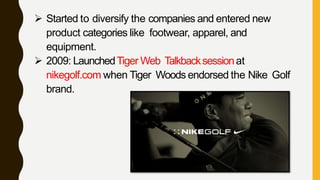
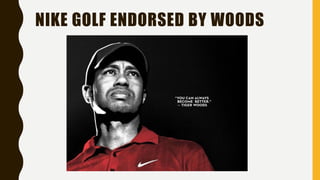
 2009: LaunchedTiger Web Talkbacksessionat
nikegolf.com when Tiger Woods endorsed the Nike Golf
brand.
NIKE GOLF ENDORSED BY WOODS
NIKE TENNIS
 Nike aligned with Tennis players Maria Sharapova, Roger
Federer,and Rafael Nadal to push its Tennis clothing and
sportsgear.
 2008WimbledonfinalbothNadalandFedererwasdressedheadto
toebyNike
2008 WIMBLEDON FINAL PICTURE
 Full head to toe
dressed by
Nike.
 Expert says “it
was a 5 hour
Nike show”
LIVESTRONG CAMPAIGN
 Also aligned with 7 times Tour de-France champion
Lance Armstrong, which alsohelped in Armstrong’s
LIVESTRONGcampaign.
 It was a campaign for cancer patients
 Nike sold 70 million yellow bracelets
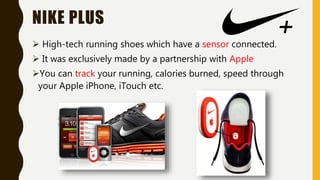
NIKE PLUS
 High-tech running shoes which have a sensor connected.
 It was exclusively made by a partnership with Apple
You can track your running, calories burned, speed through
your Apple iPhone, iTouch etc.
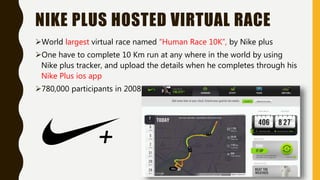
NIKE PLUS HOSTED VIRTUAL RACE
World largest virtual race named “Human Race 10K”, by Nike plus
One have to complete 10 Km run at any where in the world by using
Nike plus tracker, and upload the details when he completes through his
Nike Plus ios app
780,000 participants in 2008
SOME STATS ABOUT NIKE
•Nike has 31% market share globally
•50% market share in US
•In 2009 fiscal year it exceeds $19 billion
revenues
MARKETING STRATEGIES
Differentiated offering
Usingavariety of marketing communications mix
Brandpositioning, segmentation and targeting
Innovative technology
Celebrity Marketing: Pyramid of influence
Connecting people (Like Virtual Race)
Q&A
Q1. What are the pros, consand risksassociated with Nike’score marketing
strategy?
Nike believes in “pyramid of influence”, and it strategically positions itself and usescelebrity marketing asits core
marketing strategy to create its brandimage
Pros– Arepeatable model allows managersto refine skillsand systematize processes.Their clearly defined
audience target – athletes, sportsenthusiasts, well off and brand conscious customers– makesit easyfor them
to make target-centric ad campaigns. It represents emotions and promotes its brand asa brand of allegiance
and loyalty. It usesgeographic segmentation to promote its products andbrand.
However Nike has, always, only been about 1 thing; it only delivers a specifickind of product
Cons– It mainly focuseson producinghigh-products with cutting edge technology and sells them at competitive
prices. It doesnot communicate to the middle classand lower classsociety.
Risks– Intense competition and the influence of spokespersons posesa risk to their strategies.Alsoever
changing demandsand choicesof the consumers along with the international expansion posesa risk to their
strategies.
IF YOU WERE ADIDAS, HOW WOULD YOU
COMPETE WITH NIKE?
Ans:-The strategy for Adidas isto compete with Nike should be to target the areas
of their weakness. Adidas should look to better diversify their marketing strategy.
AlsoAdidas should aim to bring around the diversified products in market which
would further popularise among consumers directly through its goods. Investing the
increments in the profits to get some innovative and popular advertisements would
be the stupendous ground breaking product to get leverage in competing with Nike.
Adidas should focus on creating new products coming up with new strategies to
promote its brand. IT should bring a new ground breaking product into market to
trump Nike lead in the market.Adidas canalso look further to expand its reach to
other sports where Nike hasnot set its foot and look for attractive associations such
asthose of Nike with the Apple to bring out Nike+.
THANK
YOU !

Nike Case Study

  • 1.
    Nike Case Study Presentedby, Samanway Bera – 06 Debrudra Pal – 08 Sanjukta Banerjee – 11
  • 2.
     Nike wasoriginallyknown as Blue Ribbon Sports  It was founded by Philip Knight aimed at providing high quality shoes designed for athletes by athletes.
  • 3.
    • Founded in1962. • Started manufacturing shoes for runners at competitive prices. • 1985: Nike signed up basketball player, Michael Jordan asits spokesperson.
  • 4.
    • Air Jordanlineof basketball shoeswere released • 1988 : Nike aired the first ads in its $20 million “Just Do It” campaign. • Usedgeographic segmentation asthe key marketing strategy to promote its brandoverseas in Europe.
  • 5.
    1994: Nike sponsoredBrazilian team won the World Cup. Major breakthrough for thebrand when Brazilian team won.
  • 6.
    2007: Nike acquiredUMBRO, British maker of soccer related footwear, apparel and equipment.
  • 7.
    2008: In summerOlympics, at Beijing It sponsored several teamsand athletes and got permission to run Nike ads during the games. Sponsored mostoftheChinese teamsandUSAbasketball team
  • 8.
     Started todiversify the companies and entered new product categories like footwear, apparel, and equipment.  2009: LaunchedTiger Web Talkbacksessionat nikegolf.com when Tiger Woods endorsed the Nike Golf brand.
  • 9.
  • 10.
    NIKE TENNIS  Nikealigned with Tennis players Maria Sharapova, Roger Federer,and Rafael Nadal to push its Tennis clothing and sportsgear.  2008WimbledonfinalbothNadalandFedererwasdressedheadto toebyNike
  • 11.
    2008 WIMBLEDON FINALPICTURE  Full head to toe dressed by Nike.  Expert says “it was a 5 hour Nike show”
  • 12.
    LIVESTRONG CAMPAIGN  Alsoaligned with 7 times Tour de-France champion Lance Armstrong, which alsohelped in Armstrong’s LIVESTRONGcampaign.  It was a campaign for cancer patients  Nike sold 70 million yellow bracelets
  • 13.
    NIKE PLUS  High-techrunning shoes which have a sensor connected.  It was exclusively made by a partnership with Apple You can track your running, calories burned, speed through your Apple iPhone, iTouch etc.
  • 14.
    NIKE PLUS HOSTEDVIRTUAL RACE World largest virtual race named “Human Race 10K”, by Nike plus One have to complete 10 Km run at any where in the world by using Nike plus tracker, and upload the details when he completes through his Nike Plus ios app 780,000 participants in 2008
  • 15.
    SOME STATS ABOUTNIKE •Nike has 31% market share globally •50% market share in US •In 2009 fiscal year it exceeds $19 billion revenues
  • 16.
    MARKETING STRATEGIES Differentiated offering Usingavarietyof marketing communications mix Brandpositioning, segmentation and targeting Innovative technology Celebrity Marketing: Pyramid of influence Connecting people (Like Virtual Race)
  • 17.
    Q&A Q1. What arethe pros, consand risksassociated with Nike’score marketing strategy? Nike believes in “pyramid of influence”, and it strategically positions itself and usescelebrity marketing asits core marketing strategy to create its brandimage Pros– Arepeatable model allows managersto refine skillsand systematize processes.Their clearly defined audience target – athletes, sportsenthusiasts, well off and brand conscious customers– makesit easyfor them to make target-centric ad campaigns. It represents emotions and promotes its brand asa brand of allegiance and loyalty. It usesgeographic segmentation to promote its products andbrand. However Nike has, always, only been about 1 thing; it only delivers a specifickind of product Cons– It mainly focuseson producinghigh-products with cutting edge technology and sells them at competitive prices. It doesnot communicate to the middle classand lower classsociety. Risks– Intense competition and the influence of spokespersons posesa risk to their strategies.Alsoever changing demandsand choicesof the consumers along with the international expansion posesa risk to their strategies.
  • 18.
    IF YOU WEREADIDAS, HOW WOULD YOU COMPETE WITH NIKE? Ans:-The strategy for Adidas isto compete with Nike should be to target the areas of their weakness. Adidas should look to better diversify their marketing strategy. AlsoAdidas should aim to bring around the diversified products in market which would further popularise among consumers directly through its goods. Investing the increments in the profits to get some innovative and popular advertisements would be the stupendous ground breaking product to get leverage in competing with Nike. Adidas should focus on creating new products coming up with new strategies to promote its brand. IT should bring a new ground breaking product into market to trump Nike lead in the market.Adidas canalso look further to expand its reach to other sports where Nike hasnot set its foot and look for attractive associations such asthose of Nike with the Apple to bring out Nike+.
  • 19.