Nigeria and Schools
I


www.britishcouncil.org   1
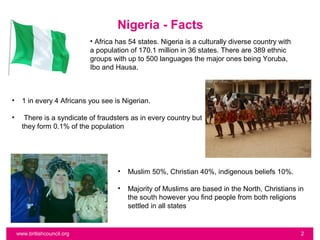
Nigeria - Facts
                             • Africa has 54 states. Nigeria is a culturally diverse country with
                             a population of 170.1 million in 36 states. There are 389 ethnic
                             groups with up to 500 languages the major ones being Yoruba,
                             Ibo and Hausa.


•     1 in every 4 Africans you see is Nigerian.

•      There is a syndicate of fraudsters as in every country but
      they form 0.1% of the population


                                      •   Muslim 50%, Christian 40%, indigenous beliefs 10%.

                                      •   Majority of Muslims are based in the North, Christians in
                                          the south however you find people from both religions
                                          settled in all states


    www.britishcouncil.org                                                                          2
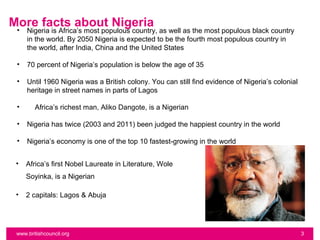
More facts about Nigeria
 •   Nigeria is Africa’s most populous country, as well as the most populous black country
     in the world. By 2050 Nigeria is expected to be the fourth most populous country in
     the world, after India, China and the United States

 •   70 percent of Nigeria’s population is below the age of 35

 •   Until 1960 Nigeria was a British colony. You can still find evidence of Nigeria’s colonial
     heritage in street names in parts of Lagos

 •      Africa’s richest man, Aliko Dangote, is a Nigerian

 •   Nigeria has twice (2003 and 2011) been judged the happiest country in the world

 •   Nigeria’s economy is one of the top 10 fastest-growing in the world


 •   Africa’s first Nobel Laureate in Literature, Wole
     Soyinka, is a Nigerian

 •   2 capitals: Lagos & Abuja


 www.britishcouncil.org                                                                           3
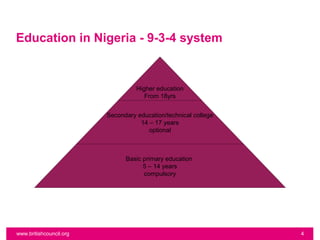
Education in Nigeria - 9-3-4 system


                                   Higher education
                                      From 18yrs
                                        optional
                         Secondary education/technical college
                                    14 – 17 years
                                       optional


                               Basic primary education
                                     5 – 14 years
                                     compulsory


www.britishcouncil.org                                           4
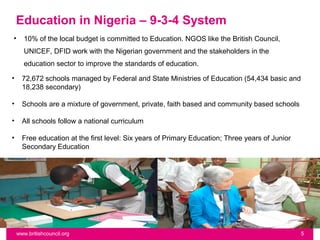
Education in Nigeria – 9-3-4 System
•      10% of the local budget is committed to Education. NGOS like the British Council,
       UNICEF, DFID work with the Nigerian government and the stakeholders in the
       education sector to improve the standards of education.

•     72,672 schools managed by Federal and State Ministries of Education (54,434 basic and
      18,238 secondary)

•     Schools are a mixture of government, private, faith based and community based schools

•     All schools follow a national curriculum

•     Free education at the first level: Six years of Primary Education; Three years of Junior
      Secondary Education


    www.britishcouncil.org                                                                       5
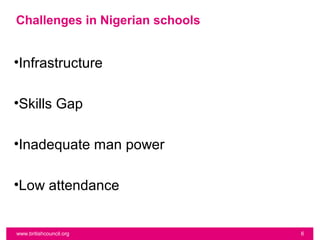
Challenges in Nigerian schools


•Infrastructure

•Skills Gap

•Inadequate man power

•Low attendance


www.britishcouncil.org           6
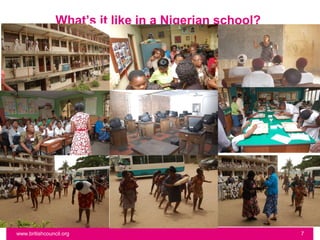
What’s it like in a Nigerian school?


www.britishcouncil.org                                 7
School Partnerships
Why?

•Cross cultural learning

•Global citizenship

•Professional Development for teachers

•Internationalising education

How do they work?

•Bilateral partnerships

•Trilateral partnerships

• If you have a bi-lateral partnership with an eligible country in Sub
Saharan Africa we would encourage you to include a new school from a
second African country through Connecting Classrooms.

www.britishcouncil.org                                                   8
Partnership opportunities – amend to partnership incl. themes
Connecting Classrooms Partnership Funding

Partner with a school in Nigeria through Connecting Classrooms for a travel grant of £1,500
per school to visit their partner. Nigeria is an eligible country to participate in the funding so
start completing your application today. The deadline is 9 November.


Opportunity to apply for the ISA Award
The International School Award is awarded to schools who demonstrate their
commitment to developing global citizens by embedding internationalism
throughout the ethos and curriculum of the school. Visit our website for more
information on how you can apply.

Connecting Classrooms Professional Development Courses
We are offering a range of online and face to face professional development
courses through Connecting Classrooms. We’ll be launching our face to face
courses in January 2013. For now, you can enrol in a range of online courses
through our Professional Learning Portal.


www.britishcouncil.org                                                                           9
Impact stories from existing partnerships
“Connecting classroom is the best thing that has ever happened to me. I can now
    boast of an improved output as a teacher.” Kola Oseh, Model secondary School
    Maitama.

‘Having the opportunity to mix with African’s has developed children’s empathy
    towards cultural differences. There’s also a better appreciation of the
    opportunities they have for their own education.’’ Jane English, Principal, PCSC


Partner with Nigeria through Connecting Classrooms School Partnerships

-   Apply by 9 November by visiting our website for more information

-   Sign up our online professional development courses through the Connecting
    Classrooms Professional Learning portal


www.britishcouncil.org                                                                 10

Nigeria powerpoint final

  • 1.
  • 2.
    Nigeria - Facts • Africa has 54 states. Nigeria is a culturally diverse country with a population of 170.1 million in 36 states. There are 389 ethnic groups with up to 500 languages the major ones being Yoruba, Ibo and Hausa. • 1 in every 4 Africans you see is Nigerian. • There is a syndicate of fraudsters as in every country but they form 0.1% of the population • Muslim 50%, Christian 40%, indigenous beliefs 10%. • Majority of Muslims are based in the North, Christians in the south however you find people from both religions settled in all states www.britishcouncil.org 2
  • 3.
    More facts aboutNigeria • Nigeria is Africa’s most populous country, as well as the most populous black country in the world. By 2050 Nigeria is expected to be the fourth most populous country in the world, after India, China and the United States • 70 percent of Nigeria’s population is below the age of 35 • Until 1960 Nigeria was a British colony. You can still find evidence of Nigeria’s colonial heritage in street names in parts of Lagos • Africa’s richest man, Aliko Dangote, is a Nigerian • Nigeria has twice (2003 and 2011) been judged the happiest country in the world • Nigeria’s economy is one of the top 10 fastest-growing in the world • Africa’s first Nobel Laureate in Literature, Wole Soyinka, is a Nigerian • 2 capitals: Lagos & Abuja www.britishcouncil.org 3
  • 4.
    Education in Nigeria- 9-3-4 system Higher education From 18yrs optional Secondary education/technical college 14 – 17 years optional Basic primary education 5 – 14 years compulsory www.britishcouncil.org 4
  • 5.
    Education in Nigeria– 9-3-4 System • 10% of the local budget is committed to Education. NGOS like the British Council, UNICEF, DFID work with the Nigerian government and the stakeholders in the education sector to improve the standards of education. • 72,672 schools managed by Federal and State Ministries of Education (54,434 basic and 18,238 secondary) • Schools are a mixture of government, private, faith based and community based schools • All schools follow a national curriculum • Free education at the first level: Six years of Primary Education; Three years of Junior Secondary Education www.britishcouncil.org 5
  • 6.
    Challenges in Nigerianschools •Infrastructure •Skills Gap •Inadequate man power •Low attendance www.britishcouncil.org 6
  • 7.
    What’s it likein a Nigerian school? www.britishcouncil.org 7
  • 8.
    School Partnerships Why? •Cross culturallearning •Global citizenship •Professional Development for teachers •Internationalising education How do they work? •Bilateral partnerships •Trilateral partnerships • If you have a bi-lateral partnership with an eligible country in Sub Saharan Africa we would encourage you to include a new school from a second African country through Connecting Classrooms. www.britishcouncil.org 8
  • 9.
    Partnership opportunities –amend to partnership incl. themes Connecting Classrooms Partnership Funding Partner with a school in Nigeria through Connecting Classrooms for a travel grant of £1,500 per school to visit their partner. Nigeria is an eligible country to participate in the funding so start completing your application today. The deadline is 9 November. Opportunity to apply for the ISA Award The International School Award is awarded to schools who demonstrate their commitment to developing global citizens by embedding internationalism throughout the ethos and curriculum of the school. Visit our website for more information on how you can apply. Connecting Classrooms Professional Development Courses We are offering a range of online and face to face professional development courses through Connecting Classrooms. We’ll be launching our face to face courses in January 2013. For now, you can enrol in a range of online courses through our Professional Learning Portal. www.britishcouncil.org 9
  • 10.
    Impact stories fromexisting partnerships “Connecting classroom is the best thing that has ever happened to me. I can now boast of an improved output as a teacher.” Kola Oseh, Model secondary School Maitama. ‘Having the opportunity to mix with African’s has developed children’s empathy towards cultural differences. There’s also a better appreciation of the opportunities they have for their own education.’’ Jane English, Principal, PCSC Partner with Nigeria through Connecting Classrooms School Partnerships - Apply by 9 November by visiting our website for more information - Sign up our online professional development courses through the Connecting Classrooms Professional Learning portal www.britishcouncil.org 10