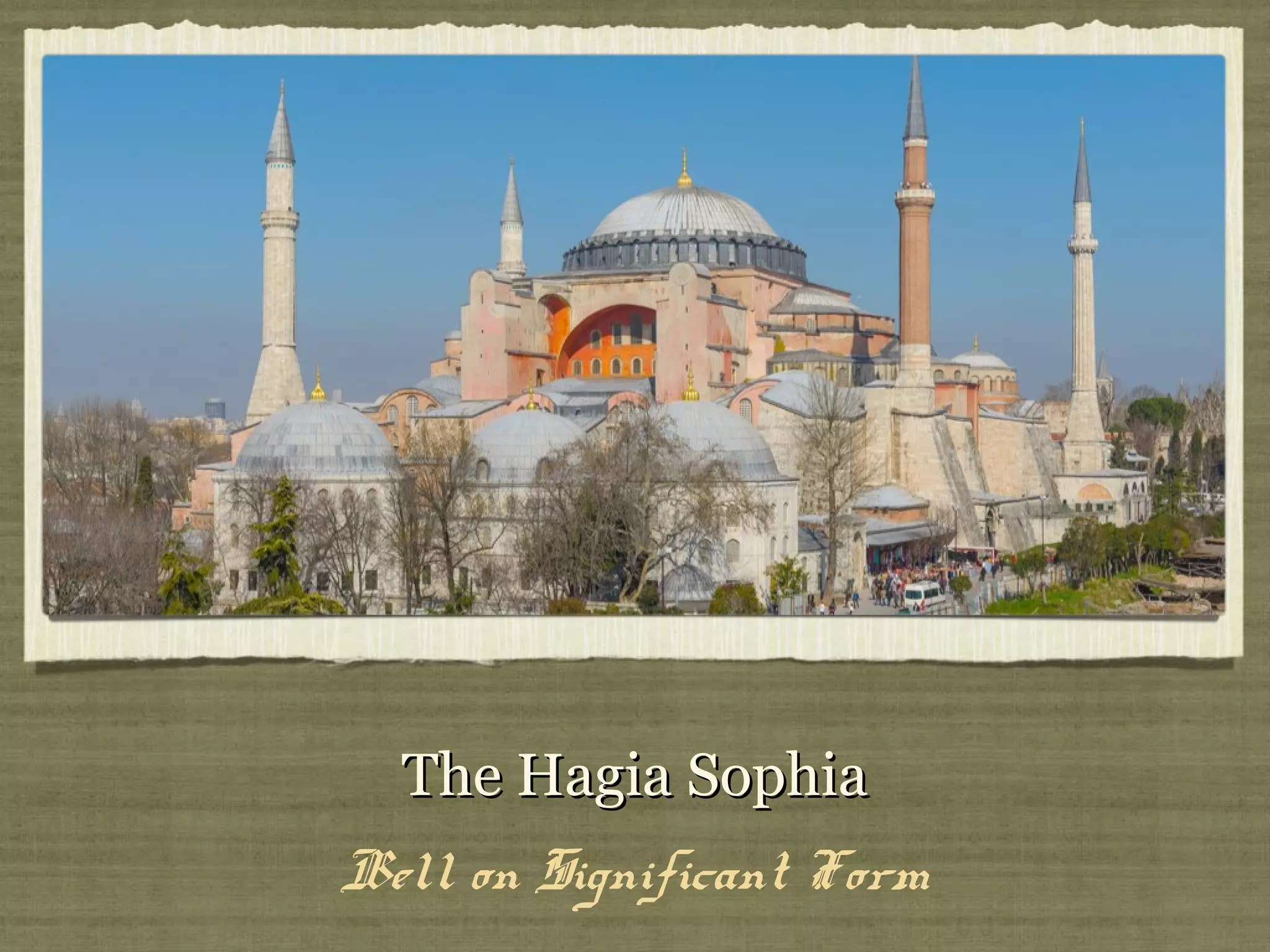
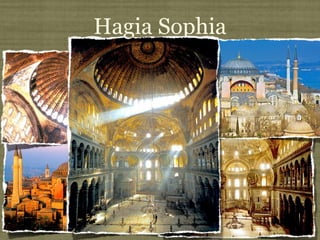
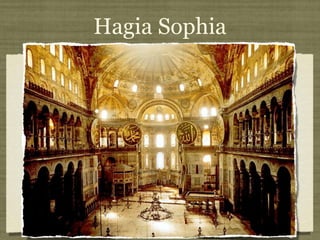
The Hagia SophiaThe Hagia Sophia
Bell on Significant Form
Art is significant form causedArt is significant form caused
by the Aesthetic emotionby the Aesthetic emotion
Bell, Art
That there is a particular kind of emotion provoked by works of visual art,
and that this emotion is provoked by every kind of visual art, by pictures,
sculptures, buildings, pots, carvings, textiles, &c., &c., is not disputed, I think,
by anyone capable of feeling it. This emotion is called the aesthetic emotion;
and if we can discover some quality common and peculiar to all the objects
that provoke it, we shall have solved what I take to be the central problem of
aesthetics.
Bell, Art
...it is useless for a critic to tell me that something is a work
of art; he must make me feel it for myself. This he can do
only by making me see; he must get at my emotions through
my eyes. Unless he can make me see something that moves
me, he cannot force my emotions.
Bell, Art
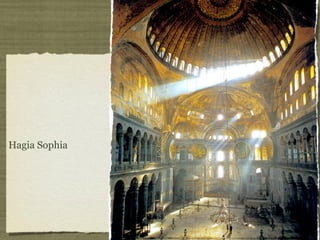
Hagia Sophia
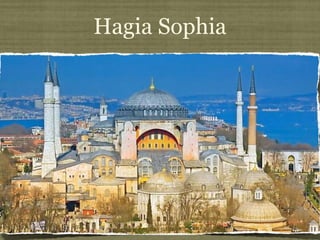
Hagia Sophia
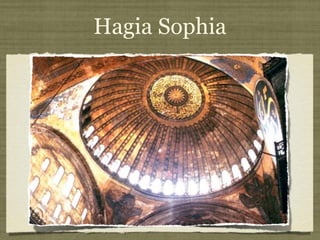
Hagia Sophia
Hagia Sophia
Hagia Sophia
Hagia Sophia
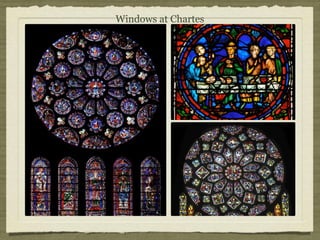
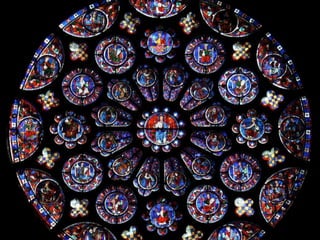
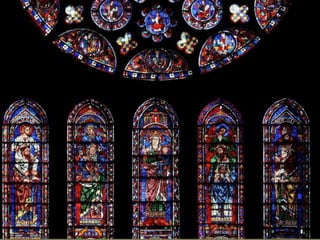
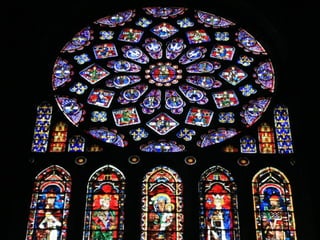
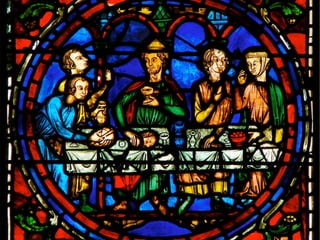
Windows at Chartes
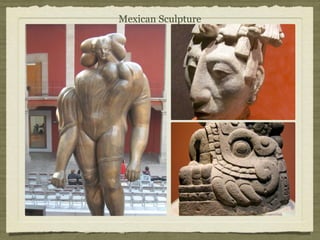
Mexican Sculpture
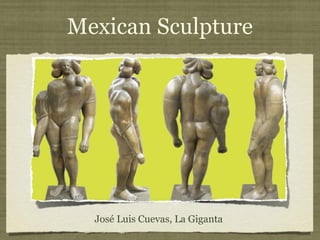
Mexican Sculpture
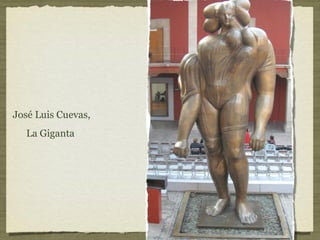
José Luis Cuevas, La Giganta
José Luis Cuevas,
La Giganta
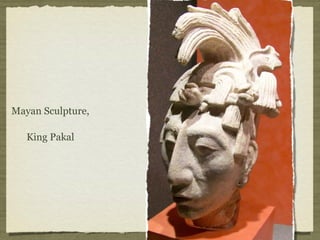
Mayan Sculpture,
King Pakal
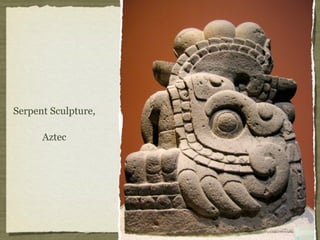
Serpent Sculpture,
Aztec
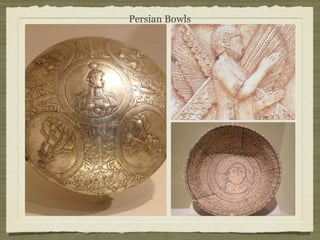
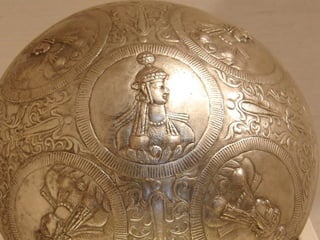
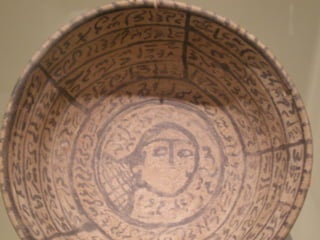
Persian Bowls
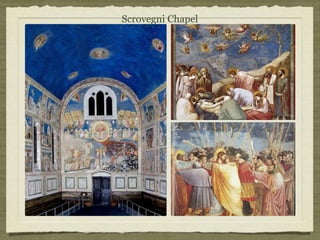
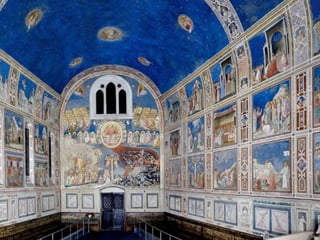
Scrovegni Chapel
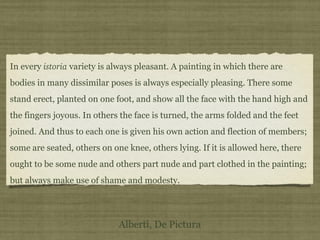
In every istoria variety is always pleasant. A painting in which there are
bodies in many dissimilar poses is always especially pleasing. There some
stand erect, planted on one foot, and show all the face with the hand high and
the fingers joyous. In others the face is turned, the arms folded and the feet
joined. And thus to each one is given his own action and flection of members;
some are seated, others on one knee, others lying. If it is allowed here, there
ought to be some nude and others part nude and part clothed in the painting;
but always make use of shame and modesty.
Alberti, De Pictura
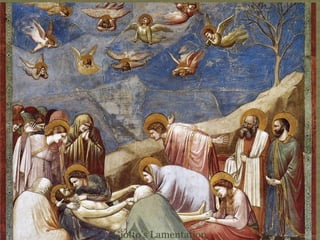
Giotto’s Lamentation
Thus I desire, as I have said, that modesty and truth should be used in every
istoria . For this reason be careful not to repeat the same gesture or pose. The
istoria will move the soul of the beholder when each man painted there clearly
shows the movement of his own soul. It happens in nature that nothing more
than herself is found capable of things like herself; [Cicero, De amicitia, xiv,
50] we weep with the weeping, laugh with the laughing, and grieve with the
grieving.
Alberti, De Pictura
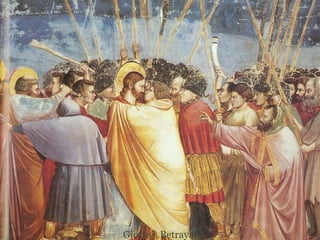
Giotto’s Betrayal
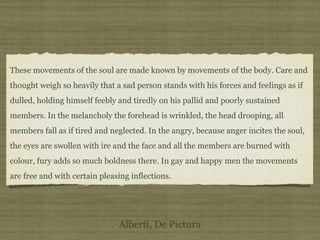
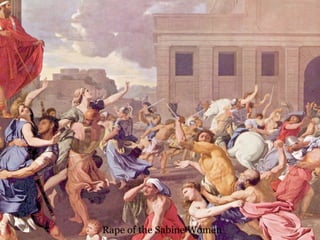
These movements of the soul are made known by movements of the body. Care and
thought weigh so heavily that a sad person stands with his forces and feelings as if
dulled, holding himself feebly and tiredly on his pallid and poorly sustained
members. In the melancholy the forehead is wrinkled, the head drooping, all
members fall as if tired and neglected. In the angry, because anger incites the soul,
the eyes are swollen with ire and the face and all the members are burned with
colour, fury adds so much boldness there. In gay and happy men the movements
are free and with certain pleasing inflections.
Alberti, De Pictura
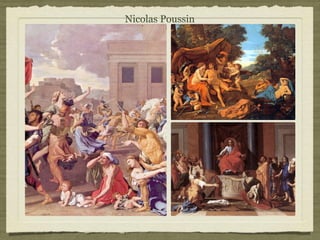
Nicolas Poussin
Rape of the Sabine Women
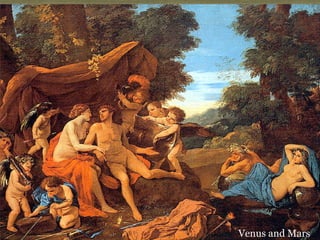
Venus and Mars
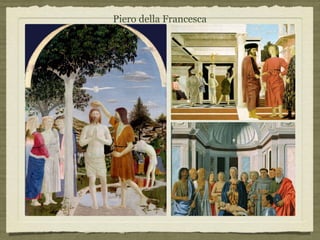
Piero della Francesca
Baptism of
Christ
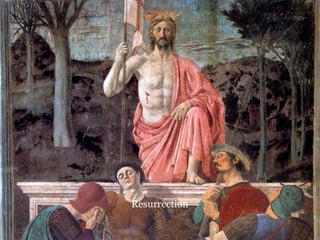
Resurrection
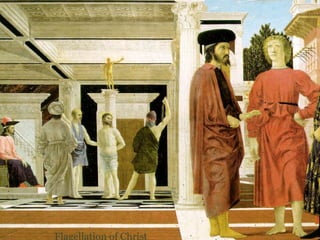
Flagellation of Christ
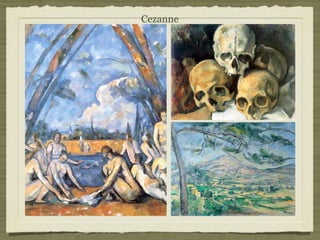
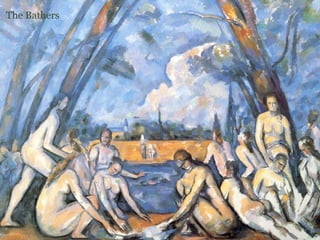
Cezanne
The Bathers
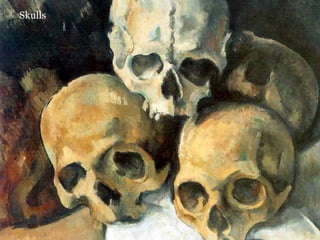
Skulls
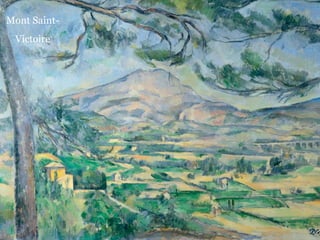
Mont Saint-
Victoire
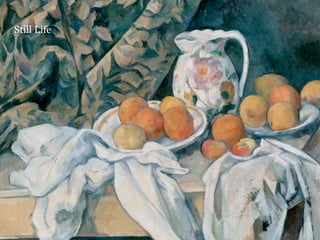
Still Life
My immediate object will be to show that significant form is the
only quality common and peculiar to all the works of visual art that
move me; and I will ask those whose aesthetic experience does not
tally with mine to see whether this quality is not also, in their
judgment, common to all works that move them, and whether they
can discover any other quality of which the same can be said.
Bell, Art

160 Slides for Bell

  • 1.
    The Hagia SophiaTheHagia Sophia Bell on Significant Form
  • 2.
    Art is significantform causedArt is significant form caused by the Aesthetic emotionby the Aesthetic emotion Bell, Art
  • 3.
    That there isa particular kind of emotion provoked by works of visual art, and that this emotion is provoked by every kind of visual art, by pictures, sculptures, buildings, pots, carvings, textiles, &c., &c., is not disputed, I think, by anyone capable of feeling it. This emotion is called the aesthetic emotion; and if we can discover some quality common and peculiar to all the objects that provoke it, we shall have solved what I take to be the central problem of aesthetics. Bell, Art
  • 4.
    ...it is uselessfor a critic to tell me that something is a work of art; he must make me feel it for myself. This he can do only by making me see; he must get at my emotions through my eyes. Unless he can make me see something that moves me, he cannot force my emotions. Bell, Art
  • 5.
  • 6.
  • 7.
  • 8.
  • 9.
  • 10.
  • 11.
  • 16.
  • 17.
    Mexican Sculpture José LuisCuevas, La Giganta
  • 18.
  • 19.
  • 20.
  • 21.
  • 25.
  • 26.
    In every istoriavariety is always pleasant. A painting in which there are bodies in many dissimilar poses is always especially pleasing. There some stand erect, planted on one foot, and show all the face with the hand high and the fingers joyous. In others the face is turned, the arms folded and the feet joined. And thus to each one is given his own action and flection of members; some are seated, others on one knee, others lying. If it is allowed here, there ought to be some nude and others part nude and part clothed in the painting; but always make use of shame and modesty. Alberti, De Pictura
  • 28.
  • 29.
    Thus I desire,as I have said, that modesty and truth should be used in every istoria . For this reason be careful not to repeat the same gesture or pose. The istoria will move the soul of the beholder when each man painted there clearly shows the movement of his own soul. It happens in nature that nothing more than herself is found capable of things like herself; [Cicero, De amicitia, xiv, 50] we weep with the weeping, laugh with the laughing, and grieve with the grieving. Alberti, De Pictura
  • 30.
  • 31.
    These movements ofthe soul are made known by movements of the body. Care and thought weigh so heavily that a sad person stands with his forces and feelings as if dulled, holding himself feebly and tiredly on his pallid and poorly sustained members. In the melancholy the forehead is wrinkled, the head drooping, all members fall as if tired and neglected. In the angry, because anger incites the soul, the eyes are swollen with ire and the face and all the members are burned with colour, fury adds so much boldness there. In gay and happy men the movements are free and with certain pleasing inflections. Alberti, De Pictura
  • 32.
  • 33.
    Rape of theSabine Women
  • 34.
  • 36.
  • 37.
  • 38.
  • 39.
  • 40.
  • 41.
  • 42.
  • 43.
  • 44.
  • 45.
    My immediate objectwill be to show that significant form is the only quality common and peculiar to all the works of visual art that move me; and I will ask those whose aesthetic experience does not tally with mine to see whether this quality is not also, in their judgment, common to all works that move them, and whether they can discover any other quality of which the same can be said. Bell, Art