london | boston | new york
corfinancial.with
coffee
Mar 2016 | London | 07 |
© Cor Financial Solutions Limited
2 minute guide
Getting ready for
MiFID II
MiFID looked to strengthen financial markets
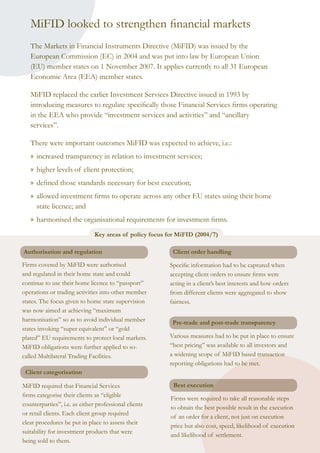
The Markets in Financial Instruments Directive (MiFID) was issued by the
European Commission (EC) in 2004 and was put into law by European Union
(EU) member states on 1 November 2007. It applies currently to all 31 European
Economic Area (EEA) member states.
MiFID replaced the earlier Investment Services Directive issued in 1993 by
introducing measures to regulate specifically those Financial Services firms operating
in the EEA who provide “investment services and activities” and “ancillary
services”.
There were important outcomes MiFID was expected to achieve, i.e.:
»» increased transparency in relation to investment services;
»» higher levels of client protection;
»» defined those standards necessary for best execution;
»» allowed investment firms to operate across any other EU states using their home
state licence; and
»» harmonised the organisational requirements for investment firms.
Client categorisation
Firms covered by MiFID were authorised
and regulated in their home state and could
continue to use their home licence to “passport”
operations or trading activities into other member
states. The focus given to home state supervision
was now aimed at achieving “maximum
harmonisation” so as to avoid individual member
states invoking “super equivalent” or “gold
plated” EU requirements to protect local markets.
MiFID obligations were further applied to so-
called Multilateral Trading Facilities.
MiFID required that Financial Services
firms categorise their clients as “eligible
counterparties”, i.e. as either professional clients
or retail clients. Each client group required
clear procedures be put in place to assess their
suitability for investment products that were
being sold to them.
Specific information had to be captured when
accepting client orders to ensure firms were
acting in a client’s best interests and how orders
from different clients were aggregated to show
fairness.
Various measures had to be put in place to ensure
“best pricing” was available to all investors and
a widening scope of MiFID based transaction
reporting obligations had to be met.
Firms were required to take all reasonable steps
to obtain the best possible result in the execution
of an order for a client, not just on execution
price but also cost, speed, likelihood of execution
and likelihood of settlement.
Authorisation and regulation Client order handling
Pre-trade and post-trade transparency
Best execution
Key areas of policy focus for MiFID (2004/7)
pg
2/3.
MiFID II looks to go further
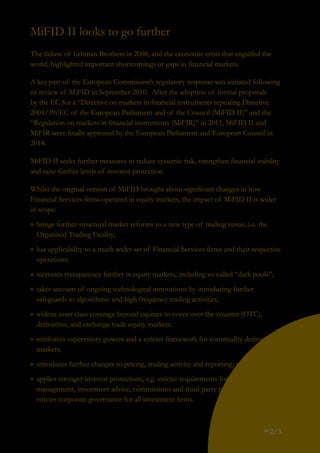
The failure of Lehman Brothers in 2008, and the economic crisis that engulfed the
world, highlighted important shortcomings or gaps in financial markets.
A key part of the European Commission’s regulatory response was initiated following
its review of MiFID in September 2010. After the adoption of formal proposals
by the EC for a “Directive on markets in financial instruments repealing Directive
2004/39/EC of the European Parliament and of the Council (MiFID II)” and the
“Regulation on markets in financial instruments (MiFIR)” in 2011, MiFID II and
MiFIR were finally approved by the European Parliament and European Council in
2014.
MiFID II seeks further measures to reduce systemic risk, strengthen financial stability
and raise further levels of investor protection.
Whilst the original version of MiFID brought about significant changes in how
Financial Services firms operated in equity markets, the impact of MiFID II is wider
in scope:
»» brings further structural market reforms to a new type of trading venue, i.e. the
Organised Trading Facility;
»» has applicability to a much wider set of Financial Services firms and their respective
operations;
»» increases transparency further in equity markets, including so-called “dark pools”;
»» takes account of ongoing technological innovations by introducing further
safeguards to algorithmic and high frequency trading activities;
»» widens asset class coverage beyond equities to cover over-the-counter (OTC),
derivatives, and exchange trade equity markets;
»» reinforces supervisory powers and a stricter framework for commodity derivatives
markets;
»» introduces further changes to pricing, trading activity and reporting; and
»» applies stronger investor protections, e.g. stricter requirements for portfolio
management, investment advice, commissions and third-party payments, and
stricter corporate governance for all investment firms.
many more Financial Services firms will have
MiFID II obligations
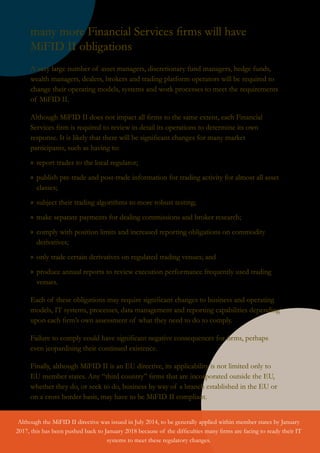
A very large number of asset managers, discretionary fund managers, hedge funds,
wealth managers, dealers, brokers and trading platform operators will be required to
change their operating models, systems and work processes to meet the requirements
of MiFID II.
Although MiFID II does not impact all firms to the same extent, each Financial
Services firm is required to review in detail its operations to determine its own
response. It is likely that there will be significant changes for many market
participants, such as having to:
»» report trades to the local regulator;
»» publish pre-trade and post-trade information for trading activity for almost all asset
classes;
»» subject their trading algorithms to more robust testing;
»» make separate payments for dealing commissions and broker research;
»» comply with position limits and increased reporting obligations on commodity
derivatives;
»» only trade certain derivatives on regulated trading venues; and
»» produce annual reports to review execution performance frequently used trading
venues.
Each of these obligations may require significant changes to business and operating
models, IT systems, processes, data management and reporting capabilities depending
upon each firm’s own assessment of what they need to do to comply.
Failure to comply could have significant negative consequences for firms, perhaps
even jeopardising their continued existence.
Finally, although MiFID II is an EU directive, its applicability is not limited only to
EU member states. Any “third country” firms that are incorporated outside the EU,
whether they do, or seek to do, business by way of a branch established in the EU or
on a cross border basis, may have to be MiFID II compliant.
pg
3/3.
Although the MiFID II directive was issued in July 2014, to be generally applied within member states by January
2017, this has been pushed back to January 2018 because of the difficulties many firms are facing to ready their IT
systems to meet these regulatory changes.

Getting ready for MiFID II

  • 1.
    london | boston| new york corfinancial.with coffee Mar 2016 | London | 07 | © Cor Financial Solutions Limited 2 minute guide Getting ready for MiFID II
  • 2.
    MiFID looked tostrengthen financial markets The Markets in Financial Instruments Directive (MiFID) was issued by the European Commission (EC) in 2004 and was put into law by European Union (EU) member states on 1 November 2007. It applies currently to all 31 European Economic Area (EEA) member states. MiFID replaced the earlier Investment Services Directive issued in 1993 by introducing measures to regulate specifically those Financial Services firms operating in the EEA who provide “investment services and activities” and “ancillary services”. There were important outcomes MiFID was expected to achieve, i.e.: »» increased transparency in relation to investment services; »» higher levels of client protection; »» defined those standards necessary for best execution; »» allowed investment firms to operate across any other EU states using their home state licence; and »» harmonised the organisational requirements for investment firms. Client categorisation Firms covered by MiFID were authorised and regulated in their home state and could continue to use their home licence to “passport” operations or trading activities into other member states. The focus given to home state supervision was now aimed at achieving “maximum harmonisation” so as to avoid individual member states invoking “super equivalent” or “gold plated” EU requirements to protect local markets. MiFID obligations were further applied to so- called Multilateral Trading Facilities. MiFID required that Financial Services firms categorise their clients as “eligible counterparties”, i.e. as either professional clients or retail clients. Each client group required clear procedures be put in place to assess their suitability for investment products that were being sold to them. Specific information had to be captured when accepting client orders to ensure firms were acting in a client’s best interests and how orders from different clients were aggregated to show fairness. Various measures had to be put in place to ensure “best pricing” was available to all investors and a widening scope of MiFID based transaction reporting obligations had to be met. Firms were required to take all reasonable steps to obtain the best possible result in the execution of an order for a client, not just on execution price but also cost, speed, likelihood of execution and likelihood of settlement. Authorisation and regulation Client order handling Pre-trade and post-trade transparency Best execution Key areas of policy focus for MiFID (2004/7)
  • 3.
    pg 2/3. MiFID II looksto go further The failure of Lehman Brothers in 2008, and the economic crisis that engulfed the world, highlighted important shortcomings or gaps in financial markets. A key part of the European Commission’s regulatory response was initiated following its review of MiFID in September 2010. After the adoption of formal proposals by the EC for a “Directive on markets in financial instruments repealing Directive 2004/39/EC of the European Parliament and of the Council (MiFID II)” and the “Regulation on markets in financial instruments (MiFIR)” in 2011, MiFID II and MiFIR were finally approved by the European Parliament and European Council in 2014. MiFID II seeks further measures to reduce systemic risk, strengthen financial stability and raise further levels of investor protection. Whilst the original version of MiFID brought about significant changes in how Financial Services firms operated in equity markets, the impact of MiFID II is wider in scope: »» brings further structural market reforms to a new type of trading venue, i.e. the Organised Trading Facility; »» has applicability to a much wider set of Financial Services firms and their respective operations; »» increases transparency further in equity markets, including so-called “dark pools”; »» takes account of ongoing technological innovations by introducing further safeguards to algorithmic and high frequency trading activities; »» widens asset class coverage beyond equities to cover over-the-counter (OTC), derivatives, and exchange trade equity markets; »» reinforces supervisory powers and a stricter framework for commodity derivatives markets; »» introduces further changes to pricing, trading activity and reporting; and »» applies stronger investor protections, e.g. stricter requirements for portfolio management, investment advice, commissions and third-party payments, and stricter corporate governance for all investment firms.
  • 4.
    many more FinancialServices firms will have MiFID II obligations A very large number of asset managers, discretionary fund managers, hedge funds, wealth managers, dealers, brokers and trading platform operators will be required to change their operating models, systems and work processes to meet the requirements of MiFID II. Although MiFID II does not impact all firms to the same extent, each Financial Services firm is required to review in detail its operations to determine its own response. It is likely that there will be significant changes for many market participants, such as having to: »» report trades to the local regulator; »» publish pre-trade and post-trade information for trading activity for almost all asset classes; »» subject their trading algorithms to more robust testing; »» make separate payments for dealing commissions and broker research; »» comply with position limits and increased reporting obligations on commodity derivatives; »» only trade certain derivatives on regulated trading venues; and »» produce annual reports to review execution performance frequently used trading venues. Each of these obligations may require significant changes to business and operating models, IT systems, processes, data management and reporting capabilities depending upon each firm’s own assessment of what they need to do to comply. Failure to comply could have significant negative consequences for firms, perhaps even jeopardising their continued existence. Finally, although MiFID II is an EU directive, its applicability is not limited only to EU member states. Any “third country” firms that are incorporated outside the EU, whether they do, or seek to do, business by way of a branch established in the EU or on a cross border basis, may have to be MiFID II compliant. pg 3/3. Although the MiFID II directive was issued in July 2014, to be generally applied within member states by January 2017, this has been pushed back to January 2018 because of the difficulties many firms are facing to ready their IT systems to meet these regulatory changes.