

FIELD EXPERIENCE
        Nicole Palmer
    EDU341 Positive Discipline
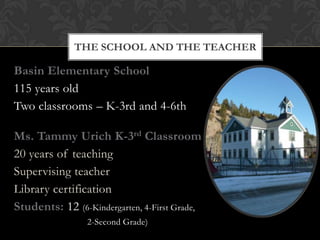
THE SCHOOL AND THE TEACHER

Basin Elementary School
115 years old
Two classrooms – K-3rd and 4-6th

Ms. Tammy Urich K-3rd Classroom
20 years of teaching
Supervising teacher
Library certification
Students: 12 (6-Kindergarten, 4-First Grade,
                 2-Second Grade)
TEACHER LED INSTRUCTION


         Lecture                       Discussion
• Ms. Urich meets with each     • Discussions that take place
  grade of students in the        around the front table in
  morning to go over reading,     grade level groups are used
  vocabulary, spelling and        most often for reading and
  math assignments.               math.
• In the afternoon the whole    • Discussion is also used
  room meets for science,         during read aloud time after
  social studies or art           lunch and for science and
  (Fridays).                      social studies.
GROUP ACTIVITIES

•   Calendar/Pledge
•   News
•   Show and Tell (Fridays)
•   Library
•   Computer Lab
•   Music
•   P.E.
•   Art
•   Read Aloud Time
SEAT WORK
Because of the need for the teacher to have time to work with
individuals and groups, the students do a lot of seat work on their
own. The teacher meets with each grade at least three times each
week to go over seat work assignments. Younger students can ask
older students for help if needed.
• Handwriting
• Vocabulary
• Spelling
• Reading
• Math
EFFECTIVE METHODS

Having set procedures in place
•     Showing two fingers to go to the restroom
•     Holding up a pencil if they need to sharpen
•     Waiting patiently and working on other work when teacher is
         instructions to other classes
Using proven teaching resources
• text books, text sets, big books, practice work
Using a set routine
Classroom Displays
• Bulletin boards, word walls, letter and number strips and courtesy
   reminders posted around the room.
Peer tutoring from older students
Working with partners
Modeling and Scaffolding
TEACHING METHODS

                                      Master y
Guided Questioning
                                     Mastery is assessed by individual
                                     work and group projects. The
This method is most often used       students do spend a lot of time at
during group discussion, or when     their desks doing worksheets and
a student has a question about his   individual work so that the teacher
or her assignment. Ms. Urich is      has time to work with the other
very good at having them really      grade levels.
think about their work, and not
just giving them the answers         Games
(which some of them want her to      Educational games, puzzles and
do!)                                 books are available to students to
                                     practice skills when they have
                                     finished their desk work.
CO-TEACHING


Working with different grade levels:
Ms. Urich worked with a grade level at the front table and I worked with
individual students at the back of the room.
Both of us worked with a different reading, math or science group.

Working together on projects:
We did two integrated science and art projects. Taking turns with leading
the discussion and asking guided questions while assisting the students
with their art projects on spiders, and the human skeleton. While she
showed students a website about spiders I helped some students assemble
their spiders. While I talked about the bones in the human body, she
assisted students in putting their skeleton together.
INTERVENTIONS

Warning
• Students are given one or two warnings to focus or stop behaviors
Head down on desk
• If behavior is very distracting, loud or very inappropriate they have to put
  their head down on their desk.
Name on board
• After other interventions have not worked the student’s name will be put
  on the board. This usually means that they will owe the teacher five
  minutes of recess time. If checks are put by the name additional time will
  be owed.
Behavior that is harmful to others
• If a student hurts another student they may lose multiple recesses and
  spend them in the classroom with their head down, or writing an apology
  note. Parents may be contacted.
OBSERVATIONS

               Te a c h e r                                Me
Seemed to work :                          Seemed to work:
• Having set procedures and a set         • Following the set procedures and
   schedule                                  schedule
• Using a signal to use the restroom      • Positive reinforcement of good
   and sharpen pencils                       behavior, constructive feedback.
• Using a “just a minute” signal to let   • Reminders of what should be
   students know she would be there          happening and to focus on work.
   to help shortly.
                                          • Putting their head down if they
• Putting their head down to stop            were really getting out of control
   misbehavior
• Losing recess time
                                          • Losing recess time.
Seemed to work short term:                Seemed to work short term:
• Warnings                                • Warning more than once
Reflection:
Overall I was impressed with how the school and
classroom were run. Personally I would want to
figure out a way that the students would not
have to spend so much time at their desks.
However, with a multi-grade room this is very
challenging because as a teacher you need time
to spend with each grade while the others are
occupied quietly. I did notice that it was very
hard for some of the kindergarten students to sit
for that long in their seats. I did not like having
students put their head down, or lose recess time,
I think I would make an effort to come up with a
more positive discipline plan. However, this is
what the students are used to and it wasn’t my

Nicole field experience1

  • 1.
    FIELD EXPERIENCE Nicole Palmer EDU341 Positive Discipline
  • 2.
    THE SCHOOL ANDTHE TEACHER Basin Elementary School 115 years old Two classrooms – K-3rd and 4-6th Ms. Tammy Urich K-3rd Classroom 20 years of teaching Supervising teacher Library certification Students: 12 (6-Kindergarten, 4-First Grade, 2-Second Grade)
  • 3.
    TEACHER LED INSTRUCTION Lecture Discussion • Ms. Urich meets with each • Discussions that take place grade of students in the around the front table in morning to go over reading, grade level groups are used vocabulary, spelling and most often for reading and math assignments. math. • In the afternoon the whole • Discussion is also used room meets for science, during read aloud time after social studies or art lunch and for science and (Fridays). social studies.
  • 4.
    GROUP ACTIVITIES • Calendar/Pledge • News • Show and Tell (Fridays) • Library • Computer Lab • Music • P.E. • Art • Read Aloud Time
  • 5.
    SEAT WORK Because ofthe need for the teacher to have time to work with individuals and groups, the students do a lot of seat work on their own. The teacher meets with each grade at least three times each week to go over seat work assignments. Younger students can ask older students for help if needed. • Handwriting • Vocabulary • Spelling • Reading • Math
  • 6.
    EFFECTIVE METHODS Having setprocedures in place • Showing two fingers to go to the restroom • Holding up a pencil if they need to sharpen • Waiting patiently and working on other work when teacher is instructions to other classes Using proven teaching resources • text books, text sets, big books, practice work Using a set routine Classroom Displays • Bulletin boards, word walls, letter and number strips and courtesy reminders posted around the room. Peer tutoring from older students Working with partners Modeling and Scaffolding
  • 7.
    TEACHING METHODS Master y Guided Questioning Mastery is assessed by individual work and group projects. The This method is most often used students do spend a lot of time at during group discussion, or when their desks doing worksheets and a student has a question about his individual work so that the teacher or her assignment. Ms. Urich is has time to work with the other very good at having them really grade levels. think about their work, and not just giving them the answers Games (which some of them want her to Educational games, puzzles and do!) books are available to students to practice skills when they have finished their desk work.
  • 8.
    CO-TEACHING Working with differentgrade levels: Ms. Urich worked with a grade level at the front table and I worked with individual students at the back of the room. Both of us worked with a different reading, math or science group. Working together on projects: We did two integrated science and art projects. Taking turns with leading the discussion and asking guided questions while assisting the students with their art projects on spiders, and the human skeleton. While she showed students a website about spiders I helped some students assemble their spiders. While I talked about the bones in the human body, she assisted students in putting their skeleton together.
  • 9.
    INTERVENTIONS Warning • Students aregiven one or two warnings to focus or stop behaviors Head down on desk • If behavior is very distracting, loud or very inappropriate they have to put their head down on their desk. Name on board • After other interventions have not worked the student’s name will be put on the board. This usually means that they will owe the teacher five minutes of recess time. If checks are put by the name additional time will be owed. Behavior that is harmful to others • If a student hurts another student they may lose multiple recesses and spend them in the classroom with their head down, or writing an apology note. Parents may be contacted.
  • 10.
    OBSERVATIONS Te a c h e r Me Seemed to work : Seemed to work: • Having set procedures and a set • Following the set procedures and schedule schedule • Using a signal to use the restroom • Positive reinforcement of good and sharpen pencils behavior, constructive feedback. • Using a “just a minute” signal to let • Reminders of what should be students know she would be there happening and to focus on work. to help shortly. • Putting their head down if they • Putting their head down to stop were really getting out of control misbehavior • Losing recess time • Losing recess time. Seemed to work short term: Seemed to work short term: • Warnings • Warning more than once
  • 11.
    Reflection: Overall I wasimpressed with how the school and classroom were run. Personally I would want to figure out a way that the students would not have to spend so much time at their desks. However, with a multi-grade room this is very challenging because as a teacher you need time to spend with each grade while the others are occupied quietly. I did notice that it was very hard for some of the kindergarten students to sit for that long in their seats. I did not like having students put their head down, or lose recess time, I think I would make an effort to come up with a more positive discipline plan. However, this is what the students are used to and it wasn’t my