Підддддддддддддддддддддддддддддддддддддручниккккккккккккк дддддддддддддддддддддддддддддддддддллллллллллллллллллллллллляяяяяяяяяяяяяяяя 111111110 ккккккккккккккккккккллллллллллллллллллласу
загаллллллллллллллльььььььььььььььноосвввввввввввввввввввітннннннннннннннніііііііііііііііііхххххххххххх навчаааааааааалллллллллллллллллььььььььььььььних закладів
(9-й рік навчання)
Профільний рівень
Рекомендовано
Міністерством
освіти і науки
України
Київ
«Генеза»
2010
3
Dорогі десятикласники!
Ви тримаєте в руках підручник для профільного вивчення англій-
ської мови. Він допоможе вам розвинути ваші мовні й мовленнєві на-
вички та вміння, отримані на попередніх етапах навчання.
Підручник складається зі вступу (Introduction) та восьми розділів
(Units) основного курсу. Кожен з них присвячений темам, які вивча-
ються за програмою з іноземних мов. Розділи поділяються на уроки,
щовисвітлюютьокреміаспектиосновноїтеми.Працюючинадматеріа-
лом уроків, приділяйте увагу вивченню нових лексичних одиниць,
які подані в таблиці “Vocabulary File”. Учіться пояснювати значення
слів англійською мовою, використовуючи при цьому вивчені раніше
слова. Працюючи над граматичним матеріалом у рубриці “Grammar
Lab”, звертайте увагу на використання граматичних форм у ситуаціях
спілкування.
Рубрики “Listening Lab”, “Reading Lab”, “Conversation Lab”,
“Writing Lab” присвячені розвитку вмінь з чотирьох видів мовленнє-
вої діяльності (аудіювання, читання, говоріння та письма) та пропо-
нують завдання в сучасному форматі. У кожному розділі подано реко-
мендації щодо виконання різних видів письмових завдань (“Writing
Lab”) та виконання проектних завдань (“Project Work”). Працювати
над проектами розпочинайте на початку вивчення розділу. Оберіть
тему, розподіліть ролі у групі, обговоріть зібраний матеріал. Мета під-
готовки проекту – якомога більше спілкуватися іноземною мовою, що
вивчається, тому в процесі роботи використовуйте англійську мову
при обговоренні зібраних матеріалів та спілкуванні з товаришами. До
кожної теми представлено два проекти на вибір, один з них (Project B)
пов’язаний з лінгвістичним дослідженням.
Також у підручник включено рубрику “English Beyond the
Classroom”, в якій запропоновано завдання на спостереження за ан-
глійською мовою, пошук автентичних зразків мовлення, використан-
ня вивченого в нових ситуаціях.
4
Останні уроки кожного розділу допоможуть вам узагальнити ви-
вчене з теми. Тестові завдання, включені в них, подані в сучасному
форматі та спрямовані на розвиток ваших умінь з аудіювання, читан-
ня, говоріння та письма.
Підручник також містить додатки. Це граматичний довідник та
тексти аудіозаписів. Список неправильних дієслів ви знайдете на фор-
зацах.
Якісне знання іноземної мови – крок в успішне майбутнє, можли-
вість відчути себе справжнім громадянином світу, який почувається
як удома в будь-якому куточку нашої планети, можливість знайти
нових друзів далеко за межами нашої країни, дізнатися про їхнє життя
і культуру та розказати їм про свою Батьківщину та ваше життя.
Плануйте свою навчальну діяльність, учіться працювати з довідко-
вою літературою та словниками.
Успіхів вам!
З повагою,
автор
* * *
These are the signs which will navigate you on your journey:
The Pictogram Its Meaning
Develop Your Listening Skills
Develop Your Reading Skills
Develop Your Speaking Skills
Develop Your Writing Skills
Homework
English Beyond the Classroom
6
Introduction
Making Progress
in Learning English
1. Read the list of activities. Say which of these are essential if one wants
to be successful in learning a language (choose at least three).
2. a) Look at the photos and match them to the names of the language skills
from the box given below.
speaking listening writing reading
Lessons 1–2
A
С
B
D
7
Making Progress in Learning English
b) Listen and read the conversation. Say which language skills the teen-
agers are going to improve this year.
Ann: What are your study plans for this year, Dan?
Dan: I understand everyday English, but my vocabulary needs to
expand so that I can understand a wide range of subjects, and
express more complex ideas. This year I’m going to work at my
vocabulary more. Besides, I’m going to attend a language course
during my autumn or spring holidays.
Ann: That sounds great. I’d like to be more fluent when I’m speaking
too. I also want to be able to speak about things in more detail.
My teacher says I need to get better at using the appropriate
language when I speak. What are your plans, Alex?
Alex: I can understand general things when I read or listen, but I want
to read texts that are relevant to my future career, and some of
these contain quite specialized language. I’m going to learn and
practise this.
Ann: We all have lots of things to do, don’t we?
3. a) Make notes about your learning goals. Write:
three things you think you have no problems with;
two–three things you’re going to improve this year.
b) Work in pairs. Discuss your ideas and give reasons for your choices. Use
the words combinations given below and Ex. 2b as a model.
Reading Skills
A text, a context, a translation, to recognize familiar words, to
go through smth, to guess smth, to understand the general meaning,
to understand the details.
Writing Skills
To keep a record of smth, to make a note of smth, accurately,
appropriate, to be relevant to smth, in detail, a wide range of subjects,
to express complex ideas, to expand vocabulary, to make mistakes.
Listening Skills
A conversation, specialized language, to ask someone to repeat words
or phrases, to explain smth, pronunciation, variants of a language
(a dialect), to identify a speaker, an opportunity to check if you can
understand the native speaker’s speech.
Speaking Skills
Еnthusiastic, motivated, encouraging, frustrating, effectively,
to persuade, to inform, to illustrate, to describe, to be aware of smth,
to improve, to express smth, to have a chat with someone.
8
Introduction
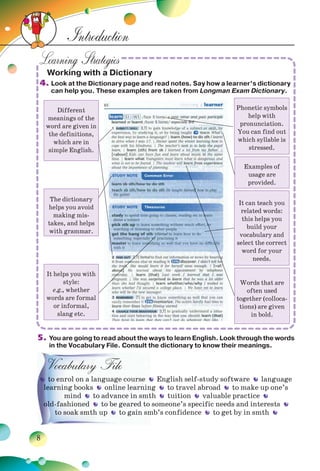
Working with a Dictionary
4. Look at the Dictionary page and read notes. Say how a learner’s dictionary
can help you. These examples are taken from Longman Exam Dictionary.
5. You are going to read about the ways to learn English. Look through the words
in the Vocabulary File. Consult the dictionary to know their meanings.
Vocabulary File
to enrol on a language course English self-study software language
learning books online learning to travel abroad to make up one’s
mind to advance in smth tuition valuable practice
old-fashioned to be geared to someone’s specific needs and interests
to soak smth up to gain smb’s confidence to get by in smth
Different
meanings of the
word are given in
the definitions,
which are in
simple English.
The dictionary
helps you avoid
making mis-
takes, and helps
with grammar.
It helps you with
style:
e.g., whether
words are formal
or informal,
slang etc.
Examples of
usage are
provided.
Words that are
often used
together (colloca-
tions) are given
in bold.
Phonetic symbols
help with
pronunciation.
You can find out
which syllable is
stressed.
It can teach you
related words:
this helps you
build your
vocabulary and
select the correct
word for your
needs.
ttttoooootto eennrol on a language course
lllllllelelllllll aaaaaarrrraarnnining books online learnin
mind to advance in smt
oooooooooololooooooooololldddddd-d---dd ffaaf shioned to be geared to
ttotototoot ssoaoakk smsmth up to gain sm
9
Making Progress in Learning English
6. Read the text. Say which way of learning English you have already
experienced.
Ways to Learn English
Making the decision to learn a language and actually going about it can
be two very different things. Below is what people think about different
ways of learning English – remember, you don’t have to stick to just one.
Choosing a combination of learning methods can often make it easier to
fit language learning into your daily routine!
Ann: This year I’ve made up my mind to enrol on a language course. In my
opinion, learning a language in a social environment like this opens me up
to meeting new people, it encourages me to practise my skills and it gives
me motivation to come back the following week. With a couple of hours’
tuition per week I cannot expect to advance too far without doing some
homework, though, I do a few hours’ study on my own too.
Steve: I’m a very active and busy person, so it’s difficult for me to find
time for regular classes. That’s why I’ve chosen a good English Self-Study
Software. These are made of a few CDs and accompanying books. I can say
that they have become a popular way to kick-start language learning, or
boost it in between the school terms. These provide valuable listening and
comprehension practice.
Tom: I study English with language learning books containing texts,
grammar modules, vocabulary lists and practice exercises. These are
probably old-fashioned but good enough to practise reading and writing
skills, and to get a base in essential grammar and vocabulary. But you’ll
definitely need extra listening and speaking practice.
Ann Dan Jane TomSteve
10
Introduction
Dan:Onlinelearningistotallyflexibleandgearedtolearner’sownspecific
needs and interests. You have your own private tutor, and lessons can
take place any time of day, for as little or as long as you want. All you
need is a computer, headset and webcam. While learning online results
are achieved fast – particularly in listening and speaking. As such it suits
people who are short of time.
Jane: In my opinion, learning a language in the country where it’s spoken is
the best way to get results – and have the most fun while you’re at it. When
you walk out of class the lesson is only just beginning: surrounded by the
sights and sounds of your chosen language and culture, you can’t help but
soak it all up and practise what you’ve learned with everyone from the tour
guidetothebusdriver.And,mostimportantly,youwillbeinspiredandgain
confidence – by being understood for the first time in a real-life situation,
by realising that you have the ability to get by in a foreign environment.
7. Read the text and say if the statements are true or false.
1. Tom has decided to learn English with the help of a computer.
2. Steve has chosen a method of learning English to suit his busy and
active life.
3. Ann would like to learn English in a group of people.
4. Dan finds his motivation in practising a foreign language at every
step.
5. Tom enjoys working with printed resources.
8. Complete the sentences given below with the words from the Vocabulary
File (Ex. 5). Use the verbs in the correct form.
1. The school’s first priority is to … … of parents in their child’s level
of knowledge.
2. James agreed to the deal in an effort … his knowledge of English.
3. Children … … language incredibly quickly.
4. Many of their ideas … popular support.
5. This idea seems rather … now.
6. Sometimes we had to … … on very little knowledge of English.
7. She has clearly … … … … to learn a second foreign language.
8. The course curriculum … to satisfy everybody’s needs.
The Gerund
9. Complete the sentences with the Gerund.
1. … (learn) a foreign language opens everybody up to … (learn) about
another culture.
2. You won’t feel comfortable in a foreign country without … (speak)
a foreign language.
11
Making Progress in Learning English
3. You can improve your listening skills by … (watch) films in a foreign
language.
4. You can hardly advance in … (learn) a language without … (do)
regular homeworks and … (correct) your mistakes.
5. After … (visit) Ireland, she has made up her mind to improve her
writing skills by … (send) emails to all her new friends.
6. We look forward to … (meet) our friends from a partner school.
10. Look through the text of Ex. 6 and write down the examples with the
Gerund into your exercise book.
11. Answer the following questions. Use the Gerund.
1. Why is language learning important?
2. How much time a day do you spend learning English?
3. How often do you have a chance to practise speaking English?
4. What is the easiest (the most difficult) thing for you about learning
languages, especially English?
12. Write down as many classroom activities as you can in three minutes.
Then decide which of these activities: you would most like to do; you would
least like to do; is the most difficult; is the least stressful; takes much prepa-
ration time; aims at developing reading (listening, writing, speaking) skills.
b) Work in small groups. Discuss your ideas.
13. Read and act out one of the situations given below.
1. Sometimes when learning a language you seem to make a lot of progress
quite quickly, other times you don’t seem to be making much progress at all,
and occasionally people even feel as though they’re going backwards! Talk
about your language learning experience. How do you keep making progress?
2. While learning English you can use a number of different textbooks and
other learning materials to avoid getting bored with the same types of les-
sons all the time. Talk about the books you have worked with. What activities
do you consider to be interesting and which ones to be quite boring? What
things can turn learning a foreign language into an enjoyable pastime?
Homework
14. Write a few sentences about your learning goals this school year. What
language skills are you going to pay more attention to? What ways of
learning a foreign language have you chosen for yourself?
15. Comment on one of the quotations in a written form.
A different language is a different vision of life.
~Federico Fellini
Learn a new language and get a new soul.
~Czech proverb
14
Unit 1
Friendship Online,
Why Not?
1. Look at the photos on page 15. Which words from the boxes given below
do you need to describe the people on them?
Age
a baby, a toddler (from 1 to 2 years), a child, in his/her early/late teens,
a middle-aged person, in his/her early/late thirties/forties/fifties/
sixties…, an elderly person
Appearance
General features
A girl/woman is beautiful, pretty, good-looking, attractive; unpleasant.
A boy/man is smart, well-dressed, handsome; unattractive.
Body and build
Strong, muscular, broad-shouldered, well-built, of average build, of
medium build, weak, fragile.
Height
Big, tall, short, of average/medium height.
Character
Positive features: nice, friendly, relaxed, calm, positive, loveable,
respectable, lively, strong, complex, original, colourful etc.
Negative features: negative, shady, strange, odd, weak, unpleasant,
violent, bad, rude etc.
Relations to others
Positive features: sociable, encouraging, open-minded, sensitive,
sympathetic, outgoing.
Negative features: unsociable, indifferent, selfish, self-centred, feels
superior, aggressive.
Neutral features: lonely, shy.
Attitude to the world
Positive features: open-minded, interested, curious, enthusiastic,
thoughtful, reflective, polite, well-mannered.
Negative features: narrow-minded, short-sighted, ill-mannered, rude,
impolite.
Neutral features: meditative, nostalgic, sceptical.
Lessons 1–2
My Family and Friends
15
2. Talk about the photos in Ex. 1. What do you think connects them and
what makes them different? Express your opinion. Use the questions given
below to help you.
When do you do things together in your family?
What makes family members feel closer to each other?
Do you think it’s important to spend time together? Why?
Why do teenagers enjoy spending time with their peers?
Who do you think influences the teenagers’ character more: family
or friends? Comment on your answer.
Where do people usually find friends?
3. Listen to the text about a social networking site. Complete the sen-
tences given below.
1. Friendster, a social networking site, was established…
2. Its headquarters are…
3. The site is appropriate for…
4. It connects people through…
5. The service allows users…
6. The most important and most commonly used features of the site are…
A
C D
B
16
Unit 1
4. Work in pairs. Ask and answer the questions about the kind of communica-
tion you find the most effective for yourself.
Example:
Do you prefer meeting someone in person or socializing via the
Internet?
5. You are going to read the text about finding friends online. Look through the
words in the Vocabulary File. Consult the dictionary to know their meanings.
Vocabulary File
sceptical to get acquinted with to exchange to have numerous
friends online to be fascinated by to give updates about smth trendy
outfits to look forward to (doing smth) to initiate a response
6. Read the story on the Internet blog. Say how the girls support their
friendship online.
Friendship Online, Why Not?
By Susan in Relationships, October 14, 20__
I’ve heard countless stories about making friends via the Internet,
but I remained sceptical until I got acquinted with Elba. She’s from the
USA. We constantly email each other and exchange personal messages
through our favourite network. Just imagine: we used to live in the
same city! She moved to the USA more than 5 years ago.
I met my friend Elba through Friendster network four years ago. At
first, I thought she was just one of the ordinary girls who wanted nothing
more than to have numerous friends online. But that common notion
proves me wrong. I was fascinated by her visit on someone’s page who
paid a visit on her page. We give updates about how things have been
in our lives like the recent events in the country we live in: pleasant,
funny or sometimes dramatic things; anything under the sun. We share
our common interests such as school life, music, shopping and most of
all, beauty! What is very particular of Elba is her trendy outfits. We
talk about fashion and would love to shop together one day. I am looking
forward to visiting her in the USA in future.
There are times we are busy with our daily routine. But what amazes
me is that, whenever the two of us initiate a thought of communicating
through the network, we are sure of a response. Every email or the web-
page visit is definitely worth it.
That is how me and Elba have been friends for four years now just
because of the online technology. That is where our friendship began!
And I’m glad, it did!
ssssccccsceeptical to get acquinted w
ffffffffffrrfrrrfrrrrrrrrrrf iiieeeeeeennnndddn ss online to be fascinated
ooooooooououoououuouooouoooouoooo ttftffffttt ittiti ss tot look forward to (do
ttttuu eu ebb eu eeb ere
II
AAA W
eevI’ve
I re
W
I’ve
I re
A WAA
II
Ibbbb tbutbutbubutbb
W
ve
rI rb e
My Family and Friends
17
7. a) Find the words in the text to match the definitions given below.
1. Connected to other computers through the Internet.
2. Something that is done as a reaction to something that has hap-
pened or been said.
3. The most recent news or information about something.
4. To arrange for something important, to start such as an official
process or a new play.
5. Extremely interested in something or someone.
6. A set of clothes worn together, especially for a special occasion.
b) Listen and check your answers.
8. Complete the sentences with the words from Ex. 7.
1. He was … by her voice.
2. The site has received a positive … from the users.
3. All the city’s schools will be … by the end of the year.
4. Many companies have … the development of a social network.
5. She bought a new … for a party.
6. The report provides a brief … on the progress of the project.
9. Read and say if the sentences are true or false according to the text of Ex. 6.
Correct the wrong statements.
1. Susan has always wanted to make friends online.
2. The girls became friends five years ago.
3. The girls give regular updates about how things have been in their
lives.
4. The girls share common interests such as school life, music,
shopping and most of all, beauty!
5. Susan would love to visit museums with her friend.
6. Susan is glad to have a friend in another country.
10. a) Look at the verb forms in Ex. 6. Which ones describe: long-term situa-
tions, habits and routines, feelings and opinions; actions happened at a
specific time in the past; past habits? Consult the Grammar Reference on
page 275.
b) Write 5–6 questions to interview your friend about people he/she commu-
nicates with. What tense forms are you going to use in your questions?
11. ‘Friend’ is a word that can be related to all generations, age groups,
and all types of people. Whether you’re young or old, you need friends to
survive. Work in small groups. Talk about the way to choose friends for
yourself. Is it difficult or easy to be a good friend?
18
Unit 1
Example:
A: Friends often mirror each other. We choose friends who have thoughts
that are similar to ours, who reflect our family values, who think the way
we do. The company we keep reflects and helps determine the kind of people
we become. So if we want to be more ambitious, we choose a friend who is
ambitious, if we want to be less short-tempered, we choose a friend who has
a cool head. Friends have an influence on current habits and new habits
that one may develop.
B: Though it’s important to have friends who are like you, it’s equally
important to have friends with other positive qualities that will lead you
to grow or develop. These friends will help you discover new ways of doing
things and help you overcome challenges in a constructive manner.
C: Last but certainly not the least: we have to choose friends we can rely on.
Homework
12. Write a few sentences about your friends. Use the words from the table to
Ex. 1, p. 14 and the correct verb tenses.
13. Read and complete the text with the word combinations from the box.
Friendship Clubs
Are you (1) ... in the hope of meeting new people online? These days
with the Internet it’s easy meeting people and (2) ... . Meeting those who
are like-minded through a (3) ... is becoming more popular each day as
it is the easiest and fastest way of meeting new people to (4) ..., but you
have to know where to look and just a little (5) ... and caution is all you
need. Using a friendship clubs searching facilities (6) ..., this enables you
to find those like-minded people with (7) ... to yours. When searching like-
minded people you will discover (8) ... giving you a brief idea about a
person’s likes, dislikes and hobbies. Using Friendship Clubs to initially
find a particular person, before embarking on a journey of (9) ... there
is nothing like (10) ... .
making friends online searching the Internet online searching
share interests and ideas friendship club similar interests
a lifelong friendship to filter your options from among thousand
of profiles meeting in person a variety of profiles
Friendship ClubsFF
Are you (1) ... in the hope of meeting new people online? These days
with the Internet it’s easy meeting people and (2) ... . Meeting those who
are like-minded through a (3) ... is becoming more popular each day as
it is the easiest and fastest way of meeting new people to (4) ..., but you
have to know where to look and just a little (5) ... and caution is all you
need. Using a friendship clubs searching facilities (6) ..., this enables you
to find those like-minded people with (7) ... to yours. When searching like-)
minded people you will discover (8) ... giving you a brief idea about a
person’s likes, dislikes and hobbies. Using Friendship Clubs to initially
find a particular person, before embarking on a journey of (9) ... there
is nothing like (10) ... .
My Family and Friends
19
Our Friends and Their
Interests
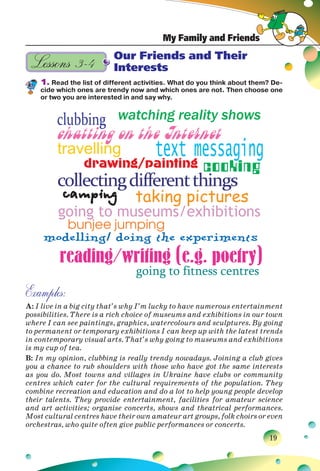
1. Read the list of different activities. What do you think about them? De-
cide which ones are trendy now and which ones are not. Then choose one
or two you are interested in and say why.
Examples:
A: I live in a big city that’s why I’m lucky to have numerous entertainment
possibilities. There is a rich choice of museums and exhibitions in our town
where I can see paintings, graphics, watercolours and sculptures. By going
to permanent or temporary exhibitions I can keep up with the latest trends
in contemporary visual arts. That’s why going to museums and exhibitions
is my cup of tea.
B: In my opinion, clubbing is really trendy nowadays. Joining a club gives
you a chance to rub shoulders with those who have got the same interests
as you do. Most towns and villages in Ukraine have clubs or community
centres which cater for the cultural requirements of the population. They
combine recreation and education and do a lot to help young people develop
their talents. They provide entertainment, facilities for amateur science
and art activities; organise concerts, shows and theatrical performances.
Most cultural centres have their own amateur art groups, folk choirs or even
orchestras, who quite often give public performances or concerts.
Lessons 3–4
20
Unit 1
2.a) Look at the photos and match them to the names of the activities in Ex. 1.
b) Work in pairs. Talk about the photos. Use the prompts given below.
Talking about Likes and Dislikes
Questions Responses
What do you like doing in your free time?
How do you like … –ing?
Do you like/enjoy … –ing?
Is … popular among your classmates?
Do you do any sports regularly?
What else can you do if you live in a big
city?
I really like…
I really don’t like…
I hate it.
I prefer…
It’s cool/brilliant/great!
I don’t mind it.
It’s awful/boring.
3.Read the dialogue. What do the children say about their free time
activities?
Jessica: Hi, Brian! Nice to see you! Are you going to the sports centre?
Brian: Yes, my training starts at 5. We are going to participate in the
tennis tournament soon.
Jessica: It’s great. I’m not into sport, although I go swimming and do
aerobics sometimes. I do this just to keep fit.
Brian: But music and singing is your cup of tea. I’ve heard you singing at
the school party. It was amazing! Have you been practising long?
Jessica: Since childhood. I do believe that I’ll be able to make it my
career in future.
Brian: Music and singing take almost all of your free time, don’t they?
Or do you enjoy doing anything else?
A B С
D E F
My Family and Friends
21
Jessica: Roller-skating is my passion, but I don’t like ball games.
Brian: Then what about roller-skating in the city centre this Sunday?
Jessica: It sounds good. Could you give me a call on Saturday?
Brian: Of course. And hope to meet you! Bye!
Jessica: Bye!
4. You are going to read the text about teens and their interests. Look through the
words in the Vocabulary File. Consult the dictionary to know their meanings.
Vocabulary File
jolly a pastry cook an apron to amaze to dream of (doing smth)
loyal to attend probably a psychologist the human brain
the powerful tool an initiative
5. a) You’re going to read the texts about four teenagers. For ques-
tions (A–J) choose from the people (1–4). There are two choices which
match each person. There are two statements which you don’t need.
Follow the recommendations given below.
Skim the instructions, the questions and the opening sentence of
each text.
Find the key words in the question and scan the text searching for
key words and information.
The words in the questions and the texts are not the same, but close
in meaning.
b) Comment on the choices you’ve made. Find the correspondent facts in
the texts and read them aloud.
This person …
A wants to help people to reach their aims
B wants to treat other people to tasty things
C is going to connect his/her life with the studies about the world
D is ready to find solutions out of the problems
E is planning to find out more about the unknown areas
F wants to know more about the hidden secrets of people
G has already travelled a lot and had wonderful adventures
H is going to take after his/her grandmother
I thinks of studying artificial intelligence in future
J is greatly involved in the activities connected with his/her future
career
jojooooj lllllllll yyy a pastry cook an apro
llool yay l to attend probabl
the powerful
22
Unit 1
1.
Ben dreams of visiting exotic countries and taking
fascinating trips. He likes to read about different
scientific expeditions and unexplored territories. He
is sure that breathtaking adventures are waiting for
him. He’ll be ready to meet all challenges on his way
to the new discoveries in his future.
2.
Jenny is going to be a journalist and a psychologist
in future. She likes to go to new places, meet new people
andmakenewfriends.Sheknowsthatmanyfactsabout
the life of famous people are still to be discovered. She
is sure that the human brain is the powerful tool which
helps people to achieve success in all initiatives. She’ll
probably make wonderful discoveries about human
nature in the future.
3.
Tania is a lively girl. She likes holidays, her family
and jolly crowds of friends. She is going to become
a pastry cook, wear a white apron and a special cap,
and amaze everyone by making delicious cakes and
cookies as her Granny does.
4.
Fred is a very serious boy. He has a loyal friend,
his dog Rex. They like to go to the forest and listen to
the birdsongs together. Fred has an album with bird
pictures which he drew. He attends the Nature Study
Club at school and knows a lot about birds and animals
too. Probably his future profession will be connected
with animals and birds.
1 2 3 4
My Family and Friends
23
Talking about Future: Will and Be Going to Do Smth
6. Listen to the dialogue between Ann and her Aunt Olha. Choose will or
be going to.
Ann: It’s my birthday soon. I’m going to/I’ll be sixteen next Friday.
Aunt Olha: Oh, really? Are you going to/Will you have a party?
Ann: I’m going to/I’ll have lunch in a café with a few friends.
Aunt Olha: That is going to/That’ll be nice.
7. Study the information. Match the sentences with will and be going to from
Ex. 5 and examples in the dialogue of Ex. 6 with the uses in the tables.
1. Introduction
WILL BE GOING TO
Will has a neutral meaning. We use
it to talk about facts in the future.
Will does not usually express an
intention.
e.g. I’ll be sixteen next Friday.
Be going to states an intention or
something we have already decided
to do.
e.g. We’re going to have lunch in a
café.
It’s her birthday. She’s going to have lunch with her friends.
Not: She’ll have a meal.
But we often use be going to for an intention and will for the details
and comments.
e.g. We’re all going to have lunch. There’ll be about ten of us. – Oh,
that’ll be nice.
As well as be going to, we can use the Present Continuous.
e.g. We’re all going to have/We’re having lunch next Friday.
2. Decisions and intentions
WILL BE GOING TO
Will states an instant decision or
agreement to do something.
e.g. There’s a post office, I’ll buy
some invitations.
(Ann is deciding now.)
Be going to means that we have
already decided.
e.g. I’m going out. I’m going to post
the invitations.
(Ann has already decided.)
3. Predictions
We can use will for a prediction about the future.
e.g. I hope everyone will have a good time.
We use be going to for a prediction, when we see from the present
situation what is going to happen in the future:
e.g. You’ve bought much food. Are you going to have a party?
It is often possible to use either form in a prediction. Usually be going
to is a little more informal and conversational than will.
24
Unit 1
8. Complete the list of collocations with the words from the box.
1. To go for coffee / a walk / …
2. To go to the cinema / the park / …
3. To go home / shopping / …
4. To play football / the piano / …
5. To watch TV / the Olympics on TV / …
6. To read my notes from class / my book / …
7. To stay at home / here / …
8. To have something to eat / a shower / …
9. Complete the conversations with ONE word from Ex. 8 in each space.
An example has been done for you. Explain each use of be going to.
Example:
A: What are you doing later?
B: I’m just going to stay at home and watch TV.
1. A: What are you doing this afternoon?
B: Nothing much. I’m just going to sit around and … my book.
2. A: What are you doing tomorrow?
B: I’m going to go for a … by the river with some friends.
3. A: What are you doing this weekend?
B: I’m going to … to Oxford with my boyfriend/girlfriend.
10. Work in pairs. Make similar dialogues and act them out in class. Use
the prompts given below.
1. A: later?
B: go / eat something / my friend
2. A: tonight?
B: stay at home / bed early / tired / you?
3. A: weekend?
B: cinema / boyfriend / watch a new film
4. A: now?
B: much / just / go home / have something to eat / you?
5. A: after the class?
B: go home / read my notes from class / you?
11. Write 3 or 4 sentences about your/your friend’s hobbies or inte-
rests. Take out every 5th
word, but leave the first letter. Exchange pa-
pers with a classmate to see if he/she can use the sound and the sense
clues to supply the missing words.
a DVD a rest bed early at your friends a meal basketball
dancing the paper
My Family and Friends
25
When you come to an unfamiliar word in reading, consider all the
sound and the sense clues. Keep that plan in mind as you read the next
story. It will help you read the sentences like this.
12. a) Make notes about your own future. Write:
three things you’re going to do with your friends next week;
three things you think you’ll do after you finish school.
b) Work in small groups. Share your intentions and predictions about your
future.
Homework
13. Write a few sentences about your free time activities. What are you going
to do during the weekends?
14. Comment on the quotation. Use the structures will or be going to.
You can become blind by seeing each day as a similar one. Each day is
a different one, each day brings a miracle of its own. It’s just a matter of
paying attention to this miracle.
~ Paulo Coelho
Family Matters
1. Look at the photos. What can you say about these people? What are their
relations?
2. Work in pairs. Discuss the questions.
1. How much do you want to be independent from your parents?
2. Do you often have a heart-to-heart talk with your family members?
3. What is a family everyday moment that you like? Why?
4. What family traditions would you like to keep in the future?
5. Who is a family member you admire?
Lessons 5–6
A B C
26
Unit 1
3. You are going to read the text about the girl’s mother. Look through the words
in the Vocabulary File. Consult the dictionary to know their meanings.
Vocabulary File
an impact an inspiration to ensure remarkable
determined to encourage frustrated to put pressure on smb
4. Read the text and say what traits of mother’s character the author
writes about.
The Person Who Inspires Me
By Ann
Successful people in every field have certain characteristics in
common. It is worth our time to analyze the characteristics of a person
who is now where we would like to be in future. Some teens turn to pop
singers or actors for inspiration but many find inspiration much closer
to home. I’m one of them. My mum is my role model, a person who has
made a major impact on my life.
My mum is a tall beautiful fair-haired woman of about 40. She has
the kindest greenish-grey eyes and a nice smile. She is easy-going and
friendly and we always have a great time together.
My mum works hard Monday to Friday to ensure that everyday basic
needs are met for our family. She is very successful because she’s very
determined and hard-working. Although she works really hard for our
family, she manages to find time for me. She says that the family comes
first and then a career.
My mum is a truly remarkable person. We often joke in our family
that our house has a star in the window to signal a safe place for everyone.
My Mum always offers a helping hand to others – a kind word, a joke or a
listening ear. Ours is a house where there is always a big, delicious meal
and plenty of extra seats for those who would stop by and for those who
sometimes come and stay. My mum simply loves people and they love her.
Weareverycloseandweoftensharesecrets. Weworktogethertosolve
our problems. My mum is very supportive, encouraging me to study well.
She says I mustn’t be so frustrated about my failures and cry so much. My
mum’s photo is on my desk and every time I have to take a serious decision
I check as if it were her choice. It helps me in my walks of life.
My mum is my inspiration because she never puts pressure on me.
Her achievements make me work on my own personality. I try to do my
best to be successful in my studies. I’ve got many friends and they can
always rely on me.
It is impossible to become exactly like someone else and there is no
need to. We have to remain ourselves but strive to acquire new traits of
character to help us achieve our goals.
an impact an inspira
ddddedeeededdddedddd teteteetett rmmrmr inineded to encourage
The Person Who Inspires MeTTBy Ann
Successful people in every field have certain characteristics in
common. It is worth our time to analyze the characteristics of a person
who is now where we would like to be in future. Some teens turn to pop
singers or actors for inspiration but many find inspiration much closer
to home. I’m one of them. My mum is my role model, a person who has
made a major impact on my life.
My mum is a tall beautiful fair-haired woman of about 40. She has
the kindest greenish-grey eyes and a nice smile. She is easy-going and
friendly and we always have a great time together.
My mum works hard Monday to Friday to ensure that everyday basic
needs are met for our family. She is very successful because she’s very
determined and hard-working. Although she works really hard for our
family, she manages to find time for me. She says that the family comes
first and then a career.
My mum is a truly remarkable person. We often joke in our family
that our house has a star in the window to signal a safe place for everyone.
My Mum always offers a helping hand to others – a kind word, a joke or a
listening ear. Ours is a house where there is always a big, delicious meal
and plenty of extra seats for those who would stop by and for those who
sometimes come and stay. My mum simply loves people and they love her.
Weareverycloseandweoftensharesecrets. Weworktogethertosolve
our problems. My mum is very supportive, encouraging me to study well.
She says I mustn’t be so frustrated about my failures and cry so much. Myd
mum’s photo is on my desk and every time I have to take a serious decision
I check as if it were her choice. It helps me in my walks of life.
My mum is my inspiration because she never puts pressure on me.
Her achievements make me work on my own personality. I try to do my
best to be successful in my studies. I’ve got many friends and they can
always rely on me.
It is impossible to become exactly like someone else and there is no
need to. We have to remain ourselves but strive to acquire new traits of
character to help us achieve our goals.
My Family and Friends
27
5. Choose the correct item (A, B or C) to answer the questions (1–4) according
to the text.
1. What is a great pleasure for the author?
A to write about the beauty of the world
B to write about the person who has made a major impact on her life
C to write about the people who help in life
2. What sentence best describes the mother?
A She’s a truly remarkable person.
B She’s pleasant most of the time.
C She is too dedicated to her work.
3. How is the girl’s mother supportive?
A She encourages the girl to study well and helps her solve the problems.
B She gives her enough pocket money.
C She tells the girl what to do.
4. Why does the girl consider her mother to be an inspiration?
A She always praises her daughter.
B She does all the work for her daughter.
C She never puts pressure on her daughter and she lets her express
herself freely.
6. Complete the definitions with the words from the Vocabulary File (Ex. 3).
1. … is a powerful effect that somebody or something has on another
person.
2. … is unusual or surprising and causes people to take notice.
3. … means to give somebody the desire, confidence and enthusiasm to
do something well.
4. … means feeling annoyed and impatient because you cannot do or
achieve something.
5. … means to make sure that something happens.
6. … means to force or strongly persuade somebody to do something.
7. … means a good idea about what you should do, write, say etc, espe-
cially one you get suddenly.
8. … means having a strong desire to do something, so that you won’t
let anyone stop you.
7. Complete the sentences with the necessary words.
1. Computers have had a significant … on the way we study.
2. She … many young people to take up sport.
3. He gets … when people don’t understand what he’s trying to say.
4. Susan has made a … progress in learning English.
5. Teachers should … that students understand the work.
6. My father has always been a source of … for me.
7. Mark was … to begin playing the guitar by his father.
8. Jack was … that the same mistakes would not be repeated.
28
Unit 1
Homework
8. Think of a person you consider to be your role model. Write 10 sentences
about his/her character. Use the words from Ex. 3 and the recommenda-
tions given below.
While describing someone’s character:
Try to avoid using simple general words.
For example, instead of saying that someone is ‘kind’, you can use such
words as considerate, generous, or sympathetic.
It’s good to give a real example of an occasion that shows that
what you are saying is true.
For example, instead of just saying that someone is helpful, you
could say: Sue is very kind and helpful. When I first started college
she made me feel at home and showed me where everything was.
If you want to say that someone does something often, and this
is an important part of their character, you can say that they are
always doing something.
For example:
Margaret’s very considerate – she’s always helping people.
If you want to say that someone sometimes behaves in a particular
way, you use tend to be or can be, especially when talking about
negative qualities:
She tends to be rather impatient. He can be very moody at times.
Taken from Longman Essential Activator
Writing a Composition
9. Work in pairs. Look through the composition of Ex. 4 and discuss the
questions.
Who does the person write about?
What life situations does she describe?
Does the author describe her Mum’s appearance?
What does she say about the mum’s personality?
Does the author include any examples?
10. Say in which paragraph the author:
talks about reasons a teen needs a role model;
describes her Mum’s appearance;
writes about the mother’s success at work;
writes about the mother’s character traits;
My Family and Friends
29
talks about the relationships between her mother and other people;
explains why the mother is a person who inspires her.
11. You are going to write an essay about your role model.
a) Before you begin, answer these questions:
1. Who is your role model?
2. How many paragraphs will your composition contain?
3. What is each paragraph going to be about?
4. What examples do you need to include in your composition?
5. What are your views about your future?
b) Write an essay plan.
c) Write notes for each paragraph. Think about the details and examples
from your personal experience.
Homework
12. a) Write a composition/an essay “The Person Who Inspires Me”.
b) When you have finished your composition, proofread it. Make sure you’ve:
used the correct language (grammar and spelling);
used important details (check with your notes);
added examples from your life;
written at least five paragraphs;
written a conclusion/a summary sentence.
One Day in My Life...
1.Look at the photos and answer the questions.
Where are the people?
What are they doing?
What emotions do they have?
Do you think these events will be kept in their memories?
Lessons 7–8
A B C
30
Unit 1
2. a) Think of one particular day/event in your life: either a good one or a
bad one. What made you remember this day? Write notes on the following
questions:
when the event happened;
who you spent this day with (or you were alone);
what kind of memories you’ve kept for years;
what life lessons you got from it.
b) Work in pairs. Share your experiences with each other. Ask and answer
questions to know the details about your friend’s experience.
3. Read the following sentences. What do you think the words and
phrases given in bold print mean? Work out their meanings from the con-
text. Don’t use the dictionary.
1. A special moment in life can sometimes turn out to be much more
than we initially expect.
Turn out means
A to force someone to leave a place permanently, especially their
home
B to happen in a particular way or to have a particular result,
especially one that you didn’t expect
C to empty something completely by taking out the contents
2. I could always talk to my dad. We’ve shared so many funny and
crazy memories!
Memories mean
A the ability to remember things, places, experiences etc
B something remembered from the past about a person, place or
experience
C during the time that people can remember
3. Occasionally, I recommend: step out of daily habits and challenges,
and think about who you’d like to give your most valuable gift of
time.
To step out means
A to start doing something new or become involved in a new situation
B to decrease an activity or a process to think and improve a situation
C leave your room or office for a short time
4. You are going to read the text about the role of a family in people’s life. Look
through the words in the Vocabulary File. Consult the dictionary to know
their meanings.
Vocabulary File
to turn out profound long-awaited potentially snow chains
a resort to recall to step out a challenge
ttttooooto tturn out profound lon
aa resort to recall
My Family and Friends
31
5. Read the text. Choose from (A–H) the one which best fits each of
(1–6). There are two choices you don’t need.
One Day in My Life…
A special moment in life can sometimes turn out to be much more
than we initially expect. This moment can be so profound,
how important it actually was and how much it meant.
It happened last year during my Christmas holidays. It was a long-
awaited moment for me. Since we live in Zakarpattia, these days would
become one of the Christmas celebrations that we see in films: snow-
capped mountains, light snowfall, candles, carols and cold winter days!
I was watching the news on the weather channel with my parents
if I would like to go skiing with him the following day. Of
course I wanted to go, because I love skiing in the mountains! My mum
and my sister did not join us, so it was just my dad and me! What great
adventures they were going to be! I almost couldn’t sleep that night,
. He has always been so busy with his work!
Earlyinthemorningweleftourhouse.Itwouldhavetakenusabouttwo
hours to get there, if there hadn’t been so much snowfall; we were forced to
install snow chains. If we hadn’t installed the snow chains, we would have
kept sliding and not going forward. Potentially, we could have ended in a
car accident. It took us – or better my dad – about 20 minutes to put the
chains on the wheels. My dad had such a big smile on his face
asking him if he could teach me how to change snow chains. He explained
it and also started to tell me some ski adventure stories he had as a teenage
boy. By the way, my dad used to be a ski teacher about 20 years ago.
When we finally got to the ski resort, the sun was shining brightly,
. We skied like crazy, nonstop, up and down the hill. We
also had a traditional ski lunch together. I could talk to my dad about
everything. How many funny and crazy memories we both had to share
with each other!
The ski adventure trip brought my dad and me so much closer
together. It will always be one of the best memories I ever experienced
with him.
As the modern industrial world is mainly focused on money and ca-
reers, I strongly believe that the most valuable gift we can give each other
is time! We don’t always recall that it is the time . I recommend
to everybody, occasionally step out of daily habits and challenges, and
think about who we would like to give the most valuable gift of time.
Time is here to observe, listen, give and change.
A because I was so excited to go just with my dad
B because I had dreamt about such a trip
C that only with time you know
D that brings people closer together
32
Unit 1
E when my dad suddenly asked
F when I explained what happened
G when I showed an interest
H and we put on our skis
6. a) Find the words in the text to match the following definitions.
1. Something that tests one’s strength, skills, or abilities, especially
in a way that is interesting.
2. Expected hopefully.
3. A place frequently visited by people for relaxation or recreation.
4. To happen in a particular way or to have a particular result, espe-
cially something you did not expect.
5. To remember a particular fact, event, or situation from the past.
6. Now and then; from time to time.
b) Complete the sentences with the words from Ex. 6a.
1. You don’t happen to … her address, do you?
2. He now faces the biggest … of his career.
3. My dad often takes my friends and me to ski … to France.
4. We only see each other very …
5. The most … moment was hearing the test results.
6. It was a difficult time, but eventually things … all right.
7. Work in pairs. Discuss the text of Ex. 5.
1. When did the events described in the story happen?
2. What fact made the event so important for the author?
3. What feelings did the child have while telling the readers about
his/her life experience?
4. What life lesson did he/she learn for himself/herself as a result of
that event?
5. What helps us communicate with each other?
6. Have you ever had a similar experience in your life? How did it in-
fluence your personality?
Talking about Your Impressions
What…! How…!
What an exciting trip it has been!
What great adventures they will be!
What a wonderful place it is!
How exciting the trip has been!
How great the adventures will be!
How wonderful the place is!
8. Choose one of the word combinations from the box given below and give
a suitable answer.
Example:
We enjoyed the trip greatly. – What a wonderful trip it was! How wonderful
the trip was!
My Family and Friends
33
1. The music was perfect and the DJ was really super.
2. This is such a picturesque place.
3. I think it’s going to rain again.
4. Let’s have a rest in the Crimea!
Talking about Past Situations or Past Habits Which No Longer Exist:
Used to
9. Read the information in the table given below.
(a) I used to live with my sister. Now I
live in my own apartment.
(b) Mary used to like Japanese cuisine,
but now she adores the French one.
Used to expresses a past
situation or habit
that no longer exists.
FORM: used to + the simple
verb form
(c) Did you use to live in Milan?
(OR Did you used to live in Milan?)
QUESTION FORM: did + subject + use
to (OR did + subject + used to)1
(d) I didn’t use to eat much at breakfast,
but now I always eat much in the mor-
ning. (OR I didn’t used to eat much.)
(e) I never used to eat very much at
breakfast, but now I always eat well in
the morning.
NEGATIVE FORM: didn’t use to
(OR didn’t used to)1
Didn’t use(d) to occurs in fre-
quently. More commonly, people
use never to express a negative
idea with used to, as in (e).
10. Read and correct the mistakes.
1. As a teen, Peter used to watching horror movies.
2. Mary used to worked at school.
3. Jean was used to do a research, but now she works in business.
4. What you used to eat?
5. I didn’t was used to get up early, but now I do.
6. Were you used to live in Spain?
11. Work in pairs. Take turns to ask and answer the questions using used to.
Example:
Where did you use to live?
A: Where did you use to live?
B: I used to live in London. And you? Where did you use to live?
A: I used to live in Beijing.
a great idea nasty weather the breathtaking landscape
a cool disco
1
Both forms (spelled use to or used to in questions and negatives) are possible
in American English. (Fundamentals of English Grammar / Betty Schrampfer
Azar. – 3rd
ed., Longman, 2003.)
34
Unit 1
1. What music did you use to listen to when you were a child, and what
music do you listen to now?
2. You are a grown-up now. What did you use to do when you were a
child that you don’t do now?
3. You lived abroad for some time. What did you use to do in that fo-
reign country and what don’t you do now?
4. Recall one particular day from your holidays. What did you use to do?
12. Speak in class.
1. Compare past and present fashion of men clothing. How are they diffe-
rent?
Example:
Pants used to be wide, but now they are not.
2. Compare the daily lives of people twenty years ago with the daily lives of
people today.
Example:
Twenty years ago people didn’t use to live in suburbs, but today people
prefer to leave big and noisy cities.
Homework
13. Write a plan of the text (Ex. 5). Then write a short summary of the story in
5–7 sentences. Focus on the events and the person’s feelings about them.
14. Read and complete the story with used to and the verbs from the box given
below.
I’m 85 now and things have changed a lot since I was young. When I
was growing up, people were much more polite. Men always (1) … doors
open for women, people would offer bus seats to old people, but nobody
does that any more. Young people never (2) … with their parents, but
many teenagers nowadays do that kind of thing. The families (3) … much
bigger. And the families (4) … rich by the number of children they had.
Young people always (5) … working at the very early age. Boys (6) … their
fathers in the field or to shepherd the cattle. Girls (7) … their mother to
work in the vegetable garden or around the house. Sixty years ago, young
women never (8) … to go out without someone to watch them. Girls never
be allowed help lie argue wear be hold ask
be help start tell
My Family and Friends
35
(9) … make-up either. It wasn’t allowed. All that has changed. Parents
were stricter then, too. My dad always (10) … me where I was going and he
(11) … me what time he wanted me home. I never (12) … to him or break
his rules. I was too scared! It’s probably nicer being young nowadays be-
cause parents are more liberal.
Life Challenges
1. a) Work in pairs. Look at the photos (A–G) and discuss the questions
given below.
Where are the teenagers?
What feelings do they have?
Do they enjoy their time with the adults?
What life situations do you think made the teenagers laugh (feel
sad, cry…)?
b) Read the dialogue and match it to one of the photos above. Say
what helps a boy and a father build a good relationship.
Max: Hello, Dan!
Dan: Hi, Max! Where are you going?
Max: To the Sports Centre. My father and I both have a training
session today.
Dan: Your father? Do you train together?
Max: Yes, my father is usually busy with his work but physical
training is the quality time that we spend together.
Dan: Does sport help you to get on well with your father?
Max: Of course, it does. My Dad is the person who understands me
best. He always gives me sound advice or a helping hand when I
need it.
Lessons 9–10
A
E F G
CB D
36
Unit 1
2. a) Listen to Miss Alison talking about lifestyles. Complete the lecture
with the words from the box given below.
What Is Lifestyle
A lifestyle is the way a person lives,
which includes patterns of social
relationships, entertainment, and
dress. (1) … typically also reflects
individual attitudes, (2) … and
opinions.
A lifestyle develops a sense of
self-identity and creates (3) …. The
behaviours and practices within a
lifestyle are a mixture of customs, or
conventional ways of doing things,
one’s habits, and one’s reasoned actions.
(4) …, a lifestyle refers to life patterns which involve how people live,
spend their time and use their money. As a construct that helps consumers
(5) … with their world, a lifestyle is a subject to constant change.
In the environment, a lifestyle is often associated with a particular
footprint. Green lifestyles are those lifestyles that consume less of the
planet’s natural resources.
“Lifestyles”, are the (6) … or partially accepted differences within the
majority culture or group.
Taken from Wikipedia, the free encyclopedia
b) Talk about yourself. Use the questions given below as a plan.
What do you like doing?
How do you spend your free time?
Do your friends and relatives support you in all walks of life?
Do you sometimes face challenges?
What kind of lifestyle do you lead?
3. You are going to read the text about adolescence. Look through the words in
the Vocabulary File. Consult the dictionary to know their meanings.
cultural symbols in business interact accepted
values a lifestyle
My Family and Friends
37
Vocabulary File
adolescence transition adulthood dependency an adjustment
to distinguish to get through an argument compromising
misunderstanding from the first sight
4. Read the text and talk about teen challenges.
Adolescence and Life Challenges
Children up to the age of fourteen, so up to the end of primary school,
are mostly interested in small unimportant things. They don’t have much
to do and they don’t have many responsibilities.
Adolescence is a period of transition between childhood and adulthood.
It is a period when one moves from dependency to autonomy. It is the pe-
riod demanding significant adjustments to the physical and social changes
which distinguish a childhood behaviour from an adult behaviour. It is a
period of rapid physiological changes and new social roles.
One can often face a number of challenges and dilemmas. How much the
person makes contact with adults depends on the personality. Of course,
there are periods when everything seems to be more difficult but one can
get through them. As a teenager you see the world absolutely differently
than the grown-ups. When arguments happen, you just have to stop and
think, perhaps both you and your parents are right. Compromising is very
difficult; but this may be the only way to find the right solution.
Relationships among teenagers are stronger than among adults. Your
only responsibility is school so you spend more time with friends. This
builds stronger relationships.
Sometimes there are misunderstandings between you and your close
friends. But this is not the end of the Universe. The teen world is not as
complicated as it looks from the first sight. You just need to learn to make
decisions by yourself and become responsible for them.
5. For questions (1–4) choose the correct answer (A, B or C) according to what
the text of Ex. 4 says.
1. What are children up to the age of fourteen interested in?
A playing computer games
B small and unimportant things
C communicating with friends
2. What is adolescence?
A a period of transition between childhood and adulthood
B the time when you are grown up
C a term of psychology
aaaaaaddddaadoloolescence transition ad
toto distinguish to get thro
misunderstandin
38
Unit 1
3. What changes take place in this period?
A changes in behaviour and relationships
B rapid physiological changes and new social roles
C changes in character
4. What do you need to learn?
A what to do in conflict situations
B how to solve problems
C to make decisions by yourself and become responsible for them
6. Complete the definitions with the words from the Vocabulary File.
1. … means to recognize the difference between two people or things.
2. … is a conversation or discussion in which two or more people
disagree.
3. …isanagreementmadebetweentwopeopleorgroupsinwhicheachside
gives up something they want so that both sides are happy in the end.
4. … is the time in a person’s life when he or she develops from a child
into an adult.
5. … means a slight disagreement or argument.
6. … is a change in the way a person behaves or thinks.
7. Look at the table. Then use the phrasal verbs to complete the sentences.
to get about – to go or travel to different places
to get across – to succeed in communicating an idea or piece of
information to someone, or to be communicated successfully
to get ahead – to be successful and do better than other people in a
job or work
to get along – to have a friendly relationship
to get at – to keep critisizing someone in an unkind way; to discover
information
to get away – to take a holiday away from the place you normally
live
to get back – to return to a place
to get by – to have enough money to buy the things you need, but no
more
to get out of smth – to avoid doing smth you have promised to do or
are supposed to do; to enjoy smth you do or experience
to get over smth – to become well again after an illness
to get through – to do an amount of work
1. Liz was determined to … the truth.
2. We must … the simple fact that smoking is dangerous for our health.
3. They’ve got a lot of work to ….
4. My parents don’t earn a huge salary, but we ….
to geet about –– too go or trravel to diffferennt pllaces
to gget across – to succeeed in commmuunicaating an iddea or piecce of
iinformatiionn to someeone, or to be coommunicated ssuccessfuullly
to geet ahead –– too be succcessful annd do bettter than other peopplee in a
jjob or worrk
to geet along – too have a ffriendly reelatioonshhip
to geet at – to kkeeepp critisizzing someeone iin ann unkind way; to diisccover
iinformatiionn
to geet away –– too take a holiday away fromm the placee you normmally
llive
to geet back – tto rreturn too a place
to geet by – to hhave enouggh money to buuy thee things yoou need, buut no
mmore
to geet out of smtth – to avoid doingg smtth yoou have proomised tto ddo or
aare suppossedd to do; tto enjoy smmth yyou ddo or experrience
to geet over smmthh – to beccome well aagainn aftter an illneess
to geet throughh –– to do ann amount of woork
My Family and Friends
39
5. It’s taken me ages to … the flu.
6. Tom and I have always … quite well.
7. My father … to his office just before lunchtime.
8. They’ve bought a new car which they are going to use for ….
9. Why is he always … me?
10. Will you manage to … this summer?
11. He soon found that it wasn’t easy to … in the show business.
12. Children can … a lot … being involved in community projects.
8. Look, compare and contrast pictures. What do people look like on the
photos? Give reasons for family misunderstandings which happen some-
times. Is there a way to avoid them?
9. Work in small groups. Talk about the life challenges you’ve experien-
ced. What helped you find the right solutions to them? Who do you usually
turn to for advice?
Homework10. You’ve found the following letter in the youth magazine TeenLife and de-
cided to respond. Write a letter of about 70–80 words to Susan. Tell her how
you build relationships with your parents. What helps you to overcome mis-
understandings which happen sometimes?
Dear TeenLife,
I am a 15 year-old girl and the only child. My problem is that my
parents don’t let me go out anywhere. I can’t go to parties or discos
like others of my age. My parents are also suspicious of my friends
and keep asking me questions. Even if I am only a few minutes late
coming back home, they ask me too many questions which start with
Where? Why? Who?
What can I do to help my parents believe me?
Susan
A B
40
Unit 1
Example:
Hi, Susan,
Though it may not sound like it, you parents really love you and are
just being protective. May be the fact that you are an only child makes
you more special to them. All their questions just reflect their love and
concern. This doesn’t mean that you should follow everything they say.
Make your point clear but do it gently. The best way is to have a heart-
to-heart talk with them. They’ll surely listen. Maybe they ask you too
many questions because they don’t know your friends. Why don’t you
ask a few friends home and let your parents get to know them better?
Once your parents are satisfied that you are “hanging out” with good
people, they’ll surely let you go out. We’ve asked our readers to tell us
about their experiences and we’ll publish their letters in the next issue.
TeenLine
11. Put the verbs in brackets into the correct tense form.
We (1) … (to offer) family rafting trips since 1969. And we (2) …
(to know) that you and your family members (3) … (to put) many hopes
into your vacations. You (4) … (to expect) to have the time of your
lives. You also (5) … (to want) to be relaxed enough. On our Family
Friendly vacations you can feel (6) … (to be) united and dependent,
adventurous and easy-going while (7) … (to spend) your time together.
We also (8) … (to know) that you dream of (9) … (to fill) your fa-
mily vacation album with meaningful and joyful memories. It could
be playing frisbee or volleyball on one of the huge sandy beaches
along the Lower Salmon River after a refreshing swim or perhaps
rafting on the exciting Main Salmon Rapids before soaking in a natural
hot spring. It could also be a lazy breakfast on the Rogue River; or
seeing a family of moose as they drink from Wyoming’s Snake River.
These are the kinds of lifelong memories your family (10) …
(to carry) away after this family adventure vacation. Only they
(11) … (to be) even better, because they (12) … (to be) yours.
WeWeee ((((1111)))) …… (t(too ofofo fefeerr) ffamammilililyy raraftftiningg trtrtrtripipipipss sisincnceeee 1111919191119111111111111 69. AnAnAnA ddd wew ((22)) ……
(t(t(t(tooo knknowowww)))) ththththaatat yyouou aaaandnddnd yyouourr fafafamimimimilylyl mmememmmbebebebersrsrr ((33)) ……… (t(t(t(tooo puut))t) mmmmanananyy hohopeeess
inininintoto yyououuurrrr vavavavacacatitionons.ss. YYYYouu ((444))) ……… (tt( oo exexxxpepepepectctctct)) toto hhavavavaveeee tht ee tititiimememem ooff yoyoururur
lilililiveves.s. YYYouououou aaaalslsl oo ((55)) …… (t(t(t(to waw ntnt)) tott bbee rereeelalalalaxexex dd enenouououughghggh. OnnOn oooourru FFammillyyy
FrFFrF ieiendndlylyyy vvvvacacacacatatioionsns yyouououou ccanan fffeeeeelll (66)) ……… (t(t(t(toooo bebe)) ununnnititititededeed aanddn dddepepepene dedenttt,
adadadadveventntururururououououssss anandd eaeaasysyyy-g-g-g-goioio ngngg wwwhihihihilele ((77)) ………… (t(t(t(toooo spspenend)d)d)d) yyyyouououo r tit mememee tttogogetetheher.r.r
WeWeee aaaalslslslsooo ((88)) …… (t(t( oooo knkknowow))) thththataa yyouou ddddrererereamama oof ((9999)))) ……… (to fififillll )) yoyy urur fa--a
mimimm lyly vvacacccatatatatioioioionn alalbubuummm wiwiww thth mmmeaeae nininnn ngngfufuuulll anananandddd jojoyfyfulululul mmmmemee orro ieieiees.s IIt cocoullddd
bebebebe pplalayiyiiingngngng ffffririr sbsbeeee oorrrr vovovv lllleyyeybabab llllll oonn ononononeeee ofofoo tthehee hhhhugugugugee sasandndndndyyy beb acacheheesss
alalala onongg ththhheeee LoLoLoLowewerr SaSaSalmlmmmonno RRivivivererr aftfterer aaaa rrrrefeeefrereshshhinininingggg swss immim ooorr peperhrhappapss
rararr ftfftiningg onononon tttthehehhe eexcxcititinini gggg MMaMainin SSSalalmomonn RaRaaapipipipiddsdsd bbefefororeeee sosososoakini gg inin a natturu alal
hohohoh tt spspririiingngngng.... ItItII ccououldldd aaaalslslsl ooo bebe aaa llazazazaa yy brbreaeaeaakfkfkfkfasasa tt ononn tttthehehehe RRRogogueueueue RRRiviverer; ororo
sesesseeieingng aaaa ffffamamamamilili yy ofof mmmoooooosessse aass thththeyeyyy dddririnknkk ffffrorororommmm WyWyomomomomininining’g ss SnSnSnnakakakeee RiRivever.r.r
ThThheseseseseeee arara ee ththee kikikikindndndn ss offof llifififfelelonongg memmememomomm ririeses yyyouoouo r faafamimimim lylylyy ((1010)) ………
(t(t(t(tooo cacarrrrrry)y)y)y) aaaawawaw yy affaffteterrrr ththt isis fffamammmililyy adadddveveveventntnn ururee vavavaacacacac tionno .. OnOnOnO lyly ttheheyyy
((((111111 )) …… (t(t(ttoooo bebebebe)) evevenen bbbetetetettetetet r,r, bbbecececauauauseses ttheheeeyyyy ((((121211 )) …… (t(t(ttoooo bebebeb )) yooyourururrs..s.
My Family and Friends
41
Project Work
Read the instructions and decide what projects you’d like to do.
Project A. One Day in Our Life…
Work in groups of four. Write about one day from the life of your class.
Describe what you did that day, who was present, what preparations were
made, what impressions you had etc. Why do you still remember that day?
Illustrate your work with drawings or photos.
Step 1. In groups of four, fill in a placemat with the class activities about
which you’d like to write. Each
member of the group writes 2–3
events. Agree on one event and write
it in the middle.
Step 2. Start collecting information, words
and phrases that have to do with
your topic. As you go through the
unit in your textbook, add more
information.
Step 3. Decide how you will present you project – a poster / a powerpoint
presentation / an overhead projector / …
Step 4. Prepare your presentation.
Step 5. Check what you have written.
Step 6. Practise your presentation.
Step 7. Gallery Walk. Present your work in class. Answer any questions.
Lessons 11–12
Group ideas
a placemat
1st
student’s ideas
4th
student’sideas
2nd
student’sideas
3rd
student’s ideas
42
Unit 1
Project B. Research Paper
Family life has always been a subject of research in literature. Famous wri-
ters have always described how people build their family relationships. Fa-
mily life has changed over the centuries, but family values have never been
a subject of change.
a) Work individually. Think of the examples from classical or modern litera-
ture where the family life is depicted. You can choose a literary work by a
British, American or Ukrainian author. For example, W. Shakespeare’s King
Lear, Romeo and Juliet, Theodore Dreiser’s The American Tragedy, Ivan
Nechui-Levytsky’s The Kaidash’ Family etc.
b) Work in groups. Decide which literary work you’re going to write about.
Share the roles. Prepare information about the plot and the main characters
of this literary work.
c) Write a short essay about the family relationships. What problems did the
author reveal? What did he/she want the readers to understand?
d) Gallery Walk. Present the results of your research in class. Answer any
questions.
Develop Your Skills
1.a) In this section you are going to listen to the text “Keeping in Touch” by
Emily Barton. Your task is to decide if the statements (1–6) below are TRUE
or FALSE according to what the text says. Mark your answers with an X in
your exercise book. An example (0) has been given.
0. Emily’s family moved three years ago.
1. Emily and her family travelled by bus.
2. When Emily arrived at her new place, she
phoned her friend at once.
3. Emily’s friend couldn’t keep in touch
with her because the phone calls were too
expensive.
4. Emily’s Mum tried to persuade her daugh-
ter not to call to her friend any more.
5. The girl couldn’t keep in touch with her
friend for two years.
6. The girls are still friends and they write to
each other regularly now.
Lessons 13–14
TRUE FALSE
0. X
1.
2.
3.
4.
5.
6.
My Family and Friends
43
b) Listen to the text “Keeping in Touch” by Emily Barton again. For ques-
tions (7–12) choose the correct answer (A, B, C, or D). There is always
ONE correct answer. Write your answers on the separate answer sheet.
7. Why did the girls depart?
A They went to different schools.
B They started to have different interests.
C Emily began to live in a new place.
D They couldn’t get on well with each other.
8. Why did Emily call her friend on the first day at school?
A She wanted to invite her for a party.
B She wanted to tell her about her new friends.
C She got a letter from her friend.
D She wanted to tell her friend about her life.
9. Why did Emily become angry with her friend?
A She didn’t receive a reply for her email.
B Emily’s friend didn’t give the girl her email address.
C Emily’s friend’s messages were too short.
D Emily’s friend wrote too long letters.
10. What did Emily’s mum advise the girl?
A To call her friend in the evening.
B To give up on her friend.
C To write a letter to another girl from her class.
D To tell her friend that she was really upset about their relations.
11. What did ‘keeping in touch’ mean for Emily?
A It didn’t seem to matter much.
B It was part of being a friend and was very important.
C It was the chance to know all the secrets.
D It was a possibility to know about things in her previous school.
12. What is the girls’ friendship like two years later?
A They don’t keep in touch very often.
B They have developed new friendships and have forgotten each
other.
C They’ve realized that true friends never really lose connection.
D They don’t feel that they are very close.
7 8 9 10 11 12
Score: ...../12
44
Unit 1
2. Read the text given below and think of the word which best fits each
space. Use only one word in each space. There is an example (0) at the be-
ginning. Write your answers on the separate answer sheet. (1 mark each)
Family Matters
It’s surprising (0) how little time we spend talking to (1) … other.
We devote countless hours to (2) … work and studies, different problems
(3) … we don’t have the luxury of talking about what’s really important
in our lives. Nothing is more valuable (4) … family. Many people,
however, have found solutions to (5) … problems in their families.
Jane’s friend has got a large globe (6) … her front door. When
her younger brother returns from school with the current events or
geography homework, they immediately check the globe to (7) … the
specific country, state, or city. Their entire (8) … has become more
(9) … of their “neighbours”.
Michele tells her younger sister one adventure story (10) … night to
ease the bedtime struggle. They both enjoy this time spent together.
Mary gives new life to her cousin’s best-loved stuffed animals by
turning (11) … into puppets. Then little children have hours of fun
creating plays and stories for family and friends. Their elder sister
takes the puppets (12) … she babysits and says they are always a hit!
Family really matters. We just need to find time for each other.
Score: ...../12
3. Put the words in brackets into the correct form. Pay attention to the
tense forms, the gerund, the passive structures. Use the relevant grammar
forms for future events. (1 mark each)
Abandon all your possessions and run for the hills: It (1) … (to foretell)
that the world (2) … (to come) to an end sooner than you (3) … (to think),
in the year 2012. It (4) … (to seem) that you (5) … (can’t / to pick up)
any newspaper or magazine without (6) … (to read) that the apocalypse is
almost upon us.
What really (7) … (to happen) in 2012? Asteroid 433 Eros (8) … (to pass)
within 17 million miles of the Earth in January; there (9) … (to be) an
annular solar eclipse in May and a solar transit of Venus in June; the
Summer Olympics (10) … (to take) place in London; the Earth’s population
(11) … (officially / to pass) 7 billion people in October; the United States
(12) … (to elect) a new President in November; construction of the new
Freedom Tower (13) … (to complete) in New York City; the sun (14) …
(to flip) its magnetic poles as it (15) … (to do) at the end of every 11-year
sunspot cycle; and, as I (16) … (to be) sure you (17) … (to hear) by now,
the Mayan calendar (18) … (to complete) its 5,125 year cycle, presumably
(19) … (to portend) the End of Days. Don’t panic! The explanation (20) …
My Family and Friends
45
(can) be as simple as they (21) … (not / to expect) people in the 21st
century
tostillbeobsessedwiththeirarchaiccalendar.NeithertheMayancalendar
people, nor the Age of Aquarius people, (22) … (to offer) any claims for
how or why the world (23) … (to end), only that their particular legend
(24) … (to point) to a rollover in some ancient calendar.
Score: ...../12
4. You are going to read an interview with Tom Justesen, 17, from Min-
nesota who came for the International Outreach Camp (IOC). The ques-
tions have been mixed up. Match the interviewer’s questions (A–F)
below to answers (1–4). There is one extra question which you don’t
need. Write your answers on the separate answer sheet. An example
(0) has been given. (3 marks each)
A Have you learned anything from this experience?
B The money you earned ... do you mean you paid for this camp yourself?
C What differences do you see between the people you met here and
Americans back home?
D How did your friends and family react to your going to Ukraine for
the International Outreach Camp?
E Are you having a tough time in Ukraine?
F Have you gone anywhere else internationally?
Journalist (J): F Have you gone anywhere else internationally?0.
Tom Justesen (TJ): I guess I wanted to travel, but it was never my
priority. I’ve been to Greece before on a school sightseeing trip.
I liked Greece, but all we saw were ruins day in and day out. I
would have liked to have met people too. In Ukraine it’s the op-
posite. I don’t feel like a tourist. I would like to see more of the
sights. The money I had earned to come here was worth it.
J: 1.
TJ: Yeah, I had to save money for it. I worked two part-time jobs.
The first was at a day care centre, where my two cousins work.
I worked there full-time in June. I also worked with my dad,
who owns a brewery.
J: 2.
TJ: Someasked,“WhereisUkraine?”and“Whyareyougoing?Well,
that’s cool... at least you’re doing something more than being at
the basketball court every day.” It wasn’t like, “You’re living out
my dream! I wanted to go there so much!” People my age don’t
even know about Chornobyl. I’m only seventeen you know.
46
Unit 1
J: 3.
TJ: Roya, my friend, thinks that people here are pretty genuine;
at first I didn’t think so. I knew very little about Ukrainians.
When I introduced myself to some Ukrainian kids in the
city and tried to be friendly, they simply nodded their heads
without any expressions on their faces. It was unusual for me.
We, Americans, smile a lot.
J: 4.
TJ: From this camp I learnt that I really want to do a study
abroad programme. IOC is great. I think with a study abroad
programme though, I can also see more of a country.
Score: ...../12
5.Read and act out one of the situations given below.
1. Talk about your experiences of meeting students from other countries/
representatives of other cultures. What things did you find different in their
characters? What did you learn as a result of your interactions? What helps
people understand each other?
2. Talk about the advantages of participating in study abroad programmes.
What helps us to break stereotypes we have about other people? Use the
words from the box given below.
to give great life opportunities to increase knowledge about student
programmes abroad to create theatre presentations and artwork to
bring to life students’ cooperation to help with future projects to
design and implement hands-on projects to explore the world to learn
about theatre, creative writing and debates to experience an amazing
atmosphere to become a part of a youth leader network to lay the
groundwork for an active future to build skills of teamwork, collabora-
tion and relationship building to cross cultural barriers to build real
relationships that continue via phone, email and letters
My Family and Friends
47
6. a) Read the information about the Ukrainian International Outreach
Camp.
IOC UkraineII
Ukrainian students ran three projects across
Ukraine last summer – taking full responsibility
for programmes they designed and funded.
Camp ABC – Kharkiv, Ukraine
CACTUS – Ternopil, Ukraine
Arts Festival – Skadovsk, Kherson Region,
Ukraine
These three programmes created a network of active young
people across Ukraine prepared to take responsibility for the social
development of their communities! Others who joined had a chance to
become part of the wave of the future!
b) Write about the advantages of participating in these camps. Use the
words from the box to Ex. 5.
Think of your records. Decide how well you know it.
4 = very well, 3 = OK, 2 = a little, 1 = needs to improve
Skills Now I can... 4 3 2 1
talk about my family members and friends
talk about youth life and youth interests
describe the events in my life
discuss the relationships people built with
each other
talk about the ways to solve problems
understand the information during the
discussions
do a multiple choice test
read and understand the magazine articles
find the necessary information quickly
write an essay
I
50
Unit 2
Sport in a Society
1. Read the names of sports and talk about them in class. Which of them
are popular in your school? What sports competitions are organized at your
school? Are you a participant or a spectator? Which sports from the list are
NOT popular in Ukraine? Where are these sporting events traditional?
Don’t confuse the words ‘sports’ and ‘games’.
Sports include all kinds of physical activities, for example, running,
hitting, or kicking a ball, climbing or fishing.
Activities that do not involve much physical activity are games, for
example, chess or billiards.
2. Match the words in the box to the correct definitions.
1. … is a game for two players. They have rackets. They hit a shuttle-
cock over a net.
2. … is a game played on an ice field by two teams of six players each.
3. … is a game in which two teams of five players bounce and pass a ball
down a court to score by sinking the ball into a fixed net basket.
4. … is a game in which you use long sticks called clubs to hit a small
ball into holes in a fine grassy patch.
Lessons 1–2Lessons 1–2
football badminton golf basketball water polo chess
ping-pong ice hockey pole vault
Sport and Leisure
51
5. … is an outdoor game for two teams of eleven players who try to put
the ball in a goal at each end of a field.
6. … is a game for two players who have sixteen figures which they
move on a board. They must trap the opponent’s king to win the
game.
7. … is an indoor game for two or sometimes four players who hit a
small plastic ball across a net.
8. … is a swimming game played with a ball and two goals. You must
be a very good swimmer.
9. … is a sporting event; participants try to jump over a high bar,
using a long pole to push themselves off the ground.
3. a) Copy the table given below and do a survey.
Questions You
Your
Friend
What sport do you play in your free time?
How regularly do you train?
Have you ever competed?
Why do you play sports? (e. g. to keep fit, for
fun, to lose weight etc)
If you could start any sport tomorrow, what
sport would it be?
What dangerous / extreme sports have you
tried? If none, which would you like to try?
Which sport would you take up if you could
afford it?
b) Speak in class. What have you found out about your classmate?
4. You are going to read the interview with Christine Ohuruogu, the UK Olympic
gold medallist (Beijing, 2008). Look through the words in the Vocabulary
File. Consult the dictionary to know their meanings.
Vocabulary File
to expand someone’s horizons a good set up for smth
good facilities competent an inkling obviously
to tick apart from bitterly to interfere to forgo
a tendency to be accountable for smth
to expand someone’s hor
good facilities compet
toto tick apart from bi
a tendency to b
52
Unit 2
5. Read the interview with Christine Ohuruogu, the UK Olympic cham-
pion. The questions have been mixed up. Match the interview ques-
tions (A–H) to the answers (1–6). There is one extra question which
you don’t need. Write your answers on the separate answer sheet.
An example (0) has been given.
A What advice would you give to schoolchildren interested in a sports
career?
B How did your career develop at school?
C What are your views on how sports should be delivered at school?
D Who directed you in your sporting career?
E Was sport an important part of your school life?
F Which sportspeople inspired you as a schoolgirl?
G Did sports interfere with your schoolwork?
H What was your most memorable sporting event as a schoolgirl?
School Sport: Christine Ohuruogu
By Gareth A Davies
“Sport teaches important lessons,” says Olympic gold medallist (2008)
Christine Ohuruogu
Journalist (J): You are an Olympic gold medallist who will defend
her title in Stratford in 2012. Where did you go to school?
E Was sport an important part of your school life?0.
Christine Ohuruogu (CO): I attended St. Edwards Church of England
School, Romford. It was a good school, and helped me to ex-
pand my horizons. There was a good set up for sport, with good
facilities and a very competent PE staff.
Sport and Leisure
53
J: 1.
CO: Getting serious about athletics pretty much came after school;
until I left school I never had an inkling I would go to the
Olympics as an athlete. But I took part in everything, playing
individual and team sports. I tried to do my best at hockey,
netball, tennis a few times, athletics, and I loved Sports Day.
J: 2.
CO: You know, I didn’t really have sports heroes. For me, the main
thingwasplayingsports.Ineverreallyfollowedsportontelevision.
Obviously, that has all changed now, because I want to know what
makes other sportspeople tick, how they think and train.
J: 3.
CO: Apart from running about and feeling great, I think playing
netball was amazing. We had a good team, one week we’d lose
bitterly and the next we’d win spectacularly, and I always took a
lot of pride in wearing my school shirt and competing for them.
J: 4.
CO: It can interfere in a sense, but there is always time to do both if
you are sensible. I certainly think that regardless of how good
someone is at sports, they should never forgo their homework.
J: 5.
CO: You need a real love for your sport and regardless of how good
you are at it, you need to be able to go out and train when it is
freezing cold and when you feel a pain. A life in sport is not
going to be easy; doing a sport is not just about relying on your
physical power, it is about putting all of yourself into it. If you
have all of that, you have a start.
J: 6.
CO: We have a problem with kids not enjoying sports. Such a
tendency has to be changed. Sport and physical education are
essential elements of quality education. They promote positive
values and skills which have a quick but lasting impact on
young people. Those who go in for sports regularly learn such
important life lessons as teamworking and being accountable
for their actions. Children should be active and healthy, and
away from bad lifestyle choices.
6.Listen and check your answers.
54
Unit 2
7. Match the words (1–8) to their synonyms (A–H).
1. To expand
2. A horizon
3. Competent
4. A facility
5. An inkling
6. To tick
7. To interfere
8. Accountable
A to trouble
B to enlarge
C a hint
D responsible
E a reach
F a convenience
G qualified
H to twinkle
8. Complete the sentences with the words from Ex. 7. Use the verbs in the cor-
rect tense form and voice.
1. We could see a ship on the … .
2. The hotel has its own pool and leisure … .
3. The study will be … to include inner-city youth.
4. He is the only coach … enough to train the team before the game.
5. The sports centre should be held … for the quality of service it pro-
vides.
6. Anxiety can … with children’s performance at the competition.
7. She had absolutely no … of what was going on.
8. I’ve never really understood what makes her … .
9.Report the sentences. Write what Christine Ohuruogu says about:
the sports competitions she took part in during her school years;
her sports role models;
sports activities at school nowadays.
10. Speak in class. Express your point of view on the suggested situation.
Our life is very busy nowadays. We are always in a hurry, sometimes we
have no time for breakfast or dinner. It is even more difficult to find time for
sports and trainings. The old proverb goes, “Health is above wealth”, so
sports are essential to improve our physical health. What do you think?
Support your ideas with relevant examples from your life.
Example:
A:Sportsandphysicalactivitiesarecrucialforalonghealthyliving.Sports
and games improve our health and well-being, extend the life expectancy,
and reduce the likelihood of such health problems as heart disease.
Sport and Leisure
55
B: Regular physical activities are essential for physical, mental,
psychological, and social development. Good habits start early in
childhood. The importance of physical education is demonstrated by the
fact that children who exercise are more likely to stay physically active
as adults. Sports play a major positive role in our emotional health; sports
also build valuable social connections, offering opportunities for play, self-
expression, and renewal of the spirit.
Homework
11. Put the verbs in brackets into the correct tense form and voice.
1. Sports such as football and wrestling … (to be) popular in Ukraine
since the 19th
century.
2. Ukraine … (to host) to the UEFA European Football Championship
in 2012, together with Poland.
3. The Ukraine Cricket Association … (to exist) to promote the game
of cricket in Ukraine.
4. Ukraine … (to send) a full team to the 2008 Beijing Summer Olym-
pics, the team members … (to be) Valentyna Holenkova, Anastasiya
Koval, Alina Kozych, Iryna Krasnianska, Dariya Zgoba, and Mary-
na Proskurina. As a team they … (to place) the 11th
in qualifications
and … (not / to qualify) for the team final.
5. Andriy Shevchenko … (to be) a famous Ukrainian footballer, who …
(to consider) a national hero in Ukraine.
6. Ukraine … (to note) for its famous heavyweight boxers – Volodymyr
and Vitaliy Klychko which … (to win) world champion’s title many
times.
7. Ukrainian gymnasts … (to enjoy) success at the 2009 European
Championships in Milan, Italy.
8. Ukraine … (to be) a regular participant in both summer and winter
Olympic Games.
12. Write a paragraph about the role of sport in a society.
Start like this:
Sport offers endless opportunities for innovative development partner-
ships and can be used as a tool to build and foster partnerships between
developed and developing nations.
Finish your story with:
In brief, sport is important for everyone. Millions can benefit directly,
through active participation in sports competitions and tournaments. For
many more, the benefits are less direct but no less important.
56
Unit 2
Sports and Youth
1.Work in pairs. Discuss the questions given below.
1. Do you agree that the current generation is weaker than the for-
mer one? Why do you think it is like that?
2. Do you think students want to participate in sports or they are
rather lazy? Explain your ideas.
3. What do you think about your school sports activities? Which of
them enjoy the greatest popularity among the boys/girls?
4. How much can the student government encourage students to par-
ticipate in sports?
2. Look at the photos (A–L) and match them to the words in the box.
Lessons 3–4
camping fishing surfing karate horse-riding parachuting
fencing figure skating boxing wrestling yoga baseball
A
D
G
J K L
H I
E F
B C
Sport and Leisure
57
Don’t say ‘My favourite sports is football’. Say ‘My favourite sport
is football’.
Use different verbs for different sports:
you play soccer/golf/tennis/baseball/basketball/volleyball/hockey
etc, but:
you do karate/judo/yoga/gymnastics/track and field etc.;
you go swimming/running/riding/skating/bowling/sailing/
fishing, etc (= sports that end with ‘–ing’).
Don’t say ‘make sport(s)’. Say ‘play’ or ‘do’, or participate in
sport(s):
I played many sports at school.
3.Talk about the sports activities you like/enjoy. Use the verbs do, go or
play and the names of the sports or activities.
Example:
I go / do / play … in my free time.
4.a) Listen to a short dialogue. Complete it with the phrases from the
box.
A: Do you enjoy…?
B: … dancing. And you?
A: … but I don’t like doing it very much.
B: What about other sports?
A: Well, I … but my sister Ann really hates it.
b) Work in pairs. Make similar dialogues about the pictures given below. Act
them out in class.
I quite like ... (e.g. swimming) I enjoy I like
Well, I really like watching it I participate in...
BA
58
Unit 2
5. You’re going to read the text about the importance of doing sports exercises.
Look through the words in the Vocabulary File. Consult the dictionary to
know their meanings.
Vocabulary File
moderate proper a protective gear the muscular strength
endurance a workout a coach to toss
6. Read the text. Your task is to fill the gaps with the titles from the list
(A–E). There are two choices that you don’t need. Write your answers
on the separate answer sheet.
Exercise Do’s
The great thing about exercise is any activity that gets you moving
is good! Try to actively exercise for about an hour a day at least 3 days
a week, and regular moderate activity during the rest of the week. You
can choose from:
which includes sports like football, tennis, soccer, volley-
ball, basketball etc. It also includes brisk walking, running, cycling,
and swimming. Always make sure you’re wearing the proper protective
gear whatever activity you choose; as mentioned previously, try to do
this level of activity at least 3 times a week.
helps you build the muscular strength and endurance. It can
involve unstructured activities like using the playground equipment.
It can also include structured strength workouts using weights, ma-
chines, or your own body weight. Always work with an adult, coach,
trainer or other expert before you start lifting weights to make sure
you know the right exercises and how to do the exercises correctly. You
can add this type of activity 2 to 3 days a week, with at least a day of
rest between sessions.
includes active games, walking or jogging, wrestling with
your friends, or tossing a ball in the backyard. This is something you
can do every day.
A Muscle-strengthening
B Out-of-school Activities
C Regular Activities
D Active Aerobic Exercising
E Breathing Exercises
7. a) Find the words in the text to match the definitions given below.
1. Something that you do because you enjoy it.
2. A piece of metal that weighs an exact amount and is lifted by people
as a sport.
3. To throw something, especially something light, with quick gentle
hand movements.
mmmomomm derate proper a prot
endurance a wor
Sport and Leisure
59
4. To do sports or physical activities in order to stay healthy and be-
come stronger.
5. To include something as a part of the all-in-one-piece.
6. A period of physical exercises, especially as training for a sport.
7. To move something or someone upwards into the air.
8. The ability to continue doing something difficult or painful over a
long period of time.
b) Listen and check your answers.
8. Put the verbs in brackets into the correct tense form and voice.
1. Who … (to sign) for the tennis tournament?
2. The new sports equipment … (to bring) to our school last month.
3. If Sue … (to tell) to wear the proper protective gear before roller
skating, she … (to injure).
4. They … (to train) in the school sports yard for two hours.
5. … you … (to plan) your daily workouts in the gym?
6. If you … (to want) … (to build) good muscular strength and endu-
rance, you … (should / to train) regularly.
9.Write 3 or 4 sentences about your favourite sports activities. Take out
every 5th
word, but leave the first letter. Exchange papers with a classmate
to see if he/she can use the sound and the sense clues to supply the missing
words.
10. Work in two groups. Compare and contrast the pictures. What simi-
larities or differences are visible?
a) Write about the things that skiing and volleyball have in common.
Example:
Skiing and volleyball are both very spectacular.
b) Write down some differences between skiing and volleyball.
Example:
Volleyball can be played in the gym and outdoors, but you can ski only
outdoors.
c) Speak in class. Which of the two sports would you prefer? Why?
BA
60
Unit 2
11. Talk about your sports life. Have you ever participated in sports com-
petitions? If not, would you like to start playing sports one day?
Start like this:
Sport plays a major role in my life. I like everything about sport, from
the game’s atmosphere to the personal influences one can have on a game.
I find it very enjoyable to watch or to play. I come from a very sport-
orientated family. My father and his two brothers all played in the local
football team. My mother did calisthenics and played volleyball for many
years; this shows that my family is sporty. When I was four, I began figure
skating and did that for five years.
Homework
12. You’ve found the following blog on the Internet. Read the information and
write what you think the questions in this blog were.
ASporting Life?
Hi, everyone, thanks for your suggestions of blog topics!
So sports, hmmm… well, right now sport is not a very big part of
my life. One reason is my day’s studies. I tend to unwind with a bit of
watching TV rather than hitting the gym or sports centre. Another
reason is that I haven’t established an exercise routine yet.
Generally I am influenced by my surroundings, and if I happen to
have a friend or acquaintance who is into sport, I am more inclined to be
motivated to participate in sports regularly. When I was in secondary
school, I played hockey and was a cross country runner, representing the
school. After the sixth form I was into music, films, reading, and dancing!
IwasmostfitandsportywhenIwasintheeighthform.Iplayedbadminton,
swam, and cycled on Sundays. So, who knows, I may get into sports again.
Now as a spectator, there are only two games that have captured my
interest, certainly on TV. That is football and tennis. Both are high
energy games. When you see a skilled footballer on the field, it’s almost
like watching a ballet. The foot movements can be so graceful! I like
tennis for the tension and the game culture.
13. You’ve decided to leave a comment on the Internet blog “A Sporting Life?”
Write a story of 80–100 words about your personal sports experience.
H
SSSSSS sssssssSSSo s
HHHHHi,
So s
Hi,
So sSS
HH
SooSS
H
S
H
S
H
So sSSSSS
Sport and Leisure
61
Take Care of the House
of You!
1. Look at the photos connected with sports activities. Use the questions
given below to discuss them.
Which is more connected with health and which is with sport? Why
do you think so?
Which one do you think is a mass sport and which one is a com-
petitive sport?
What kind of sports do you think are combined in the pictures?
Would you like to do any of these sports? Give your reasons.
2.Listen to Ann talking about her sports experience. What sports club does
she attend? Why has she chosen that kind of sports activity for herself?
3. You are going to read about yoga. Look through the words and word combi-
nations in the Vocabulary File. Consult the dictionary to know their mea-
nings.
Vocabulary File
entire to require in a non-judgmental way to channel excess
energy in combination with smth in particular the maturation of
smth to develop greater self-confidence to push boundaries
to gain a sense of achievement
Lessons 5–6
eeeenne tire to require in a no
eeeeeeeenneneneeeeee eeeerrrrere ggygy in combination with sm
ssmsmmss thth to develop greater s
to gain a se
A
C D
B
62
Unit 2
4. You’re going to read about doing yoga. Some parts of the sentences
have been removed from the article. Your task is to fill the gaps (1–6)
with the sentences from the list (A–G). There is one answer that you
don’t need.
Taking Care of the House of You!
Many people take pride in . Choosing just the right paint
colours and furniture style helps bring their entire home into focus.
Think of your body like a home – , your ‘beautiful home’.
It requires love and attention, and when you give it these things, you
bring your body into focus.
Being a teenager is a challenging time. The practice of yoga
and your true self in a non-judgmental way, and find ways to channel
your excess energy more productively.
Yoga is performed by a flow of Asanas (poses) in combination with
breath work and deep concentration. One of the noticeable benefits of
this practice is . In particular, yoga can be a great support for
the maturation of your inner organs. You will begin to feel more com-
fortable in physical strength and health.
Besides, the practice can be a wonderful and . As you prac-
tise, you become aware of your own body’s intelligence, and of the
focused, attentive power. You’ll develop greater self-confidence by
discovering your inner resources, which will definitely help you deal
with the dynamic daily experiences. Yoga can provide you with a way
to connect with yourself, . The practice of yoga offers you a
healthy, challenging way to experiment, to push boundaries, and gain
a sense of achievement in a non-competitive environment.
A your body is your temple
B the overall feeling of well-being
C decorating their homes
D can make your body more muscular
E can help you get to know your body
F and with the beauty within and around you
G fun way of practising discipline
Sport and Leisure
63
5. Match the words (1–12) to the words (A–L) to make word combinations.
1. Paint
2. A furniture
3. Challenging
4. Excess
5. Breath
6. A deep
7. Noticeable
8. A great
9. Inner
10. Physical
11. Clear
12. Dynamic
A benefits
B experience
C style
D concentration
E support
F colours
G work
H attention
I time
J organs
K energy
L strength
6. Fill in the necessary prepositions. Then make your own sentences with the
phrases you get.
1. To take pride …
2. To bring smth … focus
3. To think … smth like smth else
4. To be performed …
5. … combination …
6. To feel comfortable … smb’s physical strength and health
7. A great support … smth
8. To develop a greater sense … self-confidence … doing smth
9. To deal … smth
10. To go … experience in daily life
11. To provide smb … smth
12. To gain a sense … achievement
7.Read an advertisement about a yoga class for teenagers on page 64.
For questions (1–6) choose the correct answer (A, B or C).
1. What do the gentle yoga exercises create?
A flexibility and strength
B mental outlook
C the strength of body
2. What does the yoga class incorporate?
A emotional and mental state with the strength of body
B muscle-strengthening and mental exercises
C meditation, self-massage and guided imagery
64
Unit 2
3. What opportunity does the yoga class give to participants?
A to forget all problems
B to slow down and relax
C to relieve stress
4. What is the cost of the classes?
A $20 for a one-hour class
B $12 for a single class
C $12 for a ten-class card
5. When will the classes start?
A on January 6th
B next Tuesday
C on Tuesday at 6
6. What else must participants do?
A eat before classes
B turn off all mobile phones
C bring a yoga mat
This class for teens encourages participants to slow down, breathe
deeply and move inside their bodies.
Gentle yoga postures create flexibility, strength, and a calm emo-
tional and mental state that will create refreshing energy.
The class incorporates meditation, self-massage and guided ima-
gery; it’s a wonderful opportunity to slow down, relax, and think.
Beginners are welcome, no experience is necessary.
Time: Tuesdays, 5:15 – 6:15 PM, starting January 6, 20__
Cost: $12 for a single class, $100 for a ten-class card
Registration: Newcomers may join at any time. Drop-ins are wel-
come.
Instructor: J. Beth Baldwin
For more information or questions, please call J. Beth Baldwin at
860-344-8316.
Tips: Wear loose comfortable clothing; eat after class or have a light snack
before class. For vision improvement do not wear contact lenses. Please, turn
off all mobile phones upon entering the facility. Bring a yoga mat with you
or use one of our mats.
ThThThThisisisi classs ffforororr tttteee ns encncououraragegegegeeesssss papapp rtrticicicicccccipipipipipipipipananntsts tttoo slslowowo dowowwn,n,n bbbrereattta hhhhhhheheeeeehhhh
ddddddddeedd eppplylyyly aaaandnn moveee ininininsisiss de theeirir bododieieieeees.s.s.s.ss
Gentntntlelelele yyyyogoo a poststtstururururese creeatatee flleexixixiiixibibibibibib lilil tyty,, stststststtststrererererererr ngnggthth,, ananddd aa caalmlmm eemmmmmoooooooooo---
ttttttitiiitiono al aandndndd mmmmenee tal sttatatatateeee ththat wwililll crc eaeateteteete rrrrrefefe rereshshshshhhhhininininininini gg enenererrgygy..
The clasasasssss inininincocorporatatateseseses medititatatioion,n, ssselelelelee f-f-ff mamassssssssssagagagagagagagagee ananddd gugug ididi eded iimmmmmaaaaaaaaaaaam ---
gggggggegeeggg ry; it’s a wwwonononndededed rful opppppppporororortut nityy ttoo sllowowwww ddddddowowoo n,n, rrrrrelelelelelelelelaxaxaa , ananddd ththhinink.k
BeB ginnerss araareeee wewwew lcome,, nnnnoooo exee periienence iiss neneneneenecececessssararrrrrry.y.y.y.y.y.y.y.
TiTimem : Tuesdaaaysysyss,,,, 5:5:5:5 15 – 666:1:11:15555 PMPP , sttarartit ngg JJJJJananananana uauau ryry 66666666,,,,,,,, 20200___
CoCostst:: $1$ 2 for a sisisiingngngnglelel class, $1$1$1$10000 for aa ttene -c-clalalalaaasssssssss cccarardddddd
ReRegigiststraration: Newcwcwcomomomomeree s maayyyy jojojojoininii at annyy tiimemeeeem ..... DrDrDD opop-i-ii-iiinsnsnsnsnsnsnsn aarerer wwwwweeeeeellllleelelee --
cccccccoooooc meme..
InInststruructctoror:: J. Beth Baaaldldlddwiwiwiwinnn
FoForr momorere iinfnforo mation ooorrr ququququese tions,ss, pppplelellease cacallll JJ. BeBeethththththth BBBBalaldwdwdwwwwwwinininininininin aaaaaaaaaatttt
88888886666888 0-0-34344-4-83831616..
TiTipsps:: WeWearar lloooosese ccomomfortablee ccclooloththththinining; eat aaaaftftftfterereer class orr hahavee aa llllligigigigigghththth ssnananaaaaaaccccckckkkkkcc
bbbbbbbeeeebefforere cclalassss.. FoForr vivisisionon improvemeentntntt ddddoooo nonot weararr ccconononontatt ct lenenseses. PPleleasassasasa e,e,e,e ttuuuuuurrrrruuuu nnnnnn
oooooofffooooo fffff alaalll momobibilele pphohoneness upuponon enteringg thththheeee fafafaf cic lity. BrBrrBrinininingg aa yogaga mmatat wwitititititthhhhhhh yyyyyoyoooyoy uuuuuuu
ororororororrrroorro uuuuuuuuuuusesessesesesessess ooooooonenenenenenenee ooooooofffffffffff ouououououououououo rrrrrrrrr mamamamamamamamatttstststststststststss....
Sport and Leisure
65
8. Listen to a radio interview about power yoga. Match questions (1–6)
to the answers (A–F). Role play the interview in class.
A: Who does it?
B: 1.
A: What do you do?
B: 2.
A: How hard is it?
B: 3.
A: Who is it good for?
B: 4.
A: Can you give us an example?
B: 5.
A: Where can you do it around the country?
B: 6.
A It’s very hard, but there are beginner courses that will teach the
basics.
B Everywhere, just surf the Internet and you will find much informa-
tion.
C Gwyneth Paltrow, Geri Halliwell, Sadie Frost, Jude Law, Madonna.
D Power yoga is the most physically demanding, because it’s a dyna-
mic continuous flow of movements and postures. Breathing is also
an essential element, as you need to learn to synchronise breathing
with the movements and use breathing to get in and out of the pos-
tures.
E The Backward Bend is great for getting super-toned arms and legs.
F It is good for those who have already done other forms of yoga, for
workout fanatics who need a new challenge, and for women who
want to get strong arms.
9.Write some questions to get more information.
1. Sue has been practising yoga for five years.
2. The entire team agreed on choosing her as a captain.
3. Young sportsmen are required to attend trainings regularly.
4. Golf has gained in popularity in Ukraine in recent years.
10. Speak in class. Act out the situation.
You’ve heard the announcement about yoga classes in your school gym and
decided to attend. Now you’re talking to one of your classmates. Inform him/
her about your decision, say what influenced it. Invite your friend to join you.
66
Unit 2
Homework11. Read and complete the article. Put the verbs in brackets into the correct
tense form and voice.
Feeling Lucky? Try Paintball
Paintball (1) ... (to come) to Ukraine from the USA a couple of years
ago. A paintball game involves two teams setting out to ‘conquer’
a specified objective, which might be (2) ... (to protect) a pop star or
(3) ... (to release) hostages. Players (4) ... (to suppose) to finish the game
without getting a drop of paint on their clothes. When you (5) ...
(to play) paintball, you are provided with special equipment: an extra-
thick camouflage, a helmet (6) ... (to protect) the face and ears, and a
‘gun’ loaded with a gas cylinder and gelatine capsules (7) ... (to fill) with
paint. It’s the capsules that hit a player leaving paint stains. The Ukrai-
nian Paintball Federation (8) ... (to organize) by Sacura; new members
are always welcome. There is a place in Hydropark in Kyiv where you
can (9) ... (to try) this challenging and fascinating activity.
12. You have read the following advertisement in an English-language maga-
zine and decided to introduce a similar programme in your neighbourhood.
Write a letter to the school newspaper in which you:
state why sport is necessary for people;
say what teenagers will benefit as a result of the project;
inform the public about the sports facilities in your school;
invite the organizations and private business to sponsor the activities.
Write your letter of at least 100 words. Start your letter like this:
Dear Sir/Madam,
In our Junior Sports Programme children have the unique oppor-
tunity to receive coaching in gymnastics, athletics and ball games.
The programme includes Fit for Fun syllabus that has revolutionized
the way sport is introduced to ages 3–12. Pre-school children (Age 4)
receive 45 minutes of coaching covering gymnastic exercises for
strength and co-ordination as well as practising skills and games,
learning cooperation, running, jumping, throwing and catching.
These fun classes are an excellent preparatory course for sports and
school. Children learn to listen and follow the instructions with the
activities they enjoy. The guiding aim of our programme is to develop
as many positive attitudes towards physical activity as possible so
that an active and healthy lifestyle is continued throughout life.
Finish with:
Yours faithfully,
(your name and surname)
Sport and Leisure
67
Watching Sport
and Sports Competitions
1.Listen and read the dialogue.
Paul: I was in a desperate hurry to get home in time for the game.
Jane: What game are you talking about?
Paul: The Stanley Cup play-offs! Turn on the TV. I hope it’s still the
first quarter. It is! Who’s winning? What’s the score?
Jane: I don’t know. You know I don’t watch sports and football is not
an exception… Wow! That was a great shot. Did you see that?
Paul: No, what happened? Maybe they’ll show it again on instant replay.
I wonder who the coach is going to choose for the starting line-up.
Jane: Geez. I think there’s a player down on the field.
Paul: It looks like he’s walking off the field. He can’t be hurt too badly.
Jane: Look! They’re putting your favourite player into the game. Oh,
what a play!
Paul: Wait a second. I thought you didn’t watch sports.
Jane: I wasn’t a sports fan before this game. Do you find it strange?
Paul: Of course not. Pass the chips, please. Sit down with me to watch
the game.
2. Answer the questions.
1. Why was Paul in a hurry?
2. What game did Paul and Jane watch on TV?
3. Which sport did Paul like to watch on TV?
4. Which kind of sports do you like to watch? Why?
3. Listen and complete the conversation with the words from the box.
Lessons 7–8
afternoon back extra game hot lend meet park
68
Unit 2
A: We’re going to play football this (1) …
B: Really? Where are you going to play?
A: There’s a pitch in the (2) … near the river.
B: Is there?
A: Yes. Do you like playing football?
B: Yes, I play quite a lot (3) … home, but I’m not very good.
A: Neither am I. Why don’t you come with us and have a (4) …? We
need an (5) … player.
B: I’d love to, but I haven’t got my sneakers with me.
A: Don’t worry about that. I’m sure someone can (6) … you some.
B: OK. What time are you going to play?
A: Probably around five o’clock. It’s not so (7) … then.
B: That sounds great. Where shall I (8) … you?
A: Let’s say here, at about 4.30.
B: Great. See you then.
Cup or League?
Cup competitions start with many teams and finally finish with two.
A team can only win or lose.
Leagues are played over several weeks or months. Many games are
played and the team who gets the most points wins. A team can win, lose
or draw.
4. Decide if the following people are talking about cup games (C) or league
games (L). Write your answers in your exercise books.
1. We’re in the quarter finals.
2. We’re near the top of the table.
3. We won the semi-final on penalties.
4. We’ve drawn the last four matches.
5. We lost in the final match.
6. We were knocked out in the first round.
7. We’re going up this season.
8. They are a far ahead. No team is going to catch them.
9. There are only three games left in the season.
5. You’re going to read the text about football. Look through the words in the
Vocabulary File. Consult the dictionary to know their meanings.
Vocabulary File
to power up a ranking to triumph top-level games
to acknowledge a proper coaching structure to dedicate
the age ranges to pick up to make goalposts
to power up a ranking
toto acknowledge a proper
ththe age ranges to p
Sport and Leisure
69
6. a) Read the title of the article (Ex. 7). What do you think it’s going to
be about?
b) Read statements 1 and 2 given below. Which of the other sentences
(A, B, or C) has the same meaning as 1 and 2?
1. Five years ago football was still very much a boys’ sport.
A Girls didn’t play football five years ago.
B Five years ago not many girls played football.
C The boys didn’t let the girls play football five years ago.
2. There are more and more top-level women’s games being broadcast
on channels such as Sky.
A Women’s football matches were never broadcast on TV before.
B Women’s football matches were shown only on local TV channels
before.
C There are more women’s football matches today than before.
7. Now read the article. Then read the statements (1–6) and find the paragraph
which contains the necessary information. Prepare an answer sheet in your
exercise book. Write the letter of your choice in your answer sheet. Finally,
decide if the statements are T (True) or F (False). Write your answer on the
answer sheet.
1. The England Women’s Team is one of the best in the world.
2. TV companies didn’t broadcast women’s football matches so
often in the past.
3. Five years ago, a proper coaching structure was organized for a
few women’s team.
4. The age ranges and leagues are taken into special account while
giving sportswomen a chance to be trained at centres of excellence.
5. Less than half of the girls in the UK are keen on football.
6. You can’t play women’s football without special training.
Football Crazy
А Five years ago football was still very much a boys’ sport.
Footballing girls just had to play with the boys. Today, there are more
than 7, 200 girls’ teams in the UK and 1000 women’s teams. The Eng-
land Women’s Team is powering up the world rankings; it triumphed
last year when it reached the quarter finals of the World Cup of Japan.
В Faye White, age 30, plays for both Arsenal and England. She
says, “Playing in Japan was incredible. Women’s football has reached
new heights of skill and entertainment.”
С Even TV companies are sitting up and taking notice. There
are more and more top-level women’s games being broadcast on chan-
nels such as Sky. So what has happened?
70
Unit 2
D Morag Taylor of the Football Association explains, “About
five years ago the FA acknowledged thousands of girls who enjoyed
football and wanted to play. For their game to improve,” she says, “they
needed a proper coaching structure.”
E As a result, the FA paid for 47 dedicated women’s and girls’
football development officers to work in its county FAs and develop
the game. Really talented players train at centres of excellence, and
there is no proper structure for progressing through the age ranges
and leagues.
F “Today 70 to 80 per cent of the UK girls under 16 play some
form of football,” says Morag.
G Faye is not surprised, “Many girls have always enjoyed foot-
ball, with its team spirit, action, and skill base. It’s great for encoura-
ging responsibility, quick thinking, and healthy living. But the greatest
thing is that anyone can pick up a football and kick it: all you need for a
game is a few friends, a patch of grass and your jumpers to make goal-
posts.”
8. Look at the table on page 71. Then use the phrasal verbs in the correct tense
form and voice to complete the sentences.
1. He … the letter and read it.
2. Why don’t you … one job and try to get that finished?
3. I’m tired of … after you!
4. Claire could only … her meal, forcing down a mouthful or two.
5. They are still … … the newspapers looking for this article.
6. She … a navy blue dress.
7. She was sitting at the kitchen table … a pile of mushrooms.
8. I’d like to … a point that Steven made earlier.
Sport and Leisure
71
to pick at smth – to eat only small amounts of food because you do
not feel hungry or do not like the food
to pick on smb/smth – to choose a particular person or thing
to pick smb/smth out – to choose someone or something from a group
to pick smth/smb up – to lift something or someone up; (= to learn)
to learn something by watching or listening to other people;
(= to collect) to collect something from a place
to pick up on – to return to a point or an idea that has been men-
tioned and discuss it more
to pick up after – to tidy things that someone else has left untidy
to pick over – to examine a group of things very carefully in order to
choose the ones you want
to pick through – to search through a pile of things to find things
that you want
Talking about Football Results
When we talk about football scores, we say ‘It was nil-nil’ (0–0) or
‘They drew nil-nil’.
If the score is l–l or 2–2, we say ‘It was one-all’ or ‘They drew
two-all’.We never say ‘nil-all’.
In tennis, we say love for 0.
9. Look at the football results. Complete the sentences with the necessary
words. Use one word in each gap.
Bolton 0–4 Chelsea
Fulham 3–1 Liverpool
Arsenal 3–0 Tottenham
Stoke 2–2 Wolverhampton
Dumbarton 0–0 Brechin
Southport 5–1 Eastwood Town
Everton 1–1 Aston Villa
Peterhead 3–2 Stirling
1. Bolton … nil-four to Chelsea.
2. Fulham … Liverpool three-one.
3. Dumbarton drew …-… with Brechin.
4. Everton … one-all with Aston Villa.
5. Tottenham … Arsenal three-nil.
6. Stoke drew two-… with Wolverhampton.
7. Southport … Eastwood Town five-one.
8. What was the … in the Peterhead–Stirling?
to piick at smtth – to eat only smalll ammountts of food bbecause yoou do
nnot feel huungry or doo not like tthe foood
to piick on smbb/ssmth – too choose aa partticulaar person oor thing
to pick smb/smmthh out – to choose soomeoone orr something from aa ggroup
to pick smth/ssmmb up – too lift someething or ssomeone uupp; (= to leaarn)
tto learn ssommething by watchhing or liistening too other ppeople;
(= to colleectt) to colleect somethhing fromm a place
to piick up on – to returrn to a poiint orr an idea that has beenn mmen-
ttioned andd ddiscuss itt more
to piick up afteer – to tidyy things thhat soomeoone else hass left unntiddy
to pick over – to examinee a group oof thiings vvery carefuully in ordder to
cchoose thee onnes you wwant
to piick througgh – to seaarch throuugh aa pilee of things to find thhings
tthat you wwannt
BBoltlton 00 4–4 CChhellsea
FuFulhlhamam 33–1–1 LLivivererpopoolol
Arsenal 3–0 Tottenham
Stoke 2–2 Wolverhampton
DDu bmbartton 00–00 BBrechihin
SoSoututhphporortt 5–5–11 EaEaststwowoodod TTowownn
Everton 1–1 Aston Villa
Peterhead 3–2 Stirling
72
Unit 2
10. Work in small groups. Talk about the games / sports you like to play or
watch.
Example:
A: There are quite a few ball games, most of them are very enjoyable to
watch or play. The ones I like are football, handball, volleyball, basketball,
tennis, and table tennis. The ones I have heard about are cricket, rugby,
and golf. I love football and I often go to football matches. My favourite
team is Dynamo but I am not always happy with the way they play.
B:Ilikewatchingmostsports,especiallyballgamesandathleticcompetitions.
Whenever there is a world championship I sit in front of the television,
cheering for the Ukrainian teams or different sportsmen and sportswomen.
In winter I love watching figure skating and especially ice dancing.
Homework11. Look at the table and write sentences about the results of the football
matches. Use Ex. 9 as a model.
The Coca-Cola Football League Championship
QPR 1–2 Leicester
League of Ireland Premier Division
Bohemians 3–1 Sligo
Cork 2–1 Dundalk
Derry City 3–0 Bray
Drogheda Utd1
1–2 St Patricks
Shamrock 1–1 Galway Utd
Source: http://news.bbc.co.uk
12. Write about a sporting event you’ve attended or have watched on TV. Use
the prompts given below.
Last weekend I saw many young … players participating in the …
Ukrainian competition at … Stadium. The … (number) teams all came
from Ukraine; …, some had travelled over … km in order to participate!
The average age of the teams was between … and … which meant that
the matches were lively and energetic. It included a very good standard
of … (name of sport). During the competition I spoke to …, Acting Presi-
dent of the … Federation of Ukraine. He said that … . He also reported
that … . The regional competitions were … . The President of the … Fede-
ration of Ukraine feels that it’s this … (regional / national) approach that
will boost the game in Ukraine.
This weekend’s competition itself was a great success with … taking
the bronze, by beating … in the final on Sunday.
These two teams were finalists last year; … has won the competition …
(four) out of the … (nine) years.
1
Utd = United
ThThee CoCocaca-C-Cololaa FoFoototbaballll LLeaeaguguee ChChamampipiononshshipip
QPQPRR 1–1 22 LeLeicicesesteterr
Leaggue off Ireland Premier Division
Bohemians 3–1 Sligo
CoCorkrk 22 1–1 DDunundadalklk
Derry City 3–0 Bray
DrDrogoghehedada UUtdtd11
11 2–2 SStt PaPatrtricicksks
Shamrock 1–1 Galway Utd
Source: http://news.bbc.co.uk
Sport and Leisure
73
Olympic Games:
Past into Future
1. Look at the photos and talk about them1
. What are people celebrating?
How do they honour their Olympic champions?
2. Work in pairs. Discuss the questions.
1. How much do you think the original concept of sports has changed
in the last few years?
2. What sports can be done at different ages?
3. What do you think sportsmen can do after ending a sports career?
4. Do you like to play sports for pleasure or for professional aims?
Why?
3. The following sentences are from the text you are going to read.
What do you think the words and phrases in bold print mean? Work out
their meanings from the context. Don’t use a dictionary.
1. Ukrainian competitors were finally recognized internationally
after World War II.
To recognize (past recognized) means
A to know who someone is
B to officially accept that someone has legal or official authority
C to officially and publicly thank someone for smth they have done
2. In the 1956 Melbourne games, 34 Ukrainian athletes seized four-
teen gold, four silver and eleven bronze medals.
To seize (past seized) means
A to take hold of something suddenly and violently
B to take control of something suddenly and quickly, using military
force
C to take legal possession of something
1
Employing Nelson’s Column as a kind of sports maypole is now a British tradition (photo B).
Lessons 9–10
A B
74
Unit 2
3. Volodymyr Holubnychy, a walker from Sumy, was the first Ukrai-
nian track and field athlete to carry off a gold Olympic medal.
To carry off means
A to make an official arrangement to do something or use some-
thing at a later time
B to do something difficult successfully
C to hold something in your hand or arms, or support it as you take
it somewhere
4. An outstanding sprinter in the 100m run, Valeriy Borzov, was re-
cognized as an Olympiad hero.
A hero means
A a man who is admired for doing something extremely brave
B the man or boy who is the main character in a book
C a man who is admired very much for a particular skill or quality
4. You are going to read about the achievements of the Ukrainian sportsmen in
the Olympic Games in the past. Look through the words in the Vocabulary
File. Consult the dictionary to know their meanings.
Vocabulary File
a spectator to compete in smth to recognize to seize
overall the idol to carry off an Olympiad hero
5. Read the text and find the facts about the sporting career of the out-
standing Ukrainian sports people.
a spectator to compete
ovovererala l the idol to
The Athens Olympic Games at
Marble stadium [April 6, 1896] had
80,000 spectators. M. Ritter from
Kyiv went to Athens independently to
compete in the shooting and wrestling
contests. However, rules unknown to
Ritter demanded that he cancelled
his entry. Ukrainian competitors were
finally recognized internationally after
World War II.
In 1952 [15th
Olympiad] twenty-
five Ukrainian sportsmen won ten gold
medals, nine silver medals and one
bronze medal in both individual and
team sports. A gymnast from Lviv, Vic-
tor Chukarin, became the first Ukrainian
athlete “World Champion” by winning
eleven medals; he was twice overall
Olympic Champion. The first women
champions were Maria Gorokhovska
from Kharkiv and Nina Bocharova from
Kyiv. Zaporizhzhia wrestler Yakiv Punkin
won a gold medal.
In the 1956 Melbourne games, 34
Ukrainian athletes seized fourteen gold,
four silver and eleven bronze medals.
OutstandingathleteLarysaLatyninawent
to Melbourne as an unknown gymnast
and left as an overall champion, with 18
awards; she was named ‘the first grace of
the tournament’.
Borys Shakhlin from Kyiv won his
first gold medal; the ‘iron’ Shakhlin
became the idol of all boys by winning
thirteen Olympic medals. Yuriy Tytov,
often called Borys Shakhlin’s shadow,
became an overall World Champion in
1962 because he won nine medals.
Sport and Leisure
75
In the 1960 Roman Olympic Games,
36 Ukrainian athletes took sixteen gold,
eleven silver and six bronze medals. Af-
ter this Olympiad, the press nicknamed
Polina Astakhova, a graceful gymnast
from Donetsk, ‘the Russian birch-tree’.
Reporters called her “the most femi-
nine gymnast in the world”. Volodymyr
Holubnychy, a walker from Sumy, was
the first Ukrainian track and field ath-
lete to carry off a gold Olympic medal.
In the 1964 Tokyo Olympiad, 33
Ukrainian sportsmen won thirteen gold,
twelve silver and seven bronze medals.
Galyna Prozumenshchykova, a 16-year
old from Sevastopol, became the first
swimming gold medalist. Zaporizhzhia
weight-lifter Leonid Zhabotynsky lifted
217.5 kg, a sensational accomplish-
ment! Valeriy Brumel was a gold winner
in the high jump.
In the 1968 Mexican Games, fifty-
one Ukrainian athletes took fourteen
gold, ten silver and eight bronze me-
dals. Outstanding yachtsman Valentyn
Mankin took first in the Finn class.
In 1972 [Munich] Ukrainian sports-
men took twenty gold, seven silver and
nine bronze medals. An outstanding
sprinter in the 100m run, Valeriy Bor-
zov was recognized as an Olympiad
hero.
In the Montreal 21st
Olympiad, 1995
Ukrainians took twenty-seven gold,
twenty-onesilverandtwenty-onebronze
medals. Outstanding pole-vaulter Ser-
hiy Bubka from Donetsk, an eight-time
world champion, set 35 world records;
he is one of the world’s best athletes.
Ukrainian sports people have
always brought and will bring glory to
their native country, Ukraine.
Taken from ENGLISH – Improve
Your Language Skills by ANNAMARIE,
2003
Victor Chukarin
Volodymyr Holubnychy
Larysa Latynina
Galyna
Prozumenshchykova
Borys Shakhlin
Valeriy Borzov
Polina Astakhova
Serhiy Bubka
76
Unit 2
6. Read and choose the correct item to complete the sentences or answer the
questions.
1. In the first paragraph of the text the author talks about the Ukrai-
nian sportsman who ... .
A was the first to take part in the Olympic Games
B couldn’t participate in the Olympic Games
C didn’t know the rules of the Ancient Olympic Games
D was greatly greeted by the 80, 000 spectators
2. What does the author mean by saying that Larysa Latynina was
“the first grace of the tournament” (line 30).
A the most attractive sportswoman
B the gymnast who moved in a smooth and attractive way
C the one who behaved in the most polite and pleasant way
D the gymnast who performed the best tricks
3. Which of the following can be inferred from the text?
A Ukrainians had a chance to participate only in some Olympic Games.
B Ukrainian sportswomen didn’t take part in the Olympic Games.
C Ukrainians have always been successful in the Olympic Games.
D Ukraine has only one Olympic hero.
4. According to the text, which is WRONG about the 1960 Olympic
Games?
A Ukrainians got the first gold medal in track and fields events.
B Both men and women participated in the Games.
C Ukrainians won the greatest number of silver medals.
D Ukrainian athletes won six bronze medals.
5. When writing about Serhiy Bubka the author mentions all of the
following EXCEPT ... .
A the number of world records he set
B the name of his birthplace
C the number of times he became the world champion
D his present position
6. The author has written this article to ... .
A list the achievements of Ukrainian sportswomen
B inform about the performance of Ukrainians in the Olympic
Games
C compare the achievements of sportsmen from different countries
D present some facts about the Ukrainian athletes
7. Write 3 or 4 sentences about the Olympic Games. Take out every 5th
word, but leave the first letter. Exchange papers with a classmate to see if
he/she can use the sound and the sense clues to supply the missing words.
Sport and Leisure
77
Future Forms
8. a) Look at the picture A and say what kind of work is being done.
b) Listen to the text about the preparations for the Olympic Games 2012.
Complete the sentences with the phrases from the box.
The Olympic Games 2012 (1) … in London. All the preparations (2) …
by December 2011. Now the construction work on the Olympic Stadium is
being completed. The Olympic Stadium site (3) … canals. The stadium
(4) … a capacity of 80,000 and (5) … to convert into a 25, 000-seat venue
once the event is over. The Olympic Village (6) … 2, 800 apartments
accommodating participants and officials. Soon the company (7) … building
work on The Aquatics Centre, which (8) … the ‘gateway’ to the Olympic
Park. The Park (9) … a 50m competition pool, a 25m competition diving
pool, and a 50m training pool. VeloPark (10) … a 6,000-seat velodrome for
indoor cycling events and a BMX circuit.
9. Read the information.
Future Forms
Future actions in English can be expressed with the help of different
tense frames.
Tense/Form Usage Example
Future
Simple
(Active)
will+ verb
decisions made immediately,
hopes,fears,threats,offers,pro-
mises, warnings, comments etc;
actions/predictions which
may happen in the future;
things we are not sure about
or we haven’t decided yet
I’m hungry. I’ll cook
something.
I promise I’ll eat. / She’ll
come soon.
Summer will be here
soon.
Perhaps we’ll win./I’ll
think about that.
will house will have will be surrounded by will begin
will have will be held will be able will have been finished
will include
A B
78
Unit 2
Future
Continuous
(Active)
will+be
doing
actions in progress at a
stated future time;
actions which are the result
of a routine;
when asking politely about
people’s arrangements
This time next year
she’ll be going to the
Games.
I’ll be playing tennis on
Sunday.
Will you be training in
the gym today?
Future
Perfect
(Active)
will+ have
done
actions that are finished
before a future time
Note: by or not … until/till are
used with Future Perfect.
Until/till are normally used
with Future Perfect only in
negative sentences.
They will have finished
the stadium by
Christmas.
He will have completed
his trainings by the end
of the month.
Future
Perfect
Continuous
duration of an action up to a
certain time in the future
By his sixtieth birthday
he will have been
coaching for 30 years.
Present
Simple
with future
meaning
timetables, programmes
The match starts at
7 o’clock.
Present
Continuous
with future
meaning
fixed arrangement in the near
future
We are meeting the
Olympic champions at
the airport this weekend.
Time expressions used with:
Future
Simple
Future Perfect
Future Perfect
Continuous
tomorrow,
tonight,
next week/
month/
year, in two
days, the
day after
tomorrow
before, by, by then, by the
time (until is used only in
negative sentences with this
tense)
by … for
10. Copy the sentences with the future tenses in the Active Voice from
Ex. 8b into your exercise book. Underline the predicates. Define the tense
forms. Copy the sentences with the Passive structures. Can you define
their tense forms?
Sport and Leisure
79
11. Put the verbs in brackets into the correct future forms.
The best sporting equipment (1) … (to be) available in the local Sports
& Accessories shop next week. The new training simulators (2) … (to help)
you lose weight safely and quickly. You (3) … (not / to need) to miss meals
and you (4) … (not / to have to) spend hours measuring out your food por-
tions. By the end of the month we guarantee you (5) … (to lose) at least
7 kilos or we (6) … (to give) you your money back.
12. Look at the diagram and talk about the achievements of the Ukrainian
sportsmen in the Olympic Games (see Ex. 5, pp. 74–75). Use the compara-
tive and superlative degrees of the adjectives.
Example:
Ukrainians won the greatest number of gold medals in 1960.
13. Work in small groups. Discuss the statement. Use the future forms to
give examples.
The Olympic motto is “It’s a great honour to win, but still greater
honour to compete.”
Homework
14. Find the information and write about the achievements of the Ukrainian
sportsmen in the Olympic Games of 2004 and 2008.
15. Put the verbs in brackets into the correct future forms.
A. From June 5th
to 15th
, the Central Stadium (0) will be holding/is holding
(to hold) its City Championships. Tickets (1) … (to be) on sale to the public
from Saturday, May 1st
. This year we (2) … (to offer) special family tickets
at the discount price of £15. The gates (3) … (to open) at 9 am and the first
event (4) … (to start) at 9.30.
B. Inter-School Basketball Competitions (5) … (to start) this Monday.
The gym (6) … (to open) at 8 am. Early morning fans (7) … (to be able to)
take the best seats before the crowds (8) … (to arrive). We (9) … (to offer)
snacks and drinks in the school canteen during the break. By the end of
the day we are sure that all of guests (10) … (to have) a great time.
80
Unit 2
16. John is a Year 10 student. He studies well and he also plays basketball. He
is going to be a professional sportsman. Write a few sentences about John
in 10 years time.
Look for examples of future forms in the news stories in the English-lan-
guage newspapers and magazines, or on the Internet. Find at least one
example for each tense form. Write them in your exercise book. Share your
examples with the class.
Project Work
Read the instructions and decide on a project (A or B) which you would like
to work on.
Project A.
Survey
Project Objectives
Many children don’t go to sports clubs. What is to be done to involve
students in out-of-class sports activities?
Procedure
Step 1.
Class Discussion
Discuss the school problems concerning sports activities. What do
you like? What things would you like to change?
Homework
Find out more about the problem in your community by interviewing
people, looking through the local papers, listening to the radio or watch-
ing TV.
Step 2.
Work in groups. Share what you’ve found out about sports activities
in your community. Decide on a problem you’d like to solve. Prepare an
outline of the steps you’d like to cover.
Step 3. Gathering Information
Develop guidelines for obtaining and documenting information.
Homework
Share the roles and research the issue by going to libraries, phone
calling, interviewing people, and requesting information.
Lessons 11–12
Sport and Leisure
81
Step 4. Developing a group portfolio
Portfolio Group Tasks:
explain the issue;
develop a public policy the class will support;
develop an action plan to get the community to accept the class views.
Step 5. Gallery Walk. Presenting the portfolio.
Step 6. Reflecting on the learning experience.
Project B.
Research Paper
Verbs/Adjectives Describing Sporting Events
a) Work in pairs or small groups. Look through the newspaper or magazine
articles devoted to sports, sportsmen, or sporting events. Surf the Internet
and look for other sources of information.
Make a list of verbs and adjectives to describe a sporting event. Make a
glossary. Illustrate your work with pictures or drawings.
b) Work with an English-English dictionary and write the definitions of the
words in your glossary.
c) Gallery Walk. Present the results of your research in class. Answer any
questions.
82
Unit 2
Develop Your Skills
1. Listen to an interview with Katie Calvert about the sport she goes in for.
Write your answers to the questions given below. (1,5 marks each)
Athlete Profile
Name: Katie Calvert
Age: 15
Town: York
Sport: Gymnastics – Sports Aerobics
1. How did Katie get involved with her sport?
2. Where does she train?
3. What is her greatest sporting achievement so far?
4. When is her next big competition?
5. What are her sporting goals and dreams?
6. Who is her sports hero and why?
7. What does she enjoy most about being an athlete?
8. Who is her biggest supporter and why?
Score: ...../12
2. Complete the sentences with the words from the box given below.
(1,5 marks each)
1. Whether carried out on the (1) … and field or on ice and (2) …, sport
(3) … light the spirit of (4) … in thousands of competitors and bil-
lions of (5) … worldwide.
2. If you are interested in volunteering at (6) … events for your school,
you have to complete the form given below.
3. Last year’s sports celebration dinner at the Wembley (7) … was the
most successful fundraiser in Labour’s history.
4. This is a fantastic one-off opportunity for a (8) … of tennis with the
former headmaster of our school.
Score: ...../12
Lessons 13–14
hhllete Proffille
Name: Katie Calvert
AgAge:e: 1515
Town: York
SpSporort:t: GyGymnmnasastiticscs – SSpoportrtss AeAerorobibicscs
game spectators events track stadium
sporting achievement snow
Sport and Leisure
83
3. Put the verbs in brackets into the correct tense form and voice.
(2 marks each)
A. The 2014 Sochi Olympic and Paralympic Winter Games (1) … (to
hold) in a unique natural setting between the balmy shores of the Black Sea
and the soaring snow-capped Caucasus Mountains. The Sochi Olympics
organizers (2) … (to set) the goal of hosting “Carbon Neutral Games”.
One of the environmental initiatives (3) … (to include) the development
of “green belts” in the city and reforestation of the Sochi National Park.
B. Sport (4) … (to depend) on the environment. At the same time, the
sports industry (5) … (to depend) on energy consumption and is one of
the greenhouse gas ‘addicts’. What we have is a great opportunity and a
great responsibility to deliver and promote the model of climate-friendly
Olympics – reducing our carbon footprints to zero.
C. Sports organizations around the world should (6) … (to take) the lead to
implement solutions that combat climate changes.
Score: ...../12
4. You are going to read the article about kickboxing. Order the pa-
ragraphs (A–D). (3 marks each)
Kickboxing: An Ancient Sport Or An Art?
By Gabriel Adams
A Many people choose to take up the sport of kickboxing for their
physical health rather than for competition. A kickboxing workout will
get you in shape with various moves and kicks. Your stamina will increase
and you will become more flexible. It is also a great cardiovascular work-
out. Kickboxing is a great sport for parents and children to do together.
B If you are interested in kickboxing as a sport or as a workout,
you can choose classes or buy tapes that allow you to do kickboxing in
your home, whichever option, decide your skill level. If you aren’t sure
about a kickboxing class, ask the instructor if you can observe a class
before committing to it. For the best experience in a kickboxing class,
train under an instructor who has a black belt in some area of martial
arts and who is also recognized as a fitness instructor. The more expe-
rienced your teacher is, the more likely you’ll be able to learn quickly.
C The art of kickboxing has been known in Asia for over 2,000
years. It became very popular in the United States in the early 1970s.
Kickboxing is considered to be a form of martial arts. It is very appealing
to many individuals because it allows more contact kicks and punches
84
Unit 2
than other martial art forms. Moves include kick blocks, shadow boxing,
sparring, and wood breaking. Due to the risk of injury, kickboxing has
more competition safety rules than the other forms of martial arts.
D It is a good idea to work into a kickboxing routine, especially
if you are out of shape. Make sure you stretch properly before you start
and do a cool down at the end of the workout. Since kickboxing is so
intense that beginners can hurt themselves.
Score: ...../12
5. Follow the steps below to prepare a one-minute presentation for your
classmates.
a) You’re going to participate in a school sports competitions in a month.
Use these ideas to make notes:
when the competitions will take place;
who will participate;
what you will be doing in the coming month;
what should be done before the competitions start.
b) Use your notes to prepare your presentation for your classmates. Re-
member to use future forms in the Active and Passive Voices. Use the cor-
rect time expressions.
6. a) Match questions (1–7) to answers (A–G).
b) Work in pairs. Talk about your favourite team. Make a dialogue and act it
out in class.
1. Who do you support?
2. How long have you been supporting them?
3. Why do you support them?
4. Who’s your favourite player?
5. How are they doing now?
6. Who are their biggest rivals?
7. Do you ever go to see them play?
A Since I was a child.
B Shakhter – they’ve become much stronger later!
C Maybe once or twice a season. I usually just watch them on TV.
D I have many, but … (name) is my favourite now.
E Dynamo.
F Oh, my grandfather was a Dynamo fan, so it’s a part of my family
history.
G Terribly! We didn’t win anything last season! Just wait till next
season, though!
Sport and Leisure
85
7. You are a member of the school government. You’ve realized that many
students are interested in playing sports. You’ve decided to write an article
for the school newspaper about the suggestions of the school government.
Include the following:
what sports activities the school government will organize after school
and who will be involved;
what way the government will recognize those who participate in sports
events;
how the school government will advertise the School Fan Club.
Write an article of 80–100 words about school governmental sports.
Think of your records. Decide how well you know it.
4 = very well, 3 = OK, 2 = a little, 1 = need to improve
Skills Now I can... 4 3 2 1
talk about the role of sport in a society
talk about popular sports activities and
sporting events
share the information about sports
competitions and sportsmen
inform others about the results of a sporting
event
compare and contrast pictures
understand the text of the interview
do a multiple choice test
understand the text of an advertisement
find the necessary information quickly
write a description of a sporting event
write an email letter
write a short essay
88
Unit 3
Eat Well, Stay Healthy
1. Look at the photos. Talk about the food people eat. Which words from
the box given below do you need?
Good food
fine, tasty, well-prepared, wonderful, delicious,
excellent, one’s favourite and yummy (infml), “Yum!”
Special food exotic, gourmet, vegetarian, international cuisine
Ethniccooking Ukrainian, British, Greek, Indian, Chinese
Simple food basic, everyday, decent, reasonable food, home cooking
Healthy food
nutritious / nourishing, quality, freshly made,
homemade, natural, organic, wholesome, diet, the
right food
Unhealthy
food
rich in calories, high-calorie, fatty, fast and
genetically modified (= GM) food, junk food
Bad food
cheap, rotten, disgusting, yucky (infml) food; butter or
milk is/has gone off, meat is burnt, underdone or tough,
bread is stale, a tin or chocolate is past its shelf life
Lessons 1–2Lessons 1–2
Food
89
2. Listen to a dialogue. Look at the list of products and guess what food the
children are talking about.
3. Say who you think keeps to a healthy diet: Oksana or Ivan. Give argu-
ments to support your viewpoint.
4. Read the statements given below. Which of them is TRUE about you?
1. I do not think I eat very much. I am hungry all day.
2. I eat just about the right amount of food. I am not overstuffed and
I am not hungry.
3. I eat a little more than I should because I add more snacks to my
daily diet (or I eat large meals).
4. I eat too much because I eat large meals and several extra snacks.
5. Talk about your food preferences. Do you keep to a balanced diet?
6. You are going to read the text about the way to keep to a balanced diet. Look
through the words in the Vocabulary File. Consult the dictionary to know their
meanings.
at “on the run” healthy meals
snacks to make healthy diet choices
vels and weight to grill to stir-fry
to flavour sugary drinks
ation fibre permanently
7. Read the text about the way to keep to a balanced diet. Choose the
most suitable heading to the paragraphs (1–5) from the list (A–F).
There is one extra heading which you don’t need.
A Avoid Too Much Sugar
B Healthy Food Preparation
C Avoid “Diet Thinking”
D How to Eat Correctly
E Don’t Skip Meals
F Think Before Eating
pizza vegetable sandwich vegetable salad chicken salad
apple juice orange juice sausage meat pie ice cream
cake Coke Fanta
a balanced diet to ea
mmmmmmiiiiimmmimmm ccccrrcc oowave meals unhealthy
tttttotoootttttttototttt eeeeennnccn ourage healthy energy lev
to bake to boil t
tototo eenjnjoyo smth in moder
90
Unit 3
Eat Well, Stay Healthy
We all know we should be eating a healthier balanced diet and get-
ting more exercise. To make it work, we need to build good habits into
our daily routine. We should try not to eat “on the run”. This means
taking time to plan and prepare healthy meals at home, so that we rely
less on fast food, microwave meals, and unhealthy snacks. We should
also control the amount of fat, sugar, and salt in our diet.
Here are a few tips to make healthy diet choices:
1.
Eating three regular meals with good snacks in between encourages
healthy energy levels and weight. When eating away from home, you
can bring healthy snacks and drinks.
2.
Grilling, stir-frying, baking, and boiling are healthy ways to cook
food. Use fresh or dried herbs and spices to flavour food instead of
adding toppings like butter, margarine, or gravy.
3.
Sugary drinks are a source of empty energy (in the form of calories)
that you don’t need, without vitamins, minerals, or protein. Try su-
gar-free sodas or flavoured waters instead of regular soda or juice. Lots
of sugar is found in desserts such as cakes, cookies, and sweets. Enjoy
these foods in moderation.
4.
Eat slowly. It takes twenty minutes before you’re feeling full. Eating
when hungry and stopping when full will help balance the body’s ener-
gy needs. Eat when you’re hungry, not when stressed or bored. Fibre
rich foods such as whole grains, vegetables, and fruits increase the feeling
of being full.
5.
There aren’t any ‘bad’ foods and even so-called ‘diet’ foods or drinks
are not lower in calories. Weight loss in your growing body can perma-
nently affect your growth in height.
8. Find the words in the text to match the following definitions.
1. Containing sugar or tasting like sugar.
2. One that is healthy because it contains the right foods in the right
amounts.
3. Always or for a long time.
4. To persuade someone to do something.
5. The parts of plants that you eat but can’t digest.
6. To give something a particular taste or more taste.
Food
91
9. Complete the sentences with the words from Ex. 7.
1. A pinch of herbs will definitely … this dish.
2. Alice tries to avoid eating … snacks.
3. Fruit and vegetables are high in … content.
4. I smell a delicious soup with a delicately … flavour.
5. Advertising on TV … teenagers eat more snack foods.
6. Eating ‘on the run’ can … affect your health.
7. Kim’s diet is perfectly … .
8. She fried the chicken and put the vegetables on to … .
9. … the bacon until crisp.
10. Kate ate her … in silence.
10. Look at the table. Then use the phrasal verbs to complete the sentences.
Use the verb to eat in the correct tense form and voice.
to eat away – to gradually remove or destroy smth
to eat away at smth/smb – 1) to gradually remove or reduce the
amount of smth; 2) to make someone feel very worried over a
long period of time
to eat in – to eat at home instead of in a restaurant
to eat into smth – 1) to gradually reduce the amount of time, money
etc that is available; 2) to gradually damage or destroy smth
to eat out – to eat in a restaurant instead of at home
to eat up – to eat all of smth
to eat smth up (informal) – to use a lot of smth, especially until
there is none left
to make (something) out – to see clearly
to be eaten up with/by jealousy/curiosity/anger – to be very jea-
lous, curious etc, so that you cannot think about anything else
1. The project … … … a third of the organization’s entire research bud-
get.
2. Acid rain … … … the stone walls.
3. I’m too bored to cook tonight. Let’s … ….
4. The thought of mother alone like that … … … at her.
5. The river … … … at the bank.
6. Jealousy … … him ….
7. She’s made a cake and wants us to help … it ….
8. The new buildings … … … the character of this historic town.
9. Paying for the new house … … … my savings.
10. Come on, Jenny, … … and we’ll go for a walk.
to eaat away – to gradually removee or deestrooy smth
to eaat away aat ssmth/smmb – 1) too graaduallly removee or reduucee the
aamount off ssmth; 2) to make someeone feel very wworried ovver a
llong periood oof time
to eaat in – to eeat at homee instead oof in aa resstaurant
to eaat into smtth – 1) to ggradually rreducce thhe amount oof time, mooney
eetc that iss avvailable;; 2) to graaduallly daamage or ddestroy ssmmth
to eaat out – to eaat in a reestaurant insteead oof at home
to eaat up – to eeatt all of smmth
to eaat smth uup (informmal) – to uuse a lot oof smth, esspeciallyy uuntil
tthere is noonee left
to make (someethhing) outt – to see cclearlly
to bee eaten upp wwith/by jealousy//curioosityy/anger – to be veryy jea-
llous, curioouss etc, so tthat you cannoot thiink about aanythingg eelse
92
Unit 3
Discussion / Debate
11. Read the conversational formulas and put them into the right groups in the
table given below. Can you add more expressions of your own to each group?
Agree
Disagree
Accept that the other person is right
Persuade the other person that you’re right
12. a) Work individually. Think about food and your eating habits. What are the
most important characteristics of a healthy diet? Write three statements
about your daily diet. What food groups have you mentioned? Do you think
you keep to a balanced diet?
b) Work in pairs. Take turns reading your statements. The other person de-
cides if he/she agrees or disagrees. Think of arguments to support your
viewpoint. Discuss the issue with a partner. Decide who has a healthier diet.
Use the phrases from Ex. 11.
Homework
13. Complete the text with the words from the box.
Ensuring that you have a healthy, balanced (1) … is an important step to-
wards good (2) …. Good health is essential for leading a full and active (3) ….
The word ‘diet’ is often used to describe an eating (4) … that is intended
to aid weight (5) …. However, diet really refers to the (6) … that a person
eats during the (7) … of a day or a week. The more balanced and nutritious
your diet is, the healthier you can expect to be.
A balanced diet means eating the right (8) … of foods from all the food
(9) …. No single food contains everything the (10) … needs, so it is impor-
tant that your diet is varied. Eating a balanced diet can increase your life
(11) … by keeping your heart and body healthy, prevent many long-term
illnesses and help maintain a healthy body (12) ….
14. Write about your daily eating habits.
That’s right! I couldn’t agree with you more. I’m not sure that’s
true. I see your point. Surely you don’t think that… Absolutely!
Have you considered…? I don’t see why. Actually, … I can/can’t go
along with that. I understand your point. Don’t you agree?
loss course plan expectancy health groups body
food weight life diet amount
Food
93
Ukrainian Cuisine
1. Read the definitions of the words in the table and answer the questions
given below.
A meal is a particular time when you eat food, e.g. breakfast, lunch,
supper.
A course is a part of a meal, e.g. a three-course meal. “Soup is the first
course of our meal.”
A dish is food cooked in a special way, e.g. a chicken dish, a vegetable dish.
Cuisine is a particular style of cooking, e.g. French cuisine, vegetarian
cuisine.
How many meals a day do you usually have?
What is the first course of your dinner?
What traditional Ukrainian dishes can you name?
What do you know about Ukrainian cuisine?
2. a) Look at the pictures and talk about the dishes you see. Use the words
from the box.
b) Listen to the information about traditional Ukrainian dishes. Put the num-
ber of the dish which is being described.
3. Read and say if the sentences are true or false. Correct the wrong state-
ments.
1. Borshch is a national dish of Ukraine which has many versions; it is
served all over the country.
2. Borshch can contain at least 12 different ingredients.
3. Varenyky are never made by frying a filled dough.
Lessons 3–4
to be made of to be seasoned with to be stuffed with dough
1 2 3 4
varenyky borshch holubtsisalad
94
Unit 3
4. Varenyky can be filled with meat, potatoes, cabbage, and some-
times mushrooms as an entree; if they’re filled with sour cherries
or sweetened cottage cheese and raisins, they are served as a dessert.
5. Golubtsi are cabbage rolls stuffed with meat and rice or buckwheat;
they are often covered with a thick tomato sauce.
6. Salads are served often, but rather than being lettuce-based, com-
binations of fresh, cooked, and preserved vegetables may be mixed
with meat, cheese, or fish.
4. Look through the words in the Vocabulary File. Consult the dictionary to
know their meanings.
Vocabulary File
to originate a staple to be stewed bay leaf parsley dill
to resemble extensive
5. You are going to read the text about Ukrainian cuisine. Some sen-
tences have been removed from the text. Put the sentences (A–G) to
spaces (1–6). There is one extra sentence which you don’t need.
The core of Ukrainian cuisine originates in peasant which were dishes
based on grains and staples (vegetables like potatoes, cabbage, beets, and
mushrooms). Fish is also popular in a large variety of dishes;
there are hundreds of fish species that are used in delicious dishes. Popu-
lar Ukrainian snacks usually include varenyky; the most appreciated tra-
ditional dish is pig fat – called ‘salo’. Borshch originated in
Ukraine as a national soup – although borshch is now an international
dish that is also very popular in the surrounding regions (parts of Rus-
sia and Romania). Ukrainian cooking uses black pepper, red pepper, salt,
bay leaf, parsley, and dill (usually in spring and summer), garlic and
onion. Ukrainian people eat many dishes made from potatoes.
There are no specific distinguishable cuisines in Ukraine, but a varie-
ty of different influences can be noticed by a careful eye. Lviv
or Lutsk Regions, for example, use cuisine that resembles Polish cuisine.
The northeastern provinces (Sumy, Kharkiv or Luhansk) have been
influenced by Russian cuisine, while the southern part of Ukraine has
several recipes that are specific to Moldova and Romania. Agriculture
has always been extensive in Ukraine so wheat, rye, oats, and millet were
the main ingredients for any meal for centuries. . Bread is
served with soup as the main course, although sometimes it may be left
aside if the dish contains potatoes or pasta. Although traditional
cooking styles for most Ukrainian dishes go back in history, today most
cooking may be quite similar to any western European cuisine.
.
ttootooto ooriginate a staple to b
to resemb
Food
95
A Bread was and is still one of the main food staples of the Ukrainian
meal.
B Bread was also present since ancient times; all grain based food
products used in the past are still present today, in one form or
another.
C Neighbouring countries have influenced Ukrainian cuisine, as
Ukrainian cuisine influences the regional and national cuisines of
its neighbours.
D Meat is an important ingredient in most Ukrainian dishes; and it is
prepared in different ways (stewed, boiled, fried, or smoked).
E Ukrainian women have always been creative while preparing dishes
from locally-grown ingredients.
F When looking for a traditional meal, the best experience is home-
made Ukrainian meal.
G Ukrainians preserve salo with salt as one of their most prized na-
tional dish.
6. Read the information about the Passive Voice on p. 276. Find the sentences
in the text of Ex. 5 with the Passive Voice. Write them into your exercise
book. Decide what tense form the verb is used in.
7. Find the dish names and their descriptions in the text. Use them and the
phrases from the box given below in your own sentences.
8. a) Read and act out a dialogue.
A: What tasty borshch! I have never eaten anything better! Do you
know how it is cooked?
B: Sure! Every Ukrainian girl is taught how to cook borshch.
A: I know that it is made of beetroots, cabbage, and potatoes.
B: Well, the method of cooking is really important. Carrots, onions,
and parsley are fried in sunflower oil or butter. This is added to
boiled vegetables and it’s cooked together for a few minutes.
Borshch should be thickened with pounded grease and cloves of
garlic. Borshch is usually served with some sour cream and pam-
pushkas in a garlic sauce.
A: There must be some individual secrets!
B: Of course. Every cook changes something in the recipe. I think, the
main secret is that you must cook it with a light heart. Enjoy what
you’re doing! So people will love everything that you’ve cooked.
b) Make a similar dialogue about other traditional Ukrainian dishes. Use the
verbs in the Passive Voice.
to be based on to be popular with to be used in / with
a variety of to be specific to to be left aside
to go back to to be similar to
96
Unit 3
9. Put the verbs in brackets into the correct tense form and voice.
National cuisine (1) … (to be) part of any national heritage as any
phenomenon of national culture. Many of the Ukrainian cooking tra-
ditions go back hundreds of years. Ukrainians, for example, used to
(2) … (to prefer) boiled, stewed, or baked food to fried food.
Five thousand years ago, people of the Trypillya culture, (3) …
(to grow) wheat, barley, and millet. Rye (4) … (to come) much later,
about a thousand years ago. Kasha, kulish and halushky (5) … (to be)
the most popular dishes among the Chumacks and the Cossacks.
The chronicles (6) … (to provide) evidence that cabbage, onions, tur-
nips, and garlic (7) … (to use) for food in the early medieval times, as
well as beef, veal, pork, mutton, and fish. The meat obtained by hun-
ting (8) … (to boil) usually … rather than fried. A list of dairy products
(9) … (to be) quite long. Various kinds of beans (10) … (to be) always
popular in Ukraine. Buckwheat (11) … (to import) from somewhere in
Asia in the 11th
or 12th
century. Melons, watermelons, corn, pumpkins,
and potatoes (12) … (to bring) to Ukraine as well as sunflower and mus-
tard in the 16th
–17th
centuries. Tomatoes and eggplant (13) … (to add)
to the diet in the 19th
century.
10. Answer the questions.
1. What foods have Ukrainians always preferred?
2. What dishes were the most popular among the Chumacks and the
Cossacks?
3. What vegetables are commonly used in Ukrainian cuisine?
4. When were these brought to Ukraine?
Homework11. Read and complete the sentences with the names of dishes from the box.
1. … – beet soup often made with meat.
2. … – boiled dumplings stuffed with fruit, potatoes, cheese and cabbage.
3. … – cabbage rolls stuffed with millet or minced meat with rice.
4. … – crepes served with meat, cheese, fruit or caviar.
5. … – roast pork, lamb, beef or veal.
6. … – jellied meat or fish.
7. … – potato fritters served with sour cream or cottage cheese.
8. … – fried dough, similar to doughnuts.
9. … – a drink made from bread with a sweet-sour taste.
10. … – dried or fresh fruit drink.
12. Write the names of your favourite dishes and how often you cook them.
NNaNaNatitititiononon lalalal ccc iuiuiui isisisinenene ((((1111)))) …… (t(t(t(tooo bbebebe)))) papapa trtrtrt oooffff anananyyy nananatitititiononon lalalal hhhherererititititagagageee asasas aaanynyny
phphenenomomenenonon ooff nanatitiononalal cculultuturere.. MaManyny ooff ththee UkUkraraininiaiann cocookokiningg trtra-a
ditions go back hundreds of years. Ukrainians, for example, used to
((2)) … (t( o prp efer)) boiled,, stewed,, or baked food to fried food.
Five thousand years ago, people of the Trypillya culture, (3) …
(to grow) wheat, barley, and millet. Rye (4) … (to come) much later,
baboutt a ththousa dnd years ago. KKa hsha, kk luliishh andd hhallu hshkky ((55)) … (t(to bbe))
the most popular dishes among the Chumacks and the Cossacks.
The chronicles ((6)) … (t( o prp ovide)) evidence that cabbageg ,, onions,, tur-
nips, and garlic (7) … (to use) for food in the early medieval times, as
well as beef, veal, pork, mutton, and fish. The meat obtained by hun-
ting (8) … (to boil) usually … rather than fried. A list of dairy products
((99)) … (t(too bebe)) ququititee lolongng. VaVaririououss kikindndss ofof bbeaeansns ((1010)) … (t(too bebe)) alalwawaysys
popular in Ukraine. Buckwheat (11) … (to import) from somewhere in
Asia in the 11th
or 12th
century. Melons, watermelons, corn, pumpkins,
and potatoes (12) … (to bring) to Ukraine as well as sunflower and mus-
tard in the 16th
–17th
centuries. Tomatoes and eggplant (13) … (to add)
to the diet in the 19th
century.
pechenya holubtsi kvas deruny studynets
mlyntsi varenyky uzvar pampushky borshch
Food
97
British Сuisine (Part I)
1. The photos below show some of the traditional meals you can be served
while staying in Great Britain. Look at the photos and describe them. What
food is served? Do you know the names of these meals?
2.Read the paragraphs (1–5) and match them to the names of the meals
in the box given below. Then match them to the photos (A–E) in Ex. 1.
1 orange juice, cereals (e.g. cornflakes and muesli), or porridge, ham
and eggs (bacon and eggs, fried eggs, scrambled eggs), fried tomatoes,
baked beans, or black pudding, sausages, mushrooms, sandwiches, toast
2 a piece of meat (roast beef, lamb, or chicken), Yorkshire pud-
ding, two different boiled vegetables, gravy (sauce)
3 bread / roll, butter, cheese, jam, honey, cold cuts, hard-boiled
and soft-boiled eggs, fruit yoghurt, sausage, tea, coffee with milk /
milky / white coffee, hot chocolate
4 tea, savories (tiny sandwiches or appetizers), scones (with jam and
Devonshire or clotted cream), pastries (cakes, biscuits, shortbread, sweets)
5 sandwiches, a packet of crisps, an apple, a packet of juice or a
can of Coca-Cola
3. Listen to the texts and check your answers.
Lessons 5–6
continental breakfast full English breakfast
school lunch afternoon tea Sunday lunch
A
C D E
B
98
Unit 3
4. You are going to read the texts about English and Scottish cuisines. Look
through the words in the Vocabulary File. Consult the dictionary to know
their meanings.
Vocabulary File
to be tossed sifted dimension pertinent offal
distinctive cod halibut haddock whiting plaice
5.Work in two groups. Read the texts. Describe the features of English
and Scottish cuisines.
Group A. Read about English cuisine.
Group B. Read about Scottish cuisine.
Group A
English cuisine and its ingredients were shaped by the climate, his-
tory, and geography of the country. Potatoes, bread, and cheese are the
three basic ingredients of English cuisine.
Fish and chips with mashed peas tossed with some salt and vinegar
are a signature the English take away. Steak and kidney pie with mashed
potato is a full breakfast for an Englishman.
Black puddings and scrambled eggs are other variants preferred
by the English people. English sausages are made of fresh meat and
are strongly flavoured. The Britons also enjoy eating various types of
fish.
A traditional English teatime snack
includes assorted biscuits, sandwi-
ches, and cakes. Various types of cheese
form an integral part of their recipes.
The main dishes of England have queer
names like Toad in the Hole or Bubble
& Squeak. Pork pie, Shepherd’s pie and
Cottage pie are the mainstays of a typi-
cal English pub lunch.
Yorkshire pudding made of sifted
flour, milk, vegetable oil, eggs and
freshly ground black pepper is one of
the most famous English recipes. It is an
integral part of any celebration, be it Christmas, a wedding or a house-
warming party. Modern English dishes have been influenced by inter-
national flavours, thus they have incorporated many new ingredients
from Indian, French, Spanish, German and other European cuisine.
to be tossed sifted
didiidid ststs ininctctive cod halibu
Group A
English cuisineEE and its ingredients were shaped by the climate, his-
tory, and geography of the country. Potatoes, bread, and cheese are the
three basic ingredients of English cuisine.
Fish and chips with mashed peas tossed with some salt and vinegar
are a signature the English take away. Steak and kidney pie with mashed
potato is a full breakfast for an Englishman.
Black puddings and scrambled eggs are other variants preferred
by the English people. English sausages are made of fresh meat and
are strongly flavoured. The Britons also enjoy eating various types of
fish.
A traditional English teatime snack
includes assorted biscuits, sandwi-
ches, and cakes. Various types of cheese
form an integral part of their recipes.
The main dishes of England have queer
names like Toad in the Hole or Bubble
& Squeak. Pork pie, Shepherd’s pie and
Cottage pie are the mainstays of a typi-
cal English pub lunch.
Yorkshire pudding made ofg sifted
flour, milk, vegetable oil, eggs and
freshly ground black pepper is one of
the most famous English recipes. It is an
integral part of any celebration, be it Christmas, a wedding or a house-
warming party. Modern English dishes have been influenced by inter-
national flavours, thus they have incorporated many new ingredients
from Indian, French, Spanish, German and other European cuisine.
Food
99
Group B
Scottish cuisine has evolved through the long standing history of
the country and has come to constitute an important dimension in its
culture. It is pertinent to note that the traditional cuisine of Scotland
forms a basis of the culinary traditions. The traditional Scottish cuisine
features extensive use of local produce. For instance, smoked or salted
meat, oats, and oatcake biscuits are standard food items used widely in
the Scottish cooking.
Haggis is perhaps the most popular
traditional Scottish delicacy. Sheep’s
offal is a chief ingredient that is used
in preparing Haggis. When celebrating
the birthday of Robert Burns on January
25th
, Haggis is often eaten. Beef of Scot-
land is also quite well-known for its dis-
tinctive taste and juicy texture.
Fish constitutes yet another staple in the Scottish diet. Scottish salmon
is among the finest produced in the world. Cod, halibut, haddock, whiting
and plaice are some of other types of fish that form Scottish cuisine.
Scottish traditional delicacies would feature Scotch broth, Colcannon,
Forfar Bridies, Scotch Pies, Crowdie, Porridge and many more. These tra-
ditional foods have formed the basis of many culinary innovations today.
6. Answer the questions about the text you’ve read.
1. What was the cuisine influenced by?
2. What traditional dishes are mentioned?
3. What are the main ingredients of these dishes?
7. Find a partner from the other group. Compare the texts using your answers.
Refusing Food and Drink
8. Put the words in order and make sentences.
1. full / really / I’m / delicious / was / it / .
2. like fizzy drinks / don’t / I / juice / nice / you / if / would be / have
it / .
3. diet / on / I’m / a / now / no / thanks / .
4. mustn’t / more / any / have / I / .
5. anything / really / don’t / I / spicy / like / .
6. sweet / I / don’t / like / anything / really / .
7. one / just / I’ll / have / .
8. sleep / won’t / to / be / I / able / coffee / more / with / thanks / .
9. another / I / thing / eat / couldn’t / thanks / .
100
Unit 3
9. Read the model dialogue. Complete it with the necessary words. Act out the
situation.
A: What would you like to have, … (name)?
B: You know, … (name), now that I’m in Britain, I would like to have
something typically British. What would you recommend?
A: Well, let me check the menu again. My favourite is … . It comes
with … (mashed potatoes) and … .
B: Umm, that sounds good, but I’m afraid it’s too much for me now.
I’m on a diet. And I don’t like anything really spicy. I’d rather
have something lighter if you don’t mind. What about this …? Is it
good?
A: Excellent! But it’s a really heavy dish. It’s actually … (grilled beef)
and … (potatoes in gravy), which is quite greasy. If you want to have
a typical … meal, you won’t get away with a light salad, you know.
B: Anyway, let me just have something simple this time. What do you
say to …?
A: It is a really simple dish. It’s called … and it looks very much like … .
It contains …, …, … and … . I’m sure you’ll like it.
B: OK, I’ll settle for a … . What does it come with?
A: You can have any kind of salad or pickles. If I were you, I’d have it
with a salad.
B: Sounds fine to me.
Homework
10. Read the text of Ex. 5 you haven’t read during the lesson. Write a short
summary of it (5–6 sentences). Use the questions of Ex. 6 as a plan.
11. Read and complete the recipe with the words from the box given below.
Cheese and onion pork chops
Enjoy British pork with melted Cheshire cheese
with a kick of English mustard.
Serves 4
Prep 5 minutes
Cook 15 minutes
Method
1. (1) … grill to high, and (2) … chops on a grill pan, (3) … with oil,
(4) …. and (5) … for about 6 mins on each side (until golden).
2. (6) … a little mustard over one side of each chop, then (7) … with
1 tbsp grilled onions. (8) … with grated cheese and thyme, (9) …
over the chops, and (10) … until golden and bubbly.
heat rubbed mix place top season sprinkle
grill spread grill
Food
101
British Cuisine (Part II)
1. Look at the pictures and discuss them. Use the questions to help you.
1. How often do you have guests for lunch or dinner?
2. What do you cook for your guests?
3. Does your mother cook dinner for the whole family? When?
4. How often do you bake cakes?
5. What are the advantages of cooking at home?
6. What are the advantages and disadvantages of eating in a restau-
rant or a café?
2. Complete the following sentences with your own words. Talk about the places
in your town/city where you can go for a meal.
1. There’s a nice place on … Street, which does really good…
2. There’s a nice Italian place in the city centre, which we go to quite
often.
3. There’s a really good fish place on…
4. There’s a really good sushi bar near…
5. There’s a really good lunch buffet for lunch just round the corner/
not far from here.
6. There’s a Chinese place down the road, which is quite reasonable.
3. a) Work in pairs. Complete the conversation with the necessary words. Then
act it out in class.
A: Are you hungry?
B: Yes, I (1) … a bit hungry.
A: Do you want to (2) … something to eat?
B: Yes, OK. Have you got anywhere in (3) …?
A: Well, there’s a really nice pizza place just round the (4) … .
B: Well, actually, I went out (5) … pizza last night. I don’t really feel
(6) … eating it again. Do you know anywhere (7) …?
Lessons 7–8
have sushi bar next street for am mind corner else
good sure anything like
A B
102
Unit 3
A: Well, there’s a really nice sushi bar in the (8) … .
B: To tell you the truth, I have never been to a (9) … .
A: Really? It’s really nice food. They’ve got (10) … choice of dishes.
I’m (11) … you’ll like it.
B: OK then, I’ll try (12) … once.
b) Listen and check your answers.
4. You are going to read the texts about Welsh and Irish cuisine. Look through the
words in the Vocabulary File. Consult the dictionary to know their meanings.
Vocabulary File
a seaweed breadcrumbs to be consumed the broth
coddle wheaten
5. Work in two groups. Read the texts. Describe the national features
of the British cuisine.
Group A. Read about Welsh cuisine.
Group B. Read about Irish cuisine.
Group A
Welsh cuisine has been hugely influenced by English cuisine. How-
ever, local ingredients continue to feature prominently in the recipes
of Wales. Lamb meat is a hallmark of Welsh cooking. Beef and pork are
also popular. Dairy products are an important part of Welsh cuisine.
Some of the traditional Welsh dishes are Welshcakes, Crempogs
(small pancakes) and Welsh rarebit (bread toast mixed with cheese and
butter). Laverbread is a delicacy prepared with seaweed. Bara Birth is a
kind of bread, which is traditionally baked with raisins, Zante currants
and candied citrus peel. Glamorgan sausage (cheese rolled in bread-
crumbs to a sausage shape) is a very popular snack in Wales. Faggots or
the fresh pork meatballs are delicious and loved by all.
Cawl is a traditional Welsh stew made of leeks, lamb, and vegetables.
Beef, pork, or bacon can also be used instead of lamb, according to re-
gional variations. Vegetables used for making the dish also vary, but
potatoes and carrots are the common ingredients.
Cawl is a one-course meal. However, in many parts
of Wales it is consumed in two courses. In the first
course the broth is served, and the second course
contains meat and vegetables.
Welsh people consume many varieties of good
quality cheese.
a seaweed breadcrumb
coddle
Food
103
Group B
Irish cuisine is influenced by the
crops grown and animals farmed in the
temperate climate. The introduction of
the potato in the second half of the six-
teenth century heavily influenced cui-
sine thereafter. Irish beef is exported
and renowned for its high quality.
Other examples of Irish cuisine in-
clude Irish Stew and bacon with cabbage
(boiled together). Boxty, a type of potato pancake, is another traditional
dish. A dish particular to Dublin is coddle, which contains boiled pork
sausages. Ireland is famous for the Irish breakfast, a fried (or grilled)
meal generally of bacon, eggs, sausage, black and white pudding, fried
tomato, and may also include fried potato slices.
Colcannon is a good dish made of potato and wild garlic (earliest
form), cabbage or curly kale, (bubble and squeak). Champ consists of
mashed potato into which chopped scallions (spring onions) are mixed.
While seafood has always been a staple to the Irish, shellfish dishes
have increased in popularity recently, especially since high quality
shellfish is available from Ireland’s coastline, e.g. Dublin Bay Prawns
and Oysters. A good example of an Irish shellfish is the Dublin Lawyer,
which is a lobster cooked in whiskey and cream. Salmon and cod are
perhaps the two most common types of fish.
Traditional Irish breads include soda bread, wheaten bread and blaa,
a doughy white bread roll of Waterford.
6. a) Ask and answer the questions.
1. What influenced Welsh and Irish сuisine?
2. What traditional dishes are mentioned?
3. What are the main ingredients of these dishes?
b) Find a partner from the other group. Compare the texts using your answers.
Grammar Lab
7.Listen and complete the dialogue with the necessary words.
A: Does the lasagne have cheese in it? I’m not allowed to eat (1) … dairy
products. I’m allergic to them.
B: Not much, but it does have (2) … on top. How about spaghetti? That
doesn’t have (3) … .
A: I don’t mind (4) … this dish.
Irish Stew
104
Unit 3
8. Readthefollowinginformationabouttheverbswhichareusedwith–ingforms.
An ‘–ing form’ is usually a present participle (or the Gerund), for
example making, cooking, eating etc.
Verbs like, love, adore, prefer, hate are sometimes used with the in-
finitive form but –ing forms are more usual and general in meaning.
I like cooking.
I like to cook beef on Sunday.
We use the verb mind with and –ing form mostly in negative state-
ments or in questions.
Mary doesn’t mind cooking lunch on Sundays.
Would you mind going to the café with me?
We use –ing form after the verbs can’t, couldn’t + help, resist, face,
stand.
I can’t help trying some cake.
She couldn’t resist eating some chocolate.
Let’s eat out. I can’t face cooking supper tonight.
Tom can’t stand waiting in a café.
We use keep, keep on or carry on with –ing form to talk about some-
thing continuing, or when it happens again and again.
Keep stirring the mixture until it boils.
The cooks kept on preparing dinner.
Carry on boiling the vegetables until they are fully cooked.
9. Complete the sentences with some, any and –ing form of the verbs.
1. A: Do you like (1) … (to eat out)?
B: I quite like (2) … (to eat) dishes in this café, but (3) … (some / any)
of the dishes are disgusting.
2. A: What kind of food do you like?
B: (4) (some, any) … thing really. I don’t have (5) … (some / any)
special preferences.
3. A: Have you got (6) … (some / any) sandwiches?
B: No, just water, juice and fizzy drinks.
4. Be careful when you eat the fish. There might be (7) … (some / any)
bones still in it; I tried to get rid of most bones.
5. I really shouldn’t be eating (8) … (some / any) chocolate or things
like that now because I’m on a diet (9) … (to try) to lose (10) … (some /
any) weight. But I can’t resist (11) … (to buy) chocolates!
6. A: We should go out for a meal (12) … (some / any) time.
B: Yes, definitely. I don’t mind (13) … (to go out) (14) … (some /
any) day next week.
A: OK, how about Thursday?
B: Great. I’ll call you early next week.
10. Work in pairs. Make your own short dialogues. Use the sentences from
Ex. 9 as models. Act out your dialogues.
Food
105
Homework
11. Read the text of Ex. 5 you haven’t read during the lesson. Write a short
summary of it (5–6 sentences). Use the questions of Ex. 6 as a plan.
12. Read the situation and write an email letter of about 80–100 words.
Your English-speaking friend is staying in Ukraine. He/She is organizing a
party on the weekend. He/She asks you what to cook for his/her guests.
You:
advise him/her to take the guests to a café;
tell him/her why you think it’s better not to cook at home;
inform him/her about your favourite place to eat out and about the prices
there;
tell him/her where to find a place.
Favourite Recipes
1. Look at the pictures (A–L). Match them to the words in the box which
describe the process of preparing and cooking food.
2. Speak in class. Say what kind of food you cook or order when you eat out.
Use the words from Ex. 1.
Lessons 9–10
boiled fried steamed squeezed sliced mashed
topped toasted grilled roasted seasoned chopped
A
E
I J K L
F G H
B C D
106
Unit 3
3. Read the text about hot cross buns. Complete it with the choices (A–H) given
below. There are two choices that you don’t need.
Hot Cross Bun
Hotcrossbunisatypeofsweetbun
with a cross marked on the
top. In many historically Christian
countries, these buns on
Good Friday. It is believed that the
Saxons in honour of the
goddess Eostre (the cross is thought
); “Eostre” is probably the
origin of the name “Easter”.
English folklore says that buns
baked and served on Good Friday
will not spoil or become mouldy1
for a
year. Another story for medicinal purposes. A piece of it given
to someone who is ill; it is said .
In the 18th
century hot cross buns were allowed to be sold only at
Easter and Christmas. Now, at least in the UK, hot cross buns are sold
in supermarkets all year round. They are delicious.
A made with currants or raisins
B marked buns with a cross
C to help them recover
D are traditionally eaten
E sitting in plastic bags for a week
F encourages keeping such buns
G allowed to be sold only at Easter
H to have symbolised the four quarters of the moon
4. You are going to read the traditional British recipe of hot cross buns. Look
through the words in the Vocabulary File. Consult the dictionary to know their
meanings.
Vocabulary File
diced powder cinnamon nutmed cloves
yeast dough knead surface
1
Mouldy = covered with a soft green, grey, or black substance that grows on food
which has been kept too long.
diced powder c
yeast dough
Food
107
5. Read the recipe of hot cross buns. Find and copy the words which
mean the ways of cooking and make your own sentences with them.
What are the Ukrainian equivalents of these words?
Hot Cross Bun
Makes 10–12
Ingredients
1 lb. (1/2 kg) flour 2 oz. (60 g) yeast
1 level teaspoon mixed spice powder 2 tablespoons sugar
(cinnamon, nutmeg, cloves) pint of milk (3 dl.)
2 oz. (60 g) butter 1 egg
2 oz. (60 g) currants
Method
1. Put flour, sugar, and mixed spices into a large bowl and mix well.
2. Add diced butter; rub into the flour mixture until it looks like fine
breadcrumbs.
3. Cream the yeast with half a teaspoon of sugar and add about half
the milk (warmed).
4. Stir well and pour this mixture into the bowl; let it sit for about
ten minutes.
5. Beat the egg, add to the rest of milk and mix it into the flour / butter
to make to a firm dough. Add a little more flour if it is too sticky.
6. Knead for a few minutes; let it rise for about half an hour.
7. Divide into portions to make 10–12 buns.
Directions
1. Mix 60 g white flour with 30 g diced butter and 2 teaspoons of
sugar together in a bowl. Stir in 1–1/2 tablespoons cold water to
make a firm dough.
2. Roll out the dough fairly thinly on a floured surface, cut into
strips and brush with a little water.
3. Place strips on top of the buns, sticky side down, and bake in a
hot oven –425o
F, gas mark 7, for 10–15 minutes or until golden
brown.
To Glaze
Heat 4 tablespoons of milk and 3 tablespoons of sugar in a small
pan until dissolved.
When buns are cooked, put on a cooling rack and brush imme-
diately with the glaze.
6.You are talking with your friend. Explain the ways of cooking hot cross
buns. Use the recipe and give instructions. Start like this: Firstly, you
should...
108
Unit 3
7. Read and say which word is being defined.
1. Remove the skin.
2. Cut into many pieces.
3. Put something with another thing.
4. Press and mix until soft and smooth.
5. Cook in water.
6. Cook in oil.
7. Cook in the oven without oil or fat.
8. Cook in the oven with oil or fat.
Recipes
Linking Words: then and so
We use so to show the result of something:
e.g. The restaurant was fully booked, so we went to McDonald’s.
We also use so to show the reason for doing something:
e.g. Turn down the heat on the cooker so it doesn’t burn.
We use then to show the order of actions: First..., Then..., and
then..., Finally... . We start a new sentence with Then.
e.g. Cook the onions for ten minutes and then add the other vegetables.
You can use after that or next instead of then:
e.g. We went for dinner at a restaurant near here and after that we
went into town.
8. Complete the sentences with so, then, or and then.
1. There was quite a long queue in the school canteen during the break,
… we had to wait for more than 10 minutes.
2. We had a really nice meal … we went for a walk in the park.
3. I had a big first course, … I didn’t have a dessert.
4. Heat the oil first … put the vegetables in the pan.
5. I burnt the dinner, … we had to call to get a take-away pizza.
6. We had soup for the first course … we had a really nice fish dish …
we had pork. After that I think we had two more courses. I was so
full when we finished!
7. Cook the garlic slowly … it tastes nice and sweet.
8. Taste the sauce, … add some more salt and pepper, if necessary.
9. Last night Ann cooked dinner for Jane and her friends. This morning
Jane has sent Ann a thank-you email. Complete Ann’s reply with the words
in the box. There is one word that you don’t need.
after and then (x2) finally first so until while
add
boil
roast
mash
peel
fry
chop
bake
Food
109
Dear Jane,
I’m glad you liked the food. Here’s the recipe which you wanted.
It’s from a great cookery book. If cooking for four people you’ll need:
2 onions, 2 or 3 cloves of garlic, 2 fresh green bell peppers, 8 tomatoes,
4 medium red bell peppers, 4 eggs, salt and pepper, and fresh herbs
(parsley, celery leaves etc).
(1) …, slice the onions and garlic thinly and saute them slowly
for 10 to 15 minutes so they become nice and sweet. (2) … the onions
are cooking, take the seeds out of the peppers, and then chop them up.
Chop the tomatoes as well, (3) … add these to the onions and stir well,
adding salt and pepper. Let everything cook slowly. You might need
to add water. (4) … it doesn’t stick to the pan. Cover it. (5) … about 10
or 15 minutes, the mixture should be soft. Make four small holes in
the mixture for the eggs. (6) … break the eggs and drop them careful-
ly into the holes without breaking the yolks. Continue cooking (7) …
the eggs whites are cooked and then turn off the heat. (8) …, chop
some fresh herbs and throw them on the top. That’s it!
I’ll give you a ring again soon.
Ann
10. Work in pairs. Discuss the questions.
1. What is the style of writing: formal or informal?
2. How many paragraphs are there in this email?
3. What is described in each paragraph?
4. What phrases are used to draw the reader’s attention to what is being
described?
5. What linking words are used in this email?
11. Think of a Ukrainian dish you like to cook/to eat. You are going to write an
email to a friend telling him/her about the way you cook/your mother cooks it.
a) Before you begin, answer these questions:
1. What recipe are you going to describe?
2. How many paragraphs will your email contain?
3. What is each paragraph going to be about?
4. What linking words are you going to use?
b) Write notes for each paragraph. Think about the details.
Dear Jane,
I’m glad you liked the food. Here’s the recipe which you wanted.
It’s from a great cookery book. If cooking for four people you’ll need:
2 onions, 2 or 3 cloves of garlic, 2 fresh green bell peppers, 8 tomatoes,
4 medium red bell peppers, 4 eggs, salt and pepper, and fresh herbs
(parsley, celery leaves etc).
(1) …, slice the onions and garlic thinly and saute them slowly
for 10 to 15 minutes so they become nice and sweet. (2) … the onions
are cooking, take the seeds out of the peppers, and then chop them up.
Chop the tomatoes as well, (3) … add these to the onions and stir well,
adding salt and pepper. Let everything cook slowly. You might need
to add water. (4) … it doesn’t stick to the pan. Cover it. (5) … about 10
or 15 minutes, the mixture should be soft. Make four small holes in
the mixture for the eggs. (6) … break the eggs and drop them careful-
ly into the holes without breaking the yolks. Continue cooking (7) …
the eggs whites are cooked and then turn off the heat. (8) …, chop
some fresh herbs and throw them on the top. That’s it!
I’ll give you a ring again soon.
Ann
JaJanene s_s______ weete @@@@@@@i@i@@@@@@ .comm.uaa
ReRecicipepeppppppppp
110
Unit 3
Homework
12. a) Write an email.
b) When you have finished it, proofread it. Make sure you’ve:
used the correct language (grammar and spelling);
used important details (check with your notes);
written at least three paragraphs;
organized your email correctly (greeting, conclusion etc).
13. Do Ex. 8, p. 108 in a written form.
Look for examples of the Gerund in the news stories in the English-lan-
guage newspapers and magazines or on the Internet. Find three examples.
Write them in your exercise book. Share your examples with the class.
Project Work
Read the instructions and decide what projects you’d like to do.
Project A.
Food Around the World
Work in groups of four. Find some information about food around the world.
State why food and eating habits differ in different countries. Describe what
people eat on a daily basis, for holidays, what the ingredients are, what the
ways of cooking are etc. Illustrate your work with drawings or photos.
Step 1. In groups of four, fill in a placemat with the countries about which
you’dliketowriteabout.Eachmemberofthegroupwritesthenames
of 2–3 countries. Then agree on one and write it in the middle.
Step 2. Start collecting information, words, and phrases that have to do
with your topic. As you go through the unit in your textbook add
more information.
Step 3. Decide how you will present your project – a poster / a powerpoint
presentation / an overhead projector / a story …
Step 4. Prepare your presentation.
Step 5. Check what you have written.
Lessons 11–12
Food
111
Step 6. Practise your presentation.
Step 7. Gallery Walk. Present your work in class. Answer any questions.
Project B.
Research Paper
Work in small groups. Use an English-Ukrainian phraseological dictionary,
English-English dictionary, the dictionary of idioms or dictionary of idioms
on the Internet. Find the examples of the idioms with the names of food and
prepare a glossary.
Example:
Aa
an apple
to be the apple of smb’s eye – to be loved very much by someone
Bb
a banana
to go bananas – to become very crazy or excited
Cc
a carrot
like a carrot to a donkey – smth that is very attractive
An idiom is a group of words that has a special meaning that is
different from the ordinary meaning of each separate word.
112
Unit 3
Develop Your Skills
1. a) Listen to the recipe of the triple-decker steak sandwich and order the
photos. (1 mark each)
b) Match the captions to the photos given above. (1 mark each)
1. Assemble the sandwich.
2. Up to 2 days before, place the meat in the
marinade.
3. Secure the sandwich with wooden skewers.
4. Trim and cut the bread.
5. Heat the pan and sear the meat.
6. Fry the bread.
Score: ...../12
2. Read and complete the recipe with the words from the box given below.
(1,5 marks each)
Lessons 13–14
mash put simmer season boil stock serve grill
D
A
E
B
F
C
Food
113
Sausages and mash with quick gravy
Serves 2
Preparation and cooking times
Ready in 25 minutes
Method
1. (1) … the potatoes until tender. Mean-
while, (2) … the sausages for about 10–
15 minutes. (3) … sliced onions and (4) …
in a pan and (5) … .
2. (6) … the potatoes with a little butter and milk. (7) … and (8) … with the
sausages and onion gravy.
Score: ...../12
3. Put the verbs in brackets into the correct tense form and voice.
(1,5 marks each)
1. The table … (to decorate) with flowers yesterday.
2. The menu for the holiday meal … (to discuss) at the moment.
3. Holubtsi and varenyky … (often / to serve) with sour cream.
4. Fish … (should / to season) with laurel leaves and spices.
5. The food … (already / to order) from the restaurant.
6. What dish … (to cook) for tomorrow dinner?
7. Eating a balanced diet means … (to choose) a wide variety of foods
and drinks from all the food groups.
8. Mary … (to cook) for her family on a tiny budget for two years until
her husband … (to get) a new job.
Score: ...../12
4. You’re looking for information on food and cooking. Look through the
summaries of the Internet Food Magazines (1–8) on page 114 and match
them to the information you’re looking for (A–H). There is more than one
answer possible. Mark all the possible answers on the separate answer
sheet. (1,5 marks each)
You’re looking for:
A original baking recipes and techniques
B healthy eating tips
C simple cooking instructions
D information about different ingredients
E recommendations for those with food allergies
F cooking equipment reviews
G recipes and recommendations to organize a barbeque party
H information about famous chefs
114
Unit 3
Internet Food Magazines
1. BBC Good Food
Includesrecipes,newsandfeatures,chefprofiles,basics,andhealthy
eating tips.
2. Better Baking
Magazine featuring original recipes, baking techniques, products
and ingredients, and book reviews.
3. Cook’s Illustrated
Find recipes and cooking techniques, equipment reviews, taste tests
and much more.
4. Cooking Light
Your online guide to eating smart, being fit and living well. Search
for thousands of healthy and delicious recipes.
5. Cuisine at Home
This magazine offers flavourful recipes, cooking techniques, ingre-
dient descriptions, and answers to a myriad of culinary questions. The
recipes typically take less than an hour to prepare.
6. Fabulous Foods
Recipes in all categories, all with simple to follow step-by-step cooking
instructions.
7. Fiery Foods & BBQ
Magazinecoveringallaspectsofchilepeppers,fieryfoods,andbarbecue.
8. Living Without
Magazine for people with food allergies and sensivities. Offers glu-
ten free recipes.
Score: ...../12
Food
115
5.Work in pairs. Read the instructions given below, act out the situation in
class.
Your English-speaking friend is staying with you for the New Year. You are
having a holiday meal in your house/flat. Now you’re talking to your friend.
You:
recommend something that you also like;
tell him/her what some Ukrainian dishes are like;
help him/her choose the dish that he/she would like;
react naturally to your friend’s further questions.
6.You’re staying in Great Britain for holidays. You had a welcome party yes-
terday. Write a letter to your parents of about 80–100 words. Tell your rela-
tives:
where the party was;
who the organizers were;
inform them about the food which was served;
share your impressions about the traditional British food;
promise to cook something from the British cuisine when you’re back home.
Think of your records. Decide how well you know it.
4 = very well, 3 = OK, 2 = a little, 1 = need to improve
Skills Now I can... 4 3 2 1
compare British and Ukrainian cuisine
talk about my favourite dishes
describe a dish and the cooking process
order the meal in a café
understand the information during the
discussion
do a multiple choice test
complete a text with the necessary words
read and understand a magazine article
find the necessary information quickly
write an email letter
write a recipe
118
Unit 4
Whether
the Weather…
1.Look at the photos (A–I). Use the words from the table below to describe
them.
Weather
fine, nice, good, perfect, ideal for walking or pic-
nicking, lovely, glorious, excellent; unpleasant,
bad, terrible, awful, miserable, nasty, rough
The sky clear, blue, bright, sunny, grey, clouded, overcast
The air dry, humid, pure, warm, hot, cold, chilly, crisp,
fresh
The wind light, warm, strong, stormy, icy, north, east, west,
south
The wind gets up, blows and drops.
Lessons 1–2
A B C
D E F
G H I
Nature and Weather
119
2. Answer the questions about the photos on page 118.
What seasons of the year are shown in the photos?
Describe the weather (sky, air, wind).
What are the people doing?
How would you describe the people’s feelings?
Do you think the weather can influence one’s mood?
3. Listen to the dialogue and match it to one of the photos in Ex.1.
4. Work in pairs. Decide which type of weather in Ex. 1 is the most dangerous
for people and why. Make notes and then report your ideas to the class.
5. Read the article given below. What type of weather is described?
What is unusual about the weather in the UK at this time of the year?
UK NEWS: BRITONS SOAK UP SPRING SUNSHINE
17.03.09
London has become warmer than Istanbul and so people in Britain can
bask1
in a sun.
Bright and dry weather will continue
into the weekend across most parts of
the UK, forecasters said.
In the capital, office workers were
seen sunbathing in parks as tempe-
ratures soared to +15C.
John Hutchinson, a forecaster for
MeteoGroup, the weather division of
the Press Association, said tempera-
tures could soar to some of the war-
mest of the year so far.
He said, “The general forecast this
week is plenty of sunshine. There will
be a few cloudy areas in the north but
on the whole temperatures will be quite
pleasant. It will not be remarkably hot
for this time of year.”
He said nights would be chilly and
next week will bring much colder
weather westwards across the UK.
Source:
htth://www.thisislondon.co.uk
___________
1
To bask = to enjoy sitting or lying in the sun.
120
Unit 4
6. Read and complete the sentences.
1. Bright and dry weather will…
2. Office workers were seen…
3. John Hutchinson said that temperatures could soar…
4. The general forecast this week is…
7. a) Find the words in the text of Ex. 5 to match the definitions given below.
1. The state of the wind, rain, sunshine etc.
2. Someone who says what the weather is going to be.
3. To lie in the sun to make your body brown.
4. To rise or become very high.
5. A mass of very small drops of water floating in the sky.
6. The amount of heat or cold.
b) Listen and check your answers.
8. Read and learn how the weather is described in weather reports and
forecasts. Use the phrases from the table to describe today’s weather.
WEATHER REPORTS AND FORECASTS
Summer Weather
It is sunny, warm, (boiling) hot, dry with lots of sunshine, high tem-
peratures, a heat wave, a gentle breeze, showers, and thunderstorms
(thunder and lightning).
Winter Weather
It is (bitterly) cold, chilly or freezing, snowy, with severe gales, heavy
snow, hail, and ice.
Lakes are frozen over, roads are icy and slippery, and there are icicles
on houses.
Autumn Weather
It is grey, wet, rainy, stormy, windy, foggy, and cloudy with some sun-
ny spells.
Spring Weather
It is changeable, mild with bright days, clear skies, or harsh with (heavy
or pouring) rain.
Tomorrow we’ll see cloudy weather without precipitation.
Climates
tropical, subtropical, desert, Mediterranean, continental or temperate,
moderately continental
Temperature
high, warm, cold, low, minimum, maximum, average, daytime
temperature goes up / increases to ... degrees Fahrenheit, Celsius,
drops / falls / goes down to ... degrees
Nature and Weather
121
9.Read and complete the weather forecast for the weekend with the words
from the box.
degrees weather cloudy report precipitation
thunderstorms change temperature
Weather Forecast for the Weekend
Good morning! Today is Friday, the first of August. I’m Ann Ivanen-
ko with the weather (1) ... for the coming weekend. The (2) ... in Ukraine
this weekend will not (3) ... significantly.
According to the National Weather Centre on August 2, Ukraine will
see (4) ... weather without precipitation. The (5) ... will be 10–15C (6) …
at night, and 24–29C during the day.
On August 3–4, Ukraine will see mostly cloudy weather without (7) ... .
Only on August 3 showers and (8) ... are expected in the northern re-
gions and in Vinnytsia Oblast, and on August 4 in the western regions.
The temperature will be 12–17C at night and 24–29C during the day.
10. Work in pairs. Make a dialogue and act it out in class.
Student A. You are inviting your friend to a picnic on Sunday. Ask your friend if he/
she has heard the weather forecast for the coming weekend. Decide what you’d
like to do and where you’d like to go.
Student B. Your friend is inviting you to a picnic on Sunday. Tell him/her about the
weather forecast you’ve read on the Internet. Discuss the details of your day.
Homework
11. Write about the weather forecast for the next week.
12. Look at the photos. Choose one and describe the weather in a short essay.
Do the people like the weather?
A B
122
Unit 4
Climate Change
1. Look at the symbols and say what kind of weather is shown.
Lessons 3–4
2. Look at the weather map for Ukraine and listen to a dialogue. Then act
out similar dialogues about other regions of Ukraine. Use the prompts given
on page 123.
showers windy sunny and cloudy thunderstorm
a blizzard sunny cloudy mainly cloudy cloudy and rainy
hail snowy overcast
1
7
2
8
3
9
4
10
5
11
6
12
Nature and Weather
123
A: Have you listened to the weather forecast this morning?
B: ...
A: What is the weather in ... today?
B: It’s ...
A: We didn’t have this kind of weather in autumn a few years ago.
3.a) Look at the weather map. Say what kind of weather is expected around
the UK this weekend.
b) Listen to Dr Randall Cerveny of London State University talking about the
weather. Why has the weather changed in the UK? Do you think it is the
same for Ukraine?
4. Work in pairs. Ask and answer the questions.
1. Where does the weather come from?
2. What does the word ‘climate’ mean?
3. WhattypeofclimatedotheyhaveintheUK/dowehaveinUkraine?
4. How does the climate in the UK / in Ukraine differ in different
parts of the country?
5. Why is the climate very changeable in the UK?
5. You are going to read the article about climate changes in the UK. Look
through the text (Ex. 6, p. 125) and try to understand the meanings of the
highlighted words from the context. Consult the dictionary if necessary.
ought densely to boast to warn
a breeding site a restoration
to soak up to reduce
6. a) Before you read the article, look at the sentence beginnings
(1–6) on page 124. Try to complete each statement with your own
ideas. (Your ideas don’t have to be based on the article.)
tttotoootot tthreaten a flood a dro
to expose to wash out
incorporating
124
Unit 4
1. “Urban greening” schemes include...
2. A global increase in temperature...
3. London boasts a wide diversity of habitats that...
4. Climate change is going to...
5. The best way to combat the increase in temperature is...
6. Global warming will threaten...
A ... could expose London’s wetland areas to drought and fire in the
summer months.
B ... are hugely important to the wildlife that depends on them.
C ... river restoration, incorporating grass roofs and walls into building
designs and increasing the number of trees planted in the capital.
D ... rare species of animals and plants.
E ... by adopting “urban greening” schemes.
F ... affect us all – both Londoners and the city’s wildlife.
G ... London’s wildlife habitats.
b) Read the article about the influence of climate changes on the envi-
ronment. Match the sentence beginnings (1–6) to the endings (A–G) so
they express the main ideas in the text. Copy the answer sheet into
your exercise book. Write the letters of your choice into the answer
sheet. There’s one ending that you don’t need.
c) Now match the sentences above (Ex. 6a) to the paragraphs (A–E).
Write the letter of the paragraph into the answer sheet.
1 2 3 4 5 6
Changing weather: a torrential downpour over
the Houses of Parliament in July, 2009.
Nature and Weather
125
A Global warming will threaten
London’s wildlife habitats by increasing
the risk of flooding in the winter and
drought in the summer. Despite being
one of the world’s largest and most
densely populated cities, the capital
boasts a wide diversity of habitats that
are hugely important to the wildlife that
depends on them.
B The report by the London Cli-
mate Change Partnership warned that
a global increase in temperature could
expose London’s wetland areas to
drought and fire in summer months.
Warmer, wetter winters could also
increase pressure on rivers, which in
turn could flood and wash out impor-
tant nesting and breeding sites.
C The report suggests the best
way to combat the increase in tempera-
ture is by adopting “urban greening”
schemes.
D These would include river re-
storation, incorporating grass roofs
and walls into building designs and
increasing the number of trees planted
in the capital.
E Alison Barnes, from the go-
vernment, said, “Climate change is
going to affect us all – both Londoners
and the city’s wildlife. We know that
more habitats will increase the chances
of many species being able to cope
with the peaks of heat, drought and
flood. However, there is also growing
evidence that greening London can
protect people too, by helping to keep
the city cool and by soaking up storm
water, thus reducing the incidence of
flooding.”
Source: www. guardian.co.uk
7. Find and read a word or a phrase in the article that has an opposite meaning
to each of the following words and phrases.
1. A diversity – ...
2. Cooling – ...
3. A drought – ...
4. To reduce – ...
5. Empty – ...
6. Local – ...
8. Read and choose the correct item (A, B, or C) to complete the sentences.
1. The article deals with...
A the consequences of global warming
B the problems of London’s wildlife
C the problems in London’s wetland areas
CLIMATE CHANGE ‘THREATENS UK CAPITAL’S WILDLIFE
WITH FLOODS AND DROUGHT’
Monday, 5 October, 20__
126
Unit 4
2. London boasts of...
A a great number of species of animals
B a great number of people living there
C a wide diversity of habitats
3. According to the report by the London Climate Change Partnership,
a global increase in temperature could...
A expose London’s wetland areas to high levels of destruction
B expose London’s wetland areas to drought and fire in summer
months
C increase the risk of flooding
4. “Urban greening” schemes...
A can protect both people and wildlife
B can protect London’s wildlife
C can protect people
9. Look through the article again. Group the words used to describe the cli-
mate and wildlife. Then use your notes to talk about climate changes and
the threat to the environment.
Climate
The global warming
...
A habitat
...
Wildlife
10. Look at the table on page 127. Then complete the sentences with the
necessary phrasal verbs. Use the verb to wash in the correct tense form and
voice.
1. Can you … the driveway?
2. I’ll just … this vase for flowers.
3. She was content to let the conversation … her.
4. The seaweeds … on the beach after the storm.
5. Floods in Bangladesh have … hundreds of homes … .
6. Will this paint …?
7. The summer fair … by the English weather.
8. A feeling of relief … her.
9. Go … before dinner!
10. My anxiety … ….
11. The medicine … with water.
Nature and Weather
127
11. Work in pairs. Act out a dialogue.
Student A. You are a member of one of the environmental groups in London. Talk
about the reasons for the ecological problems in the place where you live.
Student B. You are the London Climate Change Partnership representative. What
solution are you proposing?
12. Say what you know about the climate in Ukraine and in the UK. Talk
about:
the type of climate;
the variations of climate in different parts of the country;
the things that affect the climate;
the things that describe the weather;
the factors that make the weather changeable.
Homework
13. Write about the signs of climate change scientists have observed in
Ukraine recently. What can you personally do to stop the process of global
warming?
to wwash awayy – if waterr washes ssmth away, it carriees it awaay with
ggreat force; tto get ridd of unhappppy feeelinggs, thoughtts, or memmoories
to wwash downn –– to cleann smth larrge uusingg a lot of wwater; too ddrink
ssmth withh orr after foood or withh medicinne to help yyou swalllow it
to waash smth offf – to cleean dirt, ddust eetc ffrom the suurface off some-
tthing withh wwater; iff a substannce wwashees off, youu can remmoove it
ffrom a maateerial by wwashing itt
to wwash smthh ouut – to wwash the insidde off smth quicckly; to smmash
ssmth quiccklyy
to bee washed ouut – if aan event iss washedd out, it caannot conttinue
bbecause off raain
to waash over –– iff a feelingg washed oover yyou, you suddenly feel it very
sstrongly; if you let smth wassh ovver yoou, you doo not payy cclose
aattention to it
to wwash up – BrrE to waash plates,, dishhes, kknives etc;; AmE too wwash
yyour handds
to waash smth upp – if wavves wash ssmth up, tthey carry it to thee shhore
128
Unit 4
14. Read and complete the text with the words from the box given below.
trees warmer outdoors weather frosts
daffodils months temperatures holidays warming
grandparents vegetables growing season fruit
SPRING 2080
You live in Great Britain. Based on the outcome of the high emissions scena-
rio from the Hadley climate models, here is a sample of the (1) … that you might
experience in spring 2080 if people make no effort to stop the global warming.
SPSPSPSPPRIRIRIRINGNGNGNG 2222080808080000
YYou live in Great Britain. Based on the outcome of the high emissions scenaaa-------a
rrririririririoooo from the Hadley climate models, here is a sample of the (1) … that you mighhhhttttttt
eeeeexexexee perience in spring 2080 if people make no effort to stop the global warming.
It’s early February in the Midlands
and spring has sprung. (2) ... are in
full bloom and the (3) ... are soon to
blossom. In the Southwest you can
get away with putting out the bed-
ding plants now – (4) ... in Februa-
ry have become so rare. Global
(5) … has pushed spring back into
(6) ... where, in the not-too-distant
past, blizzards caused havoc1
and
kids went tobogganing – something
your (7) … remember fondly.
March and April are considerably
(8) … than 100 years ago. The spring
bank (9) … consist of the usual rush to
coastal destinations, where many enjoy
their rest at the (10) … up to 25C.
The increase in temperature has
led to a longer (11) …, which in sou-
thern Britain is almost all year round
now. Each degree of annual war-
ming has resulted in a three-week
increase in the growing season. Fresh
(12) … and (13) … grown outdoors
can be bought from roadside stalls in
the Vale of Evesham from February
onwards.
Not only fruit: fresh Mediterra-
nean crops of all kinds can now be
cultivated (14) … well beyond their
normal ranges in southern Europe.
Oranges, lemons and lots of other
hothouse crops are now grown lo-
cally in the UK.
___________________
1
Havoc = a situation in which there is a lot of damage (syn chaos).
Nature and Weather
129
Facing Natural
Disasters
1. Listen and read the poem. Say what unusual natural phenomenon the
author describes. What does she compare the disaster with?
Storm
Jagged light, blue and bright
Flashes in the air.
Rumble bumble, crash boom
What’s going up there?
The Man in the Moon is having a party,
Fireworks burst and fly
As wild drums and dancing feet
Echo through the sky.
By Clyde Watson
2. Look at the photos on the next page. Say which of these natural disasters
are caused by people or made worse by people.
3. Read and complete the sentences with the names of natural disasters.
1. … is a violent shaking of the ground. Sometimes it is so strong that
the ground splits.
2. … is a terrible wind that rushes across the land. During this natural
disaster trees can be uprooted, buildings can be destroyed and cars
can be overturned.
3. … is a spurting out of gases and hot lava from an opening in the
Earth’s crust.
4. … happens when huge amounts of snow or rocks fall down the side of
a mountain.
5. … is caused by an overflow of water which covers the land that is
usually dry.
Lessons 5–6
130
Unit 4
a cyclonea volcanic eruption
a tornado
a drought
a flood
a hurricane
an avalanche
a forest fire a blizzard
a tsunami a landslide
an earthquake
Nature and Weather
131
6. … is the lack of rain for a long time.
7. … can burn out of control in forest areas or bush lands. This natural
disaster is caused by lightning, sparks of electricity, or careless
people.
8. … happens when there is a very strong cold wind and heavy snow.
9. … is a sudden fall of a lot of earth or rocks down a hill, cliff etc.
10. … is a very large wave caused by extreme conditions such as earth-
quake, which can cause a lot of damage when it reaches land.
11. … is a very strong wind that moves very fast in a circle.
12. … is a storm that has very strong fast winds and that moves over
water.
4. Say which of the natural disasters you have heard of recently. Where did
it happen? How did the disaster influence life in the region?
Start like this:
The world is always changing. Natural disasters are changes which
can cause damage to the shape of the land or to the lives of people and
other living creatures.
Great changes can happen deep inside the earth or on the surface. The
changes on the outer part of the Earth are caused by different kinds of
weather.
Finish your story with:
Violent floods, storms, wildfires or earthquakes are frightening even
for adults. Natural disasters can be especially dramatic for children.
5. You’re going to read the articles about natural disasters. Look through the
list of words in the Vocabulary File. Consult the dictionary to know their
meanings.
Vocabulary File
to cause to overflow to flood to affect to evacuate to damage
to wash away/through to cut to bring chaos to burst to rescue
a clean-up to be in danger to carry away to float
6. a) Work in two groups. Read the newspaper articles.
Group A. Read about the flood in Ukraine.
Group B. Read about the flood in England.
b) Answer the questions about your article.
1. Where did the disaster strike?
2. Why did the disaster happen?
3. What are the important facts about the consequences of the disaster?
4. What rescue measures were taken?
ttttttooootoot ccaua se to overflow to flo
ttttttooooo wwash away/through to cu
aa clcleae n-up to be in da
132
Unit 4
Group A
Ukraine’s Western Regions Hit by Natural Disaster
August 01, 2008
Five days of heavy rain in the southwestern Carpathian Mountains
caused the Prut and Dniester rivers to overflow.
_____________
1
Deluge = a flood.
Group B
Towns Awash after 12 cm Summer Deluge1
TWELVE CENTIMETRES OF
RAIN fell in nine hours bringing
chaos to southwest England yes-
terday. Rivers burst their banks,
and householders had to be res-
cued from their homes.
An extensive clean-up was
under way in Helston, scene of
the worst of the deluge. Residents
in the lower part of the town had
to be evacuated from the first-
floor windows as waist-high wa-
ter washed through the streets,
damaging dozens of cars and car-
rying away furniture.
In the town’s lowest-lying area,
water reached the ceilings of some
houses, and firemen had to break
windows to prevent buildings from
collapsing.
Thousands of pounds worth
of goods from the supermarket
floated out of the door on to the
High Street.
Elsewhere the heat continued
to cause problems.
Another wave of thunder-
storms from France was moving
into the South last night.
kkkkrrraaaiiiinnneee’’’sss WWWWeeessstttteeerrrnnn RRRReeegggiiiiooonnnsss HHHHiiiitttt bbbbyyy NNNNaaattttuuurrraaallll DDDDiiiisssaaassstttteeerrr
August 01, 2008
FiFiveve ddayayss ofof hheaeavyvy rraiainn inin tthehe ssououththweweststerernn CaCarprpatathihianan MMouountntaiainsns
caused the Prut and Dniester rivers to overflow.
HuHundndreredsds ooff totownwnss anandd vivillllagageses
were flooded, more than 40,000
houses were affected and aroundd
2020 0,00000 peo lple were evacuated,
officials said. Thousands of people
are still in serious danger as ther
wawateterr kekeepepss ririsisingng..
The storms have also damaged
360 roads and 561 bridges, washed
awawayay 686800.11 kmkm ooff hihighghwawaysys, anandd
cut electricity in five western
regions (Lviv, Ivano-Frankivsk,
ChCherniivttsii, ZZ kakarpattttiia, andd TTer-
nopil Oblasts).
Ukraine has not seen anything
lilikeke tthahatt inin 110000 yyeaearsrs..
Heavy floods also hit neigh-
bouring Romania and Moldova.
7. Find a partner from another group. Use your answers to compare the
articles.
8. Describe the effects of natural disasters on people and on the environment.
Nature and Weather
133
9. Listen to a radio interview with Rashid Khalikov, a U.N. official, about
international community and the affected areas of Burma after the
cyclone. Complete the sentences.
1. One has to take into account…
2. Some of the threats facing the victims in the short and longer term…
3. It’s very difficult to assess the damage in Burma because…
4. The mission of the U.N. is…
10. a) Work in pairs. Make notes about a real or imaginary natural disas-
ter. What was the aid of the international community to the affected areas?
b) Use your notes and the words from Ex. 5, p. 131 to prepare and act out a
short dialogue.
Homework
11. Write some information about a natural disaster which happened in the
world recently. Use Ex. 6 as a model.
12. Read and complete the article. Put the verbs in brackets into the correct
tense form and voice.
31.07.2008
Landslide almost completely destroyed
Chornohuzy village in Bukovyna
A landslide, which (1) … (to begin) as a result of floods on July 29,
(2) … (to continue) in Chornohuzy village of the Vyzhnytskiy district
of Chernivtsi Oblast.
According to the UNIAN correspondent, so far people (3) … (can / not
to stop) it. According to the information of the local headquarters
for liquidation of natural disaster consequences, the landslide zone
(4) … (to include) more than 8 hectares of territory. As of July 31, there
(5) … (to be) no victims, but the landslide (6) ... (to ruin) 22 houses,
and another 85 houses are under threat of being ruined, because the
landslide (7) … (to move) forward. The local gas network and electric
mains (8) … (to destroy).
More than 50 machineries, Emergency Ministry employees from diffe-
rent oblasts of Ukraine, (9) … (to work) in the landslide zone. Meanwhile,
local residents (10) … (to evacuate).
134
Unit 4
Environment and
Sustainable Development
1.Look at the photos (A–I) and match them to the captions (1–9) given below.
Lessons 7–8
This picture shows the damage made to a forest after being polluted
by the acid rain.
2. A town that has been polluted with smog.
3. Garbage thrown into a river.
4. This is a company releasing nuclear pollution into the atmosphere.
5. Is it possible to grow anything in such a soil?
6. This picture shows the industrial pollution.
7. Reducing tropical deforestation by 50 per cent over the next century
would help prevent 500 billion tons of carbon from going into the
atmosphere every year.
8. City at night: light pollution.
9. The ozone hole above the Antarctic is growing bigger with every year.
2. a) Say which two photos you find the most striking. Why? Write a few
sentences about them. Use the words from the table on page 135.
A B C
D E F
G H I
Nature and Weather
135
b) Read and learn how to talk about the pollution of the environment. Use the
phrases to talk about environmental problems in the place where you live.
POLLUTION OF THE ENVIRONMENT
Pollution is caused by various substances.
Pollution should be monitored, avoided, prevented, controlled, re-
duced, cut, minimized, limited and stopped.
Standards / laws / regulations should be introduced.
Environmental issues should be analysed and tackled by various
environmental groups, e.g. “the greens”, NGOs (non-governmental
organisations), international and national organisations.
Toxic Water Pollutants:
sewage, chemicals,,
e.g. fertilisers, insecticides, pesticides, nitrates,
lead and other heavy metals, oil-spills, nuclear wastes
Some Toxic Air Pollutants
dust, smoke, exhaust fumes / gases of vehicles, diesel smoke, aerosol,
radioactive fallout, sulphur dioxide, nitrogen oxides, smog and acid rain
Other forms of pollution:
noise pollution, light pollution, industrial pollution, the greenhouse
effect, “holes” in the ozone layer
Direct and indirect consequences of the pollution:
higher death rates, allergy, asthma, breathing problems, endan-
gered and disappearing species, extinct animals and plants, changing
flora and fauna, destruction of natural habitats, vegetation, wildlife
and climate change
3. Look at the photo and discuss the questions given below.
What do you think the area looked like many years ago?
Were there any buildings?
How has the river bank changed since then? Why?
How did the urbanization influence the environment of the area?
136
Unit 4
4. a) You’re going to read the text about the environment and sustainable
development. Look through the list of words in the Vocabulary File. Consult
the dictionary to know their meanings.
Vocabulary File
explosive civilization to shape to transform to log
to drain a marsh to embank to dam significant
an expansion an emission the ozone layer
b) Read the text. Put the paragraphs (A–C) in the correct order. Why
has the environment changed?
Environment and Sustainable Development
A The Industrial Revolution followed by a near explosive growth
in the population has changed the face of the planet. Scientists predict
that the population will reach 9 billion by 2050. The agricultural and
industrial growth as well as urbanization has also severely damaged the
environment. If the environment is damaged, people as well as flora and
fauna will suffer. We see around us today the growing evidence of man-
made harm in many regions of the Earth: dead and polluted water bodies,
acid rain, the ozone hole, climate changes, deforestation, and extinction
of species.
B Since the beginning of civilization, man has tried to con-
trol the environment in which he lives, to shape it or even transform
it to suit his needs. He has logged timber and cleared forests, drained
marshes, embanked and dammed rivers, in order to provide himself
with shelter, livelihood and safety. The impact of human activities on
the environment was not significant as long as the human population
was small and the means were limited.
C The expansion of agriculture and industrial activities has
increased greenhouse gas (GHG) emissions. This gas has caused a
hole in the ozone layer around the Earth. While the increase in GHG
leads to global warming, the hole in the ozone layer over the Antarctic
allows harmful cosmic rays to reach the surface of our planet, which
has caused a higher incidence of cancer.
5. a) Look through the text (Ex. 4) and find the words to match the definitions
given below.
b) Make your own sentences with these words.
1. To make the water or liquid in something disappear.
2. To stop the water in a river or stream from flowing by building a
special wall.
explosive civilization
to drain a marsh to
an expansion an e
Nature and Weather
137
3 To build a wide wall of earth or stones to stop water from flooding an
area or to support a road or railway.
4. To completely change the appearance, form or character of some-
thing, especially in a way that improves the situation.
5. A gas or other substance that is sent into the air.
6. When something increases in size, range, amount etc.
6. Read and complete the sentences according to what was stated in the text.
1. Since the beginning of civilization, man has tried…
2. The impact of human activities on the environment was not
significant as long as…
3. The Industrial Revolution followed by near explosive growth in
the population…
4. If the environment is damaged…
5. Expansion of agriculture and industrial activities has increased…
6. The hole in the ozone layer over the Antarctic allows…
First Conditional: if – Present Tense – will (Revision)
7. Read the information and say what kind of situation is described. Explain
the formation.
Type I: If – Present Tense – will
If the weather’s fine, we’ll have a picnic.
A porter will come if you ring the bell.
The Present Tense in the if-clause refers to a possible future action.
If the weather’s fine means that it may be either fine or not. It leaves
the question open ... will you really have a picnic or won’t have it de-
pends on the weather.
We can also use will in an if-clause when we make a request:
If you’ll just wait a moment, I’ll get the file.
(= Please wait a moment…)
Sometimes we can also use the Present Continuous Tense (e.g. are
doing) or Present Perfect (e.g. have done) in the if-clause:
If we’re having a picnic, the picnicking area will need a good
cleaning.
If you’ve finished packing our things, I’ll put the litter into this bag.
We can use other modal verbs (e.g. can, should) in the main clause.
If you’re going on a picnic, you should know the weather forecast.
138
Unit 4
8. Read and complete the sentences. Put the verbs in brackets into the correct
tense form.
1. If you … (to buy) locally, you … (to reduce) the amount of energy re-
quired to drive your products to your store.
2. You … (not / to use) plastic bags if you … (to bring) cloth bags to the
markets.
3. If you … (to use) public transport instead of a car, you … (to reduce)
air pollution.
4. If you … (to take) shorter showers, you … (to save) water.
5. You … (to save) energy if you … (to switch off) your computer when
not in use.
6. You … (to save) a lot of trees if you … (to use) recycled paper.
9. Write as in the example. Use Conditional I.
Example:
Peter advised, “I think you should eat homegrown foods.” –
If you eat homegrown food, you’ll be healthier.
1. Helen said, “We must introduce an environmental project to our
gymnasium.”
2. Inna asked, “Mum, buy me this book about the endangered bird
species, please.”
3. Peter suggested, “I think we should put on warmer clothes instead
of turning up the heat in our house.”
4. The government promised, “We will find measures to reduce nuclear
waste from this plant.”
5. Maria suggested, “People must stop destroying the wildlife.”
6. Mark said, “We can recycle a lot of things.”
7. Jask asked, “Steve, don’t leave the fire burning after the picnic.”
10. a) Make three groups, one for each of the statements on page 139.
Write your statement on a piece of paper and hang it on the classroom wall.
b) Discuss your statement for 3 minutes and complete it. Give a reason.
Move on to the next group’s statement, discuss and complete it etc. Use
Conditional I.
c) When you have added your comments to all statements, return to your
own. Discuss what the other groups have added to your statement. Then
write a final statement and read it out.
Nature and Weather
139
Example:
We have become more dependent on chemicals.
Group A added: The use of chemicals in agriculture has destroyed the
entire ecosystem not only on land but also in rivers and other water bodies.
If people eat organic food, they will be healthier.
Group B wrote: An example of a major breakdown in the ecological sys-
tem is the shrinking of a great inland lake, the Aral Sea. Receding waters
left behind miles of man-made desert lands.
Group C pointed out: The unique wildlife was devastated etc.
Homework
11. Write what people can do to help the environment. Use Conditional I.
12. Put the verbs in brackets into the correct tense form and voice.
Historians tell us that the problem of pollution (1) … (to exist) even in
ancient Troy, but it (2) … (to be) very simple. The citizens of ancient Troy
(3) … (to allow) their refuse to accumulate on the floor until there was
such an amount that their doors would not open. Then they simply (4) …
(to reposition) the doors.
The decrees issued to decrease pollution (5) … (to record) as long ago
as the Middle Ages. In England, smoke-abatement law (6) … (to pass) in
1273, and in 1306 a man (7) … (to execute) for burning coal.
However, the Industrial Revolution changed all prior concepts of pol-
lution. The introduction of power-driven machinery created a pollution
problem that (8) … (to increase) steadily from the mid-eighteenth century
to the present time. The results of industrial pollution (9) … (to be) water
and air toxification, respiratory diseases, and even death. That (10) …
(to prompt) the Environmental Protection Agencies to establish laws to
regulate levels of air and water pollution.
1 2 3
Gallery Talk Statements:
1. We have become more dependent on chemicals.
2. Drinking water in the region became polluted with fertilizers and
pesticides.
3. The accident at the Chornobyl Nuclear Power Plant caused
nuclear pollution of a vast area.
140
Unit 4
Keep It Clean!
1. Work in pairs. Look at the photo. Discuss the questions.
Lessons 9–10
1. Where was the photo taken?
2. What caused the water pollution?
3. What are the consequences of the disaster?
4. What should be done to protect water in the area?
Example:
Everybody knows that pollution refers to the contamination of the envi-
ronment with harmful wastes. Factories and plants pour their waste into
rivers and lakes, the birds leave these habitats, fish and many plants die.
In my opinion, this photo was taken near the river. There is a plant in the
background, that’s why I think that industrial waste poisoned the water
and fish couldn’t live in it etc.
Second Conditional: if – Past Tense – would
2. Listen and complete a dialogue with the words from the box given below.
will be (x2) would become had were (x2) continue
would try would make would ban are taken
A: I say, Mary. There’s an article about water pollution again in today’s
newspaper. 90 % of the river pollution is due to industrial waste.
Nature and Weather
141
B: The problem of water shortages has just started. If people (1) … living
like this, this problem (2) … even worse.
A: If I (3) … the world leader, I (4) … to stop the destruction of the earth
and I (5) … the world a better place for all people.
B: What would you do?
A: If I (6) … the power, I (7) … all cars from city centres and increase
publictransport.Ifthere(8)…moretrees,theairwebreathe(9)…
cleaner. In addition, I would introduce laws to reduce pollution.
B: Why don’t you write an article to our local newspaper with your
suggestions? Unless measures (10) … soon, it (11) … too late both for
ourselves and our children.
3. Read the information and explain what kind of situation the Second Condi-
tional describes and how it is formed.
Second Conditional: if – Past Tense – would
If factories and plants didn’t pour their waste into rivers and lakes, the
birds wouldn’t leave their habitats, fish and many plants wouldn’t die.
If we didn’t take natural resources for granted, we would have less
environmental problems.
1. The Past Tense in the if-clause often refers to something unreal,
something imaginary. If factories and plants didn’t pour their waste
into rivers and lakes… means that factories and plants in fact pour
their waste into rivers and lakes. We just imagine that a situation is
different when comparing it to reality.
… the birds wouldn’t leave their habitats, fish and many plants
wouldn’t die means we are talking about the theoretical possibilities.
Compare the two types:
Type I: If we don’t use many chemicals to grow food, the food will be
healthier to eat. (open)
Type II: If we didn’t use many chemicals to grow food, people would
be healthier. (theoretical, less real)
2. We use the past tense in the if-clause, and would/wouldn’t+verb
in the main clause.
3. We can use were instead of was as the past tense of the auxiliary
verb to be in a singular form.
If I were a world leader, I would introduce laws to reduce pollution.
4. We can use would (or ’d) in an if-clause when we make a request:
If you’d use a bike, you’ll help the environment.
(= Please use a bike…)
142
Unit 4
4. Match the parts of the sentences. Complete them with the correct form of
the verbs in brackets.
1. If people … (not / to use) petrol in their cars…
2. The world … (to be) a safer place…
3. If you … (to listen) to the weather forecast…
4. If there … (to be) more trees…
5. Life … (to be) so unbearable…
6. Many species of animals … (to lose) their habitats…
A … if we … (to stop) polluting the environment.
B … if we … (to control) the pollution level earlier.
C … you … (to take) your umbrella with you.
D … the air we breathe … (to be) cleaner.
E … they … (not / to produce) so much carbon dioxide.
F … if we … (to reduce) the global warming.
5. Read and complete the sentences. Put the verbs in brackets into the correct
tense form.
1. If people … (to be) more informed about energy-saving technologies,
they … (to pay) less for their houses.
2. People … (not / to face) the problem of water shortages if they …
(not / to pollute) rivers and lakes.
3. If we … (to launch) an environmental project in our school, we …
(to draw) students’ attention to ecological problems.
4. You … (to trade) items of all kinds with others in your commu-
nity if you … (to want) to be environmentally friendly.
5. You … (to save) electricity if you … (to use) fluorescent
bulbs in your flat.
6. If there … (not / to be) the greenhouse emissions, we … (not / to
have) climate changes.
6. Work in pairs. Say what you would do in these situations.
1. If you could invent a new type of cars…
2. If you lived far from school…
3. If you saw someone littering the street…
4. If you were a world leader…
Example:
If I could invent a new type of cars, I would make them environmen-
tally friendly.
7. You are going to read the letter to the newspaper about the environmental
problems of Delhi. Look through the words in the Vocabulary File. Consult the
dictionary to know their meanings.
Nature and Weather
143
h to draw smb’s attention to smth
miserably to dump apparently
sensitive in muck
8.Read the letter. What problems does Satis draw the reader’s attention to?
Dear Sir/Madam,
I’m writing in response to the article published in the previous issue
of your newspaper. I want to draw your attention to the problems of
my birthplace – Delhi. I just came back from my holidays. It was hot,
and humid and wonderful. I basked in the sun, spent some time with my
family, and took a close look at every corner in the neighbourhood. Un-
fortunately, it was laced with garbage, muck, and waste.
Every time I return to my homeland I go with the hope that this
time there would be different. But Delhi has failed miserably mana-
ging waste disposal. It is one of the countless major problems faced
by the city. If about two-thirds of the collected waste were dumped in
landfill sites, the surrounding areas would be much cleaner. About
15–25 % of the waste should be recycled. In your article you write that
recycling is a big industry in Delhi, that every material that can be
recycled is recycled. But unfortunately, recycling is not taken up in
an organized manner by either the government or the private sector.
It’s sad, but true, what you write about the now-famous snack
company, PizzaPlace. Apparently, this company dumped packets of
waste right into the Yamuna River, on the banks of which their manu-
facturing unit is situated. Industries like PizzaPlace should ideally
be a model for other smaller industries to manage waste disposal.
One way we can really help the city get a clean and healthy look is
by empowering various non-governmental organizations (NGOs) and
giving them effective judicial power. “Littering is illegal” and “Fines
for littering” are great signs. But they have to be enforced.
And of course, we must make people sensitive to clean environments.
Now that might be another difficult task, as Delhiites or rather Indians
are used to living in muck.
I would be grateful if you could publish my letter in the next issue for
a public discussion. If this is not possible for your newspaper, could you
please, let me know?
Yours faithfully,
Satis Shroff
tto write in response to smth
to be laced with smth m
to empower
144
Unit 4
9. Work in pairs. Look through the letter and discuss the questions.
1. Who writes the letter?
2. Whom does the author address the letter to?
3. What problems does the boy touch upon?
4. Why does he decide to write the letter?
5. What personal experiences are shared?
10. Say in which paragraph the author:
explains the problem in details;
explains why he is writing the letter;
explains his suggestions.
11. You are going to write about the environmental problems in the place
where you live.
a) Before you write, answer these questions:
1. Will your letter be formal or informal?
2. How many paragraphs will it consist of?
3. What are the paragraphs going to be about?
4. What kind of examples do you need to include in your letter?
5. What are your suggestions?
b) Write notes for each paragraph. Think of details and examples from
your personal experiences.
c) Write a paragraph plan.
Homework
12. a) Write a letter.
b) When you have written your letter, make sure that you:
have used the correct language and conditional sentences;
have used important details (check with your notes);
have added examples from your experiences;
have at least five paragraphs;
have a conclusion.
Look for examples of Conditionals I and II in the news stories in the English-
language newspapers and magazines, or on the Internet. Find three exam-
ples for each type. Write them in your exercise book. Share your examples
with the class.
Nature and Weather
145
Project Work
Read the instructions to Project A and Project B. Think of a project you’d
like to do.
Project A.
Whether the Weather...
Work in groups of four. Write down some of the most dramatic aspects of
weather that are reported in the media. Describe the typical problems that
occur with each aspect – for example, ice may cause crop damage. Illus-
trate your work with drawings or cuttings from recent newspapers and
magazines.
Step 1. In groups of four, fill in a placemat with the natural disasters
you’d like to write about. Each member of the group writes one.
Then agree on two and write them in the middle.
Step 2. Start collecting information, i.e. words and phrases that have to
do with your topic. As you go through the unit in your textbook,
add more information.
Step 3. In your group decide how you will present you project – posters /
a powerpoint presentation / an overhead projector etc.
Step 4. Prepare your presentation.
Step 5. Check what you have written.
Step 6. Practise your presentation.
Step 7. Gallery Walk. Present your work in class. Answer any questions.
Project B. Research Paper
Weather Proverbs
Read the proverbs about weather and their explanations.
A year of snow, a year of plenty.
A continuous covering of snow on farmland and orchards delays the
blossoming of fruit trees until the season of killing frosts is over. It also
prevents an alternate thawing and freezing which destroys wheat and
other winter grains that have been planted.
When the stars begin to huddle, the earth will soon become a puddle.
When clouds increase, whole areas of stars may be hidden by clouds;
groups of stars, still in the clear sky, seem to huddle together. The clouds
are increasing, so the chance of rain is increasing, too.
Lessons 11–12
146
Unit 4
Step 1. Work in pairs or small groups. Use a dictionary or other sources
of information. Make a list of proverbs about weather and nature.
Are there any proverbs about natural disasters?
Step 2. Prepare a leaflet. Write the explanation of a few proverbs. What
are the Ukrainian equivalents to these English proverbs?
Step 3. Gallery Walk. Present the results of your research. Answer any
questions.
Develop Your Skills
1. You’re going to listen to a weather summary. Listen and write your
answers to the questions given below. (2 marks each)
1. What kind of weather did people experience last week?
2. How did the weather change since Sunday?
3. What natural disaster struck in Sweden?
4. Why did it happen?
5. What did the reporter say about Ukraine?
6. How did the weather differ in the southern hemisphere?
Score: ...../12
2. Read the recommendations on how to make our planet a better place to
live. Complete the sentences with the words from the box. (1 mark each)
polluted educate conservation solar prevention
technology litter cure keep save
recycle environmental
American researchers have claimed to use (1) … power to clean up
(2) … water cheaply. As such (3) … is not available in the developing and
underdeveloped nations, we need to stress on (4) … rather than (5) … .
To start with:
(6) … yourself properly informed about the current (7) … issues.
(8) … people about the environment.
Never (9) … . Use a dustbin.
(10) … what can be reused.
Lessons 13–14
Nature and Weather
147
(11) … water.
Support the (12) … groups.
It is neither difficult nor simple but it would go a long way in making
our city, state, country, world, and planet a cleaner and healthier place
to live.
Score: ...../12
3. Read and complete the news article. Put the verbs in brackets into the
correct tense form and voice. (1 mark each)
Floods trap 300 teens at school in southern China
By GILLIAN WONG Associated Press Writer
July 5th
, 2009 | BEIJING
“Floods (1) … (to block) roads in southern China, leaving 300 teen-
agers stranded at school with limited supplies of food and water,” an
official (2) … (to say) on Sunday, “after days of heavy rains, at least 15
people (3) … (to kill).”
About 550,000 people (4) … (to leave) their homes quickly in southern
China after heavy rains which (5) … (to topple) houses, (6) … (to flood)
roads and (7) … (to damage) a dam, news reports (8) … (to say).
Flood control officials (9) … (to use) boats to deliver food, mineral
water and other supplies to the school on Saturday, including pumps to
lower the water level, Lu (10) … (to say).
She (11) … (to say) she did not know how long the children, from 13
to 15 years of age, (12) … (to be) stuck in the building.
Score: ...../12
4. You’re going to read about an eco-town project in the UK. Some
parts of the sentences have been removed from the article. Your task is
to fill in the gaps (1–6) with the sentences from the list (A–G). There is
one answer that you don’t need. Write the appropriate letter on your
answer sheet. (2 marks each)
oodddss ttrraapp 333000000 tteeeennss aatt sscchhhoooolll iiinn ssoouutthhheerrnn CCChhhiiinnaa
By GILLIAN WONG Associated Press Writer
JuJulyly 55th
,, 20200909 || BBEIEIJIJINGNG
“Floods (1) … (to block) roads in southern China, leaving 300 teen-
agers stranded at school with limited supplies of food and water,” an
foffifi ici lal (2(2)) … ((tto say)) on SSundday, ““ faftter ddays off hheavy raiins, att lleastt 1515
people (3) … (to kill).”
About 550,000 people (4) … (to leave) their homes quickly in southern
ChChiina faftter hheavy raiins hwhiichh (5(5)) … ((tto ttop lpl )e) hhouses, (6(6)) … ((tto ffllo dod))
roads and (7) … (to damage) a dam, news reports (8) … (to say).
Flood control officials (9) … (to use) boats to deliver food, mineral
water and other supplies to the school on Saturday, including pumps to
llower ththe watter llevell, LLu (1(10)0) … ((tto say)).
She (11) … (to say) she did not know how long the children, from 13
to 15 years of age, (12) … (to be) stuck in the building.
148
Unit 4
FOUR ECO-TOWNS GIVEN THE GREEN LIGHT THURSDAY,
16 JULY, 2009
The government gave the go-ahead
for the construction of four eco-towns,
offering 10,000 homes overall, which,
it hopes, will showcase 1 living
in the UK.
The settlements, to be built by 2016,
will include the latest in efficient mea-
sures, streets with charging points for
electric cars and 2 as well as
easy access to public transport.
The towns are designed to tackle
Britain’s 3 while minimising da-
mage to the environment – more than
a quarter of the UK’s CO2
4 in
houses.
Launching the initiative the Bri-
tish Prime Minister Gordon Brown
said, “Eco-towns will help to minimise
5 on a major scale. They will pro-
vide modern homes with lower ener-
gy bills, energy efficient offices and
brand-new schools, community cen-
tres and services.”
The housing minister John Healey
said, “Climate change threatens us all
and with our commitment to the eco-
towns we are taking steps to meet this
challenge and help build more affor-
dable housing. We have to 6 .
I am confirming that all new homes
from 2016 will be cleaner, greener and
cheaper to run.”
Source:
www. guardian.co.uk
A housing shortage
B influence of the people’s activities
C environmentally friendly
D set clear, green standards for the future
E numerous cycle routes
F emissions from energy use
G the effects of climate change
Score: ...../12
5. Speak in class. Express your views on the eco-town project described in
Ex. 4.
6. Talk about the possibility to develop a similar project in Ukraine. Use the
information given below and if-sentences.
Example:
If I lived in the eco-town, I would spend more time outdoors.
Community-scale heat sources, possibly using combined heat and
power plants.
A minimum of one job per household which could be reached by
walking,cycling or public transport to reduce dependence on the car.
Nature and Weather
149
All homes should be within 10 minutes walk of frequent public
transport and everyday services.
Parks, playgrounds and gardens should make up 40 % of area.
Zero-carbon buildings should include shops, restaurants and
schools.
Homesfittedwithsmartmetresandsolarorwindgeneration.Resi-
dents will be able to control the heat and ventilation of their homes
with the touch of a button.
7. Imagine that you live in an eco-town. Write about the facilities you have
using some information from Ex. 6.
Think of your records. Decide how well you know it.
4 = very well, 3 = OK, 2 = a little, 1 = need to improve
Skills Now I can... 4 3 2 1
talk about weather and weather forecast
talk about natural disasters and their
consequences
talk about men’s activities that influence
the environment
talk about the environmetal protection and
sustainable development
understand and participate in discussions
understand radio programmes
listen for details (numbers)
read and understand magazine and news-
paper articles
find the necessary information quickly
complete the texts with missing information
write a letter to a newspaper
write a report
10 англ несвіт_9год_2010_укр

10 англ несвіт_9год_2010_укр

  • 2.
    Підддддддддддддддддддддддддддддддддддддручниккккккккккккк дддддддддддддддддддддддддддддддддддллллллллллллллллллллллллляяяяяяяяяяяяяяяя 111111110ккккккккккккккккккккллллллллллллллллллласу загаллллллллллллллльььььььььььььььноосвввввввввввввввввввітннннннннннннннніііііііііііііііііхххххххххххх навчаааааааааалллллллллллллллллььььььььььььььних закладів (9-й рік навчання) Профільний рівень Рекомендовано Міністерством освіти і науки України Київ «Генеза» 2010
  • 3.
    3 Dорогі десятикласники! Ви тримаєтев руках підручник для профільного вивчення англій- ської мови. Він допоможе вам розвинути ваші мовні й мовленнєві на- вички та вміння, отримані на попередніх етапах навчання. Підручник складається зі вступу (Introduction) та восьми розділів (Units) основного курсу. Кожен з них присвячений темам, які вивча- ються за програмою з іноземних мов. Розділи поділяються на уроки, щовисвітлюютьокреміаспектиосновноїтеми.Працюючинадматеріа- лом уроків, приділяйте увагу вивченню нових лексичних одиниць, які подані в таблиці “Vocabulary File”. Учіться пояснювати значення слів англійською мовою, використовуючи при цьому вивчені раніше слова. Працюючи над граматичним матеріалом у рубриці “Grammar Lab”, звертайте увагу на використання граматичних форм у ситуаціях спілкування. Рубрики “Listening Lab”, “Reading Lab”, “Conversation Lab”, “Writing Lab” присвячені розвитку вмінь з чотирьох видів мовленнє- вої діяльності (аудіювання, читання, говоріння та письма) та пропо- нують завдання в сучасному форматі. У кожному розділі подано реко- мендації щодо виконання різних видів письмових завдань (“Writing Lab”) та виконання проектних завдань (“Project Work”). Працювати над проектами розпочинайте на початку вивчення розділу. Оберіть тему, розподіліть ролі у групі, обговоріть зібраний матеріал. Мета під- готовки проекту – якомога більше спілкуватися іноземною мовою, що вивчається, тому в процесі роботи використовуйте англійську мову при обговоренні зібраних матеріалів та спілкуванні з товаришами. До кожної теми представлено два проекти на вибір, один з них (Project B) пов’язаний з лінгвістичним дослідженням. Також у підручник включено рубрику “English Beyond the Classroom”, в якій запропоновано завдання на спостереження за ан- глійською мовою, пошук автентичних зразків мовлення, використан- ня вивченого в нових ситуаціях.
  • 4.
    4 Останні уроки кожногорозділу допоможуть вам узагальнити ви- вчене з теми. Тестові завдання, включені в них, подані в сучасному форматі та спрямовані на розвиток ваших умінь з аудіювання, читан- ня, говоріння та письма. Підручник також містить додатки. Це граматичний довідник та тексти аудіозаписів. Список неправильних дієслів ви знайдете на фор- зацах. Якісне знання іноземної мови – крок в успішне майбутнє, можли- вість відчути себе справжнім громадянином світу, який почувається як удома в будь-якому куточку нашої планети, можливість знайти нових друзів далеко за межами нашої країни, дізнатися про їхнє життя і культуру та розказати їм про свою Батьківщину та ваше життя. Плануйте свою навчальну діяльність, учіться працювати з довідко- вою літературою та словниками. Успіхів вам! З повагою, автор * * * These are the signs which will navigate you on your journey: The Pictogram Its Meaning Develop Your Listening Skills Develop Your Reading Skills Develop Your Speaking Skills Develop Your Writing Skills Homework English Beyond the Classroom
  • 6.
    6 Introduction Making Progress in LearningEnglish 1. Read the list of activities. Say which of these are essential if one wants to be successful in learning a language (choose at least three). 2. a) Look at the photos and match them to the names of the language skills from the box given below. speaking listening writing reading Lessons 1–2 A С B D
  • 7.
    7 Making Progress inLearning English b) Listen and read the conversation. Say which language skills the teen- agers are going to improve this year. Ann: What are your study plans for this year, Dan? Dan: I understand everyday English, but my vocabulary needs to expand so that I can understand a wide range of subjects, and express more complex ideas. This year I’m going to work at my vocabulary more. Besides, I’m going to attend a language course during my autumn or spring holidays. Ann: That sounds great. I’d like to be more fluent when I’m speaking too. I also want to be able to speak about things in more detail. My teacher says I need to get better at using the appropriate language when I speak. What are your plans, Alex? Alex: I can understand general things when I read or listen, but I want to read texts that are relevant to my future career, and some of these contain quite specialized language. I’m going to learn and practise this. Ann: We all have lots of things to do, don’t we? 3. a) Make notes about your learning goals. Write: three things you think you have no problems with; two–three things you’re going to improve this year. b) Work in pairs. Discuss your ideas and give reasons for your choices. Use the words combinations given below and Ex. 2b as a model. Reading Skills A text, a context, a translation, to recognize familiar words, to go through smth, to guess smth, to understand the general meaning, to understand the details. Writing Skills To keep a record of smth, to make a note of smth, accurately, appropriate, to be relevant to smth, in detail, a wide range of subjects, to express complex ideas, to expand vocabulary, to make mistakes. Listening Skills A conversation, specialized language, to ask someone to repeat words or phrases, to explain smth, pronunciation, variants of a language (a dialect), to identify a speaker, an opportunity to check if you can understand the native speaker’s speech. Speaking Skills Еnthusiastic, motivated, encouraging, frustrating, effectively, to persuade, to inform, to illustrate, to describe, to be aware of smth, to improve, to express smth, to have a chat with someone.
  • 8.
    8 Introduction Working with aDictionary 4. Look at the Dictionary page and read notes. Say how a learner’s dictionary can help you. These examples are taken from Longman Exam Dictionary. 5. You are going to read about the ways to learn English. Look through the words in the Vocabulary File. Consult the dictionary to know their meanings. Vocabulary File to enrol on a language course English self-study software language learning books online learning to travel abroad to make up one’s mind to advance in smth tuition valuable practice old-fashioned to be geared to someone’s specific needs and interests to soak smth up to gain smb’s confidence to get by in smth Different meanings of the word are given in the definitions, which are in simple English. The dictionary helps you avoid making mis- takes, and helps with grammar. It helps you with style: e.g., whether words are formal or informal, slang etc. Examples of usage are provided. Words that are often used together (colloca- tions) are given in bold. Phonetic symbols help with pronunciation. You can find out which syllable is stressed. It can teach you related words: this helps you build your vocabulary and select the correct word for your needs. ttttoooootto eennrol on a language course lllllllelelllllll aaaaaarrrraarnnining books online learnin mind to advance in smt oooooooooololooooooooololldddddd-d---dd ffaaf shioned to be geared to ttotototoot ssoaoakk smsmth up to gain sm
  • 9.
    9 Making Progress inLearning English 6. Read the text. Say which way of learning English you have already experienced. Ways to Learn English Making the decision to learn a language and actually going about it can be two very different things. Below is what people think about different ways of learning English – remember, you don’t have to stick to just one. Choosing a combination of learning methods can often make it easier to fit language learning into your daily routine! Ann: This year I’ve made up my mind to enrol on a language course. In my opinion, learning a language in a social environment like this opens me up to meeting new people, it encourages me to practise my skills and it gives me motivation to come back the following week. With a couple of hours’ tuition per week I cannot expect to advance too far without doing some homework, though, I do a few hours’ study on my own too. Steve: I’m a very active and busy person, so it’s difficult for me to find time for regular classes. That’s why I’ve chosen a good English Self-Study Software. These are made of a few CDs and accompanying books. I can say that they have become a popular way to kick-start language learning, or boost it in between the school terms. These provide valuable listening and comprehension practice. Tom: I study English with language learning books containing texts, grammar modules, vocabulary lists and practice exercises. These are probably old-fashioned but good enough to practise reading and writing skills, and to get a base in essential grammar and vocabulary. But you’ll definitely need extra listening and speaking practice. Ann Dan Jane TomSteve
  • 10.
    10 Introduction Dan:Onlinelearningistotallyflexibleandgearedtolearner’sownspecific needs and interests.You have your own private tutor, and lessons can take place any time of day, for as little or as long as you want. All you need is a computer, headset and webcam. While learning online results are achieved fast – particularly in listening and speaking. As such it suits people who are short of time. Jane: In my opinion, learning a language in the country where it’s spoken is the best way to get results – and have the most fun while you’re at it. When you walk out of class the lesson is only just beginning: surrounded by the sights and sounds of your chosen language and culture, you can’t help but soak it all up and practise what you’ve learned with everyone from the tour guidetothebusdriver.And,mostimportantly,youwillbeinspiredandgain confidence – by being understood for the first time in a real-life situation, by realising that you have the ability to get by in a foreign environment. 7. Read the text and say if the statements are true or false. 1. Tom has decided to learn English with the help of a computer. 2. Steve has chosen a method of learning English to suit his busy and active life. 3. Ann would like to learn English in a group of people. 4. Dan finds his motivation in practising a foreign language at every step. 5. Tom enjoys working with printed resources. 8. Complete the sentences given below with the words from the Vocabulary File (Ex. 5). Use the verbs in the correct form. 1. The school’s first priority is to … … of parents in their child’s level of knowledge. 2. James agreed to the deal in an effort … his knowledge of English. 3. Children … … language incredibly quickly. 4. Many of their ideas … popular support. 5. This idea seems rather … now. 6. Sometimes we had to … … on very little knowledge of English. 7. She has clearly … … … … to learn a second foreign language. 8. The course curriculum … to satisfy everybody’s needs. The Gerund 9. Complete the sentences with the Gerund. 1. … (learn) a foreign language opens everybody up to … (learn) about another culture. 2. You won’t feel comfortable in a foreign country without … (speak) a foreign language.
  • 11.
    11 Making Progress inLearning English 3. You can improve your listening skills by … (watch) films in a foreign language. 4. You can hardly advance in … (learn) a language without … (do) regular homeworks and … (correct) your mistakes. 5. After … (visit) Ireland, she has made up her mind to improve her writing skills by … (send) emails to all her new friends. 6. We look forward to … (meet) our friends from a partner school. 10. Look through the text of Ex. 6 and write down the examples with the Gerund into your exercise book. 11. Answer the following questions. Use the Gerund. 1. Why is language learning important? 2. How much time a day do you spend learning English? 3. How often do you have a chance to practise speaking English? 4. What is the easiest (the most difficult) thing for you about learning languages, especially English? 12. Write down as many classroom activities as you can in three minutes. Then decide which of these activities: you would most like to do; you would least like to do; is the most difficult; is the least stressful; takes much prepa- ration time; aims at developing reading (listening, writing, speaking) skills. b) Work in small groups. Discuss your ideas. 13. Read and act out one of the situations given below. 1. Sometimes when learning a language you seem to make a lot of progress quite quickly, other times you don’t seem to be making much progress at all, and occasionally people even feel as though they’re going backwards! Talk about your language learning experience. How do you keep making progress? 2. While learning English you can use a number of different textbooks and other learning materials to avoid getting bored with the same types of les- sons all the time. Talk about the books you have worked with. What activities do you consider to be interesting and which ones to be quite boring? What things can turn learning a foreign language into an enjoyable pastime? Homework 14. Write a few sentences about your learning goals this school year. What language skills are you going to pay more attention to? What ways of learning a foreign language have you chosen for yourself? 15. Comment on one of the quotations in a written form. A different language is a different vision of life. ~Federico Fellini Learn a new language and get a new soul. ~Czech proverb
  • 14.
    14 Unit 1 Friendship Online, WhyNot? 1. Look at the photos on page 15. Which words from the boxes given below do you need to describe the people on them? Age a baby, a toddler (from 1 to 2 years), a child, in his/her early/late teens, a middle-aged person, in his/her early/late thirties/forties/fifties/ sixties…, an elderly person Appearance General features A girl/woman is beautiful, pretty, good-looking, attractive; unpleasant. A boy/man is smart, well-dressed, handsome; unattractive. Body and build Strong, muscular, broad-shouldered, well-built, of average build, of medium build, weak, fragile. Height Big, tall, short, of average/medium height. Character Positive features: nice, friendly, relaxed, calm, positive, loveable, respectable, lively, strong, complex, original, colourful etc. Negative features: negative, shady, strange, odd, weak, unpleasant, violent, bad, rude etc. Relations to others Positive features: sociable, encouraging, open-minded, sensitive, sympathetic, outgoing. Negative features: unsociable, indifferent, selfish, self-centred, feels superior, aggressive. Neutral features: lonely, shy. Attitude to the world Positive features: open-minded, interested, curious, enthusiastic, thoughtful, reflective, polite, well-mannered. Negative features: narrow-minded, short-sighted, ill-mannered, rude, impolite. Neutral features: meditative, nostalgic, sceptical. Lessons 1–2
  • 15.
    My Family andFriends 15 2. Talk about the photos in Ex. 1. What do you think connects them and what makes them different? Express your opinion. Use the questions given below to help you. When do you do things together in your family? What makes family members feel closer to each other? Do you think it’s important to spend time together? Why? Why do teenagers enjoy spending time with their peers? Who do you think influences the teenagers’ character more: family or friends? Comment on your answer. Where do people usually find friends? 3. Listen to the text about a social networking site. Complete the sen- tences given below. 1. Friendster, a social networking site, was established… 2. Its headquarters are… 3. The site is appropriate for… 4. It connects people through… 5. The service allows users… 6. The most important and most commonly used features of the site are… A C D B
  • 16.
    16 Unit 1 4. Workin pairs. Ask and answer the questions about the kind of communica- tion you find the most effective for yourself. Example: Do you prefer meeting someone in person or socializing via the Internet? 5. You are going to read the text about finding friends online. Look through the words in the Vocabulary File. Consult the dictionary to know their meanings. Vocabulary File sceptical to get acquinted with to exchange to have numerous friends online to be fascinated by to give updates about smth trendy outfits to look forward to (doing smth) to initiate a response 6. Read the story on the Internet blog. Say how the girls support their friendship online. Friendship Online, Why Not? By Susan in Relationships, October 14, 20__ I’ve heard countless stories about making friends via the Internet, but I remained sceptical until I got acquinted with Elba. She’s from the USA. We constantly email each other and exchange personal messages through our favourite network. Just imagine: we used to live in the same city! She moved to the USA more than 5 years ago. I met my friend Elba through Friendster network four years ago. At first, I thought she was just one of the ordinary girls who wanted nothing more than to have numerous friends online. But that common notion proves me wrong. I was fascinated by her visit on someone’s page who paid a visit on her page. We give updates about how things have been in our lives like the recent events in the country we live in: pleasant, funny or sometimes dramatic things; anything under the sun. We share our common interests such as school life, music, shopping and most of all, beauty! What is very particular of Elba is her trendy outfits. We talk about fashion and would love to shop together one day. I am looking forward to visiting her in the USA in future. There are times we are busy with our daily routine. But what amazes me is that, whenever the two of us initiate a thought of communicating through the network, we are sure of a response. Every email or the web- page visit is definitely worth it. That is how me and Elba have been friends for four years now just because of the online technology. That is where our friendship began! And I’m glad, it did! ssssccccsceeptical to get acquinted w ffffffffffrrfrrrfrrrrrrrrrrf iiieeeeeeennnndddn ss online to be fascinated ooooooooououoououuouooouoooouoooo ttftffffttt ittiti ss tot look forward to (do ttttuu eu ebb eu eeb ere II AAA W eevI’ve I re W I’ve I re A WAA II Ibbbb tbutbutbubutbb W ve rI rb e
  • 17.
    My Family andFriends 17 7. a) Find the words in the text to match the definitions given below. 1. Connected to other computers through the Internet. 2. Something that is done as a reaction to something that has hap- pened or been said. 3. The most recent news or information about something. 4. To arrange for something important, to start such as an official process or a new play. 5. Extremely interested in something or someone. 6. A set of clothes worn together, especially for a special occasion. b) Listen and check your answers. 8. Complete the sentences with the words from Ex. 7. 1. He was … by her voice. 2. The site has received a positive … from the users. 3. All the city’s schools will be … by the end of the year. 4. Many companies have … the development of a social network. 5. She bought a new … for a party. 6. The report provides a brief … on the progress of the project. 9. Read and say if the sentences are true or false according to the text of Ex. 6. Correct the wrong statements. 1. Susan has always wanted to make friends online. 2. The girls became friends five years ago. 3. The girls give regular updates about how things have been in their lives. 4. The girls share common interests such as school life, music, shopping and most of all, beauty! 5. Susan would love to visit museums with her friend. 6. Susan is glad to have a friend in another country. 10. a) Look at the verb forms in Ex. 6. Which ones describe: long-term situa- tions, habits and routines, feelings and opinions; actions happened at a specific time in the past; past habits? Consult the Grammar Reference on page 275. b) Write 5–6 questions to interview your friend about people he/she commu- nicates with. What tense forms are you going to use in your questions? 11. ‘Friend’ is a word that can be related to all generations, age groups, and all types of people. Whether you’re young or old, you need friends to survive. Work in small groups. Talk about the way to choose friends for yourself. Is it difficult or easy to be a good friend?
  • 18.
    18 Unit 1 Example: A: Friendsoften mirror each other. We choose friends who have thoughts that are similar to ours, who reflect our family values, who think the way we do. The company we keep reflects and helps determine the kind of people we become. So if we want to be more ambitious, we choose a friend who is ambitious, if we want to be less short-tempered, we choose a friend who has a cool head. Friends have an influence on current habits and new habits that one may develop. B: Though it’s important to have friends who are like you, it’s equally important to have friends with other positive qualities that will lead you to grow or develop. These friends will help you discover new ways of doing things and help you overcome challenges in a constructive manner. C: Last but certainly not the least: we have to choose friends we can rely on. Homework 12. Write a few sentences about your friends. Use the words from the table to Ex. 1, p. 14 and the correct verb tenses. 13. Read and complete the text with the word combinations from the box. Friendship Clubs Are you (1) ... in the hope of meeting new people online? These days with the Internet it’s easy meeting people and (2) ... . Meeting those who are like-minded through a (3) ... is becoming more popular each day as it is the easiest and fastest way of meeting new people to (4) ..., but you have to know where to look and just a little (5) ... and caution is all you need. Using a friendship clubs searching facilities (6) ..., this enables you to find those like-minded people with (7) ... to yours. When searching like- minded people you will discover (8) ... giving you a brief idea about a person’s likes, dislikes and hobbies. Using Friendship Clubs to initially find a particular person, before embarking on a journey of (9) ... there is nothing like (10) ... . making friends online searching the Internet online searching share interests and ideas friendship club similar interests a lifelong friendship to filter your options from among thousand of profiles meeting in person a variety of profiles Friendship ClubsFF Are you (1) ... in the hope of meeting new people online? These days with the Internet it’s easy meeting people and (2) ... . Meeting those who are like-minded through a (3) ... is becoming more popular each day as it is the easiest and fastest way of meeting new people to (4) ..., but you have to know where to look and just a little (5) ... and caution is all you need. Using a friendship clubs searching facilities (6) ..., this enables you to find those like-minded people with (7) ... to yours. When searching like-) minded people you will discover (8) ... giving you a brief idea about a person’s likes, dislikes and hobbies. Using Friendship Clubs to initially find a particular person, before embarking on a journey of (9) ... there is nothing like (10) ... .
  • 19.
    My Family andFriends 19 Our Friends and Their Interests 1. Read the list of different activities. What do you think about them? De- cide which ones are trendy now and which ones are not. Then choose one or two you are interested in and say why. Examples: A: I live in a big city that’s why I’m lucky to have numerous entertainment possibilities. There is a rich choice of museums and exhibitions in our town where I can see paintings, graphics, watercolours and sculptures. By going to permanent or temporary exhibitions I can keep up with the latest trends in contemporary visual arts. That’s why going to museums and exhibitions is my cup of tea. B: In my opinion, clubbing is really trendy nowadays. Joining a club gives you a chance to rub shoulders with those who have got the same interests as you do. Most towns and villages in Ukraine have clubs or community centres which cater for the cultural requirements of the population. They combine recreation and education and do a lot to help young people develop their talents. They provide entertainment, facilities for amateur science and art activities; organise concerts, shows and theatrical performances. Most cultural centres have their own amateur art groups, folk choirs or even orchestras, who quite often give public performances or concerts. Lessons 3–4
  • 20.
    20 Unit 1 2.a) Lookat the photos and match them to the names of the activities in Ex. 1. b) Work in pairs. Talk about the photos. Use the prompts given below. Talking about Likes and Dislikes Questions Responses What do you like doing in your free time? How do you like … –ing? Do you like/enjoy … –ing? Is … popular among your classmates? Do you do any sports regularly? What else can you do if you live in a big city? I really like… I really don’t like… I hate it. I prefer… It’s cool/brilliant/great! I don’t mind it. It’s awful/boring. 3.Read the dialogue. What do the children say about their free time activities? Jessica: Hi, Brian! Nice to see you! Are you going to the sports centre? Brian: Yes, my training starts at 5. We are going to participate in the tennis tournament soon. Jessica: It’s great. I’m not into sport, although I go swimming and do aerobics sometimes. I do this just to keep fit. Brian: But music and singing is your cup of tea. I’ve heard you singing at the school party. It was amazing! Have you been practising long? Jessica: Since childhood. I do believe that I’ll be able to make it my career in future. Brian: Music and singing take almost all of your free time, don’t they? Or do you enjoy doing anything else? A B С D E F
  • 21.
    My Family andFriends 21 Jessica: Roller-skating is my passion, but I don’t like ball games. Brian: Then what about roller-skating in the city centre this Sunday? Jessica: It sounds good. Could you give me a call on Saturday? Brian: Of course. And hope to meet you! Bye! Jessica: Bye! 4. You are going to read the text about teens and their interests. Look through the words in the Vocabulary File. Consult the dictionary to know their meanings. Vocabulary File jolly a pastry cook an apron to amaze to dream of (doing smth) loyal to attend probably a psychologist the human brain the powerful tool an initiative 5. a) You’re going to read the texts about four teenagers. For ques- tions (A–J) choose from the people (1–4). There are two choices which match each person. There are two statements which you don’t need. Follow the recommendations given below. Skim the instructions, the questions and the opening sentence of each text. Find the key words in the question and scan the text searching for key words and information. The words in the questions and the texts are not the same, but close in meaning. b) Comment on the choices you’ve made. Find the correspondent facts in the texts and read them aloud. This person … A wants to help people to reach their aims B wants to treat other people to tasty things C is going to connect his/her life with the studies about the world D is ready to find solutions out of the problems E is planning to find out more about the unknown areas F wants to know more about the hidden secrets of people G has already travelled a lot and had wonderful adventures H is going to take after his/her grandmother I thinks of studying artificial intelligence in future J is greatly involved in the activities connected with his/her future career jojooooj lllllllll yyy a pastry cook an apro llool yay l to attend probabl the powerful
  • 22.
    22 Unit 1 1. Ben dreamsof visiting exotic countries and taking fascinating trips. He likes to read about different scientific expeditions and unexplored territories. He is sure that breathtaking adventures are waiting for him. He’ll be ready to meet all challenges on his way to the new discoveries in his future. 2. Jenny is going to be a journalist and a psychologist in future. She likes to go to new places, meet new people andmakenewfriends.Sheknowsthatmanyfactsabout the life of famous people are still to be discovered. She is sure that the human brain is the powerful tool which helps people to achieve success in all initiatives. She’ll probably make wonderful discoveries about human nature in the future. 3. Tania is a lively girl. She likes holidays, her family and jolly crowds of friends. She is going to become a pastry cook, wear a white apron and a special cap, and amaze everyone by making delicious cakes and cookies as her Granny does. 4. Fred is a very serious boy. He has a loyal friend, his dog Rex. They like to go to the forest and listen to the birdsongs together. Fred has an album with bird pictures which he drew. He attends the Nature Study Club at school and knows a lot about birds and animals too. Probably his future profession will be connected with animals and birds. 1 2 3 4
  • 23.
    My Family andFriends 23 Talking about Future: Will and Be Going to Do Smth 6. Listen to the dialogue between Ann and her Aunt Olha. Choose will or be going to. Ann: It’s my birthday soon. I’m going to/I’ll be sixteen next Friday. Aunt Olha: Oh, really? Are you going to/Will you have a party? Ann: I’m going to/I’ll have lunch in a café with a few friends. Aunt Olha: That is going to/That’ll be nice. 7. Study the information. Match the sentences with will and be going to from Ex. 5 and examples in the dialogue of Ex. 6 with the uses in the tables. 1. Introduction WILL BE GOING TO Will has a neutral meaning. We use it to talk about facts in the future. Will does not usually express an intention. e.g. I’ll be sixteen next Friday. Be going to states an intention or something we have already decided to do. e.g. We’re going to have lunch in a café. It’s her birthday. She’s going to have lunch with her friends. Not: She’ll have a meal. But we often use be going to for an intention and will for the details and comments. e.g. We’re all going to have lunch. There’ll be about ten of us. – Oh, that’ll be nice. As well as be going to, we can use the Present Continuous. e.g. We’re all going to have/We’re having lunch next Friday. 2. Decisions and intentions WILL BE GOING TO Will states an instant decision or agreement to do something. e.g. There’s a post office, I’ll buy some invitations. (Ann is deciding now.) Be going to means that we have already decided. e.g. I’m going out. I’m going to post the invitations. (Ann has already decided.) 3. Predictions We can use will for a prediction about the future. e.g. I hope everyone will have a good time. We use be going to for a prediction, when we see from the present situation what is going to happen in the future: e.g. You’ve bought much food. Are you going to have a party? It is often possible to use either form in a prediction. Usually be going to is a little more informal and conversational than will.
  • 24.
    24 Unit 1 8. Completethe list of collocations with the words from the box. 1. To go for coffee / a walk / … 2. To go to the cinema / the park / … 3. To go home / shopping / … 4. To play football / the piano / … 5. To watch TV / the Olympics on TV / … 6. To read my notes from class / my book / … 7. To stay at home / here / … 8. To have something to eat / a shower / … 9. Complete the conversations with ONE word from Ex. 8 in each space. An example has been done for you. Explain each use of be going to. Example: A: What are you doing later? B: I’m just going to stay at home and watch TV. 1. A: What are you doing this afternoon? B: Nothing much. I’m just going to sit around and … my book. 2. A: What are you doing tomorrow? B: I’m going to go for a … by the river with some friends. 3. A: What are you doing this weekend? B: I’m going to … to Oxford with my boyfriend/girlfriend. 10. Work in pairs. Make similar dialogues and act them out in class. Use the prompts given below. 1. A: later? B: go / eat something / my friend 2. A: tonight? B: stay at home / bed early / tired / you? 3. A: weekend? B: cinema / boyfriend / watch a new film 4. A: now? B: much / just / go home / have something to eat / you? 5. A: after the class? B: go home / read my notes from class / you? 11. Write 3 or 4 sentences about your/your friend’s hobbies or inte- rests. Take out every 5th word, but leave the first letter. Exchange pa- pers with a classmate to see if he/she can use the sound and the sense clues to supply the missing words. a DVD a rest bed early at your friends a meal basketball dancing the paper
  • 25.
    My Family andFriends 25 When you come to an unfamiliar word in reading, consider all the sound and the sense clues. Keep that plan in mind as you read the next story. It will help you read the sentences like this. 12. a) Make notes about your own future. Write: three things you’re going to do with your friends next week; three things you think you’ll do after you finish school. b) Work in small groups. Share your intentions and predictions about your future. Homework 13. Write a few sentences about your free time activities. What are you going to do during the weekends? 14. Comment on the quotation. Use the structures will or be going to. You can become blind by seeing each day as a similar one. Each day is a different one, each day brings a miracle of its own. It’s just a matter of paying attention to this miracle. ~ Paulo Coelho Family Matters 1. Look at the photos. What can you say about these people? What are their relations? 2. Work in pairs. Discuss the questions. 1. How much do you want to be independent from your parents? 2. Do you often have a heart-to-heart talk with your family members? 3. What is a family everyday moment that you like? Why? 4. What family traditions would you like to keep in the future? 5. Who is a family member you admire? Lessons 5–6 A B C
  • 26.
    26 Unit 1 3. Youare going to read the text about the girl’s mother. Look through the words in the Vocabulary File. Consult the dictionary to know their meanings. Vocabulary File an impact an inspiration to ensure remarkable determined to encourage frustrated to put pressure on smb 4. Read the text and say what traits of mother’s character the author writes about. The Person Who Inspires Me By Ann Successful people in every field have certain characteristics in common. It is worth our time to analyze the characteristics of a person who is now where we would like to be in future. Some teens turn to pop singers or actors for inspiration but many find inspiration much closer to home. I’m one of them. My mum is my role model, a person who has made a major impact on my life. My mum is a tall beautiful fair-haired woman of about 40. She has the kindest greenish-grey eyes and a nice smile. She is easy-going and friendly and we always have a great time together. My mum works hard Monday to Friday to ensure that everyday basic needs are met for our family. She is very successful because she’s very determined and hard-working. Although she works really hard for our family, she manages to find time for me. She says that the family comes first and then a career. My mum is a truly remarkable person. We often joke in our family that our house has a star in the window to signal a safe place for everyone. My Mum always offers a helping hand to others – a kind word, a joke or a listening ear. Ours is a house where there is always a big, delicious meal and plenty of extra seats for those who would stop by and for those who sometimes come and stay. My mum simply loves people and they love her. Weareverycloseandweoftensharesecrets. Weworktogethertosolve our problems. My mum is very supportive, encouraging me to study well. She says I mustn’t be so frustrated about my failures and cry so much. My mum’s photo is on my desk and every time I have to take a serious decision I check as if it were her choice. It helps me in my walks of life. My mum is my inspiration because she never puts pressure on me. Her achievements make me work on my own personality. I try to do my best to be successful in my studies. I’ve got many friends and they can always rely on me. It is impossible to become exactly like someone else and there is no need to. We have to remain ourselves but strive to acquire new traits of character to help us achieve our goals. an impact an inspira ddddedeeededdddedddd teteteetett rmmrmr inineded to encourage The Person Who Inspires MeTTBy Ann Successful people in every field have certain characteristics in common. It is worth our time to analyze the characteristics of a person who is now where we would like to be in future. Some teens turn to pop singers or actors for inspiration but many find inspiration much closer to home. I’m one of them. My mum is my role model, a person who has made a major impact on my life. My mum is a tall beautiful fair-haired woman of about 40. She has the kindest greenish-grey eyes and a nice smile. She is easy-going and friendly and we always have a great time together. My mum works hard Monday to Friday to ensure that everyday basic needs are met for our family. She is very successful because she’s very determined and hard-working. Although she works really hard for our family, she manages to find time for me. She says that the family comes first and then a career. My mum is a truly remarkable person. We often joke in our family that our house has a star in the window to signal a safe place for everyone. My Mum always offers a helping hand to others – a kind word, a joke or a listening ear. Ours is a house where there is always a big, delicious meal and plenty of extra seats for those who would stop by and for those who sometimes come and stay. My mum simply loves people and they love her. Weareverycloseandweoftensharesecrets. Weworktogethertosolve our problems. My mum is very supportive, encouraging me to study well. She says I mustn’t be so frustrated about my failures and cry so much. Myd mum’s photo is on my desk and every time I have to take a serious decision I check as if it were her choice. It helps me in my walks of life. My mum is my inspiration because she never puts pressure on me. Her achievements make me work on my own personality. I try to do my best to be successful in my studies. I’ve got many friends and they can always rely on me. It is impossible to become exactly like someone else and there is no need to. We have to remain ourselves but strive to acquire new traits of character to help us achieve our goals.
  • 27.
    My Family andFriends 27 5. Choose the correct item (A, B or C) to answer the questions (1–4) according to the text. 1. What is a great pleasure for the author? A to write about the beauty of the world B to write about the person who has made a major impact on her life C to write about the people who help in life 2. What sentence best describes the mother? A She’s a truly remarkable person. B She’s pleasant most of the time. C She is too dedicated to her work. 3. How is the girl’s mother supportive? A She encourages the girl to study well and helps her solve the problems. B She gives her enough pocket money. C She tells the girl what to do. 4. Why does the girl consider her mother to be an inspiration? A She always praises her daughter. B She does all the work for her daughter. C She never puts pressure on her daughter and she lets her express herself freely. 6. Complete the definitions with the words from the Vocabulary File (Ex. 3). 1. … is a powerful effect that somebody or something has on another person. 2. … is unusual or surprising and causes people to take notice. 3. … means to give somebody the desire, confidence and enthusiasm to do something well. 4. … means feeling annoyed and impatient because you cannot do or achieve something. 5. … means to make sure that something happens. 6. … means to force or strongly persuade somebody to do something. 7. … means a good idea about what you should do, write, say etc, espe- cially one you get suddenly. 8. … means having a strong desire to do something, so that you won’t let anyone stop you. 7. Complete the sentences with the necessary words. 1. Computers have had a significant … on the way we study. 2. She … many young people to take up sport. 3. He gets … when people don’t understand what he’s trying to say. 4. Susan has made a … progress in learning English. 5. Teachers should … that students understand the work. 6. My father has always been a source of … for me. 7. Mark was … to begin playing the guitar by his father. 8. Jack was … that the same mistakes would not be repeated.
  • 28.
    28 Unit 1 Homework 8. Thinkof a person you consider to be your role model. Write 10 sentences about his/her character. Use the words from Ex. 3 and the recommenda- tions given below. While describing someone’s character: Try to avoid using simple general words. For example, instead of saying that someone is ‘kind’, you can use such words as considerate, generous, or sympathetic. It’s good to give a real example of an occasion that shows that what you are saying is true. For example, instead of just saying that someone is helpful, you could say: Sue is very kind and helpful. When I first started college she made me feel at home and showed me where everything was. If you want to say that someone does something often, and this is an important part of their character, you can say that they are always doing something. For example: Margaret’s very considerate – she’s always helping people. If you want to say that someone sometimes behaves in a particular way, you use tend to be or can be, especially when talking about negative qualities: She tends to be rather impatient. He can be very moody at times. Taken from Longman Essential Activator Writing a Composition 9. Work in pairs. Look through the composition of Ex. 4 and discuss the questions. Who does the person write about? What life situations does she describe? Does the author describe her Mum’s appearance? What does she say about the mum’s personality? Does the author include any examples? 10. Say in which paragraph the author: talks about reasons a teen needs a role model; describes her Mum’s appearance; writes about the mother’s success at work; writes about the mother’s character traits;
  • 29.
    My Family andFriends 29 talks about the relationships between her mother and other people; explains why the mother is a person who inspires her. 11. You are going to write an essay about your role model. a) Before you begin, answer these questions: 1. Who is your role model? 2. How many paragraphs will your composition contain? 3. What is each paragraph going to be about? 4. What examples do you need to include in your composition? 5. What are your views about your future? b) Write an essay plan. c) Write notes for each paragraph. Think about the details and examples from your personal experience. Homework 12. a) Write a composition/an essay “The Person Who Inspires Me”. b) When you have finished your composition, proofread it. Make sure you’ve: used the correct language (grammar and spelling); used important details (check with your notes); added examples from your life; written at least five paragraphs; written a conclusion/a summary sentence. One Day in My Life... 1.Look at the photos and answer the questions. Where are the people? What are they doing? What emotions do they have? Do you think these events will be kept in their memories? Lessons 7–8 A B C
  • 30.
    30 Unit 1 2. a)Think of one particular day/event in your life: either a good one or a bad one. What made you remember this day? Write notes on the following questions: when the event happened; who you spent this day with (or you were alone); what kind of memories you’ve kept for years; what life lessons you got from it. b) Work in pairs. Share your experiences with each other. Ask and answer questions to know the details about your friend’s experience. 3. Read the following sentences. What do you think the words and phrases given in bold print mean? Work out their meanings from the con- text. Don’t use the dictionary. 1. A special moment in life can sometimes turn out to be much more than we initially expect. Turn out means A to force someone to leave a place permanently, especially their home B to happen in a particular way or to have a particular result, especially one that you didn’t expect C to empty something completely by taking out the contents 2. I could always talk to my dad. We’ve shared so many funny and crazy memories! Memories mean A the ability to remember things, places, experiences etc B something remembered from the past about a person, place or experience C during the time that people can remember 3. Occasionally, I recommend: step out of daily habits and challenges, and think about who you’d like to give your most valuable gift of time. To step out means A to start doing something new or become involved in a new situation B to decrease an activity or a process to think and improve a situation C leave your room or office for a short time 4. You are going to read the text about the role of a family in people’s life. Look through the words in the Vocabulary File. Consult the dictionary to know their meanings. Vocabulary File to turn out profound long-awaited potentially snow chains a resort to recall to step out a challenge ttttooooto tturn out profound lon aa resort to recall
  • 31.
    My Family andFriends 31 5. Read the text. Choose from (A–H) the one which best fits each of (1–6). There are two choices you don’t need. One Day in My Life… A special moment in life can sometimes turn out to be much more than we initially expect. This moment can be so profound, how important it actually was and how much it meant. It happened last year during my Christmas holidays. It was a long- awaited moment for me. Since we live in Zakarpattia, these days would become one of the Christmas celebrations that we see in films: snow- capped mountains, light snowfall, candles, carols and cold winter days! I was watching the news on the weather channel with my parents if I would like to go skiing with him the following day. Of course I wanted to go, because I love skiing in the mountains! My mum and my sister did not join us, so it was just my dad and me! What great adventures they were going to be! I almost couldn’t sleep that night, . He has always been so busy with his work! Earlyinthemorningweleftourhouse.Itwouldhavetakenusabouttwo hours to get there, if there hadn’t been so much snowfall; we were forced to install snow chains. If we hadn’t installed the snow chains, we would have kept sliding and not going forward. Potentially, we could have ended in a car accident. It took us – or better my dad – about 20 minutes to put the chains on the wheels. My dad had such a big smile on his face asking him if he could teach me how to change snow chains. He explained it and also started to tell me some ski adventure stories he had as a teenage boy. By the way, my dad used to be a ski teacher about 20 years ago. When we finally got to the ski resort, the sun was shining brightly, . We skied like crazy, nonstop, up and down the hill. We also had a traditional ski lunch together. I could talk to my dad about everything. How many funny and crazy memories we both had to share with each other! The ski adventure trip brought my dad and me so much closer together. It will always be one of the best memories I ever experienced with him. As the modern industrial world is mainly focused on money and ca- reers, I strongly believe that the most valuable gift we can give each other is time! We don’t always recall that it is the time . I recommend to everybody, occasionally step out of daily habits and challenges, and think about who we would like to give the most valuable gift of time. Time is here to observe, listen, give and change. A because I was so excited to go just with my dad B because I had dreamt about such a trip C that only with time you know D that brings people closer together
  • 32.
    32 Unit 1 E whenmy dad suddenly asked F when I explained what happened G when I showed an interest H and we put on our skis 6. a) Find the words in the text to match the following definitions. 1. Something that tests one’s strength, skills, or abilities, especially in a way that is interesting. 2. Expected hopefully. 3. A place frequently visited by people for relaxation or recreation. 4. To happen in a particular way or to have a particular result, espe- cially something you did not expect. 5. To remember a particular fact, event, or situation from the past. 6. Now and then; from time to time. b) Complete the sentences with the words from Ex. 6a. 1. You don’t happen to … her address, do you? 2. He now faces the biggest … of his career. 3. My dad often takes my friends and me to ski … to France. 4. We only see each other very … 5. The most … moment was hearing the test results. 6. It was a difficult time, but eventually things … all right. 7. Work in pairs. Discuss the text of Ex. 5. 1. When did the events described in the story happen? 2. What fact made the event so important for the author? 3. What feelings did the child have while telling the readers about his/her life experience? 4. What life lesson did he/she learn for himself/herself as a result of that event? 5. What helps us communicate with each other? 6. Have you ever had a similar experience in your life? How did it in- fluence your personality? Talking about Your Impressions What…! How…! What an exciting trip it has been! What great adventures they will be! What a wonderful place it is! How exciting the trip has been! How great the adventures will be! How wonderful the place is! 8. Choose one of the word combinations from the box given below and give a suitable answer. Example: We enjoyed the trip greatly. – What a wonderful trip it was! How wonderful the trip was!
  • 33.
    My Family andFriends 33 1. The music was perfect and the DJ was really super. 2. This is such a picturesque place. 3. I think it’s going to rain again. 4. Let’s have a rest in the Crimea! Talking about Past Situations or Past Habits Which No Longer Exist: Used to 9. Read the information in the table given below. (a) I used to live with my sister. Now I live in my own apartment. (b) Mary used to like Japanese cuisine, but now she adores the French one. Used to expresses a past situation or habit that no longer exists. FORM: used to + the simple verb form (c) Did you use to live in Milan? (OR Did you used to live in Milan?) QUESTION FORM: did + subject + use to (OR did + subject + used to)1 (d) I didn’t use to eat much at breakfast, but now I always eat much in the mor- ning. (OR I didn’t used to eat much.) (e) I never used to eat very much at breakfast, but now I always eat well in the morning. NEGATIVE FORM: didn’t use to (OR didn’t used to)1 Didn’t use(d) to occurs in fre- quently. More commonly, people use never to express a negative idea with used to, as in (e). 10. Read and correct the mistakes. 1. As a teen, Peter used to watching horror movies. 2. Mary used to worked at school. 3. Jean was used to do a research, but now she works in business. 4. What you used to eat? 5. I didn’t was used to get up early, but now I do. 6. Were you used to live in Spain? 11. Work in pairs. Take turns to ask and answer the questions using used to. Example: Where did you use to live? A: Where did you use to live? B: I used to live in London. And you? Where did you use to live? A: I used to live in Beijing. a great idea nasty weather the breathtaking landscape a cool disco 1 Both forms (spelled use to or used to in questions and negatives) are possible in American English. (Fundamentals of English Grammar / Betty Schrampfer Azar. – 3rd ed., Longman, 2003.)
  • 34.
    34 Unit 1 1. Whatmusic did you use to listen to when you were a child, and what music do you listen to now? 2. You are a grown-up now. What did you use to do when you were a child that you don’t do now? 3. You lived abroad for some time. What did you use to do in that fo- reign country and what don’t you do now? 4. Recall one particular day from your holidays. What did you use to do? 12. Speak in class. 1. Compare past and present fashion of men clothing. How are they diffe- rent? Example: Pants used to be wide, but now they are not. 2. Compare the daily lives of people twenty years ago with the daily lives of people today. Example: Twenty years ago people didn’t use to live in suburbs, but today people prefer to leave big and noisy cities. Homework 13. Write a plan of the text (Ex. 5). Then write a short summary of the story in 5–7 sentences. Focus on the events and the person’s feelings about them. 14. Read and complete the story with used to and the verbs from the box given below. I’m 85 now and things have changed a lot since I was young. When I was growing up, people were much more polite. Men always (1) … doors open for women, people would offer bus seats to old people, but nobody does that any more. Young people never (2) … with their parents, but many teenagers nowadays do that kind of thing. The families (3) … much bigger. And the families (4) … rich by the number of children they had. Young people always (5) … working at the very early age. Boys (6) … their fathers in the field or to shepherd the cattle. Girls (7) … their mother to work in the vegetable garden or around the house. Sixty years ago, young women never (8) … to go out without someone to watch them. Girls never be allowed help lie argue wear be hold ask be help start tell
  • 35.
    My Family andFriends 35 (9) … make-up either. It wasn’t allowed. All that has changed. Parents were stricter then, too. My dad always (10) … me where I was going and he (11) … me what time he wanted me home. I never (12) … to him or break his rules. I was too scared! It’s probably nicer being young nowadays be- cause parents are more liberal. Life Challenges 1. a) Work in pairs. Look at the photos (A–G) and discuss the questions given below. Where are the teenagers? What feelings do they have? Do they enjoy their time with the adults? What life situations do you think made the teenagers laugh (feel sad, cry…)? b) Read the dialogue and match it to one of the photos above. Say what helps a boy and a father build a good relationship. Max: Hello, Dan! Dan: Hi, Max! Where are you going? Max: To the Sports Centre. My father and I both have a training session today. Dan: Your father? Do you train together? Max: Yes, my father is usually busy with his work but physical training is the quality time that we spend together. Dan: Does sport help you to get on well with your father? Max: Of course, it does. My Dad is the person who understands me best. He always gives me sound advice or a helping hand when I need it. Lessons 9–10 A E F G CB D
  • 36.
    36 Unit 1 2. a)Listen to Miss Alison talking about lifestyles. Complete the lecture with the words from the box given below. What Is Lifestyle A lifestyle is the way a person lives, which includes patterns of social relationships, entertainment, and dress. (1) … typically also reflects individual attitudes, (2) … and opinions. A lifestyle develops a sense of self-identity and creates (3) …. The behaviours and practices within a lifestyle are a mixture of customs, or conventional ways of doing things, one’s habits, and one’s reasoned actions. (4) …, a lifestyle refers to life patterns which involve how people live, spend their time and use their money. As a construct that helps consumers (5) … with their world, a lifestyle is a subject to constant change. In the environment, a lifestyle is often associated with a particular footprint. Green lifestyles are those lifestyles that consume less of the planet’s natural resources. “Lifestyles”, are the (6) … or partially accepted differences within the majority culture or group. Taken from Wikipedia, the free encyclopedia b) Talk about yourself. Use the questions given below as a plan. What do you like doing? How do you spend your free time? Do your friends and relatives support you in all walks of life? Do you sometimes face challenges? What kind of lifestyle do you lead? 3. You are going to read the text about adolescence. Look through the words in the Vocabulary File. Consult the dictionary to know their meanings. cultural symbols in business interact accepted values a lifestyle
  • 37.
    My Family andFriends 37 Vocabulary File adolescence transition adulthood dependency an adjustment to distinguish to get through an argument compromising misunderstanding from the first sight 4. Read the text and talk about teen challenges. Adolescence and Life Challenges Children up to the age of fourteen, so up to the end of primary school, are mostly interested in small unimportant things. They don’t have much to do and they don’t have many responsibilities. Adolescence is a period of transition between childhood and adulthood. It is a period when one moves from dependency to autonomy. It is the pe- riod demanding significant adjustments to the physical and social changes which distinguish a childhood behaviour from an adult behaviour. It is a period of rapid physiological changes and new social roles. One can often face a number of challenges and dilemmas. How much the person makes contact with adults depends on the personality. Of course, there are periods when everything seems to be more difficult but one can get through them. As a teenager you see the world absolutely differently than the grown-ups. When arguments happen, you just have to stop and think, perhaps both you and your parents are right. Compromising is very difficult; but this may be the only way to find the right solution. Relationships among teenagers are stronger than among adults. Your only responsibility is school so you spend more time with friends. This builds stronger relationships. Sometimes there are misunderstandings between you and your close friends. But this is not the end of the Universe. The teen world is not as complicated as it looks from the first sight. You just need to learn to make decisions by yourself and become responsible for them. 5. For questions (1–4) choose the correct answer (A, B or C) according to what the text of Ex. 4 says. 1. What are children up to the age of fourteen interested in? A playing computer games B small and unimportant things C communicating with friends 2. What is adolescence? A a period of transition between childhood and adulthood B the time when you are grown up C a term of psychology aaaaaaddddaadoloolescence transition ad toto distinguish to get thro misunderstandin
  • 38.
    38 Unit 1 3. Whatchanges take place in this period? A changes in behaviour and relationships B rapid physiological changes and new social roles C changes in character 4. What do you need to learn? A what to do in conflict situations B how to solve problems C to make decisions by yourself and become responsible for them 6. Complete the definitions with the words from the Vocabulary File. 1. … means to recognize the difference between two people or things. 2. … is a conversation or discussion in which two or more people disagree. 3. …isanagreementmadebetweentwopeopleorgroupsinwhicheachside gives up something they want so that both sides are happy in the end. 4. … is the time in a person’s life when he or she develops from a child into an adult. 5. … means a slight disagreement or argument. 6. … is a change in the way a person behaves or thinks. 7. Look at the table. Then use the phrasal verbs to complete the sentences. to get about – to go or travel to different places to get across – to succeed in communicating an idea or piece of information to someone, or to be communicated successfully to get ahead – to be successful and do better than other people in a job or work to get along – to have a friendly relationship to get at – to keep critisizing someone in an unkind way; to discover information to get away – to take a holiday away from the place you normally live to get back – to return to a place to get by – to have enough money to buy the things you need, but no more to get out of smth – to avoid doing smth you have promised to do or are supposed to do; to enjoy smth you do or experience to get over smth – to become well again after an illness to get through – to do an amount of work 1. Liz was determined to … the truth. 2. We must … the simple fact that smoking is dangerous for our health. 3. They’ve got a lot of work to …. 4. My parents don’t earn a huge salary, but we …. to geet about –– too go or trravel to diffferennt pllaces to gget across – to succeeed in commmuunicaating an iddea or piecce of iinformatiionn to someeone, or to be coommunicated ssuccessfuullly to geet ahead –– too be succcessful annd do bettter than other peopplee in a jjob or worrk to geet along – too have a ffriendly reelatioonshhip to geet at – to kkeeepp critisizzing someeone iin ann unkind way; to diisccover iinformatiionn to geet away –– too take a holiday away fromm the placee you normmally llive to geet back – tto rreturn too a place to geet by – to hhave enouggh money to buuy thee things yoou need, buut no mmore to geet out of smtth – to avoid doingg smtth yoou have proomised tto ddo or aare suppossedd to do; tto enjoy smmth yyou ddo or experrience to geet over smmthh – to beccome well aagainn aftter an illneess to geet throughh –– to do ann amount of woork
  • 39.
    My Family andFriends 39 5. It’s taken me ages to … the flu. 6. Tom and I have always … quite well. 7. My father … to his office just before lunchtime. 8. They’ve bought a new car which they are going to use for …. 9. Why is he always … me? 10. Will you manage to … this summer? 11. He soon found that it wasn’t easy to … in the show business. 12. Children can … a lot … being involved in community projects. 8. Look, compare and contrast pictures. What do people look like on the photos? Give reasons for family misunderstandings which happen some- times. Is there a way to avoid them? 9. Work in small groups. Talk about the life challenges you’ve experien- ced. What helped you find the right solutions to them? Who do you usually turn to for advice? Homework10. You’ve found the following letter in the youth magazine TeenLife and de- cided to respond. Write a letter of about 70–80 words to Susan. Tell her how you build relationships with your parents. What helps you to overcome mis- understandings which happen sometimes? Dear TeenLife, I am a 15 year-old girl and the only child. My problem is that my parents don’t let me go out anywhere. I can’t go to parties or discos like others of my age. My parents are also suspicious of my friends and keep asking me questions. Even if I am only a few minutes late coming back home, they ask me too many questions which start with Where? Why? Who? What can I do to help my parents believe me? Susan A B
  • 40.
    40 Unit 1 Example: Hi, Susan, Thoughit may not sound like it, you parents really love you and are just being protective. May be the fact that you are an only child makes you more special to them. All their questions just reflect their love and concern. This doesn’t mean that you should follow everything they say. Make your point clear but do it gently. The best way is to have a heart- to-heart talk with them. They’ll surely listen. Maybe they ask you too many questions because they don’t know your friends. Why don’t you ask a few friends home and let your parents get to know them better? Once your parents are satisfied that you are “hanging out” with good people, they’ll surely let you go out. We’ve asked our readers to tell us about their experiences and we’ll publish their letters in the next issue. TeenLine 11. Put the verbs in brackets into the correct tense form. We (1) … (to offer) family rafting trips since 1969. And we (2) … (to know) that you and your family members (3) … (to put) many hopes into your vacations. You (4) … (to expect) to have the time of your lives. You also (5) … (to want) to be relaxed enough. On our Family Friendly vacations you can feel (6) … (to be) united and dependent, adventurous and easy-going while (7) … (to spend) your time together. We also (8) … (to know) that you dream of (9) … (to fill) your fa- mily vacation album with meaningful and joyful memories. It could be playing frisbee or volleyball on one of the huge sandy beaches along the Lower Salmon River after a refreshing swim or perhaps rafting on the exciting Main Salmon Rapids before soaking in a natural hot spring. It could also be a lazy breakfast on the Rogue River; or seeing a family of moose as they drink from Wyoming’s Snake River. These are the kinds of lifelong memories your family (10) … (to carry) away after this family adventure vacation. Only they (11) … (to be) even better, because they (12) … (to be) yours. WeWeee ((((1111)))) …… (t(too ofofo fefeerr) ffamammilililyy raraftftiningg trtrtrtripipipipss sisincnceeee 1111919191119111111111111 69. AnAnAnA ddd wew ((22)) …… (t(t(t(tooo knknowowww)))) ththththaatat yyouou aaaandnddnd yyouourr fafafamimimimilylyl mmememmmbebebebersrsrr ((33)) ……… (t(t(t(tooo puut))t) mmmmanananyy hohopeeess inininintoto yyououuurrrr vavavavacacatitionons.ss. YYYYouu ((444))) ……… (tt( oo exexxxpepepepectctctct)) toto hhavavavaveeee tht ee tititiimememem ooff yoyoururur lilililiveves.s. YYYouououou aaaalslsl oo ((55)) …… (t(t(t(to waw ntnt)) tott bbee rereeelalalalaxexex dd enenouououughghggh. OnnOn oooourru FFammillyyy FrFFrF ieiendndlylyyy vvvvacacacacatatioionsns yyouououou ccanan fffeeeeelll (66)) ……… (t(t(t(toooo bebe)) ununnnititititededeed aanddn dddepepepene dedenttt, adadadadveventntururururououououssss anandd eaeaasysyyy-g-g-g-goioio ngngg wwwhihihihilele ((77)) ………… (t(t(t(toooo spspenend)d)d)d) yyyyouououo r tit mememee tttogogetetheher.r.r WeWeee aaaalslslslsooo ((88)) …… (t(t( oooo knkknowow))) thththataa yyouou ddddrererereamama oof ((9999)))) ……… (to fififillll )) yoyy urur fa--a mimimm lyly vvacacccatatatatioioioionn alalbubuummm wiwiww thth mmmeaeae nininnn ngngfufuuulll anananandddd jojoyfyfulululul mmmmemee orro ieieiees.s IIt cocoullddd bebebebe pplalayiyiiingngngng ffffririr sbsbeeee oorrrr vovovv lllleyyeybabab llllll oonn ononononeeee ofofoo tthehee hhhhugugugugee sasandndndndyyy beb acacheheesss alalala onongg ththhheeee LoLoLoLowewerr SaSaSalmlmmmonno RRivivivererr aftfterer aaaa rrrrefeeefrereshshhinininingggg swss immim ooorr peperhrhappapss rararr ftfftiningg onononon tttthehehhe eexcxcititinini gggg MMaMainin SSSalalmomonn RaRaaapipipipiddsdsd bbefefororeeee sosososoakini gg inin a natturu alal hohohoh tt spspririiingngngng.... ItItII ccououldldd aaaalslslsl ooo bebe aaa llazazazaa yy brbreaeaeaakfkfkfkfasasa tt ononn tttthehehehe RRRogogueueueue RRRiviverer; ororo sesesseeieingng aaaa ffffamamamamilili yy ofof mmmoooooosessse aass thththeyeyyy dddririnknkk ffffrorororommmm WyWyomomomomininining’g ss SnSnSnnakakakeee RiRivever.r.r ThThheseseseseeee arara ee ththee kikikikindndndn ss offof llifififfelelonongg memmememomomm ririeses yyyouoouo r faafamimimim lylylyy ((1010)) ……… (t(t(t(tooo cacarrrrrry)y)y)y) aaaawawaw yy affaffteterrrr ththt isis fffamammmililyy adadddveveveventntnn ururee vavavaacacacac tionno .. OnOnOnO lyly ttheheyyy ((((111111 )) …… (t(t(ttoooo bebebebe)) evevenen bbbetetetettetetet r,r, bbbecececauauauseses ttheheeeyyyy ((((121211 )) …… (t(t(ttoooo bebebeb )) yooyourururrs..s.
  • 41.
    My Family andFriends 41 Project Work Read the instructions and decide what projects you’d like to do. Project A. One Day in Our Life… Work in groups of four. Write about one day from the life of your class. Describe what you did that day, who was present, what preparations were made, what impressions you had etc. Why do you still remember that day? Illustrate your work with drawings or photos. Step 1. In groups of four, fill in a placemat with the class activities about which you’d like to write. Each member of the group writes 2–3 events. Agree on one event and write it in the middle. Step 2. Start collecting information, words and phrases that have to do with your topic. As you go through the unit in your textbook, add more information. Step 3. Decide how you will present you project – a poster / a powerpoint presentation / an overhead projector / … Step 4. Prepare your presentation. Step 5. Check what you have written. Step 6. Practise your presentation. Step 7. Gallery Walk. Present your work in class. Answer any questions. Lessons 11–12 Group ideas a placemat 1st student’s ideas 4th student’sideas 2nd student’sideas 3rd student’s ideas
  • 42.
    42 Unit 1 Project B.Research Paper Family life has always been a subject of research in literature. Famous wri- ters have always described how people build their family relationships. Fa- mily life has changed over the centuries, but family values have never been a subject of change. a) Work individually. Think of the examples from classical or modern litera- ture where the family life is depicted. You can choose a literary work by a British, American or Ukrainian author. For example, W. Shakespeare’s King Lear, Romeo and Juliet, Theodore Dreiser’s The American Tragedy, Ivan Nechui-Levytsky’s The Kaidash’ Family etc. b) Work in groups. Decide which literary work you’re going to write about. Share the roles. Prepare information about the plot and the main characters of this literary work. c) Write a short essay about the family relationships. What problems did the author reveal? What did he/she want the readers to understand? d) Gallery Walk. Present the results of your research in class. Answer any questions. Develop Your Skills 1.a) In this section you are going to listen to the text “Keeping in Touch” by Emily Barton. Your task is to decide if the statements (1–6) below are TRUE or FALSE according to what the text says. Mark your answers with an X in your exercise book. An example (0) has been given. 0. Emily’s family moved three years ago. 1. Emily and her family travelled by bus. 2. When Emily arrived at her new place, she phoned her friend at once. 3. Emily’s friend couldn’t keep in touch with her because the phone calls were too expensive. 4. Emily’s Mum tried to persuade her daugh- ter not to call to her friend any more. 5. The girl couldn’t keep in touch with her friend for two years. 6. The girls are still friends and they write to each other regularly now. Lessons 13–14 TRUE FALSE 0. X 1. 2. 3. 4. 5. 6.
  • 43.
    My Family andFriends 43 b) Listen to the text “Keeping in Touch” by Emily Barton again. For ques- tions (7–12) choose the correct answer (A, B, C, or D). There is always ONE correct answer. Write your answers on the separate answer sheet. 7. Why did the girls depart? A They went to different schools. B They started to have different interests. C Emily began to live in a new place. D They couldn’t get on well with each other. 8. Why did Emily call her friend on the first day at school? A She wanted to invite her for a party. B She wanted to tell her about her new friends. C She got a letter from her friend. D She wanted to tell her friend about her life. 9. Why did Emily become angry with her friend? A She didn’t receive a reply for her email. B Emily’s friend didn’t give the girl her email address. C Emily’s friend’s messages were too short. D Emily’s friend wrote too long letters. 10. What did Emily’s mum advise the girl? A To call her friend in the evening. B To give up on her friend. C To write a letter to another girl from her class. D To tell her friend that she was really upset about their relations. 11. What did ‘keeping in touch’ mean for Emily? A It didn’t seem to matter much. B It was part of being a friend and was very important. C It was the chance to know all the secrets. D It was a possibility to know about things in her previous school. 12. What is the girls’ friendship like two years later? A They don’t keep in touch very often. B They have developed new friendships and have forgotten each other. C They’ve realized that true friends never really lose connection. D They don’t feel that they are very close. 7 8 9 10 11 12 Score: ...../12
  • 44.
    44 Unit 1 2. Readthe text given below and think of the word which best fits each space. Use only one word in each space. There is an example (0) at the be- ginning. Write your answers on the separate answer sheet. (1 mark each) Family Matters It’s surprising (0) how little time we spend talking to (1) … other. We devote countless hours to (2) … work and studies, different problems (3) … we don’t have the luxury of talking about what’s really important in our lives. Nothing is more valuable (4) … family. Many people, however, have found solutions to (5) … problems in their families. Jane’s friend has got a large globe (6) … her front door. When her younger brother returns from school with the current events or geography homework, they immediately check the globe to (7) … the specific country, state, or city. Their entire (8) … has become more (9) … of their “neighbours”. Michele tells her younger sister one adventure story (10) … night to ease the bedtime struggle. They both enjoy this time spent together. Mary gives new life to her cousin’s best-loved stuffed animals by turning (11) … into puppets. Then little children have hours of fun creating plays and stories for family and friends. Their elder sister takes the puppets (12) … she babysits and says they are always a hit! Family really matters. We just need to find time for each other. Score: ...../12 3. Put the words in brackets into the correct form. Pay attention to the tense forms, the gerund, the passive structures. Use the relevant grammar forms for future events. (1 mark each) Abandon all your possessions and run for the hills: It (1) … (to foretell) that the world (2) … (to come) to an end sooner than you (3) … (to think), in the year 2012. It (4) … (to seem) that you (5) … (can’t / to pick up) any newspaper or magazine without (6) … (to read) that the apocalypse is almost upon us. What really (7) … (to happen) in 2012? Asteroid 433 Eros (8) … (to pass) within 17 million miles of the Earth in January; there (9) … (to be) an annular solar eclipse in May and a solar transit of Venus in June; the Summer Olympics (10) … (to take) place in London; the Earth’s population (11) … (officially / to pass) 7 billion people in October; the United States (12) … (to elect) a new President in November; construction of the new Freedom Tower (13) … (to complete) in New York City; the sun (14) … (to flip) its magnetic poles as it (15) … (to do) at the end of every 11-year sunspot cycle; and, as I (16) … (to be) sure you (17) … (to hear) by now, the Mayan calendar (18) … (to complete) its 5,125 year cycle, presumably (19) … (to portend) the End of Days. Don’t panic! The explanation (20) …
  • 45.
    My Family andFriends 45 (can) be as simple as they (21) … (not / to expect) people in the 21st century tostillbeobsessedwiththeirarchaiccalendar.NeithertheMayancalendar people, nor the Age of Aquarius people, (22) … (to offer) any claims for how or why the world (23) … (to end), only that their particular legend (24) … (to point) to a rollover in some ancient calendar. Score: ...../12 4. You are going to read an interview with Tom Justesen, 17, from Min- nesota who came for the International Outreach Camp (IOC). The ques- tions have been mixed up. Match the interviewer’s questions (A–F) below to answers (1–4). There is one extra question which you don’t need. Write your answers on the separate answer sheet. An example (0) has been given. (3 marks each) A Have you learned anything from this experience? B The money you earned ... do you mean you paid for this camp yourself? C What differences do you see between the people you met here and Americans back home? D How did your friends and family react to your going to Ukraine for the International Outreach Camp? E Are you having a tough time in Ukraine? F Have you gone anywhere else internationally? Journalist (J): F Have you gone anywhere else internationally?0. Tom Justesen (TJ): I guess I wanted to travel, but it was never my priority. I’ve been to Greece before on a school sightseeing trip. I liked Greece, but all we saw were ruins day in and day out. I would have liked to have met people too. In Ukraine it’s the op- posite. I don’t feel like a tourist. I would like to see more of the sights. The money I had earned to come here was worth it. J: 1. TJ: Yeah, I had to save money for it. I worked two part-time jobs. The first was at a day care centre, where my two cousins work. I worked there full-time in June. I also worked with my dad, who owns a brewery. J: 2. TJ: Someasked,“WhereisUkraine?”and“Whyareyougoing?Well, that’s cool... at least you’re doing something more than being at the basketball court every day.” It wasn’t like, “You’re living out my dream! I wanted to go there so much!” People my age don’t even know about Chornobyl. I’m only seventeen you know.
  • 46.
    46 Unit 1 J: 3. TJ:Roya, my friend, thinks that people here are pretty genuine; at first I didn’t think so. I knew very little about Ukrainians. When I introduced myself to some Ukrainian kids in the city and tried to be friendly, they simply nodded their heads without any expressions on their faces. It was unusual for me. We, Americans, smile a lot. J: 4. TJ: From this camp I learnt that I really want to do a study abroad programme. IOC is great. I think with a study abroad programme though, I can also see more of a country. Score: ...../12 5.Read and act out one of the situations given below. 1. Talk about your experiences of meeting students from other countries/ representatives of other cultures. What things did you find different in their characters? What did you learn as a result of your interactions? What helps people understand each other? 2. Talk about the advantages of participating in study abroad programmes. What helps us to break stereotypes we have about other people? Use the words from the box given below. to give great life opportunities to increase knowledge about student programmes abroad to create theatre presentations and artwork to bring to life students’ cooperation to help with future projects to design and implement hands-on projects to explore the world to learn about theatre, creative writing and debates to experience an amazing atmosphere to become a part of a youth leader network to lay the groundwork for an active future to build skills of teamwork, collabora- tion and relationship building to cross cultural barriers to build real relationships that continue via phone, email and letters
  • 47.
    My Family andFriends 47 6. a) Read the information about the Ukrainian International Outreach Camp. IOC UkraineII Ukrainian students ran three projects across Ukraine last summer – taking full responsibility for programmes they designed and funded. Camp ABC – Kharkiv, Ukraine CACTUS – Ternopil, Ukraine Arts Festival – Skadovsk, Kherson Region, Ukraine These three programmes created a network of active young people across Ukraine prepared to take responsibility for the social development of their communities! Others who joined had a chance to become part of the wave of the future! b) Write about the advantages of participating in these camps. Use the words from the box to Ex. 5. Think of your records. Decide how well you know it. 4 = very well, 3 = OK, 2 = a little, 1 = needs to improve Skills Now I can... 4 3 2 1 talk about my family members and friends talk about youth life and youth interests describe the events in my life discuss the relationships people built with each other talk about the ways to solve problems understand the information during the discussions do a multiple choice test read and understand the magazine articles find the necessary information quickly write an essay I
  • 50.
    50 Unit 2 Sport ina Society 1. Read the names of sports and talk about them in class. Which of them are popular in your school? What sports competitions are organized at your school? Are you a participant or a spectator? Which sports from the list are NOT popular in Ukraine? Where are these sporting events traditional? Don’t confuse the words ‘sports’ and ‘games’. Sports include all kinds of physical activities, for example, running, hitting, or kicking a ball, climbing or fishing. Activities that do not involve much physical activity are games, for example, chess or billiards. 2. Match the words in the box to the correct definitions. 1. … is a game for two players. They have rackets. They hit a shuttle- cock over a net. 2. … is a game played on an ice field by two teams of six players each. 3. … is a game in which two teams of five players bounce and pass a ball down a court to score by sinking the ball into a fixed net basket. 4. … is a game in which you use long sticks called clubs to hit a small ball into holes in a fine grassy patch. Lessons 1–2Lessons 1–2 football badminton golf basketball water polo chess ping-pong ice hockey pole vault
  • 51.
    Sport and Leisure 51 5.… is an outdoor game for two teams of eleven players who try to put the ball in a goal at each end of a field. 6. … is a game for two players who have sixteen figures which they move on a board. They must trap the opponent’s king to win the game. 7. … is an indoor game for two or sometimes four players who hit a small plastic ball across a net. 8. … is a swimming game played with a ball and two goals. You must be a very good swimmer. 9. … is a sporting event; participants try to jump over a high bar, using a long pole to push themselves off the ground. 3. a) Copy the table given below and do a survey. Questions You Your Friend What sport do you play in your free time? How regularly do you train? Have you ever competed? Why do you play sports? (e. g. to keep fit, for fun, to lose weight etc) If you could start any sport tomorrow, what sport would it be? What dangerous / extreme sports have you tried? If none, which would you like to try? Which sport would you take up if you could afford it? b) Speak in class. What have you found out about your classmate? 4. You are going to read the interview with Christine Ohuruogu, the UK Olympic gold medallist (Beijing, 2008). Look through the words in the Vocabulary File. Consult the dictionary to know their meanings. Vocabulary File to expand someone’s horizons a good set up for smth good facilities competent an inkling obviously to tick apart from bitterly to interfere to forgo a tendency to be accountable for smth to expand someone’s hor good facilities compet toto tick apart from bi a tendency to b
  • 52.
    52 Unit 2 5. Readthe interview with Christine Ohuruogu, the UK Olympic cham- pion. The questions have been mixed up. Match the interview ques- tions (A–H) to the answers (1–6). There is one extra question which you don’t need. Write your answers on the separate answer sheet. An example (0) has been given. A What advice would you give to schoolchildren interested in a sports career? B How did your career develop at school? C What are your views on how sports should be delivered at school? D Who directed you in your sporting career? E Was sport an important part of your school life? F Which sportspeople inspired you as a schoolgirl? G Did sports interfere with your schoolwork? H What was your most memorable sporting event as a schoolgirl? School Sport: Christine Ohuruogu By Gareth A Davies “Sport teaches important lessons,” says Olympic gold medallist (2008) Christine Ohuruogu Journalist (J): You are an Olympic gold medallist who will defend her title in Stratford in 2012. Where did you go to school? E Was sport an important part of your school life?0. Christine Ohuruogu (CO): I attended St. Edwards Church of England School, Romford. It was a good school, and helped me to ex- pand my horizons. There was a good set up for sport, with good facilities and a very competent PE staff.
  • 53.
    Sport and Leisure 53 J:1. CO: Getting serious about athletics pretty much came after school; until I left school I never had an inkling I would go to the Olympics as an athlete. But I took part in everything, playing individual and team sports. I tried to do my best at hockey, netball, tennis a few times, athletics, and I loved Sports Day. J: 2. CO: You know, I didn’t really have sports heroes. For me, the main thingwasplayingsports.Ineverreallyfollowedsportontelevision. Obviously, that has all changed now, because I want to know what makes other sportspeople tick, how they think and train. J: 3. CO: Apart from running about and feeling great, I think playing netball was amazing. We had a good team, one week we’d lose bitterly and the next we’d win spectacularly, and I always took a lot of pride in wearing my school shirt and competing for them. J: 4. CO: It can interfere in a sense, but there is always time to do both if you are sensible. I certainly think that regardless of how good someone is at sports, they should never forgo their homework. J: 5. CO: You need a real love for your sport and regardless of how good you are at it, you need to be able to go out and train when it is freezing cold and when you feel a pain. A life in sport is not going to be easy; doing a sport is not just about relying on your physical power, it is about putting all of yourself into it. If you have all of that, you have a start. J: 6. CO: We have a problem with kids not enjoying sports. Such a tendency has to be changed. Sport and physical education are essential elements of quality education. They promote positive values and skills which have a quick but lasting impact on young people. Those who go in for sports regularly learn such important life lessons as teamworking and being accountable for their actions. Children should be active and healthy, and away from bad lifestyle choices. 6.Listen and check your answers.
  • 54.
    54 Unit 2 7. Matchthe words (1–8) to their synonyms (A–H). 1. To expand 2. A horizon 3. Competent 4. A facility 5. An inkling 6. To tick 7. To interfere 8. Accountable A to trouble B to enlarge C a hint D responsible E a reach F a convenience G qualified H to twinkle 8. Complete the sentences with the words from Ex. 7. Use the verbs in the cor- rect tense form and voice. 1. We could see a ship on the … . 2. The hotel has its own pool and leisure … . 3. The study will be … to include inner-city youth. 4. He is the only coach … enough to train the team before the game. 5. The sports centre should be held … for the quality of service it pro- vides. 6. Anxiety can … with children’s performance at the competition. 7. She had absolutely no … of what was going on. 8. I’ve never really understood what makes her … . 9.Report the sentences. Write what Christine Ohuruogu says about: the sports competitions she took part in during her school years; her sports role models; sports activities at school nowadays. 10. Speak in class. Express your point of view on the suggested situation. Our life is very busy nowadays. We are always in a hurry, sometimes we have no time for breakfast or dinner. It is even more difficult to find time for sports and trainings. The old proverb goes, “Health is above wealth”, so sports are essential to improve our physical health. What do you think? Support your ideas with relevant examples from your life. Example: A:Sportsandphysicalactivitiesarecrucialforalonghealthyliving.Sports and games improve our health and well-being, extend the life expectancy, and reduce the likelihood of such health problems as heart disease.
  • 55.
    Sport and Leisure 55 B:Regular physical activities are essential for physical, mental, psychological, and social development. Good habits start early in childhood. The importance of physical education is demonstrated by the fact that children who exercise are more likely to stay physically active as adults. Sports play a major positive role in our emotional health; sports also build valuable social connections, offering opportunities for play, self- expression, and renewal of the spirit. Homework 11. Put the verbs in brackets into the correct tense form and voice. 1. Sports such as football and wrestling … (to be) popular in Ukraine since the 19th century. 2. Ukraine … (to host) to the UEFA European Football Championship in 2012, together with Poland. 3. The Ukraine Cricket Association … (to exist) to promote the game of cricket in Ukraine. 4. Ukraine … (to send) a full team to the 2008 Beijing Summer Olym- pics, the team members … (to be) Valentyna Holenkova, Anastasiya Koval, Alina Kozych, Iryna Krasnianska, Dariya Zgoba, and Mary- na Proskurina. As a team they … (to place) the 11th in qualifications and … (not / to qualify) for the team final. 5. Andriy Shevchenko … (to be) a famous Ukrainian footballer, who … (to consider) a national hero in Ukraine. 6. Ukraine … (to note) for its famous heavyweight boxers – Volodymyr and Vitaliy Klychko which … (to win) world champion’s title many times. 7. Ukrainian gymnasts … (to enjoy) success at the 2009 European Championships in Milan, Italy. 8. Ukraine … (to be) a regular participant in both summer and winter Olympic Games. 12. Write a paragraph about the role of sport in a society. Start like this: Sport offers endless opportunities for innovative development partner- ships and can be used as a tool to build and foster partnerships between developed and developing nations. Finish your story with: In brief, sport is important for everyone. Millions can benefit directly, through active participation in sports competitions and tournaments. For many more, the benefits are less direct but no less important.
  • 56.
    56 Unit 2 Sports andYouth 1.Work in pairs. Discuss the questions given below. 1. Do you agree that the current generation is weaker than the for- mer one? Why do you think it is like that? 2. Do you think students want to participate in sports or they are rather lazy? Explain your ideas. 3. What do you think about your school sports activities? Which of them enjoy the greatest popularity among the boys/girls? 4. How much can the student government encourage students to par- ticipate in sports? 2. Look at the photos (A–L) and match them to the words in the box. Lessons 3–4 camping fishing surfing karate horse-riding parachuting fencing figure skating boxing wrestling yoga baseball A D G J K L H I E F B C
  • 57.
    Sport and Leisure 57 Don’tsay ‘My favourite sports is football’. Say ‘My favourite sport is football’. Use different verbs for different sports: you play soccer/golf/tennis/baseball/basketball/volleyball/hockey etc, but: you do karate/judo/yoga/gymnastics/track and field etc.; you go swimming/running/riding/skating/bowling/sailing/ fishing, etc (= sports that end with ‘–ing’). Don’t say ‘make sport(s)’. Say ‘play’ or ‘do’, or participate in sport(s): I played many sports at school. 3.Talk about the sports activities you like/enjoy. Use the verbs do, go or play and the names of the sports or activities. Example: I go / do / play … in my free time. 4.a) Listen to a short dialogue. Complete it with the phrases from the box. A: Do you enjoy…? B: … dancing. And you? A: … but I don’t like doing it very much. B: What about other sports? A: Well, I … but my sister Ann really hates it. b) Work in pairs. Make similar dialogues about the pictures given below. Act them out in class. I quite like ... (e.g. swimming) I enjoy I like Well, I really like watching it I participate in... BA
  • 58.
    58 Unit 2 5. You’regoing to read the text about the importance of doing sports exercises. Look through the words in the Vocabulary File. Consult the dictionary to know their meanings. Vocabulary File moderate proper a protective gear the muscular strength endurance a workout a coach to toss 6. Read the text. Your task is to fill the gaps with the titles from the list (A–E). There are two choices that you don’t need. Write your answers on the separate answer sheet. Exercise Do’s The great thing about exercise is any activity that gets you moving is good! Try to actively exercise for about an hour a day at least 3 days a week, and regular moderate activity during the rest of the week. You can choose from: which includes sports like football, tennis, soccer, volley- ball, basketball etc. It also includes brisk walking, running, cycling, and swimming. Always make sure you’re wearing the proper protective gear whatever activity you choose; as mentioned previously, try to do this level of activity at least 3 times a week. helps you build the muscular strength and endurance. It can involve unstructured activities like using the playground equipment. It can also include structured strength workouts using weights, ma- chines, or your own body weight. Always work with an adult, coach, trainer or other expert before you start lifting weights to make sure you know the right exercises and how to do the exercises correctly. You can add this type of activity 2 to 3 days a week, with at least a day of rest between sessions. includes active games, walking or jogging, wrestling with your friends, or tossing a ball in the backyard. This is something you can do every day. A Muscle-strengthening B Out-of-school Activities C Regular Activities D Active Aerobic Exercising E Breathing Exercises 7. a) Find the words in the text to match the definitions given below. 1. Something that you do because you enjoy it. 2. A piece of metal that weighs an exact amount and is lifted by people as a sport. 3. To throw something, especially something light, with quick gentle hand movements. mmmomomm derate proper a prot endurance a wor
  • 59.
    Sport and Leisure 59 4.To do sports or physical activities in order to stay healthy and be- come stronger. 5. To include something as a part of the all-in-one-piece. 6. A period of physical exercises, especially as training for a sport. 7. To move something or someone upwards into the air. 8. The ability to continue doing something difficult or painful over a long period of time. b) Listen and check your answers. 8. Put the verbs in brackets into the correct tense form and voice. 1. Who … (to sign) for the tennis tournament? 2. The new sports equipment … (to bring) to our school last month. 3. If Sue … (to tell) to wear the proper protective gear before roller skating, she … (to injure). 4. They … (to train) in the school sports yard for two hours. 5. … you … (to plan) your daily workouts in the gym? 6. If you … (to want) … (to build) good muscular strength and endu- rance, you … (should / to train) regularly. 9.Write 3 or 4 sentences about your favourite sports activities. Take out every 5th word, but leave the first letter. Exchange papers with a classmate to see if he/she can use the sound and the sense clues to supply the missing words. 10. Work in two groups. Compare and contrast the pictures. What simi- larities or differences are visible? a) Write about the things that skiing and volleyball have in common. Example: Skiing and volleyball are both very spectacular. b) Write down some differences between skiing and volleyball. Example: Volleyball can be played in the gym and outdoors, but you can ski only outdoors. c) Speak in class. Which of the two sports would you prefer? Why? BA
  • 60.
    60 Unit 2 11. Talkabout your sports life. Have you ever participated in sports com- petitions? If not, would you like to start playing sports one day? Start like this: Sport plays a major role in my life. I like everything about sport, from the game’s atmosphere to the personal influences one can have on a game. I find it very enjoyable to watch or to play. I come from a very sport- orientated family. My father and his two brothers all played in the local football team. My mother did calisthenics and played volleyball for many years; this shows that my family is sporty. When I was four, I began figure skating and did that for five years. Homework 12. You’ve found the following blog on the Internet. Read the information and write what you think the questions in this blog were. ASporting Life? Hi, everyone, thanks for your suggestions of blog topics! So sports, hmmm… well, right now sport is not a very big part of my life. One reason is my day’s studies. I tend to unwind with a bit of watching TV rather than hitting the gym or sports centre. Another reason is that I haven’t established an exercise routine yet. Generally I am influenced by my surroundings, and if I happen to have a friend or acquaintance who is into sport, I am more inclined to be motivated to participate in sports regularly. When I was in secondary school, I played hockey and was a cross country runner, representing the school. After the sixth form I was into music, films, reading, and dancing! IwasmostfitandsportywhenIwasintheeighthform.Iplayedbadminton, swam, and cycled on Sundays. So, who knows, I may get into sports again. Now as a spectator, there are only two games that have captured my interest, certainly on TV. That is football and tennis. Both are high energy games. When you see a skilled footballer on the field, it’s almost like watching a ballet. The foot movements can be so graceful! I like tennis for the tension and the game culture. 13. You’ve decided to leave a comment on the Internet blog “A Sporting Life?” Write a story of 80–100 words about your personal sports experience. H SSSSSS sssssssSSSo s HHHHHi, So s Hi, So sSS HH SooSS H S H S H So sSSSSS
  • 61.
    Sport and Leisure 61 TakeCare of the House of You! 1. Look at the photos connected with sports activities. Use the questions given below to discuss them. Which is more connected with health and which is with sport? Why do you think so? Which one do you think is a mass sport and which one is a com- petitive sport? What kind of sports do you think are combined in the pictures? Would you like to do any of these sports? Give your reasons. 2.Listen to Ann talking about her sports experience. What sports club does she attend? Why has she chosen that kind of sports activity for herself? 3. You are going to read about yoga. Look through the words and word combi- nations in the Vocabulary File. Consult the dictionary to know their mea- nings. Vocabulary File entire to require in a non-judgmental way to channel excess energy in combination with smth in particular the maturation of smth to develop greater self-confidence to push boundaries to gain a sense of achievement Lessons 5–6 eeeenne tire to require in a no eeeeeeeenneneneeeeee eeeerrrrere ggygy in combination with sm ssmsmmss thth to develop greater s to gain a se A C D B
  • 62.
    62 Unit 2 4. You’regoing to read about doing yoga. Some parts of the sentences have been removed from the article. Your task is to fill the gaps (1–6) with the sentences from the list (A–G). There is one answer that you don’t need. Taking Care of the House of You! Many people take pride in . Choosing just the right paint colours and furniture style helps bring their entire home into focus. Think of your body like a home – , your ‘beautiful home’. It requires love and attention, and when you give it these things, you bring your body into focus. Being a teenager is a challenging time. The practice of yoga and your true self in a non-judgmental way, and find ways to channel your excess energy more productively. Yoga is performed by a flow of Asanas (poses) in combination with breath work and deep concentration. One of the noticeable benefits of this practice is . In particular, yoga can be a great support for the maturation of your inner organs. You will begin to feel more com- fortable in physical strength and health. Besides, the practice can be a wonderful and . As you prac- tise, you become aware of your own body’s intelligence, and of the focused, attentive power. You’ll develop greater self-confidence by discovering your inner resources, which will definitely help you deal with the dynamic daily experiences. Yoga can provide you with a way to connect with yourself, . The practice of yoga offers you a healthy, challenging way to experiment, to push boundaries, and gain a sense of achievement in a non-competitive environment. A your body is your temple B the overall feeling of well-being C decorating their homes D can make your body more muscular E can help you get to know your body F and with the beauty within and around you G fun way of practising discipline
  • 63.
    Sport and Leisure 63 5.Match the words (1–12) to the words (A–L) to make word combinations. 1. Paint 2. A furniture 3. Challenging 4. Excess 5. Breath 6. A deep 7. Noticeable 8. A great 9. Inner 10. Physical 11. Clear 12. Dynamic A benefits B experience C style D concentration E support F colours G work H attention I time J organs K energy L strength 6. Fill in the necessary prepositions. Then make your own sentences with the phrases you get. 1. To take pride … 2. To bring smth … focus 3. To think … smth like smth else 4. To be performed … 5. … combination … 6. To feel comfortable … smb’s physical strength and health 7. A great support … smth 8. To develop a greater sense … self-confidence … doing smth 9. To deal … smth 10. To go … experience in daily life 11. To provide smb … smth 12. To gain a sense … achievement 7.Read an advertisement about a yoga class for teenagers on page 64. For questions (1–6) choose the correct answer (A, B or C). 1. What do the gentle yoga exercises create? A flexibility and strength B mental outlook C the strength of body 2. What does the yoga class incorporate? A emotional and mental state with the strength of body B muscle-strengthening and mental exercises C meditation, self-massage and guided imagery
  • 64.
    64 Unit 2 3. Whatopportunity does the yoga class give to participants? A to forget all problems B to slow down and relax C to relieve stress 4. What is the cost of the classes? A $20 for a one-hour class B $12 for a single class C $12 for a ten-class card 5. When will the classes start? A on January 6th B next Tuesday C on Tuesday at 6 6. What else must participants do? A eat before classes B turn off all mobile phones C bring a yoga mat This class for teens encourages participants to slow down, breathe deeply and move inside their bodies. Gentle yoga postures create flexibility, strength, and a calm emo- tional and mental state that will create refreshing energy. The class incorporates meditation, self-massage and guided ima- gery; it’s a wonderful opportunity to slow down, relax, and think. Beginners are welcome, no experience is necessary. Time: Tuesdays, 5:15 – 6:15 PM, starting January 6, 20__ Cost: $12 for a single class, $100 for a ten-class card Registration: Newcomers may join at any time. Drop-ins are wel- come. Instructor: J. Beth Baldwin For more information or questions, please call J. Beth Baldwin at 860-344-8316. Tips: Wear loose comfortable clothing; eat after class or have a light snack before class. For vision improvement do not wear contact lenses. Please, turn off all mobile phones upon entering the facility. Bring a yoga mat with you or use one of our mats. ThThThThisisisi classs ffforororr tttteee ns encncououraragegegegeeesssss papapp rtrticicicicccccipipipipipipipipananntsts tttoo slslowowo dowowwn,n,n bbbrereattta hhhhhhheheeeeehhhh ddddddddeedd eppplylyyly aaaandnn moveee ininininsisiss de theeirir bododieieieeees.s.s.s.ss Gentntntlelelele yyyyogoo a poststtstururururese creeatatee flleexixixiiixibibibibibib lilil tyty,, stststststtststrererererererr ngnggthth,, ananddd aa caalmlmm eemmmmmoooooooooo--- ttttttitiiitiono al aandndndd mmmmenee tal sttatatatateeee ththat wwililll crc eaeateteteete rrrrrefefe rereshshshshhhhhininininininini gg enenererrgygy.. The clasasasssss inininincocorporatatateseseses medititatatioion,n, ssselelelelee f-f-ff mamassssssssssagagagagagagagagee ananddd gugug ididi eded iimmmmmaaaaaaaaaaaam --- gggggggegeeggg ry; it’s a wwwonononndededed rful opppppppporororortut nityy ttoo sllowowwww ddddddowowoo n,n, rrrrrelelelelelelelelaxaxaa , ananddd ththhinink.k BeB ginnerss araareeee wewwew lcome,, nnnnoooo exee periienence iiss neneneneenecececessssararrrrrry.y.y.y.y.y.y.y. TiTimem : Tuesdaaaysysyss,,,, 5:5:5:5 15 – 666:1:11:15555 PMPP , sttarartit ngg JJJJJananananana uauau ryry 66666666,,,,,,,, 20200___ CoCostst:: $1$ 2 for a sisisiingngngnglelel class, $1$1$1$10000 for aa ttene -c-clalalalaaasssssssss cccarardddddd ReRegigiststraration: Newcwcwcomomomomeree s maayyyy jojojojoininii at annyy tiimemeeeem ..... DrDrDD opop-i-ii-iiinsnsnsnsnsnsnsn aarerer wwwwweeeeeellllleelelee -- cccccccoooooc meme.. InInststruructctoror:: J. Beth Baaaldldlddwiwiwiwinnn FoForr momorere iinfnforo mation ooorrr ququququese tions,ss, pppplelellease cacallll JJ. BeBeethththththth BBBBalaldwdwdwwwwwwinininininininin aaaaaaaaaatttt 88888886666888 0-0-34344-4-83831616.. TiTipsps:: WeWearar lloooosese ccomomfortablee ccclooloththththinining; eat aaaaftftftfterereer class orr hahavee aa llllligigigigigghththth ssnananaaaaaaccccckckkkkkcc bbbbbbbeeeebefforere cclalassss.. FoForr vivisisionon improvemeentntntt ddddoooo nonot weararr ccconononontatt ct lenenseses. PPleleasassasasa e,e,e,e ttuuuuuurrrrruuuu nnnnnn oooooofffooooo fffff alaalll momobibilele pphohoneness upuponon enteringg thththheeee fafafaf cic lity. BrBrrBrinininingg aa yogaga mmatat wwitititititthhhhhhh yyyyyoyoooyoy uuuuuuu ororororororrrroorro uuuuuuuuuuusesessesesesessess ooooooonenenenenenenee ooooooofffffffffff ouououououououououo rrrrrrrrr mamamamamamamamatttstststststststststss....
  • 65.
    Sport and Leisure 65 8.Listen to a radio interview about power yoga. Match questions (1–6) to the answers (A–F). Role play the interview in class. A: Who does it? B: 1. A: What do you do? B: 2. A: How hard is it? B: 3. A: Who is it good for? B: 4. A: Can you give us an example? B: 5. A: Where can you do it around the country? B: 6. A It’s very hard, but there are beginner courses that will teach the basics. B Everywhere, just surf the Internet and you will find much informa- tion. C Gwyneth Paltrow, Geri Halliwell, Sadie Frost, Jude Law, Madonna. D Power yoga is the most physically demanding, because it’s a dyna- mic continuous flow of movements and postures. Breathing is also an essential element, as you need to learn to synchronise breathing with the movements and use breathing to get in and out of the pos- tures. E The Backward Bend is great for getting super-toned arms and legs. F It is good for those who have already done other forms of yoga, for workout fanatics who need a new challenge, and for women who want to get strong arms. 9.Write some questions to get more information. 1. Sue has been practising yoga for five years. 2. The entire team agreed on choosing her as a captain. 3. Young sportsmen are required to attend trainings regularly. 4. Golf has gained in popularity in Ukraine in recent years. 10. Speak in class. Act out the situation. You’ve heard the announcement about yoga classes in your school gym and decided to attend. Now you’re talking to one of your classmates. Inform him/ her about your decision, say what influenced it. Invite your friend to join you.
  • 66.
    66 Unit 2 Homework11. Readand complete the article. Put the verbs in brackets into the correct tense form and voice. Feeling Lucky? Try Paintball Paintball (1) ... (to come) to Ukraine from the USA a couple of years ago. A paintball game involves two teams setting out to ‘conquer’ a specified objective, which might be (2) ... (to protect) a pop star or (3) ... (to release) hostages. Players (4) ... (to suppose) to finish the game without getting a drop of paint on their clothes. When you (5) ... (to play) paintball, you are provided with special equipment: an extra- thick camouflage, a helmet (6) ... (to protect) the face and ears, and a ‘gun’ loaded with a gas cylinder and gelatine capsules (7) ... (to fill) with paint. It’s the capsules that hit a player leaving paint stains. The Ukrai- nian Paintball Federation (8) ... (to organize) by Sacura; new members are always welcome. There is a place in Hydropark in Kyiv where you can (9) ... (to try) this challenging and fascinating activity. 12. You have read the following advertisement in an English-language maga- zine and decided to introduce a similar programme in your neighbourhood. Write a letter to the school newspaper in which you: state why sport is necessary for people; say what teenagers will benefit as a result of the project; inform the public about the sports facilities in your school; invite the organizations and private business to sponsor the activities. Write your letter of at least 100 words. Start your letter like this: Dear Sir/Madam, In our Junior Sports Programme children have the unique oppor- tunity to receive coaching in gymnastics, athletics and ball games. The programme includes Fit for Fun syllabus that has revolutionized the way sport is introduced to ages 3–12. Pre-school children (Age 4) receive 45 minutes of coaching covering gymnastic exercises for strength and co-ordination as well as practising skills and games, learning cooperation, running, jumping, throwing and catching. These fun classes are an excellent preparatory course for sports and school. Children learn to listen and follow the instructions with the activities they enjoy. The guiding aim of our programme is to develop as many positive attitudes towards physical activity as possible so that an active and healthy lifestyle is continued throughout life. Finish with: Yours faithfully, (your name and surname)
  • 67.
    Sport and Leisure 67 WatchingSport and Sports Competitions 1.Listen and read the dialogue. Paul: I was in a desperate hurry to get home in time for the game. Jane: What game are you talking about? Paul: The Stanley Cup play-offs! Turn on the TV. I hope it’s still the first quarter. It is! Who’s winning? What’s the score? Jane: I don’t know. You know I don’t watch sports and football is not an exception… Wow! That was a great shot. Did you see that? Paul: No, what happened? Maybe they’ll show it again on instant replay. I wonder who the coach is going to choose for the starting line-up. Jane: Geez. I think there’s a player down on the field. Paul: It looks like he’s walking off the field. He can’t be hurt too badly. Jane: Look! They’re putting your favourite player into the game. Oh, what a play! Paul: Wait a second. I thought you didn’t watch sports. Jane: I wasn’t a sports fan before this game. Do you find it strange? Paul: Of course not. Pass the chips, please. Sit down with me to watch the game. 2. Answer the questions. 1. Why was Paul in a hurry? 2. What game did Paul and Jane watch on TV? 3. Which sport did Paul like to watch on TV? 4. Which kind of sports do you like to watch? Why? 3. Listen and complete the conversation with the words from the box. Lessons 7–8 afternoon back extra game hot lend meet park
  • 68.
    68 Unit 2 A: We’regoing to play football this (1) … B: Really? Where are you going to play? A: There’s a pitch in the (2) … near the river. B: Is there? A: Yes. Do you like playing football? B: Yes, I play quite a lot (3) … home, but I’m not very good. A: Neither am I. Why don’t you come with us and have a (4) …? We need an (5) … player. B: I’d love to, but I haven’t got my sneakers with me. A: Don’t worry about that. I’m sure someone can (6) … you some. B: OK. What time are you going to play? A: Probably around five o’clock. It’s not so (7) … then. B: That sounds great. Where shall I (8) … you? A: Let’s say here, at about 4.30. B: Great. See you then. Cup or League? Cup competitions start with many teams and finally finish with two. A team can only win or lose. Leagues are played over several weeks or months. Many games are played and the team who gets the most points wins. A team can win, lose or draw. 4. Decide if the following people are talking about cup games (C) or league games (L). Write your answers in your exercise books. 1. We’re in the quarter finals. 2. We’re near the top of the table. 3. We won the semi-final on penalties. 4. We’ve drawn the last four matches. 5. We lost in the final match. 6. We were knocked out in the first round. 7. We’re going up this season. 8. They are a far ahead. No team is going to catch them. 9. There are only three games left in the season. 5. You’re going to read the text about football. Look through the words in the Vocabulary File. Consult the dictionary to know their meanings. Vocabulary File to power up a ranking to triumph top-level games to acknowledge a proper coaching structure to dedicate the age ranges to pick up to make goalposts to power up a ranking toto acknowledge a proper ththe age ranges to p
  • 69.
    Sport and Leisure 69 6.a) Read the title of the article (Ex. 7). What do you think it’s going to be about? b) Read statements 1 and 2 given below. Which of the other sentences (A, B, or C) has the same meaning as 1 and 2? 1. Five years ago football was still very much a boys’ sport. A Girls didn’t play football five years ago. B Five years ago not many girls played football. C The boys didn’t let the girls play football five years ago. 2. There are more and more top-level women’s games being broadcast on channels such as Sky. A Women’s football matches were never broadcast on TV before. B Women’s football matches were shown only on local TV channels before. C There are more women’s football matches today than before. 7. Now read the article. Then read the statements (1–6) and find the paragraph which contains the necessary information. Prepare an answer sheet in your exercise book. Write the letter of your choice in your answer sheet. Finally, decide if the statements are T (True) or F (False). Write your answer on the answer sheet. 1. The England Women’s Team is one of the best in the world. 2. TV companies didn’t broadcast women’s football matches so often in the past. 3. Five years ago, a proper coaching structure was organized for a few women’s team. 4. The age ranges and leagues are taken into special account while giving sportswomen a chance to be trained at centres of excellence. 5. Less than half of the girls in the UK are keen on football. 6. You can’t play women’s football without special training. Football Crazy А Five years ago football was still very much a boys’ sport. Footballing girls just had to play with the boys. Today, there are more than 7, 200 girls’ teams in the UK and 1000 women’s teams. The Eng- land Women’s Team is powering up the world rankings; it triumphed last year when it reached the quarter finals of the World Cup of Japan. В Faye White, age 30, plays for both Arsenal and England. She says, “Playing in Japan was incredible. Women’s football has reached new heights of skill and entertainment.” С Even TV companies are sitting up and taking notice. There are more and more top-level women’s games being broadcast on chan- nels such as Sky. So what has happened?
  • 70.
    70 Unit 2 D MoragTaylor of the Football Association explains, “About five years ago the FA acknowledged thousands of girls who enjoyed football and wanted to play. For their game to improve,” she says, “they needed a proper coaching structure.” E As a result, the FA paid for 47 dedicated women’s and girls’ football development officers to work in its county FAs and develop the game. Really talented players train at centres of excellence, and there is no proper structure for progressing through the age ranges and leagues. F “Today 70 to 80 per cent of the UK girls under 16 play some form of football,” says Morag. G Faye is not surprised, “Many girls have always enjoyed foot- ball, with its team spirit, action, and skill base. It’s great for encoura- ging responsibility, quick thinking, and healthy living. But the greatest thing is that anyone can pick up a football and kick it: all you need for a game is a few friends, a patch of grass and your jumpers to make goal- posts.” 8. Look at the table on page 71. Then use the phrasal verbs in the correct tense form and voice to complete the sentences. 1. He … the letter and read it. 2. Why don’t you … one job and try to get that finished? 3. I’m tired of … after you! 4. Claire could only … her meal, forcing down a mouthful or two. 5. They are still … … the newspapers looking for this article. 6. She … a navy blue dress. 7. She was sitting at the kitchen table … a pile of mushrooms. 8. I’d like to … a point that Steven made earlier.
  • 71.
    Sport and Leisure 71 topick at smth – to eat only small amounts of food because you do not feel hungry or do not like the food to pick on smb/smth – to choose a particular person or thing to pick smb/smth out – to choose someone or something from a group to pick smth/smb up – to lift something or someone up; (= to learn) to learn something by watching or listening to other people; (= to collect) to collect something from a place to pick up on – to return to a point or an idea that has been men- tioned and discuss it more to pick up after – to tidy things that someone else has left untidy to pick over – to examine a group of things very carefully in order to choose the ones you want to pick through – to search through a pile of things to find things that you want Talking about Football Results When we talk about football scores, we say ‘It was nil-nil’ (0–0) or ‘They drew nil-nil’. If the score is l–l or 2–2, we say ‘It was one-all’ or ‘They drew two-all’.We never say ‘nil-all’. In tennis, we say love for 0. 9. Look at the football results. Complete the sentences with the necessary words. Use one word in each gap. Bolton 0–4 Chelsea Fulham 3–1 Liverpool Arsenal 3–0 Tottenham Stoke 2–2 Wolverhampton Dumbarton 0–0 Brechin Southport 5–1 Eastwood Town Everton 1–1 Aston Villa Peterhead 3–2 Stirling 1. Bolton … nil-four to Chelsea. 2. Fulham … Liverpool three-one. 3. Dumbarton drew …-… with Brechin. 4. Everton … one-all with Aston Villa. 5. Tottenham … Arsenal three-nil. 6. Stoke drew two-… with Wolverhampton. 7. Southport … Eastwood Town five-one. 8. What was the … in the Peterhead–Stirling? to piick at smtth – to eat only smalll ammountts of food bbecause yoou do nnot feel huungry or doo not like tthe foood to piick on smbb/ssmth – too choose aa partticulaar person oor thing to pick smb/smmthh out – to choose soomeoone orr something from aa ggroup to pick smth/ssmmb up – too lift someething or ssomeone uupp; (= to leaarn) tto learn ssommething by watchhing or liistening too other ppeople; (= to colleectt) to colleect somethhing fromm a place to piick up on – to returrn to a poiint orr an idea that has beenn mmen- ttioned andd ddiscuss itt more to piick up afteer – to tidyy things thhat soomeoone else hass left unntiddy to pick over – to examinee a group oof thiings vvery carefuully in ordder to cchoose thee onnes you wwant to piick througgh – to seaarch throuugh aa pilee of things to find thhings tthat you wwannt BBoltlton 00 4–4 CChhellsea FuFulhlhamam 33–1–1 LLivivererpopoolol Arsenal 3–0 Tottenham Stoke 2–2 Wolverhampton DDu bmbartton 00–00 BBrechihin SoSoututhphporortt 5–5–11 EaEaststwowoodod TTowownn Everton 1–1 Aston Villa Peterhead 3–2 Stirling
  • 72.
    72 Unit 2 10. Workin small groups. Talk about the games / sports you like to play or watch. Example: A: There are quite a few ball games, most of them are very enjoyable to watch or play. The ones I like are football, handball, volleyball, basketball, tennis, and table tennis. The ones I have heard about are cricket, rugby, and golf. I love football and I often go to football matches. My favourite team is Dynamo but I am not always happy with the way they play. B:Ilikewatchingmostsports,especiallyballgamesandathleticcompetitions. Whenever there is a world championship I sit in front of the television, cheering for the Ukrainian teams or different sportsmen and sportswomen. In winter I love watching figure skating and especially ice dancing. Homework11. Look at the table and write sentences about the results of the football matches. Use Ex. 9 as a model. The Coca-Cola Football League Championship QPR 1–2 Leicester League of Ireland Premier Division Bohemians 3–1 Sligo Cork 2–1 Dundalk Derry City 3–0 Bray Drogheda Utd1 1–2 St Patricks Shamrock 1–1 Galway Utd Source: http://news.bbc.co.uk 12. Write about a sporting event you’ve attended or have watched on TV. Use the prompts given below. Last weekend I saw many young … players participating in the … Ukrainian competition at … Stadium. The … (number) teams all came from Ukraine; …, some had travelled over … km in order to participate! The average age of the teams was between … and … which meant that the matches were lively and energetic. It included a very good standard of … (name of sport). During the competition I spoke to …, Acting Presi- dent of the … Federation of Ukraine. He said that … . He also reported that … . The regional competitions were … . The President of the … Fede- ration of Ukraine feels that it’s this … (regional / national) approach that will boost the game in Ukraine. This weekend’s competition itself was a great success with … taking the bronze, by beating … in the final on Sunday. These two teams were finalists last year; … has won the competition … (four) out of the … (nine) years. 1 Utd = United ThThee CoCocaca-C-Cololaa FoFoototbaballll LLeaeaguguee ChChamampipiononshshipip QPQPRR 1–1 22 LeLeicicesesteterr Leaggue off Ireland Premier Division Bohemians 3–1 Sligo CoCorkrk 22 1–1 DDunundadalklk Derry City 3–0 Bray DrDrogoghehedada UUtdtd11 11 2–2 SStt PaPatrtricicksks Shamrock 1–1 Galway Utd Source: http://news.bbc.co.uk
  • 73.
    Sport and Leisure 73 OlympicGames: Past into Future 1. Look at the photos and talk about them1 . What are people celebrating? How do they honour their Olympic champions? 2. Work in pairs. Discuss the questions. 1. How much do you think the original concept of sports has changed in the last few years? 2. What sports can be done at different ages? 3. What do you think sportsmen can do after ending a sports career? 4. Do you like to play sports for pleasure or for professional aims? Why? 3. The following sentences are from the text you are going to read. What do you think the words and phrases in bold print mean? Work out their meanings from the context. Don’t use a dictionary. 1. Ukrainian competitors were finally recognized internationally after World War II. To recognize (past recognized) means A to know who someone is B to officially accept that someone has legal or official authority C to officially and publicly thank someone for smth they have done 2. In the 1956 Melbourne games, 34 Ukrainian athletes seized four- teen gold, four silver and eleven bronze medals. To seize (past seized) means A to take hold of something suddenly and violently B to take control of something suddenly and quickly, using military force C to take legal possession of something 1 Employing Nelson’s Column as a kind of sports maypole is now a British tradition (photo B). Lessons 9–10 A B
  • 74.
    74 Unit 2 3. VolodymyrHolubnychy, a walker from Sumy, was the first Ukrai- nian track and field athlete to carry off a gold Olympic medal. To carry off means A to make an official arrangement to do something or use some- thing at a later time B to do something difficult successfully C to hold something in your hand or arms, or support it as you take it somewhere 4. An outstanding sprinter in the 100m run, Valeriy Borzov, was re- cognized as an Olympiad hero. A hero means A a man who is admired for doing something extremely brave B the man or boy who is the main character in a book C a man who is admired very much for a particular skill or quality 4. You are going to read about the achievements of the Ukrainian sportsmen in the Olympic Games in the past. Look through the words in the Vocabulary File. Consult the dictionary to know their meanings. Vocabulary File a spectator to compete in smth to recognize to seize overall the idol to carry off an Olympiad hero 5. Read the text and find the facts about the sporting career of the out- standing Ukrainian sports people. a spectator to compete ovovererala l the idol to The Athens Olympic Games at Marble stadium [April 6, 1896] had 80,000 spectators. M. Ritter from Kyiv went to Athens independently to compete in the shooting and wrestling contests. However, rules unknown to Ritter demanded that he cancelled his entry. Ukrainian competitors were finally recognized internationally after World War II. In 1952 [15th Olympiad] twenty- five Ukrainian sportsmen won ten gold medals, nine silver medals and one bronze medal in both individual and team sports. A gymnast from Lviv, Vic- tor Chukarin, became the first Ukrainian athlete “World Champion” by winning eleven medals; he was twice overall Olympic Champion. The first women champions were Maria Gorokhovska from Kharkiv and Nina Bocharova from Kyiv. Zaporizhzhia wrestler Yakiv Punkin won a gold medal. In the 1956 Melbourne games, 34 Ukrainian athletes seized fourteen gold, four silver and eleven bronze medals. OutstandingathleteLarysaLatyninawent to Melbourne as an unknown gymnast and left as an overall champion, with 18 awards; she was named ‘the first grace of the tournament’. Borys Shakhlin from Kyiv won his first gold medal; the ‘iron’ Shakhlin became the idol of all boys by winning thirteen Olympic medals. Yuriy Tytov, often called Borys Shakhlin’s shadow, became an overall World Champion in 1962 because he won nine medals.
  • 75.
    Sport and Leisure 75 Inthe 1960 Roman Olympic Games, 36 Ukrainian athletes took sixteen gold, eleven silver and six bronze medals. Af- ter this Olympiad, the press nicknamed Polina Astakhova, a graceful gymnast from Donetsk, ‘the Russian birch-tree’. Reporters called her “the most femi- nine gymnast in the world”. Volodymyr Holubnychy, a walker from Sumy, was the first Ukrainian track and field ath- lete to carry off a gold Olympic medal. In the 1964 Tokyo Olympiad, 33 Ukrainian sportsmen won thirteen gold, twelve silver and seven bronze medals. Galyna Prozumenshchykova, a 16-year old from Sevastopol, became the first swimming gold medalist. Zaporizhzhia weight-lifter Leonid Zhabotynsky lifted 217.5 kg, a sensational accomplish- ment! Valeriy Brumel was a gold winner in the high jump. In the 1968 Mexican Games, fifty- one Ukrainian athletes took fourteen gold, ten silver and eight bronze me- dals. Outstanding yachtsman Valentyn Mankin took first in the Finn class. In 1972 [Munich] Ukrainian sports- men took twenty gold, seven silver and nine bronze medals. An outstanding sprinter in the 100m run, Valeriy Bor- zov was recognized as an Olympiad hero. In the Montreal 21st Olympiad, 1995 Ukrainians took twenty-seven gold, twenty-onesilverandtwenty-onebronze medals. Outstanding pole-vaulter Ser- hiy Bubka from Donetsk, an eight-time world champion, set 35 world records; he is one of the world’s best athletes. Ukrainian sports people have always brought and will bring glory to their native country, Ukraine. Taken from ENGLISH – Improve Your Language Skills by ANNAMARIE, 2003 Victor Chukarin Volodymyr Holubnychy Larysa Latynina Galyna Prozumenshchykova Borys Shakhlin Valeriy Borzov Polina Astakhova Serhiy Bubka
  • 76.
    76 Unit 2 6. Readand choose the correct item to complete the sentences or answer the questions. 1. In the first paragraph of the text the author talks about the Ukrai- nian sportsman who ... . A was the first to take part in the Olympic Games B couldn’t participate in the Olympic Games C didn’t know the rules of the Ancient Olympic Games D was greatly greeted by the 80, 000 spectators 2. What does the author mean by saying that Larysa Latynina was “the first grace of the tournament” (line 30). A the most attractive sportswoman B the gymnast who moved in a smooth and attractive way C the one who behaved in the most polite and pleasant way D the gymnast who performed the best tricks 3. Which of the following can be inferred from the text? A Ukrainians had a chance to participate only in some Olympic Games. B Ukrainian sportswomen didn’t take part in the Olympic Games. C Ukrainians have always been successful in the Olympic Games. D Ukraine has only one Olympic hero. 4. According to the text, which is WRONG about the 1960 Olympic Games? A Ukrainians got the first gold medal in track and fields events. B Both men and women participated in the Games. C Ukrainians won the greatest number of silver medals. D Ukrainian athletes won six bronze medals. 5. When writing about Serhiy Bubka the author mentions all of the following EXCEPT ... . A the number of world records he set B the name of his birthplace C the number of times he became the world champion D his present position 6. The author has written this article to ... . A list the achievements of Ukrainian sportswomen B inform about the performance of Ukrainians in the Olympic Games C compare the achievements of sportsmen from different countries D present some facts about the Ukrainian athletes 7. Write 3 or 4 sentences about the Olympic Games. Take out every 5th word, but leave the first letter. Exchange papers with a classmate to see if he/she can use the sound and the sense clues to supply the missing words.
  • 77.
    Sport and Leisure 77 FutureForms 8. a) Look at the picture A and say what kind of work is being done. b) Listen to the text about the preparations for the Olympic Games 2012. Complete the sentences with the phrases from the box. The Olympic Games 2012 (1) … in London. All the preparations (2) … by December 2011. Now the construction work on the Olympic Stadium is being completed. The Olympic Stadium site (3) … canals. The stadium (4) … a capacity of 80,000 and (5) … to convert into a 25, 000-seat venue once the event is over. The Olympic Village (6) … 2, 800 apartments accommodating participants and officials. Soon the company (7) … building work on The Aquatics Centre, which (8) … the ‘gateway’ to the Olympic Park. The Park (9) … a 50m competition pool, a 25m competition diving pool, and a 50m training pool. VeloPark (10) … a 6,000-seat velodrome for indoor cycling events and a BMX circuit. 9. Read the information. Future Forms Future actions in English can be expressed with the help of different tense frames. Tense/Form Usage Example Future Simple (Active) will+ verb decisions made immediately, hopes,fears,threats,offers,pro- mises, warnings, comments etc; actions/predictions which may happen in the future; things we are not sure about or we haven’t decided yet I’m hungry. I’ll cook something. I promise I’ll eat. / She’ll come soon. Summer will be here soon. Perhaps we’ll win./I’ll think about that. will house will have will be surrounded by will begin will have will be held will be able will have been finished will include A B
  • 78.
    78 Unit 2 Future Continuous (Active) will+be doing actions inprogress at a stated future time; actions which are the result of a routine; when asking politely about people’s arrangements This time next year she’ll be going to the Games. I’ll be playing tennis on Sunday. Will you be training in the gym today? Future Perfect (Active) will+ have done actions that are finished before a future time Note: by or not … until/till are used with Future Perfect. Until/till are normally used with Future Perfect only in negative sentences. They will have finished the stadium by Christmas. He will have completed his trainings by the end of the month. Future Perfect Continuous duration of an action up to a certain time in the future By his sixtieth birthday he will have been coaching for 30 years. Present Simple with future meaning timetables, programmes The match starts at 7 o’clock. Present Continuous with future meaning fixed arrangement in the near future We are meeting the Olympic champions at the airport this weekend. Time expressions used with: Future Simple Future Perfect Future Perfect Continuous tomorrow, tonight, next week/ month/ year, in two days, the day after tomorrow before, by, by then, by the time (until is used only in negative sentences with this tense) by … for 10. Copy the sentences with the future tenses in the Active Voice from Ex. 8b into your exercise book. Underline the predicates. Define the tense forms. Copy the sentences with the Passive structures. Can you define their tense forms?
  • 79.
    Sport and Leisure 79 11.Put the verbs in brackets into the correct future forms. The best sporting equipment (1) … (to be) available in the local Sports & Accessories shop next week. The new training simulators (2) … (to help) you lose weight safely and quickly. You (3) … (not / to need) to miss meals and you (4) … (not / to have to) spend hours measuring out your food por- tions. By the end of the month we guarantee you (5) … (to lose) at least 7 kilos or we (6) … (to give) you your money back. 12. Look at the diagram and talk about the achievements of the Ukrainian sportsmen in the Olympic Games (see Ex. 5, pp. 74–75). Use the compara- tive and superlative degrees of the adjectives. Example: Ukrainians won the greatest number of gold medals in 1960. 13. Work in small groups. Discuss the statement. Use the future forms to give examples. The Olympic motto is “It’s a great honour to win, but still greater honour to compete.” Homework 14. Find the information and write about the achievements of the Ukrainian sportsmen in the Olympic Games of 2004 and 2008. 15. Put the verbs in brackets into the correct future forms. A. From June 5th to 15th , the Central Stadium (0) will be holding/is holding (to hold) its City Championships. Tickets (1) … (to be) on sale to the public from Saturday, May 1st . This year we (2) … (to offer) special family tickets at the discount price of £15. The gates (3) … (to open) at 9 am and the first event (4) … (to start) at 9.30. B. Inter-School Basketball Competitions (5) … (to start) this Monday. The gym (6) … (to open) at 8 am. Early morning fans (7) … (to be able to) take the best seats before the crowds (8) … (to arrive). We (9) … (to offer) snacks and drinks in the school canteen during the break. By the end of the day we are sure that all of guests (10) … (to have) a great time.
  • 80.
    80 Unit 2 16. Johnis a Year 10 student. He studies well and he also plays basketball. He is going to be a professional sportsman. Write a few sentences about John in 10 years time. Look for examples of future forms in the news stories in the English-lan- guage newspapers and magazines, or on the Internet. Find at least one example for each tense form. Write them in your exercise book. Share your examples with the class. Project Work Read the instructions and decide on a project (A or B) which you would like to work on. Project A. Survey Project Objectives Many children don’t go to sports clubs. What is to be done to involve students in out-of-class sports activities? Procedure Step 1. Class Discussion Discuss the school problems concerning sports activities. What do you like? What things would you like to change? Homework Find out more about the problem in your community by interviewing people, looking through the local papers, listening to the radio or watch- ing TV. Step 2. Work in groups. Share what you’ve found out about sports activities in your community. Decide on a problem you’d like to solve. Prepare an outline of the steps you’d like to cover. Step 3. Gathering Information Develop guidelines for obtaining and documenting information. Homework Share the roles and research the issue by going to libraries, phone calling, interviewing people, and requesting information. Lessons 11–12
  • 81.
    Sport and Leisure 81 Step4. Developing a group portfolio Portfolio Group Tasks: explain the issue; develop a public policy the class will support; develop an action plan to get the community to accept the class views. Step 5. Gallery Walk. Presenting the portfolio. Step 6. Reflecting on the learning experience. Project B. Research Paper Verbs/Adjectives Describing Sporting Events a) Work in pairs or small groups. Look through the newspaper or magazine articles devoted to sports, sportsmen, or sporting events. Surf the Internet and look for other sources of information. Make a list of verbs and adjectives to describe a sporting event. Make a glossary. Illustrate your work with pictures or drawings. b) Work with an English-English dictionary and write the definitions of the words in your glossary. c) Gallery Walk. Present the results of your research in class. Answer any questions.
  • 82.
    82 Unit 2 Develop YourSkills 1. Listen to an interview with Katie Calvert about the sport she goes in for. Write your answers to the questions given below. (1,5 marks each) Athlete Profile Name: Katie Calvert Age: 15 Town: York Sport: Gymnastics – Sports Aerobics 1. How did Katie get involved with her sport? 2. Where does she train? 3. What is her greatest sporting achievement so far? 4. When is her next big competition? 5. What are her sporting goals and dreams? 6. Who is her sports hero and why? 7. What does she enjoy most about being an athlete? 8. Who is her biggest supporter and why? Score: ...../12 2. Complete the sentences with the words from the box given below. (1,5 marks each) 1. Whether carried out on the (1) … and field or on ice and (2) …, sport (3) … light the spirit of (4) … in thousands of competitors and bil- lions of (5) … worldwide. 2. If you are interested in volunteering at (6) … events for your school, you have to complete the form given below. 3. Last year’s sports celebration dinner at the Wembley (7) … was the most successful fundraiser in Labour’s history. 4. This is a fantastic one-off opportunity for a (8) … of tennis with the former headmaster of our school. Score: ...../12 Lessons 13–14 hhllete Proffille Name: Katie Calvert AgAge:e: 1515 Town: York SpSporort:t: GyGymnmnasastiticscs – SSpoportrtss AeAerorobibicscs game spectators events track stadium sporting achievement snow
  • 83.
    Sport and Leisure 83 3.Put the verbs in brackets into the correct tense form and voice. (2 marks each) A. The 2014 Sochi Olympic and Paralympic Winter Games (1) … (to hold) in a unique natural setting between the balmy shores of the Black Sea and the soaring snow-capped Caucasus Mountains. The Sochi Olympics organizers (2) … (to set) the goal of hosting “Carbon Neutral Games”. One of the environmental initiatives (3) … (to include) the development of “green belts” in the city and reforestation of the Sochi National Park. B. Sport (4) … (to depend) on the environment. At the same time, the sports industry (5) … (to depend) on energy consumption and is one of the greenhouse gas ‘addicts’. What we have is a great opportunity and a great responsibility to deliver and promote the model of climate-friendly Olympics – reducing our carbon footprints to zero. C. Sports organizations around the world should (6) … (to take) the lead to implement solutions that combat climate changes. Score: ...../12 4. You are going to read the article about kickboxing. Order the pa- ragraphs (A–D). (3 marks each) Kickboxing: An Ancient Sport Or An Art? By Gabriel Adams A Many people choose to take up the sport of kickboxing for their physical health rather than for competition. A kickboxing workout will get you in shape with various moves and kicks. Your stamina will increase and you will become more flexible. It is also a great cardiovascular work- out. Kickboxing is a great sport for parents and children to do together. B If you are interested in kickboxing as a sport or as a workout, you can choose classes or buy tapes that allow you to do kickboxing in your home, whichever option, decide your skill level. If you aren’t sure about a kickboxing class, ask the instructor if you can observe a class before committing to it. For the best experience in a kickboxing class, train under an instructor who has a black belt in some area of martial arts and who is also recognized as a fitness instructor. The more expe- rienced your teacher is, the more likely you’ll be able to learn quickly. C The art of kickboxing has been known in Asia for over 2,000 years. It became very popular in the United States in the early 1970s. Kickboxing is considered to be a form of martial arts. It is very appealing to many individuals because it allows more contact kicks and punches
  • 84.
    84 Unit 2 than othermartial art forms. Moves include kick blocks, shadow boxing, sparring, and wood breaking. Due to the risk of injury, kickboxing has more competition safety rules than the other forms of martial arts. D It is a good idea to work into a kickboxing routine, especially if you are out of shape. Make sure you stretch properly before you start and do a cool down at the end of the workout. Since kickboxing is so intense that beginners can hurt themselves. Score: ...../12 5. Follow the steps below to prepare a one-minute presentation for your classmates. a) You’re going to participate in a school sports competitions in a month. Use these ideas to make notes: when the competitions will take place; who will participate; what you will be doing in the coming month; what should be done before the competitions start. b) Use your notes to prepare your presentation for your classmates. Re- member to use future forms in the Active and Passive Voices. Use the cor- rect time expressions. 6. a) Match questions (1–7) to answers (A–G). b) Work in pairs. Talk about your favourite team. Make a dialogue and act it out in class. 1. Who do you support? 2. How long have you been supporting them? 3. Why do you support them? 4. Who’s your favourite player? 5. How are they doing now? 6. Who are their biggest rivals? 7. Do you ever go to see them play? A Since I was a child. B Shakhter – they’ve become much stronger later! C Maybe once or twice a season. I usually just watch them on TV. D I have many, but … (name) is my favourite now. E Dynamo. F Oh, my grandfather was a Dynamo fan, so it’s a part of my family history. G Terribly! We didn’t win anything last season! Just wait till next season, though!
  • 85.
    Sport and Leisure 85 7.You are a member of the school government. You’ve realized that many students are interested in playing sports. You’ve decided to write an article for the school newspaper about the suggestions of the school government. Include the following: what sports activities the school government will organize after school and who will be involved; what way the government will recognize those who participate in sports events; how the school government will advertise the School Fan Club. Write an article of 80–100 words about school governmental sports. Think of your records. Decide how well you know it. 4 = very well, 3 = OK, 2 = a little, 1 = need to improve Skills Now I can... 4 3 2 1 talk about the role of sport in a society talk about popular sports activities and sporting events share the information about sports competitions and sportsmen inform others about the results of a sporting event compare and contrast pictures understand the text of the interview do a multiple choice test understand the text of an advertisement find the necessary information quickly write a description of a sporting event write an email letter write a short essay
  • 88.
    88 Unit 3 Eat Well,Stay Healthy 1. Look at the photos. Talk about the food people eat. Which words from the box given below do you need? Good food fine, tasty, well-prepared, wonderful, delicious, excellent, one’s favourite and yummy (infml), “Yum!” Special food exotic, gourmet, vegetarian, international cuisine Ethniccooking Ukrainian, British, Greek, Indian, Chinese Simple food basic, everyday, decent, reasonable food, home cooking Healthy food nutritious / nourishing, quality, freshly made, homemade, natural, organic, wholesome, diet, the right food Unhealthy food rich in calories, high-calorie, fatty, fast and genetically modified (= GM) food, junk food Bad food cheap, rotten, disgusting, yucky (infml) food; butter or milk is/has gone off, meat is burnt, underdone or tough, bread is stale, a tin or chocolate is past its shelf life Lessons 1–2Lessons 1–2
  • 89.
    Food 89 2. Listen toa dialogue. Look at the list of products and guess what food the children are talking about. 3. Say who you think keeps to a healthy diet: Oksana or Ivan. Give argu- ments to support your viewpoint. 4. Read the statements given below. Which of them is TRUE about you? 1. I do not think I eat very much. I am hungry all day. 2. I eat just about the right amount of food. I am not overstuffed and I am not hungry. 3. I eat a little more than I should because I add more snacks to my daily diet (or I eat large meals). 4. I eat too much because I eat large meals and several extra snacks. 5. Talk about your food preferences. Do you keep to a balanced diet? 6. You are going to read the text about the way to keep to a balanced diet. Look through the words in the Vocabulary File. Consult the dictionary to know their meanings. at “on the run” healthy meals snacks to make healthy diet choices vels and weight to grill to stir-fry to flavour sugary drinks ation fibre permanently 7. Read the text about the way to keep to a balanced diet. Choose the most suitable heading to the paragraphs (1–5) from the list (A–F). There is one extra heading which you don’t need. A Avoid Too Much Sugar B Healthy Food Preparation C Avoid “Diet Thinking” D How to Eat Correctly E Don’t Skip Meals F Think Before Eating pizza vegetable sandwich vegetable salad chicken salad apple juice orange juice sausage meat pie ice cream cake Coke Fanta a balanced diet to ea mmmmmmiiiiimmmimmm ccccrrcc oowave meals unhealthy tttttotoootttttttototttt eeeeennnccn ourage healthy energy lev to bake to boil t tototo eenjnjoyo smth in moder
  • 90.
    90 Unit 3 Eat Well,Stay Healthy We all know we should be eating a healthier balanced diet and get- ting more exercise. To make it work, we need to build good habits into our daily routine. We should try not to eat “on the run”. This means taking time to plan and prepare healthy meals at home, so that we rely less on fast food, microwave meals, and unhealthy snacks. We should also control the amount of fat, sugar, and salt in our diet. Here are a few tips to make healthy diet choices: 1. Eating three regular meals with good snacks in between encourages healthy energy levels and weight. When eating away from home, you can bring healthy snacks and drinks. 2. Grilling, stir-frying, baking, and boiling are healthy ways to cook food. Use fresh or dried herbs and spices to flavour food instead of adding toppings like butter, margarine, or gravy. 3. Sugary drinks are a source of empty energy (in the form of calories) that you don’t need, without vitamins, minerals, or protein. Try su- gar-free sodas or flavoured waters instead of regular soda or juice. Lots of sugar is found in desserts such as cakes, cookies, and sweets. Enjoy these foods in moderation. 4. Eat slowly. It takes twenty minutes before you’re feeling full. Eating when hungry and stopping when full will help balance the body’s ener- gy needs. Eat when you’re hungry, not when stressed or bored. Fibre rich foods such as whole grains, vegetables, and fruits increase the feeling of being full. 5. There aren’t any ‘bad’ foods and even so-called ‘diet’ foods or drinks are not lower in calories. Weight loss in your growing body can perma- nently affect your growth in height. 8. Find the words in the text to match the following definitions. 1. Containing sugar or tasting like sugar. 2. One that is healthy because it contains the right foods in the right amounts. 3. Always or for a long time. 4. To persuade someone to do something. 5. The parts of plants that you eat but can’t digest. 6. To give something a particular taste or more taste.
  • 91.
    Food 91 9. Complete thesentences with the words from Ex. 7. 1. A pinch of herbs will definitely … this dish. 2. Alice tries to avoid eating … snacks. 3. Fruit and vegetables are high in … content. 4. I smell a delicious soup with a delicately … flavour. 5. Advertising on TV … teenagers eat more snack foods. 6. Eating ‘on the run’ can … affect your health. 7. Kim’s diet is perfectly … . 8. She fried the chicken and put the vegetables on to … . 9. … the bacon until crisp. 10. Kate ate her … in silence. 10. Look at the table. Then use the phrasal verbs to complete the sentences. Use the verb to eat in the correct tense form and voice. to eat away – to gradually remove or destroy smth to eat away at smth/smb – 1) to gradually remove or reduce the amount of smth; 2) to make someone feel very worried over a long period of time to eat in – to eat at home instead of in a restaurant to eat into smth – 1) to gradually reduce the amount of time, money etc that is available; 2) to gradually damage or destroy smth to eat out – to eat in a restaurant instead of at home to eat up – to eat all of smth to eat smth up (informal) – to use a lot of smth, especially until there is none left to make (something) out – to see clearly to be eaten up with/by jealousy/curiosity/anger – to be very jea- lous, curious etc, so that you cannot think about anything else 1. The project … … … a third of the organization’s entire research bud- get. 2. Acid rain … … … the stone walls. 3. I’m too bored to cook tonight. Let’s … …. 4. The thought of mother alone like that … … … at her. 5. The river … … … at the bank. 6. Jealousy … … him …. 7. She’s made a cake and wants us to help … it …. 8. The new buildings … … … the character of this historic town. 9. Paying for the new house … … … my savings. 10. Come on, Jenny, … … and we’ll go for a walk. to eaat away – to gradually removee or deestrooy smth to eaat away aat ssmth/smmb – 1) too graaduallly removee or reduucee the aamount off ssmth; 2) to make someeone feel very wworried ovver a llong periood oof time to eaat in – to eeat at homee instead oof in aa resstaurant to eaat into smtth – 1) to ggradually rreducce thhe amount oof time, mooney eetc that iss avvailable;; 2) to graaduallly daamage or ddestroy ssmmth to eaat out – to eaat in a reestaurant insteead oof at home to eaat up – to eeatt all of smmth to eaat smth uup (informmal) – to uuse a lot oof smth, esspeciallyy uuntil tthere is noonee left to make (someethhing) outt – to see cclearlly to bee eaten upp wwith/by jealousy//curioosityy/anger – to be veryy jea- llous, curioouss etc, so tthat you cannoot thiink about aanythingg eelse
  • 92.
    92 Unit 3 Discussion /Debate 11. Read the conversational formulas and put them into the right groups in the table given below. Can you add more expressions of your own to each group? Agree Disagree Accept that the other person is right Persuade the other person that you’re right 12. a) Work individually. Think about food and your eating habits. What are the most important characteristics of a healthy diet? Write three statements about your daily diet. What food groups have you mentioned? Do you think you keep to a balanced diet? b) Work in pairs. Take turns reading your statements. The other person de- cides if he/she agrees or disagrees. Think of arguments to support your viewpoint. Discuss the issue with a partner. Decide who has a healthier diet. Use the phrases from Ex. 11. Homework 13. Complete the text with the words from the box. Ensuring that you have a healthy, balanced (1) … is an important step to- wards good (2) …. Good health is essential for leading a full and active (3) …. The word ‘diet’ is often used to describe an eating (4) … that is intended to aid weight (5) …. However, diet really refers to the (6) … that a person eats during the (7) … of a day or a week. The more balanced and nutritious your diet is, the healthier you can expect to be. A balanced diet means eating the right (8) … of foods from all the food (9) …. No single food contains everything the (10) … needs, so it is impor- tant that your diet is varied. Eating a balanced diet can increase your life (11) … by keeping your heart and body healthy, prevent many long-term illnesses and help maintain a healthy body (12) …. 14. Write about your daily eating habits. That’s right! I couldn’t agree with you more. I’m not sure that’s true. I see your point. Surely you don’t think that… Absolutely! Have you considered…? I don’t see why. Actually, … I can/can’t go along with that. I understand your point. Don’t you agree? loss course plan expectancy health groups body food weight life diet amount
  • 93.
    Food 93 Ukrainian Cuisine 1. Readthe definitions of the words in the table and answer the questions given below. A meal is a particular time when you eat food, e.g. breakfast, lunch, supper. A course is a part of a meal, e.g. a three-course meal. “Soup is the first course of our meal.” A dish is food cooked in a special way, e.g. a chicken dish, a vegetable dish. Cuisine is a particular style of cooking, e.g. French cuisine, vegetarian cuisine. How many meals a day do you usually have? What is the first course of your dinner? What traditional Ukrainian dishes can you name? What do you know about Ukrainian cuisine? 2. a) Look at the pictures and talk about the dishes you see. Use the words from the box. b) Listen to the information about traditional Ukrainian dishes. Put the num- ber of the dish which is being described. 3. Read and say if the sentences are true or false. Correct the wrong state- ments. 1. Borshch is a national dish of Ukraine which has many versions; it is served all over the country. 2. Borshch can contain at least 12 different ingredients. 3. Varenyky are never made by frying a filled dough. Lessons 3–4 to be made of to be seasoned with to be stuffed with dough 1 2 3 4 varenyky borshch holubtsisalad
  • 94.
    94 Unit 3 4. Varenykycan be filled with meat, potatoes, cabbage, and some- times mushrooms as an entree; if they’re filled with sour cherries or sweetened cottage cheese and raisins, they are served as a dessert. 5. Golubtsi are cabbage rolls stuffed with meat and rice or buckwheat; they are often covered with a thick tomato sauce. 6. Salads are served often, but rather than being lettuce-based, com- binations of fresh, cooked, and preserved vegetables may be mixed with meat, cheese, or fish. 4. Look through the words in the Vocabulary File. Consult the dictionary to know their meanings. Vocabulary File to originate a staple to be stewed bay leaf parsley dill to resemble extensive 5. You are going to read the text about Ukrainian cuisine. Some sen- tences have been removed from the text. Put the sentences (A–G) to spaces (1–6). There is one extra sentence which you don’t need. The core of Ukrainian cuisine originates in peasant which were dishes based on grains and staples (vegetables like potatoes, cabbage, beets, and mushrooms). Fish is also popular in a large variety of dishes; there are hundreds of fish species that are used in delicious dishes. Popu- lar Ukrainian snacks usually include varenyky; the most appreciated tra- ditional dish is pig fat – called ‘salo’. Borshch originated in Ukraine as a national soup – although borshch is now an international dish that is also very popular in the surrounding regions (parts of Rus- sia and Romania). Ukrainian cooking uses black pepper, red pepper, salt, bay leaf, parsley, and dill (usually in spring and summer), garlic and onion. Ukrainian people eat many dishes made from potatoes. There are no specific distinguishable cuisines in Ukraine, but a varie- ty of different influences can be noticed by a careful eye. Lviv or Lutsk Regions, for example, use cuisine that resembles Polish cuisine. The northeastern provinces (Sumy, Kharkiv or Luhansk) have been influenced by Russian cuisine, while the southern part of Ukraine has several recipes that are specific to Moldova and Romania. Agriculture has always been extensive in Ukraine so wheat, rye, oats, and millet were the main ingredients for any meal for centuries. . Bread is served with soup as the main course, although sometimes it may be left aside if the dish contains potatoes or pasta. Although traditional cooking styles for most Ukrainian dishes go back in history, today most cooking may be quite similar to any western European cuisine. . ttootooto ooriginate a staple to b to resemb
  • 95.
    Food 95 A Bread wasand is still one of the main food staples of the Ukrainian meal. B Bread was also present since ancient times; all grain based food products used in the past are still present today, in one form or another. C Neighbouring countries have influenced Ukrainian cuisine, as Ukrainian cuisine influences the regional and national cuisines of its neighbours. D Meat is an important ingredient in most Ukrainian dishes; and it is prepared in different ways (stewed, boiled, fried, or smoked). E Ukrainian women have always been creative while preparing dishes from locally-grown ingredients. F When looking for a traditional meal, the best experience is home- made Ukrainian meal. G Ukrainians preserve salo with salt as one of their most prized na- tional dish. 6. Read the information about the Passive Voice on p. 276. Find the sentences in the text of Ex. 5 with the Passive Voice. Write them into your exercise book. Decide what tense form the verb is used in. 7. Find the dish names and their descriptions in the text. Use them and the phrases from the box given below in your own sentences. 8. a) Read and act out a dialogue. A: What tasty borshch! I have never eaten anything better! Do you know how it is cooked? B: Sure! Every Ukrainian girl is taught how to cook borshch. A: I know that it is made of beetroots, cabbage, and potatoes. B: Well, the method of cooking is really important. Carrots, onions, and parsley are fried in sunflower oil or butter. This is added to boiled vegetables and it’s cooked together for a few minutes. Borshch should be thickened with pounded grease and cloves of garlic. Borshch is usually served with some sour cream and pam- pushkas in a garlic sauce. A: There must be some individual secrets! B: Of course. Every cook changes something in the recipe. I think, the main secret is that you must cook it with a light heart. Enjoy what you’re doing! So people will love everything that you’ve cooked. b) Make a similar dialogue about other traditional Ukrainian dishes. Use the verbs in the Passive Voice. to be based on to be popular with to be used in / with a variety of to be specific to to be left aside to go back to to be similar to
  • 96.
    96 Unit 3 9. Putthe verbs in brackets into the correct tense form and voice. National cuisine (1) … (to be) part of any national heritage as any phenomenon of national culture. Many of the Ukrainian cooking tra- ditions go back hundreds of years. Ukrainians, for example, used to (2) … (to prefer) boiled, stewed, or baked food to fried food. Five thousand years ago, people of the Trypillya culture, (3) … (to grow) wheat, barley, and millet. Rye (4) … (to come) much later, about a thousand years ago. Kasha, kulish and halushky (5) … (to be) the most popular dishes among the Chumacks and the Cossacks. The chronicles (6) … (to provide) evidence that cabbage, onions, tur- nips, and garlic (7) … (to use) for food in the early medieval times, as well as beef, veal, pork, mutton, and fish. The meat obtained by hun- ting (8) … (to boil) usually … rather than fried. A list of dairy products (9) … (to be) quite long. Various kinds of beans (10) … (to be) always popular in Ukraine. Buckwheat (11) … (to import) from somewhere in Asia in the 11th or 12th century. Melons, watermelons, corn, pumpkins, and potatoes (12) … (to bring) to Ukraine as well as sunflower and mus- tard in the 16th –17th centuries. Tomatoes and eggplant (13) … (to add) to the diet in the 19th century. 10. Answer the questions. 1. What foods have Ukrainians always preferred? 2. What dishes were the most popular among the Chumacks and the Cossacks? 3. What vegetables are commonly used in Ukrainian cuisine? 4. When were these brought to Ukraine? Homework11. Read and complete the sentences with the names of dishes from the box. 1. … – beet soup often made with meat. 2. … – boiled dumplings stuffed with fruit, potatoes, cheese and cabbage. 3. … – cabbage rolls stuffed with millet or minced meat with rice. 4. … – crepes served with meat, cheese, fruit or caviar. 5. … – roast pork, lamb, beef or veal. 6. … – jellied meat or fish. 7. … – potato fritters served with sour cream or cottage cheese. 8. … – fried dough, similar to doughnuts. 9. … – a drink made from bread with a sweet-sour taste. 10. … – dried or fresh fruit drink. 12. Write the names of your favourite dishes and how often you cook them. NNaNaNatitititiononon lalalal ccc iuiuiui isisisinenene ((((1111)))) …… (t(t(t(tooo bbebebe)))) papapa trtrtrt oooffff anananyyy nananatitititiononon lalalal hhhherererititititagagageee asasas aaanynyny phphenenomomenenonon ooff nanatitiononalal cculultuturere.. MaManyny ooff ththee UkUkraraininiaiann cocookokiningg trtra-a ditions go back hundreds of years. Ukrainians, for example, used to ((2)) … (t( o prp efer)) boiled,, stewed,, or baked food to fried food. Five thousand years ago, people of the Trypillya culture, (3) … (to grow) wheat, barley, and millet. Rye (4) … (to come) much later, baboutt a ththousa dnd years ago. KKa hsha, kk luliishh andd hhallu hshkky ((55)) … (t(to bbe)) the most popular dishes among the Chumacks and the Cossacks. The chronicles ((6)) … (t( o prp ovide)) evidence that cabbageg ,, onions,, tur- nips, and garlic (7) … (to use) for food in the early medieval times, as well as beef, veal, pork, mutton, and fish. The meat obtained by hun- ting (8) … (to boil) usually … rather than fried. A list of dairy products ((99)) … (t(too bebe)) ququititee lolongng. VaVaririououss kikindndss ofof bbeaeansns ((1010)) … (t(too bebe)) alalwawaysys popular in Ukraine. Buckwheat (11) … (to import) from somewhere in Asia in the 11th or 12th century. Melons, watermelons, corn, pumpkins, and potatoes (12) … (to bring) to Ukraine as well as sunflower and mus- tard in the 16th –17th centuries. Tomatoes and eggplant (13) … (to add) to the diet in the 19th century. pechenya holubtsi kvas deruny studynets mlyntsi varenyky uzvar pampushky borshch
  • 97.
    Food 97 British Сuisine (PartI) 1. The photos below show some of the traditional meals you can be served while staying in Great Britain. Look at the photos and describe them. What food is served? Do you know the names of these meals? 2.Read the paragraphs (1–5) and match them to the names of the meals in the box given below. Then match them to the photos (A–E) in Ex. 1. 1 orange juice, cereals (e.g. cornflakes and muesli), or porridge, ham and eggs (bacon and eggs, fried eggs, scrambled eggs), fried tomatoes, baked beans, or black pudding, sausages, mushrooms, sandwiches, toast 2 a piece of meat (roast beef, lamb, or chicken), Yorkshire pud- ding, two different boiled vegetables, gravy (sauce) 3 bread / roll, butter, cheese, jam, honey, cold cuts, hard-boiled and soft-boiled eggs, fruit yoghurt, sausage, tea, coffee with milk / milky / white coffee, hot chocolate 4 tea, savories (tiny sandwiches or appetizers), scones (with jam and Devonshire or clotted cream), pastries (cakes, biscuits, shortbread, sweets) 5 sandwiches, a packet of crisps, an apple, a packet of juice or a can of Coca-Cola 3. Listen to the texts and check your answers. Lessons 5–6 continental breakfast full English breakfast school lunch afternoon tea Sunday lunch A C D E B
  • 98.
    98 Unit 3 4. Youare going to read the texts about English and Scottish cuisines. Look through the words in the Vocabulary File. Consult the dictionary to know their meanings. Vocabulary File to be tossed sifted dimension pertinent offal distinctive cod halibut haddock whiting plaice 5.Work in two groups. Read the texts. Describe the features of English and Scottish cuisines. Group A. Read about English cuisine. Group B. Read about Scottish cuisine. Group A English cuisine and its ingredients were shaped by the climate, his- tory, and geography of the country. Potatoes, bread, and cheese are the three basic ingredients of English cuisine. Fish and chips with mashed peas tossed with some salt and vinegar are a signature the English take away. Steak and kidney pie with mashed potato is a full breakfast for an Englishman. Black puddings and scrambled eggs are other variants preferred by the English people. English sausages are made of fresh meat and are strongly flavoured. The Britons also enjoy eating various types of fish. A traditional English teatime snack includes assorted biscuits, sandwi- ches, and cakes. Various types of cheese form an integral part of their recipes. The main dishes of England have queer names like Toad in the Hole or Bubble & Squeak. Pork pie, Shepherd’s pie and Cottage pie are the mainstays of a typi- cal English pub lunch. Yorkshire pudding made of sifted flour, milk, vegetable oil, eggs and freshly ground black pepper is one of the most famous English recipes. It is an integral part of any celebration, be it Christmas, a wedding or a house- warming party. Modern English dishes have been influenced by inter- national flavours, thus they have incorporated many new ingredients from Indian, French, Spanish, German and other European cuisine. to be tossed sifted didiidid ststs ininctctive cod halibu Group A English cuisineEE and its ingredients were shaped by the climate, his- tory, and geography of the country. Potatoes, bread, and cheese are the three basic ingredients of English cuisine. Fish and chips with mashed peas tossed with some salt and vinegar are a signature the English take away. Steak and kidney pie with mashed potato is a full breakfast for an Englishman. Black puddings and scrambled eggs are other variants preferred by the English people. English sausages are made of fresh meat and are strongly flavoured. The Britons also enjoy eating various types of fish. A traditional English teatime snack includes assorted biscuits, sandwi- ches, and cakes. Various types of cheese form an integral part of their recipes. The main dishes of England have queer names like Toad in the Hole or Bubble & Squeak. Pork pie, Shepherd’s pie and Cottage pie are the mainstays of a typi- cal English pub lunch. Yorkshire pudding made ofg sifted flour, milk, vegetable oil, eggs and freshly ground black pepper is one of the most famous English recipes. It is an integral part of any celebration, be it Christmas, a wedding or a house- warming party. Modern English dishes have been influenced by inter- national flavours, thus they have incorporated many new ingredients from Indian, French, Spanish, German and other European cuisine.
  • 99.
    Food 99 Group B Scottish cuisinehas evolved through the long standing history of the country and has come to constitute an important dimension in its culture. It is pertinent to note that the traditional cuisine of Scotland forms a basis of the culinary traditions. The traditional Scottish cuisine features extensive use of local produce. For instance, smoked or salted meat, oats, and oatcake biscuits are standard food items used widely in the Scottish cooking. Haggis is perhaps the most popular traditional Scottish delicacy. Sheep’s offal is a chief ingredient that is used in preparing Haggis. When celebrating the birthday of Robert Burns on January 25th , Haggis is often eaten. Beef of Scot- land is also quite well-known for its dis- tinctive taste and juicy texture. Fish constitutes yet another staple in the Scottish diet. Scottish salmon is among the finest produced in the world. Cod, halibut, haddock, whiting and plaice are some of other types of fish that form Scottish cuisine. Scottish traditional delicacies would feature Scotch broth, Colcannon, Forfar Bridies, Scotch Pies, Crowdie, Porridge and many more. These tra- ditional foods have formed the basis of many culinary innovations today. 6. Answer the questions about the text you’ve read. 1. What was the cuisine influenced by? 2. What traditional dishes are mentioned? 3. What are the main ingredients of these dishes? 7. Find a partner from the other group. Compare the texts using your answers. Refusing Food and Drink 8. Put the words in order and make sentences. 1. full / really / I’m / delicious / was / it / . 2. like fizzy drinks / don’t / I / juice / nice / you / if / would be / have it / . 3. diet / on / I’m / a / now / no / thanks / . 4. mustn’t / more / any / have / I / . 5. anything / really / don’t / I / spicy / like / . 6. sweet / I / don’t / like / anything / really / . 7. one / just / I’ll / have / . 8. sleep / won’t / to / be / I / able / coffee / more / with / thanks / . 9. another / I / thing / eat / couldn’t / thanks / .
  • 100.
    100 Unit 3 9. Readthe model dialogue. Complete it with the necessary words. Act out the situation. A: What would you like to have, … (name)? B: You know, … (name), now that I’m in Britain, I would like to have something typically British. What would you recommend? A: Well, let me check the menu again. My favourite is … . It comes with … (mashed potatoes) and … . B: Umm, that sounds good, but I’m afraid it’s too much for me now. I’m on a diet. And I don’t like anything really spicy. I’d rather have something lighter if you don’t mind. What about this …? Is it good? A: Excellent! But it’s a really heavy dish. It’s actually … (grilled beef) and … (potatoes in gravy), which is quite greasy. If you want to have a typical … meal, you won’t get away with a light salad, you know. B: Anyway, let me just have something simple this time. What do you say to …? A: It is a really simple dish. It’s called … and it looks very much like … . It contains …, …, … and … . I’m sure you’ll like it. B: OK, I’ll settle for a … . What does it come with? A: You can have any kind of salad or pickles. If I were you, I’d have it with a salad. B: Sounds fine to me. Homework 10. Read the text of Ex. 5 you haven’t read during the lesson. Write a short summary of it (5–6 sentences). Use the questions of Ex. 6 as a plan. 11. Read and complete the recipe with the words from the box given below. Cheese and onion pork chops Enjoy British pork with melted Cheshire cheese with a kick of English mustard. Serves 4 Prep 5 minutes Cook 15 minutes Method 1. (1) … grill to high, and (2) … chops on a grill pan, (3) … with oil, (4) …. and (5) … for about 6 mins on each side (until golden). 2. (6) … a little mustard over one side of each chop, then (7) … with 1 tbsp grilled onions. (8) … with grated cheese and thyme, (9) … over the chops, and (10) … until golden and bubbly. heat rubbed mix place top season sprinkle grill spread grill
  • 101.
    Food 101 British Cuisine (PartII) 1. Look at the pictures and discuss them. Use the questions to help you. 1. How often do you have guests for lunch or dinner? 2. What do you cook for your guests? 3. Does your mother cook dinner for the whole family? When? 4. How often do you bake cakes? 5. What are the advantages of cooking at home? 6. What are the advantages and disadvantages of eating in a restau- rant or a café? 2. Complete the following sentences with your own words. Talk about the places in your town/city where you can go for a meal. 1. There’s a nice place on … Street, which does really good… 2. There’s a nice Italian place in the city centre, which we go to quite often. 3. There’s a really good fish place on… 4. There’s a really good sushi bar near… 5. There’s a really good lunch buffet for lunch just round the corner/ not far from here. 6. There’s a Chinese place down the road, which is quite reasonable. 3. a) Work in pairs. Complete the conversation with the necessary words. Then act it out in class. A: Are you hungry? B: Yes, I (1) … a bit hungry. A: Do you want to (2) … something to eat? B: Yes, OK. Have you got anywhere in (3) …? A: Well, there’s a really nice pizza place just round the (4) … . B: Well, actually, I went out (5) … pizza last night. I don’t really feel (6) … eating it again. Do you know anywhere (7) …? Lessons 7–8 have sushi bar next street for am mind corner else good sure anything like A B
  • 102.
    102 Unit 3 A: Well,there’s a really nice sushi bar in the (8) … . B: To tell you the truth, I have never been to a (9) … . A: Really? It’s really nice food. They’ve got (10) … choice of dishes. I’m (11) … you’ll like it. B: OK then, I’ll try (12) … once. b) Listen and check your answers. 4. You are going to read the texts about Welsh and Irish cuisine. Look through the words in the Vocabulary File. Consult the dictionary to know their meanings. Vocabulary File a seaweed breadcrumbs to be consumed the broth coddle wheaten 5. Work in two groups. Read the texts. Describe the national features of the British cuisine. Group A. Read about Welsh cuisine. Group B. Read about Irish cuisine. Group A Welsh cuisine has been hugely influenced by English cuisine. How- ever, local ingredients continue to feature prominently in the recipes of Wales. Lamb meat is a hallmark of Welsh cooking. Beef and pork are also popular. Dairy products are an important part of Welsh cuisine. Some of the traditional Welsh dishes are Welshcakes, Crempogs (small pancakes) and Welsh rarebit (bread toast mixed with cheese and butter). Laverbread is a delicacy prepared with seaweed. Bara Birth is a kind of bread, which is traditionally baked with raisins, Zante currants and candied citrus peel. Glamorgan sausage (cheese rolled in bread- crumbs to a sausage shape) is a very popular snack in Wales. Faggots or the fresh pork meatballs are delicious and loved by all. Cawl is a traditional Welsh stew made of leeks, lamb, and vegetables. Beef, pork, or bacon can also be used instead of lamb, according to re- gional variations. Vegetables used for making the dish also vary, but potatoes and carrots are the common ingredients. Cawl is a one-course meal. However, in many parts of Wales it is consumed in two courses. In the first course the broth is served, and the second course contains meat and vegetables. Welsh people consume many varieties of good quality cheese. a seaweed breadcrumb coddle
  • 103.
    Food 103 Group B Irish cuisineis influenced by the crops grown and animals farmed in the temperate climate. The introduction of the potato in the second half of the six- teenth century heavily influenced cui- sine thereafter. Irish beef is exported and renowned for its high quality. Other examples of Irish cuisine in- clude Irish Stew and bacon with cabbage (boiled together). Boxty, a type of potato pancake, is another traditional dish. A dish particular to Dublin is coddle, which contains boiled pork sausages. Ireland is famous for the Irish breakfast, a fried (or grilled) meal generally of bacon, eggs, sausage, black and white pudding, fried tomato, and may also include fried potato slices. Colcannon is a good dish made of potato and wild garlic (earliest form), cabbage or curly kale, (bubble and squeak). Champ consists of mashed potato into which chopped scallions (spring onions) are mixed. While seafood has always been a staple to the Irish, shellfish dishes have increased in popularity recently, especially since high quality shellfish is available from Ireland’s coastline, e.g. Dublin Bay Prawns and Oysters. A good example of an Irish shellfish is the Dublin Lawyer, which is a lobster cooked in whiskey and cream. Salmon and cod are perhaps the two most common types of fish. Traditional Irish breads include soda bread, wheaten bread and blaa, a doughy white bread roll of Waterford. 6. a) Ask and answer the questions. 1. What influenced Welsh and Irish сuisine? 2. What traditional dishes are mentioned? 3. What are the main ingredients of these dishes? b) Find a partner from the other group. Compare the texts using your answers. Grammar Lab 7.Listen and complete the dialogue with the necessary words. A: Does the lasagne have cheese in it? I’m not allowed to eat (1) … dairy products. I’m allergic to them. B: Not much, but it does have (2) … on top. How about spaghetti? That doesn’t have (3) … . A: I don’t mind (4) … this dish. Irish Stew
  • 104.
    104 Unit 3 8. Readthefollowinginformationabouttheverbswhichareusedwith–ingforms. An‘–ing form’ is usually a present participle (or the Gerund), for example making, cooking, eating etc. Verbs like, love, adore, prefer, hate are sometimes used with the in- finitive form but –ing forms are more usual and general in meaning. I like cooking. I like to cook beef on Sunday. We use the verb mind with and –ing form mostly in negative state- ments or in questions. Mary doesn’t mind cooking lunch on Sundays. Would you mind going to the café with me? We use –ing form after the verbs can’t, couldn’t + help, resist, face, stand. I can’t help trying some cake. She couldn’t resist eating some chocolate. Let’s eat out. I can’t face cooking supper tonight. Tom can’t stand waiting in a café. We use keep, keep on or carry on with –ing form to talk about some- thing continuing, or when it happens again and again. Keep stirring the mixture until it boils. The cooks kept on preparing dinner. Carry on boiling the vegetables until they are fully cooked. 9. Complete the sentences with some, any and –ing form of the verbs. 1. A: Do you like (1) … (to eat out)? B: I quite like (2) … (to eat) dishes in this café, but (3) … (some / any) of the dishes are disgusting. 2. A: What kind of food do you like? B: (4) (some, any) … thing really. I don’t have (5) … (some / any) special preferences. 3. A: Have you got (6) … (some / any) sandwiches? B: No, just water, juice and fizzy drinks. 4. Be careful when you eat the fish. There might be (7) … (some / any) bones still in it; I tried to get rid of most bones. 5. I really shouldn’t be eating (8) … (some / any) chocolate or things like that now because I’m on a diet (9) … (to try) to lose (10) … (some / any) weight. But I can’t resist (11) … (to buy) chocolates! 6. A: We should go out for a meal (12) … (some / any) time. B: Yes, definitely. I don’t mind (13) … (to go out) (14) … (some / any) day next week. A: OK, how about Thursday? B: Great. I’ll call you early next week. 10. Work in pairs. Make your own short dialogues. Use the sentences from Ex. 9 as models. Act out your dialogues.
  • 105.
    Food 105 Homework 11. Read thetext of Ex. 5 you haven’t read during the lesson. Write a short summary of it (5–6 sentences). Use the questions of Ex. 6 as a plan. 12. Read the situation and write an email letter of about 80–100 words. Your English-speaking friend is staying in Ukraine. He/She is organizing a party on the weekend. He/She asks you what to cook for his/her guests. You: advise him/her to take the guests to a café; tell him/her why you think it’s better not to cook at home; inform him/her about your favourite place to eat out and about the prices there; tell him/her where to find a place. Favourite Recipes 1. Look at the pictures (A–L). Match them to the words in the box which describe the process of preparing and cooking food. 2. Speak in class. Say what kind of food you cook or order when you eat out. Use the words from Ex. 1. Lessons 9–10 boiled fried steamed squeezed sliced mashed topped toasted grilled roasted seasoned chopped A E I J K L F G H B C D
  • 106.
    106 Unit 3 3. Readthe text about hot cross buns. Complete it with the choices (A–H) given below. There are two choices that you don’t need. Hot Cross Bun Hotcrossbunisatypeofsweetbun with a cross marked on the top. In many historically Christian countries, these buns on Good Friday. It is believed that the Saxons in honour of the goddess Eostre (the cross is thought ); “Eostre” is probably the origin of the name “Easter”. English folklore says that buns baked and served on Good Friday will not spoil or become mouldy1 for a year. Another story for medicinal purposes. A piece of it given to someone who is ill; it is said . In the 18th century hot cross buns were allowed to be sold only at Easter and Christmas. Now, at least in the UK, hot cross buns are sold in supermarkets all year round. They are delicious. A made with currants or raisins B marked buns with a cross C to help them recover D are traditionally eaten E sitting in plastic bags for a week F encourages keeping such buns G allowed to be sold only at Easter H to have symbolised the four quarters of the moon 4. You are going to read the traditional British recipe of hot cross buns. Look through the words in the Vocabulary File. Consult the dictionary to know their meanings. Vocabulary File diced powder cinnamon nutmed cloves yeast dough knead surface 1 Mouldy = covered with a soft green, grey, or black substance that grows on food which has been kept too long. diced powder c yeast dough
  • 107.
    Food 107 5. Read therecipe of hot cross buns. Find and copy the words which mean the ways of cooking and make your own sentences with them. What are the Ukrainian equivalents of these words? Hot Cross Bun Makes 10–12 Ingredients 1 lb. (1/2 kg) flour 2 oz. (60 g) yeast 1 level teaspoon mixed spice powder 2 tablespoons sugar (cinnamon, nutmeg, cloves) pint of milk (3 dl.) 2 oz. (60 g) butter 1 egg 2 oz. (60 g) currants Method 1. Put flour, sugar, and mixed spices into a large bowl and mix well. 2. Add diced butter; rub into the flour mixture until it looks like fine breadcrumbs. 3. Cream the yeast with half a teaspoon of sugar and add about half the milk (warmed). 4. Stir well and pour this mixture into the bowl; let it sit for about ten minutes. 5. Beat the egg, add to the rest of milk and mix it into the flour / butter to make to a firm dough. Add a little more flour if it is too sticky. 6. Knead for a few minutes; let it rise for about half an hour. 7. Divide into portions to make 10–12 buns. Directions 1. Mix 60 g white flour with 30 g diced butter and 2 teaspoons of sugar together in a bowl. Stir in 1–1/2 tablespoons cold water to make a firm dough. 2. Roll out the dough fairly thinly on a floured surface, cut into strips and brush with a little water. 3. Place strips on top of the buns, sticky side down, and bake in a hot oven –425o F, gas mark 7, for 10–15 minutes or until golden brown. To Glaze Heat 4 tablespoons of milk and 3 tablespoons of sugar in a small pan until dissolved. When buns are cooked, put on a cooling rack and brush imme- diately with the glaze. 6.You are talking with your friend. Explain the ways of cooking hot cross buns. Use the recipe and give instructions. Start like this: Firstly, you should...
  • 108.
    108 Unit 3 7. Readand say which word is being defined. 1. Remove the skin. 2. Cut into many pieces. 3. Put something with another thing. 4. Press and mix until soft and smooth. 5. Cook in water. 6. Cook in oil. 7. Cook in the oven without oil or fat. 8. Cook in the oven with oil or fat. Recipes Linking Words: then and so We use so to show the result of something: e.g. The restaurant was fully booked, so we went to McDonald’s. We also use so to show the reason for doing something: e.g. Turn down the heat on the cooker so it doesn’t burn. We use then to show the order of actions: First..., Then..., and then..., Finally... . We start a new sentence with Then. e.g. Cook the onions for ten minutes and then add the other vegetables. You can use after that or next instead of then: e.g. We went for dinner at a restaurant near here and after that we went into town. 8. Complete the sentences with so, then, or and then. 1. There was quite a long queue in the school canteen during the break, … we had to wait for more than 10 minutes. 2. We had a really nice meal … we went for a walk in the park. 3. I had a big first course, … I didn’t have a dessert. 4. Heat the oil first … put the vegetables in the pan. 5. I burnt the dinner, … we had to call to get a take-away pizza. 6. We had soup for the first course … we had a really nice fish dish … we had pork. After that I think we had two more courses. I was so full when we finished! 7. Cook the garlic slowly … it tastes nice and sweet. 8. Taste the sauce, … add some more salt and pepper, if necessary. 9. Last night Ann cooked dinner for Jane and her friends. This morning Jane has sent Ann a thank-you email. Complete Ann’s reply with the words in the box. There is one word that you don’t need. after and then (x2) finally first so until while add boil roast mash peel fry chop bake
  • 109.
    Food 109 Dear Jane, I’m gladyou liked the food. Here’s the recipe which you wanted. It’s from a great cookery book. If cooking for four people you’ll need: 2 onions, 2 or 3 cloves of garlic, 2 fresh green bell peppers, 8 tomatoes, 4 medium red bell peppers, 4 eggs, salt and pepper, and fresh herbs (parsley, celery leaves etc). (1) …, slice the onions and garlic thinly and saute them slowly for 10 to 15 minutes so they become nice and sweet. (2) … the onions are cooking, take the seeds out of the peppers, and then chop them up. Chop the tomatoes as well, (3) … add these to the onions and stir well, adding salt and pepper. Let everything cook slowly. You might need to add water. (4) … it doesn’t stick to the pan. Cover it. (5) … about 10 or 15 minutes, the mixture should be soft. Make four small holes in the mixture for the eggs. (6) … break the eggs and drop them careful- ly into the holes without breaking the yolks. Continue cooking (7) … the eggs whites are cooked and then turn off the heat. (8) …, chop some fresh herbs and throw them on the top. That’s it! I’ll give you a ring again soon. Ann 10. Work in pairs. Discuss the questions. 1. What is the style of writing: formal or informal? 2. How many paragraphs are there in this email? 3. What is described in each paragraph? 4. What phrases are used to draw the reader’s attention to what is being described? 5. What linking words are used in this email? 11. Think of a Ukrainian dish you like to cook/to eat. You are going to write an email to a friend telling him/her about the way you cook/your mother cooks it. a) Before you begin, answer these questions: 1. What recipe are you going to describe? 2. How many paragraphs will your email contain? 3. What is each paragraph going to be about? 4. What linking words are you going to use? b) Write notes for each paragraph. Think about the details. Dear Jane, I’m glad you liked the food. Here’s the recipe which you wanted. It’s from a great cookery book. If cooking for four people you’ll need: 2 onions, 2 or 3 cloves of garlic, 2 fresh green bell peppers, 8 tomatoes, 4 medium red bell peppers, 4 eggs, salt and pepper, and fresh herbs (parsley, celery leaves etc). (1) …, slice the onions and garlic thinly and saute them slowly for 10 to 15 minutes so they become nice and sweet. (2) … the onions are cooking, take the seeds out of the peppers, and then chop them up. Chop the tomatoes as well, (3) … add these to the onions and stir well, adding salt and pepper. Let everything cook slowly. You might need to add water. (4) … it doesn’t stick to the pan. Cover it. (5) … about 10 or 15 minutes, the mixture should be soft. Make four small holes in the mixture for the eggs. (6) … break the eggs and drop them careful- ly into the holes without breaking the yolks. Continue cooking (7) … the eggs whites are cooked and then turn off the heat. (8) …, chop some fresh herbs and throw them on the top. That’s it! I’ll give you a ring again soon. Ann JaJanene s_s______ weete @@@@@@@i@i@@@@@@ .comm.uaa ReRecicipepeppppppppp
  • 110.
    110 Unit 3 Homework 12. a)Write an email. b) When you have finished it, proofread it. Make sure you’ve: used the correct language (grammar and spelling); used important details (check with your notes); written at least three paragraphs; organized your email correctly (greeting, conclusion etc). 13. Do Ex. 8, p. 108 in a written form. Look for examples of the Gerund in the news stories in the English-lan- guage newspapers and magazines or on the Internet. Find three examples. Write them in your exercise book. Share your examples with the class. Project Work Read the instructions and decide what projects you’d like to do. Project A. Food Around the World Work in groups of four. Find some information about food around the world. State why food and eating habits differ in different countries. Describe what people eat on a daily basis, for holidays, what the ingredients are, what the ways of cooking are etc. Illustrate your work with drawings or photos. Step 1. In groups of four, fill in a placemat with the countries about which you’dliketowriteabout.Eachmemberofthegroupwritesthenames of 2–3 countries. Then agree on one and write it in the middle. Step 2. Start collecting information, words, and phrases that have to do with your topic. As you go through the unit in your textbook add more information. Step 3. Decide how you will present your project – a poster / a powerpoint presentation / an overhead projector / a story … Step 4. Prepare your presentation. Step 5. Check what you have written. Lessons 11–12
  • 111.
    Food 111 Step 6. Practiseyour presentation. Step 7. Gallery Walk. Present your work in class. Answer any questions. Project B. Research Paper Work in small groups. Use an English-Ukrainian phraseological dictionary, English-English dictionary, the dictionary of idioms or dictionary of idioms on the Internet. Find the examples of the idioms with the names of food and prepare a glossary. Example: Aa an apple to be the apple of smb’s eye – to be loved very much by someone Bb a banana to go bananas – to become very crazy or excited Cc a carrot like a carrot to a donkey – smth that is very attractive An idiom is a group of words that has a special meaning that is different from the ordinary meaning of each separate word.
  • 112.
    112 Unit 3 Develop YourSkills 1. a) Listen to the recipe of the triple-decker steak sandwich and order the photos. (1 mark each) b) Match the captions to the photos given above. (1 mark each) 1. Assemble the sandwich. 2. Up to 2 days before, place the meat in the marinade. 3. Secure the sandwich with wooden skewers. 4. Trim and cut the bread. 5. Heat the pan and sear the meat. 6. Fry the bread. Score: ...../12 2. Read and complete the recipe with the words from the box given below. (1,5 marks each) Lessons 13–14 mash put simmer season boil stock serve grill D A E B F C
  • 113.
    Food 113 Sausages and mashwith quick gravy Serves 2 Preparation and cooking times Ready in 25 minutes Method 1. (1) … the potatoes until tender. Mean- while, (2) … the sausages for about 10– 15 minutes. (3) … sliced onions and (4) … in a pan and (5) … . 2. (6) … the potatoes with a little butter and milk. (7) … and (8) … with the sausages and onion gravy. Score: ...../12 3. Put the verbs in brackets into the correct tense form and voice. (1,5 marks each) 1. The table … (to decorate) with flowers yesterday. 2. The menu for the holiday meal … (to discuss) at the moment. 3. Holubtsi and varenyky … (often / to serve) with sour cream. 4. Fish … (should / to season) with laurel leaves and spices. 5. The food … (already / to order) from the restaurant. 6. What dish … (to cook) for tomorrow dinner? 7. Eating a balanced diet means … (to choose) a wide variety of foods and drinks from all the food groups. 8. Mary … (to cook) for her family on a tiny budget for two years until her husband … (to get) a new job. Score: ...../12 4. You’re looking for information on food and cooking. Look through the summaries of the Internet Food Magazines (1–8) on page 114 and match them to the information you’re looking for (A–H). There is more than one answer possible. Mark all the possible answers on the separate answer sheet. (1,5 marks each) You’re looking for: A original baking recipes and techniques B healthy eating tips C simple cooking instructions D information about different ingredients E recommendations for those with food allergies F cooking equipment reviews G recipes and recommendations to organize a barbeque party H information about famous chefs
  • 114.
    114 Unit 3 Internet FoodMagazines 1. BBC Good Food Includesrecipes,newsandfeatures,chefprofiles,basics,andhealthy eating tips. 2. Better Baking Magazine featuring original recipes, baking techniques, products and ingredients, and book reviews. 3. Cook’s Illustrated Find recipes and cooking techniques, equipment reviews, taste tests and much more. 4. Cooking Light Your online guide to eating smart, being fit and living well. Search for thousands of healthy and delicious recipes. 5. Cuisine at Home This magazine offers flavourful recipes, cooking techniques, ingre- dient descriptions, and answers to a myriad of culinary questions. The recipes typically take less than an hour to prepare. 6. Fabulous Foods Recipes in all categories, all with simple to follow step-by-step cooking instructions. 7. Fiery Foods & BBQ Magazinecoveringallaspectsofchilepeppers,fieryfoods,andbarbecue. 8. Living Without Magazine for people with food allergies and sensivities. Offers glu- ten free recipes. Score: ...../12
  • 115.
    Food 115 5.Work in pairs.Read the instructions given below, act out the situation in class. Your English-speaking friend is staying with you for the New Year. You are having a holiday meal in your house/flat. Now you’re talking to your friend. You: recommend something that you also like; tell him/her what some Ukrainian dishes are like; help him/her choose the dish that he/she would like; react naturally to your friend’s further questions. 6.You’re staying in Great Britain for holidays. You had a welcome party yes- terday. Write a letter to your parents of about 80–100 words. Tell your rela- tives: where the party was; who the organizers were; inform them about the food which was served; share your impressions about the traditional British food; promise to cook something from the British cuisine when you’re back home. Think of your records. Decide how well you know it. 4 = very well, 3 = OK, 2 = a little, 1 = need to improve Skills Now I can... 4 3 2 1 compare British and Ukrainian cuisine talk about my favourite dishes describe a dish and the cooking process order the meal in a café understand the information during the discussion do a multiple choice test complete a text with the necessary words read and understand a magazine article find the necessary information quickly write an email letter write a recipe
  • 118.
    118 Unit 4 Whether the Weather… 1.Lookat the photos (A–I). Use the words from the table below to describe them. Weather fine, nice, good, perfect, ideal for walking or pic- nicking, lovely, glorious, excellent; unpleasant, bad, terrible, awful, miserable, nasty, rough The sky clear, blue, bright, sunny, grey, clouded, overcast The air dry, humid, pure, warm, hot, cold, chilly, crisp, fresh The wind light, warm, strong, stormy, icy, north, east, west, south The wind gets up, blows and drops. Lessons 1–2 A B C D E F G H I
  • 119.
    Nature and Weather 119 2.Answer the questions about the photos on page 118. What seasons of the year are shown in the photos? Describe the weather (sky, air, wind). What are the people doing? How would you describe the people’s feelings? Do you think the weather can influence one’s mood? 3. Listen to the dialogue and match it to one of the photos in Ex.1. 4. Work in pairs. Decide which type of weather in Ex. 1 is the most dangerous for people and why. Make notes and then report your ideas to the class. 5. Read the article given below. What type of weather is described? What is unusual about the weather in the UK at this time of the year? UK NEWS: BRITONS SOAK UP SPRING SUNSHINE 17.03.09 London has become warmer than Istanbul and so people in Britain can bask1 in a sun. Bright and dry weather will continue into the weekend across most parts of the UK, forecasters said. In the capital, office workers were seen sunbathing in parks as tempe- ratures soared to +15C. John Hutchinson, a forecaster for MeteoGroup, the weather division of the Press Association, said tempera- tures could soar to some of the war- mest of the year so far. He said, “The general forecast this week is plenty of sunshine. There will be a few cloudy areas in the north but on the whole temperatures will be quite pleasant. It will not be remarkably hot for this time of year.” He said nights would be chilly and next week will bring much colder weather westwards across the UK. Source: htth://www.thisislondon.co.uk ___________ 1 To bask = to enjoy sitting or lying in the sun.
  • 120.
    120 Unit 4 6. Readand complete the sentences. 1. Bright and dry weather will… 2. Office workers were seen… 3. John Hutchinson said that temperatures could soar… 4. The general forecast this week is… 7. a) Find the words in the text of Ex. 5 to match the definitions given below. 1. The state of the wind, rain, sunshine etc. 2. Someone who says what the weather is going to be. 3. To lie in the sun to make your body brown. 4. To rise or become very high. 5. A mass of very small drops of water floating in the sky. 6. The amount of heat or cold. b) Listen and check your answers. 8. Read and learn how the weather is described in weather reports and forecasts. Use the phrases from the table to describe today’s weather. WEATHER REPORTS AND FORECASTS Summer Weather It is sunny, warm, (boiling) hot, dry with lots of sunshine, high tem- peratures, a heat wave, a gentle breeze, showers, and thunderstorms (thunder and lightning). Winter Weather It is (bitterly) cold, chilly or freezing, snowy, with severe gales, heavy snow, hail, and ice. Lakes are frozen over, roads are icy and slippery, and there are icicles on houses. Autumn Weather It is grey, wet, rainy, stormy, windy, foggy, and cloudy with some sun- ny spells. Spring Weather It is changeable, mild with bright days, clear skies, or harsh with (heavy or pouring) rain. Tomorrow we’ll see cloudy weather without precipitation. Climates tropical, subtropical, desert, Mediterranean, continental or temperate, moderately continental Temperature high, warm, cold, low, minimum, maximum, average, daytime temperature goes up / increases to ... degrees Fahrenheit, Celsius, drops / falls / goes down to ... degrees
  • 121.
    Nature and Weather 121 9.Readand complete the weather forecast for the weekend with the words from the box. degrees weather cloudy report precipitation thunderstorms change temperature Weather Forecast for the Weekend Good morning! Today is Friday, the first of August. I’m Ann Ivanen- ko with the weather (1) ... for the coming weekend. The (2) ... in Ukraine this weekend will not (3) ... significantly. According to the National Weather Centre on August 2, Ukraine will see (4) ... weather without precipitation. The (5) ... will be 10–15C (6) … at night, and 24–29C during the day. On August 3–4, Ukraine will see mostly cloudy weather without (7) ... . Only on August 3 showers and (8) ... are expected in the northern re- gions and in Vinnytsia Oblast, and on August 4 in the western regions. The temperature will be 12–17C at night and 24–29C during the day. 10. Work in pairs. Make a dialogue and act it out in class. Student A. You are inviting your friend to a picnic on Sunday. Ask your friend if he/ she has heard the weather forecast for the coming weekend. Decide what you’d like to do and where you’d like to go. Student B. Your friend is inviting you to a picnic on Sunday. Tell him/her about the weather forecast you’ve read on the Internet. Discuss the details of your day. Homework 11. Write about the weather forecast for the next week. 12. Look at the photos. Choose one and describe the weather in a short essay. Do the people like the weather? A B
  • 122.
    122 Unit 4 Climate Change 1.Look at the symbols and say what kind of weather is shown. Lessons 3–4 2. Look at the weather map for Ukraine and listen to a dialogue. Then act out similar dialogues about other regions of Ukraine. Use the prompts given on page 123. showers windy sunny and cloudy thunderstorm a blizzard sunny cloudy mainly cloudy cloudy and rainy hail snowy overcast 1 7 2 8 3 9 4 10 5 11 6 12
  • 123.
    Nature and Weather 123 A:Have you listened to the weather forecast this morning? B: ... A: What is the weather in ... today? B: It’s ... A: We didn’t have this kind of weather in autumn a few years ago. 3.a) Look at the weather map. Say what kind of weather is expected around the UK this weekend. b) Listen to Dr Randall Cerveny of London State University talking about the weather. Why has the weather changed in the UK? Do you think it is the same for Ukraine? 4. Work in pairs. Ask and answer the questions. 1. Where does the weather come from? 2. What does the word ‘climate’ mean? 3. WhattypeofclimatedotheyhaveintheUK/dowehaveinUkraine? 4. How does the climate in the UK / in Ukraine differ in different parts of the country? 5. Why is the climate very changeable in the UK? 5. You are going to read the article about climate changes in the UK. Look through the text (Ex. 6, p. 125) and try to understand the meanings of the highlighted words from the context. Consult the dictionary if necessary. ought densely to boast to warn a breeding site a restoration to soak up to reduce 6. a) Before you read the article, look at the sentence beginnings (1–6) on page 124. Try to complete each statement with your own ideas. (Your ideas don’t have to be based on the article.) tttotoootot tthreaten a flood a dro to expose to wash out incorporating
  • 124.
    124 Unit 4 1. “Urbangreening” schemes include... 2. A global increase in temperature... 3. London boasts a wide diversity of habitats that... 4. Climate change is going to... 5. The best way to combat the increase in temperature is... 6. Global warming will threaten... A ... could expose London’s wetland areas to drought and fire in the summer months. B ... are hugely important to the wildlife that depends on them. C ... river restoration, incorporating grass roofs and walls into building designs and increasing the number of trees planted in the capital. D ... rare species of animals and plants. E ... by adopting “urban greening” schemes. F ... affect us all – both Londoners and the city’s wildlife. G ... London’s wildlife habitats. b) Read the article about the influence of climate changes on the envi- ronment. Match the sentence beginnings (1–6) to the endings (A–G) so they express the main ideas in the text. Copy the answer sheet into your exercise book. Write the letters of your choice into the answer sheet. There’s one ending that you don’t need. c) Now match the sentences above (Ex. 6a) to the paragraphs (A–E). Write the letter of the paragraph into the answer sheet. 1 2 3 4 5 6 Changing weather: a torrential downpour over the Houses of Parliament in July, 2009.
  • 125.
    Nature and Weather 125 AGlobal warming will threaten London’s wildlife habitats by increasing the risk of flooding in the winter and drought in the summer. Despite being one of the world’s largest and most densely populated cities, the capital boasts a wide diversity of habitats that are hugely important to the wildlife that depends on them. B The report by the London Cli- mate Change Partnership warned that a global increase in temperature could expose London’s wetland areas to drought and fire in summer months. Warmer, wetter winters could also increase pressure on rivers, which in turn could flood and wash out impor- tant nesting and breeding sites. C The report suggests the best way to combat the increase in tempera- ture is by adopting “urban greening” schemes. D These would include river re- storation, incorporating grass roofs and walls into building designs and increasing the number of trees planted in the capital. E Alison Barnes, from the go- vernment, said, “Climate change is going to affect us all – both Londoners and the city’s wildlife. We know that more habitats will increase the chances of many species being able to cope with the peaks of heat, drought and flood. However, there is also growing evidence that greening London can protect people too, by helping to keep the city cool and by soaking up storm water, thus reducing the incidence of flooding.” Source: www. guardian.co.uk 7. Find and read a word or a phrase in the article that has an opposite meaning to each of the following words and phrases. 1. A diversity – ... 2. Cooling – ... 3. A drought – ... 4. To reduce – ... 5. Empty – ... 6. Local – ... 8. Read and choose the correct item (A, B, or C) to complete the sentences. 1. The article deals with... A the consequences of global warming B the problems of London’s wildlife C the problems in London’s wetland areas CLIMATE CHANGE ‘THREATENS UK CAPITAL’S WILDLIFE WITH FLOODS AND DROUGHT’ Monday, 5 October, 20__
  • 126.
    126 Unit 4 2. Londonboasts of... A a great number of species of animals B a great number of people living there C a wide diversity of habitats 3. According to the report by the London Climate Change Partnership, a global increase in temperature could... A expose London’s wetland areas to high levels of destruction B expose London’s wetland areas to drought and fire in summer months C increase the risk of flooding 4. “Urban greening” schemes... A can protect both people and wildlife B can protect London’s wildlife C can protect people 9. Look through the article again. Group the words used to describe the cli- mate and wildlife. Then use your notes to talk about climate changes and the threat to the environment. Climate The global warming ... A habitat ... Wildlife 10. Look at the table on page 127. Then complete the sentences with the necessary phrasal verbs. Use the verb to wash in the correct tense form and voice. 1. Can you … the driveway? 2. I’ll just … this vase for flowers. 3. She was content to let the conversation … her. 4. The seaweeds … on the beach after the storm. 5. Floods in Bangladesh have … hundreds of homes … . 6. Will this paint …? 7. The summer fair … by the English weather. 8. A feeling of relief … her. 9. Go … before dinner! 10. My anxiety … …. 11. The medicine … with water.
  • 127.
    Nature and Weather 127 11.Work in pairs. Act out a dialogue. Student A. You are a member of one of the environmental groups in London. Talk about the reasons for the ecological problems in the place where you live. Student B. You are the London Climate Change Partnership representative. What solution are you proposing? 12. Say what you know about the climate in Ukraine and in the UK. Talk about: the type of climate; the variations of climate in different parts of the country; the things that affect the climate; the things that describe the weather; the factors that make the weather changeable. Homework 13. Write about the signs of climate change scientists have observed in Ukraine recently. What can you personally do to stop the process of global warming? to wwash awayy – if waterr washes ssmth away, it carriees it awaay with ggreat force; tto get ridd of unhappppy feeelinggs, thoughtts, or memmoories to wwash downn –– to cleann smth larrge uusingg a lot of wwater; too ddrink ssmth withh orr after foood or withh medicinne to help yyou swalllow it to waash smth offf – to cleean dirt, ddust eetc ffrom the suurface off some- tthing withh wwater; iff a substannce wwashees off, youu can remmoove it ffrom a maateerial by wwashing itt to wwash smthh ouut – to wwash the insidde off smth quicckly; to smmash ssmth quiccklyy to bee washed ouut – if aan event iss washedd out, it caannot conttinue bbecause off raain to waash over –– iff a feelingg washed oover yyou, you suddenly feel it very sstrongly; if you let smth wassh ovver yoou, you doo not payy cclose aattention to it to wwash up – BrrE to waash plates,, dishhes, kknives etc;; AmE too wwash yyour handds to waash smth upp – if wavves wash ssmth up, tthey carry it to thee shhore
  • 128.
    128 Unit 4 14. Readand complete the text with the words from the box given below. trees warmer outdoors weather frosts daffodils months temperatures holidays warming grandparents vegetables growing season fruit SPRING 2080 You live in Great Britain. Based on the outcome of the high emissions scena- rio from the Hadley climate models, here is a sample of the (1) … that you might experience in spring 2080 if people make no effort to stop the global warming. SPSPSPSPPRIRIRIRINGNGNGNG 2222080808080000 YYou live in Great Britain. Based on the outcome of the high emissions scenaaa-------a rrririririririoooo from the Hadley climate models, here is a sample of the (1) … that you mighhhhttttttt eeeeexexexee perience in spring 2080 if people make no effort to stop the global warming. It’s early February in the Midlands and spring has sprung. (2) ... are in full bloom and the (3) ... are soon to blossom. In the Southwest you can get away with putting out the bed- ding plants now – (4) ... in Februa- ry have become so rare. Global (5) … has pushed spring back into (6) ... where, in the not-too-distant past, blizzards caused havoc1 and kids went tobogganing – something your (7) … remember fondly. March and April are considerably (8) … than 100 years ago. The spring bank (9) … consist of the usual rush to coastal destinations, where many enjoy their rest at the (10) … up to 25C. The increase in temperature has led to a longer (11) …, which in sou- thern Britain is almost all year round now. Each degree of annual war- ming has resulted in a three-week increase in the growing season. Fresh (12) … and (13) … grown outdoors can be bought from roadside stalls in the Vale of Evesham from February onwards. Not only fruit: fresh Mediterra- nean crops of all kinds can now be cultivated (14) … well beyond their normal ranges in southern Europe. Oranges, lemons and lots of other hothouse crops are now grown lo- cally in the UK. ___________________ 1 Havoc = a situation in which there is a lot of damage (syn chaos).
  • 129.
    Nature and Weather 129 FacingNatural Disasters 1. Listen and read the poem. Say what unusual natural phenomenon the author describes. What does she compare the disaster with? Storm Jagged light, blue and bright Flashes in the air. Rumble bumble, crash boom What’s going up there? The Man in the Moon is having a party, Fireworks burst and fly As wild drums and dancing feet Echo through the sky. By Clyde Watson 2. Look at the photos on the next page. Say which of these natural disasters are caused by people or made worse by people. 3. Read and complete the sentences with the names of natural disasters. 1. … is a violent shaking of the ground. Sometimes it is so strong that the ground splits. 2. … is a terrible wind that rushes across the land. During this natural disaster trees can be uprooted, buildings can be destroyed and cars can be overturned. 3. … is a spurting out of gases and hot lava from an opening in the Earth’s crust. 4. … happens when huge amounts of snow or rocks fall down the side of a mountain. 5. … is caused by an overflow of water which covers the land that is usually dry. Lessons 5–6
  • 130.
    130 Unit 4 a cycloneavolcanic eruption a tornado a drought a flood a hurricane an avalanche a forest fire a blizzard a tsunami a landslide an earthquake
  • 131.
    Nature and Weather 131 6.… is the lack of rain for a long time. 7. … can burn out of control in forest areas or bush lands. This natural disaster is caused by lightning, sparks of electricity, or careless people. 8. … happens when there is a very strong cold wind and heavy snow. 9. … is a sudden fall of a lot of earth or rocks down a hill, cliff etc. 10. … is a very large wave caused by extreme conditions such as earth- quake, which can cause a lot of damage when it reaches land. 11. … is a very strong wind that moves very fast in a circle. 12. … is a storm that has very strong fast winds and that moves over water. 4. Say which of the natural disasters you have heard of recently. Where did it happen? How did the disaster influence life in the region? Start like this: The world is always changing. Natural disasters are changes which can cause damage to the shape of the land or to the lives of people and other living creatures. Great changes can happen deep inside the earth or on the surface. The changes on the outer part of the Earth are caused by different kinds of weather. Finish your story with: Violent floods, storms, wildfires or earthquakes are frightening even for adults. Natural disasters can be especially dramatic for children. 5. You’re going to read the articles about natural disasters. Look through the list of words in the Vocabulary File. Consult the dictionary to know their meanings. Vocabulary File to cause to overflow to flood to affect to evacuate to damage to wash away/through to cut to bring chaos to burst to rescue a clean-up to be in danger to carry away to float 6. a) Work in two groups. Read the newspaper articles. Group A. Read about the flood in Ukraine. Group B. Read about the flood in England. b) Answer the questions about your article. 1. Where did the disaster strike? 2. Why did the disaster happen? 3. What are the important facts about the consequences of the disaster? 4. What rescue measures were taken? ttttttooootoot ccaua se to overflow to flo ttttttooooo wwash away/through to cu aa clcleae n-up to be in da
  • 132.
    132 Unit 4 Group A Ukraine’sWestern Regions Hit by Natural Disaster August 01, 2008 Five days of heavy rain in the southwestern Carpathian Mountains caused the Prut and Dniester rivers to overflow. _____________ 1 Deluge = a flood. Group B Towns Awash after 12 cm Summer Deluge1 TWELVE CENTIMETRES OF RAIN fell in nine hours bringing chaos to southwest England yes- terday. Rivers burst their banks, and householders had to be res- cued from their homes. An extensive clean-up was under way in Helston, scene of the worst of the deluge. Residents in the lower part of the town had to be evacuated from the first- floor windows as waist-high wa- ter washed through the streets, damaging dozens of cars and car- rying away furniture. In the town’s lowest-lying area, water reached the ceilings of some houses, and firemen had to break windows to prevent buildings from collapsing. Thousands of pounds worth of goods from the supermarket floated out of the door on to the High Street. Elsewhere the heat continued to cause problems. Another wave of thunder- storms from France was moving into the South last night. kkkkrrraaaiiiinnneee’’’sss WWWWeeessstttteeerrrnnn RRRReeegggiiiiooonnnsss HHHHiiiitttt bbbbyyy NNNNaaattttuuurrraaallll DDDDiiiisssaaassstttteeerrr August 01, 2008 FiFiveve ddayayss ofof hheaeavyvy rraiainn inin tthehe ssououththweweststerernn CaCarprpatathihianan MMouountntaiainsns caused the Prut and Dniester rivers to overflow. HuHundndreredsds ooff totownwnss anandd vivillllagageses were flooded, more than 40,000 houses were affected and aroundd 2020 0,00000 peo lple were evacuated, officials said. Thousands of people are still in serious danger as ther wawateterr kekeepepss ririsisingng.. The storms have also damaged 360 roads and 561 bridges, washed awawayay 686800.11 kmkm ooff hihighghwawaysys, anandd cut electricity in five western regions (Lviv, Ivano-Frankivsk, ChCherniivttsii, ZZ kakarpattttiia, andd TTer- nopil Oblasts). Ukraine has not seen anything lilikeke tthahatt inin 110000 yyeaearsrs.. Heavy floods also hit neigh- bouring Romania and Moldova. 7. Find a partner from another group. Use your answers to compare the articles. 8. Describe the effects of natural disasters on people and on the environment.
  • 133.
    Nature and Weather 133 9.Listen to a radio interview with Rashid Khalikov, a U.N. official, about international community and the affected areas of Burma after the cyclone. Complete the sentences. 1. One has to take into account… 2. Some of the threats facing the victims in the short and longer term… 3. It’s very difficult to assess the damage in Burma because… 4. The mission of the U.N. is… 10. a) Work in pairs. Make notes about a real or imaginary natural disas- ter. What was the aid of the international community to the affected areas? b) Use your notes and the words from Ex. 5, p. 131 to prepare and act out a short dialogue. Homework 11. Write some information about a natural disaster which happened in the world recently. Use Ex. 6 as a model. 12. Read and complete the article. Put the verbs in brackets into the correct tense form and voice. 31.07.2008 Landslide almost completely destroyed Chornohuzy village in Bukovyna A landslide, which (1) … (to begin) as a result of floods on July 29, (2) … (to continue) in Chornohuzy village of the Vyzhnytskiy district of Chernivtsi Oblast. According to the UNIAN correspondent, so far people (3) … (can / not to stop) it. According to the information of the local headquarters for liquidation of natural disaster consequences, the landslide zone (4) … (to include) more than 8 hectares of territory. As of July 31, there (5) … (to be) no victims, but the landslide (6) ... (to ruin) 22 houses, and another 85 houses are under threat of being ruined, because the landslide (7) … (to move) forward. The local gas network and electric mains (8) … (to destroy). More than 50 machineries, Emergency Ministry employees from diffe- rent oblasts of Ukraine, (9) … (to work) in the landslide zone. Meanwhile, local residents (10) … (to evacuate).
  • 134.
    134 Unit 4 Environment and SustainableDevelopment 1.Look at the photos (A–I) and match them to the captions (1–9) given below. Lessons 7–8 This picture shows the damage made to a forest after being polluted by the acid rain. 2. A town that has been polluted with smog. 3. Garbage thrown into a river. 4. This is a company releasing nuclear pollution into the atmosphere. 5. Is it possible to grow anything in such a soil? 6. This picture shows the industrial pollution. 7. Reducing tropical deforestation by 50 per cent over the next century would help prevent 500 billion tons of carbon from going into the atmosphere every year. 8. City at night: light pollution. 9. The ozone hole above the Antarctic is growing bigger with every year. 2. a) Say which two photos you find the most striking. Why? Write a few sentences about them. Use the words from the table on page 135. A B C D E F G H I
  • 135.
    Nature and Weather 135 b)Read and learn how to talk about the pollution of the environment. Use the phrases to talk about environmental problems in the place where you live. POLLUTION OF THE ENVIRONMENT Pollution is caused by various substances. Pollution should be monitored, avoided, prevented, controlled, re- duced, cut, minimized, limited and stopped. Standards / laws / regulations should be introduced. Environmental issues should be analysed and tackled by various environmental groups, e.g. “the greens”, NGOs (non-governmental organisations), international and national organisations. Toxic Water Pollutants: sewage, chemicals,, e.g. fertilisers, insecticides, pesticides, nitrates, lead and other heavy metals, oil-spills, nuclear wastes Some Toxic Air Pollutants dust, smoke, exhaust fumes / gases of vehicles, diesel smoke, aerosol, radioactive fallout, sulphur dioxide, nitrogen oxides, smog and acid rain Other forms of pollution: noise pollution, light pollution, industrial pollution, the greenhouse effect, “holes” in the ozone layer Direct and indirect consequences of the pollution: higher death rates, allergy, asthma, breathing problems, endan- gered and disappearing species, extinct animals and plants, changing flora and fauna, destruction of natural habitats, vegetation, wildlife and climate change 3. Look at the photo and discuss the questions given below. What do you think the area looked like many years ago? Were there any buildings? How has the river bank changed since then? Why? How did the urbanization influence the environment of the area?
  • 136.
    136 Unit 4 4. a)You’re going to read the text about the environment and sustainable development. Look through the list of words in the Vocabulary File. Consult the dictionary to know their meanings. Vocabulary File explosive civilization to shape to transform to log to drain a marsh to embank to dam significant an expansion an emission the ozone layer b) Read the text. Put the paragraphs (A–C) in the correct order. Why has the environment changed? Environment and Sustainable Development A The Industrial Revolution followed by a near explosive growth in the population has changed the face of the planet. Scientists predict that the population will reach 9 billion by 2050. The agricultural and industrial growth as well as urbanization has also severely damaged the environment. If the environment is damaged, people as well as flora and fauna will suffer. We see around us today the growing evidence of man- made harm in many regions of the Earth: dead and polluted water bodies, acid rain, the ozone hole, climate changes, deforestation, and extinction of species. B Since the beginning of civilization, man has tried to con- trol the environment in which he lives, to shape it or even transform it to suit his needs. He has logged timber and cleared forests, drained marshes, embanked and dammed rivers, in order to provide himself with shelter, livelihood and safety. The impact of human activities on the environment was not significant as long as the human population was small and the means were limited. C The expansion of agriculture and industrial activities has increased greenhouse gas (GHG) emissions. This gas has caused a hole in the ozone layer around the Earth. While the increase in GHG leads to global warming, the hole in the ozone layer over the Antarctic allows harmful cosmic rays to reach the surface of our planet, which has caused a higher incidence of cancer. 5. a) Look through the text (Ex. 4) and find the words to match the definitions given below. b) Make your own sentences with these words. 1. To make the water or liquid in something disappear. 2. To stop the water in a river or stream from flowing by building a special wall. explosive civilization to drain a marsh to an expansion an e
  • 137.
    Nature and Weather 137 3To build a wide wall of earth or stones to stop water from flooding an area or to support a road or railway. 4. To completely change the appearance, form or character of some- thing, especially in a way that improves the situation. 5. A gas or other substance that is sent into the air. 6. When something increases in size, range, amount etc. 6. Read and complete the sentences according to what was stated in the text. 1. Since the beginning of civilization, man has tried… 2. The impact of human activities on the environment was not significant as long as… 3. The Industrial Revolution followed by near explosive growth in the population… 4. If the environment is damaged… 5. Expansion of agriculture and industrial activities has increased… 6. The hole in the ozone layer over the Antarctic allows… First Conditional: if – Present Tense – will (Revision) 7. Read the information and say what kind of situation is described. Explain the formation. Type I: If – Present Tense – will If the weather’s fine, we’ll have a picnic. A porter will come if you ring the bell. The Present Tense in the if-clause refers to a possible future action. If the weather’s fine means that it may be either fine or not. It leaves the question open ... will you really have a picnic or won’t have it de- pends on the weather. We can also use will in an if-clause when we make a request: If you’ll just wait a moment, I’ll get the file. (= Please wait a moment…) Sometimes we can also use the Present Continuous Tense (e.g. are doing) or Present Perfect (e.g. have done) in the if-clause: If we’re having a picnic, the picnicking area will need a good cleaning. If you’ve finished packing our things, I’ll put the litter into this bag. We can use other modal verbs (e.g. can, should) in the main clause. If you’re going on a picnic, you should know the weather forecast.
  • 138.
    138 Unit 4 8. Readand complete the sentences. Put the verbs in brackets into the correct tense form. 1. If you … (to buy) locally, you … (to reduce) the amount of energy re- quired to drive your products to your store. 2. You … (not / to use) plastic bags if you … (to bring) cloth bags to the markets. 3. If you … (to use) public transport instead of a car, you … (to reduce) air pollution. 4. If you … (to take) shorter showers, you … (to save) water. 5. You … (to save) energy if you … (to switch off) your computer when not in use. 6. You … (to save) a lot of trees if you … (to use) recycled paper. 9. Write as in the example. Use Conditional I. Example: Peter advised, “I think you should eat homegrown foods.” – If you eat homegrown food, you’ll be healthier. 1. Helen said, “We must introduce an environmental project to our gymnasium.” 2. Inna asked, “Mum, buy me this book about the endangered bird species, please.” 3. Peter suggested, “I think we should put on warmer clothes instead of turning up the heat in our house.” 4. The government promised, “We will find measures to reduce nuclear waste from this plant.” 5. Maria suggested, “People must stop destroying the wildlife.” 6. Mark said, “We can recycle a lot of things.” 7. Jask asked, “Steve, don’t leave the fire burning after the picnic.” 10. a) Make three groups, one for each of the statements on page 139. Write your statement on a piece of paper and hang it on the classroom wall. b) Discuss your statement for 3 minutes and complete it. Give a reason. Move on to the next group’s statement, discuss and complete it etc. Use Conditional I. c) When you have added your comments to all statements, return to your own. Discuss what the other groups have added to your statement. Then write a final statement and read it out.
  • 139.
    Nature and Weather 139 Example: Wehave become more dependent on chemicals. Group A added: The use of chemicals in agriculture has destroyed the entire ecosystem not only on land but also in rivers and other water bodies. If people eat organic food, they will be healthier. Group B wrote: An example of a major breakdown in the ecological sys- tem is the shrinking of a great inland lake, the Aral Sea. Receding waters left behind miles of man-made desert lands. Group C pointed out: The unique wildlife was devastated etc. Homework 11. Write what people can do to help the environment. Use Conditional I. 12. Put the verbs in brackets into the correct tense form and voice. Historians tell us that the problem of pollution (1) … (to exist) even in ancient Troy, but it (2) … (to be) very simple. The citizens of ancient Troy (3) … (to allow) their refuse to accumulate on the floor until there was such an amount that their doors would not open. Then they simply (4) … (to reposition) the doors. The decrees issued to decrease pollution (5) … (to record) as long ago as the Middle Ages. In England, smoke-abatement law (6) … (to pass) in 1273, and in 1306 a man (7) … (to execute) for burning coal. However, the Industrial Revolution changed all prior concepts of pol- lution. The introduction of power-driven machinery created a pollution problem that (8) … (to increase) steadily from the mid-eighteenth century to the present time. The results of industrial pollution (9) … (to be) water and air toxification, respiratory diseases, and even death. That (10) … (to prompt) the Environmental Protection Agencies to establish laws to regulate levels of air and water pollution. 1 2 3 Gallery Talk Statements: 1. We have become more dependent on chemicals. 2. Drinking water in the region became polluted with fertilizers and pesticides. 3. The accident at the Chornobyl Nuclear Power Plant caused nuclear pollution of a vast area.
  • 140.
    140 Unit 4 Keep ItClean! 1. Work in pairs. Look at the photo. Discuss the questions. Lessons 9–10 1. Where was the photo taken? 2. What caused the water pollution? 3. What are the consequences of the disaster? 4. What should be done to protect water in the area? Example: Everybody knows that pollution refers to the contamination of the envi- ronment with harmful wastes. Factories and plants pour their waste into rivers and lakes, the birds leave these habitats, fish and many plants die. In my opinion, this photo was taken near the river. There is a plant in the background, that’s why I think that industrial waste poisoned the water and fish couldn’t live in it etc. Second Conditional: if – Past Tense – would 2. Listen and complete a dialogue with the words from the box given below. will be (x2) would become had were (x2) continue would try would make would ban are taken A: I say, Mary. There’s an article about water pollution again in today’s newspaper. 90 % of the river pollution is due to industrial waste.
  • 141.
    Nature and Weather 141 B:The problem of water shortages has just started. If people (1) … living like this, this problem (2) … even worse. A: If I (3) … the world leader, I (4) … to stop the destruction of the earth and I (5) … the world a better place for all people. B: What would you do? A: If I (6) … the power, I (7) … all cars from city centres and increase publictransport.Ifthere(8)…moretrees,theairwebreathe(9)… cleaner. In addition, I would introduce laws to reduce pollution. B: Why don’t you write an article to our local newspaper with your suggestions? Unless measures (10) … soon, it (11) … too late both for ourselves and our children. 3. Read the information and explain what kind of situation the Second Condi- tional describes and how it is formed. Second Conditional: if – Past Tense – would If factories and plants didn’t pour their waste into rivers and lakes, the birds wouldn’t leave their habitats, fish and many plants wouldn’t die. If we didn’t take natural resources for granted, we would have less environmental problems. 1. The Past Tense in the if-clause often refers to something unreal, something imaginary. If factories and plants didn’t pour their waste into rivers and lakes… means that factories and plants in fact pour their waste into rivers and lakes. We just imagine that a situation is different when comparing it to reality. … the birds wouldn’t leave their habitats, fish and many plants wouldn’t die means we are talking about the theoretical possibilities. Compare the two types: Type I: If we don’t use many chemicals to grow food, the food will be healthier to eat. (open) Type II: If we didn’t use many chemicals to grow food, people would be healthier. (theoretical, less real) 2. We use the past tense in the if-clause, and would/wouldn’t+verb in the main clause. 3. We can use were instead of was as the past tense of the auxiliary verb to be in a singular form. If I were a world leader, I would introduce laws to reduce pollution. 4. We can use would (or ’d) in an if-clause when we make a request: If you’d use a bike, you’ll help the environment. (= Please use a bike…)
  • 142.
    142 Unit 4 4. Matchthe parts of the sentences. Complete them with the correct form of the verbs in brackets. 1. If people … (not / to use) petrol in their cars… 2. The world … (to be) a safer place… 3. If you … (to listen) to the weather forecast… 4. If there … (to be) more trees… 5. Life … (to be) so unbearable… 6. Many species of animals … (to lose) their habitats… A … if we … (to stop) polluting the environment. B … if we … (to control) the pollution level earlier. C … you … (to take) your umbrella with you. D … the air we breathe … (to be) cleaner. E … they … (not / to produce) so much carbon dioxide. F … if we … (to reduce) the global warming. 5. Read and complete the sentences. Put the verbs in brackets into the correct tense form. 1. If people … (to be) more informed about energy-saving technologies, they … (to pay) less for their houses. 2. People … (not / to face) the problem of water shortages if they … (not / to pollute) rivers and lakes. 3. If we … (to launch) an environmental project in our school, we … (to draw) students’ attention to ecological problems. 4. You … (to trade) items of all kinds with others in your commu- nity if you … (to want) to be environmentally friendly. 5. You … (to save) electricity if you … (to use) fluorescent bulbs in your flat. 6. If there … (not / to be) the greenhouse emissions, we … (not / to have) climate changes. 6. Work in pairs. Say what you would do in these situations. 1. If you could invent a new type of cars… 2. If you lived far from school… 3. If you saw someone littering the street… 4. If you were a world leader… Example: If I could invent a new type of cars, I would make them environmen- tally friendly. 7. You are going to read the letter to the newspaper about the environmental problems of Delhi. Look through the words in the Vocabulary File. Consult the dictionary to know their meanings.
  • 143.
    Nature and Weather 143 hto draw smb’s attention to smth miserably to dump apparently sensitive in muck 8.Read the letter. What problems does Satis draw the reader’s attention to? Dear Sir/Madam, I’m writing in response to the article published in the previous issue of your newspaper. I want to draw your attention to the problems of my birthplace – Delhi. I just came back from my holidays. It was hot, and humid and wonderful. I basked in the sun, spent some time with my family, and took a close look at every corner in the neighbourhood. Un- fortunately, it was laced with garbage, muck, and waste. Every time I return to my homeland I go with the hope that this time there would be different. But Delhi has failed miserably mana- ging waste disposal. It is one of the countless major problems faced by the city. If about two-thirds of the collected waste were dumped in landfill sites, the surrounding areas would be much cleaner. About 15–25 % of the waste should be recycled. In your article you write that recycling is a big industry in Delhi, that every material that can be recycled is recycled. But unfortunately, recycling is not taken up in an organized manner by either the government or the private sector. It’s sad, but true, what you write about the now-famous snack company, PizzaPlace. Apparently, this company dumped packets of waste right into the Yamuna River, on the banks of which their manu- facturing unit is situated. Industries like PizzaPlace should ideally be a model for other smaller industries to manage waste disposal. One way we can really help the city get a clean and healthy look is by empowering various non-governmental organizations (NGOs) and giving them effective judicial power. “Littering is illegal” and “Fines for littering” are great signs. But they have to be enforced. And of course, we must make people sensitive to clean environments. Now that might be another difficult task, as Delhiites or rather Indians are used to living in muck. I would be grateful if you could publish my letter in the next issue for a public discussion. If this is not possible for your newspaper, could you please, let me know? Yours faithfully, Satis Shroff tto write in response to smth to be laced with smth m to empower
  • 144.
    144 Unit 4 9. Workin pairs. Look through the letter and discuss the questions. 1. Who writes the letter? 2. Whom does the author address the letter to? 3. What problems does the boy touch upon? 4. Why does he decide to write the letter? 5. What personal experiences are shared? 10. Say in which paragraph the author: explains the problem in details; explains why he is writing the letter; explains his suggestions. 11. You are going to write about the environmental problems in the place where you live. a) Before you write, answer these questions: 1. Will your letter be formal or informal? 2. How many paragraphs will it consist of? 3. What are the paragraphs going to be about? 4. What kind of examples do you need to include in your letter? 5. What are your suggestions? b) Write notes for each paragraph. Think of details and examples from your personal experiences. c) Write a paragraph plan. Homework 12. a) Write a letter. b) When you have written your letter, make sure that you: have used the correct language and conditional sentences; have used important details (check with your notes); have added examples from your experiences; have at least five paragraphs; have a conclusion. Look for examples of Conditionals I and II in the news stories in the English- language newspapers and magazines, or on the Internet. Find three exam- ples for each type. Write them in your exercise book. Share your examples with the class.
  • 145.
    Nature and Weather 145 ProjectWork Read the instructions to Project A and Project B. Think of a project you’d like to do. Project A. Whether the Weather... Work in groups of four. Write down some of the most dramatic aspects of weather that are reported in the media. Describe the typical problems that occur with each aspect – for example, ice may cause crop damage. Illus- trate your work with drawings or cuttings from recent newspapers and magazines. Step 1. In groups of four, fill in a placemat with the natural disasters you’d like to write about. Each member of the group writes one. Then agree on two and write them in the middle. Step 2. Start collecting information, i.e. words and phrases that have to do with your topic. As you go through the unit in your textbook, add more information. Step 3. In your group decide how you will present you project – posters / a powerpoint presentation / an overhead projector etc. Step 4. Prepare your presentation. Step 5. Check what you have written. Step 6. Practise your presentation. Step 7. Gallery Walk. Present your work in class. Answer any questions. Project B. Research Paper Weather Proverbs Read the proverbs about weather and their explanations. A year of snow, a year of plenty. A continuous covering of snow on farmland and orchards delays the blossoming of fruit trees until the season of killing frosts is over. It also prevents an alternate thawing and freezing which destroys wheat and other winter grains that have been planted. When the stars begin to huddle, the earth will soon become a puddle. When clouds increase, whole areas of stars may be hidden by clouds; groups of stars, still in the clear sky, seem to huddle together. The clouds are increasing, so the chance of rain is increasing, too. Lessons 11–12
  • 146.
    146 Unit 4 Step 1.Work in pairs or small groups. Use a dictionary or other sources of information. Make a list of proverbs about weather and nature. Are there any proverbs about natural disasters? Step 2. Prepare a leaflet. Write the explanation of a few proverbs. What are the Ukrainian equivalents to these English proverbs? Step 3. Gallery Walk. Present the results of your research. Answer any questions. Develop Your Skills 1. You’re going to listen to a weather summary. Listen and write your answers to the questions given below. (2 marks each) 1. What kind of weather did people experience last week? 2. How did the weather change since Sunday? 3. What natural disaster struck in Sweden? 4. Why did it happen? 5. What did the reporter say about Ukraine? 6. How did the weather differ in the southern hemisphere? Score: ...../12 2. Read the recommendations on how to make our planet a better place to live. Complete the sentences with the words from the box. (1 mark each) polluted educate conservation solar prevention technology litter cure keep save recycle environmental American researchers have claimed to use (1) … power to clean up (2) … water cheaply. As such (3) … is not available in the developing and underdeveloped nations, we need to stress on (4) … rather than (5) … . To start with: (6) … yourself properly informed about the current (7) … issues. (8) … people about the environment. Never (9) … . Use a dustbin. (10) … what can be reused. Lessons 13–14
  • 147.
    Nature and Weather 147 (11)… water. Support the (12) … groups. It is neither difficult nor simple but it would go a long way in making our city, state, country, world, and planet a cleaner and healthier place to live. Score: ...../12 3. Read and complete the news article. Put the verbs in brackets into the correct tense form and voice. (1 mark each) Floods trap 300 teens at school in southern China By GILLIAN WONG Associated Press Writer July 5th , 2009 | BEIJING “Floods (1) … (to block) roads in southern China, leaving 300 teen- agers stranded at school with limited supplies of food and water,” an official (2) … (to say) on Sunday, “after days of heavy rains, at least 15 people (3) … (to kill).” About 550,000 people (4) … (to leave) their homes quickly in southern China after heavy rains which (5) … (to topple) houses, (6) … (to flood) roads and (7) … (to damage) a dam, news reports (8) … (to say). Flood control officials (9) … (to use) boats to deliver food, mineral water and other supplies to the school on Saturday, including pumps to lower the water level, Lu (10) … (to say). She (11) … (to say) she did not know how long the children, from 13 to 15 years of age, (12) … (to be) stuck in the building. Score: ...../12 4. You’re going to read about an eco-town project in the UK. Some parts of the sentences have been removed from the article. Your task is to fill in the gaps (1–6) with the sentences from the list (A–G). There is one answer that you don’t need. Write the appropriate letter on your answer sheet. (2 marks each) oodddss ttrraapp 333000000 tteeeennss aatt sscchhhoooolll iiinn ssoouutthhheerrnn CCChhhiiinnaa By GILLIAN WONG Associated Press Writer JuJulyly 55th ,, 20200909 || BBEIEIJIJINGNG “Floods (1) … (to block) roads in southern China, leaving 300 teen- agers stranded at school with limited supplies of food and water,” an foffifi ici lal (2(2)) … ((tto say)) on SSundday, ““ faftter ddays off hheavy raiins, att lleastt 1515 people (3) … (to kill).” About 550,000 people (4) … (to leave) their homes quickly in southern ChChiina faftter hheavy raiins hwhiichh (5(5)) … ((tto ttop lpl )e) hhouses, (6(6)) … ((tto ffllo dod)) roads and (7) … (to damage) a dam, news reports (8) … (to say). Flood control officials (9) … (to use) boats to deliver food, mineral water and other supplies to the school on Saturday, including pumps to llower ththe watter llevell, LLu (1(10)0) … ((tto say)). She (11) … (to say) she did not know how long the children, from 13 to 15 years of age, (12) … (to be) stuck in the building.
  • 148.
    148 Unit 4 FOUR ECO-TOWNSGIVEN THE GREEN LIGHT THURSDAY, 16 JULY, 2009 The government gave the go-ahead for the construction of four eco-towns, offering 10,000 homes overall, which, it hopes, will showcase 1 living in the UK. The settlements, to be built by 2016, will include the latest in efficient mea- sures, streets with charging points for electric cars and 2 as well as easy access to public transport. The towns are designed to tackle Britain’s 3 while minimising da- mage to the environment – more than a quarter of the UK’s CO2 4 in houses. Launching the initiative the Bri- tish Prime Minister Gordon Brown said, “Eco-towns will help to minimise 5 on a major scale. They will pro- vide modern homes with lower ener- gy bills, energy efficient offices and brand-new schools, community cen- tres and services.” The housing minister John Healey said, “Climate change threatens us all and with our commitment to the eco- towns we are taking steps to meet this challenge and help build more affor- dable housing. We have to 6 . I am confirming that all new homes from 2016 will be cleaner, greener and cheaper to run.” Source: www. guardian.co.uk A housing shortage B influence of the people’s activities C environmentally friendly D set clear, green standards for the future E numerous cycle routes F emissions from energy use G the effects of climate change Score: ...../12 5. Speak in class. Express your views on the eco-town project described in Ex. 4. 6. Talk about the possibility to develop a similar project in Ukraine. Use the information given below and if-sentences. Example: If I lived in the eco-town, I would spend more time outdoors. Community-scale heat sources, possibly using combined heat and power plants. A minimum of one job per household which could be reached by walking,cycling or public transport to reduce dependence on the car.
  • 149.
    Nature and Weather 149 Allhomes should be within 10 minutes walk of frequent public transport and everyday services. Parks, playgrounds and gardens should make up 40 % of area. Zero-carbon buildings should include shops, restaurants and schools. Homesfittedwithsmartmetresandsolarorwindgeneration.Resi- dents will be able to control the heat and ventilation of their homes with the touch of a button. 7. Imagine that you live in an eco-town. Write about the facilities you have using some information from Ex. 6. Think of your records. Decide how well you know it. 4 = very well, 3 = OK, 2 = a little, 1 = need to improve Skills Now I can... 4 3 2 1 talk about weather and weather forecast talk about natural disasters and their consequences talk about men’s activities that influence the environment talk about the environmetal protection and sustainable development understand and participate in discussions understand radio programmes listen for details (numbers) read and understand magazine and news- paper articles find the necessary information quickly complete the texts with missing information write a letter to a newspaper write a report