Intro to NGS
— Assembly: practical examples —
Zemin Ning, Francesca Giordano
1
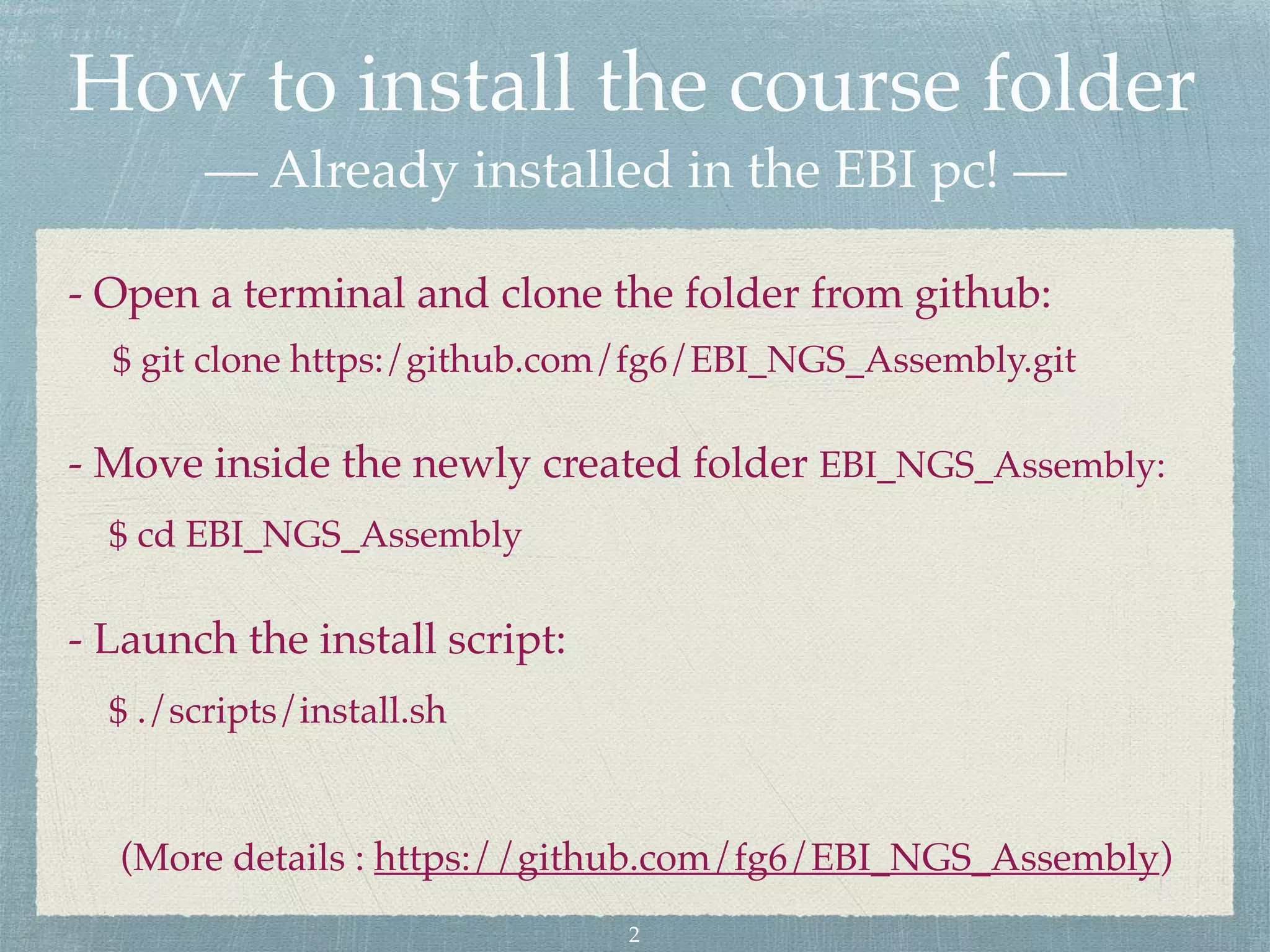
How to install the course folder
— Already installed in the EBI pc! —
- Open a terminal and clone the folder from github:
$ git clone https:/github.com/fg6/EBI_NGS_Assembly.git
- Move inside the newly created folder EBI_NGS_Assembly:
$ cd EBI_NGS_Assembly
- Launch the install script:
$ ./scripts/install.sh
(More details : https://github.com/fg6/EBI_NGS_Assembly)
2
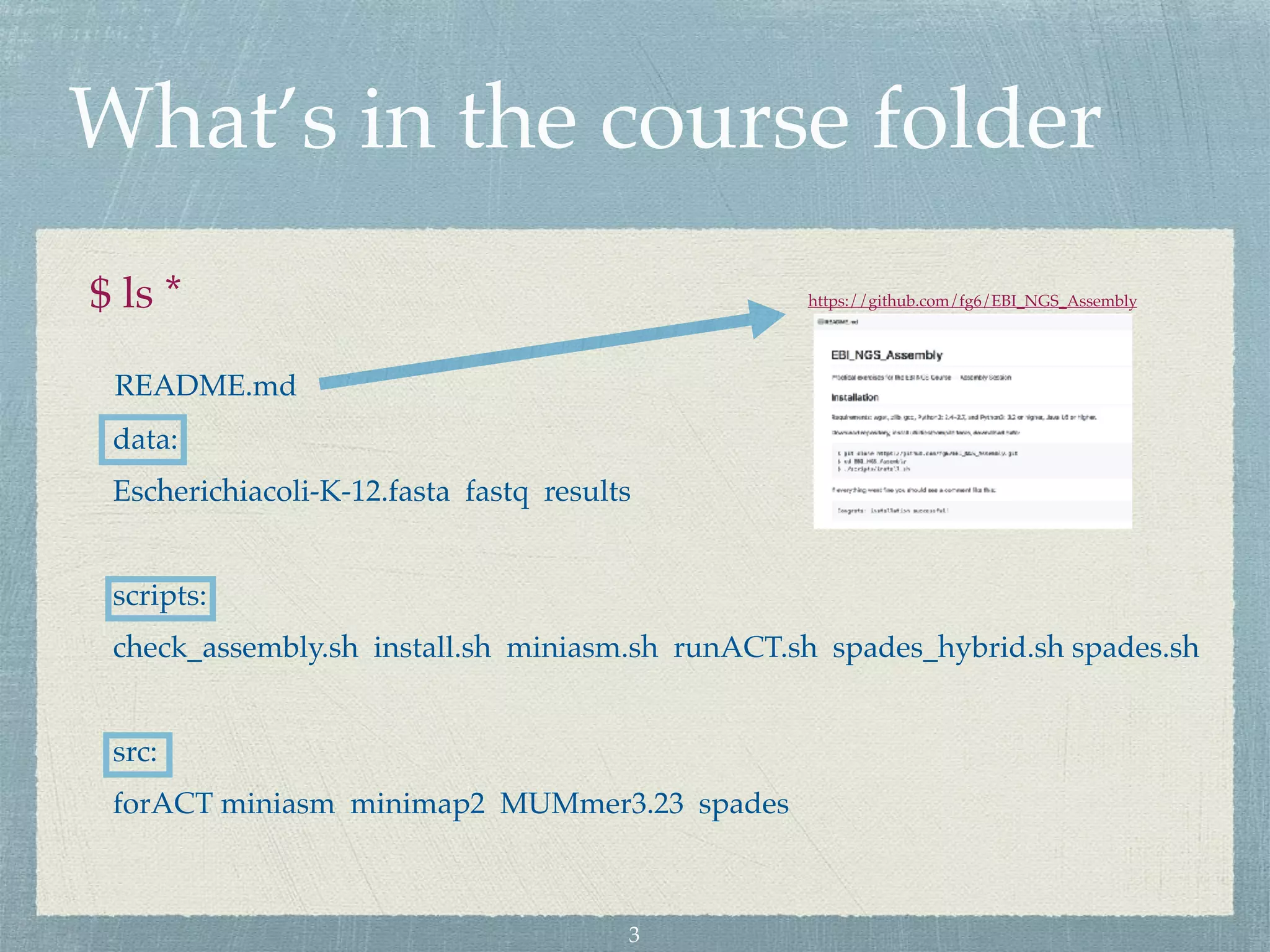
What’s in the course folder
$ ls *
README.md
data:
Escherichiacoli-K-12.fasta fastq results
scripts:
check_assembly.sh install.sh miniasm.sh runACT.sh spades_hybrid.sh spades.sh
src:
forACT miniasm minimap2 MUMmer3.23 spades
https://github.com/fg6/EBI_NGS_Assembly
3
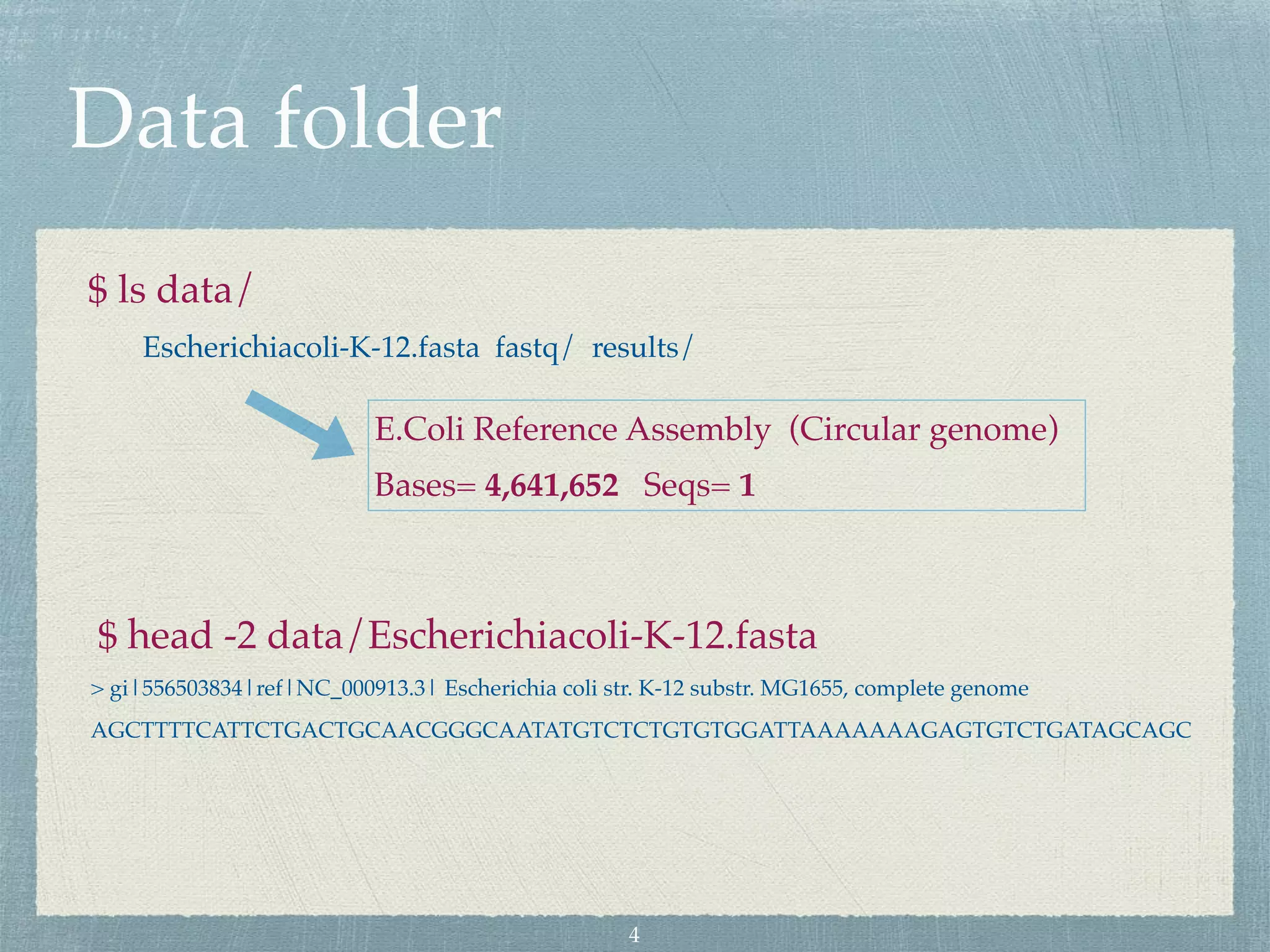
Data folder
$ ls data/
Escherichiacoli-K-12.fasta fastq/ results/
$ head -2 data/Escherichiacoli-K-12.fasta
> gi|556503834|ref|NC_000913.3| Escherichia coli str. K-12 substr. MG1655, complete genome
AGCTTTTCATTCTGACTGCAACGGGCAATATGTCTCTGTGTGGATTAAAAAAAGAGTGTCTGATAGCAGC
E.Coli Reference Assembly (Circular genome)
Bases= 4,641,652 Seqs= 1
4
Data folder
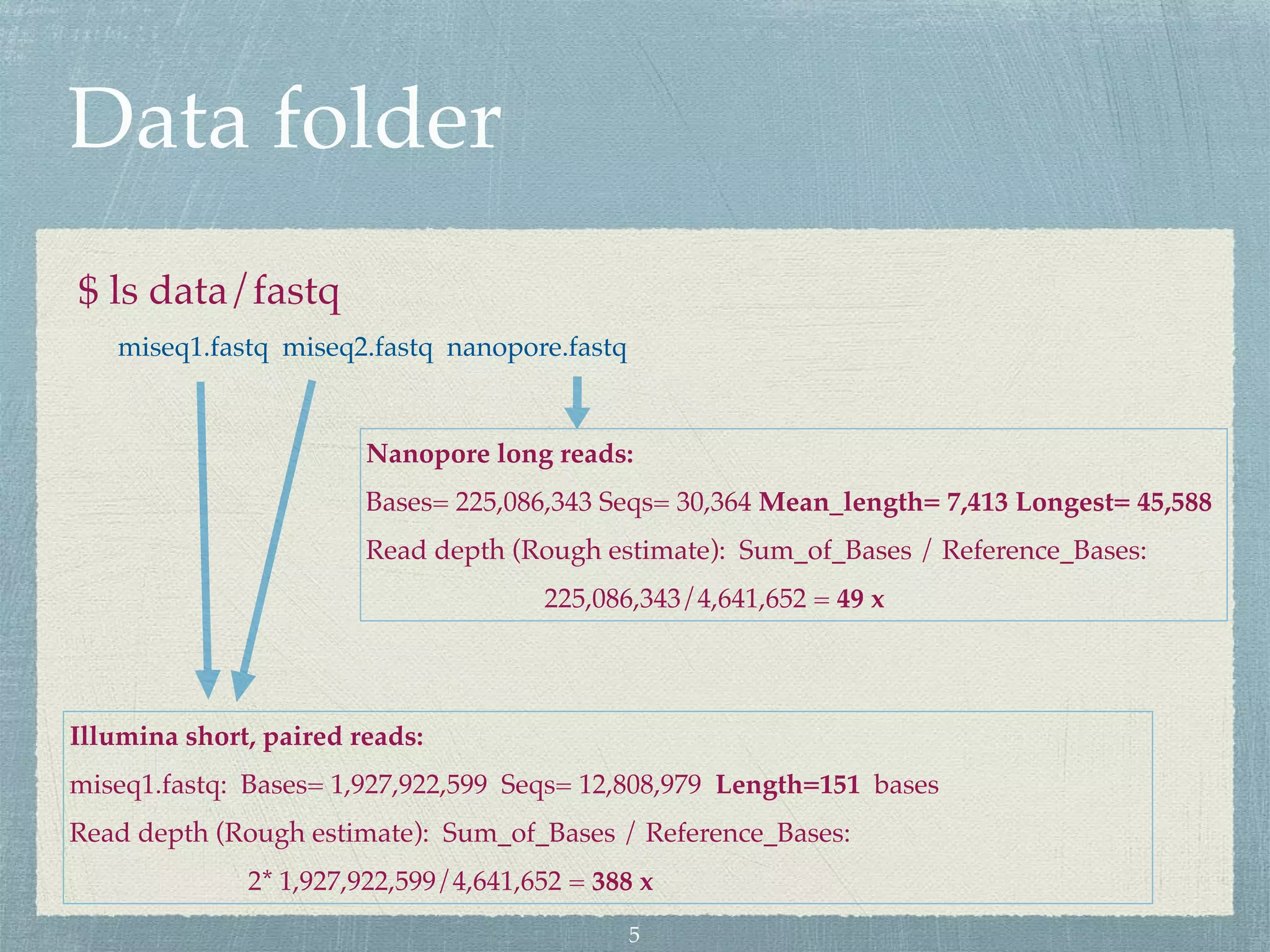
$ ls data/fastq
miseq1.fastq miseq2.fastq nanopore.fastq
Illumina short, paired reads:
miseq1.fastq: Bases= 1,927,922,599 Seqs= 12,808,979 Length=151 bases
Read depth (Rough estimate): Sum_of_Bases / Reference_Bases:
2* 1,927,922,599/4,641,652 = 388 x
Nanopore long reads:
Bases= 225,086,343 Seqs= 30,364 Mean_length= 7,413 Longest= 45,588
Read depth (Rough estimate): Sum_of_Bases / Reference_Bases:
225,086,343/4,641,652 = 49 x
5
Data folder
$ ls data/results/*
data/results/act:
act_hybridspades_contigs act_hybridspades_scaffolds act_miniasm
act_spades_contigs act_spades_scaffolds
data/results/assemblies:
hybridspades_contigs.fasta hybridspades_scaffolds.fasta miniasm.fasta
spades_contigs.fasta spades_scaffolds.fasta
These are the assemblies and the alignment files for the ACT visualisation that the
pipelines create. They are added here to compare with your results, but also because
some of the pipelines takes too long and we will not be running them: if you wish you
can try to run them on your own.
6
Check an assembly Stats:
scripts/check_assembly.sh
Once an assembly is generated it needs to be assessed: evaluating a few stats can be
helpful to understand the quality of your assembly.
We can use the script scripts/check_assembly.sh to estimates a few stats and assess the
average identity with respect to the reference.
check_assembly.sh has 2 steps:
1. an executable called n50 that estimates assembly total number of bases, total
number of contigs and more stats
2. dnadiff: a pipeline from MUMmer that map the assembly against the reference and
estimate percentage of the reference covered and average identity of the assembly with
respect to the reference (among other things..)
$ ./scripts/check_assembly.sh
Usage: check_assembly.sh assembly.fasta reference.fasta
7
Check an assembly stats
$ ./scripts/check_assembly.sh data/results/assemblies/spades_contigs.fasta 
data/Escherichiacoli-K-12.fasta
Bases= 4611519 contigs= 279 mean_length= 16529 longest= 414005 N50= 129100 n= 12
Assembly stats saved in /home/training/EBI_NGS_Assembly/results/report/
report_spades_contigs/n50.stats
Dnadiff results are in file /home/training/EBI_NGS_Assembly/results/report/
report_spades_contigs/out.report
AvgIdentity 99.97 99.97
8
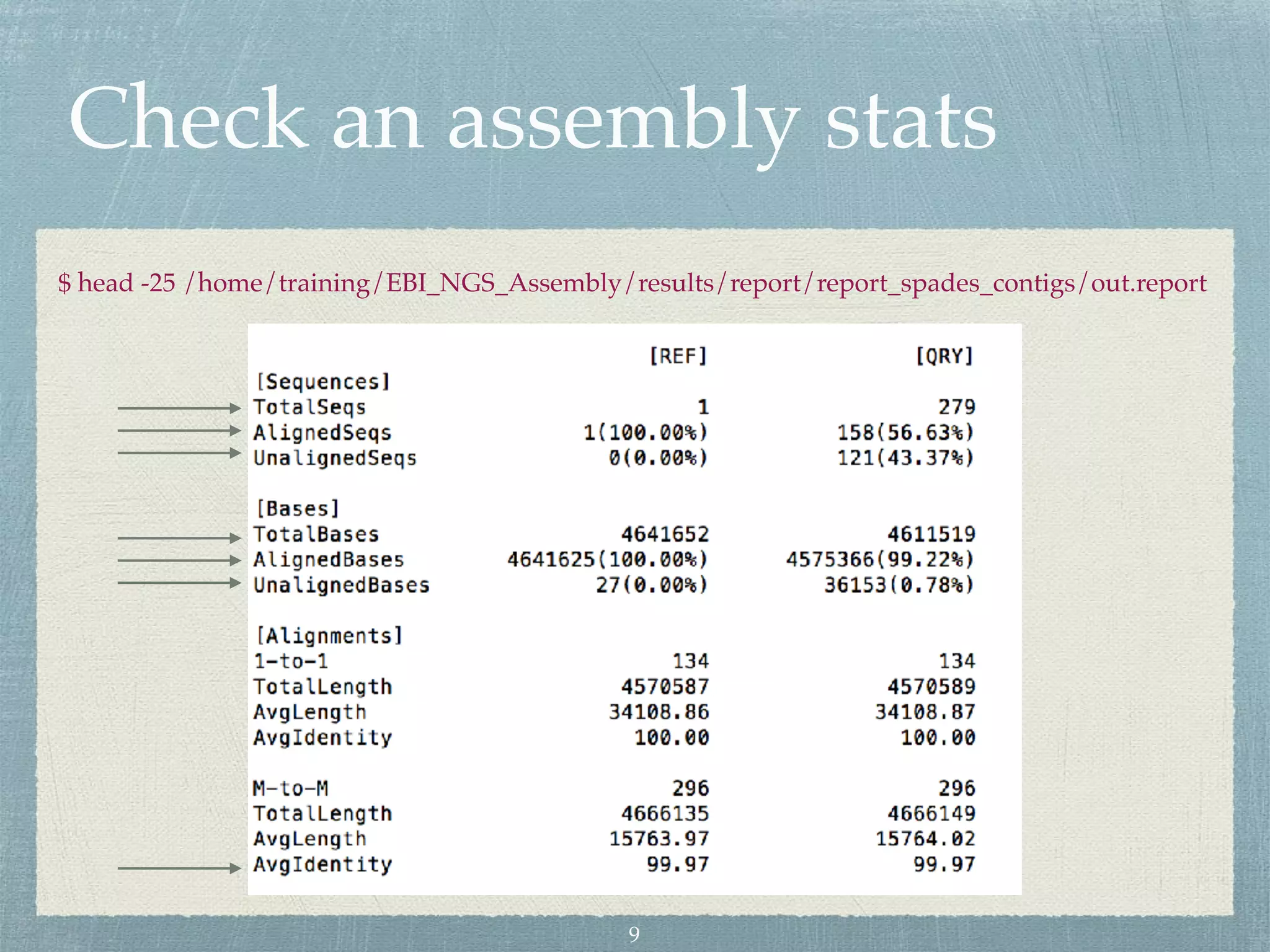
Check an assembly stats
$ head -25 /home/training/EBI_NGS_Assembly/results/report/report_spades_contigs/out.report
9
Exercise 1: Assembly the long reads
using MiniAsm
The pipeline has two steps:
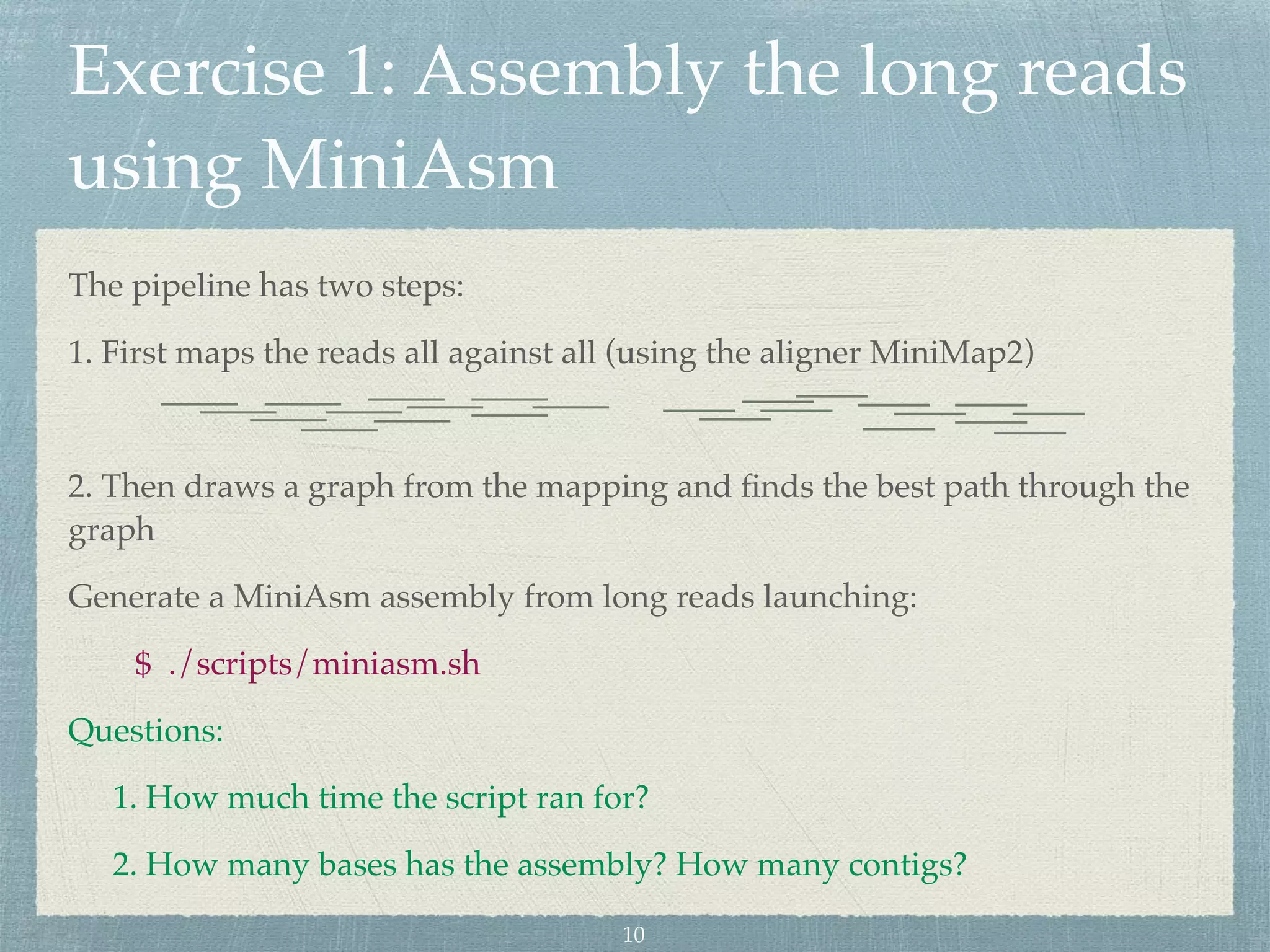
1. First maps the reads all against all (using the aligner MiniMap2)
2. Then draws a graph from the mapping and finds the best path through the
graph
Generate a MiniAsm assembly from long reads launching:
$ ./scripts/miniasm.sh
Questions:
1. How much time the script ran for?
2. How many bases has the assembly? How many contigs?
10
Exercise 1: — Results
Questions:
1. How much time the script ran for?
Launch in this way to find out:
$ time ./scripts/miniasm.sh
2. How many bases has the assembly? How many contigs?
Bases: 4,544,451
Contigs: 1
11
Exercise 2: — Compare long reads
and short reads-based assemblies
Check the assembly stats for the long read assembly:
results/miniasm/miniasm.fasta
and the short read assembly from SPAdes:
data/results/assemblies/spades_contigs.fasta
Questions:
1. Which has the higher average identity? Can you guess why?
2. Which has the longest contigs? Can you guess why?
3. How many sequences are aligned in both cases? How much of the reference is
covered?
12
Exercise 2: — Compare long reads
and short reads -based assemblies
Questions:
1. Which has the higher average identity? Can you guess why
The SPAdes assembly has higher avg id: 99.97%, against the miniasm avg id: 88.90%.
The reason is that the illumina reads are more accurate and contain less base-errors (<~1%) than the
Oxford Nanopore reads (up to 20%).
Also: higher depth means higher accuracy, and we saw the short reads have higher depth.
2. Which has the longest contigs? Can you guess why?
MiniAsm generates a unique contig that cover the whole reference. The shorter the reads the more
fragmented the assembly.
3. How many sequences are aligned in both cases? How much of the reference is
covered?
MiniAsm : 1 seq aligned, covers 95% of reference; SPAdes: 158 seqs aligned, cover 100% of
reference
13
Exercise 3: — Hybrid assembly
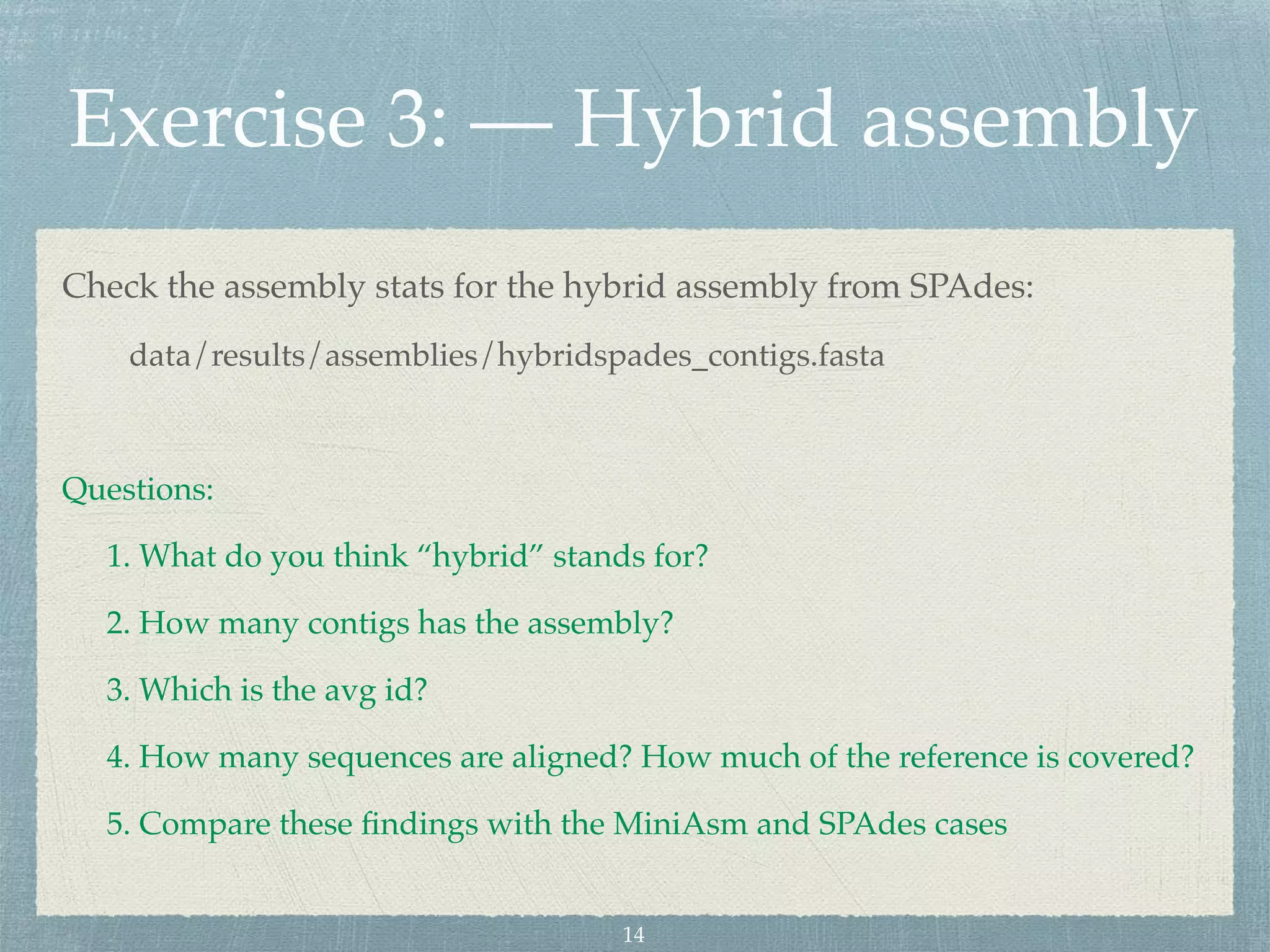
Check the assembly stats for the hybrid assembly from SPAdes:
data/results/assemblies/hybridspades_contigs.fasta
Questions:
1. What do you think “hybrid” stands for?
2. How many contigs has the assembly?
3. Which is the avg id?
4. How many sequences are aligned? How much of the reference is covered?
5. Compare these findings with the MiniAsm and SPAdes cases
14
Exercise 3: — Hybrid assembly
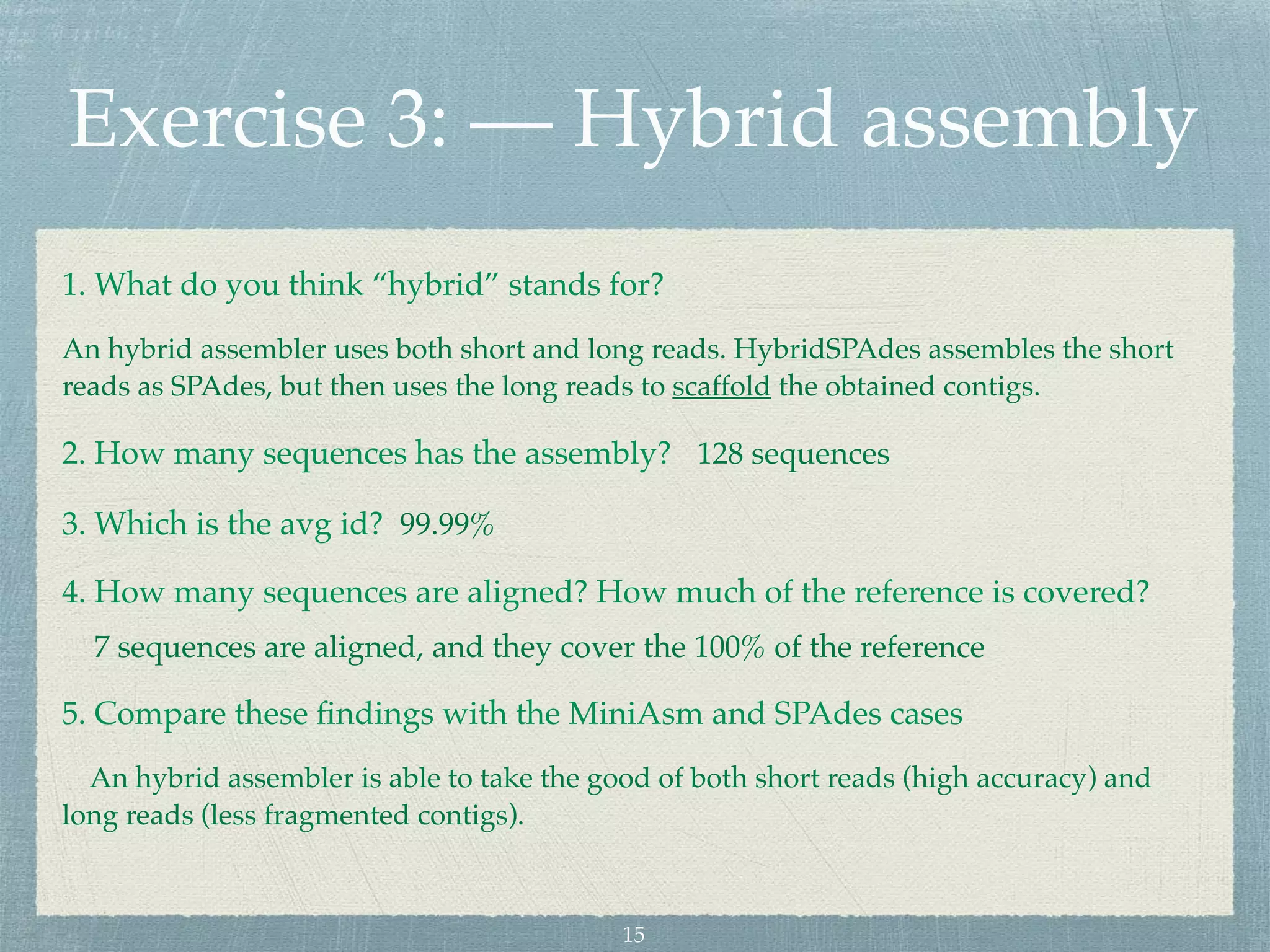
1. What do you think “hybrid” stands for?
An hybrid assembler uses both short and long reads. HybridSPAdes assembles the short
reads as SPAdes, but then uses the long reads to scaffold the obtained contigs.
2. How many sequences has the assembly? 128 sequences
3. Which is the avg id? 99.99%
4. How many sequences are aligned? How much of the reference is covered?
7 sequences are aligned, and they cover the 100% of the reference
5. Compare these findings with the MiniAsm and SPAdes cases
An hybrid assembler is able to take the good of both short reads (high accuracy) and
long reads (less fragmented contigs).
15
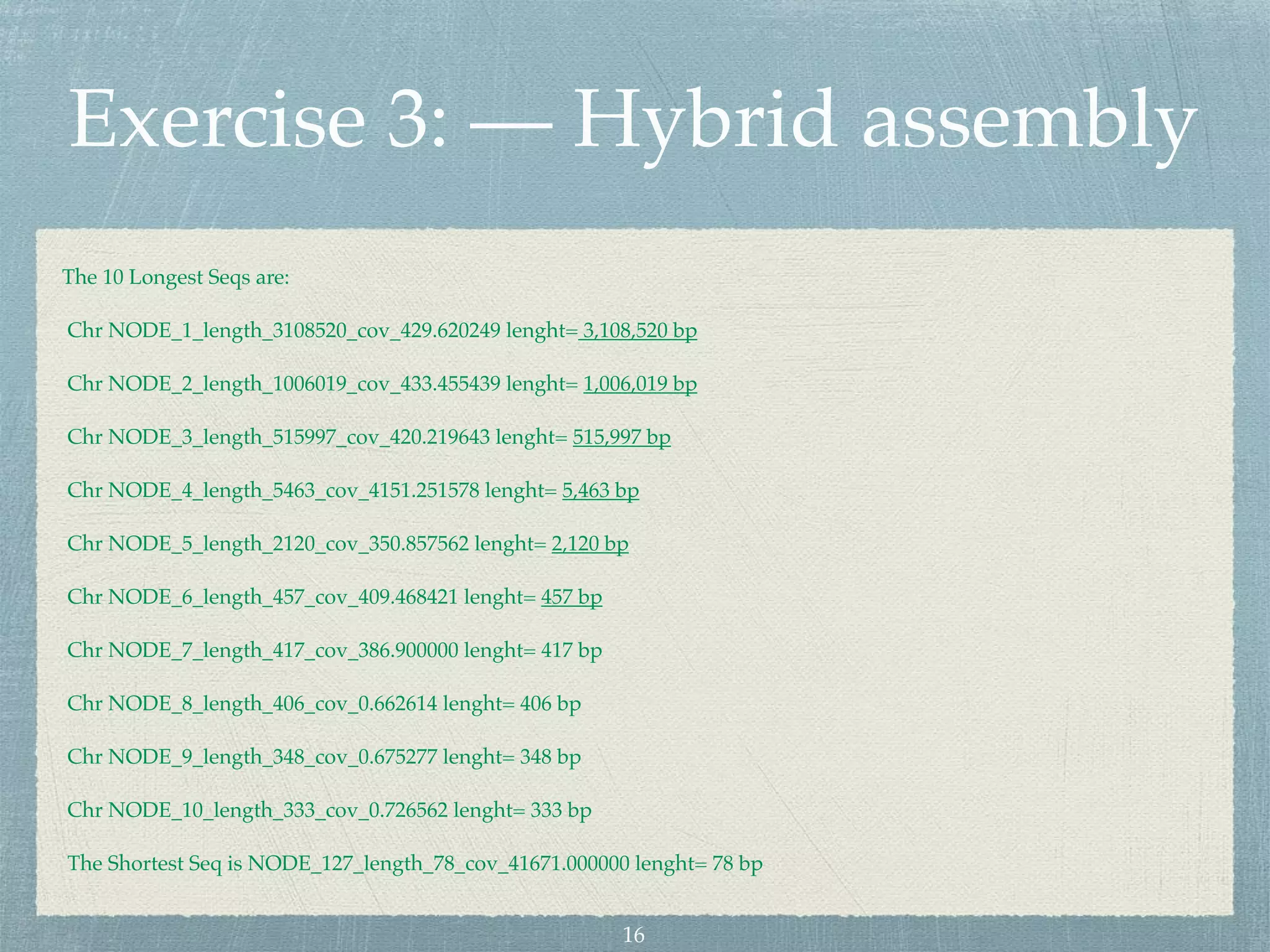
The 10 Longest Seqs are:
Chr NODE_1_length_3108520_cov_429.620249 lenght= 3,108,520 bp
Chr NODE_2_length_1006019_cov_433.455439 lenght= 1,006,019 bp
Chr NODE_3_length_515997_cov_420.219643 lenght= 515,997 bp
Chr NODE_4_length_5463_cov_4151.251578 lenght= 5,463 bp
Chr NODE_5_length_2120_cov_350.857562 lenght= 2,120 bp
Chr NODE_6_length_457_cov_409.468421 lenght= 457 bp
Chr NODE_7_length_417_cov_386.900000 lenght= 417 bp
Chr NODE_8_length_406_cov_0.662614 lenght= 406 bp
Chr NODE_9_length_348_cov_0.675277 lenght= 348 bp
Chr NODE_10_length_333_cov_0.726562 lenght= 333 bp
The Shortest Seq is NODE_127_length_78_cov_41671.000000 lenght= 78 bp
Exercise 3: — Hybrid assembly
16
Visualisation: Artemis ACT
http://www.sanger.ac.uk/science/tools/artemis
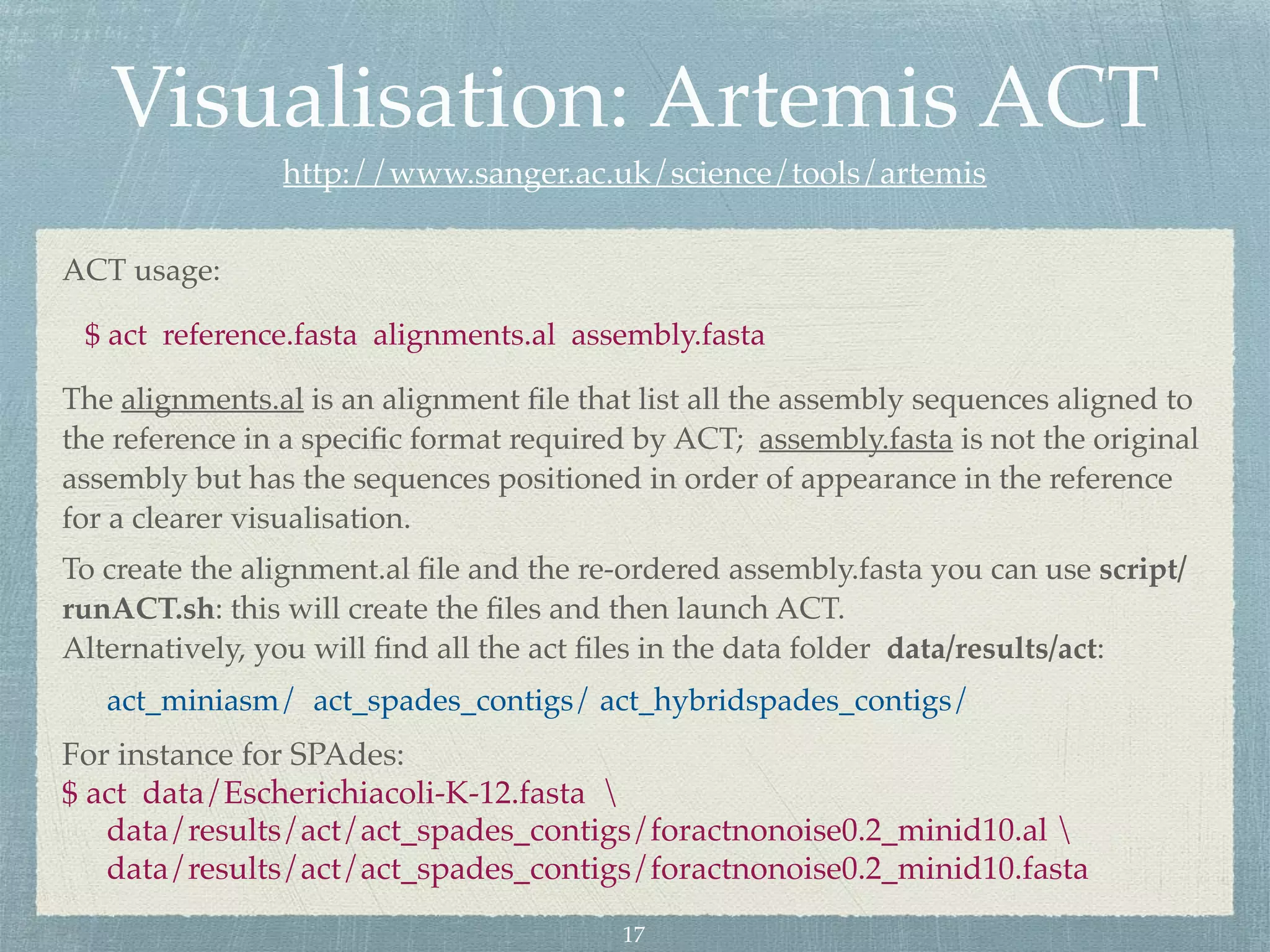
ACT usage:
$ act reference.fasta alignments.al assembly.fasta
The alignments.al is an alignment file that list all the assembly sequences aligned to
the reference in a specific format required by ACT; assembly.fasta is not the original
assembly but has the sequences positioned in order of appearance in the reference
for a clearer visualisation.
To create the alignment.al file and the re-ordered assembly.fasta you can use script/
runACT.sh: this will create the files and then launch ACT.
Alternatively, you will find all the act files in the data folder data/results/act:
act_miniasm/ act_spades_contigs/ act_hybridspades_contigs/
For instance for SPAdes:
$ act data/Escherichiacoli-K-12.fasta 
data/results/act/act_spades_contigs/foractnonoise0.2_minid10.al 
data/results/act/act_spades_contigs/foractnonoise0.2_minid10.fasta
17
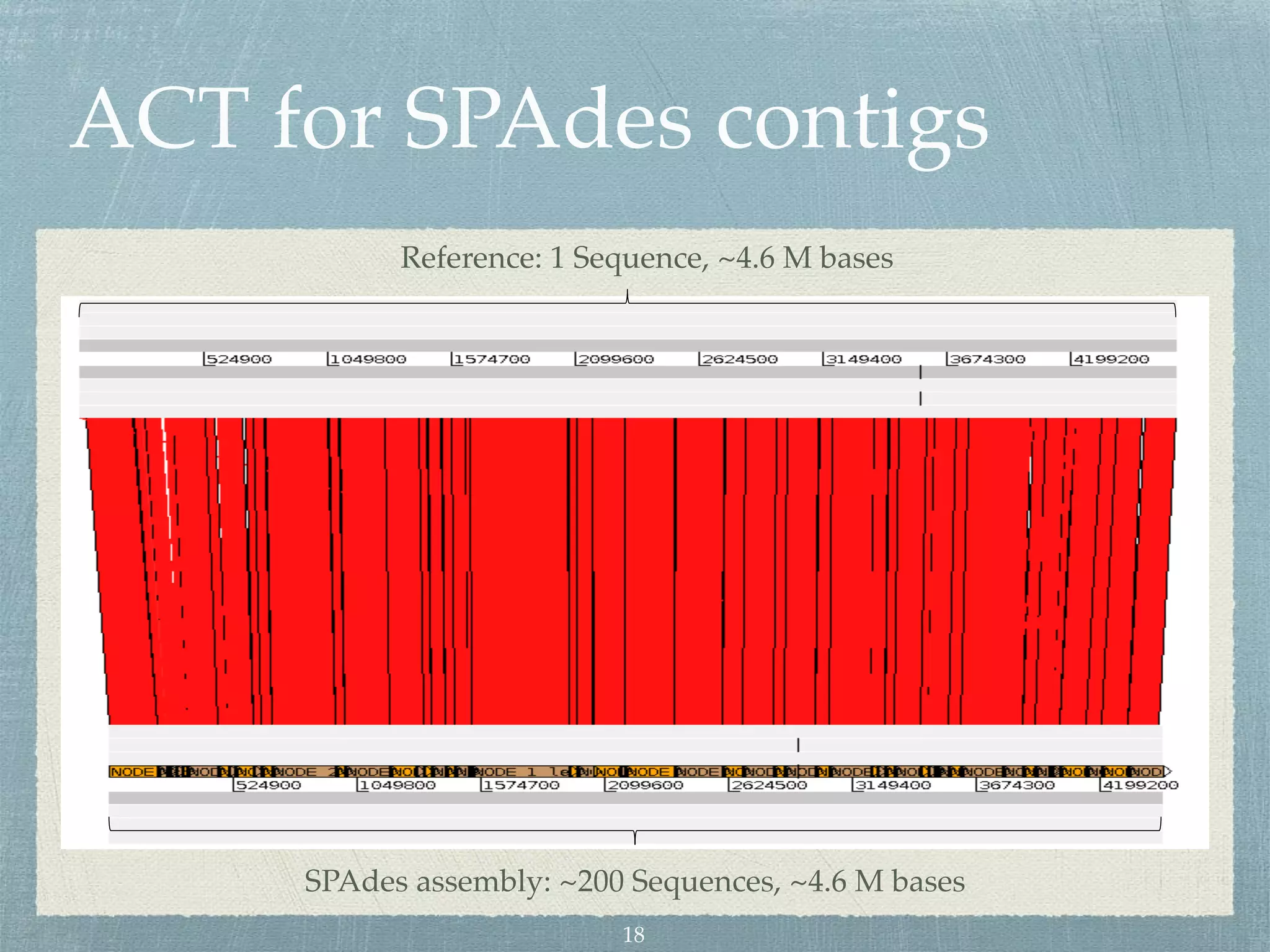
ACT for SPAdes contigs
Reference: 1 Sequence, ~4.6 M bases
SPAdes assembly: ~200 Sequences, ~4.6 M bases
18
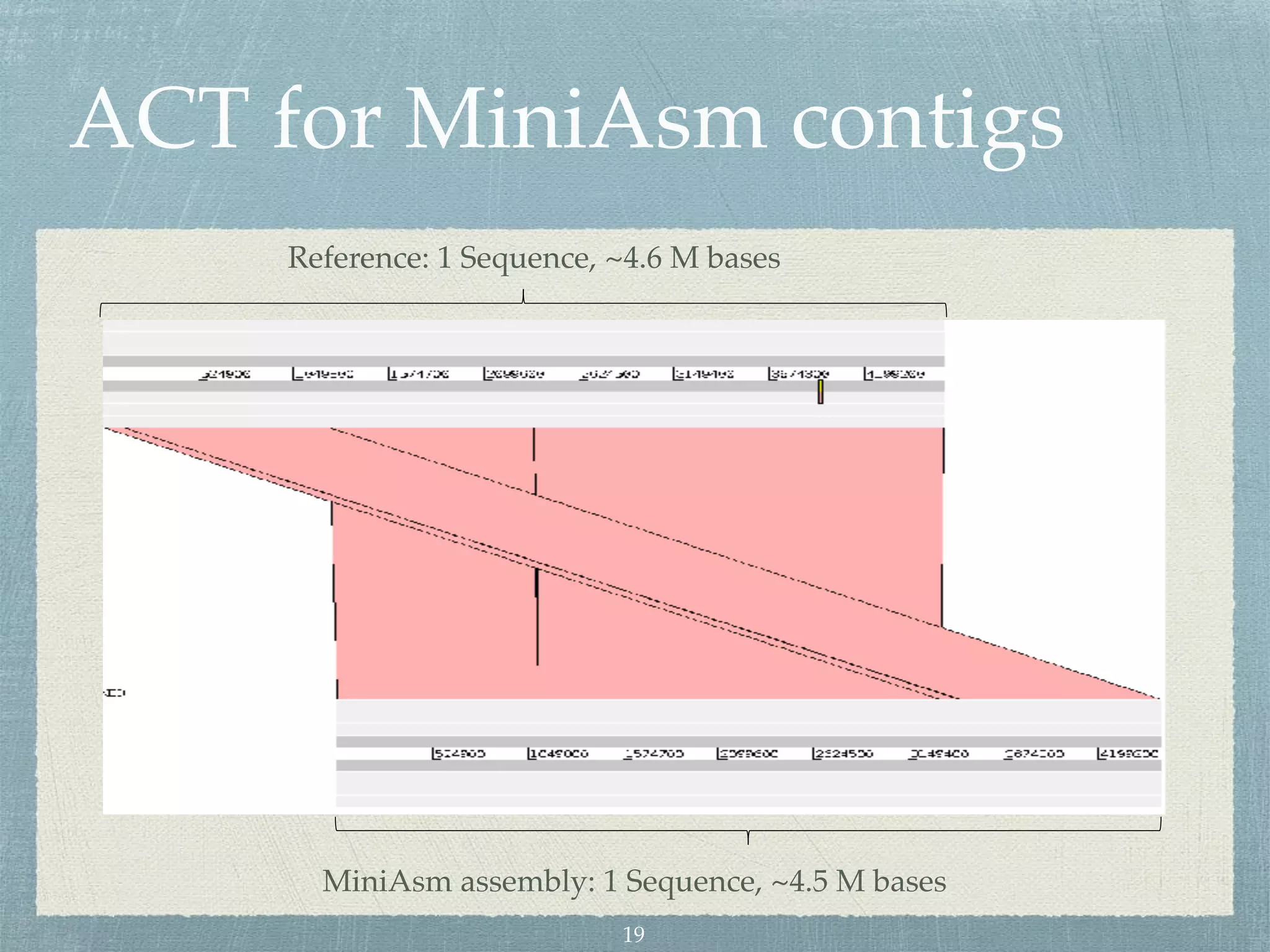
Reference: 1 Sequence, ~4.6 M bases
MiniAsm assembly: 1 Sequence, ~4.5 M bases
19
ACT for MiniAsm contigs
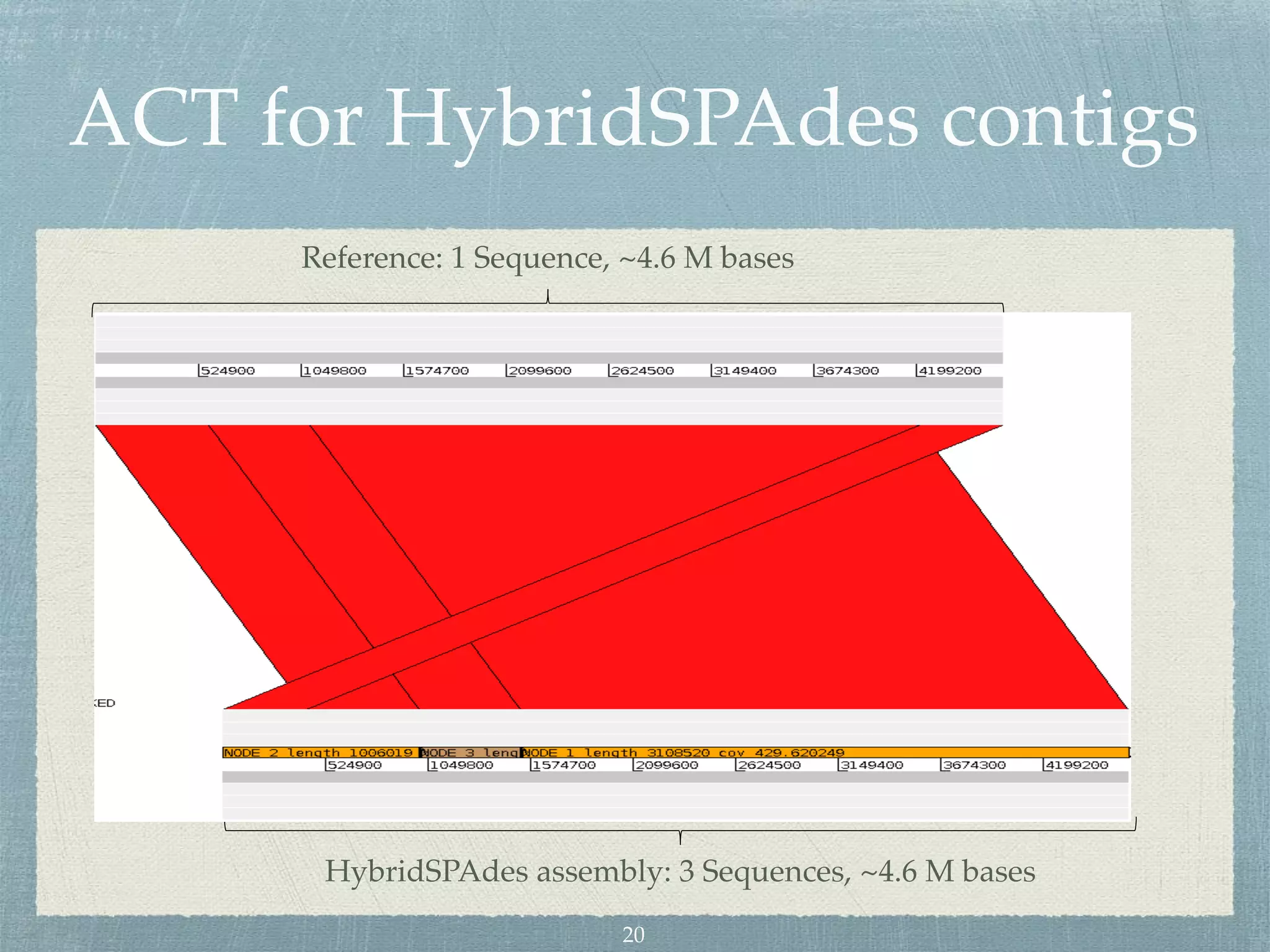
ACT for HybridSPAdes contigs
Reference: 1 Sequence, ~4.6 M bases
HybridSPAdes assembly: 3 Sequences, ~4.6 M bases
20

NGS Assembly Practical Lesson (EBI course)

  • 1.
    Intro to NGS —Assembly: practical examples — Zemin Ning, Francesca Giordano 1
  • 2.
    How to installthe course folder — Already installed in the EBI pc! — - Open a terminal and clone the folder from github: $ git clone https:/github.com/fg6/EBI_NGS_Assembly.git - Move inside the newly created folder EBI_NGS_Assembly: $ cd EBI_NGS_Assembly - Launch the install script: $ ./scripts/install.sh (More details : https://github.com/fg6/EBI_NGS_Assembly) 2
  • 3.
    What’s in thecourse folder $ ls * README.md data: Escherichiacoli-K-12.fasta fastq results scripts: check_assembly.sh install.sh miniasm.sh runACT.sh spades_hybrid.sh spades.sh src: forACT miniasm minimap2 MUMmer3.23 spades https://github.com/fg6/EBI_NGS_Assembly 3
  • 4.
    Data folder $ lsdata/ Escherichiacoli-K-12.fasta fastq/ results/ $ head -2 data/Escherichiacoli-K-12.fasta > gi|556503834|ref|NC_000913.3| Escherichia coli str. K-12 substr. MG1655, complete genome AGCTTTTCATTCTGACTGCAACGGGCAATATGTCTCTGTGTGGATTAAAAAAAGAGTGTCTGATAGCAGC E.Coli Reference Assembly (Circular genome) Bases= 4,641,652 Seqs= 1 4
  • 5.
    Data folder $ lsdata/fastq miseq1.fastq miseq2.fastq nanopore.fastq Illumina short, paired reads: miseq1.fastq: Bases= 1,927,922,599 Seqs= 12,808,979 Length=151 bases Read depth (Rough estimate): Sum_of_Bases / Reference_Bases: 2* 1,927,922,599/4,641,652 = 388 x Nanopore long reads: Bases= 225,086,343 Seqs= 30,364 Mean_length= 7,413 Longest= 45,588 Read depth (Rough estimate): Sum_of_Bases / Reference_Bases: 225,086,343/4,641,652 = 49 x 5
  • 6.
    Data folder $ lsdata/results/* data/results/act: act_hybridspades_contigs act_hybridspades_scaffolds act_miniasm act_spades_contigs act_spades_scaffolds data/results/assemblies: hybridspades_contigs.fasta hybridspades_scaffolds.fasta miniasm.fasta spades_contigs.fasta spades_scaffolds.fasta These are the assemblies and the alignment files for the ACT visualisation that the pipelines create. They are added here to compare with your results, but also because some of the pipelines takes too long and we will not be running them: if you wish you can try to run them on your own. 6
  • 7.
    Check an assemblyStats: scripts/check_assembly.sh Once an assembly is generated it needs to be assessed: evaluating a few stats can be helpful to understand the quality of your assembly. We can use the script scripts/check_assembly.sh to estimates a few stats and assess the average identity with respect to the reference. check_assembly.sh has 2 steps: 1. an executable called n50 that estimates assembly total number of bases, total number of contigs and more stats 2. dnadiff: a pipeline from MUMmer that map the assembly against the reference and estimate percentage of the reference covered and average identity of the assembly with respect to the reference (among other things..) $ ./scripts/check_assembly.sh Usage: check_assembly.sh assembly.fasta reference.fasta 7
  • 8.
    Check an assemblystats $ ./scripts/check_assembly.sh data/results/assemblies/spades_contigs.fasta data/Escherichiacoli-K-12.fasta Bases= 4611519 contigs= 279 mean_length= 16529 longest= 414005 N50= 129100 n= 12 Assembly stats saved in /home/training/EBI_NGS_Assembly/results/report/ report_spades_contigs/n50.stats Dnadiff results are in file /home/training/EBI_NGS_Assembly/results/report/ report_spades_contigs/out.report AvgIdentity 99.97 99.97 8
  • 9.
    Check an assemblystats $ head -25 /home/training/EBI_NGS_Assembly/results/report/report_spades_contigs/out.report 9
  • 10.
    Exercise 1: Assemblythe long reads using MiniAsm The pipeline has two steps: 1. First maps the reads all against all (using the aligner MiniMap2) 2. Then draws a graph from the mapping and finds the best path through the graph Generate a MiniAsm assembly from long reads launching: $ ./scripts/miniasm.sh Questions: 1. How much time the script ran for? 2. How many bases has the assembly? How many contigs? 10
  • 11.
    Exercise 1: —Results Questions: 1. How much time the script ran for? Launch in this way to find out: $ time ./scripts/miniasm.sh 2. How many bases has the assembly? How many contigs? Bases: 4,544,451 Contigs: 1 11
  • 12.
    Exercise 2: —Compare long reads and short reads-based assemblies Check the assembly stats for the long read assembly: results/miniasm/miniasm.fasta and the short read assembly from SPAdes: data/results/assemblies/spades_contigs.fasta Questions: 1. Which has the higher average identity? Can you guess why? 2. Which has the longest contigs? Can you guess why? 3. How many sequences are aligned in both cases? How much of the reference is covered? 12
  • 13.
    Exercise 2: —Compare long reads and short reads -based assemblies Questions: 1. Which has the higher average identity? Can you guess why The SPAdes assembly has higher avg id: 99.97%, against the miniasm avg id: 88.90%. The reason is that the illumina reads are more accurate and contain less base-errors (<~1%) than the Oxford Nanopore reads (up to 20%). Also: higher depth means higher accuracy, and we saw the short reads have higher depth. 2. Which has the longest contigs? Can you guess why? MiniAsm generates a unique contig that cover the whole reference. The shorter the reads the more fragmented the assembly. 3. How many sequences are aligned in both cases? How much of the reference is covered? MiniAsm : 1 seq aligned, covers 95% of reference; SPAdes: 158 seqs aligned, cover 100% of reference 13
  • 14.
    Exercise 3: —Hybrid assembly Check the assembly stats for the hybrid assembly from SPAdes: data/results/assemblies/hybridspades_contigs.fasta Questions: 1. What do you think “hybrid” stands for? 2. How many contigs has the assembly? 3. Which is the avg id? 4. How many sequences are aligned? How much of the reference is covered? 5. Compare these findings with the MiniAsm and SPAdes cases 14
  • 15.
    Exercise 3: —Hybrid assembly 1. What do you think “hybrid” stands for? An hybrid assembler uses both short and long reads. HybridSPAdes assembles the short reads as SPAdes, but then uses the long reads to scaffold the obtained contigs. 2. How many sequences has the assembly? 128 sequences 3. Which is the avg id? 99.99% 4. How many sequences are aligned? How much of the reference is covered? 7 sequences are aligned, and they cover the 100% of the reference 5. Compare these findings with the MiniAsm and SPAdes cases An hybrid assembler is able to take the good of both short reads (high accuracy) and long reads (less fragmented contigs). 15
  • 16.
    The 10 LongestSeqs are: Chr NODE_1_length_3108520_cov_429.620249 lenght= 3,108,520 bp Chr NODE_2_length_1006019_cov_433.455439 lenght= 1,006,019 bp Chr NODE_3_length_515997_cov_420.219643 lenght= 515,997 bp Chr NODE_4_length_5463_cov_4151.251578 lenght= 5,463 bp Chr NODE_5_length_2120_cov_350.857562 lenght= 2,120 bp Chr NODE_6_length_457_cov_409.468421 lenght= 457 bp Chr NODE_7_length_417_cov_386.900000 lenght= 417 bp Chr NODE_8_length_406_cov_0.662614 lenght= 406 bp Chr NODE_9_length_348_cov_0.675277 lenght= 348 bp Chr NODE_10_length_333_cov_0.726562 lenght= 333 bp The Shortest Seq is NODE_127_length_78_cov_41671.000000 lenght= 78 bp Exercise 3: — Hybrid assembly 16
  • 17.
    Visualisation: Artemis ACT http://www.sanger.ac.uk/science/tools/artemis ACTusage: $ act reference.fasta alignments.al assembly.fasta The alignments.al is an alignment file that list all the assembly sequences aligned to the reference in a specific format required by ACT; assembly.fasta is not the original assembly but has the sequences positioned in order of appearance in the reference for a clearer visualisation. To create the alignment.al file and the re-ordered assembly.fasta you can use script/ runACT.sh: this will create the files and then launch ACT. Alternatively, you will find all the act files in the data folder data/results/act: act_miniasm/ act_spades_contigs/ act_hybridspades_contigs/ For instance for SPAdes: $ act data/Escherichiacoli-K-12.fasta data/results/act/act_spades_contigs/foractnonoise0.2_minid10.al data/results/act/act_spades_contigs/foractnonoise0.2_minid10.fasta 17
  • 18.
    ACT for SPAdescontigs Reference: 1 Sequence, ~4.6 M bases SPAdes assembly: ~200 Sequences, ~4.6 M bases 18
  • 19.
    Reference: 1 Sequence,~4.6 M bases MiniAsm assembly: 1 Sequence, ~4.5 M bases 19 ACT for MiniAsm contigs
  • 20.
    ACT for HybridSPAdescontigs Reference: 1 Sequence, ~4.6 M bases HybridSPAdes assembly: 3 Sequences, ~4.6 M bases 20