NG911: Time to
dispatch = 15 years and
counting
HENNING SCHULZRINNE
COLUMBIA UNIVERSITY & FCC (WITH USUAL DISCLAIMERS)
7/23/16 TEMU 2016 1
Emergency
communication in the
United States
7/23/16 TEMU 2016 2
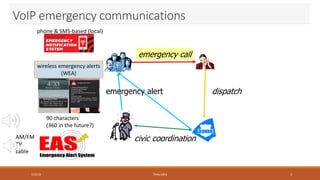
VoIP emergency communications
7/23/16
emergency call
dispatch
civic coordination
emergency alert
TEMU 2016 3
90 characters
(360 in the future?)
wireless emergency alerts
(WEA)
phone & SMS-based (local)
AM/FM
TV
cable
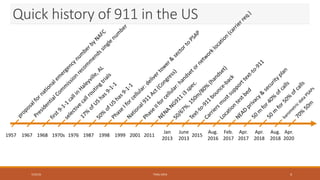
Quick history of 911 in the US
7/23/16 TEMU 2016 4
1957 1967 1968 1970s 1976 1987 1998 2001
Jan
2013
20111999 2015
June
2013
Aug.
2016
Feb.
2017
Apr.
2017
Apr.
2018
Aug.
2018
Apr.
2020
What distinguishes US 911 from elsewhere?
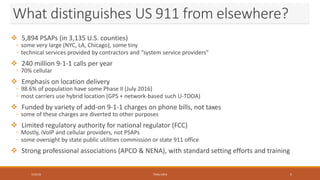
 5,894 PSAPs (in 3,135 U.S. counties)
◦ some very large (NYC, LA, Chicago), some tiny
◦ technical services provided by contractors and “system service providers”
 240 million 9-1-1 calls per year
◦ 70% cellular
 Emphasis on location delivery
◦ 98.6% of population have some Phase II (July 2016)
◦ most carriers use hybrid location (GPS + network-based such U-TDOA)
 Funded by variety of add-on 9-1-1 charges on phone bills, not taxes
◦ some of these charges are diverted to other purposes
 Limited regulatory authority for national regulator (FCC)
◦ Mostly, iVoIP and cellular providers, not PSAPs
◦ some oversight by state public utilities commission or state 911 office
 Strong professional associations (APCO & NENA), with standard setting efforts and training
7/23/16 TEMU 2016 5
TEMU 2016
What do we need for emergency calling?
Identify
emergency call
Route call to
PSAP
Dispatch first
responder
numbers depend
on location
at least cell & sector,
preferably full geo (say,
100 m)
indoor & outdoor
dispatchable
location
location
7/23/16 TEMU 2016 6
E911  NG911
7/23/16 TEMU 2016 7
TEMU 2016
E911 vs. NG911
Identify
emergency call
Route call to
PSAP
Dispatch first
responder
112, 911 (in SIM)E911
NG911
dial number from ECRF
sos URN
ALI + MSAG  selective
router (SR)
based on street address
location  ECRF
ESRP
landline: ALI  civic
(static)
wireless: ALI  geo (dyn.)
SIP Geolocation header
7/23/16 TEMU 2016 8
E9-1-1 for wireline
EO Switch Selective Router
or 911 Tandem
LEC
network
555-1234
313 Main St
ALI
100-500 Main Street  ESN 1789
555-1234  PSAP #1, 313 Main St
CAMA or PRI
delivers ANI
(555-1234)CAMA or SS7
ANI: 555-1234
 313 Main
555-1234
 PSAP #1
PSAP #1
verify address
validity
provisioned
updates
private
data link
MSAG
7/23/16 TEMU 2016 9
TEMU 2016
Different sources for emergency calls
7/23/16
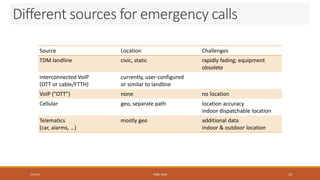
Source Location Challenges
TDM landline civic, static rapidly fading; equipment
obsolete
interconnected VoIP
(OTT or cable/FTTH)
currently, user-configured
or similar to landline
VoIP (“OTT”) none no location
Cellular geo, separate path location accuracy
indoor dispatchable location
Telematics
(car, alarms, …)
mostly geo additional data
indoor & outdoor location
TEMU 2016 10
TEMU 2016
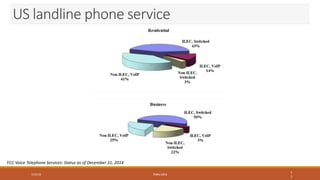
US landline phone service
1
1
FCC Voice Telephone Services: Status as of December 31, 2014
7/23/16 TEMU 2016
About half of households are wireless-only
7/23/16 TEMU 2016 12
Wireless 911
 Phase I (April 1998)
◦ Route all call to the appropriate PSAP based on call sector
◦ Provide cell/sector location data to PSAP
◦ Provide call back number to PSAP
 Phase II (October 2001)
◦ Phase I + latitude and longitude
67% 95%
handset 50m 150m
network 100m 300m
7/23/16 TEMU 2016 13
TEMU 2016
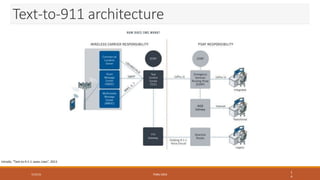
Text-to-911 architecture
1
4
Intrado, “Text-to-9-1-1 saves Lives”, 2013
7/23/16 TEMU 2016
7/23/16 TEMU 2016 15
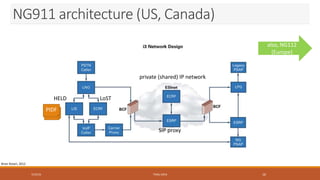
NG911 architecture (US, Canada)
Brian Rosen, 2012
SIP proxy
LoSTHELD
private (shared) IP network
PIDFPIDF
also, NG112
(Europe)
7/23/16 TEMU 2016 16
Emergency Call Routing Function
Queried using LoST Protocol
Location and Service in, URI out
External ECRF provided by 9-1-1 Authority
Location Information Server
Stores location against some kind of key
Provided by Access Network
Uses either DHCP or HELD to give location to
end device
Border Control Function
Security barrier between
origination/access networks and
ESInet
Combination of firewall and Session
Border Controller
Emergency Services Routing Proxy
Call Router for ESInet
Uses ECRF to get next hop route
Policy Controlled Routing
Legacy Network Gateway
Looks like SR/ALI to legacy
network
Routes using ECRF to ESInet
Legacy PSAP Gateway
Looks like SR/ALI to
unupgraded PSAP
7/23/16 TEMU 2016 17
Insanity is … Doing something 6,200 times
and expecting a speedy result.
(Einstein + Heisenberg)
7/23/16 TEMU 2016 18
TEMU 2016
US NG911 status
2011
(27 responses)
2013
(39 responses)
Statewide NG911 plan 9 15
Concept of operations 3 12
Request for proposals released 13
Contracts 13
Testing parts, functions and
components at state level
9
7/23/16 TEMU 2016 19
What are the causes?
Bottom up: small groups of PSAPs get together
◦ build (have built) their own ESInet
◦ Deploy their own ESRP, ECRF, LNG
◦ Each requires educating the late adopters, consultants, RFP, negotiation with carriers, coordinated funding,
…
Engineered as one-offs
◦ Custom interconnect, equipment, configuration, …
600 selective routers
Capital investment
◦ But 911 entities typically cannot issue bonds
◦ No significant national funding sources
◦ Diversion of 911 fees collected by many U.S. states
Expertise uneven (GIS, IP networks, cybersecurity, …)
Carrier obligations – make PSAPs pay for legacy services
7/23/16 TEMU 2016 20
Alternative network models
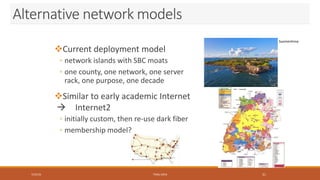
Current deployment model
◦ network islands with SBC moats
◦ one county, one network, one server
rack, one purpose, one decade
Similar to early academic Internet
 Internet2
◦ initially custom, then re-use dark fiber
◦ membership model?
Suomenlinna
7/23/16 TEMU 2016 21
Alternative network models
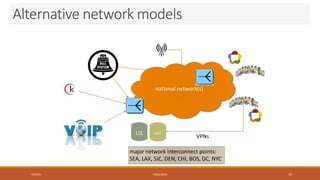
national network(s)
LoSTLIS
VPNs
major network interconnect points:
SEA, LAX, SJC, DEN, CHI, BOS, DC, NYC
7/23/16 TEMU 2016 22
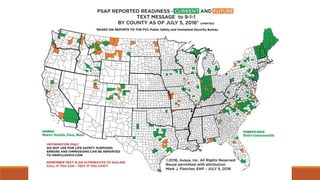
911 apps emerging
7/23/16 TEMU 2016 23
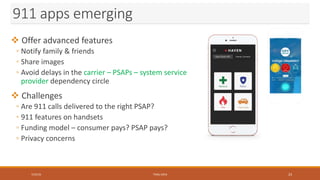
 Offer advanced features
◦ Notify family & friends
◦ Share images
◦ Avoid delays in the carrier – PSAPs – system service
provider dependency circle
 Challenges
◦ Are 911 calls delivered to the right PSAP?
◦ 911 features on handsets
◦ Funding model – consumer pays? PSAP pays?
◦ Privacy concerns
Locating emergency
callers
7/23/16 TEMU 2016 24
Caller location
25
 Builds on long history of FCC location accuracy requirements
◦ implicitly outdoor: 50m (67%)/150m (80%-90%) circles (1996), with geographic exclusions
 dispatchable location or x/y within 50 m
◦ ~70% calls are wireless
◦ unknown % indoor
◦ residential indoor may allow GPS
 z axis:
◦ 3 years: uncompensated barometric
◦ 6 years: 80% of top 25 CMAs
 open issues:
◦ nomadic iVoIP
◦ separation of location & call delivery
◦ reliable location w/o power
0
20
40
60
80
100
2 3 5 6
%ofcalls
years
%
7/23/16 TEMU 2016
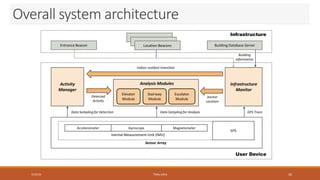
Overall system architecture
GPS
Accelerometer MagnetometerGyroscope
Inertial Measurement Unit (IMU)
Activity
Manager
Infrastructure
Monitor
Analysis Modules
Sensor Array
Elevator
Module
Escalator
Module
Stairway
Module
Data Sampling for Detection Data Sampling for Analysis
Detected
Activity
Anchor
Location
Infrastructure
User Device
Building
Information
Indoor-outdoor transition
GPS Trace
Building Database ServerEntrance Beacon Location Beacons
7/23/16 TEMU 2016 26
TEMU 2016
Indoor location
NEAD
indoor or
outdoor?
7/23/16 TEMU 2016 27
crowdsourced
database
commercial
Wi-Fi
database
building/street
WiFi AP
floor, apartment, office
GPS or GNSS
known location?
location =
f(observed
APs,
barometer)
“where
are
you?”
record
common
locations?
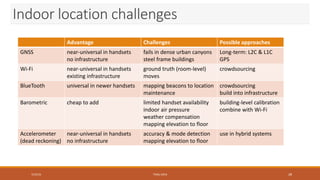
Indoor location challenges
7/23/16 TEMU 2016 28
Advantage Challenges Possible approaches
GNSS near-universal in handsets
no infrastructure
fails in dense urban canyons
steel frame buildings
Long-term: L2C & L1C
GPS
Wi-Fi near-universal in handsets
existing infrastructure
ground truth (room-level)
moves
crowdsourcing
BlueTooth universal in newer handsets mapping beacons to location
maintenance
crowdsourcing
build into infrastructure
Barometric cheap to add limited handset availability
indoor air pressure
weather compensation
mapping elevation to floor
building-level calibration
combine with Wi-Fi
Accelerometer
(dead reckoning)
near-universal in handsets
no infrastructure
accuracy & mode detection
mapping elevation to floor
use in hybrid systems
Using accelerometer to measure floors
Errors when traveling 1-9 floors without stopping
using elevator
Errors when traveling 9 floors making 1-4
stops using elevator
Landing counting errors in 50 trials of
walking 4 floors on stairway
CDF of errors when traveling 2 floors (7.3m)
using escalator
W. Song, J. Lee, B. Lee, and H. Schulzrinne:
Finding 9-1-1 Callers in Tall Buildings
Location services beyond Wi-Fi
7/23/16 TEMU 2016 30
Conclusion
7/23/16 TEMU 2016 31
 US 911: slow & fast
◦ scale advantage + large cities
◦ but resource-challenged and entrenched interests
 continuous improvement as technologies become available
◦ often, layered on top of existing technology: ALI, SMS, TTY
 face more fundamental changes: 911 apps, indoor location
Backup
7/23/16 TEMU 2016 32
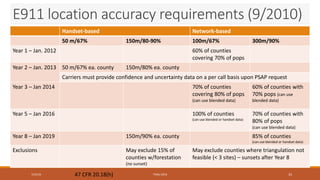
E911 location accuracy requirements (9/2010)
7/23/16 TEMU 2016 33
Handset-based Network-based
50 m/67% 150m/80-90% 100m/67% 300m/90%
Year 1 – Jan. 2012 60% of counties
covering 70% of pops
Year 2 – Jan. 2013 50 m/67% ea. county 150m/80% ea. county
Carriers must provide confidence and uncertainty data on a per call basis upon PSAP request
Year 3 – Jan 2014 70% of counties
covering 80% of pops
(can use blended data)
60% of counties with
70% pops (can use
blended data)
Year 5 – Jan 2016 100% of counties
(can use blended or handset data)
70% of counties with
80% of pops
(can use blended data)
Year 8 – Jan 2019 150m/90% ea. county 85% of counties
(can use blended or handset data)
Exclusions May exclude 15% of
counties w/forestation
(no sunset)
May exclude counties where triangulation not
feasible (< 3 sites) – sunsets after Year 8
47 CFR 20.18(h)
TEMU 2016
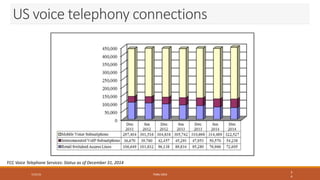
US voice telephony connections
3
4
FCC Voice Telephone Services: Status as of December 31, 2014
7/23/16 TEMU 2016

1.1 NG911: Emergency communication in the United States

  • 1.
    NG911: Time to dispatch= 15 years and counting HENNING SCHULZRINNE COLUMBIA UNIVERSITY & FCC (WITH USUAL DISCLAIMERS) 7/23/16 TEMU 2016 1
  • 2.
    Emergency communication in the UnitedStates 7/23/16 TEMU 2016 2
  • 3.
    VoIP emergency communications 7/23/16 emergencycall dispatch civic coordination emergency alert TEMU 2016 3 90 characters (360 in the future?) wireless emergency alerts (WEA) phone & SMS-based (local) AM/FM TV cable
  • 4.
    Quick history of911 in the US 7/23/16 TEMU 2016 4 1957 1967 1968 1970s 1976 1987 1998 2001 Jan 2013 20111999 2015 June 2013 Aug. 2016 Feb. 2017 Apr. 2017 Apr. 2018 Aug. 2018 Apr. 2020
  • 5.
    What distinguishes US911 from elsewhere?  5,894 PSAPs (in 3,135 U.S. counties) ◦ some very large (NYC, LA, Chicago), some tiny ◦ technical services provided by contractors and “system service providers”  240 million 9-1-1 calls per year ◦ 70% cellular  Emphasis on location delivery ◦ 98.6% of population have some Phase II (July 2016) ◦ most carriers use hybrid location (GPS + network-based such U-TDOA)  Funded by variety of add-on 9-1-1 charges on phone bills, not taxes ◦ some of these charges are diverted to other purposes  Limited regulatory authority for national regulator (FCC) ◦ Mostly, iVoIP and cellular providers, not PSAPs ◦ some oversight by state public utilities commission or state 911 office  Strong professional associations (APCO & NENA), with standard setting efforts and training 7/23/16 TEMU 2016 5
  • 6.
    TEMU 2016 What dowe need for emergency calling? Identify emergency call Route call to PSAP Dispatch first responder numbers depend on location at least cell & sector, preferably full geo (say, 100 m) indoor & outdoor dispatchable location location 7/23/16 TEMU 2016 6
  • 7.
  • 8.
    TEMU 2016 E911 vs.NG911 Identify emergency call Route call to PSAP Dispatch first responder 112, 911 (in SIM)E911 NG911 dial number from ECRF sos URN ALI + MSAG  selective router (SR) based on street address location  ECRF ESRP landline: ALI  civic (static) wireless: ALI  geo (dyn.) SIP Geolocation header 7/23/16 TEMU 2016 8
  • 9.
    E9-1-1 for wireline EOSwitch Selective Router or 911 Tandem LEC network 555-1234 313 Main St ALI 100-500 Main Street  ESN 1789 555-1234  PSAP #1, 313 Main St CAMA or PRI delivers ANI (555-1234)CAMA or SS7 ANI: 555-1234  313 Main 555-1234  PSAP #1 PSAP #1 verify address validity provisioned updates private data link MSAG 7/23/16 TEMU 2016 9
  • 10.
    TEMU 2016 Different sourcesfor emergency calls 7/23/16 Source Location Challenges TDM landline civic, static rapidly fading; equipment obsolete interconnected VoIP (OTT or cable/FTTH) currently, user-configured or similar to landline VoIP (“OTT”) none no location Cellular geo, separate path location accuracy indoor dispatchable location Telematics (car, alarms, …) mostly geo additional data indoor & outdoor location TEMU 2016 10
  • 11.
    TEMU 2016 US landlinephone service 1 1 FCC Voice Telephone Services: Status as of December 31, 2014 7/23/16 TEMU 2016
  • 12.
    About half ofhouseholds are wireless-only 7/23/16 TEMU 2016 12
  • 13.
    Wireless 911  PhaseI (April 1998) ◦ Route all call to the appropriate PSAP based on call sector ◦ Provide cell/sector location data to PSAP ◦ Provide call back number to PSAP  Phase II (October 2001) ◦ Phase I + latitude and longitude 67% 95% handset 50m 150m network 100m 300m 7/23/16 TEMU 2016 13
  • 14.
    TEMU 2016 Text-to-911 architecture 1 4 Intrado,“Text-to-9-1-1 saves Lives”, 2013 7/23/16 TEMU 2016
  • 15.
  • 16.
    NG911 architecture (US,Canada) Brian Rosen, 2012 SIP proxy LoSTHELD private (shared) IP network PIDFPIDF also, NG112 (Europe) 7/23/16 TEMU 2016 16
  • 17.
    Emergency Call RoutingFunction Queried using LoST Protocol Location and Service in, URI out External ECRF provided by 9-1-1 Authority Location Information Server Stores location against some kind of key Provided by Access Network Uses either DHCP or HELD to give location to end device Border Control Function Security barrier between origination/access networks and ESInet Combination of firewall and Session Border Controller Emergency Services Routing Proxy Call Router for ESInet Uses ECRF to get next hop route Policy Controlled Routing Legacy Network Gateway Looks like SR/ALI to legacy network Routes using ECRF to ESInet Legacy PSAP Gateway Looks like SR/ALI to unupgraded PSAP 7/23/16 TEMU 2016 17
  • 18.
    Insanity is …Doing something 6,200 times and expecting a speedy result. (Einstein + Heisenberg) 7/23/16 TEMU 2016 18
  • 19.
    TEMU 2016 US NG911status 2011 (27 responses) 2013 (39 responses) Statewide NG911 plan 9 15 Concept of operations 3 12 Request for proposals released 13 Contracts 13 Testing parts, functions and components at state level 9 7/23/16 TEMU 2016 19
  • 20.
    What are thecauses? Bottom up: small groups of PSAPs get together ◦ build (have built) their own ESInet ◦ Deploy their own ESRP, ECRF, LNG ◦ Each requires educating the late adopters, consultants, RFP, negotiation with carriers, coordinated funding, … Engineered as one-offs ◦ Custom interconnect, equipment, configuration, … 600 selective routers Capital investment ◦ But 911 entities typically cannot issue bonds ◦ No significant national funding sources ◦ Diversion of 911 fees collected by many U.S. states Expertise uneven (GIS, IP networks, cybersecurity, …) Carrier obligations – make PSAPs pay for legacy services 7/23/16 TEMU 2016 20
  • 21.
    Alternative network models Currentdeployment model ◦ network islands with SBC moats ◦ one county, one network, one server rack, one purpose, one decade Similar to early academic Internet  Internet2 ◦ initially custom, then re-use dark fiber ◦ membership model? Suomenlinna 7/23/16 TEMU 2016 21
  • 22.
    Alternative network models nationalnetwork(s) LoSTLIS VPNs major network interconnect points: SEA, LAX, SJC, DEN, CHI, BOS, DC, NYC 7/23/16 TEMU 2016 22
  • 23.
    911 apps emerging 7/23/16TEMU 2016 23  Offer advanced features ◦ Notify family & friends ◦ Share images ◦ Avoid delays in the carrier – PSAPs – system service provider dependency circle  Challenges ◦ Are 911 calls delivered to the right PSAP? ◦ 911 features on handsets ◦ Funding model – consumer pays? PSAP pays? ◦ Privacy concerns
  • 24.
  • 25.
    Caller location 25  Buildson long history of FCC location accuracy requirements ◦ implicitly outdoor: 50m (67%)/150m (80%-90%) circles (1996), with geographic exclusions  dispatchable location or x/y within 50 m ◦ ~70% calls are wireless ◦ unknown % indoor ◦ residential indoor may allow GPS  z axis: ◦ 3 years: uncompensated barometric ◦ 6 years: 80% of top 25 CMAs  open issues: ◦ nomadic iVoIP ◦ separation of location & call delivery ◦ reliable location w/o power 0 20 40 60 80 100 2 3 5 6 %ofcalls years % 7/23/16 TEMU 2016
  • 26.
    Overall system architecture GPS AccelerometerMagnetometerGyroscope Inertial Measurement Unit (IMU) Activity Manager Infrastructure Monitor Analysis Modules Sensor Array Elevator Module Escalator Module Stairway Module Data Sampling for Detection Data Sampling for Analysis Detected Activity Anchor Location Infrastructure User Device Building Information Indoor-outdoor transition GPS Trace Building Database ServerEntrance Beacon Location Beacons 7/23/16 TEMU 2016 26
  • 27.
    TEMU 2016 Indoor location NEAD indooror outdoor? 7/23/16 TEMU 2016 27 crowdsourced database commercial Wi-Fi database building/street WiFi AP floor, apartment, office GPS or GNSS known location? location = f(observed APs, barometer) “where are you?” record common locations?
  • 28.
    Indoor location challenges 7/23/16TEMU 2016 28 Advantage Challenges Possible approaches GNSS near-universal in handsets no infrastructure fails in dense urban canyons steel frame buildings Long-term: L2C & L1C GPS Wi-Fi near-universal in handsets existing infrastructure ground truth (room-level) moves crowdsourcing BlueTooth universal in newer handsets mapping beacons to location maintenance crowdsourcing build into infrastructure Barometric cheap to add limited handset availability indoor air pressure weather compensation mapping elevation to floor building-level calibration combine with Wi-Fi Accelerometer (dead reckoning) near-universal in handsets no infrastructure accuracy & mode detection mapping elevation to floor use in hybrid systems
  • 29.
    Using accelerometer tomeasure floors Errors when traveling 1-9 floors without stopping using elevator Errors when traveling 9 floors making 1-4 stops using elevator Landing counting errors in 50 trials of walking 4 floors on stairway CDF of errors when traveling 2 floors (7.3m) using escalator W. Song, J. Lee, B. Lee, and H. Schulzrinne: Finding 9-1-1 Callers in Tall Buildings
  • 30.
    Location services beyondWi-Fi 7/23/16 TEMU 2016 30
  • 31.
    Conclusion 7/23/16 TEMU 201631  US 911: slow & fast ◦ scale advantage + large cities ◦ but resource-challenged and entrenched interests  continuous improvement as technologies become available ◦ often, layered on top of existing technology: ALI, SMS, TTY  face more fundamental changes: 911 apps, indoor location
  • 32.
  • 33.
    E911 location accuracyrequirements (9/2010) 7/23/16 TEMU 2016 33 Handset-based Network-based 50 m/67% 150m/80-90% 100m/67% 300m/90% Year 1 – Jan. 2012 60% of counties covering 70% of pops Year 2 – Jan. 2013 50 m/67% ea. county 150m/80% ea. county Carriers must provide confidence and uncertainty data on a per call basis upon PSAP request Year 3 – Jan 2014 70% of counties covering 80% of pops (can use blended data) 60% of counties with 70% pops (can use blended data) Year 5 – Jan 2016 100% of counties (can use blended or handset data) 70% of counties with 80% of pops (can use blended data) Year 8 – Jan 2019 150m/90% ea. county 85% of counties (can use blended or handset data) Exclusions May exclude 15% of counties w/forestation (no sunset) May exclude counties where triangulation not feasible (< 3 sites) – sunsets after Year 8 47 CFR 20.18(h)
  • 34.
    TEMU 2016 US voicetelephony connections 3 4 FCC Voice Telephone Services: Status as of December 31, 2014 7/23/16 TEMU 2016