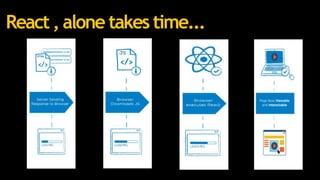
Next.js helps address some shortcomings of React like initial load time and SEO support. It introduces features like server-side rendering, static generation, and incremental static regeneration that improve performance. The new App Router in Next.js 13.4 introduces shared layouts and nested routing to provide a more structured approach to building apps. React Server Components in Next.js also improve performance by enabling server-centric routing and caching of component trees.

Next 12
Six MonthsAgo,
Pre-rendering
strategies - SSG, ISR,
SSR
Next 13.0.1
App Router Beta
Improved Error
Reporting
Server Components
Layouts and Pages
Next 13.4
App Router ( Stable )
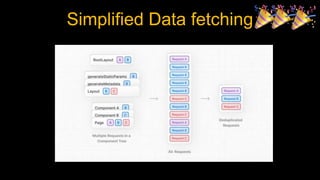
Simplified Data Fetching
Server Actions ( Alpha )
14.
• Layouts:
• Alayout is UI that is shared between multiple pages.
• Layout is on the top hierarchy of the component tree which
wraps any page or any child segments.
• Pages:
• A page is a UI unique to a route segment.
• A page.js file is required to make a route segment publicly
accessible.
• Pages are Server Components by default but can be set to
a Client Component.
- Features
- Best Practices
- Performance
15.
App Router (Stable with Next.js 13.4 )
- Buit on top of React Server Components
• Shared Layouts and Nested Layouts
• Nested routes
• Streaming and Loading UI
• Error handling at any level
• Dynamic intercept Route handlers
• Not Found UI
16.
Component Hierarchy
• Layouts:
•A layout is UI that is shared between multiple pages.
• Layout is on the top hierarchy of the component tree which
wraps any page or any child segments.
• Pages:
• A page is a UI unique to a route segment.
• A page.js file is required to make a route segment publicly
accessible.
• Pages are Server Components by default but can be set to
a Client Component.
17.
Performance Benefits of
AppRouter
• Uses Server-Centric Routing
• On Navigating Routes, it stores the result of React Server
Components payload in an in-memory client-side cache
which is split by route segment – allowing cache to be
reused
• SupportPartialRendering
• Does supportAdvanceRoutingPatterns
• ParallelRoutes
• InterceptRoutes
Caching vs Dynamicvs Revalidating Data
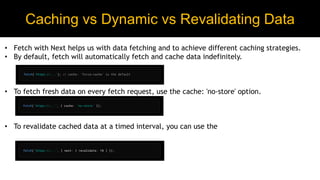
• Fetch with Next helps us with data fetching and to achieve different caching strategies.
• By default, fetch will automatically fetch and cache data indefinitely.
• To fetch fresh data on every fetch request, use the cache: 'no-store' option.
• To revalidate cached data at a timed interval, you can use the
Other Features
• FontOptimization - @next/font
• Image Optimizations & Core Web Vitals Improvement - @next/image
• Link API Improvement for better engagement
• Introducing Client-Side Hooks
• Introducing Special Functions for Server Components
Read More on Medium