API Driven Development
Kenneth Reitz
How I Develop Things and Why.
Hi.
@kennethreitz
Open Source
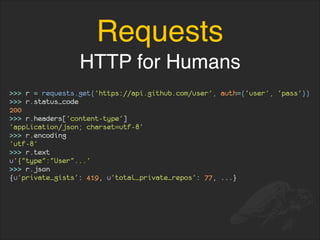
Requests
HTTP for Humans
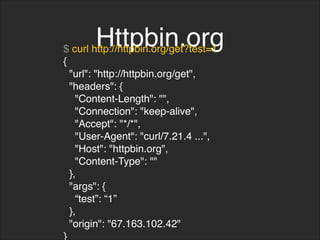
Httpbin.org
$ curl http://httpbin.org/get?test=1
{
"url": "http://httpbin.org/get",
"headers": {
"Content-Length": "",
"Connection": "keep-alive",
"Accept": "*/*",
"User-Agent": "curl/7.21.4 ...",
"Host": "httpbin.org",
"Content-Type": ""
},
"args": {
“test”: “1”
},
"origin": "67.163.102.42"
}
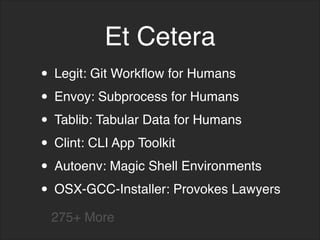
Et Cetera
• Legit: Git Workflow for Humans
• Envoy: Subprocess for Humans
• Tablib: Tabular Data for Humans
• Clint: CLI App Toolkit
• Autoenv: Magic Shell Environments
• OSX-GCC-Installer: Provokes Lawyers
275+ More
Purpose
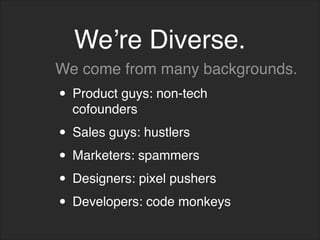
We’re Diverse.
• Product guys: non-tech
cofounders
• Sales guys: hustlers
• Marketers: spammers
• Designers: pixel pushers
• Developers: code monkeys
We come from many backgrounds.
What do we have
in common?
We’re Makers.
• Product guys: visionaries
• Sales guys: sustainability
• Marketers: communication
• Designers: experience and
philosophy
• Developers: make the magic
We craft experiences & interfaces.
Developers!
Developers, Developers,
Developers.
— Steve Jobs, 1983
People are going to be
spending two or three hours a
day
with these machines — more
than they spend with a car.
— Steve Jobs, 1983
Software design must be given
at least as much consideration
as we give automobiles today
— if not a lot more.
That worked.
Beautiful Interfaces.
• Industrial Design
• Web Interfaces
• iOS, Android, Mobile Apps
• Desktop Clients & Applications
Today, beautiful applications abound.
Hackers are
the real Makers.
Developers spend 8+ hours a
day with APIs.
Why are they treated differently?
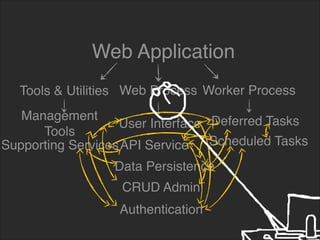
Web Application
Management
Tools
Supporting Services
Tools & Utilities Web Process Worker Process
Scheduled Tasks
Deferred Tasks
API Service
CRUD Admin
Data Persistence
User Interface
Authentication
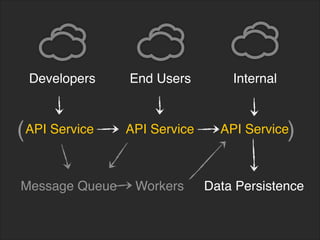
API Service
End Users
API Service
Internal
API Service
Developers
( )
Data Persistence
Message Queue Workers
Everything is a remix*.
* APIs Rule Everything Around Us.
How?
Step I: Have an
A Real, Tangible
Problem.
You can't solve a problem properly if
you don't experience it firsthand.
Example: OneNote.
• Hierarchical, freeform note-taking
software that assumes nothing.
• Only available on Windows.
• I want to make OneNote for OS
X.
• It would be incredible.
The finest note-taking platform on earth.
GitHub Success
• GitHub wasn't built for the developer
community at large.
• Resonated with millions of
developers.
• They themselves happen to be
developers.
Over two million people collaborating.
Other’s Success
• Gumroad, built for the founder.
• 37 Signals product, build for the
team.
• Ruby on Rails, by Rubyists for
Rubyists.
Optimization
• Feature driven development?
• Profit driven development?
• Growth driven development?
• Problem driven development.
What drives your decisions?
pra•gmat•ic |pragˈmatik|, adj:
Dealing with things sensibly and
realistically in a way that is based on
practical rather than theoretical
considerations
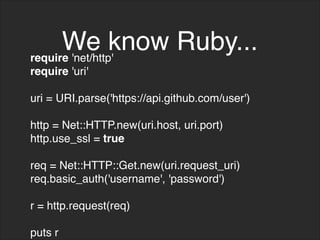
We know Ruby...
require 'net/http'
require 'uri'
uri = URI.parse('https://api.github.com/user')
http = Net::HTTP.new(uri.host, uri.port)
http.use_ssl = true
req = Net::HTTP::Get.new(uri.request_uri)
req.basic_auth('username', 'password')
r = http.request(req)
puts r
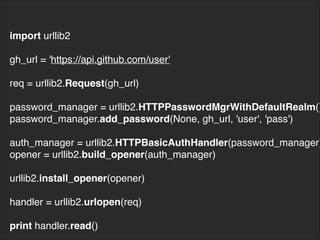
import urllib2
gh_url = 'https://api.github.com/user'
req = urllib2.Request(gh_url)
password_manager = urllib2.HTTPPasswordMgrWithDefaultRealm()
password_manager.add_password(None, gh_url, 'user', 'pass')
auth_manager = urllib2.HTTPBasicAuthHandler(password_manager)
opener = urllib2.build_opener(auth_manager)
urllib2.install_opener(opener)
handler = urllib2.urlopen(req)
print handler.read()
import re
class HTTPForcedBasicAuthHandler(HTTPBasicAuthHandler):
auth_header = 'Authorization'
rx = re.compile('(?:.*,)*[ t]*([^ t]+)[ t]+'
'realm=(["'])(.*?)2', re.I)
def __init__(self, *args, **kwargs):
HTTPBasicAuthHandler.__init__(self, *args, **kwargs)
def http_error_401(self, req, fp, code, msg, headers):
url = req.get_full_url()
response = self._http_error_auth_reqed(
'www-authenticate', url, req, headers)
self.reset_retry_count()
return response
Admit it.
You’d leave and never come
back.
This is a serious
problem.
HTTP should be as
simple as a print
statement.
APIs For Humans
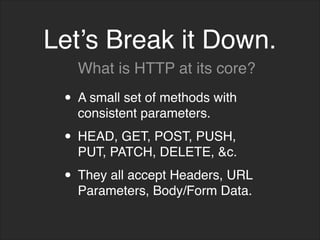
Let’s Break it Down.
• A small set of methods with
consistent parameters.
• HEAD, GET, POST, PUSH,
PUT, PATCH, DELETE, &c.
• They all accept Headers, URL
Parameters, Body/Form Data.
What is HTTP at its core?
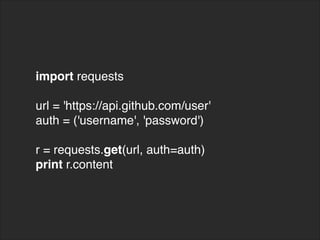
Enter Requests.
HTTP for Humans.
import requests
url = 'https://api.github.com/user'
auth = ('username', 'password')
r = requests.get(url, auth=auth)
print r.content
Achievement
Unlocked!
• A small set of methods with
consistent parameters.
• HEAD, GET, POST, PUSH,
PUT, PATCH, DELETE, &c.
• They all accept Headers, URL
Parameters, Body/Form Data.
Requests Success
• Python is a language built for
Humans.
• Why should HTTP be non-trivial?
• I explored and discovered what I
really needed, and built it.
• I had a real problem that I solved for
myself.
Requests Success
• At first, Requests was far from
powerful.
• But, it deeply resonated with
people.
• Features grew over time, but the
API was never compromised.
• Quite popular.
Developers spend 8+ hours a
day with APIs.
Build for yourself—a developer.
Step II: Respond.
Write the README.
• Before any code is written,
write the README — show
some examples.
• Write some code with the
theoretical code that you’ve
documented.
Achievement
Unlocked!
• Instead of engineering something to
get the job done, you interact with
the problem itself and build an
interface that reacts to it.
• You discover it. You respond to it.
• Great sculptures aren’t
engineered or manufactured—
they’re discovered.
• The sculptor studies and listens
to the marble. He identifies with
it.
• Then, he responds.
• Setting free something hidden
Sculptures, Etc.
• It’s not about a design that will
“work” on a phone, tablet, and
desktop.
• It’s about making something that
identifies itself enough to respond
to the environment it’s placed in.
• Free of arbitrary constraints.
Responsive Design
Readme-Driven Development?
Responsive API Design.
Step III: Build.
• Once you discover the API: build
it.
• Write all the code necessary to
make exactly what you
documented happen.
• Complex code? Layer your API.
• “Porcelain” layer is documented.
Responsive Design
The API is all that matters.
Everything else is secondary.
Do unto others as you would
have them do to you?
Build tools for others that you
want to be built for you.
Pro Tips™
CONSTRA
INTS
FOST
ER
CREATI
Open Source
All The Things!
Build for Open
Source
• Components become concise &
decoupled.
• Concerns separate themselves.
• Best practices emerge (e.g. no creds in
code).
• Documentation and tests become
crucial.
Build for Open
Source
• Components become concise &
decoupled.
• Concerns separate themselves.
• Best practices emerge (e.g. no creds in
code).
• Documentation and tests become
crucial.
Build for Services
• Components become concise &
decoupled.
• Concerns separate themselves.
• Best practices emerge (e.g. ideal tools).
• Documentation and contracts become
crucial.
• Services can be scaled separately at
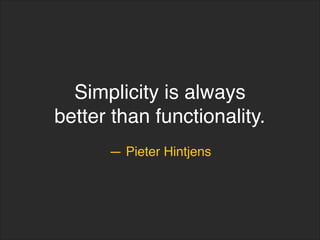
— Pieter Hintjens
Simplicity is always
better than functionality.
github.com/kennethreitz
Questions?

api-driven-development.pdf

  • 1.
    API Driven Development KennethReitz How I Develop Things and Why.
  • 2.
  • 3.
  • 5.
  • 6.
  • 7.
    Httpbin.org $ curl http://httpbin.org/get?test=1 { "url":"http://httpbin.org/get", "headers": { "Content-Length": "", "Connection": "keep-alive", "Accept": "*/*", "User-Agent": "curl/7.21.4 ...", "Host": "httpbin.org", "Content-Type": "" }, "args": { “test”: “1” }, "origin": "67.163.102.42" }
  • 8.
    Et Cetera • Legit:Git Workflow for Humans • Envoy: Subprocess for Humans • Tablib: Tabular Data for Humans • Clint: CLI App Toolkit • Autoenv: Magic Shell Environments • OSX-GCC-Installer: Provokes Lawyers 275+ More
  • 9.
  • 10.
    We’re Diverse. • Productguys: non-tech cofounders • Sales guys: hustlers • Marketers: spammers • Designers: pixel pushers • Developers: code monkeys We come from many backgrounds.
  • 11.
    What do wehave in common?
  • 12.
    We’re Makers. • Productguys: visionaries • Sales guys: sustainability • Marketers: communication • Designers: experience and philosophy • Developers: make the magic We craft experiences & interfaces.
  • 13.
  • 14.
    — Steve Jobs,1983 People are going to be spending two or three hours a day with these machines — more than they spend with a car.
  • 15.
    — Steve Jobs,1983 Software design must be given at least as much consideration as we give automobiles today — if not a lot more.
  • 16.
  • 17.
    Beautiful Interfaces. • IndustrialDesign • Web Interfaces • iOS, Android, Mobile Apps • Desktop Clients & Applications Today, beautiful applications abound.
  • 18.
  • 19.
    Developers spend 8+hours a day with APIs. Why are they treated differently?
  • 20.
    Web Application Management Tools Supporting Services Tools& Utilities Web Process Worker Process Scheduled Tasks Deferred Tasks API Service CRUD Admin Data Persistence User Interface Authentication
  • 21.
    API Service End Users APIService Internal API Service Developers ( ) Data Persistence Message Queue Workers
  • 22.
    Everything is aremix*. * APIs Rule Everything Around Us.
  • 23.
  • 24.
  • 25.
    A Real, Tangible Problem. Youcan't solve a problem properly if you don't experience it firsthand.
  • 26.
    Example: OneNote. • Hierarchical,freeform note-taking software that assumes nothing. • Only available on Windows. • I want to make OneNote for OS X. • It would be incredible. The finest note-taking platform on earth.
  • 27.
    GitHub Success • GitHubwasn't built for the developer community at large. • Resonated with millions of developers. • They themselves happen to be developers. Over two million people collaborating.
  • 28.
    Other’s Success • Gumroad,built for the founder. • 37 Signals product, build for the team. • Ruby on Rails, by Rubyists for Rubyists.
  • 29.
    Optimization • Feature drivendevelopment? • Profit driven development? • Growth driven development? • Problem driven development. What drives your decisions?
  • 30.
    pra•gmat•ic |pragˈmatik|, adj: Dealingwith things sensibly and realistically in a way that is based on practical rather than theoretical considerations
  • 31.
    We know Ruby... require'net/http' require 'uri' uri = URI.parse('https://api.github.com/user') http = Net::HTTP.new(uri.host, uri.port) http.use_ssl = true req = Net::HTTP::Get.new(uri.request_uri) req.basic_auth('username', 'password') r = http.request(req) puts r
  • 32.
    import urllib2 gh_url ='https://api.github.com/user' req = urllib2.Request(gh_url) password_manager = urllib2.HTTPPasswordMgrWithDefaultRealm() password_manager.add_password(None, gh_url, 'user', 'pass') auth_manager = urllib2.HTTPBasicAuthHandler(password_manager) opener = urllib2.build_opener(auth_manager) urllib2.install_opener(opener) handler = urllib2.urlopen(req) print handler.read()
  • 33.
    import re class HTTPForcedBasicAuthHandler(HTTPBasicAuthHandler): auth_header= 'Authorization' rx = re.compile('(?:.*,)*[ t]*([^ t]+)[ t]+' 'realm=(["'])(.*?)2', re.I) def __init__(self, *args, **kwargs): HTTPBasicAuthHandler.__init__(self, *args, **kwargs) def http_error_401(self, req, fp, code, msg, headers): url = req.get_full_url() response = self._http_error_auth_reqed( 'www-authenticate', url, req, headers) self.reset_retry_count() return response
  • 34.
    Admit it. You’d leaveand never come back.
  • 35.
    This is aserious problem. HTTP should be as simple as a print statement.
  • 36.
  • 37.
    Let’s Break itDown. • A small set of methods with consistent parameters. • HEAD, GET, POST, PUSH, PUT, PATCH, DELETE, &c. • They all accept Headers, URL Parameters, Body/Form Data. What is HTTP at its core?
  • 38.
  • 39.
  • 40.
    import requests url ='https://api.github.com/user' auth = ('username', 'password') r = requests.get(url, auth=auth) print r.content
  • 42.
    Achievement Unlocked! • A smallset of methods with consistent parameters. • HEAD, GET, POST, PUSH, PUT, PATCH, DELETE, &c. • They all accept Headers, URL Parameters, Body/Form Data.
  • 43.
    Requests Success • Pythonis a language built for Humans. • Why should HTTP be non-trivial? • I explored and discovered what I really needed, and built it. • I had a real problem that I solved for myself.
  • 44.
    Requests Success • Atfirst, Requests was far from powerful. • But, it deeply resonated with people. • Features grew over time, but the API was never compromised. • Quite popular.
  • 45.
    Developers spend 8+hours a day with APIs. Build for yourself—a developer.
  • 46.
  • 47.
  • 48.
    • Before anycode is written, write the README — show some examples. • Write some code with the theoretical code that you’ve documented.
  • 49.
    Achievement Unlocked! • Instead ofengineering something to get the job done, you interact with the problem itself and build an interface that reacts to it. • You discover it. You respond to it.
  • 50.
    • Great sculpturesaren’t engineered or manufactured— they’re discovered. • The sculptor studies and listens to the marble. He identifies with it. • Then, he responds. • Setting free something hidden Sculptures, Etc.
  • 51.
    • It’s notabout a design that will “work” on a phone, tablet, and desktop. • It’s about making something that identifies itself enough to respond to the environment it’s placed in. • Free of arbitrary constraints. Responsive Design
  • 52.
  • 53.
  • 54.
    • Once youdiscover the API: build it. • Write all the code necessary to make exactly what you documented happen. • Complex code? Layer your API. • “Porcelain” layer is documented. Responsive Design
  • 55.
    The API isall that matters. Everything else is secondary.
  • 56.
    Do unto othersas you would have them do to you? Build tools for others that you want to be built for you.
  • 57.
  • 58.
  • 59.
  • 60.
    Build for Open Source •Components become concise & decoupled. • Concerns separate themselves. • Best practices emerge (e.g. no creds in code). • Documentation and tests become crucial.
  • 61.
    Build for Open Source •Components become concise & decoupled. • Concerns separate themselves. • Best practices emerge (e.g. no creds in code). • Documentation and tests become crucial.
  • 62.
    Build for Services •Components become concise & decoupled. • Concerns separate themselves. • Best practices emerge (e.g. ideal tools). • Documentation and contracts become crucial. • Services can be scaled separately at
  • 63.
    — Pieter Hintjens Simplicityis always better than functionality.
  • 64.