App Directory ( beta )
The routing of next.js is file-
based
Server vs Client Components
New way to fetch Data
( React suspense )
CSR
SSR
SSG
ISR
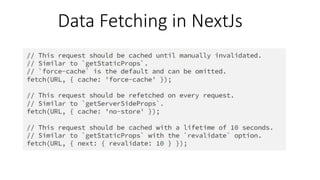
Data Fetching in NextJs
Other Features/Support
- Internationalisation
- Theming
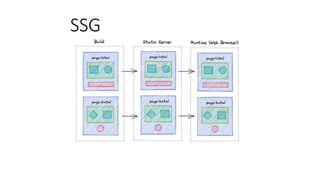
- Core Web vitals
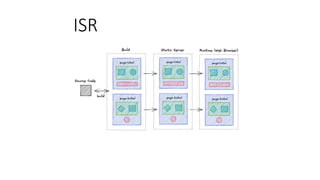
- Accessibility
- JSX for templating
- Alternative patterns to the Context API.
Demo

Nextjs13.pptx

Editor's Notes

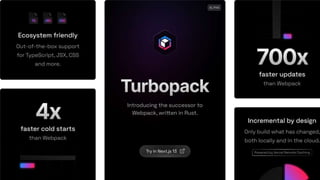
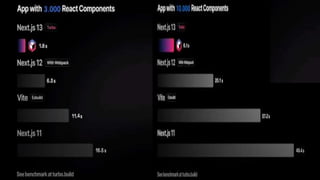
  • #4 Webpack has been widely used for over 10 years now and downloaded over 3 billion times. At its conception, Webpack served its purpose, but as technology has advanced - developers have reached the limits and full capabilities of Webpack. So how has Turbopack pushed the limits further? Turbopack is a Rust-based successor to Webpack, and even the creator of the Webpack joined the Vercel team to work on Turbopack. When Turbopack performs a task, it never has to run it again, significantly decreasing bundling times, and showing updates 10x faster than Vite.js and over 700x faster than Webpack. 
  • #5 There is no configuration necessary to make a route, just simply create a new folder in the /pages directory, and a route is made
  • #6 There is no configuration necessary to make a route, just simply create a new folder in the /pages directory, and a route is made
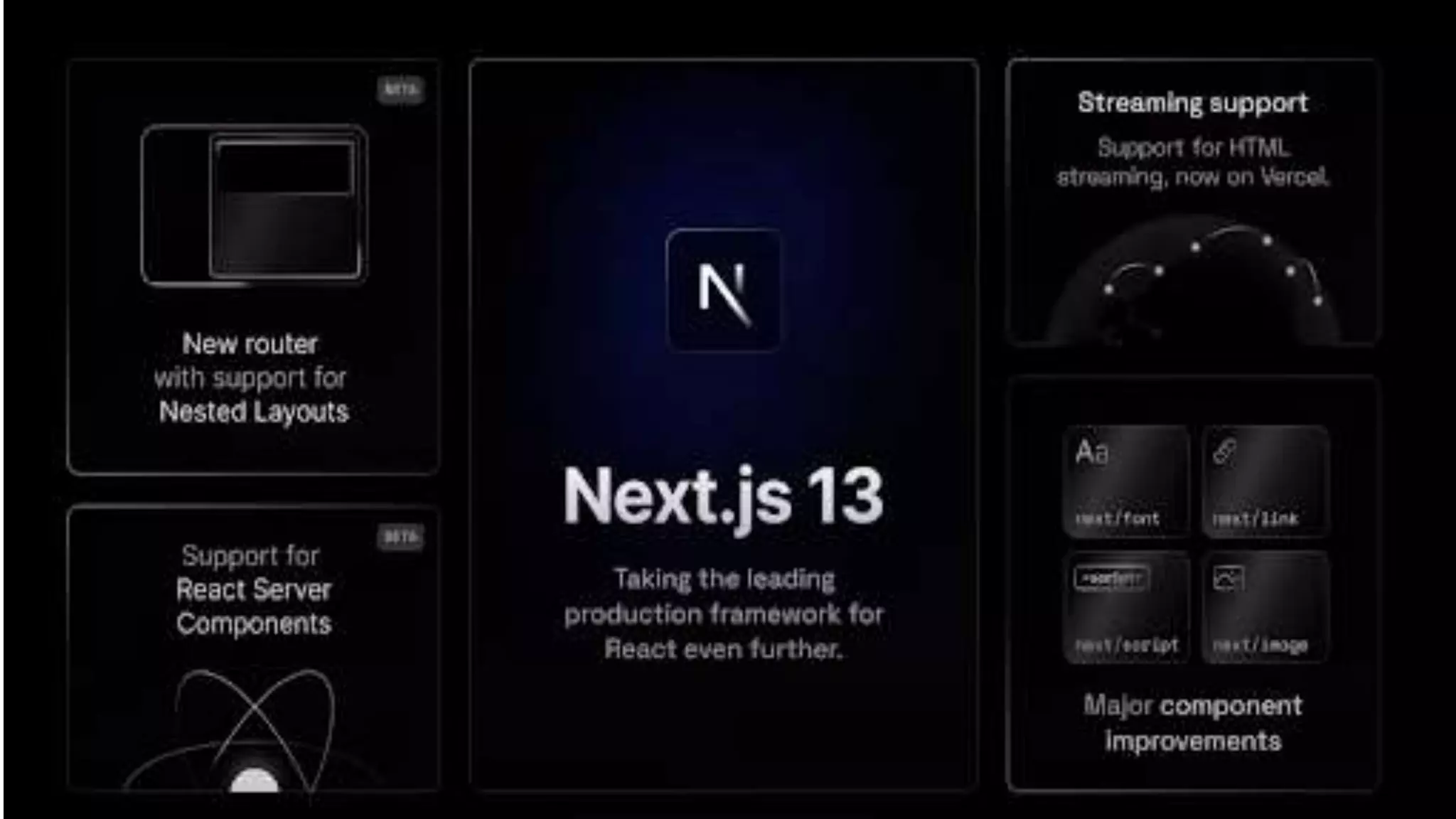
  • #8 The next major feature upgrade with this version release is the updated and improved rendering engine. The rendering engine behind Next.js has always been one of the most popular and easy-to-use features. There is no configuration necessary to make a route, just simply create a new folder in the /pages directory, and a route is made! But like everything, there is always room for improvement, and that's what Next.js did with this update. The new Next.js router keeps the same syntax as before, but now has support for Nested Layouts. This makes it easier for components to share and preserve state, which prevents heavy re-rendering of component data or even re-rendering large animations. Along with the ability to create custom error rendering and loading with an error.js or loader.js file in the /app directory, Next.js routing is more flexible and dynamic than ever. The new Next.js router gives all the benefits of static data fetching, server-side data fetching, ISR, and SWR in one hybrid solution. With this upgrade, developers can build faster sites by shipping with less client-side JavaScript.
  • #9 The next major feature upgrade with this version release is the updated and improved rendering engine. The rendering engine behind Next.js has always been one of the most popular and easy-to-use features. There is no configuration necessary to make a route, just simply create a new folder in the /pages directory, and a route is made! But like everything, there is always room for improvement, and that's what Next.js did with this update. The new Next.js router keeps the same syntax as before, but now has support for Nested Layouts. This makes it easier for components to share and preserve state, which prevents heavy re-rendering of component data or even re-rendering large animations. Along with the ability to create custom error rendering and loading with an error.js or loader.js file in the /app directory, Next.js routing is more flexible and dynamic than ever. The new Next.js router gives all the benefits of static data fetching, server-side data fetching, ISR, and SWR in one hybrid solution. With this upgrade, developers can build faster sites by shipping with less client-side JavaScript.
  • #10 The next major feature upgrade with this version release is the updated and improved rendering engine. The rendering engine behind Next.js has always been one of the most popular and easy-to-use features. There is no configuration necessary to make a route, just simply create a new folder in the /pages directory, and a route is made! But like everything, there is always room for improvement, and that's what Next.js did with this update. The new Next.js router keeps the same syntax as before, but now has support for Nested Layouts. This makes it easier for components to share and preserve state, which prevents heavy re-rendering of component data or even re-rendering large animations. Along with the ability to create custom error rendering and loading with an error.js or loader.js file in the /app directory, Next.js routing is more flexible and dynamic than ever. The new Next.js router gives all the benefits of static data fetching, server-side data fetching, ISR, and SWR in one hybrid solution. With this upgrade, developers can build faster sites by shipping with less client-side JavaScript.
  • #11 The next major feature upgrade with this version release is the updated and improved rendering engine. The rendering engine behind Next.js has always been one of the most popular and easy-to-use features. There is no configuration necessary to make a route, just simply create a new folder in the /pages directory, and a route is made! But like everything, there is always room for improvement, and that's what Next.js did with this update. The new Next.js router keeps the same syntax as before, but now has support for Nested Layouts. This makes it easier for components to share and preserve state, which prevents heavy re-rendering of component data or even re-rendering large animations. Along with the ability to create custom error rendering and loading with an error.js or loader.js file in the /app directory, Next.js routing is more flexible and dynamic than ever. The new Next.js router gives all the benefits of static data fetching, server-side data fetching, ISR, and SWR in one hybrid solution. With this upgrade, developers can build faster sites by shipping with less client-side JavaScript.
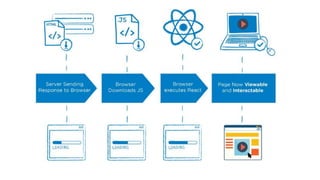
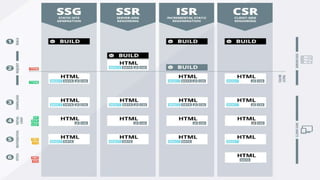
  • #12 Basically web browser will initially load an empty HTML file. Javascript and styles which are loaded after, are responsible for rendering the full user friendly page in the web browser.
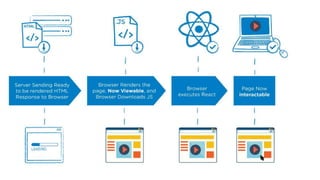
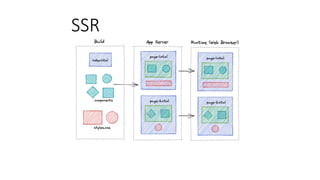
  • #13 Not like CSR, Each page will initiate a request to App Server, where it dynamically renders and serves full HTML for that page. Since it requests and renders the page each time user requests, page serve time is more than a CSR application.
  • #14 To avoid the rendering in each request, why don't we generate those files in the build time, so that we can instantly serve the pages when user requests it. To avoid the rendering in each request, why don't we generate those files in the build time, so that we can instantly serve the pages when user requests it.
  • #15 ISR is the next improvement to SSG, where it periodically builds and revalidates the new pages so that content never gets too much out-dated.
  • #16 ISR is the next improvement to SSG, where it periodically builds and revalidates the new pages so that content never gets too much out-dated.
  • #17 ISR is the next improvement to SSG, where it periodically builds and revalidates the new pages so that content never gets too much out-dated.
  • #18 There is no configuration necessary to make a route, just simply create a new folder in the /pages directory, and a route is made
  • #19 The last major upgrade to come with this version update is still as impactful and useful as the others - an improved and innovative component toolkit. Starting with the next/image component, which is said to be used by over 70% of next.js users, and results in increased core web vital scores, is now even more improved. Images account for 44% of a page's weight on average and making a site fast with third-party hosted images can be troublesome. With next/image, the performance and developer experience is seamless. The Image component brings us native lazy loading, better performance, improved accessibility, and reduced size (across all major browsers), all while using less client-side JavaScript! This version upgrade didn't just stop with the image component however, next/font has also been dramatically improved. This component, which was developed in collaboration with the Chrome team, removes external network requests by eliminating connection time with 3rd party hosts. Whether it be a Google font or a custom font locally, Next.js can now deliver it automatically, and by doing so it can avoid 99% of layout shifts caused by custom fonts and 100% of visual disruption caused by moments of invisible text. Lastly, Next released the new Vercel OG image generation. This allows for dynamic social cards to be generated 5x faster than existing solutions and therefore increase conversions and SEO. In some cases, having an Open Graph image can increase click engagement by up to 40%!