1
Relevant data
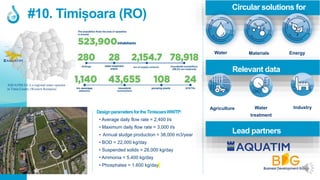
AQUATIM SA is a regional water operator
in Timiș County (Western Romania).
#10. Timișoara (RO)
Circular solutions for
Water Materials Energy
Agriculture Water
treatment
Industry
Lead partners
DesignparametersfortheTimisoaraWWTP:
• Average daily flow rate = 2,400 l/s
• Maximum daily flow rate = 3,000 l/s
• Annual sludge production = 38,000 m3/year
• BOD = 22,000 kg/day
• Suspended solids = 28,000 kg/day
• Ammonia = 5.400 kg/day
• Phosphates = 1.600 kg/day
2
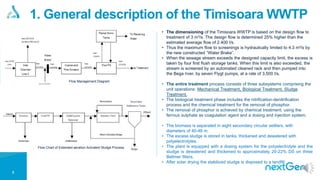
Flow Management Diagram
Flow Chart of Extended aeration Activated Sludge Process
1. General description of the Timisoara WWTP
• The dimensioning of the Timisoara WWTP is based on the design flow to
treatment of 3 m³/s. The design flow is determined 25% higher than the
estimated average flow of 2.400 l/s.
• Thus the maximum flow to screenings is hydraulically limited to 4.3 m³/s by
the new constructed “Water Brake”.
• When the sewage stream exceeds the designed capacity limit, the excess is
taken by four first flush storage tanks. When this limit is also exceeded, the
stream is screened by an automated cleaned rack and then pumped into
the Bega river, by seven Flygt pumps, at a rate of 3,500 l/s.
• The entire treatment process consists of three subsystems comprising the
unit operations: Mechanical Treatment, Biological Treatment, Sludge
Treatment.
• The biological treatment phase includes the nitrification-denitrification
process and the chemical treatment for the removal of phosphor.
• The removal of phosphor is achieved by chemical treatment, using the
ferrous sulphate as coagulation agent and a dosing and injection system.
• The biomass is separated in eight secondary circular settlers, with
diameters of 40-48 m.
• The excess sludge is stored in tanks, thickened and dewatered with
polyelectrolytes.
• The plant is equipped with a dosing system for the polyelectrolyte and the
sludge is dewatered and thickened to approximately 20-22% DS on three
Bellmer filters.
• After solar drying the stabilized sludge is disposed to a landfill.
3
2. Objectives of the NextGen solutions
• To demonstrate sludge management with production of by-products and
energy, by pilot-scale testing of thermochemical conversion of sludge producing
different output (biochar, oil and gas), which can be exploited energetically as fuel
or soil enhancing agent or sorbent.
• Perform a feasibility study of water reuse of effluent from the Timisoara WWTP for
urban, industrial and agricultural applications. This includes a potential analysis of
water reuse options and a feasibility study for identified users in the Timisoara
region.
• Promote regional partnership with industrial and agricultural stakeholders for
wastewater reuse after treatment .
4
3. Summary Table
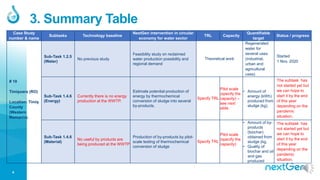
Case Study
number & name
Subtasks Technology baseline
NextGen intervention in circular
economy for water sector
TRL Capacity
Quantifiable
target
Status / progress
# 10
Timișoara (RO)
Location: Timiș
County
(Western
Romania).
Sub-Task 1.2.5
(Water)
No previous study
Feasibility study on reclaimed
water production possibility and
regional demand
Theoretical work
Regenerated
water for
several uses
(industrial,
urban and
agricultural
uses)
Started
1 Nov. 2020
Sub-Task 1.4.6
(Energy)
Currently there is no energy
production al the WWTP.
Estimate potential production of
energy by thermochemical
conversion of sludge into several
by-products.
Specify TRL
Pilot scale
(specify the
capacity) –
see next
slide
• Amount of
energy (kWh)
produced from
sludge (kg).
The subtask has
not started yet but
we can hope to
start it by the end
of this year
depending on the
pandemic
situation.
Sub-Task 1.4.6
(Material)
No useful by products are
being produced at the WWTP
Production of by-products by pilot-
scale testing of thermochemical
conversion of sludge
Specify TRL
Pilot scale
(specify the
capacity)
• Amount of by-
products
(biochar)
obtained from
sludge (kg.
• Quality of
biochar and oil
and gas
produced
The subtask has
not started yet but
we can hope to
start it by the end
of this year
depending on the
pandemic
situation.
5
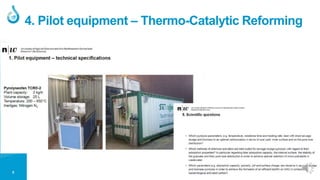
4. Pilot equipment – Thermo-Catalytic Reforming
6
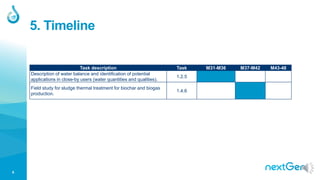
5. Timeline
Task description Task M31-M36 M37-M42 M43-48
Description of water balance and identification of potential
applications in close-by users (water quantities and qualities).
1.2.5
Field study for sludge thermal treatment for biochar and biogas
production.
1.4.6
7
Thank you!
of Practice
cristina.borca@aquatim.ro

NextGen Timisoara, Romania

  • 1.
    1 Relevant data AQUATIM SAis a regional water operator in Timiș County (Western Romania). #10. Timișoara (RO) Circular solutions for Water Materials Energy Agriculture Water treatment Industry Lead partners DesignparametersfortheTimisoaraWWTP: • Average daily flow rate = 2,400 l/s • Maximum daily flow rate = 3,000 l/s • Annual sludge production = 38,000 m3/year • BOD = 22,000 kg/day • Suspended solids = 28,000 kg/day • Ammonia = 5.400 kg/day • Phosphates = 1.600 kg/day
  • 2.
    2 Flow Management Diagram FlowChart of Extended aeration Activated Sludge Process 1. General description of the Timisoara WWTP • The dimensioning of the Timisoara WWTP is based on the design flow to treatment of 3 m³/s. The design flow is determined 25% higher than the estimated average flow of 2.400 l/s. • Thus the maximum flow to screenings is hydraulically limited to 4.3 m³/s by the new constructed “Water Brake”. • When the sewage stream exceeds the designed capacity limit, the excess is taken by four first flush storage tanks. When this limit is also exceeded, the stream is screened by an automated cleaned rack and then pumped into the Bega river, by seven Flygt pumps, at a rate of 3,500 l/s. • The entire treatment process consists of three subsystems comprising the unit operations: Mechanical Treatment, Biological Treatment, Sludge Treatment. • The biological treatment phase includes the nitrification-denitrification process and the chemical treatment for the removal of phosphor. • The removal of phosphor is achieved by chemical treatment, using the ferrous sulphate as coagulation agent and a dosing and injection system. • The biomass is separated in eight secondary circular settlers, with diameters of 40-48 m. • The excess sludge is stored in tanks, thickened and dewatered with polyelectrolytes. • The plant is equipped with a dosing system for the polyelectrolyte and the sludge is dewatered and thickened to approximately 20-22% DS on three Bellmer filters. • After solar drying the stabilized sludge is disposed to a landfill.
  • 3.
    3 2. Objectives ofthe NextGen solutions • To demonstrate sludge management with production of by-products and energy, by pilot-scale testing of thermochemical conversion of sludge producing different output (biochar, oil and gas), which can be exploited energetically as fuel or soil enhancing agent or sorbent. • Perform a feasibility study of water reuse of effluent from the Timisoara WWTP for urban, industrial and agricultural applications. This includes a potential analysis of water reuse options and a feasibility study for identified users in the Timisoara region. • Promote regional partnership with industrial and agricultural stakeholders for wastewater reuse after treatment .
  • 4.
    4 3. Summary Table CaseStudy number & name Subtasks Technology baseline NextGen intervention in circular economy for water sector TRL Capacity Quantifiable target Status / progress # 10 Timișoara (RO) Location: Timiș County (Western Romania). Sub-Task 1.2.5 (Water) No previous study Feasibility study on reclaimed water production possibility and regional demand Theoretical work Regenerated water for several uses (industrial, urban and agricultural uses) Started 1 Nov. 2020 Sub-Task 1.4.6 (Energy) Currently there is no energy production al the WWTP. Estimate potential production of energy by thermochemical conversion of sludge into several by-products. Specify TRL Pilot scale (specify the capacity) – see next slide • Amount of energy (kWh) produced from sludge (kg). The subtask has not started yet but we can hope to start it by the end of this year depending on the pandemic situation. Sub-Task 1.4.6 (Material) No useful by products are being produced at the WWTP Production of by-products by pilot- scale testing of thermochemical conversion of sludge Specify TRL Pilot scale (specify the capacity) • Amount of by- products (biochar) obtained from sludge (kg. • Quality of biochar and oil and gas produced The subtask has not started yet but we can hope to start it by the end of this year depending on the pandemic situation.
  • 5.
    5 4. Pilot equipment– Thermo-Catalytic Reforming
  • 6.
    6 5. Timeline Task descriptionTask M31-M36 M37-M42 M43-48 Description of water balance and identification of potential applications in close-by users (water quantities and qualities). 1.2.5 Field study for sludge thermal treatment for biochar and biogas production. 1.4.6
  • 7.

Editor's Notes

  • #2 Regarding Timisoara WWTP, The site is situated on the right bank of the Bega River. the station was majorly rehabilitated in 2012.
  • #3 Diagrams of the treatment processes together with a general description of the mechanical and biological processes.