
2009 King-Hall Naval History Conference  The Commonwealth Navies: 100 Years of Cooperation  Commonwealth Naval Cooperation: Are We Ready  for the Next 100 Years? Mr. George Galdorisi, Dr. Stephanie Hszieh, Dr. Darren Sutton July 30-31, 2009
“ Everyone serves the good wine first, and then the inferior wine after the guests have become drunk.  But you have kept the good wine until now.” John 2:11
“ Everyone serves the good wine first, and then the inferior wine after the guests have become drunk.  But you have kept the good wine until now.” John 2:11 – The chief steward at the  wedding feast at Cana to the bridegroom,  commenting on the quality of the wine at  the end of the feast
“ Buying the right systems may give us enormous advantages if we understand how to fight the new way.  If we buy the new systems but not the tactical style that goes with them, we will lose capability, even against those who have not invested in similar equipment.” Dr. Norman Friedman Network-Centric Warfare
SSC San Diego…on Point and at the Center of C4ISR
… what we are trying to accomplish today…
… what we are trying to accomplish today…is bracketed by the following quotes….
“ Naval History and its analysis is an important subject that helps alleviate the tyranny of limited experience.  Only by studying history can we properly understand our own strengths and weaknesses and those of our friends and enemies.” Vice Admiral Russ Shalders Royal Australian Navy Chief of Navy Welcoming Remarks 2007 King Hall Conference
“ Australia’s defence policy…means that we must have the capacity to lead military coalitions where we have shared strategic interests at stake with others…and make tailored contributions to military coalitions where we share wider strategic interests with others.”  Defending Australia in the Asia Pacific  Century: Force 2030
What We Will Cover Today Background Perspective The Challenge of Naval Coalition Networking Tell It to the Labs Achieving Coalition Networking A Way Forward
Background
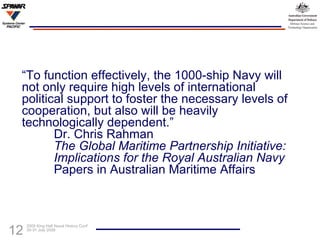
“ To function effectively, the 1000-ship Navy will not only require high levels of international political support to foster the necessary levels of cooperation, but also will be heavily technologically dependent.” Dr. Chris Rahman The Global Maritime Partnership Initiative:  Implications for the Royal Australian Navy Papers in Australian Maritime Affairs
 
“ The Future Navy must possess the Command, Control, Communications, Computers (C4) capabilities required to maintain interoperability with coalition forces in the future.” Royal Australian Navy Plan Blue 2006
Background Commonwealth Navies – and their partners – have a rich history of cooperation at sea This successful cooperation in peace & war has raised the bar for future levels of cooperation Understanding this history is essential to dealing with future challenges to this cooperation The highest-level Commonwealth policy documents all call for  more  cooperation at sea
Background This naval cooperation has become instantiated in the nascent global maritime partnership Challenges to this enhanced cooperation are many and are dependent on effective C4ISR Australia has been a leader in calling for more effective C4ISR between among coalition navies Publications such as  Future Maritime Operating Concept – 2025  and  Plan Blue  have called for better networking among navies as an essential ingredient of effective partnering at sea
Perspective
“ Most think that bigger, faster, and more is best when talking about providing technology to naval forces.  But this is not always the case.  What matters in not how  much  you communicate, but rather getting the right information to the right people at the right time.” Professor Nicholas Rodger Exeter University Keynote Address 2007 King Hall Conference
 
“ When John Fisher became First Sea Lord in 1904, his main pledge was to solve this intractable problem…Fisher in effect invented picture-based warfare.  He created a pair of war rooms in the Admiralty, one built around a world (trade) map, the other around a North Sea map.”   Dr. Norman Friedman   “Netting and Navies: Achieving a Balance”   Sea Power: Challenges Old and New
Perspective Rapid advances in technology, beginning at the dawn of the 20 th  Century, have ushered in exciting possibilities for faster, better, and more effective naval communication Commonwealth naval communication and cooperation can be traced back at least as far back as First Sea Lord Fisher’s Admiralty War Rooms in 1904
Perspective But the history of communications over the past century has revealed that there are often negative unintended consequences when rapidly introducing technology to navies Navies wishing to effectively network at sea will likely make substantial investments in technology, what is  crucial  is ensuring that these technologies enhance, not impede, networking The fact navies have led land forces in networking obscures technological challenges
Naval Coalition Networking:  How Big a Challenge?
“ Is there a place for small navies in network-centric warfare? Will they be able to make any sort of contribution in multinational naval operations of the future?  Or will they be relegated to the sidelines, undertaking the most menial of tasks, encouraged to stay out of the way—or stay at home…The ‘need for speed’ in network-centric operations places the whole notion of multinational operations at risk.” Professor Paul Mitchell “Small Navies and Network-centric  Warfare:  Is There a Role?” Naval War College Review
 
“ The thorniest issue is to what extent participants are expected to contribute to the timely sharing of information to be used for the identification, monitoring, disruption or interdiction of illegal activities…Each nation can be expected, for example, to have clearly defined rules for releasing information about intelligence platform capabilities.”   Lieutenant Commander Chris Watson, RAN   “How Might the World’s Navies Contribute    to and Benefit from the ‘1000-Ship Navy’    Proposal?”   Australian Maritime Issues 2007
Naval Coalition Networking:  How Big a Challenge? Effective coalition networking depends on mutually compatible C4ISR technology Rapid technology advances and insertion have often  impeded  effective coalition networking Australian Maritime Doctrine  probably says it best – “Interoperability can never be assumed and requires substantial and sustained effort to achieve common doctrine, common procedures and common communications” – and addresses the challenge for all our navies
Naval Coalition Networking:  How Big a Challenge? Coalition partners often ask the question: “ What is the price of  admission  to network effectively” But the right question is: “ What is the price of  omission  if we can not network together” Coordinated technological development in parallel offers one promising solution This sounds great in theory, but who will provide stewardship for this parallel development?
Tell it to the Labs
“ The DSTO mission covers the full spectrum of science and technology support for Defence…The DSTO will continue a significant portion of research into forward-looking enabling technologies such as hypersonics, computer security, electro-optics and smart materials which impact future Defence capability.”    Defending Australia in the Asia Pacific    Century: Force 2030
 
“ We will win—or lose—the next series of wars in our nation’s laboratories.” Admiral Jim Stavridis As SOUTHCOM Commander “Deconstructing War” U.S.   Naval Institute Proceedings  December 2005
Tell it to the Labs DSTO and the companion defense laboratories in the other Commonwealth nations – as well as their likely coalition partners – have a rich history of “connecting” navies at sea Effective nation-to-nation defense laboratory cooperation has been going on for over a half-century under the auspices of The Technical Cooperation Program (TTCP) and other entities
Tell it to the Labs TTCP leadership has recognized the challenges to effective coalition networking at sea In 2001, the TTCP Maritime Systems Group commissioned a team to address this issue This five-nation cooperative effort has completed two three-year efforts and future work is planned We are sharing our results as one best-practices model for all nations represented here
Out of the Labs: Achieving Coalition Networking
“ The ADF…must continue the transition to a force with fully integrated services that is interoperable with other agencies of government and its coalition partners and allies…The future force will need assured access to other agency, coalition, and open source information capabilities…We have a strong record of meeting the challenges of interagency and coalition operations, both as a leader and a participant.  The future will present more challenges in the regard.” Australian Defence Force Joint Operations for the 21 st  Century
SSC San Diego…on Point and at the Center of C4ISR
“ In today’s world, nothing significant can get done outside of a coalition context, but we have been  humbled  by the challenges of devising effective coalition communications.” Dr. David Alberts Director of Research U.S. Dept of Defense 7 th  International Command and Control  Research and Technology Symposium September 2002
Our “Beta-Test” Under the Auspices of The Technical Cooperation Program: One Path to “Building the Networks” One  Model for International Defense and Networking Cooperation: MAR AG-1/AG-6 SSC San Diego…on Point and at the Center of C4ISR
“ The Technical Cooperation Program (TTCP), a longstanding forum for defence science and technology cooperation between Australia, Canada, New Zealand, the United Kingdom and the United States, has, for example, established an initiative to consider the ‘FORCEnet Implications for Coalition Partners’” Dr. Chris Rahman The Global Maritime Partnership Initiative:  Implications for the Royal Australian Navy
MAR Action Group 1:  “Maritime Network Centric Warfare”
MAR Action Group 1 Maritime Network Centric Warfare Open ended Focus on “bounding the problem” Good product Proof of concept through multilateral analysis Warfighting scenarios with traction for all Two Studies Broad Issues: First Principles of NCW Tactical Level Analysis: MIO/ASW/ASuW
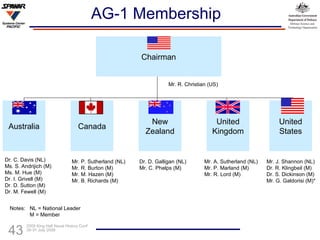
AG-1 Membership Chairman Australia Canada New Zealand United Kingdom United States Dr. C. Davis (NL) Ms. S. Andrijich (M)  Ms. M. Hue (M)  Dr. I. Grivell (M)  Dr. D. Sutton (M)  Dr. M. Fewell (M)  Mr. P. Sutherland (NL)  Mr. R. Burton (M) Mr. M. Hazen (M) Mr. B. Richards (M)  Dr. D. Galligan (NL) Mr. C. Phelps (M) Mr. A. Sutherland (NL)  Mr. P. Marland (M) Mr. R. Lord (M) Mr. J. Shannon (NL)  Dr. R. Klingbeil (M)  Dr. S. Dickinson (M)  Mr. G. Galdorisi (M)* Notes:  NL = National Leader M = Member Mr. R. Christian (US)
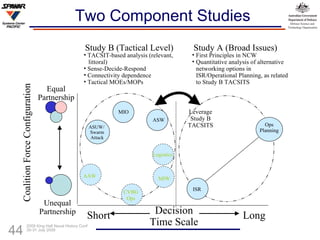
Two Component Studies Decision Time Scale Short Long Unequal Partnership Equal Partnership First Principles in NCW Quantitative analysis of alternative networking options in ISR/Operational Planning, as related to Study B TACSITS TACSIT-based analysis (relevant,  littoral) Sense-Decide-Respond Connectivity dependence Tactical MOEs/MOPs Study B (Tactical Level) Study A (Broad Issues) ASW CVBG Ops AAW ASUW/  Swarm Attack MIO Logistics ISR Ops Planning MIW Leverage Study B TACSITS Coalition Force Configuration
MAR AG-1 Study B Tactical Level Analysis
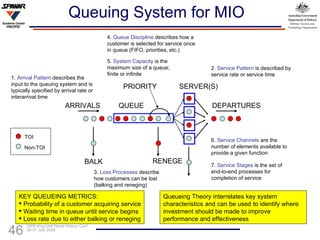
Queuing System for MIO  RENEGE BALK ARRIVALS PRIORITY DEPARTURES SERVER(S) QUEUE 1.  Arrival Pattern  describes the input to the queuing system and is typically specified by arrival rate or interarrival time 2.  Service Pattern  is described by service rate or service time  3.  Loss Processes  describe how customers can be lost (balking and reneging) 4.  Queue Discipline  describes how a customer is selected for service once in queue (FIFO, priorities, etc.)  5.  System Capacity  is the maximum size of a queue; finite or infinite 6.  Service Channels  are the number of elements available to provide a given function  7.  Service Stages  is the set of end-to-end processes for completion of service KEY QUEUEING METRICS: Probability of a customer acquiring service Waiting time in queue until service begins Loss rate due to either balking or reneging Queueing Theory interrelates key system characteristics and can be used to identify where investment should be made to improve performance and effectiveness TOI Non-TOI
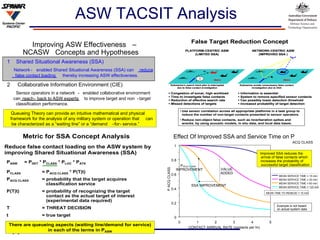
ASW TACSIT Analysis 0 0.2 0.4 0.6 0.8 1 0 1 2 3 4 5 CONTACT ARRIVAL RATE (contacts per hr) PLOC MEAN SERVICE TIME = 15 min MEAN SERVICE TIME = 30 min MEAN SERVICE TIME = 60 min MEAN SERVICE TIME = 120 min Effect Of Improved SSA and Service Time on P ACQ CLASS SSA IMPROVEMENT P ACQ CLASS IMPROVEMENT VALUE ADDED Improved SSA reduces the  arrival of false contacts which  increases the probability of  successful target classification MEAN TIME TO RENEGE = 15 min Example is not based  on actual system data P ACQ CLASS Improving ASW Effectiveness  – NCASW Concepts and Hypotheses 1 Shared Situational Awareness (SSA) Network - enabled Shared Situational Awareness (SSA) can  reduce  false contact loading thereby increasing ASW effectiveness. 2 Collaborative Information Environment (CIE) Sensor operators in a network - enabled collaborative environment  can  reach - back to ASW experts to improve target and non - target  classification performance. Queueing Theory can provide an intuitive mathematical and physical framework for the analysis of any military system or operation that can  be characterized as a “waiting line” or a “demand - for - service.”
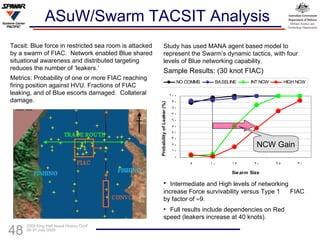
ASuW/Swarm TACSIT Analysis Study has used MANA agent based model to represent the Swarm’s dynamic tactics, with four levels of Blue networking capability. Sample Results: (30 knot FIAC)  Intermediate and High levels of networking  increase Force survivability versus Type 1  FIAC by factor of   9.  Full results include dependencies on Red  speed (leakers increase at 40 knots).  Tacsit: Blue force in restricted sea room is attacked by a swarm of FIAC.  Network enabled Blue shared situational awareness and distributed targeting reduces the number of ‘leakers.’  Metrics: Probability of one or more FIAC reaching firing position against HVU. Fractions of FIAC leaking, and of Blue escorts damaged.  Collateral damage. NCW Gain
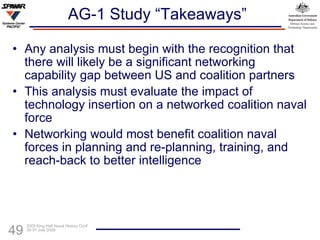
AG-1 Study “Takeaways” Any analysis must begin with the recognition that there will likely be a significant networking capability gap between US and coalition partners This analysis must evaluate the impact of technology insertion on a networked coalition naval force Networking would most benefit coalition naval forces in planning and re-planning, training, and reach-back to better intelligence
MAR Action Group 6 “FORCEnet Implications  for Coalitions”
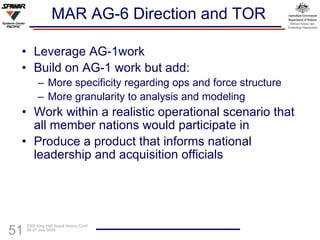
MAR AG-6 Direction and TOR Leverage AG-1work Build on AG-1 work but add: More specificity regarding ops and force structure More granularity to analysis and modeling Work within a realistic operational scenario that all member nations would participate in Produce a product that informs national leadership and acquisition officials
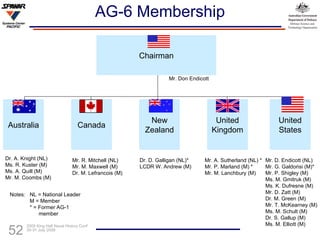
AG-6 Membership Chairman Australia Canada New Zealand United Kingdom United States Dr. A. Knight (NL) Ms. R. Kuster (M) Ms. A. Quill (M) Mr. M. Coombs (M) Mr. R. Mitchell (NL) Mr. M. Maxwell (M) Dr. M. Lefrancois (M)  Dr. D. Galligan (NL)* LCDR W. Andrew (M) Mr. A. Sutherland (NL) * Mr. P. Marland (M) * Mr. M. Lanchbury (M) Mr. D. Endicott (NL)  Mr. G. Galdorisi (M)*  Mr. P. Shigley (M) Ms. M. Gmitruk (M) Ms. K. Dufresne (M) Mr. D. Zatt (M) Dr. M. Green (M) Mr. T. McKearney (M) Ms. M. Schult (M) Dr. S. Gallup (M) Ms. M. Elliott (M) Notes:  NL = National Leader M = Member * = Former AG-1    member Mr. Don Endicott
What is FORCEnet? FORCEnet is an “…operational construct and architectural framework for naval warfare in the information age, integrating warriors, sensors, command and control, platforms, and weapons into a networked, distributed combat force.”  Admiral Vern Clark Former Chief of Naval Operations (2000-2005) U.S. Naval Institute   Proceedings  October 2002
Premises FORCEnet will empower warfighters at all levels to execute more effective decision-making at an increased tempo, which will result in improved combat effectiveness and mission accomplishment. 1 The warfighting benefits of FORCEnet in a coalition context can be assessed through analysis and quantified to  provide input to national balance of investment studies of  the five member nations . 2 It is necessary that FORCEnet address current and near term information system requirements that support operations in the joint and coalition environments.  Coalition Communications was the clear number one priority  of all numbered fleet commanders and is a critical enabler in leveraging coalition partners in the GWOT. 3 FORCEnet:   A Functional Concept for the 21 st  Century   MAR AG-6   Terms of Reference FY 2006 Numbered Fleet Top C4 Requirements (CFFC/CPF consolidated message)
Hypothesis Conducting modeling and simulation and detailed analysis to demonstrate the enhanced warfighting effectiveness of coalition partners (in this case – the AUSCANNZUKUS nations) netted in a FORCEnet environment can help inform national naval C4ISR acquisition programs.
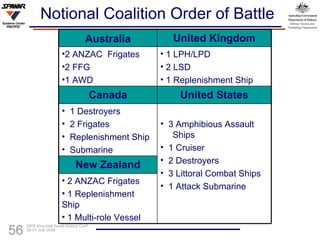
Notional Coalition Order of Battle Australia United Kingdom 2 ANZAC  Frigates 2 FFG 1 AWD 1 LPH/LPD 2 LSD 1 Replenishment Ship Canada United States 1 Destroyers 2 Frigates Replenishment Ship Submarine 3 Amphibious Assault  Ships 1 Cruiser 2 Destroyers 3 Littoral Combat Ships 1 Attack Submarine New Zealand 2 ANZAC Frigates  1 Replenishment Ship 1 Multi-role Vessel
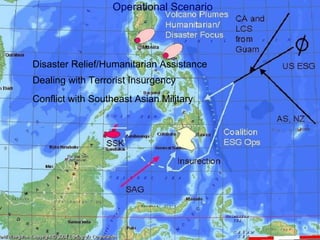
Operational Scenario Conflict with Southeast Asian Military Dealing with Terrorist Insurgency Disaster Relief/Humanitarian Assistance
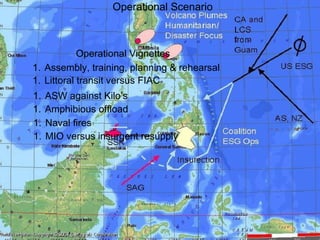
Operational Scenario Assembly, training, planning & rehearsal Littoral transit versus FIAC ASW against Kilo’s Amphibious offload Naval fires MIO versus insurgent resupply Operational Vignettes
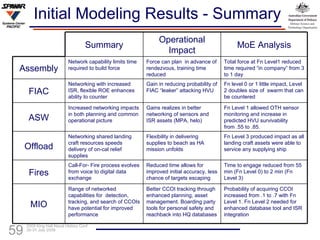
Initial Modeling Results - Summary Summary Operational Impact MoE Analysis Assembly Network capability limits time required to build force Force can plan  in advance of rendezvous, training time reduced Total force at Fn Level1 reduced time required “in company” from 3 to 1 day FIAC Networking with increased ISR, flexible ROE enhances ability to counter Gain in reducing probability of FIAC “leaker” attacking HVU Fn level 0 or 1 little impact, Level 2 doubles size of  swarm that can be countered ASW Increased networking impacts in both planning and common operational picture  Gains realizes in better networking of sensors and ISR assets (MPA, helo) Fn Level 1 allowed OTH sensor monitoring and increase in predicted HVU survivability from .55 to .85.  Offload Networking shared landing craft resources speeds delivery of on-cal relief supplies Flexibility in delivering supplies to beach as HA mission unfolds Fn Level 3 produced impact as all landing craft assets were able to service any supplying ship Fires Call-For- Fire process evolves from voice to digital data exchange Reduced time allows for improved initial accuracy, less chance of targets escaping Time to engage reduced from 55 min (Fn Level 0) to 2 min (Fn Level 3) MIO Range of networked capabilities for  detection, tracking, and search of CCOIs have potential for improved performance Better CCOI tracking through enhanced planning, asset management. Boarding party tools for personal safety and reachback into HQ databases Probability of acquiring CCOI increased from .1 to .7 with Fn Level 1. Fn Level 2 needed for enhanced database tool and ISR integration
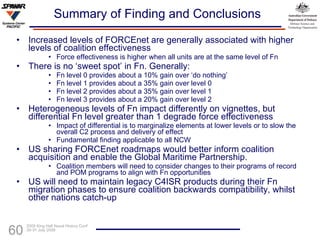
Increased levels of FORCEnet are generally associated with higher levels of coalition effectiveness Force effectiveness is higher when all units are at the same level of Fn There is no ‘sweet spot’ in Fn. Generally: Fn level 0 provides about a 10% gain over ‘do nothing’ Fn level 1 provides about a 35% gain over level 0 Fn level 2 provides about a 35% gain over level 1 Fn level 3 provides about a 20% gain over level 2  Heterogeneous levels of Fn impact differently on vignettes, but differential Fn level greater than 1 degrade force effectiveness Impact of differential is to marginalize elements at lower levels or to slow the overall C2 process and delivery of effect Fundamental finding applicable to all NCW  US sharing FORCEnet roadmaps would better inform coalition acquisition and enable the Global Maritime Partnership. Coalition members will need to consider changes to their programs of record and POM programs to align with Fn opportunities US will need to maintain legacy C4ISR products during their Fn migration phases to ensure coalition backwards compatibility, whilst other nations catch-up Summary of Finding and Conclusions
Summary of Key Findings FORCEnet improves military performance in every vignette assessed Improvements primarily in process time, decision making, information availability and planning Force effectiveness higher when all coalition units operate at same FORCEnet level Differential levels >1 among coalition units degrade force effectiveness
TTCP MAR “AG-Next”
A Way Forward?
“ A new idea is first condemned as ridiculous and then dismissed as trivial, until finally, it becomes what everyone knows.” William James--1879
SSC San Diego…on Point and at the Center of C4ISR
“ The DMO (Defence Material Organization) maintains a number of relationship with allies and other partner nations in order to ensure that Australia has access to the world’s best technologies, systems and capabilities.  The DMO uses those relationships to identify interoperability objectives, explore collaborative activities, share data on reciprocal projects, benchmark acquisition and sustainment processes, and streamline technology transfer arrangements.” Defending Australia in the Asia Pacific  Century: Force 2030
A Way Forward? The rich history of Commonwealth naval cooperation simultaneously offers good examples of how our navies can cooperate today while raising the bar for how these navies work together in the future Today, globalization and a wide range of challenges mean that no navy stands alone and networking navies effectively is a  necessary  condition for mutual security and prosperity via an effective global maritime partnership
A Way Forward? The next 100 years of Commonwealth naval cooperation will be heavily dependent upon these navies – and their likely coalition partners – having mutually compatible C4ISR systems that enhance robust networking We have “beta-tested” one methodology for helping navies network more effectively by addressing C4ISR challenges at the defense laboratory level and this model can be extrapolated to other nations and navies
 
“ Interoperability can never be assumed and requires substantial and sustained effort to  achieve common doctrine, common  procedures and common communications” Australian Maritime Doctrine
SSC San Diego…on Point and at the Center of C4ISR
Back-ups
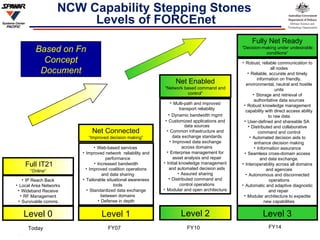
NCW Capability Stepping Stones  Levels of FORCEnet Level 3 Robust, reliable communication to all nodes Reliable, accurate and timely information on friendly, environmental, neutral and hostile units Storage and retrieval of authoritative data sources Robust knowledge management capability with direct access ability to raw data User-defined and shareable SA  Distributed and collaborative command and control Automated decision aids to enhance decision making Information assurance Seamless cross-domain access and data exchange. Interoperability across all domains and agencies Autonomous and disconnected operations Automatic and adaptive diagnostic and repair  Modular architecture to expedite new capabilities Fully Net Ready “ Decision-making under undesirable conditions“ IP Reach Back Local Area Networks Wideband Receive RF Management Survivable comms Full IT21 “ Online“ Level 0 Web-based services  Improved network  reliability and performance Increased bandwidth Improved coalition operations and data sharing Tailorable situational awareness tools Standardized data exchange between domains Defense in depth Net Connected “ Improved decision making” Level 1 Net Enabled “ Network based command and control” Multi-path and improved transport reliability Dynamic bandwidth mgmt Customized applications and data sources Common infrastructure and data exchange standards Improved data exchange across domains Enterprise management for asset analysis and repair Initial knowledge management and automated decision aids Assured sharing Distributed command and control operations Modular and open architecture Level 2 Today FY07 FY10 FY14 Based on Fn Concept Document
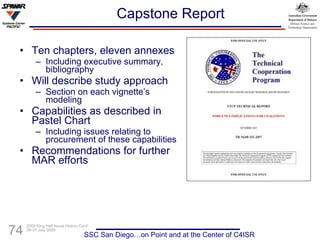
Capstone Report Ten chapters, eleven annexes Including executive summary, bibliography Will describe study approach Section on each vignette’s modeling Capabilities as described in Pastel Chart Including issues relating to procurement of these capabilities Recommendations for further MAR efforts SSC San Diego…on Point and at the Center of C4ISR

Session 8 - Next 100 Years

  • 1.
    2009 King-Hall NavalHistory Conference The Commonwealth Navies: 100 Years of Cooperation Commonwealth Naval Cooperation: Are We Ready for the Next 100 Years? Mr. George Galdorisi, Dr. Stephanie Hszieh, Dr. Darren Sutton July 30-31, 2009
  • 2.
    “ Everyone servesthe good wine first, and then the inferior wine after the guests have become drunk. But you have kept the good wine until now.” John 2:11
  • 3.
    “ Everyone servesthe good wine first, and then the inferior wine after the guests have become drunk. But you have kept the good wine until now.” John 2:11 – The chief steward at the wedding feast at Cana to the bridegroom, commenting on the quality of the wine at the end of the feast
  • 4.
    “ Buying theright systems may give us enormous advantages if we understand how to fight the new way. If we buy the new systems but not the tactical style that goes with them, we will lose capability, even against those who have not invested in similar equipment.” Dr. Norman Friedman Network-Centric Warfare
  • 5.
    SSC San Diego…onPoint and at the Center of C4ISR
  • 6.
    … what weare trying to accomplish today…
  • 7.
    … what weare trying to accomplish today…is bracketed by the following quotes….
  • 8.
    “ Naval Historyand its analysis is an important subject that helps alleviate the tyranny of limited experience. Only by studying history can we properly understand our own strengths and weaknesses and those of our friends and enemies.” Vice Admiral Russ Shalders Royal Australian Navy Chief of Navy Welcoming Remarks 2007 King Hall Conference
  • 9.
    “ Australia’s defencepolicy…means that we must have the capacity to lead military coalitions where we have shared strategic interests at stake with others…and make tailored contributions to military coalitions where we share wider strategic interests with others.” Defending Australia in the Asia Pacific Century: Force 2030
  • 10.
    What We WillCover Today Background Perspective The Challenge of Naval Coalition Networking Tell It to the Labs Achieving Coalition Networking A Way Forward
  • 11.
  • 12.
    “ To functioneffectively, the 1000-ship Navy will not only require high levels of international political support to foster the necessary levels of cooperation, but also will be heavily technologically dependent.” Dr. Chris Rahman The Global Maritime Partnership Initiative: Implications for the Royal Australian Navy Papers in Australian Maritime Affairs
  • 13.
  • 14.
    “ The FutureNavy must possess the Command, Control, Communications, Computers (C4) capabilities required to maintain interoperability with coalition forces in the future.” Royal Australian Navy Plan Blue 2006
  • 15.
    Background Commonwealth Navies– and their partners – have a rich history of cooperation at sea This successful cooperation in peace & war has raised the bar for future levels of cooperation Understanding this history is essential to dealing with future challenges to this cooperation The highest-level Commonwealth policy documents all call for more cooperation at sea
  • 16.
    Background This navalcooperation has become instantiated in the nascent global maritime partnership Challenges to this enhanced cooperation are many and are dependent on effective C4ISR Australia has been a leader in calling for more effective C4ISR between among coalition navies Publications such as Future Maritime Operating Concept – 2025 and Plan Blue have called for better networking among navies as an essential ingredient of effective partnering at sea
  • 17.
  • 18.
    “ Most thinkthat bigger, faster, and more is best when talking about providing technology to naval forces. But this is not always the case. What matters in not how much you communicate, but rather getting the right information to the right people at the right time.” Professor Nicholas Rodger Exeter University Keynote Address 2007 King Hall Conference
  • 19.
  • 20.
    “ When JohnFisher became First Sea Lord in 1904, his main pledge was to solve this intractable problem…Fisher in effect invented picture-based warfare. He created a pair of war rooms in the Admiralty, one built around a world (trade) map, the other around a North Sea map.” Dr. Norman Friedman “Netting and Navies: Achieving a Balance” Sea Power: Challenges Old and New
  • 21.
    Perspective Rapid advancesin technology, beginning at the dawn of the 20 th Century, have ushered in exciting possibilities for faster, better, and more effective naval communication Commonwealth naval communication and cooperation can be traced back at least as far back as First Sea Lord Fisher’s Admiralty War Rooms in 1904
  • 22.
    Perspective But thehistory of communications over the past century has revealed that there are often negative unintended consequences when rapidly introducing technology to navies Navies wishing to effectively network at sea will likely make substantial investments in technology, what is crucial is ensuring that these technologies enhance, not impede, networking The fact navies have led land forces in networking obscures technological challenges
  • 23.
    Naval Coalition Networking: How Big a Challenge?
  • 24.
    “ Is therea place for small navies in network-centric warfare? Will they be able to make any sort of contribution in multinational naval operations of the future? Or will they be relegated to the sidelines, undertaking the most menial of tasks, encouraged to stay out of the way—or stay at home…The ‘need for speed’ in network-centric operations places the whole notion of multinational operations at risk.” Professor Paul Mitchell “Small Navies and Network-centric Warfare: Is There a Role?” Naval War College Review
  • 25.
  • 26.
    “ The thorniestissue is to what extent participants are expected to contribute to the timely sharing of information to be used for the identification, monitoring, disruption or interdiction of illegal activities…Each nation can be expected, for example, to have clearly defined rules for releasing information about intelligence platform capabilities.” Lieutenant Commander Chris Watson, RAN “How Might the World’s Navies Contribute to and Benefit from the ‘1000-Ship Navy’ Proposal?” Australian Maritime Issues 2007
  • 27.
    Naval Coalition Networking: How Big a Challenge? Effective coalition networking depends on mutually compatible C4ISR technology Rapid technology advances and insertion have often impeded effective coalition networking Australian Maritime Doctrine probably says it best – “Interoperability can never be assumed and requires substantial and sustained effort to achieve common doctrine, common procedures and common communications” – and addresses the challenge for all our navies
  • 28.
    Naval Coalition Networking: How Big a Challenge? Coalition partners often ask the question: “ What is the price of admission to network effectively” But the right question is: “ What is the price of omission if we can not network together” Coordinated technological development in parallel offers one promising solution This sounds great in theory, but who will provide stewardship for this parallel development?
  • 29.
    Tell it tothe Labs
  • 30.
    “ The DSTOmission covers the full spectrum of science and technology support for Defence…The DSTO will continue a significant portion of research into forward-looking enabling technologies such as hypersonics, computer security, electro-optics and smart materials which impact future Defence capability.” Defending Australia in the Asia Pacific Century: Force 2030
  • 31.
  • 32.
    “ We willwin—or lose—the next series of wars in our nation’s laboratories.” Admiral Jim Stavridis As SOUTHCOM Commander “Deconstructing War” U.S. Naval Institute Proceedings December 2005
  • 33.
    Tell it tothe Labs DSTO and the companion defense laboratories in the other Commonwealth nations – as well as their likely coalition partners – have a rich history of “connecting” navies at sea Effective nation-to-nation defense laboratory cooperation has been going on for over a half-century under the auspices of The Technical Cooperation Program (TTCP) and other entities
  • 34.
    Tell it tothe Labs TTCP leadership has recognized the challenges to effective coalition networking at sea In 2001, the TTCP Maritime Systems Group commissioned a team to address this issue This five-nation cooperative effort has completed two three-year efforts and future work is planned We are sharing our results as one best-practices model for all nations represented here
  • 35.
    Out of theLabs: Achieving Coalition Networking
  • 36.
    “ The ADF…mustcontinue the transition to a force with fully integrated services that is interoperable with other agencies of government and its coalition partners and allies…The future force will need assured access to other agency, coalition, and open source information capabilities…We have a strong record of meeting the challenges of interagency and coalition operations, both as a leader and a participant. The future will present more challenges in the regard.” Australian Defence Force Joint Operations for the 21 st Century
  • 37.
    SSC San Diego…onPoint and at the Center of C4ISR
  • 38.
    “ In today’sworld, nothing significant can get done outside of a coalition context, but we have been humbled by the challenges of devising effective coalition communications.” Dr. David Alberts Director of Research U.S. Dept of Defense 7 th International Command and Control Research and Technology Symposium September 2002
  • 39.
    Our “Beta-Test” Underthe Auspices of The Technical Cooperation Program: One Path to “Building the Networks” One Model for International Defense and Networking Cooperation: MAR AG-1/AG-6 SSC San Diego…on Point and at the Center of C4ISR
  • 40.
    “ The TechnicalCooperation Program (TTCP), a longstanding forum for defence science and technology cooperation between Australia, Canada, New Zealand, the United Kingdom and the United States, has, for example, established an initiative to consider the ‘FORCEnet Implications for Coalition Partners’” Dr. Chris Rahman The Global Maritime Partnership Initiative: Implications for the Royal Australian Navy
  • 41.
    MAR Action Group1: “Maritime Network Centric Warfare”
  • 42.
    MAR Action Group1 Maritime Network Centric Warfare Open ended Focus on “bounding the problem” Good product Proof of concept through multilateral analysis Warfighting scenarios with traction for all Two Studies Broad Issues: First Principles of NCW Tactical Level Analysis: MIO/ASW/ASuW
  • 43.
    AG-1 Membership ChairmanAustralia Canada New Zealand United Kingdom United States Dr. C. Davis (NL) Ms. S. Andrijich (M) Ms. M. Hue (M) Dr. I. Grivell (M) Dr. D. Sutton (M) Dr. M. Fewell (M) Mr. P. Sutherland (NL) Mr. R. Burton (M) Mr. M. Hazen (M) Mr. B. Richards (M) Dr. D. Galligan (NL) Mr. C. Phelps (M) Mr. A. Sutherland (NL) Mr. P. Marland (M) Mr. R. Lord (M) Mr. J. Shannon (NL) Dr. R. Klingbeil (M) Dr. S. Dickinson (M) Mr. G. Galdorisi (M)* Notes: NL = National Leader M = Member Mr. R. Christian (US)
  • 44.
    Two Component StudiesDecision Time Scale Short Long Unequal Partnership Equal Partnership First Principles in NCW Quantitative analysis of alternative networking options in ISR/Operational Planning, as related to Study B TACSITS TACSIT-based analysis (relevant, littoral) Sense-Decide-Respond Connectivity dependence Tactical MOEs/MOPs Study B (Tactical Level) Study A (Broad Issues) ASW CVBG Ops AAW ASUW/ Swarm Attack MIO Logistics ISR Ops Planning MIW Leverage Study B TACSITS Coalition Force Configuration
  • 45.
    MAR AG-1 StudyB Tactical Level Analysis
  • 46.
    Queuing System forMIO RENEGE BALK ARRIVALS PRIORITY DEPARTURES SERVER(S) QUEUE 1. Arrival Pattern describes the input to the queuing system and is typically specified by arrival rate or interarrival time 2. Service Pattern is described by service rate or service time 3. Loss Processes describe how customers can be lost (balking and reneging) 4. Queue Discipline describes how a customer is selected for service once in queue (FIFO, priorities, etc.) 5. System Capacity is the maximum size of a queue; finite or infinite 6. Service Channels are the number of elements available to provide a given function 7. Service Stages is the set of end-to-end processes for completion of service KEY QUEUEING METRICS: Probability of a customer acquiring service Waiting time in queue until service begins Loss rate due to either balking or reneging Queueing Theory interrelates key system characteristics and can be used to identify where investment should be made to improve performance and effectiveness TOI Non-TOI
  • 47.
    ASW TACSIT Analysis0 0.2 0.4 0.6 0.8 1 0 1 2 3 4 5 CONTACT ARRIVAL RATE (contacts per hr) PLOC MEAN SERVICE TIME = 15 min MEAN SERVICE TIME = 30 min MEAN SERVICE TIME = 60 min MEAN SERVICE TIME = 120 min Effect Of Improved SSA and Service Time on P ACQ CLASS SSA IMPROVEMENT P ACQ CLASS IMPROVEMENT VALUE ADDED Improved SSA reduces the arrival of false contacts which increases the probability of successful target classification MEAN TIME TO RENEGE = 15 min Example is not based on actual system data P ACQ CLASS Improving ASW Effectiveness – NCASW Concepts and Hypotheses 1 Shared Situational Awareness (SSA) Network - enabled Shared Situational Awareness (SSA) can reduce false contact loading thereby increasing ASW effectiveness. 2 Collaborative Information Environment (CIE) Sensor operators in a network - enabled collaborative environment can reach - back to ASW experts to improve target and non - target classification performance. Queueing Theory can provide an intuitive mathematical and physical framework for the analysis of any military system or operation that can be characterized as a “waiting line” or a “demand - for - service.”
  • 48.
    ASuW/Swarm TACSIT AnalysisStudy has used MANA agent based model to represent the Swarm’s dynamic tactics, with four levels of Blue networking capability. Sample Results: (30 knot FIAC) Intermediate and High levels of networking increase Force survivability versus Type 1 FIAC by factor of  9. Full results include dependencies on Red speed (leakers increase at 40 knots). Tacsit: Blue force in restricted sea room is attacked by a swarm of FIAC. Network enabled Blue shared situational awareness and distributed targeting reduces the number of ‘leakers.’ Metrics: Probability of one or more FIAC reaching firing position against HVU. Fractions of FIAC leaking, and of Blue escorts damaged. Collateral damage. NCW Gain
  • 49.
    AG-1 Study “Takeaways”Any analysis must begin with the recognition that there will likely be a significant networking capability gap between US and coalition partners This analysis must evaluate the impact of technology insertion on a networked coalition naval force Networking would most benefit coalition naval forces in planning and re-planning, training, and reach-back to better intelligence
  • 50.
    MAR Action Group6 “FORCEnet Implications for Coalitions”
  • 51.
    MAR AG-6 Directionand TOR Leverage AG-1work Build on AG-1 work but add: More specificity regarding ops and force structure More granularity to analysis and modeling Work within a realistic operational scenario that all member nations would participate in Produce a product that informs national leadership and acquisition officials
  • 52.
    AG-6 Membership ChairmanAustralia Canada New Zealand United Kingdom United States Dr. A. Knight (NL) Ms. R. Kuster (M) Ms. A. Quill (M) Mr. M. Coombs (M) Mr. R. Mitchell (NL) Mr. M. Maxwell (M) Dr. M. Lefrancois (M) Dr. D. Galligan (NL)* LCDR W. Andrew (M) Mr. A. Sutherland (NL) * Mr. P. Marland (M) * Mr. M. Lanchbury (M) Mr. D. Endicott (NL) Mr. G. Galdorisi (M)* Mr. P. Shigley (M) Ms. M. Gmitruk (M) Ms. K. Dufresne (M) Mr. D. Zatt (M) Dr. M. Green (M) Mr. T. McKearney (M) Ms. M. Schult (M) Dr. S. Gallup (M) Ms. M. Elliott (M) Notes: NL = National Leader M = Member * = Former AG-1 member Mr. Don Endicott
  • 53.
    What is FORCEnet?FORCEnet is an “…operational construct and architectural framework for naval warfare in the information age, integrating warriors, sensors, command and control, platforms, and weapons into a networked, distributed combat force.” Admiral Vern Clark Former Chief of Naval Operations (2000-2005) U.S. Naval Institute Proceedings October 2002
  • 54.
    Premises FORCEnet willempower warfighters at all levels to execute more effective decision-making at an increased tempo, which will result in improved combat effectiveness and mission accomplishment. 1 The warfighting benefits of FORCEnet in a coalition context can be assessed through analysis and quantified to provide input to national balance of investment studies of the five member nations . 2 It is necessary that FORCEnet address current and near term information system requirements that support operations in the joint and coalition environments. Coalition Communications was the clear number one priority of all numbered fleet commanders and is a critical enabler in leveraging coalition partners in the GWOT. 3 FORCEnet: A Functional Concept for the 21 st Century MAR AG-6 Terms of Reference FY 2006 Numbered Fleet Top C4 Requirements (CFFC/CPF consolidated message)
  • 55.
    Hypothesis Conducting modelingand simulation and detailed analysis to demonstrate the enhanced warfighting effectiveness of coalition partners (in this case – the AUSCANNZUKUS nations) netted in a FORCEnet environment can help inform national naval C4ISR acquisition programs.
  • 56.
    Notional Coalition Orderof Battle Australia United Kingdom 2 ANZAC Frigates 2 FFG 1 AWD 1 LPH/LPD 2 LSD 1 Replenishment Ship Canada United States 1 Destroyers 2 Frigates Replenishment Ship Submarine 3 Amphibious Assault Ships 1 Cruiser 2 Destroyers 3 Littoral Combat Ships 1 Attack Submarine New Zealand 2 ANZAC Frigates 1 Replenishment Ship 1 Multi-role Vessel
  • 57.
    Operational Scenario Conflictwith Southeast Asian Military Dealing with Terrorist Insurgency Disaster Relief/Humanitarian Assistance
  • 58.
    Operational Scenario Assembly,training, planning & rehearsal Littoral transit versus FIAC ASW against Kilo’s Amphibious offload Naval fires MIO versus insurgent resupply Operational Vignettes
  • 59.
    Initial Modeling Results- Summary Summary Operational Impact MoE Analysis Assembly Network capability limits time required to build force Force can plan in advance of rendezvous, training time reduced Total force at Fn Level1 reduced time required “in company” from 3 to 1 day FIAC Networking with increased ISR, flexible ROE enhances ability to counter Gain in reducing probability of FIAC “leaker” attacking HVU Fn level 0 or 1 little impact, Level 2 doubles size of swarm that can be countered ASW Increased networking impacts in both planning and common operational picture Gains realizes in better networking of sensors and ISR assets (MPA, helo) Fn Level 1 allowed OTH sensor monitoring and increase in predicted HVU survivability from .55 to .85. Offload Networking shared landing craft resources speeds delivery of on-cal relief supplies Flexibility in delivering supplies to beach as HA mission unfolds Fn Level 3 produced impact as all landing craft assets were able to service any supplying ship Fires Call-For- Fire process evolves from voice to digital data exchange Reduced time allows for improved initial accuracy, less chance of targets escaping Time to engage reduced from 55 min (Fn Level 0) to 2 min (Fn Level 3) MIO Range of networked capabilities for detection, tracking, and search of CCOIs have potential for improved performance Better CCOI tracking through enhanced planning, asset management. Boarding party tools for personal safety and reachback into HQ databases Probability of acquiring CCOI increased from .1 to .7 with Fn Level 1. Fn Level 2 needed for enhanced database tool and ISR integration
  • 60.
    Increased levels ofFORCEnet are generally associated with higher levels of coalition effectiveness Force effectiveness is higher when all units are at the same level of Fn There is no ‘sweet spot’ in Fn. Generally: Fn level 0 provides about a 10% gain over ‘do nothing’ Fn level 1 provides about a 35% gain over level 0 Fn level 2 provides about a 35% gain over level 1 Fn level 3 provides about a 20% gain over level 2 Heterogeneous levels of Fn impact differently on vignettes, but differential Fn level greater than 1 degrade force effectiveness Impact of differential is to marginalize elements at lower levels or to slow the overall C2 process and delivery of effect Fundamental finding applicable to all NCW US sharing FORCEnet roadmaps would better inform coalition acquisition and enable the Global Maritime Partnership. Coalition members will need to consider changes to their programs of record and POM programs to align with Fn opportunities US will need to maintain legacy C4ISR products during their Fn migration phases to ensure coalition backwards compatibility, whilst other nations catch-up Summary of Finding and Conclusions
  • 61.
    Summary of KeyFindings FORCEnet improves military performance in every vignette assessed Improvements primarily in process time, decision making, information availability and planning Force effectiveness higher when all coalition units operate at same FORCEnet level Differential levels >1 among coalition units degrade force effectiveness
  • 62.
  • 63.
  • 64.
    “ A newidea is first condemned as ridiculous and then dismissed as trivial, until finally, it becomes what everyone knows.” William James--1879
  • 65.
    SSC San Diego…onPoint and at the Center of C4ISR
  • 66.
    “ The DMO(Defence Material Organization) maintains a number of relationship with allies and other partner nations in order to ensure that Australia has access to the world’s best technologies, systems and capabilities. The DMO uses those relationships to identify interoperability objectives, explore collaborative activities, share data on reciprocal projects, benchmark acquisition and sustainment processes, and streamline technology transfer arrangements.” Defending Australia in the Asia Pacific Century: Force 2030
  • 67.
    A Way Forward?The rich history of Commonwealth naval cooperation simultaneously offers good examples of how our navies can cooperate today while raising the bar for how these navies work together in the future Today, globalization and a wide range of challenges mean that no navy stands alone and networking navies effectively is a necessary condition for mutual security and prosperity via an effective global maritime partnership
  • 68.
    A Way Forward?The next 100 years of Commonwealth naval cooperation will be heavily dependent upon these navies – and their likely coalition partners – having mutually compatible C4ISR systems that enhance robust networking We have “beta-tested” one methodology for helping navies network more effectively by addressing C4ISR challenges at the defense laboratory level and this model can be extrapolated to other nations and navies
  • 69.
  • 70.
    “ Interoperability cannever be assumed and requires substantial and sustained effort to achieve common doctrine, common procedures and common communications” Australian Maritime Doctrine
  • 71.
    SSC San Diego…onPoint and at the Center of C4ISR
  • 72.
  • 73.
    NCW Capability SteppingStones Levels of FORCEnet Level 3 Robust, reliable communication to all nodes Reliable, accurate and timely information on friendly, environmental, neutral and hostile units Storage and retrieval of authoritative data sources Robust knowledge management capability with direct access ability to raw data User-defined and shareable SA Distributed and collaborative command and control Automated decision aids to enhance decision making Information assurance Seamless cross-domain access and data exchange. Interoperability across all domains and agencies Autonomous and disconnected operations Automatic and adaptive diagnostic and repair Modular architecture to expedite new capabilities Fully Net Ready “ Decision-making under undesirable conditions“ IP Reach Back Local Area Networks Wideband Receive RF Management Survivable comms Full IT21 “ Online“ Level 0 Web-based services Improved network reliability and performance Increased bandwidth Improved coalition operations and data sharing Tailorable situational awareness tools Standardized data exchange between domains Defense in depth Net Connected “ Improved decision making” Level 1 Net Enabled “ Network based command and control” Multi-path and improved transport reliability Dynamic bandwidth mgmt Customized applications and data sources Common infrastructure and data exchange standards Improved data exchange across domains Enterprise management for asset analysis and repair Initial knowledge management and automated decision aids Assured sharing Distributed command and control operations Modular and open architecture Level 2 Today FY07 FY10 FY14 Based on Fn Concept Document
  • 74.
    Capstone Report Tenchapters, eleven annexes Including executive summary, bibliography Will describe study approach Section on each vignette’s modeling Capabilities as described in Pastel Chart Including issues relating to procurement of these capabilities Recommendations for further MAR efforts SSC San Diego…on Point and at the Center of C4ISR

Editor's Notes

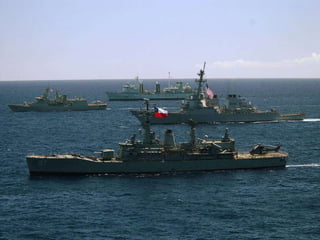
  • #6 * Coalition ships that took part in RIMPAC 2006. Foreground, Chilean Leander class frigate Lynch (07); middle, an Arleigh Burke class DDG; left background, Australian Meko 200 class frigate HMAS Parramatta (154); far background, possibly the Canadian Navy’s aux oil replenishment ship the HMCS Protecteur (509).
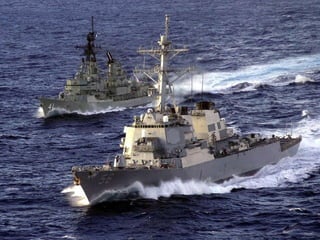
  • #14 010519-N-4790M-005 Shoalwater Bay, Queensland, Australia (May 19, 2001) – The Australian destroyer HMAS Brisbane (DDG 41) (top) and the U.S. Navy destroyer USS John S. McCain (DDG 56) (center) cruise side by side in Australian waters during Operation Exercise Tandem Thrust 2001. Tandem Thrust is a combined U.S. and Australian military training exercise being held in the Shoalwater Bay Training area off the coast of Australia. More than 27,000 Soldiers, Sailors, Airman and Marines are participating with Canadian units taking part as opposing forces. U.S. Navy Photo by Photographer’s Mate 2nd Class Andrew Meyers. (RELEASED)
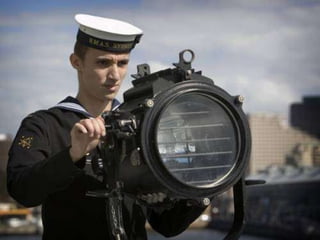
  • #20 Able Seaman Communications and Information Systems Specialist Ellijah Majanovic sends an important signal prior to HMAS Sydney leaving Fleet Base East on Operation Northern Trident 2009.
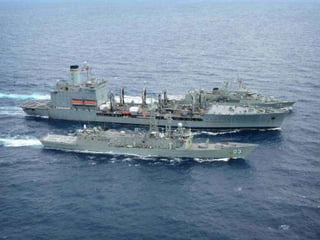
  • #26 HMAS SYDNEY (foreground) during the Replenishment At Sea evolution with USNS RAPPAHANNOCK. Mid Caption: HMAS SYDNEY and HMAS BALLARAT are currently on the first leg of Operation Northern Trident, a worldwide deployment aimed at supporting Government of Australia priorities in selected Western, European, North America and Asian Countries.
  • #32 Picture from DSTO website on hyperspectral research.
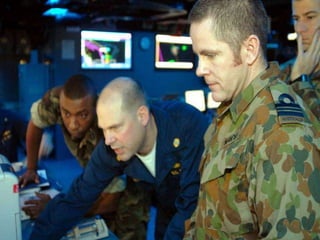
  • #38 *Royal Australian Navy Lt. Cmdr. Bryan C. Edwards, Australian Fleet Battle Staff liaison officer, looks on as Lt. Cmdr. Gary Larson, of Expeditionary Strike Group 7, pulls up information on a computer screen that depicts information about upcoming integration events between U.S. and Australian forces as part of Talisman Saber 2007 (TS07). -- Navy NewStand
  • #45 Two component studies – Scales of Coalition Interoperability
  • #47 Maritime interdiction operations is another maritime-centric effort in our contribution to the GWOT and forms perhaps our greatest area for “growth opportunity” in our fight against terrorism. Admiral Walter Doran, Pacific Fleet Commander, West 2005, February 2, 2005 This is a generic representation of a queuing system. It is provided to illustrate what a queue is, and to introduce various queuing terminology. Various probability distribution functions describe a queue. Customers arrive at the queue according to some probability distribution, and the time spent receiving service follows another probability distribution function (usually different than the arrival distribution). Customers can leave the system before completing service (renege), and a probability distribution describes the time spent in the system before leaving. There are two terms that need some explanation. The first is balking. A customer balks if the queue is too long. Think of the line at the bank. When the line stretches out the door, most people will not enter the line, instead choosing to return later. The other term needing explanation is reneging. This is a measure of how patient each customer is. Each customer will only wait in line so long between leaving. A pdf determines this time. A customer can renege either before service has begun, or at any time until service is complete.
  • #57 Location: Southern Pacific littoral HA-DR mission morphs into Anti-terrorism mission morphs into ASW/ASuW mission
  • #58 Historical Setting: Oil has been confirmed in the Spratly Islands Region in 2008. This has led to greater territorial dispute and re-interpretation of the Economic Exclusion Zone by the five nations laying claim to the Spratly’s and their potential mineral wealth. International arbitration has resulted in the Philippines being awarded major holding in the disputed area in 2010; The scenario opens with an internationally compelling natural humanitarian disaster -public sentiment requires relief action an the part of each nation. Each nation has in the vicinity assets with some dual use capability (naval/humanitarian relief) so their initial response can be measured in days not weeks the Philippines are affected by two large volcanic eruptions affecting the centre of the country (Luzon), and the overall disruption leads to a political crisis and change of government. Other nations provide support with humanitarian and disaster relief, but whilst this effort gathers pace, Muslim factions in the southern province of Mindanao use the opportunity to foment trouble and achieve their own goal of a separate secular state. The coalition support then widens to include peace making/peace enforcement, and the US despatch an Expeditionary Strike Group (ESG) with an amphibious component to ensure that disaster relief is not impeded, and to provide additional land support to Philippine ground forces facing the insurgents. In turn this triggers increased support by another Southeast Asian nation (previously covert) to the separatists, and their naval units (SAG and SSK) attempt to oppose access by the ESG. (HEADLINE – HA/DR – GWOT – ASW – ASUW – BUILD)
  • #59 We started with a humanitarian relief operation scenario called PHILIPPINE COMFORT which would require a coalition force to deliver aid under tense political conditions. To fully assess the ability of network capability to support the sort of operations this very realistic situation might impose, we’ve developed a series of vignettes spanning the various phases of the operation responding to this crises. This is a robust set of missions designed by us to full test the command and control processes the coalition force might employ. However, it’s not only playable but probable; these are the sorts of things that others will be reasonably counting on our naval forces to do at some level for the foreseeable future. Our initial plans called for using nine vignettes for modeling. However, limited resources led us to discard three vignettes as less important operationally.
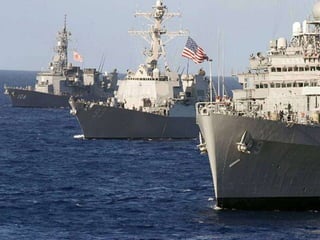
  • #66 Left to right: JDS Samidare (DD 106), USS Chung-Hoon (DDG 93), and USS Denver (LPD 9). All three ships participated in RIMPAC 2006. So that’s what we want to share with you this afternoon, a little bit of history to shape our discussion about Networking the Global Maritime Partnership…and a key theme in that is best expressed in this slide…
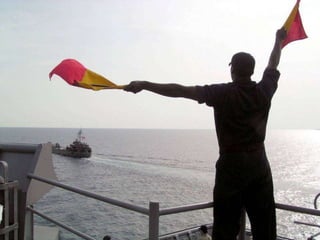
  • #72 *A signalman on the USS Harpers Ferry (LSD 49) practices signaling to the Royal Thai Navy tank landing ship HTMS Prathong (LST 715). Both ships were part of Cooperation Afloat Readiness and Training (CARAT) in 2003.
  • #74 These four timeframes represent the stepping stone increases in our naval platforms Network Centric Warfare Readiness. Level 0 is IT21 Capability today; Level 1, with an IOC of FY07 would bring Net Connected capability; Level 2, with an IOC of FY10 will bring Net Enabled capability; and Level 3 with an IOC of FY14 will bring Fully Net Ready capability.
  • #75 Our final deliverable will be a comprehensive capstone report. This document is truly a collaborative effort, with all of our team participating in the drafting and review. In addition to providing a summary of our work, we’ve found that the Capstone is also a framework for narrowing and guiding our efforts. Our current draft is continuing to be refined through this collaborative effort and we will have a technical writing team from SPAWAR Systems Center assist in the final assembly of the document. We expect to have it completed on time and want to have it available to the MAR, other TTCP groups and, most importantly, our participating nations’ procurement programs.