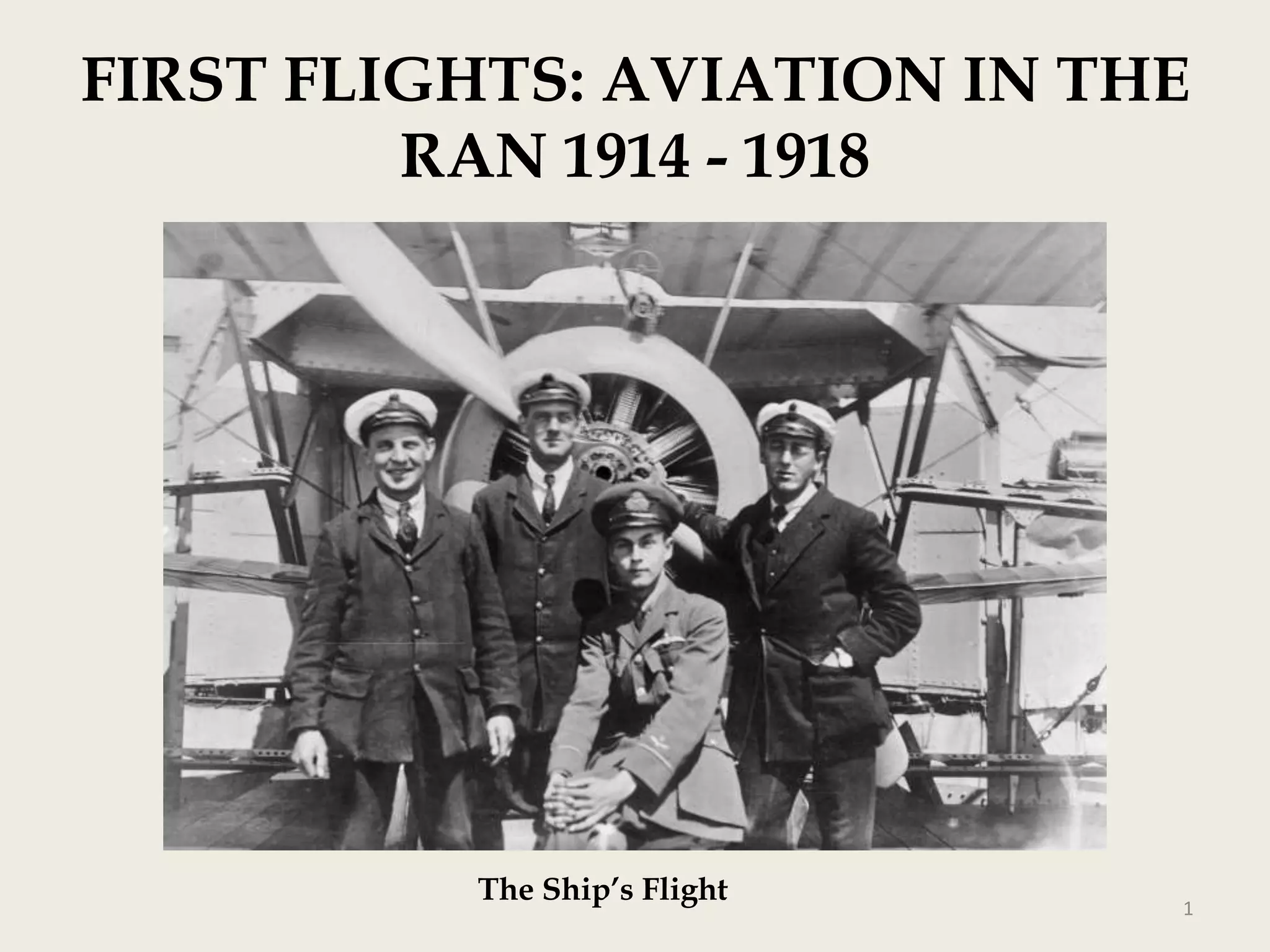
FIRST FLIGHTS: AVIATION IN THE
RAN 1914 - 1918

The Ship’s Flight

1
EARLY NAVAL DEVELOPMENTS
• Continental vs
Maritime Strategies
• The Empire Navy vs
Local Dominion
Forces
• The Naval Agreement
Act 1903
• Deakin and Creswell

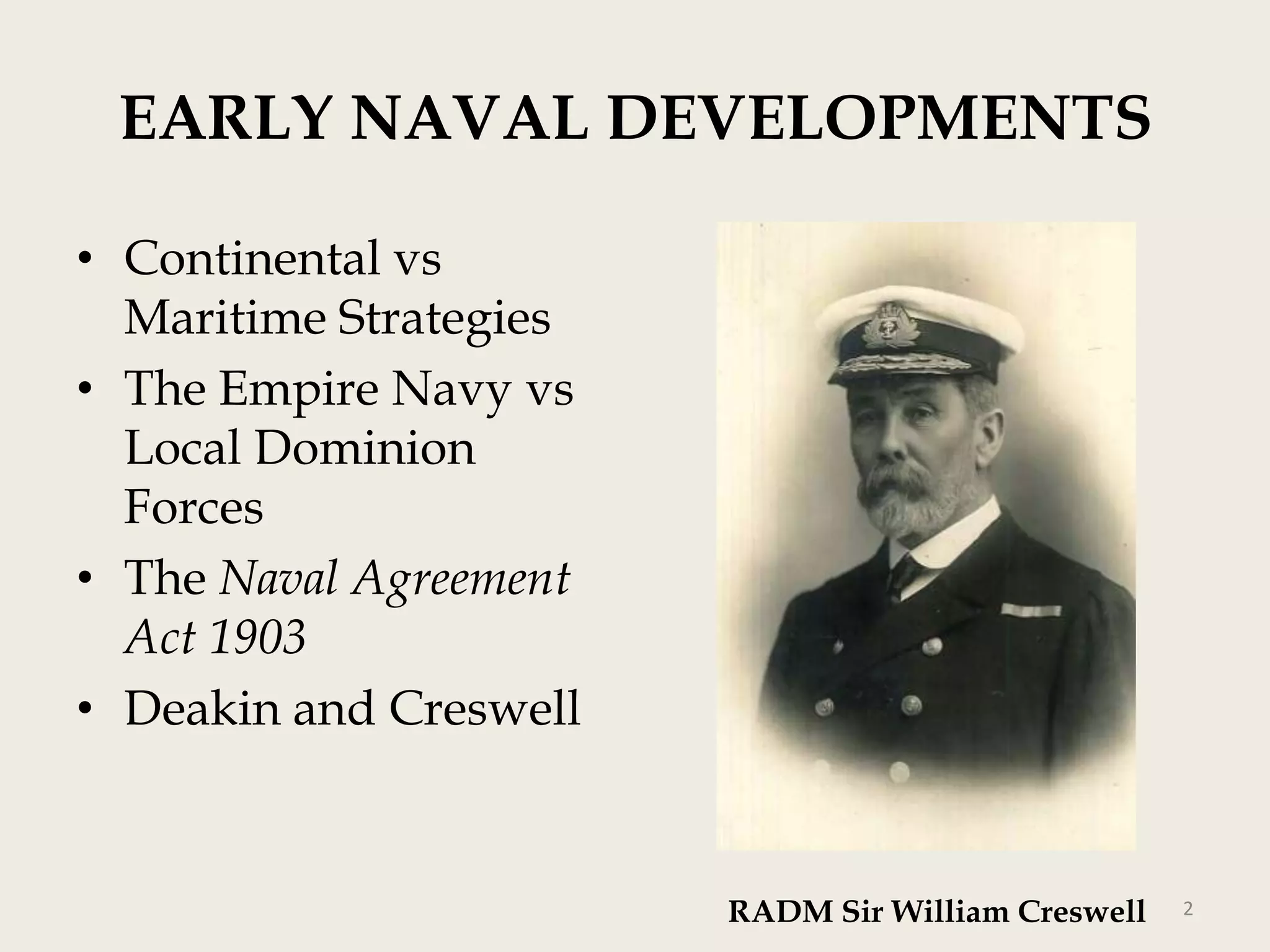
RADM Sir William Creswell

2
EARLY NAVAL
DEVELOPMENTS
• The RAN Fleet Unit
• Submarines?
• Henderson Report
• Force Structure
Ambitions
• Aviation – not at first

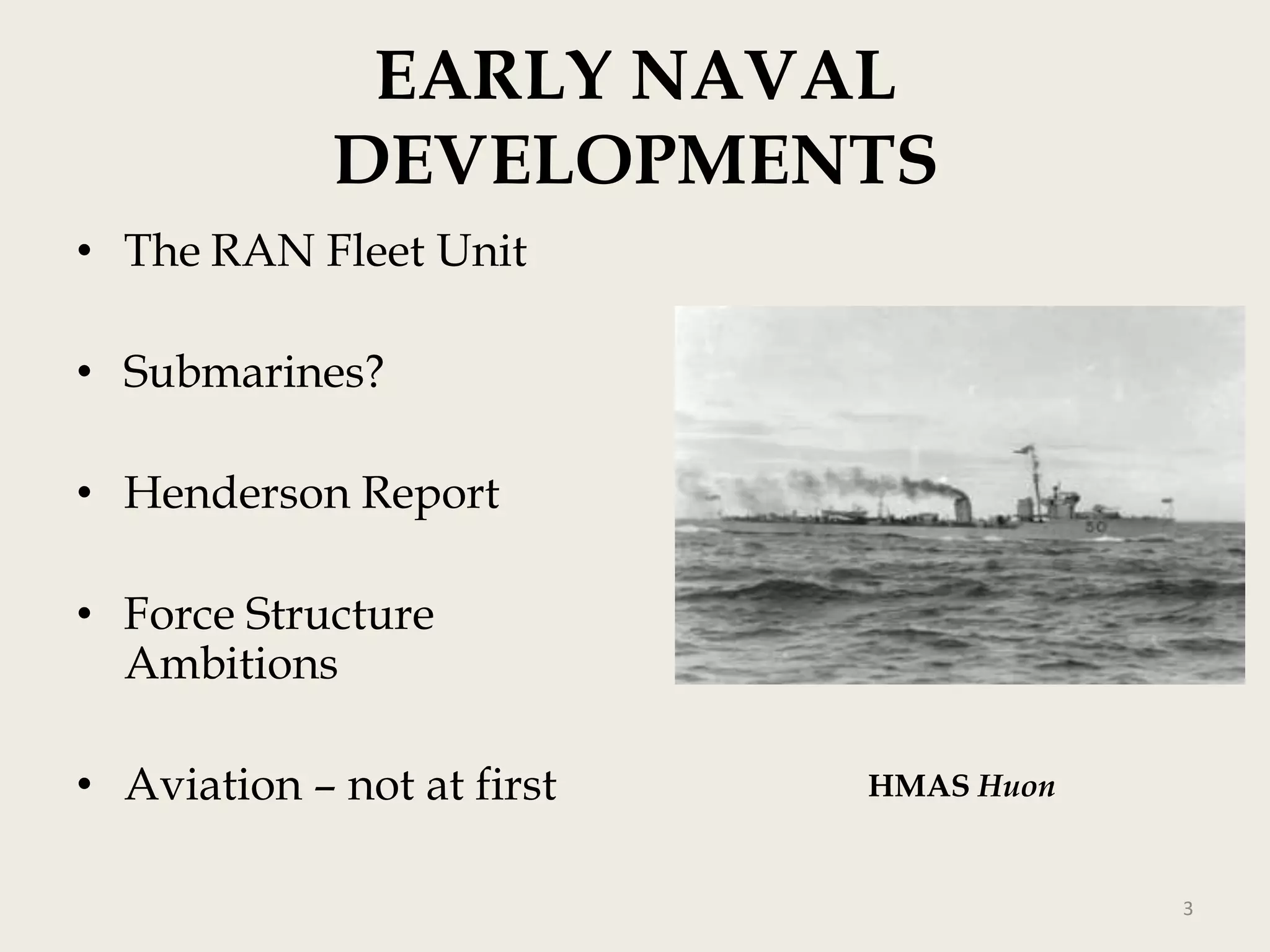
HMAS Huon

3
AVIATION DEVELOPMENTS
• Army prize for flying
machine – 1909
• First Australian
powered flight – March
1910
• AFC – 22 October 1912
• CFS Pt Cook – 1914
• Progress
slow…isolation…
resources…priorities
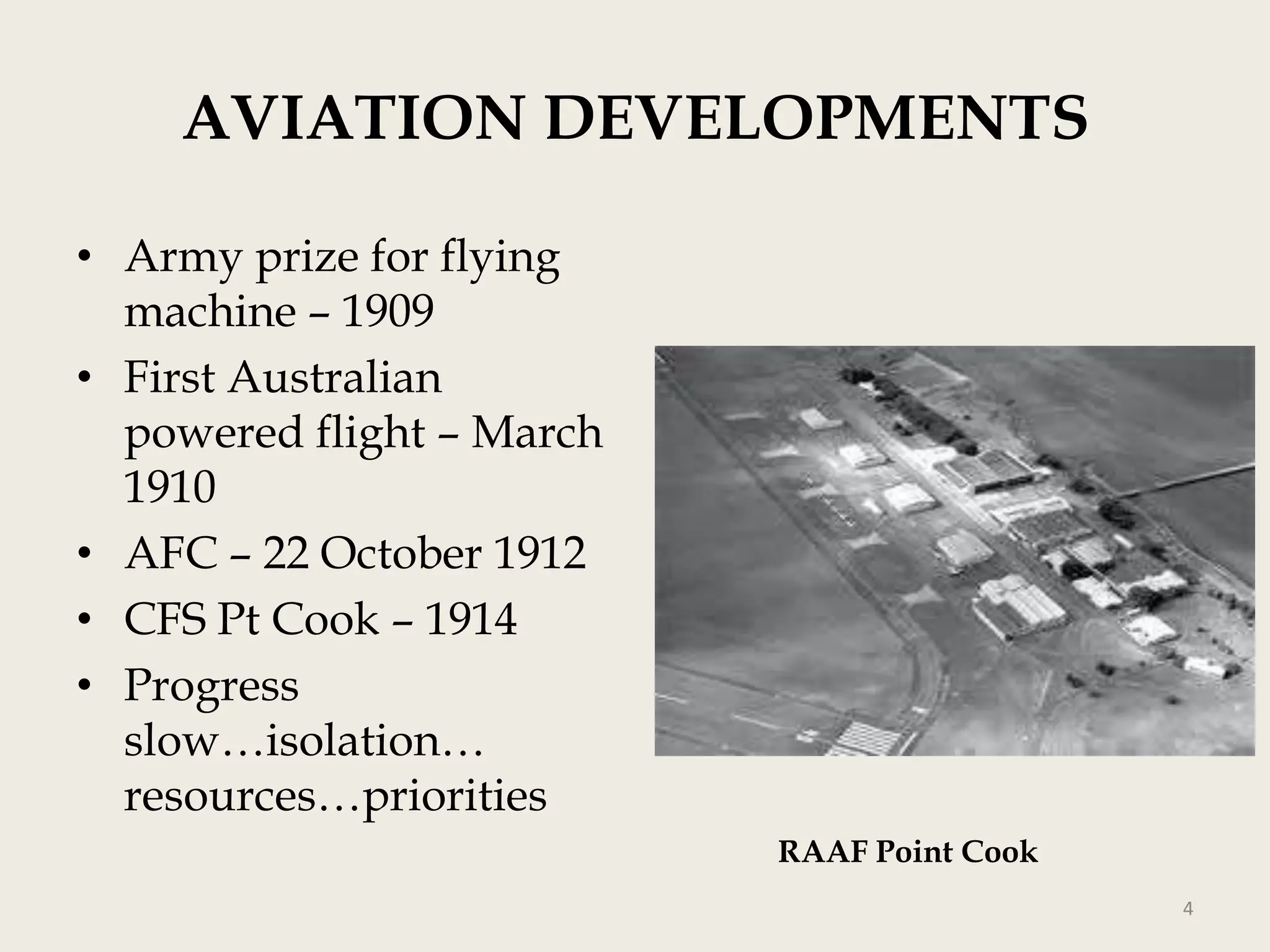
RAAF Point Cook
4
NAVAL AVIATION STIRRINGS
• Potential for scouting and
attack
• „Water planes‟ for
northern defence

• Seaplanes for bases in the
north
• Joint naval and military
flying school
• Lack of local expertise
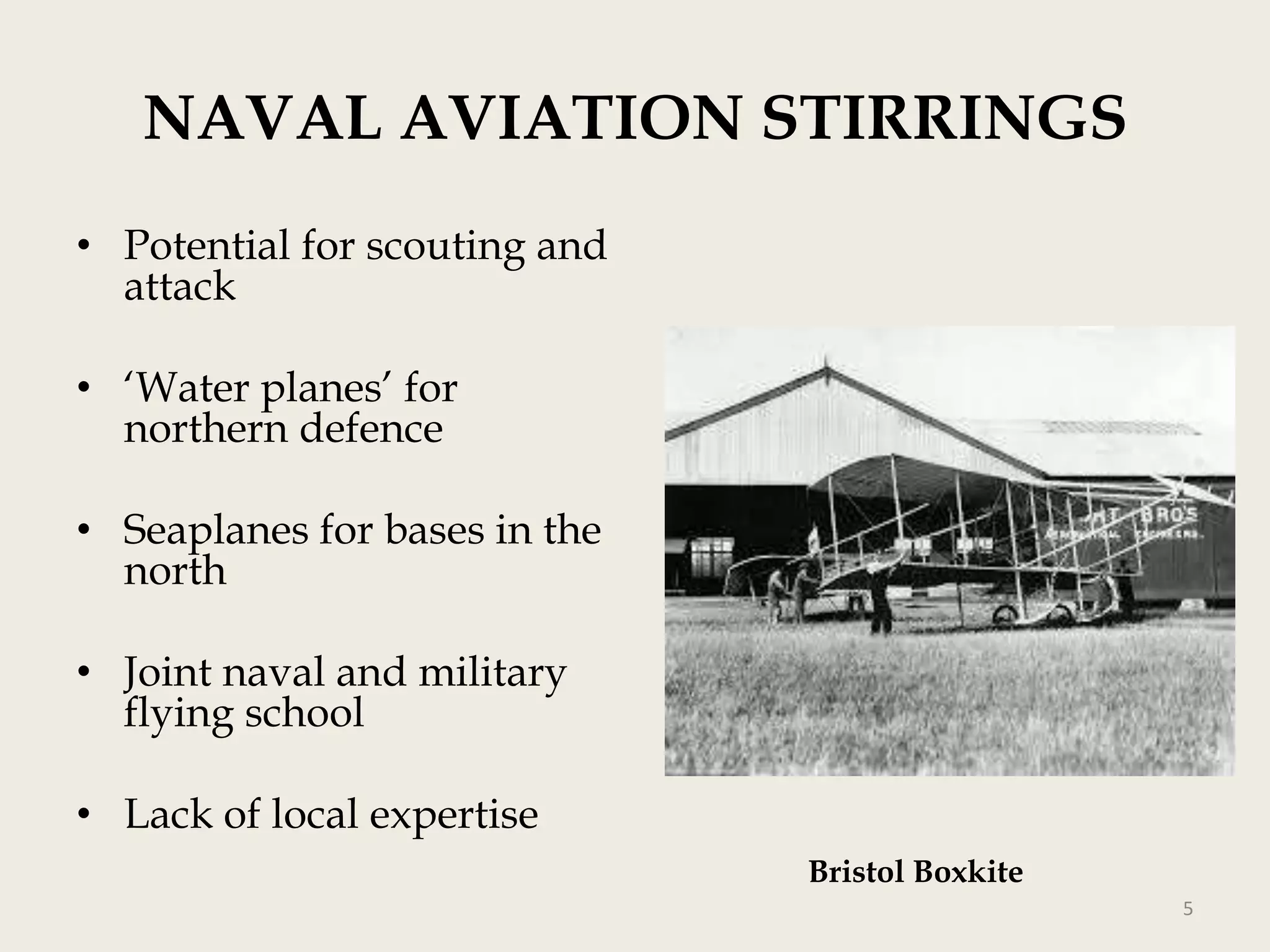
Bristol Boxkite
5
NAVAL AVIATION STIRRINGS
• Looking for a few good
men…
• Education
• Temperament…
• “…the best pilots were
usually highly strung
individuals…a bundle
of nerves…”.
• 1914-15 Estimates to
fund training
• Four small „sea planes‟
plus depot ship to be
the start
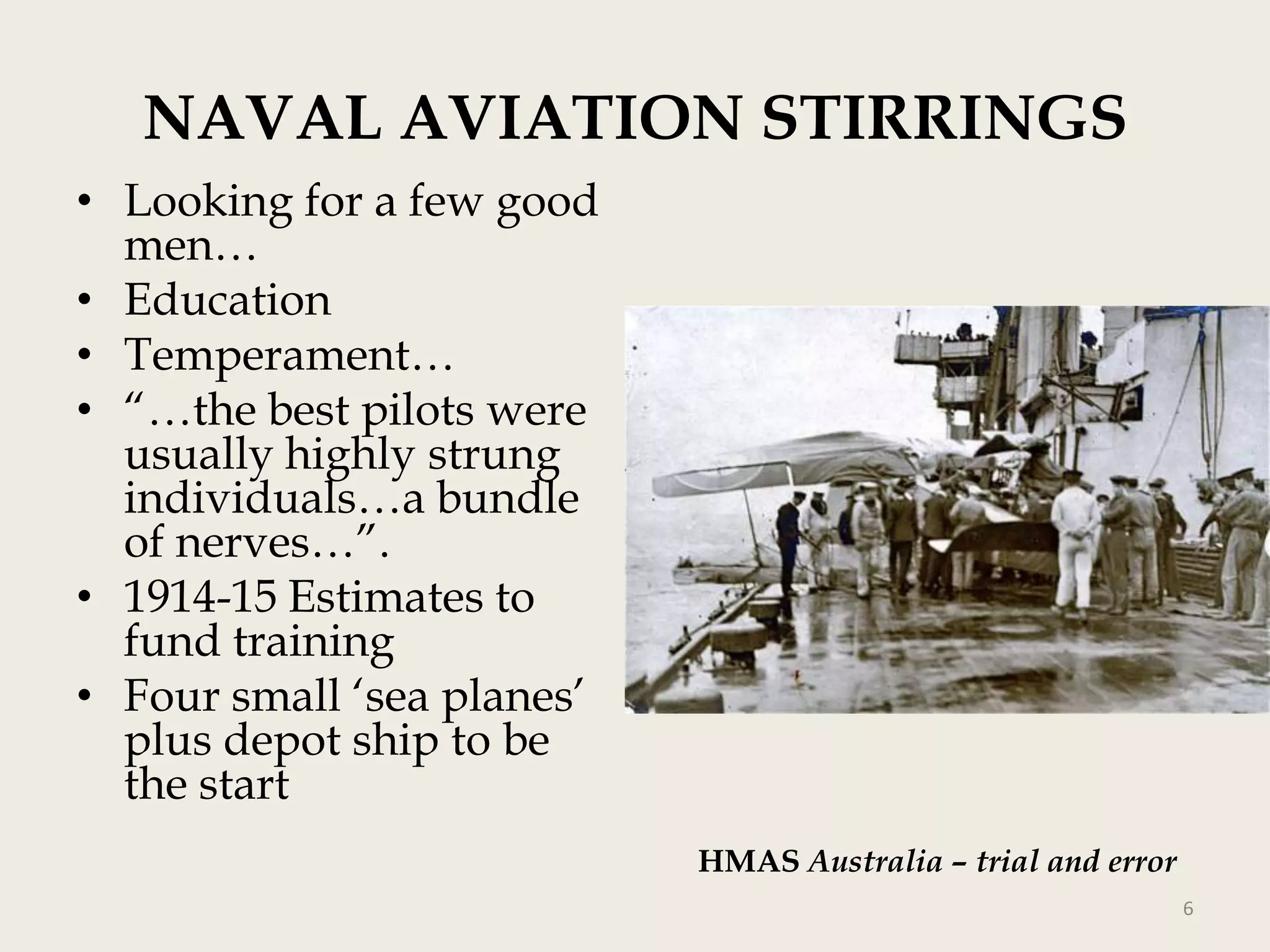
HMAS Australia – trial and error
6
THE FIRST WORLD WAR
• Admiralty control
• RNAS – defence of
the homeland
• RN initiatives
• Major combatants
and aircraft

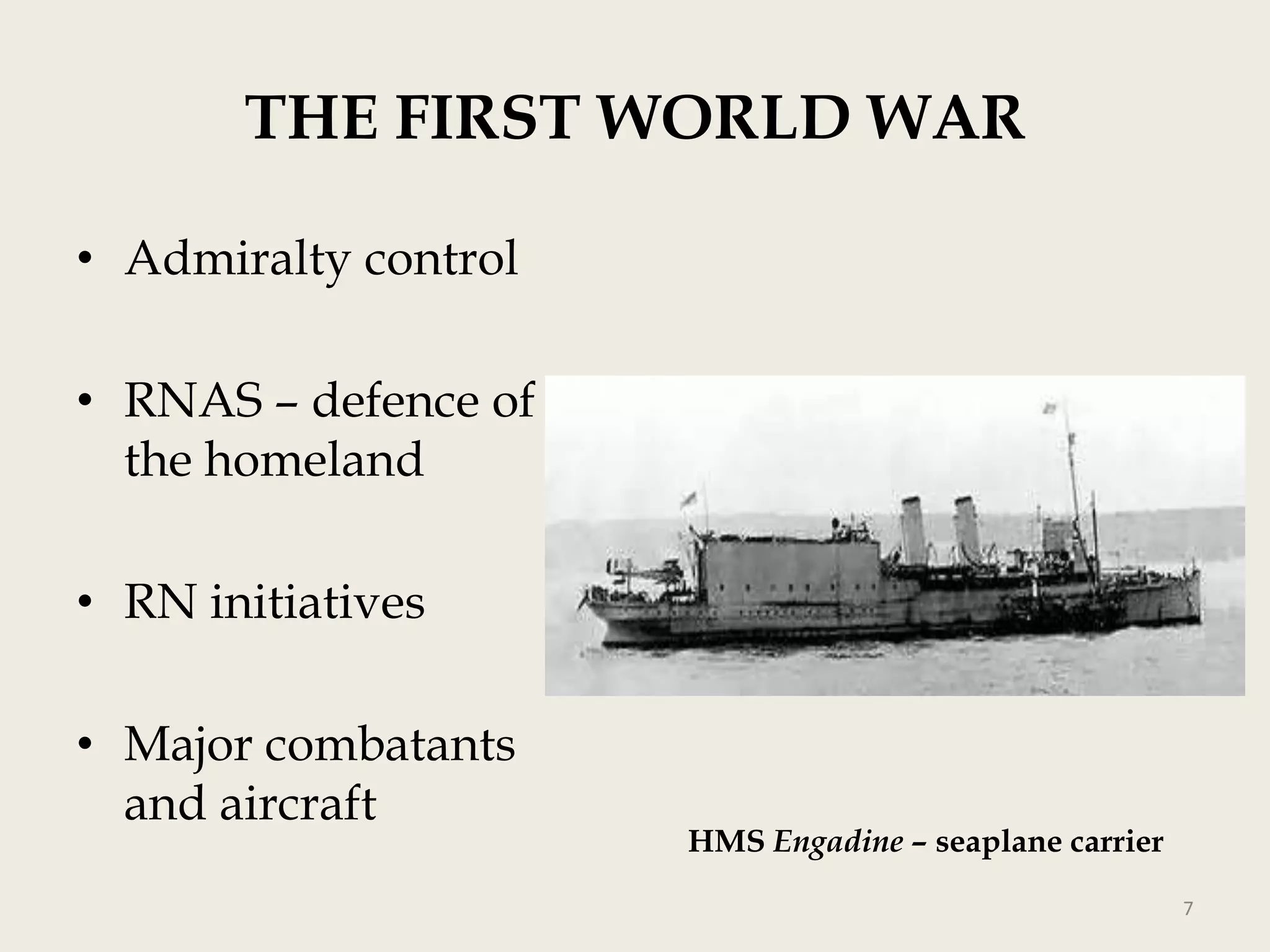
HMS Engadine – seaplane carrier
7
THE FIRST WORLD WAR
• HMAS Brisbane
– Embarked Sopwith
Baby in Indian Ocean
– CO then wanted to
carry two
– Reported on their
utility in defence of
Australia
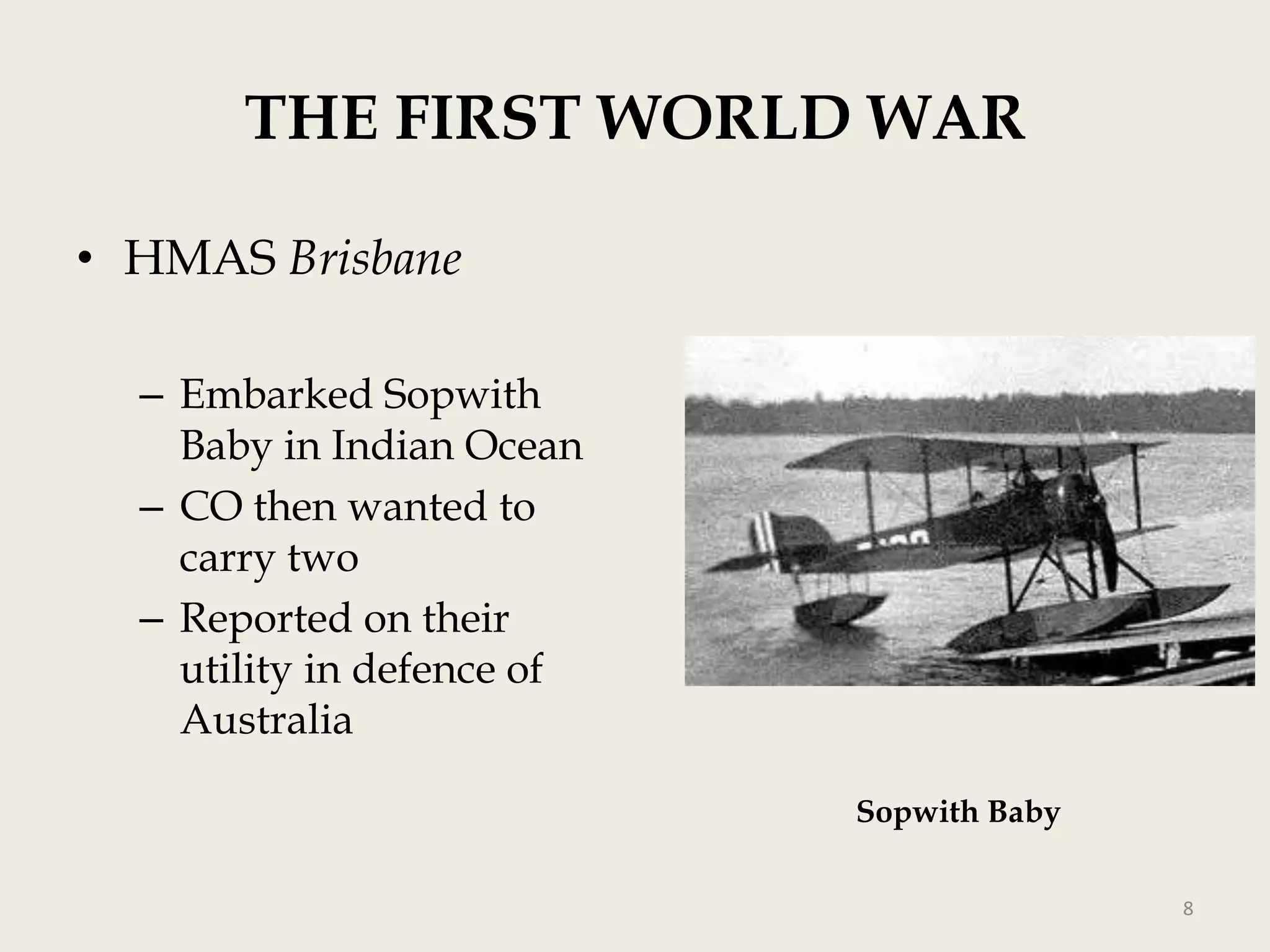
Sopwith Baby
8
THE FIRST WORLD WAR
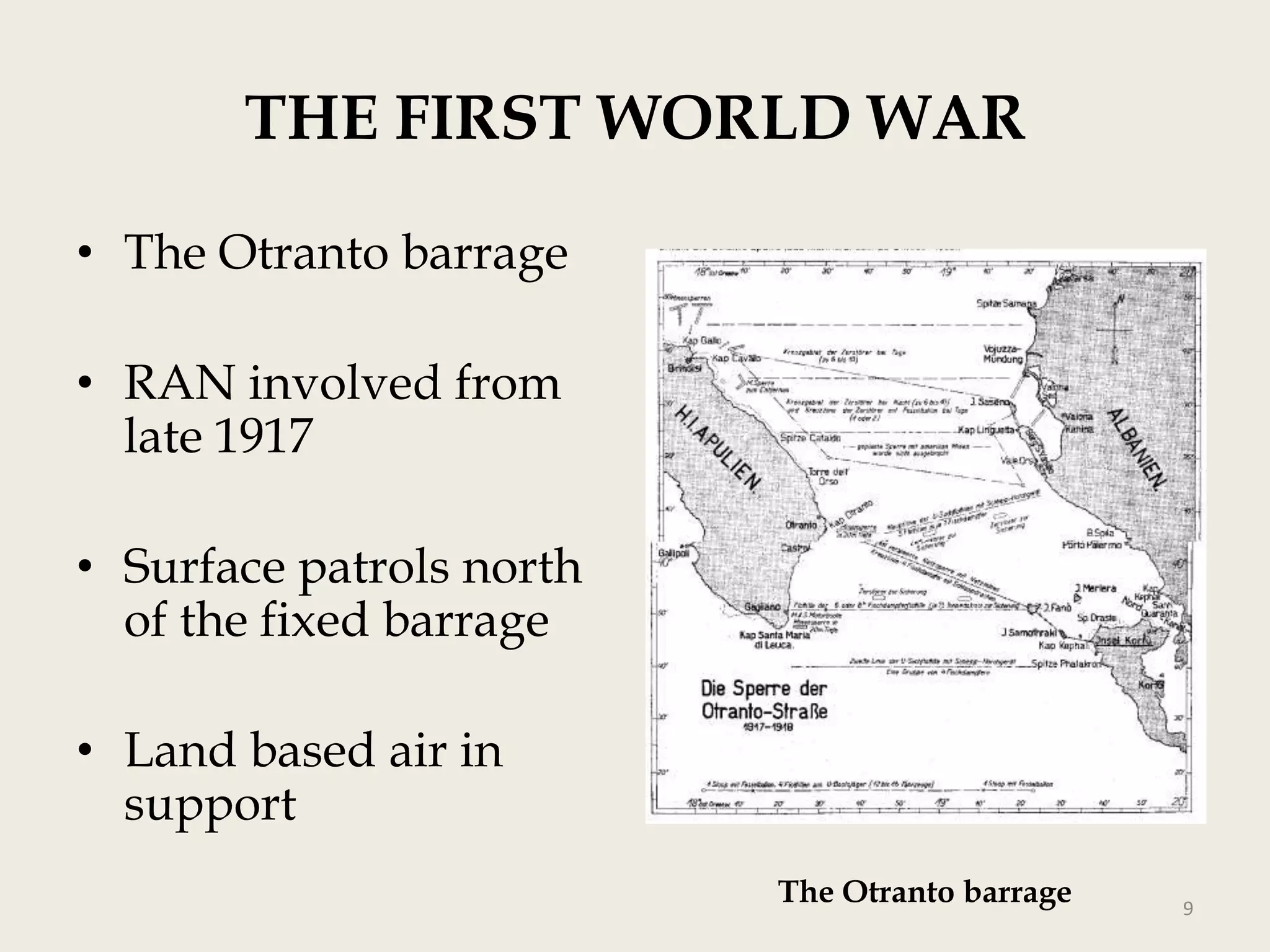
• The Otranto barrage
• RAN involved from
late 1917

• Surface patrols north
of the fixed barrage
• Land based air in
support
The Otranto barrage

9
THE FIRST WORLD WAR
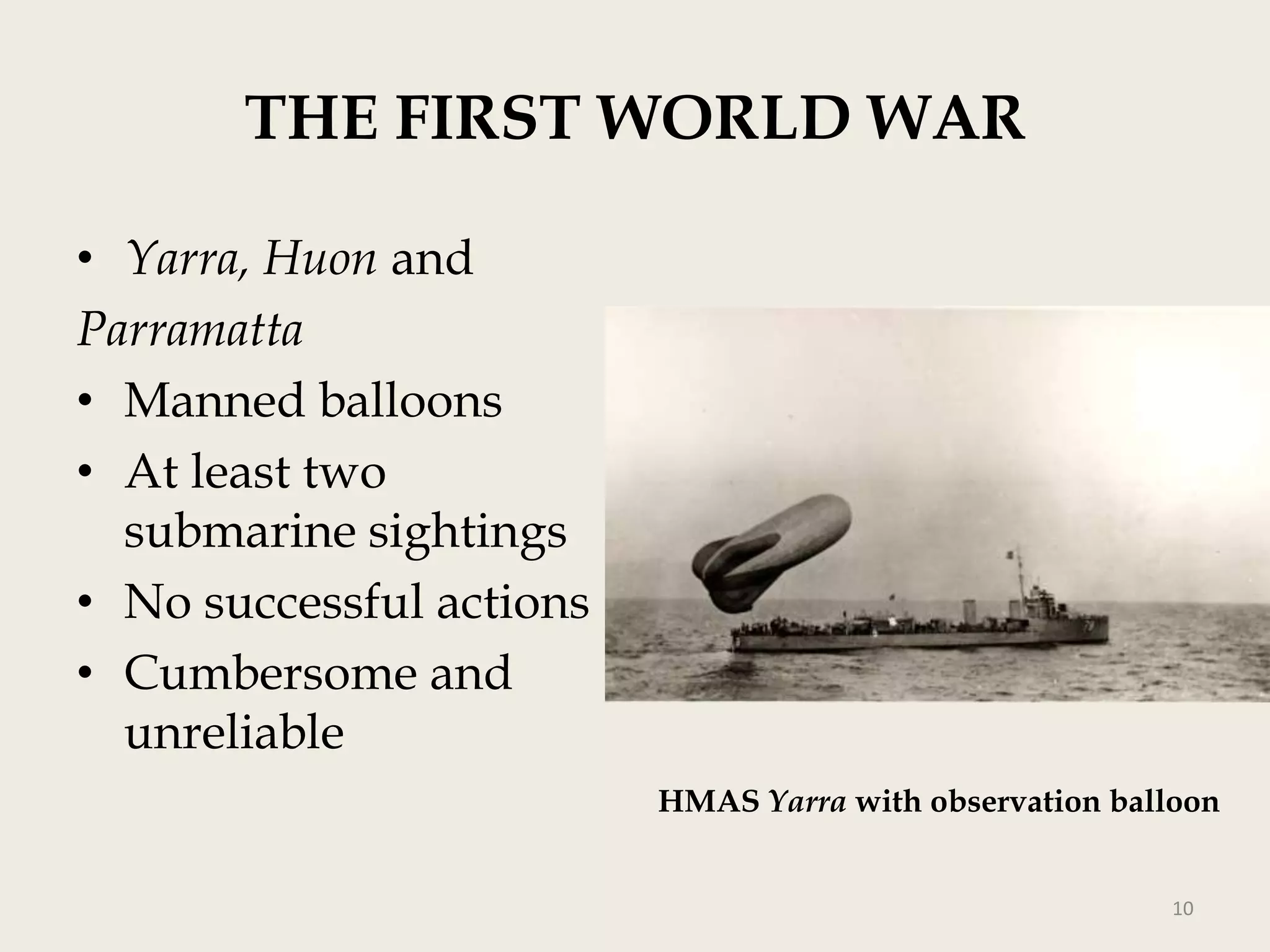
• Yarra, Huon and
Parramatta
• Manned balloons
• At least two
submarine sightings
• No successful actions
• Cumbersome and
unreliable
HMAS Yarra with observation balloon
10
THE FIRST WORLD WAR
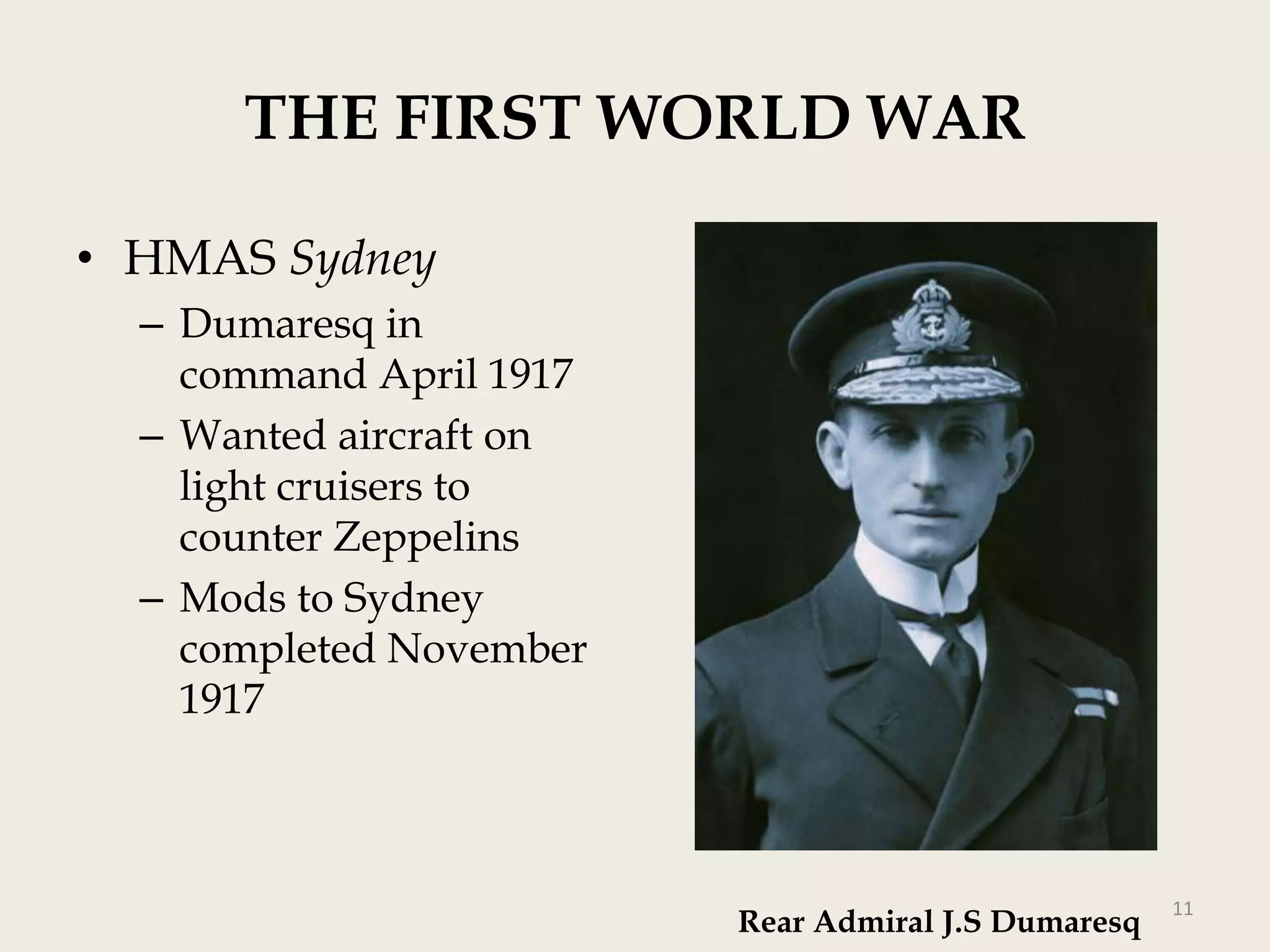
• HMAS Sydney
– Dumaresq in
command April 1917
– Wanted aircraft on
light cruisers to
counter Zeppelins
– Mods to Sydney
completed November
1917

Rear Admiral J.S Dumaresq

11
FIRST WORLD WAR
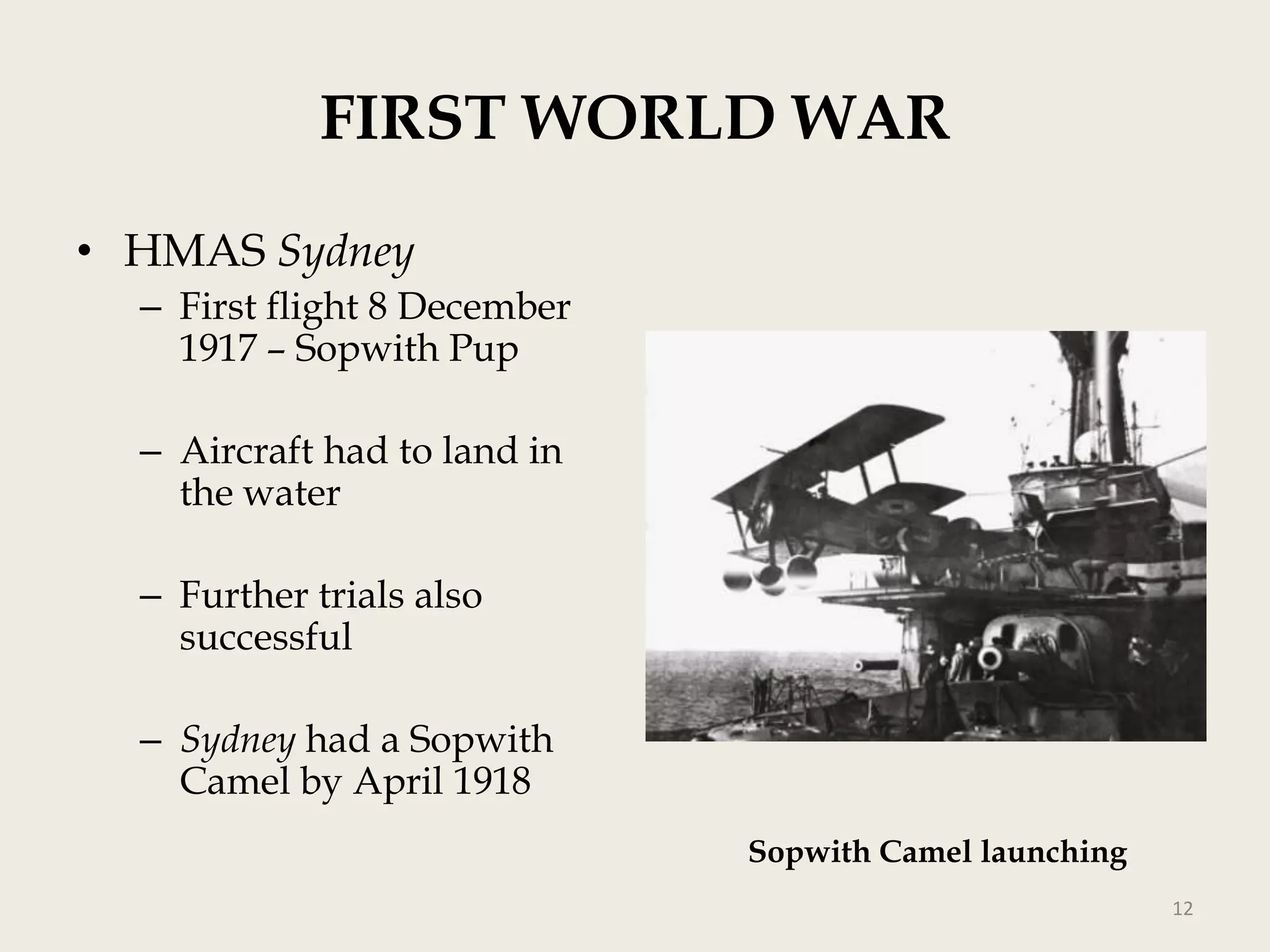
• HMAS Sydney
– First flight 8 December
1917 – Sopwith Pup
– Aircraft had to land in
the water
– Further trials also
successful
– Sydney had a Sopwith
Camel by April 1918
Sopwith Camel launching
12
FIRST WORLD WAR
• HMAS Sydney
– 1 June 1918 operating
in North Sea
– Force attacked by
German aircraft
– Sydney and Melbourne
launched Camels
– Melbourne’s Camel
returned without
sighting enemy
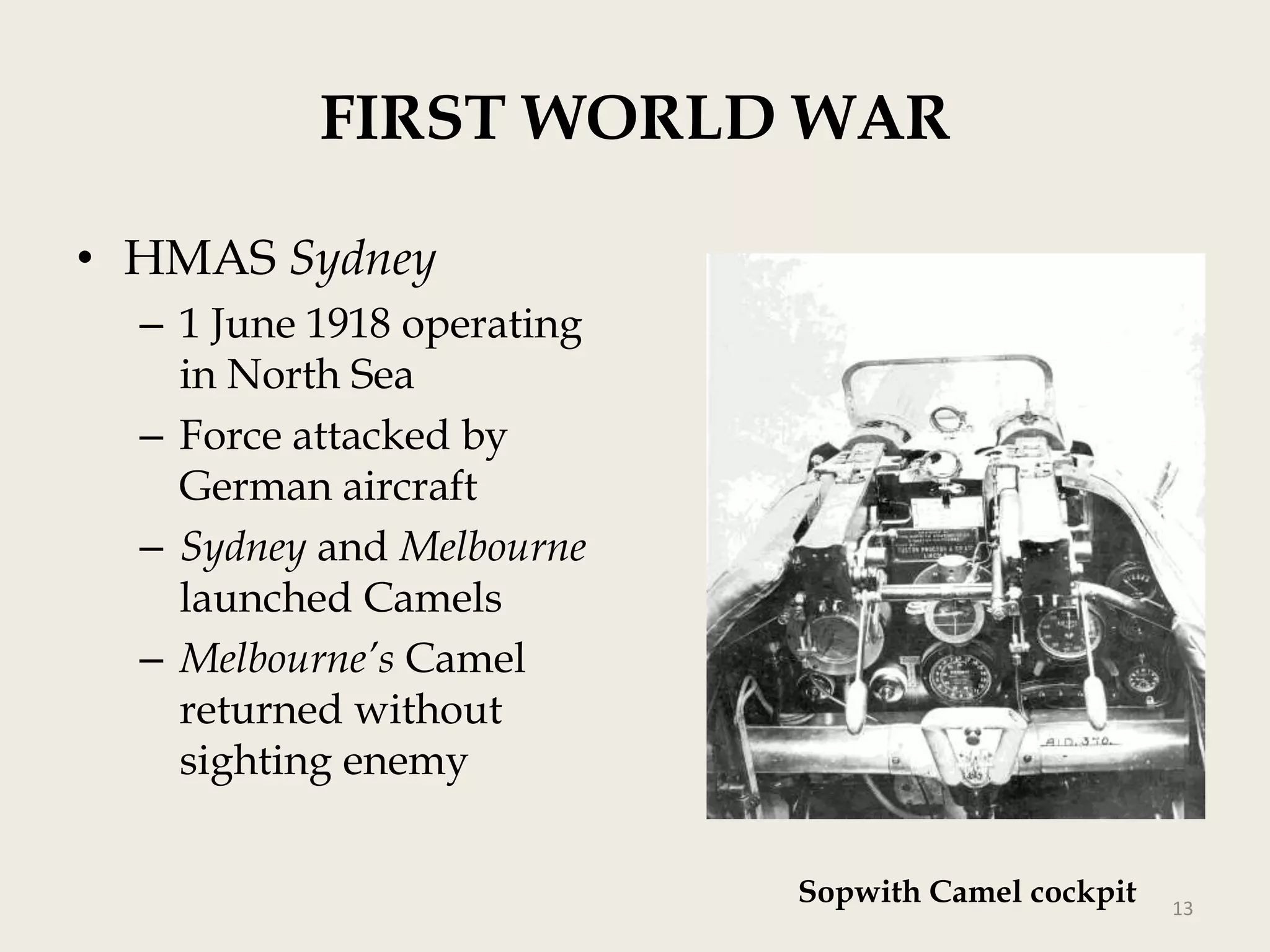
Sopwith Camel cockpit

13
FIRST WORLD WAR
• Sharwood chased and
engaged
• Claimed a probable
• Might have been a
first
• German use of
aircraft for strike
direction
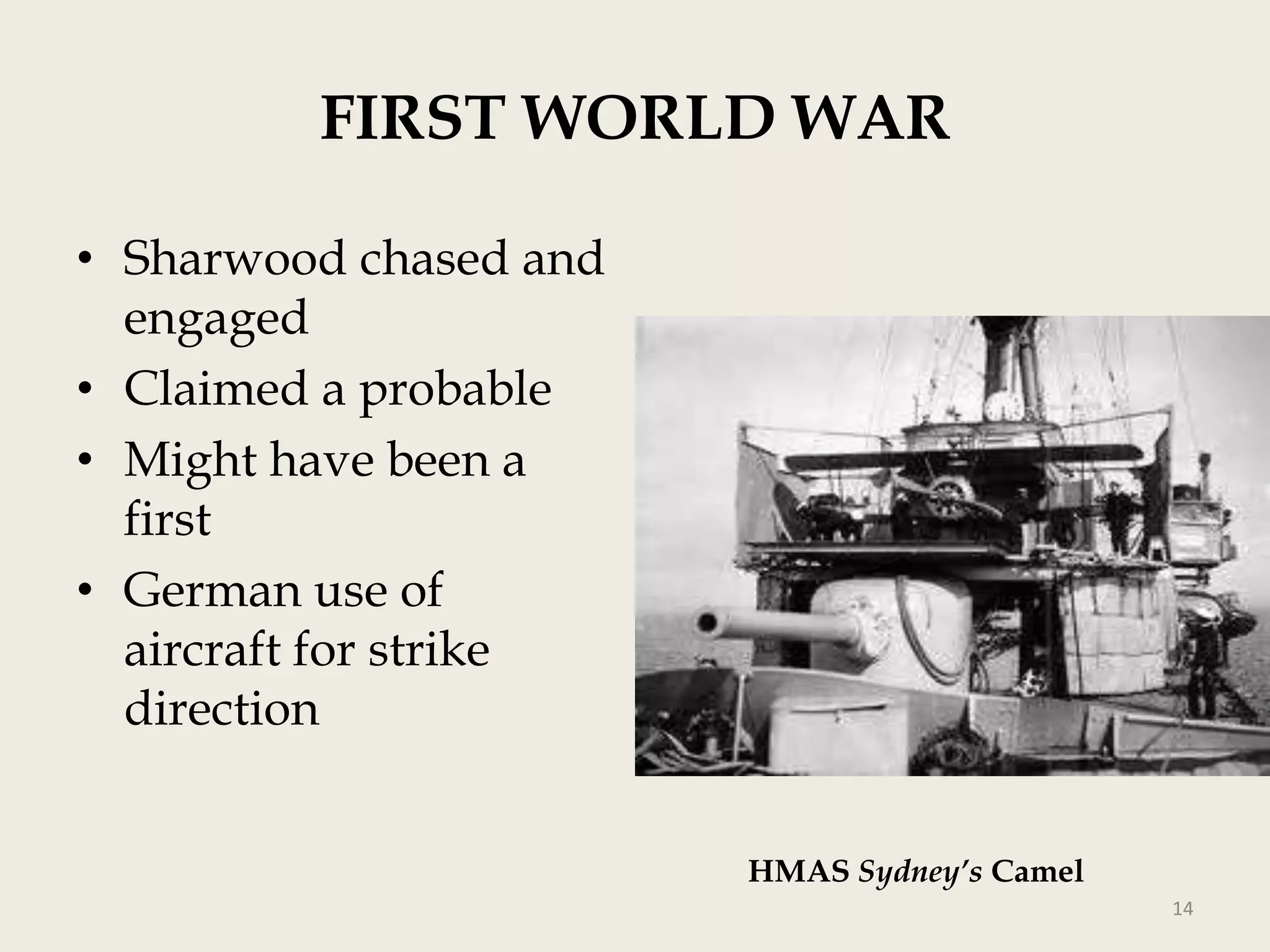
HMAS Sydney’s Camel
14
FIRST WORLD WAR
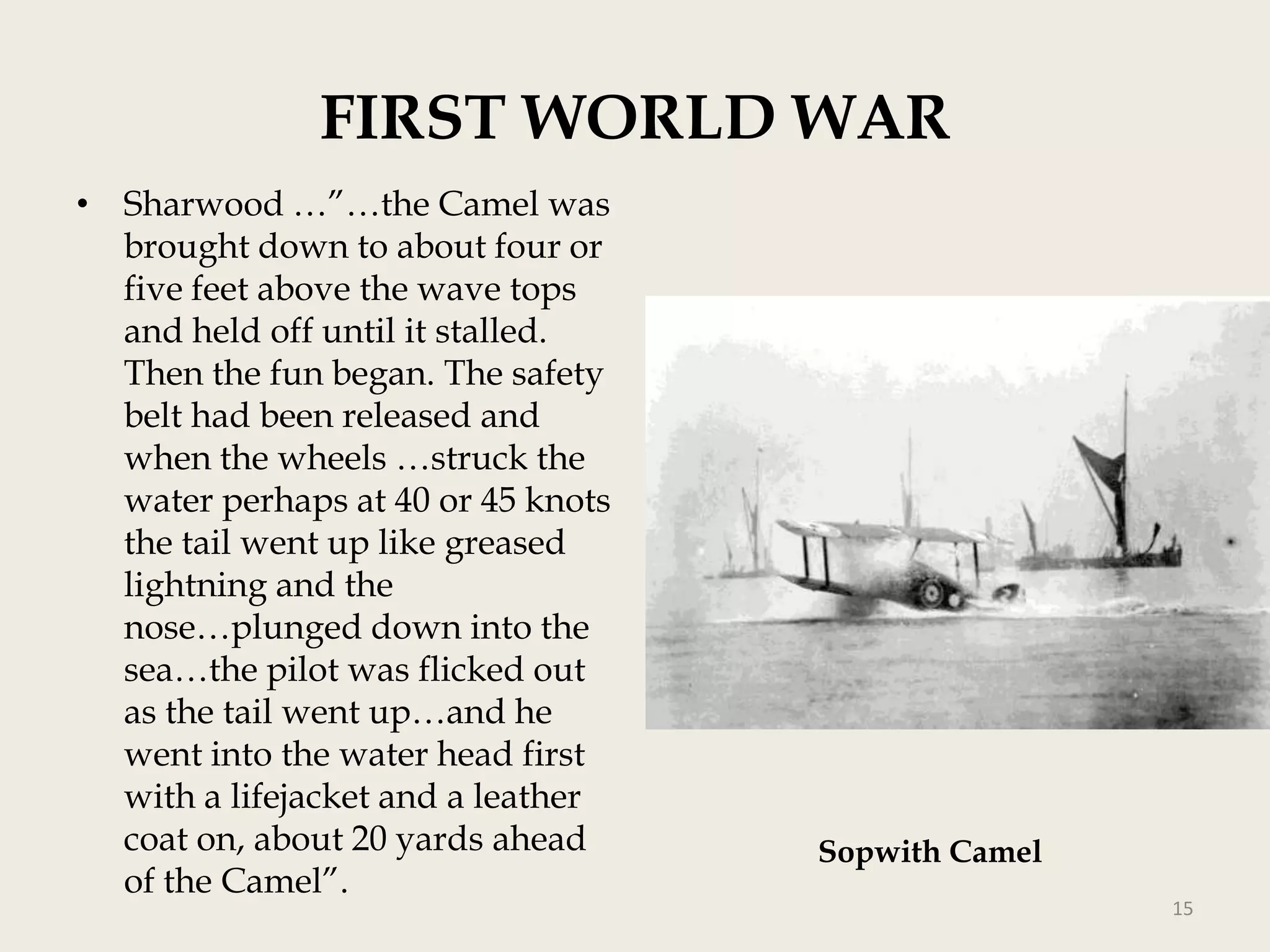
• Sharwood …”…the Camel was
brought down to about four or
five feet above the wave tops
and held off until it stalled.
Then the fun began. The safety
belt had been released and
when the wheels …struck the
water perhaps at 40 or 45 knots
the tail went up like greased
lightning and the
nose…plunged down into the
sea…the pilot was flicked out
as the tail went up…and he
went into the water head first
with a lifejacket and a leather
coat on, about 20 yards ahead
of the Camel”.

Sopwith Camel
15
FIRST WORLD WAR
• HMAS Melbourne’s
experience:
– Pilot had great difficulty
finding the German
aircraft
– Never sighted Sharwood
– Wasn‟t aware Sharwood
launched at same time

• Aircraft needed to be
already airborne for
successful intercept
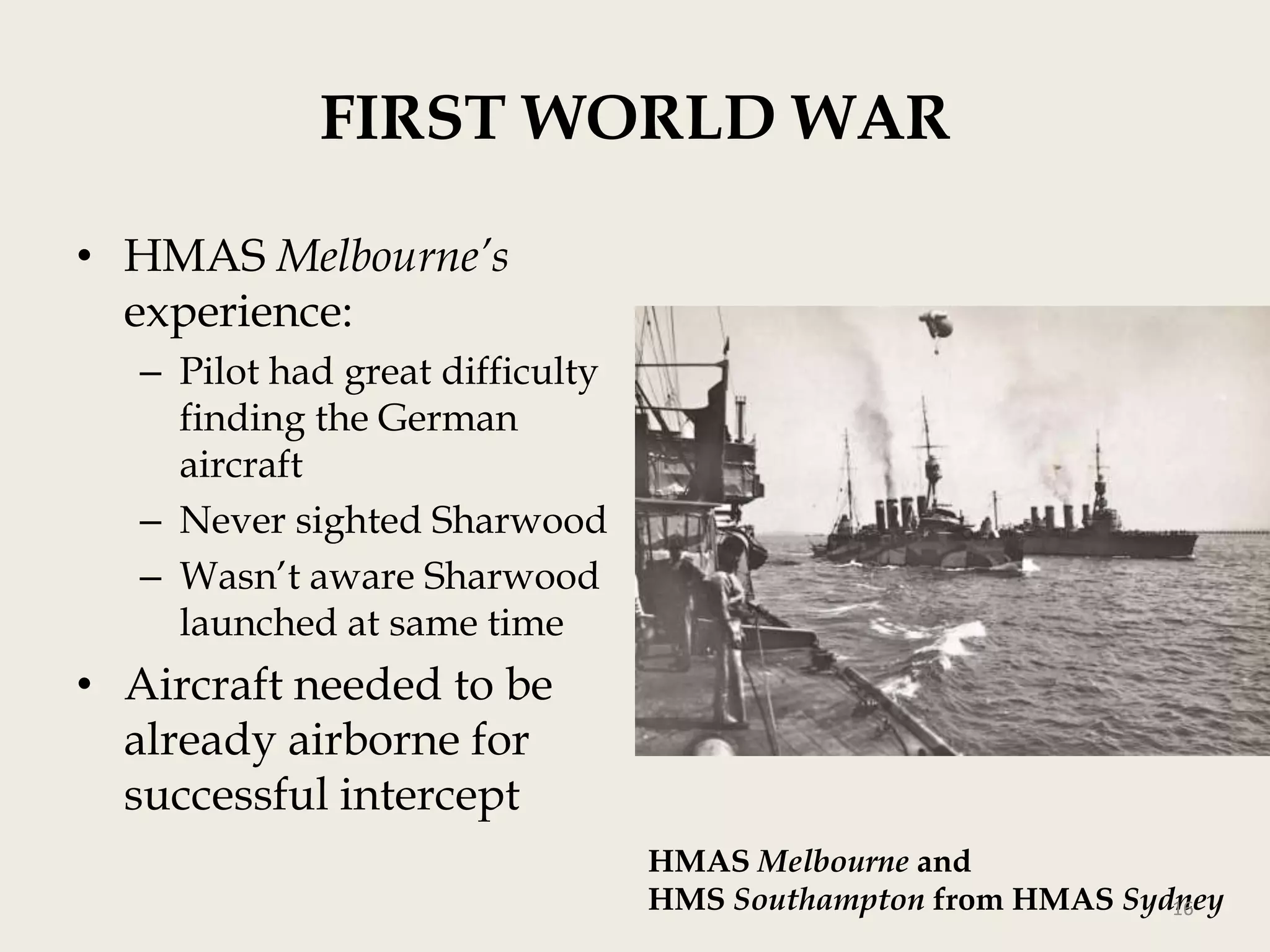
HMAS Melbourne and
HMS Southampton from HMAS Sydney
16
FIRST WORLD WAR
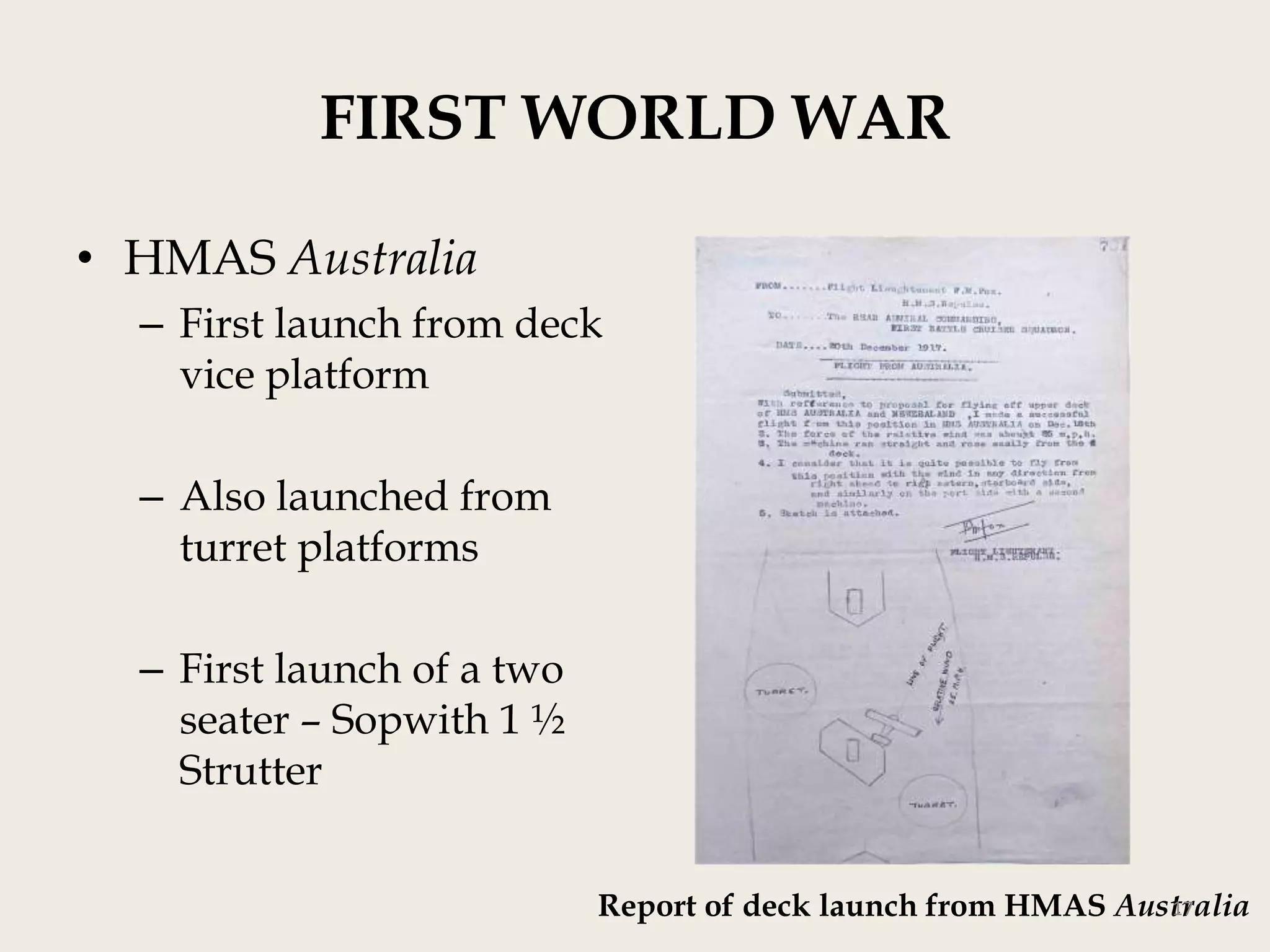
• HMAS Australia
– First launch from deck
vice platform
– Also launched from
turret platforms
– First launch of a two
seater – Sopwith 1 ½
Strutter
17
Report of deck launch from HMAS Australia
FIRST WORLD WAR
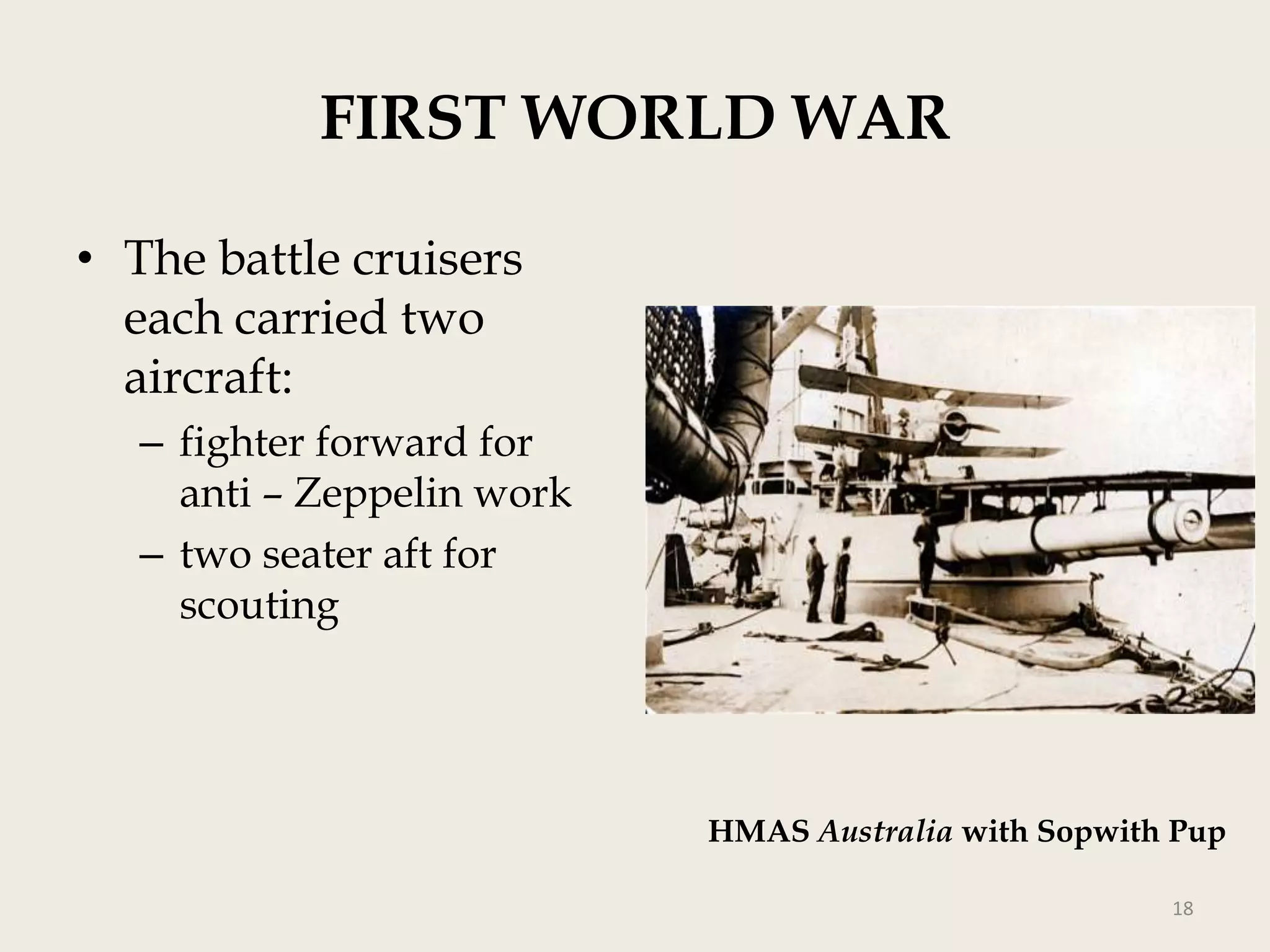
• The battle cruisers
each carried two
aircraft:
– fighter forward for
anti – Zeppelin work
– two seater aft for
scouting

HMAS Australia with Sopwith Pup
18
PREPARING FOR A NAVAL AIR
SERVICE
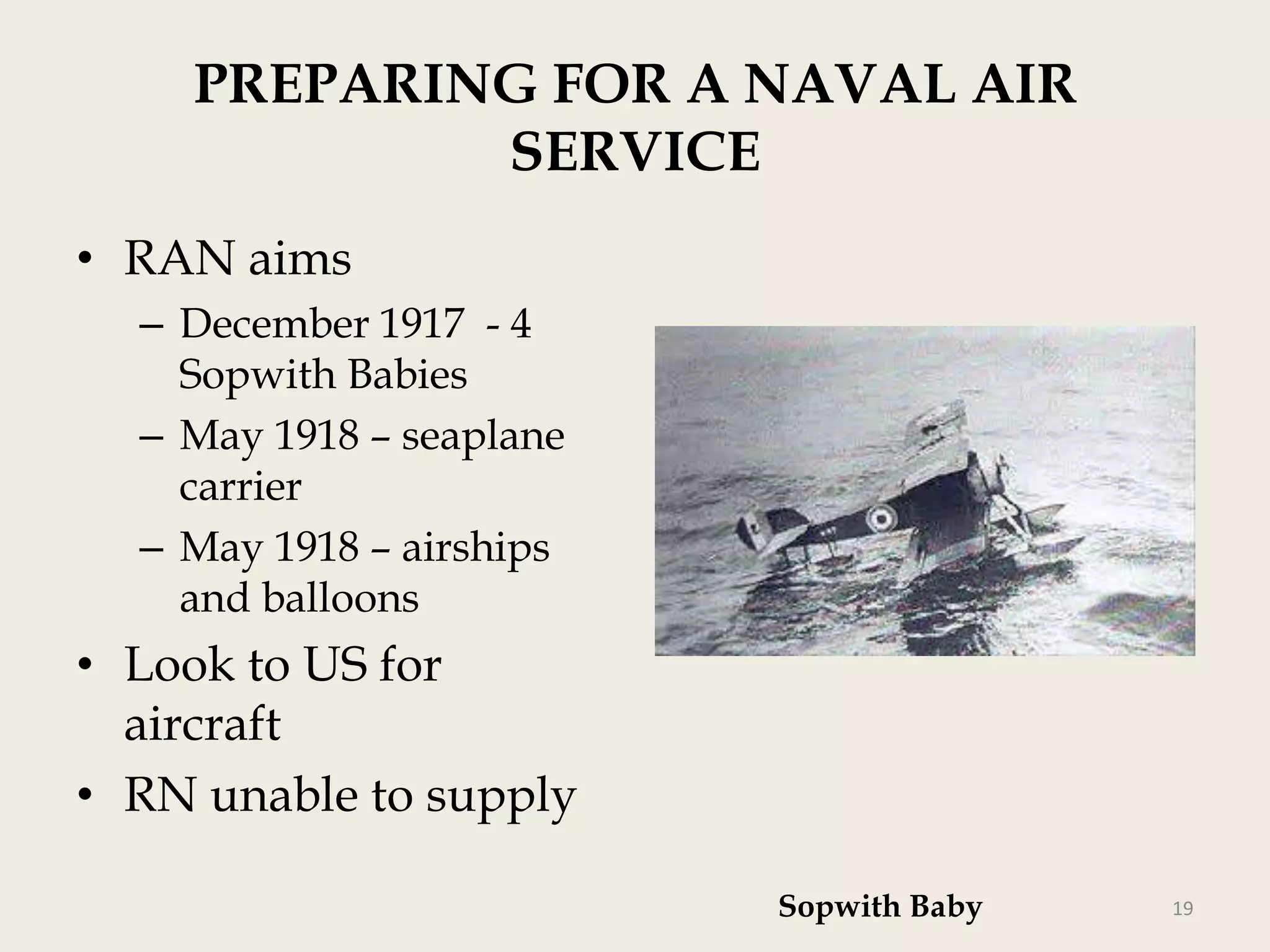
• RAN aims
– December 1917 - 4
Sopwith Babies
– May 1918 – seaplane
carrier
– May 1918 – airships
and balloons

• Look to US for
aircraft
• RN unable to supply
Sopwith Baby

19
POST-WAR DEVELOPMENTS
• Lack of existing
organization…
• Government hesitant
• Inter-Service rivalry –
Army and then RAAF
• Revulsion at WW1
costs
• Severe funding cuts
• 1928 – RAAF won
argument
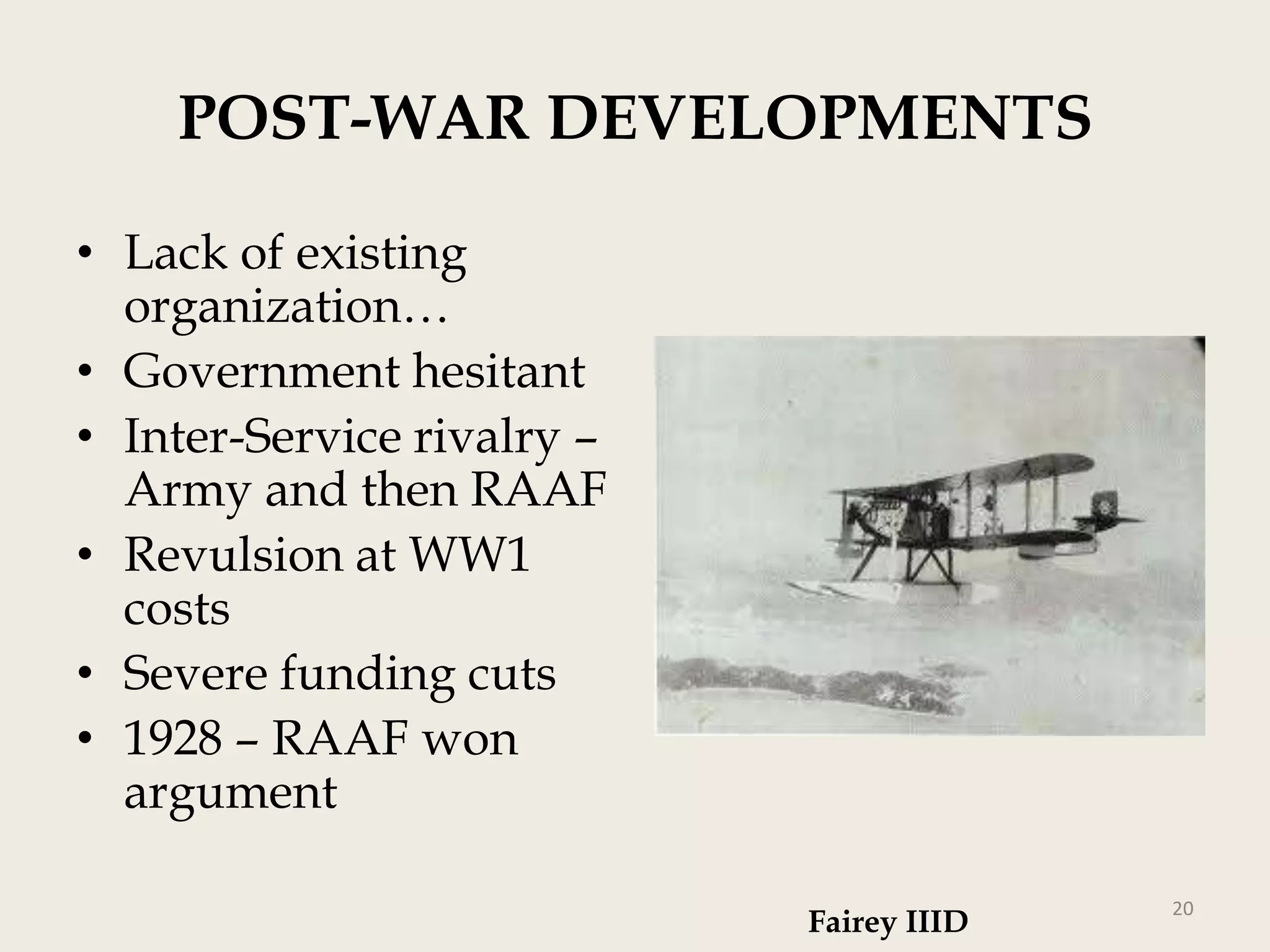
Fairey IIID

20
CONCLUSIONS
• RAN relatively quick to see potential of
aviation but failed to establish an
organization before or during the War
• Isolation a problem – had to rely on RN
• Gained significant operational experience
during the War
• RAN sought to establish Air Service postWar but beaten by:
– Competing priorities
– Lack of funding
– Inter-Service arguments

21

2013 King Hall Day 2 Session 2 - 2

  • 1.
    FIRST FLIGHTS: AVIATIONIN THE RAN 1914 - 1918 The Ship’s Flight 1
  • 2.
    EARLY NAVAL DEVELOPMENTS •Continental vs Maritime Strategies • The Empire Navy vs Local Dominion Forces • The Naval Agreement Act 1903 • Deakin and Creswell RADM Sir William Creswell 2
  • 3.
    EARLY NAVAL DEVELOPMENTS • TheRAN Fleet Unit • Submarines? • Henderson Report • Force Structure Ambitions • Aviation – not at first HMAS Huon 3
  • 4.
    AVIATION DEVELOPMENTS • Armyprize for flying machine – 1909 • First Australian powered flight – March 1910 • AFC – 22 October 1912 • CFS Pt Cook – 1914 • Progress slow…isolation… resources…priorities RAAF Point Cook 4
  • 5.
    NAVAL AVIATION STIRRINGS •Potential for scouting and attack • „Water planes‟ for northern defence • Seaplanes for bases in the north • Joint naval and military flying school • Lack of local expertise Bristol Boxkite 5
  • 6.
    NAVAL AVIATION STIRRINGS •Looking for a few good men… • Education • Temperament… • “…the best pilots were usually highly strung individuals…a bundle of nerves…”. • 1914-15 Estimates to fund training • Four small „sea planes‟ plus depot ship to be the start HMAS Australia – trial and error 6
  • 7.
    THE FIRST WORLDWAR • Admiralty control • RNAS – defence of the homeland • RN initiatives • Major combatants and aircraft HMS Engadine – seaplane carrier 7
  • 8.
    THE FIRST WORLDWAR • HMAS Brisbane – Embarked Sopwith Baby in Indian Ocean – CO then wanted to carry two – Reported on their utility in defence of Australia Sopwith Baby 8
  • 9.
    THE FIRST WORLDWAR • The Otranto barrage • RAN involved from late 1917 • Surface patrols north of the fixed barrage • Land based air in support The Otranto barrage 9
  • 10.
    THE FIRST WORLDWAR • Yarra, Huon and Parramatta • Manned balloons • At least two submarine sightings • No successful actions • Cumbersome and unreliable HMAS Yarra with observation balloon 10
  • 11.
    THE FIRST WORLDWAR • HMAS Sydney – Dumaresq in command April 1917 – Wanted aircraft on light cruisers to counter Zeppelins – Mods to Sydney completed November 1917 Rear Admiral J.S Dumaresq 11
  • 12.
    FIRST WORLD WAR •HMAS Sydney – First flight 8 December 1917 – Sopwith Pup – Aircraft had to land in the water – Further trials also successful – Sydney had a Sopwith Camel by April 1918 Sopwith Camel launching 12
  • 13.
    FIRST WORLD WAR •HMAS Sydney – 1 June 1918 operating in North Sea – Force attacked by German aircraft – Sydney and Melbourne launched Camels – Melbourne’s Camel returned without sighting enemy Sopwith Camel cockpit 13
  • 14.
    FIRST WORLD WAR •Sharwood chased and engaged • Claimed a probable • Might have been a first • German use of aircraft for strike direction HMAS Sydney’s Camel 14
  • 15.
    FIRST WORLD WAR •Sharwood …”…the Camel was brought down to about four or five feet above the wave tops and held off until it stalled. Then the fun began. The safety belt had been released and when the wheels …struck the water perhaps at 40 or 45 knots the tail went up like greased lightning and the nose…plunged down into the sea…the pilot was flicked out as the tail went up…and he went into the water head first with a lifejacket and a leather coat on, about 20 yards ahead of the Camel”. Sopwith Camel 15
  • 16.
    FIRST WORLD WAR •HMAS Melbourne’s experience: – Pilot had great difficulty finding the German aircraft – Never sighted Sharwood – Wasn‟t aware Sharwood launched at same time • Aircraft needed to be already airborne for successful intercept HMAS Melbourne and HMS Southampton from HMAS Sydney 16
  • 17.
    FIRST WORLD WAR •HMAS Australia – First launch from deck vice platform – Also launched from turret platforms – First launch of a two seater – Sopwith 1 ½ Strutter 17 Report of deck launch from HMAS Australia
  • 18.
    FIRST WORLD WAR •The battle cruisers each carried two aircraft: – fighter forward for anti – Zeppelin work – two seater aft for scouting HMAS Australia with Sopwith Pup 18
  • 19.
    PREPARING FOR ANAVAL AIR SERVICE • RAN aims – December 1917 - 4 Sopwith Babies – May 1918 – seaplane carrier – May 1918 – airships and balloons • Look to US for aircraft • RN unable to supply Sopwith Baby 19
  • 20.
    POST-WAR DEVELOPMENTS • Lackof existing organization… • Government hesitant • Inter-Service rivalry – Army and then RAAF • Revulsion at WW1 costs • Severe funding cuts • 1928 – RAAF won argument Fairey IIID 20
  • 21.
    CONCLUSIONS • RAN relativelyquick to see potential of aviation but failed to establish an organization before or during the War • Isolation a problem – had to rely on RN • Gained significant operational experience during the War • RAN sought to establish Air Service postWar but beaten by: – Competing priorities – Lack of funding – Inter-Service arguments 21