Team members :
1. Hemang Tailor
2. Sushant Choudhary
3. Vinay Jain
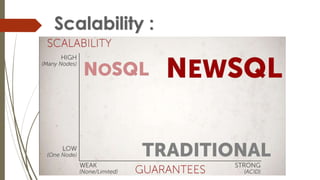
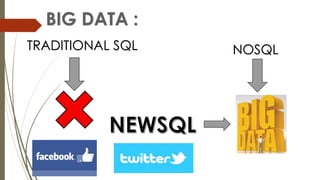
Combination of Traditional SQL and NOSQL
First time NEWSQL term used in 2011
 Matthew Aslett used this
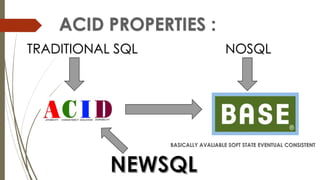
 Guarantees ACID Properties
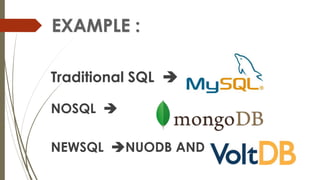
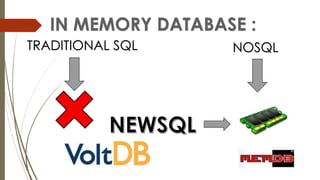
Traditional SQL 
NOSQL 
NEWSQL NUODB AND
TRADITIONAL SQL NOSQL
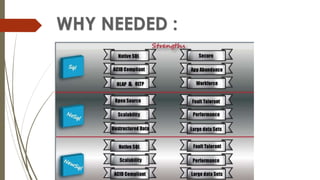
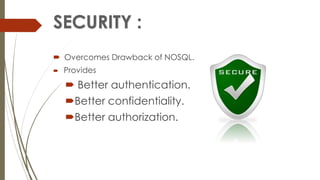
 Overcomes Drawback of NOSQL.
 Provides
 Better authentication.
Better confidentiality.
Better authorization.
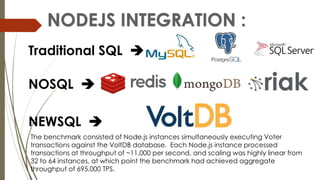
Traditional SQL 
NOSQL 
NEWSQL 
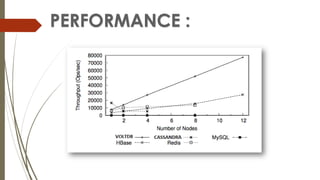
The benchmark consisted of Node.js instances simultaneously executing Voter
transactions against the VoltDB database. Each Node.js instance processed
transactions at throughput of ~11,000 per second, and scaling was highly linear from
32 to 64 instances, at which point the benchmark had achieved aggregate
throughput of 695,000 TPS.
TRADITIONAL SQL NOSQL
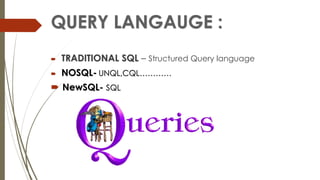
 TRADITIONAL SQL – Structured Query language
 NOSQL- UNQL,CQL…………
 NewSQL- SQL
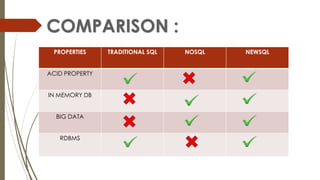
PROPERTIES TRADITIONAL SQL NOSQL NEWSQL
ACID PROPERTY
IN MEMORY DB
BIG DATA
RDBMS
 The world's largest distributed database
 Store data across multiple data centers, millions of
machines and trillions of rows.
 Internally used by Google.
 Has a true time API to avoid latency problems.
 Supports Google's Advertising business.
 It is fault tolerant to large scale outages.
 Offers very high availability and latency (Aiming for 99%
and 50 ms)
 Spanner has evolved from a Bigtable-like versioned key-
value store
 Stonebraker, Michael (2011-06-16). "NewSQL: An Alternative to
NoSQL and Old SQL for New OLTP Apps". Communications of the
ACM Blog. Retrieved 2012-07-06
 Hoff, Todd (2012-09-24). "Google Spanner's Most Surprising
Revelation: NoSQL is Out and NewSQL is In". Retrieved 2012-10-07
 Cattell, R. (2011). "Scalable SQL and NoSQL data stores". ACM
SIGMOD Record 39 (4): 12. doi:10.1145/1978915.1978919
 Venkatesh, Prasanna (2012). "NewSQL - The New Way to Handle Big
Data" (published 2012-01-30). Retrieved 2012-10-07.
 http://nosql-database.org/
 http://www.mysql.com/
 http://newsql.sourceforge.net/
NewSQL: The Best of Both "OldSQL" and "NoSQL"

NewSQL: The Best of Both "OldSQL" and "NoSQL"

  • 1.
    Team members : 1.Hemang Tailor 2. Sushant Choudhary 3. Vinay Jain
  • 2.
    Combination of TraditionalSQL and NOSQL First time NEWSQL term used in 2011  Matthew Aslett used this  Guarantees ACID Properties
  • 6.
    Traditional SQL  NOSQL NEWSQL NUODB AND
  • 8.
  • 13.
  • 14.
     Overcomes Drawbackof NOSQL.  Provides  Better authentication. Better confidentiality. Better authorization.
  • 15.
    Traditional SQL  NOSQL NEWSQL  The benchmark consisted of Node.js instances simultaneously executing Voter transactions against the VoltDB database. Each Node.js instance processed transactions at throughput of ~11,000 per second, and scaling was highly linear from 32 to 64 instances, at which point the benchmark had achieved aggregate throughput of 695,000 TPS.
  • 17.
  • 18.
     TRADITIONAL SQL– Structured Query language  NOSQL- UNQL,CQL…………  NewSQL- SQL
  • 19.
    PROPERTIES TRADITIONAL SQLNOSQL NEWSQL ACID PROPERTY IN MEMORY DB BIG DATA RDBMS
  • 20.
     The world'slargest distributed database  Store data across multiple data centers, millions of machines and trillions of rows.  Internally used by Google.  Has a true time API to avoid latency problems.  Supports Google's Advertising business.  It is fault tolerant to large scale outages.  Offers very high availability and latency (Aiming for 99% and 50 ms)  Spanner has evolved from a Bigtable-like versioned key- value store
  • 22.
     Stonebraker, Michael(2011-06-16). "NewSQL: An Alternative to NoSQL and Old SQL for New OLTP Apps". Communications of the ACM Blog. Retrieved 2012-07-06  Hoff, Todd (2012-09-24). "Google Spanner's Most Surprising Revelation: NoSQL is Out and NewSQL is In". Retrieved 2012-10-07  Cattell, R. (2011). "Scalable SQL and NoSQL data stores". ACM SIGMOD Record 39 (4): 12. doi:10.1145/1978915.1978919  Venkatesh, Prasanna (2012). "NewSQL - The New Way to Handle Big Data" (published 2012-01-30). Retrieved 2012-10-07.  http://nosql-database.org/  http://www.mysql.com/  http://newsql.sourceforge.net/