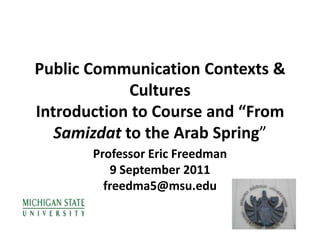
Public Communication Contexts & CulturesIntroduction to Course and “From Samizdat to the Arab Spring” Professor Eric Freedman9 September 2011freedma5@msu.edu
Today’s OutlineCourse overviewUpcoming lecture topicsAcademic expectations and assignmentsResearch & using academic journal articles & studiesBreakLecture: “From Samizdat to the Arab Spring”
The Political Power of Communications Technologies“Why should any man be allowed to buy a printing press and disseminate pernicious opinions calculated to embarrass the government?”		Vladimir Lenin (1920)“Print is the sharpest and the strongest weapon of our party.”		Josef Stalin (1923)
Common ThemesPower of the media in a variety of countries and political systems. Conflicts between those with political and economic power on one side and those with less power or no power on the other side.Impacts of changing communication technologies and economic models.Role of the press in bringing events to light, helping to  set the public agenda for discussion and action by citizens and policymakers.
Goals and ExpectationsAcademic integrityRespect for the class and your classmatesCritical—analytical--thinkingIntellectual and professional curiosityClear and precise communicationMeet deadlines
Lecture TopicsFrom Samizdat to the Arab Spring: Government controls over social and new media, Use of Information and Communication Technologies as citizen tools for political organization.Coverage of foreign affairs: Reporting on foreign affairs from home; identifying newsworthy impacts and implications at home of distant events and controversies; finding local “ordinary” and elite sources for such stories. The U.S. press system: Trends in media consolidation; blurring definitions of “journalists”; citizen journalism; challenges to credibility; revenue and staffing losses; entertainment versus news; changing patterns in coverage of public affairs; journalism education trends.Media constraints in formerly Soviet Central Asia: How repressitarian regimes in former Soviet republics control and censor media content; legal/extra-legal impediments to professional practices; libel & honour-and-decency; prospects for financial sustainability of independent media; role of Western trainers/educators. Foreign coverage of Central Asian news. Coverage of international NGOs: Reporting on the UN, other world organizations & NGOs; human rights crises & how the press covers them (for example, religious persecution of Christians in Muslim countries, suppression of political dissent in Iran, genital mutilation in Africa, ethnic persecution of Tibetans in China.Peace journalism: Role of the press in conflict resolution; ethics and activism; covering genocide; elitism; psychological trauma of journalists.
Research ProceduresSelect a problemReview existing research & theoryDevelop hypotheses and/or research questionsDetermine methodology/research designCollect relevant dataAnalyze & interpret the resultsPresent the resultsReplicate the study when necessary.					 Wimmer & Dommick
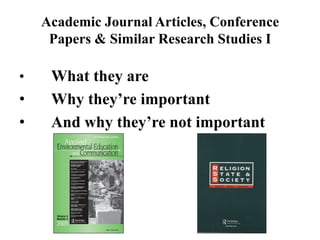
Academic Journal Articles, Conference Papers & Similar Research Studies IWhat they are	Why they’re importantAnd why they’re not important
Academic Journal Articles, Conference Papers & Similar Research Studies IPolitical Contest, News Bias, and the Israeli-Palestinian Conflict: How and Why Rival Official Sources Were Unevenly Treated in Four Major U.S. Newspapers	 	Abstract	Guided by the political contest model and concepts of indexing and cascading, this study examined how and why news bias—uneven treatment of  Israeli and Palestinian official sources—occurred in four major U.S. newspapers’ coverage. Findings suggest that press access to rival official news sources, U.S. foreign policy, and the ratios of local Arab-American to Jewish-American population are strong predictors of the occurrence of news imbalance. Also the outcomes suggest that contending nations and sources should free, not impede, press access to help achieve fair and balanced treatment of their sources and viewpoints.  	Keywords: news treatment, official sources, media bias, Israeli-Palestinian conflict.
Hypothesis	Assumption as a starting point for researchers trying to find data to support	Example: Cigarette smoking can cause lung cancer.	Example: Cigarette smoking does not cause lung cancer.
Research QuestionSubject of researchers’ inquiry without a formal assumption (hypothesis)  Example: What cause-and-effect relationships exist between cigarette smoking and human health?
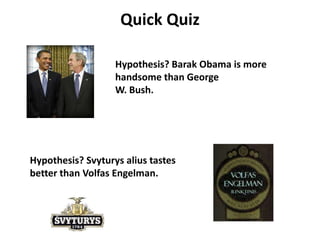
Quick QuizHypothesis? Barak Obama is more handsome than GeorgeW. Bush.Hypothesis? Svyturys alius tastes better than Volfas Engelman.
From Samizdat to the Arab Spring: Lecture OutlineQuestions to ponderSamizdat in the Soviet eraModern regime efforts to suppress cyberdissentArab Spring 2011Implications & unresolved issues for the future
GlossaryRepressitarian:Both authoritarian in governance and repressive in human rights practicesSamizdat: Illegal. underground publications during Soviet timesICT: Information and communication technologyStakeholder: A person, group of institution affected by a decision or policy NGO: Nongovernmental organization
From Samizdat to the Arab Spring: Questions to Ponder Is grassroots-generated political change always good, and for whom?Can communications technology be misused, and who determines that?What happens when established power institutions themselves wield new communications technologies?Are there important things that the “old,” “traditional” or “legacy” media do—or at least did—better than online and social media do—at least so far?
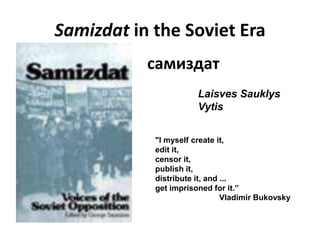
Samizdat in the Soviet Era ,самиздатLaisves SauklysVytis"I myself create it,edit it,censor it,publish it,distribute it, and ...get imprisoned for it.”		Vladimir Bukovsky
“Recent developments demonstrate how bloggingand social media tools may fulfill a crucial role for non-journalists and oppositional groups that journalism serves in more democratic societies.”					Bowe, Freedman & Blom, 2011
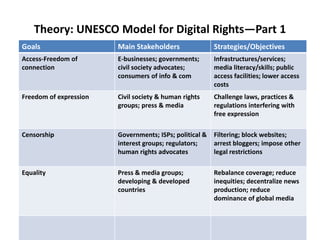
Theory: UNESCO Model for Digital Rights—Part 1
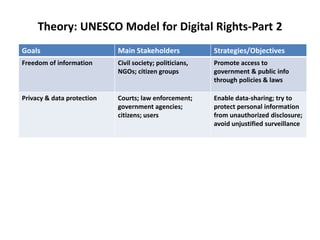
Theory: UNESCO Model for Digital Rights-Part 2
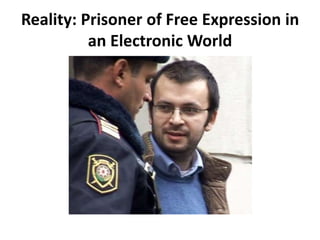
Reality: Prisoner of Free Expression in an Electronic World
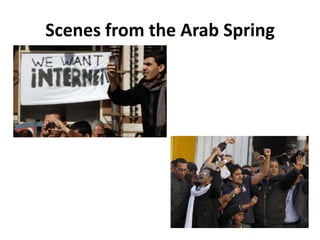
Scenes from the Arab Spring
Reminder: Questions to Ponder Is grassroots-generated political change always good, and for whom?Can communications technology be misused, and who determines that?What happens when established power institutions themselves wield new communications technologies?Are there important things that the “old,” “traditional” or “legacy” media do—or at least did—better than online and social media do—at least so far?
		Readings for Next WeekMAIN READING“Diplomacy and Journalism” in International Reporting: Frontlines & Deadlines (2009)SUPPLEMENTAL READINGS“Assad Legalizes Opposition Parties” (Agence France Press, 2011)“French Deal to Sell Ships to Russians Is Criticized” (New York Times, 2010)“Poland: Immigration to UK is back for good life despite economic crisis” (Guardian, 2011)

3 1 public com samizdat sept 7 final

  • 1.
    Public Communication Contexts& CulturesIntroduction to Course and “From Samizdat to the Arab Spring” Professor Eric Freedman9 September 2011freedma5@msu.edu
  • 2.
    Today’s OutlineCourse overviewUpcominglecture topicsAcademic expectations and assignmentsResearch & using academic journal articles & studiesBreakLecture: “From Samizdat to the Arab Spring”
  • 3.
    The Political Powerof Communications Technologies“Why should any man be allowed to buy a printing press and disseminate pernicious opinions calculated to embarrass the government?” Vladimir Lenin (1920)“Print is the sharpest and the strongest weapon of our party.” Josef Stalin (1923)
  • 4.
    Common ThemesPower ofthe media in a variety of countries and political systems. Conflicts between those with political and economic power on one side and those with less power or no power on the other side.Impacts of changing communication technologies and economic models.Role of the press in bringing events to light, helping to set the public agenda for discussion and action by citizens and policymakers.
  • 5.
    Goals and ExpectationsAcademicintegrityRespect for the class and your classmatesCritical—analytical--thinkingIntellectual and professional curiosityClear and precise communicationMeet deadlines
  • 6.
    Lecture TopicsFrom Samizdatto the Arab Spring: Government controls over social and new media, Use of Information and Communication Technologies as citizen tools for political organization.Coverage of foreign affairs: Reporting on foreign affairs from home; identifying newsworthy impacts and implications at home of distant events and controversies; finding local “ordinary” and elite sources for such stories. The U.S. press system: Trends in media consolidation; blurring definitions of “journalists”; citizen journalism; challenges to credibility; revenue and staffing losses; entertainment versus news; changing patterns in coverage of public affairs; journalism education trends.Media constraints in formerly Soviet Central Asia: How repressitarian regimes in former Soviet republics control and censor media content; legal/extra-legal impediments to professional practices; libel & honour-and-decency; prospects for financial sustainability of independent media; role of Western trainers/educators. Foreign coverage of Central Asian news. Coverage of international NGOs: Reporting on the UN, other world organizations & NGOs; human rights crises & how the press covers them (for example, religious persecution of Christians in Muslim countries, suppression of political dissent in Iran, genital mutilation in Africa, ethnic persecution of Tibetans in China.Peace journalism: Role of the press in conflict resolution; ethics and activism; covering genocide; elitism; psychological trauma of journalists.
  • 7.
    Research ProceduresSelect aproblemReview existing research & theoryDevelop hypotheses and/or research questionsDetermine methodology/research designCollect relevant dataAnalyze & interpret the resultsPresent the resultsReplicate the study when necessary. Wimmer & Dommick
  • 8.
    Academic Journal Articles,Conference Papers & Similar Research Studies IWhat they are Why they’re importantAnd why they’re not important
  • 9.
    Academic Journal Articles,Conference Papers & Similar Research Studies IPolitical Contest, News Bias, and the Israeli-Palestinian Conflict: How and Why Rival Official Sources Were Unevenly Treated in Four Major U.S. Newspapers   Abstract Guided by the political contest model and concepts of indexing and cascading, this study examined how and why news bias—uneven treatment of Israeli and Palestinian official sources—occurred in four major U.S. newspapers’ coverage. Findings suggest that press access to rival official news sources, U.S. foreign policy, and the ratios of local Arab-American to Jewish-American population are strong predictors of the occurrence of news imbalance. Also the outcomes suggest that contending nations and sources should free, not impede, press access to help achieve fair and balanced treatment of their sources and viewpoints.   Keywords: news treatment, official sources, media bias, Israeli-Palestinian conflict.
  • 10.
    Hypothesis Assumption as astarting point for researchers trying to find data to support Example: Cigarette smoking can cause lung cancer. Example: Cigarette smoking does not cause lung cancer.
  • 11.
    Research QuestionSubject ofresearchers’ inquiry without a formal assumption (hypothesis) Example: What cause-and-effect relationships exist between cigarette smoking and human health?
  • 12.
    Quick QuizHypothesis? BarakObama is more handsome than GeorgeW. Bush.Hypothesis? Svyturys alius tastes better than Volfas Engelman.
  • 13.
    From Samizdat tothe Arab Spring: Lecture OutlineQuestions to ponderSamizdat in the Soviet eraModern regime efforts to suppress cyberdissentArab Spring 2011Implications & unresolved issues for the future
  • 14.
    GlossaryRepressitarian:Both authoritarian ingovernance and repressive in human rights practicesSamizdat: Illegal. underground publications during Soviet timesICT: Information and communication technologyStakeholder: A person, group of institution affected by a decision or policy NGO: Nongovernmental organization
  • 15.
    From Samizdat tothe Arab Spring: Questions to Ponder Is grassroots-generated political change always good, and for whom?Can communications technology be misused, and who determines that?What happens when established power institutions themselves wield new communications technologies?Are there important things that the “old,” “traditional” or “legacy” media do—or at least did—better than online and social media do—at least so far?
  • 16.
    Samizdat in theSoviet Era ,самиздатLaisves SauklysVytis"I myself create it,edit it,censor it,publish it,distribute it, and ...get imprisoned for it.” Vladimir Bukovsky
  • 17.
    “Recent developments demonstratehow bloggingand social media tools may fulfill a crucial role for non-journalists and oppositional groups that journalism serves in more democratic societies.” Bowe, Freedman & Blom, 2011
  • 18.
    Theory: UNESCO Modelfor Digital Rights—Part 1
  • 19.
    Theory: UNESCO Modelfor Digital Rights-Part 2
  • 20.
    Reality: Prisoner ofFree Expression in an Electronic World
  • 21.
    Scenes from theArab Spring
  • 22.
    Reminder: Questions toPonder Is grassroots-generated political change always good, and for whom?Can communications technology be misused, and who determines that?What happens when established power institutions themselves wield new communications technologies?Are there important things that the “old,” “traditional” or “legacy” media do—or at least did—better than online and social media do—at least so far?
  • 23.
    Readings for NextWeekMAIN READING“Diplomacy and Journalism” in International Reporting: Frontlines & Deadlines (2009)SUPPLEMENTAL READINGS“Assad Legalizes Opposition Parties” (Agence France Press, 2011)“French Deal to Sell Ships to Russians Is Criticized” (New York Times, 2010)“Poland: Immigration to UK is back for good life despite economic crisis” (Guardian, 2011)