Applied Ecological Services, Inc.


   Converting Some Select
  Park Mowed Lawn Areas to
     Prairie, Savannas or
     Wetlands to Reduce
      Maintenance costs


Sustainable Solutions for Over 30 Years
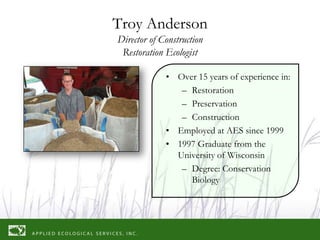
Troy Anderson
Director of Construction
 Restoration Ecologist

             • Over 15 years of experience in:
                – Restoration
                – Preservation
                – Construction
             • Employed at AES since 1999
             • 1997 Graduate from the
               University of Wisconsin
                – Degree: Conservation
                  Biology
How important are our parks?
How many have faced budget cuts

• But…
  –   No drop off in service allowed
  –   Staffing freezes (or reduction in staff)
  –   No new equipment
  –   Maybe additional tasks?
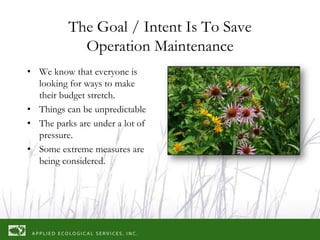
The Goal / Intent Is To Save
            Operation Maintenance
• We know that everyone is
  looking for ways to make
  their budget stretch.
• Things can be unpredictable
• The parks are under a lot of
  pressure.
• Some extreme measures are
  being considered.
Session I


•   Cost savings potential
•   Site Selection
•   Public outreach / process
•   Non monetary ecosystem value
Session II

–   Equipment and tools of the trade
–   Site preparation
–   Seeding or planting
–   Maintenance
–   Using volunteers or recruiting a “citizen
    champion”
Session I


•   Cost savings potential
•   Site Selection
•   Public outreach / process
•   Non monetary ecosystem value
Cost factored in
•Mowed park lawn per acre per year
   •Labor, gas, turf repair, maintenance of equipment,
   travel to park with truck and trailer…, some
   overhead like building / garage and supervisor
   salary, depreciation….


•Basic Prairie per acre per year
   •Labor, gas, herbicide, maintenance of equipment,
   travel to park with truck and trailer…, overhead,
   permits, supervisor salary, depreciation, training .
   and profit
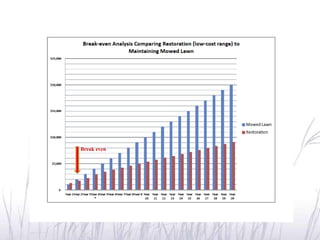
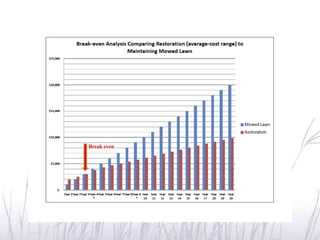
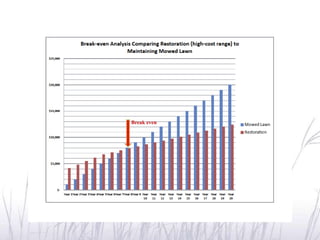
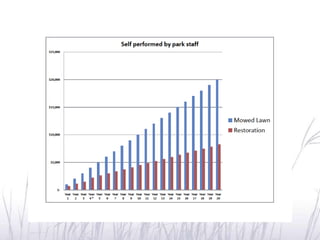
Example cost comparison
•Based on
   •Real restoration projects and real
   feedback from park maintenance
   professionals.

•Every project is different
   •Scale, shape, type, region…
Low, Medium and High cost
ranges are influenced by…
 •Type of natural area conversion
    •Prairie
    •Wet Prairie
    •Savanna
 •Diversity
 •Plant plugs vs. seed
 •Formal vs. Restoration
 •Access to site
 •Economy of scale
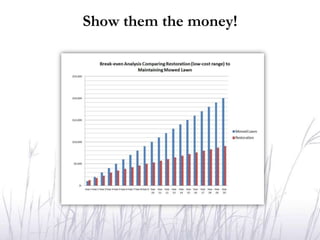
Break even
Break even
Break even
Session I


•   Cost savings potential
•   Site Selection
•   Public outreach / process
•   Non monetary ecosystem value
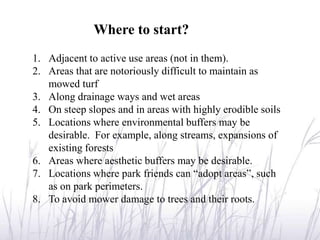
Where to start?
1. Adjacent to active use areas (not in them).
2. Areas that are notoriously difficult to maintain as
   mowed turf
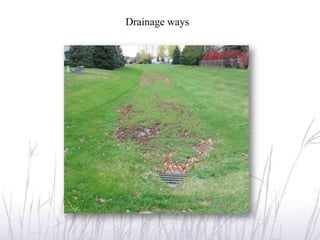
3. Along drainage ways and wet areas
4. On steep slopes and in areas with highly erodible soils
5. Locations where environmental buffers may be
   desirable. For example, along streams, expansions of
   existing forests
6. Areas where aesthetic buffers may be desirable.
7. Locations where park friends can “adopt areas”, such
   as on park perimeters.
8. To avoid mower damage to trees and their roots.
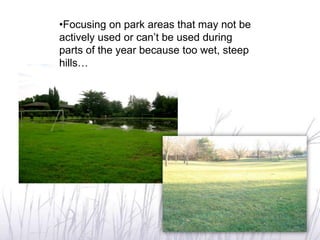
•Focusing on park areas that may not be
actively used or can’t be used during
parts of the year because too wet, steep
hills…
Drainage ways
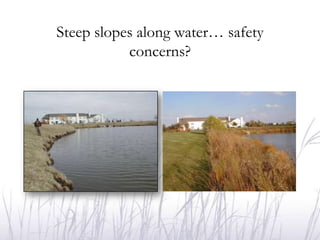
Steep slopes along water… safety
           concerns?
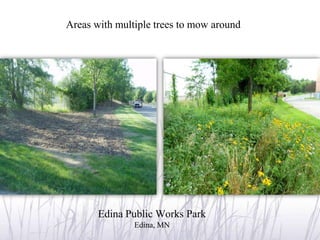
Areas with multiple trees to mow around


       Edina Public Works Park
               Edina, MN
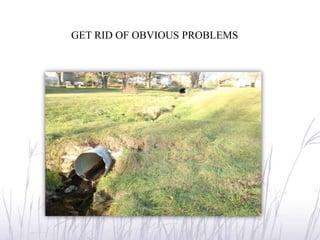
GET RID OF OBVIOUS PROBLEMS
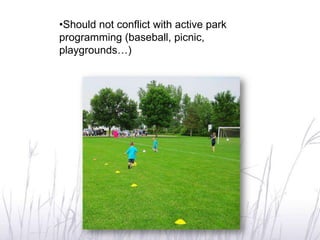
•Should not conflict with active park
programming (baseball, picnic,
playgrounds…)
Session I


•   Cost savings potential
•   Site Selection
•   Public outreach / process
•   Non monetary ecosystem value
Possible Questions and
concerns from community

•Are you taking my park away?
•Increase of wildlife
•Trash in natural areas
•Do not like the “wild” look
•Type of maintenance like prescribed burning
and spot herbiciding.
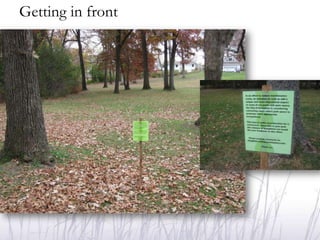
Getting in front
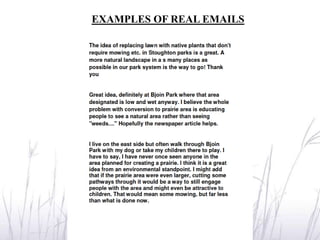
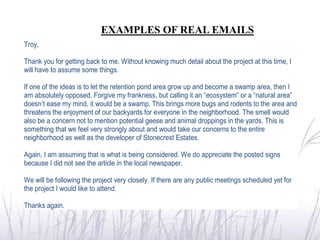
EXAMPLES OF REAL EMAILS
Troy,

Thank you for getting back to me. Without knowing much detail about the project at this time, I
will have to assume some things.

If one of the ideas is to let the retention pond area grow up and become a swamp area, then I
am absolutely opposed. Forgive my frankness, but calling it an “ecosystem” or a “natural area”
doesn’t ease my mind, it would be a swamp. This brings more bugs and rodents to the area and
threatens the enjoyment of our backyards for everyone in the neighborhood. The smell would
also be a concern not to mention potential geese and animal droppings in the yards. This is
something that we feel very strongly about and would take our concerns to the entire
neighborhood as well as the developer of Stonecrest Estates.

Again, I am assuming that is what is being considered. We do appreciate the posted signs
because I did not see the article in the local newspaper.

We will be following the project very closely. If there are any public meetings scheduled yet for
the project I would like to attend.

Thanks again.
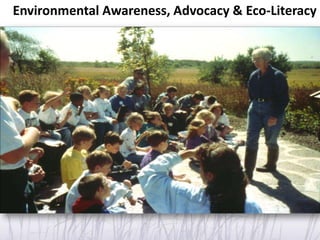
Environmental Awareness, Advocacy & Eco-Literacy
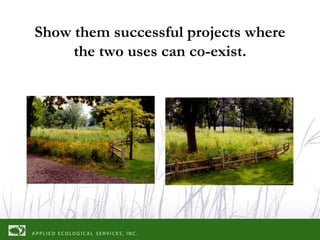
Show them successful projects where
     the two uses can co-exist.
Show them the money!
Session I


•   Cost savings potential
•   Site Selection
•   Public outreach / process
•   Non monetary ecosystem value
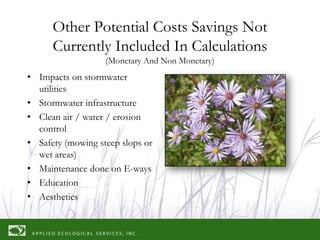
Other Potential Costs Savings Not
      Currently Included In Calculations
                   (Monetary And Non Monetary)
• Impacts on stormwater
  utilities
• Stormwater infrastructure
• Clean air / water / erosion
  control
• Safety (mowing steep slops or
  wet areas)
• Maintenance done on E-ways
• Education
• Aesthetics
WORKSHOP I

•Identify total areas of turf in the park.

•Identify areas that would be appropriate to make the conversion
(You can draw on the trace paper).

•Calculate the number of acres (approximately) you will plan on
converting using the scale on the plan.

•Define a preliminary public outreach campaign.

•Determine the cost savings using the excel calculator provided
(my help).

•Develop your proposal to the Mayor or Council that includes the
reasons why you are making this conversion.
Session II
      Equipment and tools of the trade

– Site preparation
– Seeding or planting
– Maintenance
Session II
       Equipment and tools of the trade

– Site preparation
– Seeding or planting
– Maintenance
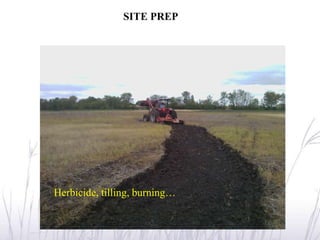
SITE PREP


Herbicide, tilling, burning…
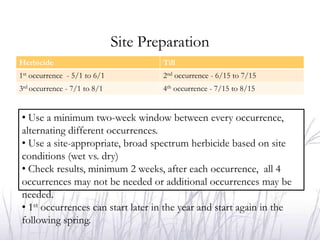
Site Preparation
Herbicide                             Till
1st occurrence - 5/1 to 6/1           2nd occurrence - 6/15 to 7/15
3rd occurrence - 7/1 to 8/1           4th occurrence - 7/15 to 8/15


• Use a minimum two-week window between every occurrence,
alternating different occurrences.
• Use a site-appropriate, broad spectrum herbicide based on site
conditions (wet vs. dry)
• Check results, minimum 2 weeks, after each occurrence, all 4
occurrences may not be needed or additional occurrences may be
needed.
• 1st occurrences can start later in the year and start again in the
following spring.
Session II
       Equipment and tools of the trade

– Site preparation
– Seeding or planting
– Maintenance
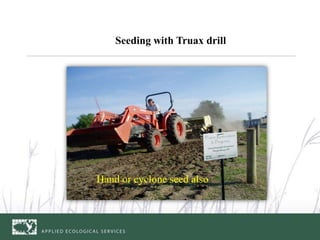
Seeding with Truax drill


Hand or cyclone seed also
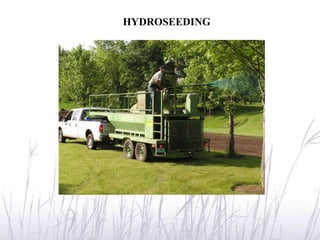
HYDROSEEDING
Session II
       Equipment and tools of the trade

– Site preparation
– Seeding or planting
– Maintenance
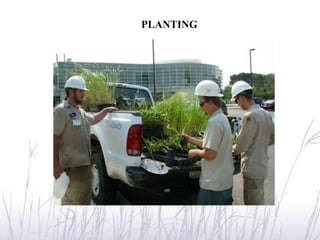
PLANTING
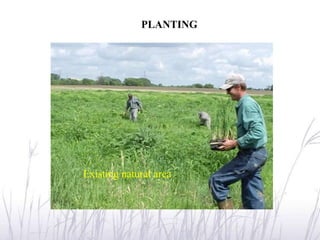
PLANTING


Existing natural area
PLANTING


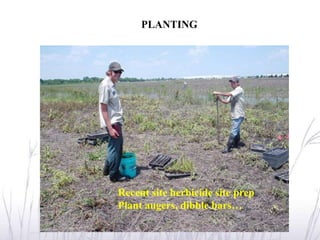
Recent site herbicide site prep
Plant augers, dibble bars…
Session II
       Equipment and tools of the trade

– Site preparation
– Seeding or planting
– Maintenance
   • Mowing
   • Spot herbiciding
   • Prescribed burn
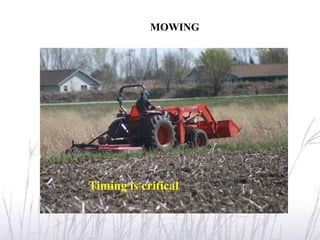
MOWING


Timing is critical
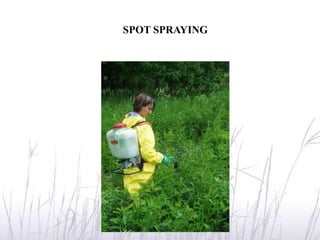
SPOT SPRAYING
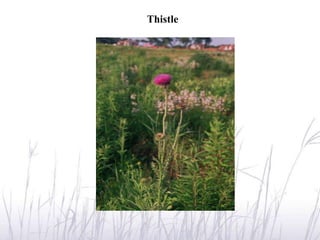
Thistle
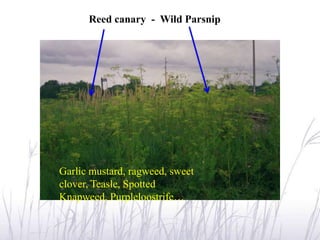
Reed canary - Wild Parsnip


Garlic mustard, ragweed, sweet
clover, Teasle, Spotted
Knapweed, Purpleloostrife…
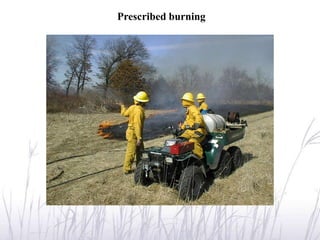
Prescribed burning
WORKSHOP II


•Locate the areas you have already identified
in workshop 1.

•Identify the first steps you will take to
implement your plan.

•Define the specific ecological management
techniques you will use (along with their
frequency, timing, tools or equipment to be
used) starting with year 1 and ending in year
5.

Converting Turf to Prairie

  • 1.
    Applied Ecological Services,Inc. Converting Some Select Park Mowed Lawn Areas to Prairie, Savannas or Wetlands to Reduce Maintenance costs Sustainable Solutions for Over 30 Years
  • 2.
    Troy Anderson Director ofConstruction Restoration Ecologist • Over 15 years of experience in: – Restoration – Preservation – Construction • Employed at AES since 1999 • 1997 Graduate from the University of Wisconsin – Degree: Conservation Biology
  • 3.
  • 4.
    How many havefaced budget cuts • But… – No drop off in service allowed – Staffing freezes (or reduction in staff) – No new equipment – Maybe additional tasks?
  • 5.
    The Goal /Intent Is To Save Operation Maintenance • We know that everyone is looking for ways to make their budget stretch. • Things can be unpredictable • The parks are under a lot of pressure. • Some extreme measures are being considered.
  • 6.
    Session I • Cost savings potential • Site Selection • Public outreach / process • Non monetary ecosystem value
  • 7.
    Session II – Equipment and tools of the trade – Site preparation – Seeding or planting – Maintenance – Using volunteers or recruiting a “citizen champion”
  • 8.
    Session I • Cost savings potential • Site Selection • Public outreach / process • Non monetary ecosystem value
  • 9.
    Cost factored in •Mowedpark lawn per acre per year •Labor, gas, turf repair, maintenance of equipment, travel to park with truck and trailer…, some overhead like building / garage and supervisor salary, depreciation…. •Basic Prairie per acre per year •Labor, gas, herbicide, maintenance of equipment, travel to park with truck and trailer…, overhead, permits, supervisor salary, depreciation, training . and profit
  • 10.
    Example cost comparison •Basedon •Real restoration projects and real feedback from park maintenance professionals. •Every project is different •Scale, shape, type, region…
  • 11.
    Low, Medium andHigh cost ranges are influenced by… •Type of natural area conversion •Prairie •Wet Prairie •Savanna •Diversity •Plant plugs vs. seed •Formal vs. Restoration •Access to site •Economy of scale
  • 12.
  • 13.
  • 14.
  • 16.
    Session I • Cost savings potential • Site Selection • Public outreach / process • Non monetary ecosystem value
  • 17.
    Where to start? 1.Adjacent to active use areas (not in them). 2. Areas that are notoriously difficult to maintain as mowed turf 3. Along drainage ways and wet areas 4. On steep slopes and in areas with highly erodible soils 5. Locations where environmental buffers may be desirable. For example, along streams, expansions of existing forests 6. Areas where aesthetic buffers may be desirable. 7. Locations where park friends can “adopt areas”, such as on park perimeters. 8. To avoid mower damage to trees and their roots.
  • 18.
    •Focusing on parkareas that may not be actively used or can’t be used during parts of the year because too wet, steep hills…
  • 19.
  • 20.
    Steep slopes alongwater… safety concerns?
  • 21.
    Areas with multipletrees to mow around Edina Public Works Park Edina, MN
  • 22.
    GET RID OFOBVIOUS PROBLEMS
  • 23.
    •Should not conflictwith active park programming (baseball, picnic, playgrounds…)
  • 24.
    Session I • Cost savings potential • Site Selection • Public outreach / process • Non monetary ecosystem value
  • 25.
    Possible Questions and concernsfrom community •Are you taking my park away? •Increase of wildlife •Trash in natural areas •Do not like the “wild” look •Type of maintenance like prescribed burning and spot herbiciding.
  • 26.
  • 27.
  • 28.
    EXAMPLES OF REALEMAILS Troy, Thank you for getting back to me. Without knowing much detail about the project at this time, I will have to assume some things. If one of the ideas is to let the retention pond area grow up and become a swamp area, then I am absolutely opposed. Forgive my frankness, but calling it an “ecosystem” or a “natural area” doesn’t ease my mind, it would be a swamp. This brings more bugs and rodents to the area and threatens the enjoyment of our backyards for everyone in the neighborhood. The smell would also be a concern not to mention potential geese and animal droppings in the yards. This is something that we feel very strongly about and would take our concerns to the entire neighborhood as well as the developer of Stonecrest Estates. Again, I am assuming that is what is being considered. We do appreciate the posted signs because I did not see the article in the local newspaper. We will be following the project very closely. If there are any public meetings scheduled yet for the project I would like to attend. Thanks again.
  • 29.
  • 30.
    Show them successfulprojects where the two uses can co-exist.
  • 31.
  • 32.
    Session I • Cost savings potential • Site Selection • Public outreach / process • Non monetary ecosystem value
  • 33.
    Other Potential CostsSavings Not Currently Included In Calculations (Monetary And Non Monetary) • Impacts on stormwater utilities • Stormwater infrastructure • Clean air / water / erosion control • Safety (mowing steep slops or wet areas) • Maintenance done on E-ways • Education • Aesthetics
  • 34.
    WORKSHOP I •Identify totalareas of turf in the park. •Identify areas that would be appropriate to make the conversion (You can draw on the trace paper). •Calculate the number of acres (approximately) you will plan on converting using the scale on the plan. •Define a preliminary public outreach campaign. •Determine the cost savings using the excel calculator provided (my help). •Develop your proposal to the Mayor or Council that includes the reasons why you are making this conversion.
  • 35.
    Session II Equipment and tools of the trade – Site preparation – Seeding or planting – Maintenance
  • 36.
    Session II Equipment and tools of the trade – Site preparation – Seeding or planting – Maintenance
  • 37.
  • 38.
    Site Preparation Herbicide Till 1st occurrence - 5/1 to 6/1 2nd occurrence - 6/15 to 7/15 3rd occurrence - 7/1 to 8/1 4th occurrence - 7/15 to 8/15 • Use a minimum two-week window between every occurrence, alternating different occurrences. • Use a site-appropriate, broad spectrum herbicide based on site conditions (wet vs. dry) • Check results, minimum 2 weeks, after each occurrence, all 4 occurrences may not be needed or additional occurrences may be needed. • 1st occurrences can start later in the year and start again in the following spring.
  • 39.
    Session II Equipment and tools of the trade – Site preparation – Seeding or planting – Maintenance
  • 40.
    Seeding with Truaxdrill Hand or cyclone seed also
  • 41.
  • 42.
    Session II Equipment and tools of the trade – Site preparation – Seeding or planting – Maintenance
  • 43.
  • 44.
  • 45.
    PLANTING Recent site herbicidesite prep Plant augers, dibble bars…
  • 46.
    Session II Equipment and tools of the trade – Site preparation – Seeding or planting – Maintenance • Mowing • Spot herbiciding • Prescribed burn
  • 47.
  • 48.
  • 49.
  • 50.
    Reed canary -Wild Parsnip Garlic mustard, ragweed, sweet clover, Teasle, Spotted Knapweed, Purpleloostrife…
  • 51.
  • 52.
    WORKSHOP II •Locate theareas you have already identified in workshop 1. •Identify the first steps you will take to implement your plan. •Define the specific ecological management techniques you will use (along with their frequency, timing, tools or equipment to be used) starting with year 1 and ending in year 5.