Waste Segregation &
Scientific Management of Waste
An Action Plan for implementing waste segregation and
scientific management of waste within your
community in Bhiwandi
• Why segregate and take responsibility of our waste
• How to go about it
1. Form a green team and train
2. Plan and Set-up the backend disposal methods
3. Plan Segregation method at homes
4. Train housekeeping staff
5. Awareness campaign/session for residents
6. Door to door distribution of kits & training for residents
7. Start collection of segregated waste on daily basis
8. Treat/dispose scientifically
9. Conduct periodic waste audits, follow-ups and reviews, report results
10. Conduct quarterly e-waste collection drives and train new move-ins
Contents
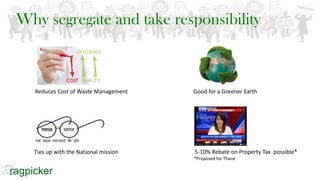
Why segregate and take responsibility
Ties up with the National mission 5-10% Rebate on Property Tax possible*
*Proposed for Thane
Reduces Cost of Waste Management Good for a Greener Earth
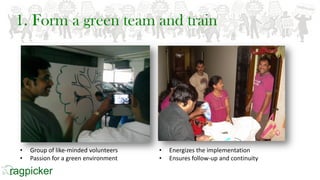
1. Form a green team and train
• Group of like-minded volunteers
• Passion for a green environment
• Energizes the implementation
• Ensures follow-up and continuity
2. Plan and Set-up the backend (i)
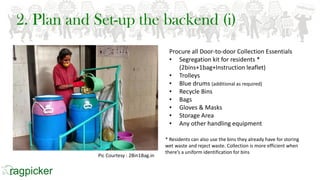
Procure all Door-to-door Collection Essentials
• Segregation kit for residents *
(2bins+1bag+Instruction leaflet)
• Trolleys
• Blue drums (additional as required)
• Recycle Bins
• Bags
• Gloves & Masks
• Storage Area
• Any other handling equipment
Pic Courtesy : 2Bin1Bag.in
* Residents can also use the bins they already have for storing
wet waste and reject waste. Collection is more efficient when
there’s a uniform identification for bins
2. Plan and Set-up the backend (ii)
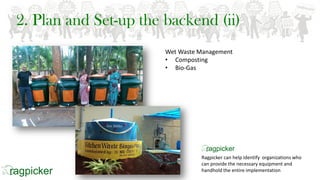
Wet Waste Management
• Composting
• Bio-Gas
Ragpicker can help identify organizations who
can provide the necessary equipment and
handhold the entire implementation
2. Plan and Set-up the backend (iii)
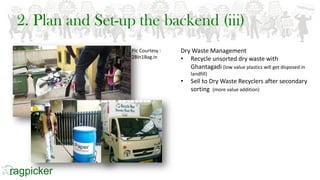
Dry Waste Management
• Recycle unsorted dry waste with
Ghantagadi (low value plastics will get disposed in
landfill)
• Sell to Dry Waste Recyclers after secondary
sorting (more value addition)
Pic Courtesy : 2Bin1Bag.in
Pic Courtesy :
2Bin1Bag.in
3. Plan Segregation at Homes
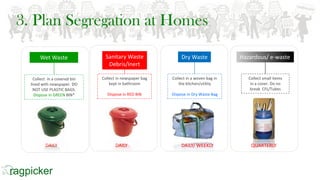
Hazardous/ e-waste
Collect small items
in a cover. Do no
break CFL/Tubes
QUARTERLY
Wet Waste
Collect in a covered bin
lined with newspaper. DO
NOT USE PLASTIC BAGS.
Dispose in GREEN BIN*
DAILY
Sanitary Waste
Debris/Inert
Collect in newspaper bag
kept in bathroom
Dispose in RED BIN
DAILY
Dry Waste
Collect in a woven bag in
the kitchen/utility
Dispose in Dry Waste Bag
DAILY/ WEEKLY
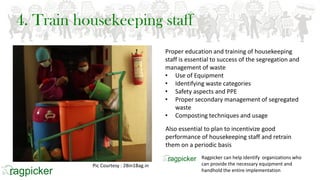
4. Train housekeeping staff
Proper education and training of housekeeping
staff is essential to success of the segregation and
management of waste
• Use of Equipment
• Identifying waste categories
• Safety aspects and PPE
• Proper secondary management of segregated
waste
• Composting techniques and usage
Also essential to plan to incentivize good
performance of housekeeping staff and retrain
them on a periodic basis
Pic Courtesy : 2Bin1Bag.in
Ragpicker can help identify organizations who
can provide the necessary equipment and
handhold the entire implementation
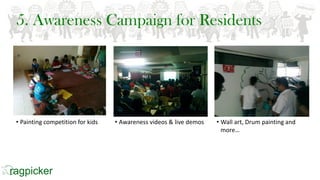
5. Awareness Campaign for Residents
• Painting competition for kids • Awareness videos & live demos • Wall art, Drum painting and
more…
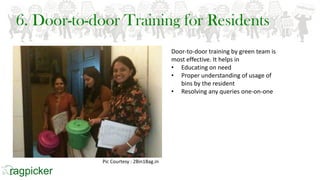
6. Door-to-door Training for Residents
Door-to-door training by green team is
most effective. It helps in
• Educating on need
• Proper understanding of usage of
bins by the resident
• Resolving any queries one-on-one
Pic Courtesy : 2Bin1Bag.in
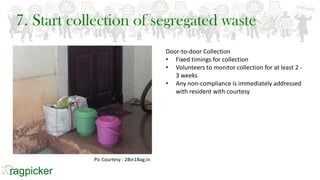
7. Start collection of segregated waste
Door-to-door Collection
• Fixed timings for collection
• Volunteers to monitor collection for at least 2 -
3 weeks
• Any non-compliance is immediately addressed
with resident with courtesy
Pic Courtesy : 2Bin1Bag.in
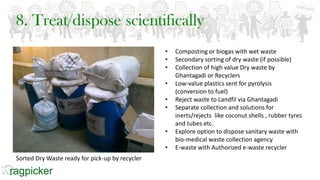
8. Treat/dispose scientifically
• Composting or biogas with wet waste
• Secondary sorting of dry waste (if possible)
• Collection of high value Dry waste by
Ghantagadi or Recyclers
• Low-value plastics sent for pyrolysis
(conversion to fuel)
• Reject waste to Landfil via Ghantagadi
• Separate collection and solutions for
inerts/rejects like coconut shells , rubber tyres
and tubes etc.
• Explore option to dispose sanitary waste with
bio-medical waste collection agency
• E-waste with Authorized e-waste recycler
Sorted Dry Waste ready for pick-up by recycler
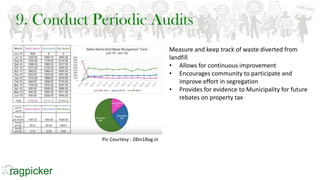
9. Conduct Periodic Audits
Measure and keep track of waste diverted from
landfill
• Allows for continuous improvement
• Encourages community to participate and
improve effort in segregation
• Provides for evidence to Municipality for future
rebates on property tax
Pic Courtesy : 2Bin1Bag.in
10. Quarterly e-waste collection drives
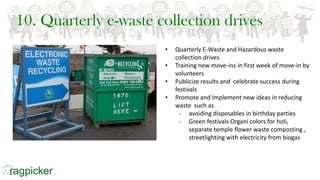
• Quarterly E-Waste and Hazardous waste
collection drives
• Training new move-ins in first week of move-in by
volunteers
• Publicize results and celebrate success during
festivals
• Promote and Implement new ideas in reducing
waste such as
- avoiding disposables in birthday parties
- Green festivals Organi colors for holi,
separate temple flower waste composting ,
streetlighting with electricity from biogas
Resources
http://www.swachhbharaturban.in:8080/SBMUL
B/ulbadmin/documentManagement?type=CaseS
tudies
https://youtu.be/u_tdRzRxIsA
Happy Segregation,
Composting
and Recycling!
http://www.slideshare.net/ragpickerifyRagpicker presentations and Leaflets
2Bin1Bag Apartment Segregation Video
Swachch Bharat Waste management Case Studies

Waste Segregation & Management - An Action Plan for Bhiwandi

  • 1.
    Waste Segregation & ScientificManagement of Waste An Action Plan for implementing waste segregation and scientific management of waste within your community in Bhiwandi
  • 2.
    • Why segregateand take responsibility of our waste • How to go about it 1. Form a green team and train 2. Plan and Set-up the backend disposal methods 3. Plan Segregation method at homes 4. Train housekeeping staff 5. Awareness campaign/session for residents 6. Door to door distribution of kits & training for residents 7. Start collection of segregated waste on daily basis 8. Treat/dispose scientifically 9. Conduct periodic waste audits, follow-ups and reviews, report results 10. Conduct quarterly e-waste collection drives and train new move-ins Contents
  • 3.
    Why segregate andtake responsibility Ties up with the National mission 5-10% Rebate on Property Tax possible* *Proposed for Thane Reduces Cost of Waste Management Good for a Greener Earth
  • 4.
    1. Form agreen team and train • Group of like-minded volunteers • Passion for a green environment • Energizes the implementation • Ensures follow-up and continuity
  • 5.
    2. Plan andSet-up the backend (i) Procure all Door-to-door Collection Essentials • Segregation kit for residents * (2bins+1bag+Instruction leaflet) • Trolleys • Blue drums (additional as required) • Recycle Bins • Bags • Gloves & Masks • Storage Area • Any other handling equipment Pic Courtesy : 2Bin1Bag.in * Residents can also use the bins they already have for storing wet waste and reject waste. Collection is more efficient when there’s a uniform identification for bins
  • 6.
    2. Plan andSet-up the backend (ii) Wet Waste Management • Composting • Bio-Gas Ragpicker can help identify organizations who can provide the necessary equipment and handhold the entire implementation
  • 7.
    2. Plan andSet-up the backend (iii) Dry Waste Management • Recycle unsorted dry waste with Ghantagadi (low value plastics will get disposed in landfill) • Sell to Dry Waste Recyclers after secondary sorting (more value addition) Pic Courtesy : 2Bin1Bag.in Pic Courtesy : 2Bin1Bag.in
  • 8.
    3. Plan Segregationat Homes Hazardous/ e-waste Collect small items in a cover. Do no break CFL/Tubes QUARTERLY Wet Waste Collect in a covered bin lined with newspaper. DO NOT USE PLASTIC BAGS. Dispose in GREEN BIN* DAILY Sanitary Waste Debris/Inert Collect in newspaper bag kept in bathroom Dispose in RED BIN DAILY Dry Waste Collect in a woven bag in the kitchen/utility Dispose in Dry Waste Bag DAILY/ WEEKLY
  • 9.
    4. Train housekeepingstaff Proper education and training of housekeeping staff is essential to success of the segregation and management of waste • Use of Equipment • Identifying waste categories • Safety aspects and PPE • Proper secondary management of segregated waste • Composting techniques and usage Also essential to plan to incentivize good performance of housekeeping staff and retrain them on a periodic basis Pic Courtesy : 2Bin1Bag.in Ragpicker can help identify organizations who can provide the necessary equipment and handhold the entire implementation
  • 10.
    5. Awareness Campaignfor Residents • Painting competition for kids • Awareness videos & live demos • Wall art, Drum painting and more…
  • 11.
    6. Door-to-door Trainingfor Residents Door-to-door training by green team is most effective. It helps in • Educating on need • Proper understanding of usage of bins by the resident • Resolving any queries one-on-one Pic Courtesy : 2Bin1Bag.in
  • 12.
    7. Start collectionof segregated waste Door-to-door Collection • Fixed timings for collection • Volunteers to monitor collection for at least 2 - 3 weeks • Any non-compliance is immediately addressed with resident with courtesy Pic Courtesy : 2Bin1Bag.in
  • 13.
    8. Treat/dispose scientifically •Composting or biogas with wet waste • Secondary sorting of dry waste (if possible) • Collection of high value Dry waste by Ghantagadi or Recyclers • Low-value plastics sent for pyrolysis (conversion to fuel) • Reject waste to Landfil via Ghantagadi • Separate collection and solutions for inerts/rejects like coconut shells , rubber tyres and tubes etc. • Explore option to dispose sanitary waste with bio-medical waste collection agency • E-waste with Authorized e-waste recycler Sorted Dry Waste ready for pick-up by recycler
  • 14.
    9. Conduct PeriodicAudits Measure and keep track of waste diverted from landfill • Allows for continuous improvement • Encourages community to participate and improve effort in segregation • Provides for evidence to Municipality for future rebates on property tax Pic Courtesy : 2Bin1Bag.in
  • 15.
    10. Quarterly e-wastecollection drives • Quarterly E-Waste and Hazardous waste collection drives • Training new move-ins in first week of move-in by volunteers • Publicize results and celebrate success during festivals • Promote and Implement new ideas in reducing waste such as - avoiding disposables in birthday parties - Green festivals Organi colors for holi, separate temple flower waste composting , streetlighting with electricity from biogas
  • 16.