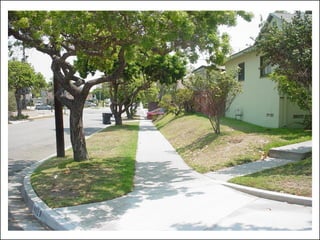
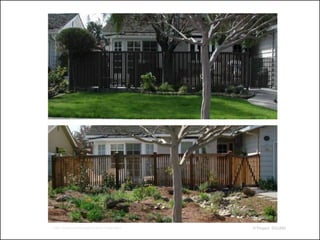
Out of the Wilds and Into Your Garden


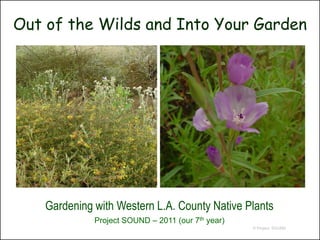
    Gardening with Western L.A. County Native Plants
              Project SOUND – 2011 (our 7th year)
                                                    © Project SOUND
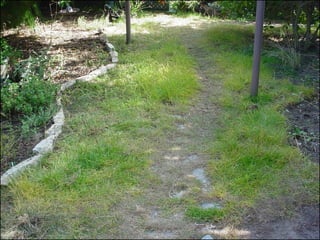
Lawns Gone Wild


  C.M. Vadheim and T. Drake
   CSUDH & Madrona Marsh Preserve


   Madrona Marsh Nature Center
         January 8, 2011

                                    © Project SOUND
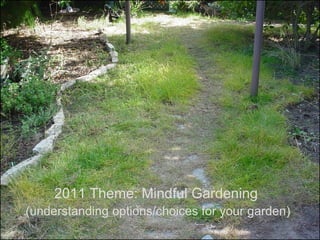
2011 Theme: Mindful Gardening
(understanding options/choices for your garden)
                                        © Project SOUND
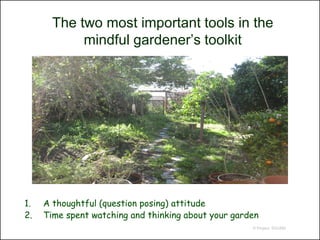
The two most important tools in the
            mindful gardener’s toolkit


1.   A thoughtful (question posing) attitude
2.   Time spent watching and thinking about your garden
                                                     © Project SOUND
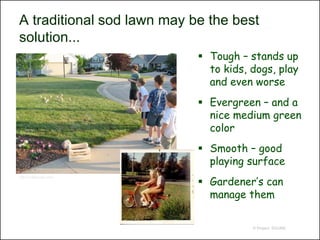
A traditional sod lawn may be the best
solution...
                             Tough – stands up
                              to kids, dogs, play
                              and even worse
                             Evergreen – and a
                              nice medium green
                              color
                             Smooth – good
                              playing surface
                             Gardener’s can
http://molkkyusa.com/


                              manage them

                                       © Project SOUND
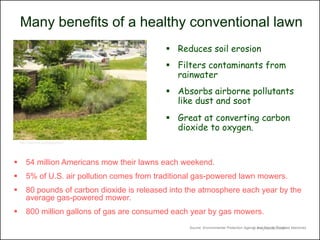
Many benefits of a healthy conventional lawn
                                               Reduces soil erosion
                                               Filters contaminants from
                                                rainwater
                                               Absorbs airborne pollutants
                                                like dust and soot
                                               Great at converting carbon
                                                dioxide to oxygen.
    http://xploring.org/tag/green/


       54 million Americans mow their lawns each weekend.
       5% of U.S. air pollution comes from traditional gas-powered lawn mowers.
       80 pounds of carbon dioxide is released into the atmosphere each year by the
        average gas-powered mower.
       800 million gallons of gas are consumed each year by gas mowers.
                                                     Source: Environmental Protection Agency and People Powered Machines
                                                                                           © Project SOUND
So, ideally you should choose a conventional turf lawn
    based on conscious weighing of pros & cons…


                           …rather than simply going
                           with the ‘usual’ solution

                                             © Project SOUND
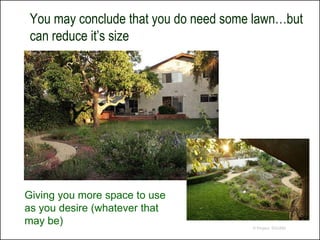
You may conclude that you do need some lawn…but
 can reduce it’s size


Giving you more space to use
as you desire (whatever that
may be)                                © Project SOUND
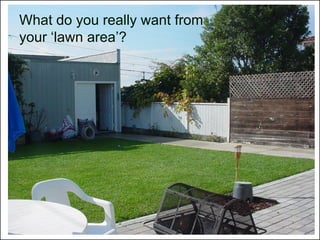
What do you really want from
your ‘lawn area’?


                               © Project SOUND
Your first answer may
                                                                      be ‘drought tolerant’

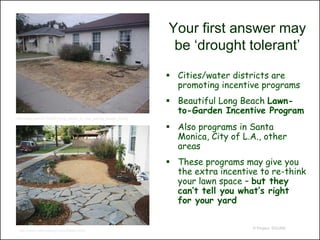
                                                                      Cities/water districts are
                                                                       promoting incentive programs
                                                                      Beautiful Long Beach Lawn-
                                                                       to-Garden Incentive Program
http://laist.com/2010/03/31/long_beach_is_now_paying_people_to.php

                                                                      Also programs in Santa
                                                                       Monica, City of L.A., other
                                                                       areas
                                                                      These programs may give you
                                                                       the extra incentive to re-think
                                                                       your lawn space – but they
                                                                       can’t tell you what’s right
                                                                       for your yard

                                                                                         © Project SOUND
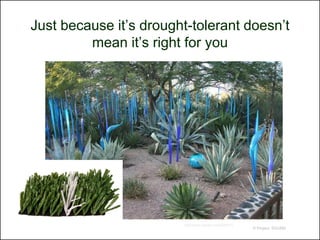
 http://www.calecodesign.com/Gallery.html
Just because it’s drought-tolerant doesn’t
         mean it’s right for you


                        http://www.citydirt.net/2008/01/
                                                           © Project SOUND
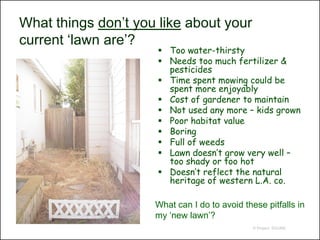
What things don’t you like about your
current ‘lawn are’?
                       Too water-thirsty
                       Needs too much fertilizer &
                        pesticides
                       Time spent mowing could be
                        spent more enjoyably
                       Cost of gardener to maintain
                       Not used any more – kids grown
                       Poor habitat value
                       Boring
                       Full of weeds
                       Lawn doesn’t grow very well –
                        too shady or too hot
                       Doesn’t reflect the natural
                        heritage of western L.A. co.

                     What can I do to avoid these pitfalls in
                     my ‘new lawn’?
                                               © Project SOUND
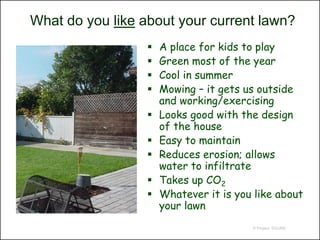
What do you like about your current lawn?
                     A place for kids to play
                     Green most of the year
                     Cool in summer
                     Mowing – it gets us outside
                      and working/exercising
                     Looks good with the design
                      of the house
                     Easy to maintain
                     Reduces erosion; allows
                      water to infiltrate
                     Takes up CO2
                     Whatever it is you like about
                      your lawn
                                        © Project SOUND
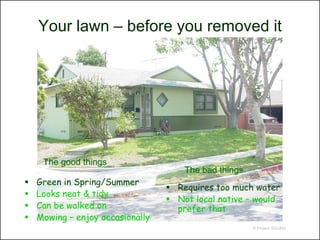
Your lawn – before you removed it


     The good things
                                      The bad things
   Green in Spring/Summer
                                   Requires too much water
   Looks neat & tidy
                                   Not local native – would
   Can be walked on                prefer that
   Mowing – enjoy occasionally
                                                       © Project SOUND
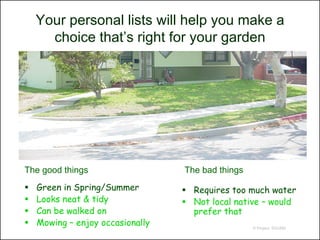
Your personal lists will help you make a
      choice that’s right for your garden


The good things                   The bad things
   Green in Spring/Summer         Requires too much water
   Looks neat & tidy              Not local native – would
   Can be walked on                prefer that
   Mowing – enjoy occasionally                    © Project SOUND
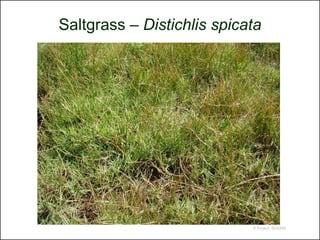
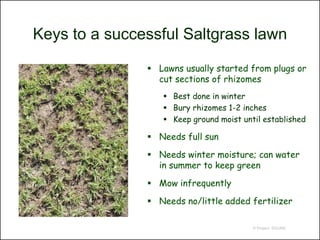
Saltgrass – Distichlis spicata


                            © Project SOUND
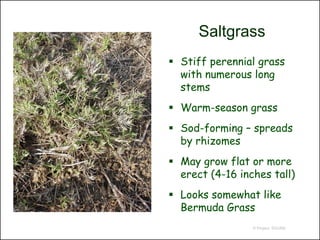
Saltgrass
 Stiff perennial grass
  with numerous long
  stems
 Warm-season grass
 Sod-forming – spreads
  by rhizomes
 May grow flat or more
  erect (4-16 inches tall)
 Looks somewhat like
  Bermuda Grass
                 © Project SOUND
Keys to a successful Saltgrass lawn

                Lawns usually started from plugs or
                 cut sections of rhizomes
                   Best done in winter
                   Bury rhizomes 1-2 inches
                   Keep ground moist until established

                Needs full sun

                Needs winter moisture; can water
                 in summer to keep green

                Mow infrequently

                Needs no/little added fertilizer

                                         © Project SOUND
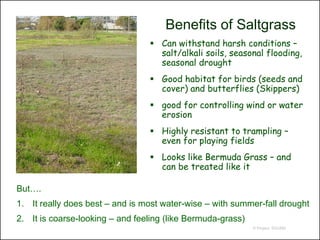
Benefits of Saltgrass
                                  Can withstand harsh conditions –
                                   salt/alkali soils, seasonal flooding,
                                   seasonal drought
                                  Good habitat for birds (seeds and
                                   cover) and butterflies (Skippers)
                                  good for controlling wind or water
                                   erosion
                                  Highly resistant to trampling –
                                   even for playing fields
                                  Looks like Bermuda Grass – and
                                   can be treated like it

But….
1. It really does best – and is most water-wise – with summer-fall drought
2. It is coarse-looking – and feeling (like Bermuda-grass)
                                                             © Project SOUND
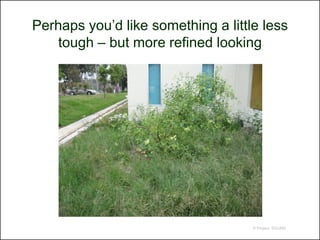
Perhaps you’d like something a little less
    tough – but more refined looking


                                    © Project SOUND
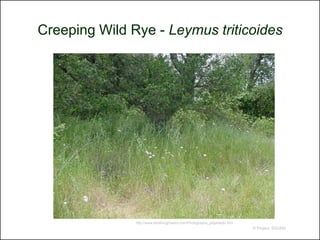
Creeping Wild Rye - Leymus triticoides


               http://www.elnativogrowers.com/Photographs_page/leytri.htm
                                                                            © Project SOUND
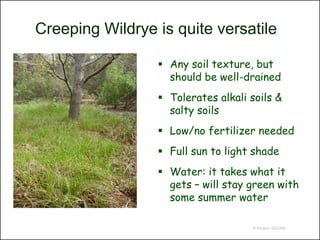
Creeping Wildrye is quite versatile

                  Any soil texture, but
                   should be well-drained
                  Tolerates alkali soils &
                   salty soils
                  Low/no fertilizer needed
                  Full sun to light shade
                  Water: it takes what it
                   gets – will stay green with
                   some summer water

                                    © Project SOUND
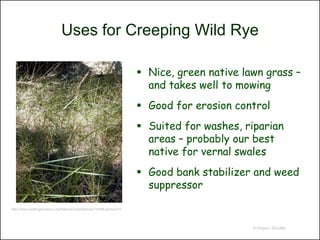
Uses for Creeping Wild Rye

                                                                      Nice, green native lawn grass –
                                                                       and takes well to mowing
                                                                      Good for erosion control
                                                                      Suited for washes, riparian
                                                                       areas – probably our best
                                                                       native for vernal swales
                                                                      Good bank stabilizer and weed
                                                                       suppressor

http://www.hastingsreserve.org/NativeGrass/Natives.html#LeymusTrit


                                                                                            © Project SOUND
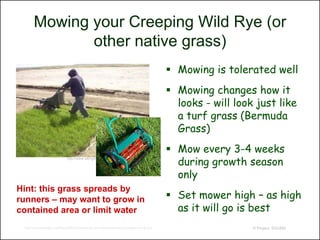
Mowing your Creeping Wild Rye (or
              other native grass)
                                                                                                Mowing is tolerated well
                                                                                                Mowing changes how it
                                                                                                 looks - will look just like
                                                                                                 a turf grass (Bermuda
                                                                                                 Grass)
                                                                                                Mow every 3-4 weeks
                                                                                                 during growth season
                               http://www.albrightseed.com/wildryeswalefilter.htm


                                                                                                 only
Hint: this grass spreads by
runners – may want to grow in                                                                   Set mower high – as high
contained area or limit water                                                                    as it will go is best
 http://www.treehugger.com/files/2008/09/review-push-reel-mower-lawnmower-sunlawn-lmm-40.php                      © Project SOUND
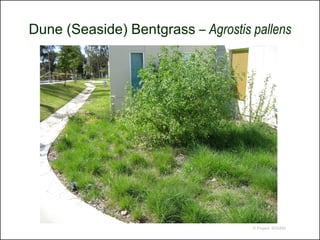
Dune (Seaside) Bentgrass – Agrostis pallens


                                    © Project SOUND
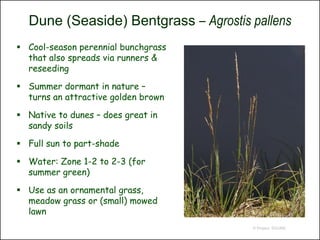
Dune (Seaside) Bentgrass – Agrostis pallens
 Cool-season perennial bunchgrass
  that also spreads via runners &
  reseeding

 Summer dormant in nature –
  turns an attractive golden brown

 Native to dunes – does great in
  sandy soils

 Full sun to part-shade

 Water: Zone 1-2 to 2-3 (for
  summer green)

 Use as an ornamental grass,
  meadow grass or (small) mowed
  lawn
                                      © Project SOUND
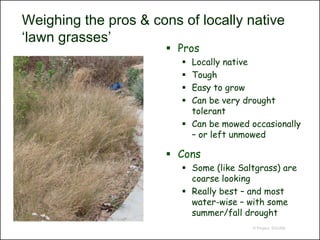
Weighing the pros & cons of locally native
‘lawn grasses’
                        Pros
                          Locally native
                          Tough
                          Easy to grow
                          Can be very drought
                           tolerant
                          Can be mowed occasionally
                           – or left unmowed

                        Cons
                          Some (like Saltgrass) are
                           coarse looking
                          Really best – and most
                           water-wise – with some
                           summer/fall drought
                                         © Project SOUND
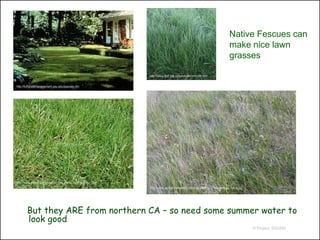
Native Fescues can
                                                                                                                       make nice lawn
                                                                                                                       grasses

                                                               http://www.ibot.cas.cz/krkonose/mm/mm.htm


http://turfgrassmanagement.psu.edu/species.cfm


http://www.mobot.org/gardeninghelp/plantfinder/Plant.asp?cod
e=G880                                                         http://www.soquelcreekwater.com/images/Pho-Grass_festuca_rubra.jpg


       But they ARE from northern CA – so need some summer water to
       look good
                                                                                                                                    © Project SOUND
The really ‘lawn-like’ native grasses are from
   further North (and require more water)
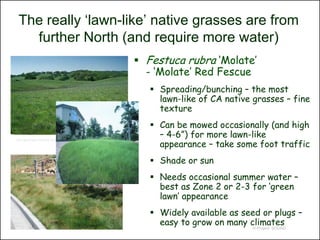
                                                                          Festuca rubra ‘Molate’
                                                                           - ‘Molate’ Red Fescue
                                                                             Spreading/bunching – the most
                                                                              lawn-like of CA native grasses – fine
                                                                              texture
                                                                             Can be mowed occasionally (and high
                                                                              – 4-6”) for more lawn-like
                                                                              appearance – take some foot traffic
http://geoimages.berkeley.edu/geoImages/BainCalif/CAL400/BUNGRASS.HTML


                                                                             Shade or sun
                                                                             Needs occasional summer water –
                                                                              best as Zone 2 or 2-3 for ‘green
                                                                              lawn’ appearance
                                                                             Widely available as seed or plugs –
                                                                              easy to grow on many climates
                                                                                                     © Project SOUND
Your personal lists will help you make a
      choice that’s right for your garden


The good things                      The bad things
   Evergreen – ‘swath of green’        Requires too much water
   Low maintenance                     Doesn’t look great in the
   Reminds me of being out in the       shady areas of the yard
    woods (which I like)
                                                        © Project SOUND
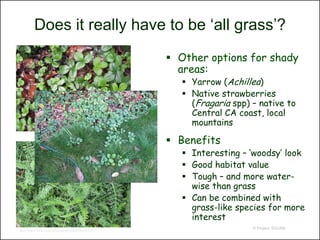
Does it really have to be ‘all grass’?
                                                   Other options for shady
                                                    areas:
                                                      Yarrow (Achillea)
                                                      Native strawberries
                                                       (Fragaria spp) – native to
                                                       Central CA coast, local
                                                       mountains

                                                   Benefits
                                                      Interesting – ‘woodsy’ look
                                                      Good habitat value
                                                      Tough – and more water-
                                                       wise than grass
                                                      Can be combined with
                                                       grass-like species for more
                                                       interest
                                                                      © Project SOUND
http://www.flickr.com/photos/spidra/2290393751/
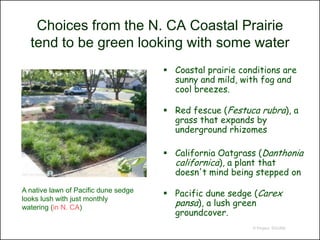
Choices from the N. CA Coastal Prairie
     tend to be green looking with some water
                                                                    Coastal prairie conditions are
                                                                     sunny and mild, with fog and
                                                                     cool breezes.

                                                                    Red fescue (Festuca rubra), a
                                                                     grass that expands by
                                                                     underground rhizomes

                                                                    California Oatgrass (Danthonia
                                                                     californica), a plant that
http://lomaprieta.sierraclub.org/thelomaprietan.asp?q=2009030802     doesn't mind being stepped on
A native lawn of Pacific dune sedge
                                                                    Pacific dune sedge (Carex
                                                                     pansa), a lush green
looks lush with just monthly
watering (in N. CA)
                                                                     groundcover.
                                                                                        © Project SOUND
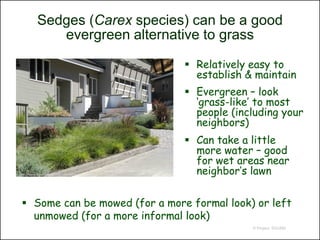
Sedges (Carex species) can be a good
              evergreen alternative to grass

                                                    Relatively easy to
                                                     establish & maintain
                                                    Evergreen – look
                                                     ‘grass-like’ to most
                                                     people (including your
                                                     neighbors)
                                                    Can take a little
                                                     more water – good
                                                     for wet areas near
http://blueplanetgardening.com/art-lawnsubs.html     neighbor’s lawn


  Some can be mowed (for a more formal look) or left
   unmowed (for a more informal look)
                                                                © Project SOUND
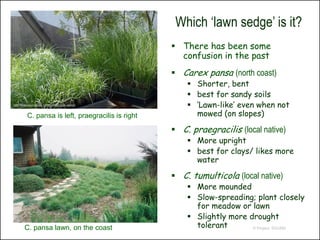
Which ‘lawn sedge’ is it?
                                                    There has been some
                                                     confusion in the past
                                                    Carex pansa (north coast)
                                                        Shorter, bent
                                                        best for sandy soils
http://www.baynatives.com/plants/Carex-pansa/           ‘Lawn-like’ even when not
         C. pansa is left, praegracilis is right         mowed (on slopes)

                                                    C. praegracilis (local native)
                                                        More upright
                                                        best for clays/ likes more
                                                         water

                                                    C. tumulticola (local native)
                                                        More mounded
                                                        Slow-spreading; plant closely
                                                         for meadow or lawn
                                                        Slightly more drought
       C. pansa lawn, on the coast                       tolerant       © Project SOUND
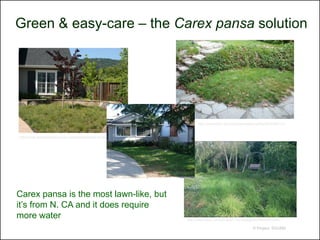
Green & easy-care – the Carex pansa solution


                                                                                           http://www.flickr.com/photos/eastbaywilds/2673289141/


http://www.landscaperesource.com/articles/study-of-lawn-in-our-gardens-part-ii.htm


Carex pansa is the most lawn-like, but
it’s from N. CA and it does require
more water                                                                           http://www.flickr.com/photos/11525626@N00/3881883242

                                                                                                                            © Project SOUND
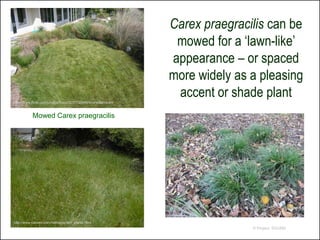
Carex praegracilis can be
                                                                 mowed for a ‘lawn-like’
                                                                appearance – or spaced
                                                                more widely as a pleasing
http://www.flickr.com/photos/fross/3237730086/in/photostream/
                                                                 accent or shade plant
           Mowed Carex praegracilis


http://www.calown.com/nativegarden_plants.html
                                                                               © Project SOUND
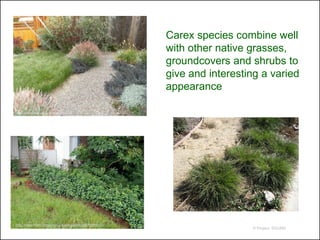
Carex species combine well
                                                        with other native grasses,
                                                        groundcovers and shrubs to
                                                        give and interesting a varied
                                                        appearance

http://www.satoridesigns.net/?p=19


http://www.flickr.com/photos/eastbaywilds/2673289141/
                                                                          © Project SOUND
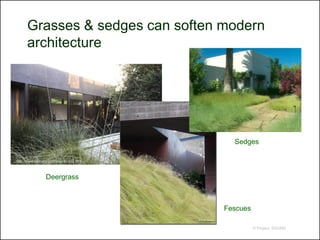
Grasses & sedges can soften modern
      architecture


                                            Sedges

http://www.asla.org/2009awards/612.html


                 Deergrass


                                          Fescues

                                                    © Project SOUND
© Project SOUND
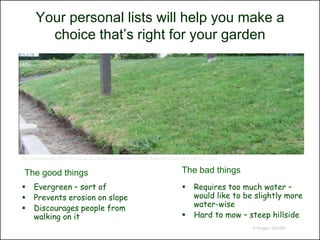
Your personal lists will help you make a
           choice that’s right for your garden


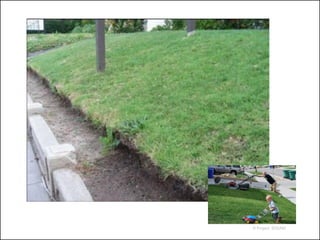
http://greenlandoceanblue.com/2011/01/03/say-you-got-some-snoo-on-your-lawn-larry-o%E2%80%99shea-in-the-tv-series-that%E2%80%99s-my-bush/


 The good things                                                                                                The bad things
       Evergreen – sort of                                                                                            Requires too much water –
       Prevents erosion on slope                                                                                       would like to be slightly more
       Discourages people from                                                                                         water-wise
        walking on it                                                                                                  Hard to mow – steep hillside
                                                                                                                                            © Project SOUND
Do I really need to mow? If not, the options
expand dramatically
                            Many ‘lawn-like’ species
                             can be left un-mowed
                             (‘ornamental grasses’)
                                 Carex species
                                 Juncus species
                                 Fescue species
                                 Many local & other CA
                                  Native bunchgrasses

                            Many other groundcover
                             species
                               Herbaceous species
                               Even low-growing
                                woody species from
                                N./Central CA coast
                                [Manzanitas;
                                Ceanothus]

                                          © Project SOUND
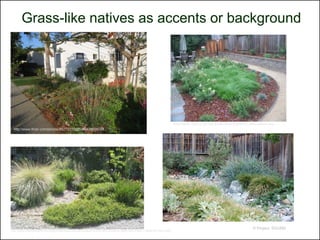
Grass-like natives as accents or background


                                                                                                                           http://www.cnps.org/cnps/grownative/tips/lawn_alternatives.php
  http://www.flickr.com/photos/83213315@N00/498800058


                                                                                                                                                                           © Project SOUND
http://www.thedigeratilife.com/blog/index.php/2008/06/04/save-money-and-conserve-water-with-these-7-ideas-for-your-yard/
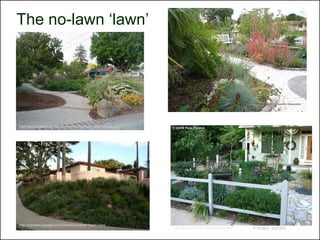
The no-lawn ‘lawn’


http://www.cnps.org/cnps/grownative/tips/lawn_alternatives.php


http://freshdirt.sunset.com/2009/03/another-front-l.html
                                                                 http://www.penick.net/digging/?p=497   © Project SOUND
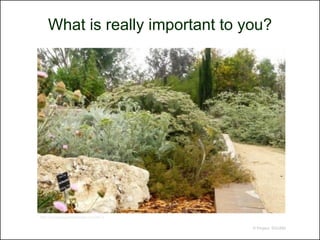
What is really important to you?


http://cocreativegardendesign.com/56-2/


                                          © Project SOUND
Your personal lists will help you make a
      choice that’s right for your garden


The good things                  The bad things
   Changes with the seasons –      Requires too much water
    green in winter/spring          Too boring – not enough going on
                                    Poor habitat value
                                    No sense of place
                                                      © Project SOUND
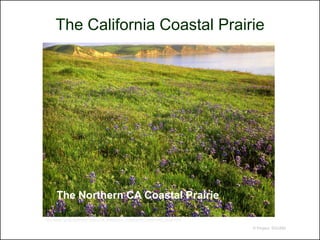
The California Coastal Prairie


      The Northern CA Coastal Prairie

http://www.geog.ucsb.edu/~joel/g148_f09/lecture_notes/north_coast/north_coast.html

                                                                                     © Project SOUND
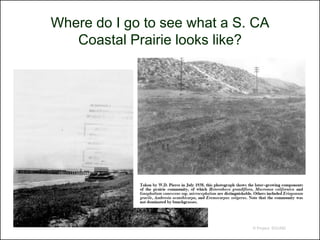
Where do I go to see what a S. CA
   Coastal Prairie looks like?


                              © Project SOUND
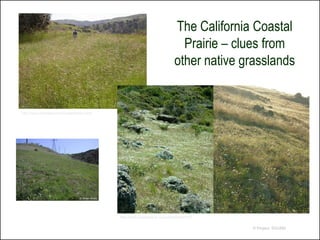
The California Coastal
                                                                                 Prairie – clues from
                                                                               other native grasslands


http://www.savetejonranch.org/all/index.html


                                               http://www.coastalzone-ca.com/realworld.htm


                                                                                             © Project SOUND
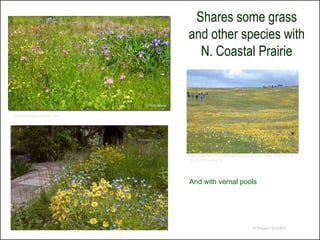
Shares some grass
                                and other species with
                                  N. Coastal Prairie


http://philipsgardenblog.com/


                                http://www.elkhornsloughctp.org/training/show_train_detail.php?T
                                RAIN_ID=CoyEJZ39


                                And with vernal pools


                                                                      © Project SOUND
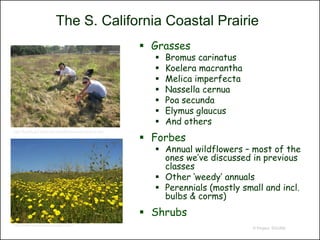
The S. California Coastal Prairie
                                                            Grasses
                                                                Bromus carinatus
                                                                Koelera macrantha
                                                                Melica imperfecta
                                                                Nassella cernua
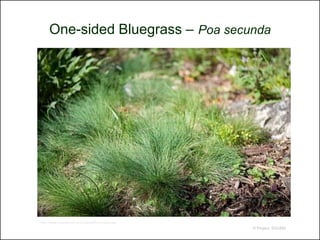
                                                                Poa secunda
                                                                Elymus glaucus
                                                                And others
                                                            Forbes
http://faculty.jsd.claremont.edu/dthomson/studentres.htm


                                                              Annual wildflowers – most of the
                                                               ones we’ve discussed in previous
                                                               classes
                                                              Other ‘weedy’ annuals
                                                              Perennials (mostly small and incl.
                                                               bulbs & corms)
                                                            Shrubs
http://www.caopenspace.org/pv1.html
                                                                                     © Project SOUND
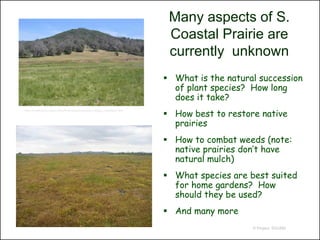
Many aspects of S.
                                                                   Coastal Prairie are
                                                                   currently unknown
                                                                   What is the natural succession
                                                                    of plant species? How long
                                                                    does it take?
                                                                   How best to restore native
http://interwork.sdsu.edu/fire/resources/san-diego-habitats.htm


                                                                    prairies
                                                                   How to combat weeds (note:
                                                                    native prairies don’t have
                                                                    natural mulch)
                                                                   What species are best suited
                                                                    for home gardens? How
                                                                    should they be used?
                                                                   And many more
                                                                                      © Project SOUND
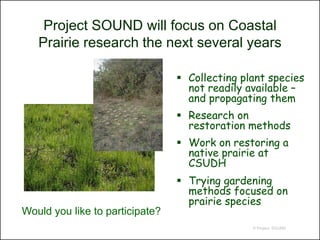
Project SOUND will focus on Coastal
   Prairie research the next several years

                                  Collecting plant species
                                   not readily available –
                                   and propagating them
                                  Research on
                                   restoration methods
                                  Work on restoring a
                                   native prairie at
                                   CSUDH
                                  Trying gardening
                                   methods focused on
                                   prairie species
Would you like to participate?
                                                © Project SOUND
One-sided Bluegrass – Poa secunda


http://www.baynatives.com/plants/Poa-secunda/
                                                © Project SOUND
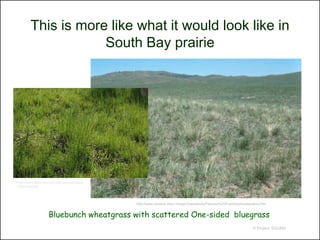
This is more like what it would look like in
                    South Bay prairie


http://www.flickr.com/photos/raphaelmazor
/3400158978/


                                            http://www.tarleton.edu/~range/Grasslands/Palouse%20Prairie/palouseprairie.htm


                   Bluebunch wheatgrass with scattered One-sided bluegrass
                                                                                                                  © Project SOUND
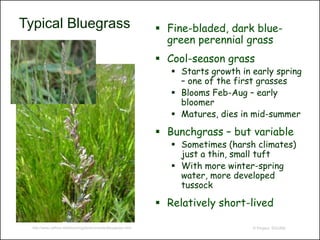
Typical Bluegrass                                                  Fine-bladed, dark blue-
                                                                    green perennial grass
                                                                   Cool-season grass
                                                                      Starts growth in early spring
                                                                       – one of the first grasses
                                                                      Blooms Feb-Aug – early
                                                                       bloomer
                                                                      Matures, dies in mid-summer

                                                                   Bunchgrass – but variable
                                                                      Sometimes (harsh climates)
                                                                       just a thin, small tuft
                                                                      With more winter-spring
                                                                       water, more developed
                                                                       tussock

                                                                   Relatively short-lived

  http://www.calflora.net/bloomingplants/onesidedbluegrass.html                         © Project SOUND
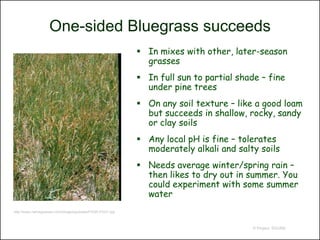
One-sided Bluegrass succeeds
                                                             In mixes with other, later-season
                                                              grasses
                                                             In full sun to partial shade – fine
                                                              under pine trees
                                                             On any soil texture – like a good loam
                                                              but succeeds in shallow, rocky, sandy
                                                              or clay soils
                                                             Any local pH is fine – tolerates
                                                              moderately alkali and salty soils
                                                             Needs average winter/spring rain –
                                                              then likes to dry out in summer. You
                                                              could experiment with some summer
                                                              water
http://www.nativegrasses.com/images/grasses/FHGR-FHG1.jpg


                                                                                        © Project SOUND
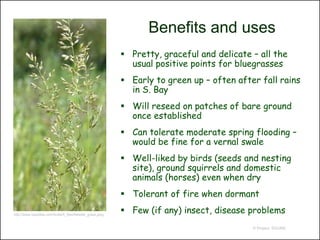
Benefits and uses
                                                              Pretty, graceful and delicate – all the
                                                               usual positive points for bluegrasses
                                                              Early to green up – often after fall rains
                                                               in S. Bay
                                                              Will reseed on patches of bare ground
                                                               once established
                                                              Can tolerate moderate spring flooding –
                                                               would be fine for a vernal swale
                                                              Well-liked by birds (seeds and nesting
                                                               site), ground squirrels and domestic
                                                               animals (horses) even when dry
                                                              Tolerant of fire when dormant

http://www.laspilitas.com/butterfl_files/Needle_grass.jpeg
                                                              Few (if any) insect, disease problems
                                                                                             © Project SOUND
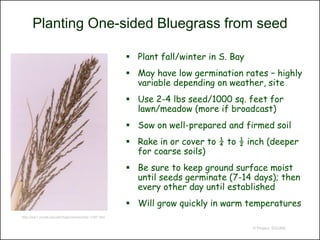
Planting One-sided Bluegrass from seed

                                                     Plant fall/winter in S. Bay
                                                     May have low germination rates – highly
                                                      variable depending on weather, site
                                                     Use 2-4 lbs seed/1000 sq. feet for
                                                      lawn/meadow (more if broadcast)
                                                     Sow on well-prepared and firmed soil
                                                     Rake in or cover to ¼ to ½ inch (deeper
                                                      for coarse soils)
                                                     Be sure to keep ground surface moist
                                                      until seeds germinate (7-14 days); then
                                                      every other day until established
                                                     Will grow quickly in warm temperatures
http://ww1.clunet.edu/wf/chap/common/bjc-1397.htm


                                                                                    © Project SOUND
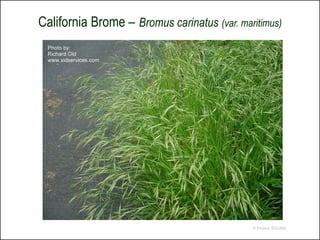
California Brome – Bromus carinatus (var. maritimus)


                                             © Project SOUND
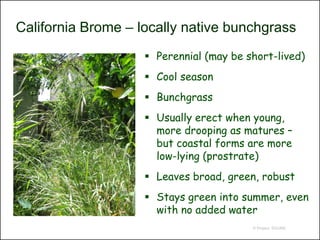
California Brome – locally native bunchgrass
                     Perennial (may be short-lived)
                     Cool season
                     Bunchgrass
                     Usually erect when young,
                      more drooping as matures –
                      but coastal forms are more
                      low-lying (prostrate)
                     Leaves broad, green, robust
                     Stays green into summer, even
                      with no added water
                                         © Project SOUND
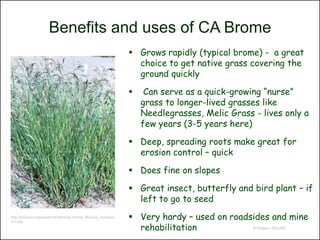
Benefits and uses of CA Brome
                                                                    Grows rapidly (typical brome) - a great
                                                                     choice to get native grass covering the
                                                                     ground quickly

                                                                       Can serve as a quick-growing “nurse”
                                                                       grass to longer-lived grasses like
                                                                       Needlegrasses, Melic Grass - lives only a
                                                                       few years (3-5 years here)

                                                                    Deep, spreading roots make great for
                                                                     erosion control – quick

                                                                    Does fine on slopes

                                                                    Great insect, butterfly and bird plant – if
                                                                     left to go to seed
http://pnwpest.org/weeds/id/California_brome--Bromus_carinatus--
m.s.jpg
                                                                    Very hardy – used on roadsides and mine
                                                                     rehabilitation            © Project SOUND
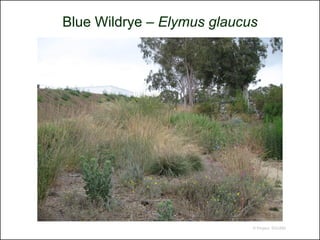
Blue Wildrye – Elymus glaucus


                            © Project SOUND
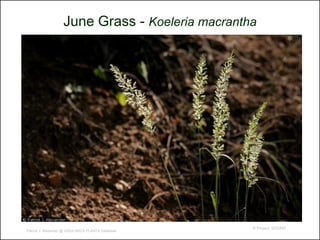
June Grass - Koeleria macrantha


                                                   © Project SOUND
Patrick J. Alexander @ USDA-NRCS PLANTS Database
http://www.cedarcreek.umn.edu/plants/newslides/koeleria480.jpg


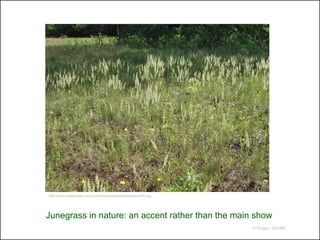
Junegrass in nature: an accent rather than the main show
                                                                 © Project SOUND
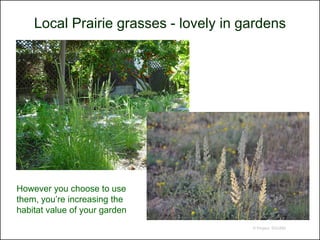
Local Prairie grasses - lovely in gardens


However you choose to use
them, you’re increasing the
habitat value of your garden
                                       © Project SOUND
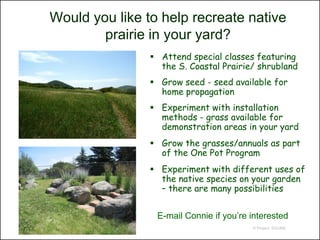
Would you like to help recreate native
                        prairie in your yard?
                                                                   Attend special classes featuring
                                                                    the S. Coastal Prairie/ shrubland
                                                                   Grow seed - seed available for
                                                                    home propagation
                                                                   Experiment with installation
                                                                    methods - grass available for
                                                                    demonstration areas in your yard
                                                                   Grow the grasses/annuals as part
                                                                    of the One Pot Program
                                                                   Experiment with different uses of
                                                                    the native species on your garden
                                                                    – there are many possibilities


                                                                   E-mail Connie if you’re interested
                                                                                           © Project SOUND
http://forums.gardenweb.com/forums/load/calif/msg0617091222429.
html
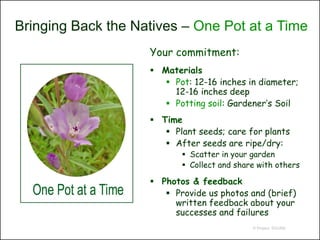
Bringing Back the Natives – One Pot at a Time
                    Your commitment:
                     Materials
                        Pot: 12-16 inches in diameter;
                         12-16 inches deep
                        Potting soil: Gardener’s Soil
                     Time
                        Plant seeds; care for plants
                        After seeds are ripe/dry:
                            Scatter in your garden
                            Collect and share with others

                     Photos & feedback
                        Provide us photos and (brief)
                         written feedback about your
                         successes and failures
                                             © Project SOUND
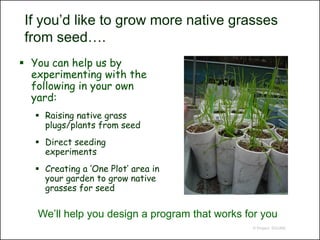
If you’d like to grow more native grasses
 from seed….
 You can help us by
  experimenting with the
  following in your own
  yard:
    Raising native grass
     plugs/plants from seed
    Direct seeding
     experiments
    Creating a ‘One Plot’ area in
     your garden to grow native
     grasses for seed

   We’ll help you design a program that works for you
                                               © Project SOUND
http://susanwrites.livejournal.com/tag/haiku   © Project SOUND
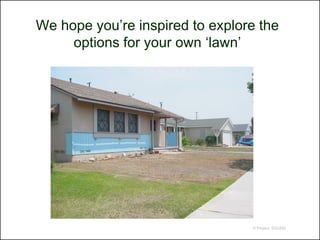
We hope you’re inspired to explore the
     options for your own ‘lawn’


                                 © Project SOUND

Lawns gone wild 2011

  • 1.
    Out of theWilds and Into Your Garden Gardening with Western L.A. County Native Plants Project SOUND – 2011 (our 7th year) © Project SOUND
  • 2.
    Lawns Gone Wild C.M. Vadheim and T. Drake CSUDH & Madrona Marsh Preserve Madrona Marsh Nature Center January 8, 2011 © Project SOUND
  • 3.
    2011 Theme: MindfulGardening (understanding options/choices for your garden) © Project SOUND
  • 4.
    The two mostimportant tools in the mindful gardener’s toolkit 1. A thoughtful (question posing) attitude 2. Time spent watching and thinking about your garden © Project SOUND
  • 5.
    A traditional sodlawn may be the best solution...  Tough – stands up to kids, dogs, play and even worse  Evergreen – and a nice medium green color  Smooth – good playing surface  Gardener’s can http://molkkyusa.com/ manage them © Project SOUND
  • 6.
    Many benefits ofa healthy conventional lawn  Reduces soil erosion  Filters contaminants from rainwater  Absorbs airborne pollutants like dust and soot  Great at converting carbon dioxide to oxygen. http://xploring.org/tag/green/  54 million Americans mow their lawns each weekend.  5% of U.S. air pollution comes from traditional gas-powered lawn mowers.  80 pounds of carbon dioxide is released into the atmosphere each year by the average gas-powered mower.  800 million gallons of gas are consumed each year by gas mowers. Source: Environmental Protection Agency and People Powered Machines © Project SOUND
  • 7.
    So, ideally youshould choose a conventional turf lawn based on conscious weighing of pros & cons… …rather than simply going with the ‘usual’ solution © Project SOUND
  • 8.
    You may concludethat you do need some lawn…but can reduce it’s size Giving you more space to use as you desire (whatever that may be) © Project SOUND
  • 9.
    What do youreally want from your ‘lawn area’? © Project SOUND
  • 10.
    Your first answermay be ‘drought tolerant’  Cities/water districts are promoting incentive programs  Beautiful Long Beach Lawn- to-Garden Incentive Program http://laist.com/2010/03/31/long_beach_is_now_paying_people_to.php  Also programs in Santa Monica, City of L.A., other areas  These programs may give you the extra incentive to re-think your lawn space – but they can’t tell you what’s right for your yard © Project SOUND http://www.calecodesign.com/Gallery.html
  • 11.
    Just because it’sdrought-tolerant doesn’t mean it’s right for you http://www.citydirt.net/2008/01/ © Project SOUND
  • 12.
    What things don’tyou like about your current ‘lawn are’?  Too water-thirsty  Needs too much fertilizer & pesticides  Time spent mowing could be spent more enjoyably  Cost of gardener to maintain  Not used any more – kids grown  Poor habitat value  Boring  Full of weeds  Lawn doesn’t grow very well – too shady or too hot  Doesn’t reflect the natural heritage of western L.A. co. What can I do to avoid these pitfalls in my ‘new lawn’? © Project SOUND
  • 13.
    What do youlike about your current lawn?  A place for kids to play  Green most of the year  Cool in summer  Mowing – it gets us outside and working/exercising  Looks good with the design of the house  Easy to maintain  Reduces erosion; allows water to infiltrate  Takes up CO2  Whatever it is you like about your lawn © Project SOUND
  • 14.
    Your lawn –before you removed it The good things The bad things  Green in Spring/Summer  Requires too much water  Looks neat & tidy  Not local native – would  Can be walked on prefer that  Mowing – enjoy occasionally © Project SOUND
  • 15.
    Your personal listswill help you make a choice that’s right for your garden The good things The bad things  Green in Spring/Summer  Requires too much water  Looks neat & tidy  Not local native – would  Can be walked on prefer that  Mowing – enjoy occasionally © Project SOUND
  • 16.
    Saltgrass – Distichlisspicata © Project SOUND
  • 17.
    Saltgrass  Stiff perennialgrass with numerous long stems  Warm-season grass  Sod-forming – spreads by rhizomes  May grow flat or more erect (4-16 inches tall)  Looks somewhat like Bermuda Grass © Project SOUND
  • 18.
    Keys to asuccessful Saltgrass lawn  Lawns usually started from plugs or cut sections of rhizomes  Best done in winter  Bury rhizomes 1-2 inches  Keep ground moist until established  Needs full sun  Needs winter moisture; can water in summer to keep green  Mow infrequently  Needs no/little added fertilizer © Project SOUND
  • 19.
    Benefits of Saltgrass  Can withstand harsh conditions – salt/alkali soils, seasonal flooding, seasonal drought  Good habitat for birds (seeds and cover) and butterflies (Skippers)  good for controlling wind or water erosion  Highly resistant to trampling – even for playing fields  Looks like Bermuda Grass – and can be treated like it But…. 1. It really does best – and is most water-wise – with summer-fall drought 2. It is coarse-looking – and feeling (like Bermuda-grass) © Project SOUND
  • 20.
    Perhaps you’d likesomething a little less tough – but more refined looking © Project SOUND
  • 21.
    Creeping Wild Rye- Leymus triticoides http://www.elnativogrowers.com/Photographs_page/leytri.htm © Project SOUND
  • 22.
    Creeping Wildrye isquite versatile  Any soil texture, but should be well-drained  Tolerates alkali soils & salty soils  Low/no fertilizer needed  Full sun to light shade  Water: it takes what it gets – will stay green with some summer water © Project SOUND
  • 23.
    Uses for CreepingWild Rye  Nice, green native lawn grass – and takes well to mowing  Good for erosion control  Suited for washes, riparian areas – probably our best native for vernal swales  Good bank stabilizer and weed suppressor http://www.hastingsreserve.org/NativeGrass/Natives.html#LeymusTrit © Project SOUND
  • 24.
    Mowing your CreepingWild Rye (or other native grass)  Mowing is tolerated well  Mowing changes how it looks - will look just like a turf grass (Bermuda Grass)  Mow every 3-4 weeks during growth season http://www.albrightseed.com/wildryeswalefilter.htm only Hint: this grass spreads by runners – may want to grow in  Set mower high – as high contained area or limit water as it will go is best http://www.treehugger.com/files/2008/09/review-push-reel-mower-lawnmower-sunlawn-lmm-40.php © Project SOUND
  • 25.
    Dune (Seaside) Bentgrass– Agrostis pallens © Project SOUND
  • 26.
    Dune (Seaside) Bentgrass– Agrostis pallens  Cool-season perennial bunchgrass that also spreads via runners & reseeding  Summer dormant in nature – turns an attractive golden brown  Native to dunes – does great in sandy soils  Full sun to part-shade  Water: Zone 1-2 to 2-3 (for summer green)  Use as an ornamental grass, meadow grass or (small) mowed lawn © Project SOUND
  • 27.
    Weighing the pros& cons of locally native ‘lawn grasses’  Pros  Locally native  Tough  Easy to grow  Can be very drought tolerant  Can be mowed occasionally – or left unmowed  Cons  Some (like Saltgrass) are coarse looking  Really best – and most water-wise – with some summer/fall drought © Project SOUND
  • 28.
    Native Fescues can make nice lawn grasses http://www.ibot.cas.cz/krkonose/mm/mm.htm http://turfgrassmanagement.psu.edu/species.cfm http://www.mobot.org/gardeninghelp/plantfinder/Plant.asp?cod e=G880 http://www.soquelcreekwater.com/images/Pho-Grass_festuca_rubra.jpg But they ARE from northern CA – so need some summer water to look good © Project SOUND
  • 29.
    The really ‘lawn-like’native grasses are from further North (and require more water)  Festuca rubra ‘Molate’ - ‘Molate’ Red Fescue  Spreading/bunching – the most lawn-like of CA native grasses – fine texture  Can be mowed occasionally (and high – 4-6”) for more lawn-like appearance – take some foot traffic http://geoimages.berkeley.edu/geoImages/BainCalif/CAL400/BUNGRASS.HTML  Shade or sun  Needs occasional summer water – best as Zone 2 or 2-3 for ‘green lawn’ appearance  Widely available as seed or plugs – easy to grow on many climates © Project SOUND
  • 30.
    Your personal listswill help you make a choice that’s right for your garden The good things The bad things  Evergreen – ‘swath of green’  Requires too much water  Low maintenance  Doesn’t look great in the  Reminds me of being out in the shady areas of the yard woods (which I like) © Project SOUND
  • 31.
    Does it reallyhave to be ‘all grass’?  Other options for shady areas:  Yarrow (Achillea)  Native strawberries (Fragaria spp) – native to Central CA coast, local mountains  Benefits  Interesting – ‘woodsy’ look  Good habitat value  Tough – and more water- wise than grass  Can be combined with grass-like species for more interest © Project SOUND http://www.flickr.com/photos/spidra/2290393751/
  • 32.
    Choices from theN. CA Coastal Prairie tend to be green looking with some water  Coastal prairie conditions are sunny and mild, with fog and cool breezes.  Red fescue (Festuca rubra), a grass that expands by underground rhizomes  California Oatgrass (Danthonia californica), a plant that http://lomaprieta.sierraclub.org/thelomaprietan.asp?q=2009030802 doesn't mind being stepped on A native lawn of Pacific dune sedge  Pacific dune sedge (Carex pansa), a lush green looks lush with just monthly watering (in N. CA) groundcover. © Project SOUND
  • 33.
    Sedges (Carex species)can be a good evergreen alternative to grass  Relatively easy to establish & maintain  Evergreen – look ‘grass-like’ to most people (including your neighbors)  Can take a little more water – good for wet areas near http://blueplanetgardening.com/art-lawnsubs.html neighbor’s lawn  Some can be mowed (for a more formal look) or left unmowed (for a more informal look) © Project SOUND
  • 34.
    Which ‘lawn sedge’is it?  There has been some confusion in the past  Carex pansa (north coast)  Shorter, bent  best for sandy soils http://www.baynatives.com/plants/Carex-pansa/  ‘Lawn-like’ even when not C. pansa is left, praegracilis is right mowed (on slopes)  C. praegracilis (local native)  More upright  best for clays/ likes more water  C. tumulticola (local native)  More mounded  Slow-spreading; plant closely for meadow or lawn  Slightly more drought C. pansa lawn, on the coast tolerant © Project SOUND
  • 35.
    Green & easy-care– the Carex pansa solution http://www.flickr.com/photos/eastbaywilds/2673289141/ http://www.landscaperesource.com/articles/study-of-lawn-in-our-gardens-part-ii.htm Carex pansa is the most lawn-like, but it’s from N. CA and it does require more water http://www.flickr.com/photos/11525626@N00/3881883242 © Project SOUND
  • 36.
    Carex praegracilis canbe mowed for a ‘lawn-like’ appearance – or spaced more widely as a pleasing http://www.flickr.com/photos/fross/3237730086/in/photostream/ accent or shade plant Mowed Carex praegracilis http://www.calown.com/nativegarden_plants.html © Project SOUND
  • 37.
    Carex species combinewell with other native grasses, groundcovers and shrubs to give and interesting a varied appearance http://www.satoridesigns.net/?p=19 http://www.flickr.com/photos/eastbaywilds/2673289141/ © Project SOUND
  • 38.
    Grasses & sedgescan soften modern architecture Sedges http://www.asla.org/2009awards/612.html Deergrass Fescues © Project SOUND
  • 39.
  • 40.
    Your personal listswill help you make a choice that’s right for your garden http://greenlandoceanblue.com/2011/01/03/say-you-got-some-snoo-on-your-lawn-larry-o%E2%80%99shea-in-the-tv-series-that%E2%80%99s-my-bush/ The good things The bad things  Evergreen – sort of  Requires too much water –  Prevents erosion on slope would like to be slightly more  Discourages people from water-wise walking on it  Hard to mow – steep hillside © Project SOUND
  • 41.
    Do I reallyneed to mow? If not, the options expand dramatically  Many ‘lawn-like’ species can be left un-mowed (‘ornamental grasses’)  Carex species  Juncus species  Fescue species  Many local & other CA Native bunchgrasses  Many other groundcover species  Herbaceous species  Even low-growing woody species from N./Central CA coast [Manzanitas; Ceanothus] © Project SOUND
  • 42.
    Grass-like natives asaccents or background http://www.cnps.org/cnps/grownative/tips/lawn_alternatives.php http://www.flickr.com/photos/83213315@N00/498800058 © Project SOUND http://www.thedigeratilife.com/blog/index.php/2008/06/04/save-money-and-conserve-water-with-these-7-ideas-for-your-yard/
  • 43.
  • 44.
    What is reallyimportant to you? http://cocreativegardendesign.com/56-2/ © Project SOUND
  • 45.
    Your personal listswill help you make a choice that’s right for your garden The good things The bad things  Changes with the seasons –  Requires too much water green in winter/spring  Too boring – not enough going on  Poor habitat value  No sense of place © Project SOUND
  • 46.
    The California CoastalPrairie The Northern CA Coastal Prairie http://www.geog.ucsb.edu/~joel/g148_f09/lecture_notes/north_coast/north_coast.html © Project SOUND
  • 47.
    Where do Igo to see what a S. CA Coastal Prairie looks like? © Project SOUND
  • 48.
    The California Coastal Prairie – clues from other native grasslands http://www.savetejonranch.org/all/index.html http://www.coastalzone-ca.com/realworld.htm © Project SOUND
  • 49.
    Shares some grass and other species with N. Coastal Prairie http://philipsgardenblog.com/ http://www.elkhornsloughctp.org/training/show_train_detail.php?T RAIN_ID=CoyEJZ39 And with vernal pools © Project SOUND
  • 50.
    The S. CaliforniaCoastal Prairie  Grasses  Bromus carinatus  Koelera macrantha  Melica imperfecta  Nassella cernua  Poa secunda  Elymus glaucus  And others  Forbes http://faculty.jsd.claremont.edu/dthomson/studentres.htm  Annual wildflowers – most of the ones we’ve discussed in previous classes  Other ‘weedy’ annuals  Perennials (mostly small and incl. bulbs & corms)  Shrubs http://www.caopenspace.org/pv1.html © Project SOUND
  • 51.
    Many aspects ofS. Coastal Prairie are currently unknown  What is the natural succession of plant species? How long does it take?  How best to restore native http://interwork.sdsu.edu/fire/resources/san-diego-habitats.htm prairies  How to combat weeds (note: native prairies don’t have natural mulch)  What species are best suited for home gardens? How should they be used?  And many more © Project SOUND
  • 52.
    Project SOUND willfocus on Coastal Prairie research the next several years  Collecting plant species not readily available – and propagating them  Research on restoration methods  Work on restoring a native prairie at CSUDH  Trying gardening methods focused on prairie species Would you like to participate? © Project SOUND
  • 53.
    One-sided Bluegrass –Poa secunda http://www.baynatives.com/plants/Poa-secunda/ © Project SOUND
  • 54.
    This is morelike what it would look like in South Bay prairie http://www.flickr.com/photos/raphaelmazor /3400158978/ http://www.tarleton.edu/~range/Grasslands/Palouse%20Prairie/palouseprairie.htm Bluebunch wheatgrass with scattered One-sided bluegrass © Project SOUND
  • 55.
    Typical Bluegrass  Fine-bladed, dark blue- green perennial grass  Cool-season grass  Starts growth in early spring – one of the first grasses  Blooms Feb-Aug – early bloomer  Matures, dies in mid-summer  Bunchgrass – but variable  Sometimes (harsh climates) just a thin, small tuft  With more winter-spring water, more developed tussock  Relatively short-lived http://www.calflora.net/bloomingplants/onesidedbluegrass.html © Project SOUND
  • 56.
    One-sided Bluegrass succeeds  In mixes with other, later-season grasses  In full sun to partial shade – fine under pine trees  On any soil texture – like a good loam but succeeds in shallow, rocky, sandy or clay soils  Any local pH is fine – tolerates moderately alkali and salty soils  Needs average winter/spring rain – then likes to dry out in summer. You could experiment with some summer water http://www.nativegrasses.com/images/grasses/FHGR-FHG1.jpg © Project SOUND
  • 57.
    Benefits and uses  Pretty, graceful and delicate – all the usual positive points for bluegrasses  Early to green up – often after fall rains in S. Bay  Will reseed on patches of bare ground once established  Can tolerate moderate spring flooding – would be fine for a vernal swale  Well-liked by birds (seeds and nesting site), ground squirrels and domestic animals (horses) even when dry  Tolerant of fire when dormant http://www.laspilitas.com/butterfl_files/Needle_grass.jpeg  Few (if any) insect, disease problems © Project SOUND
  • 58.
    Planting One-sided Bluegrassfrom seed  Plant fall/winter in S. Bay  May have low germination rates – highly variable depending on weather, site  Use 2-4 lbs seed/1000 sq. feet for lawn/meadow (more if broadcast)  Sow on well-prepared and firmed soil  Rake in or cover to ¼ to ½ inch (deeper for coarse soils)  Be sure to keep ground surface moist until seeds germinate (7-14 days); then every other day until established  Will grow quickly in warm temperatures http://ww1.clunet.edu/wf/chap/common/bjc-1397.htm © Project SOUND
  • 59.
    California Brome –Bromus carinatus (var. maritimus) © Project SOUND
  • 60.
    California Brome –locally native bunchgrass  Perennial (may be short-lived)  Cool season  Bunchgrass  Usually erect when young, more drooping as matures – but coastal forms are more low-lying (prostrate)  Leaves broad, green, robust  Stays green into summer, even with no added water © Project SOUND
  • 61.
    Benefits and usesof CA Brome  Grows rapidly (typical brome) - a great choice to get native grass covering the ground quickly  Can serve as a quick-growing “nurse” grass to longer-lived grasses like Needlegrasses, Melic Grass - lives only a few years (3-5 years here)  Deep, spreading roots make great for erosion control – quick  Does fine on slopes  Great insect, butterfly and bird plant – if left to go to seed http://pnwpest.org/weeds/id/California_brome--Bromus_carinatus-- m.s.jpg  Very hardy – used on roadsides and mine rehabilitation © Project SOUND
  • 62.
    Blue Wildrye –Elymus glaucus © Project SOUND
  • 63.
    June Grass -Koeleria macrantha © Project SOUND Patrick J. Alexander @ USDA-NRCS PLANTS Database
  • 64.
  • 65.
    Local Prairie grasses- lovely in gardens However you choose to use them, you’re increasing the habitat value of your garden © Project SOUND
  • 66.
    Would you liketo help recreate native prairie in your yard?  Attend special classes featuring the S. Coastal Prairie/ shrubland  Grow seed - seed available for home propagation  Experiment with installation methods - grass available for demonstration areas in your yard  Grow the grasses/annuals as part of the One Pot Program  Experiment with different uses of the native species on your garden – there are many possibilities E-mail Connie if you’re interested © Project SOUND http://forums.gardenweb.com/forums/load/calif/msg0617091222429. html
  • 67.
    Bringing Back theNatives – One Pot at a Time Your commitment:  Materials  Pot: 12-16 inches in diameter; 12-16 inches deep  Potting soil: Gardener’s Soil  Time  Plant seeds; care for plants  After seeds are ripe/dry:  Scatter in your garden  Collect and share with others  Photos & feedback  Provide us photos and (brief) written feedback about your successes and failures © Project SOUND
  • 68.
    If you’d liketo grow more native grasses from seed….  You can help us by experimenting with the following in your own yard:  Raising native grass plugs/plants from seed  Direct seeding experiments  Creating a ‘One Plot’ area in your garden to grow native grasses for seed We’ll help you design a program that works for you © Project SOUND
  • 69.
  • 70.
    We hope you’reinspired to explore the options for your own ‘lawn’ © Project SOUND