Become a LEED AP & Maintain Your Credential
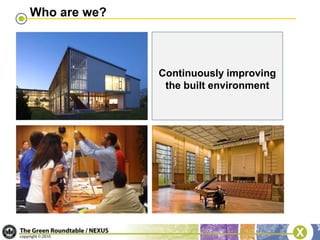
Who are we?Continuously improving the built environment
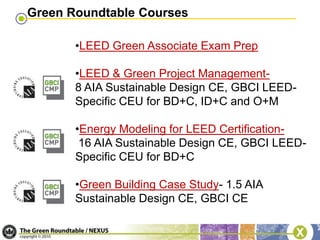
Green Roundtable CoursesLEED Green Associate Exam Prep
LEED & Green Project Management- 8 AIA Sustainable Design CE, GBCI LEED-Specific CEU for BD+C, ID+C and O+M
Energy Modeling for LEED Certification- 16 AIA Sustainable Design CE, GBCI LEED-Specific CEU for BD+C
Green Building Case Study- 1.5 AIA Sustainable Design CE, GBCI CE
Rhode Island Center for Biotechnology & Life Sciences
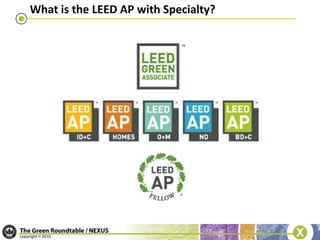
Mass Audubon Wellfleet Bay SanctuaryWhat is the LEED AP with Specialty?
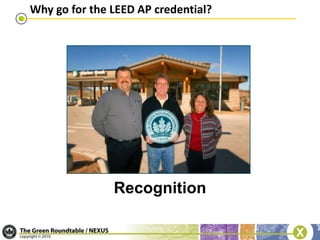
Why go for the LEED AP credential?Recognition
Why go for the LEED AP credential?Trust
Why go for the LEED AP credential?Knowledge
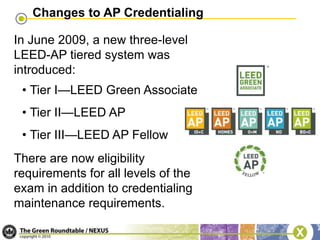
Changes to AP CredentialingIn June 2009, a new three-level LEED-AP tiered system was introduced:Tier I—LEED Green Associate
Tier II—LEED AP
Tier III—LEED AP FellowThere are now eligibility requirements for all levels of the exam in addition to credentialing maintenance requirements.
The LEED APExam
LEED AP with SpecialtyTier II—LEED AP:Extraordinary depth of knowledge in green building practices and specialization in a particular field:
Commercial building design and construction
Commercial operations and maintenance
Commercial interior design and construction
Residential design and construction
Neighborhood development
Must pass 2 exams- Green Associate (2 hrs, 100 mult. choice questions) and AP (2 hrs, 100 mult. choice questions)
Biennial educational maintenance requirement of 30 hoursLEED AP Exam RequirementsEligibility requirements for taking LEED AP exam:Documented work on at least one LEED project within the last 3 years, with verification in the form of a letter of attestation from a supervisor, client, or project manager
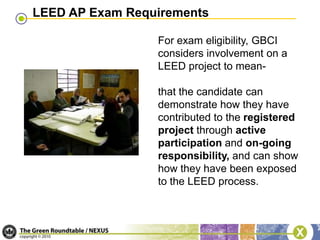
Submit to application auditLEED AP Exam Requirements	For exam eligibility, GBCI considers involvement on a LEED project to mean-	that the candidate can demonstrate how they have contributed to the registered project through active participation and on-going responsibility, and can show how they have been exposed to the LEED process.
LEED AP ExamLEED AP candidates must pass both the Green Associate and the LEED AP sections of the exam to earn the LEED AP credential. You are allowed three attempts per section during the one-year application period.
LEED Green Associate ExamThe Green Associate exam tests:Knowledge of what LEED is
Knowledge of administrative processes, including registration, certification, CIRs, etc.
Familiarity with terminology
Potential strategies for achieving sustainability goals
How to be involved with and support other LEED project team membersLEED AP ExamThe LEED APs exam tests:Knowledge and skills necessary to participate in the design process, to support and encourage integrated design, and to streamline the LEED application and certification process
Understanding of green building practices and principles, and familiarity with LEED requirements and reference standardsMaintaining Your AP Credential
Maintaining Your LEED AP Credential: LEED APs without SpecialtyLEED APs without specialty (those who passed exam prior to July 1, 2009) who enroll in the CMP system follow a different CMP compliance path than LEED Green Associates and LEED APs who have taken one of the new specialty exams.For LEED APs without specialty, GBCI provides an enrollment window between Fall 2009 and October 27, 2011.Enrolling in the CMP allows these LEED APs to use the new LEED AP with specialty credential aligned with the exam they initially took.
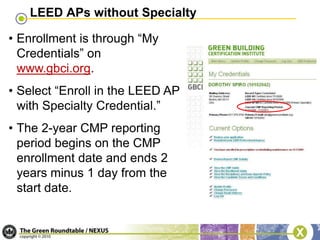
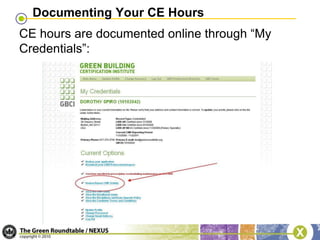
LEED APs without SpecialtyEnrollment is through “My Credentials” on www.gbci.org.
Select “Enroll in the LEED AP with Specialty Credential.”
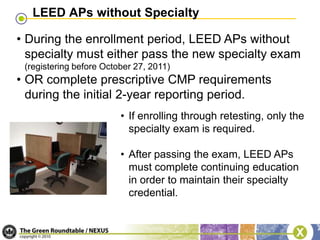
The 2-year CMP reporting period begins on the CMP enrollment date and ends 2 years minus 1 day from the start date.LEED APs without SpecialtyDuring the enrollment period, LEED APs without specialty must either pass the new specialty exam (registering before October 27, 2011)
OR complete prescriptive CMP requirements during the initial 2-year reporting period.
If enrolling through retesting, only the specialty exam is required.
After passing the exam, LEED APs must complete continuing education in order to maintain their specialty credential.LEED APs without SpecialtyLEED APs without specialty who do not enroll in the CMP are not required to do any credentialing maintenance or to pay any fees.LEED APs without specialty who do not enroll in the CMP or those who enroll and don’t maintain the specialty credential-
will continue to be listed as LEED APs without specialty in the LEED Professional Directory,
will hold the credential in perpetuity, and
can continue to use LEED AP without specialty title and logo (as of 3/2011).LEED APs without SpecialtyIf LEED APs without specialty want to get their specialty designation after their enrollment period ends, they must take both parts of the exam.
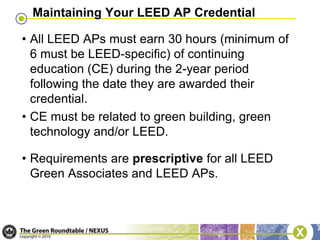
Maintaining Your LEED AP CredentialAll LEED APs must earn 30 hours (minimum of 6 must be LEED-specific) of continuing education (CE) during the 2-year period following the date they are awarded their credential.CE must be related to green building, green technology and/or LEED.Requirements are prescriptivefor all LEED Green Associates and LEED APs.
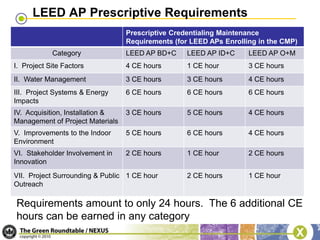
LEED AP Prescriptive RequirementsRequirements amount to only 24 hours.  The 6additional CE hours can be earned in any category
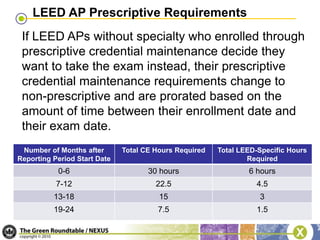
LEED AP Prescriptive RequirementsIf LEED APs without specialty who enrolled through prescriptive credential maintenance decide they want to take the exam instead, their prescriptive credential maintenance requirements change to non-prescriptive and are prorated based on the amount of time between their enrollment date and their exam date.
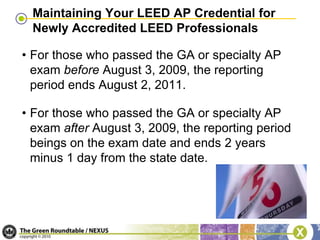
Maintaining Your LEED AP Credential for Newly Accredited LEED ProfessionalsFor those who passed the GA or specialty AP exam before August 3, 2009, the reporting period ends August 2, 2011.For those who passed the GA or specialty AP exam after August 3, 2009, the reporting period beings on the exam date and ends 2 years minus 1 day from the state date.
Newly Accredited LEED ProfessionalsIf LEED APs with specialty maintain their credential by retesting, they must register for the exam between 12 months after the start date and 3 months from the end of the reporting period (months 13-21).LEED APs with specialty who retest do not have to complete continuing education in that initial two-year period.If LEED APs wait until 24 months after their exam date and their credential expires, they must retake both parts of the exam to become a LEED AP with specialty.
Newly Accredited LEED ProfessionalsIf LEED APs with specialty enroll and don’t fulfill the requirements or if the CE hours are not reported to GBCI, the LEED AP with specialty credential expires and the individual is removed from the LEED Professional Directory.
The individual then becomes a LEED AP without specialty.Maintaining Your LEED AP CredentialThere is a $50 biennial CMP renewal fee.  If this fee isn’t paid in the 30 days following the end of the reporting periods, the credential expires.  This fee is waived for LEED APs without specialty who enroll in the new CMP system within their enrollment period.When enrolling, you must also sign the Disciplinary and Exam Appeals Policy and agree to credential maintenance.
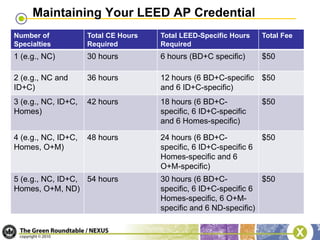
Maintaining Your LEED AP Credential LEED APs who have more than one specialty must maintain each of them.  One will be designated as the primary specialty; all others will be secondary specialty(ies).LEED APs who passed more than one of the “old” exams (NC, CI or EBOM) must complete hours of CE for each specialty; 6 of these hours must be LEED-specific for each specialty.
Maintaining Your LEED AP Credential
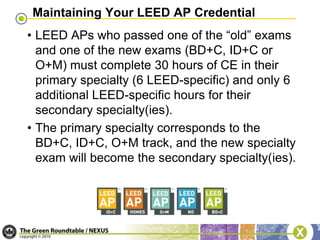
Maintaining Your LEED AP CredentialLEED APs who passed one of the “old” exams and one of the new exams (BD+C, ID+C or O+M) must complete 30 hours of CE in their primary specialty (6 LEED-specific) and only 6 additional LEED-specific hours for their secondary specialty(ies).The primary specialty corresponds to the BD+C, ID+C, O+M track, and the new specialty exam will become the secondary specialty(ies).
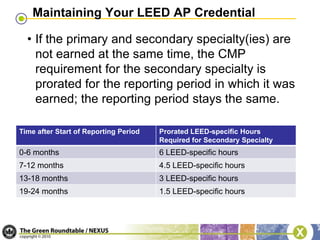
Maintaining Your LEED AP CredentialIf the primary and secondary specialty(ies) are not earned at the same time, the CMP requirement for the secondary specialty is prorated for the reporting period in which it was earned; the reporting period stays the same.
Obtaining the Continuing Education Hours
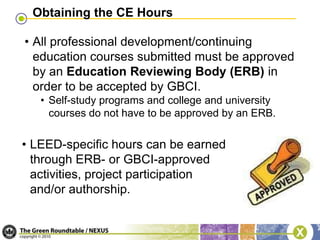
Obtaining the CE HoursAll professional development/continuing education courses submitted must be approved by an Education Reviewing Body (ERB) in order to be accepted by GBCI.
Self-study programs and college and university courses do not have to be approved by an ERB.LEED-specific hours can be earned through ERB- or GBCI-approved activities, project participation and/or authorship.
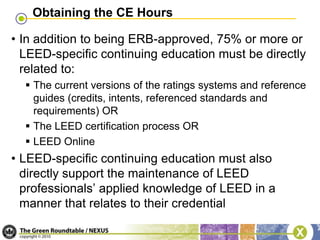
Obtaining the CE HoursIn addition to being ERB-approved, 75% or more or LEED-specific continuing education must be directly related to:The current versions of the ratings systems and reference guides (credits, intents, referenced standards and requirements) OR
The LEED certification process OR
LEED Online
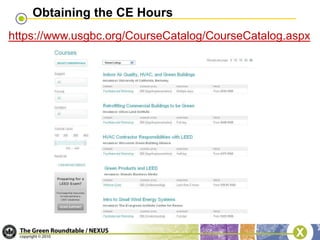
LEED-specific continuing education must also directly support the maintenance of LEED professionals’ applied knowledge of LEED in a manner that relates to their credentialObtaining the CE Hourshttps://www.usgbc.org/CourseCatalog/CourseCatalog.aspx
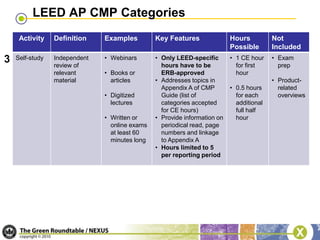
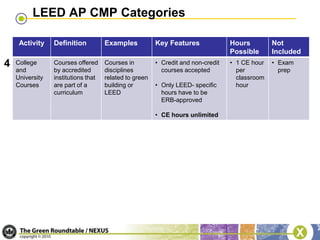
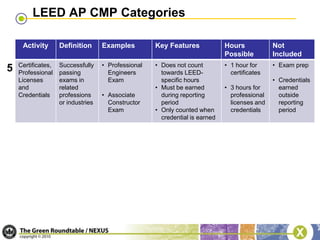
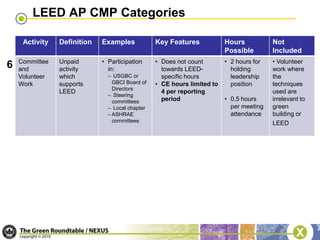
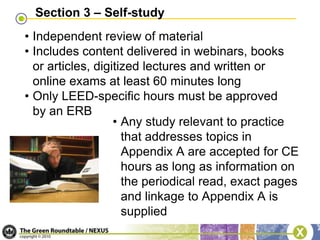
Obtaining the CE HoursCE hours are calculated differently depending on the activity delivery method:Professional development/continuing education coursesLive presentationsSelf-study programs, including readingCollege and university coursesCertificates, professional licenses and credentialsCommittee and volunteer workAuthorshipLEED project participation
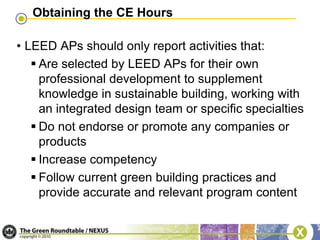
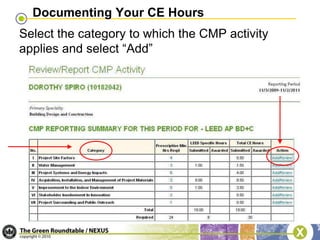
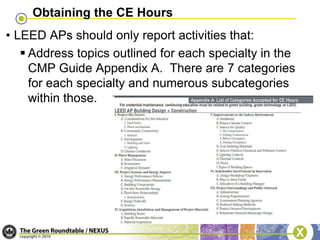
Obtaining the CE HoursLEED APs should only report activities that:Address topics outlined for each specialty in the CMP Guide Appendix A.  There are 7 categories for each specialty and numerous subcategories within those.  Obtaining the CE HoursLEED APs should only report activities that:Are selected by LEED APs for their own professional development to supplement knowledge in sustainable building, working with an integrated design team or specific specialties
Do not endorse or promote any companies or products
Increase competency
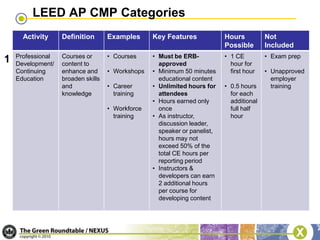
Follow current green building practices and provide accurate and relevant program contentLEED AP CMP Categories1
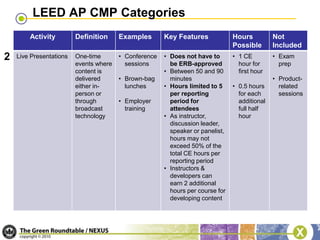
LEED AP CMP Categories2
LEED AP CMP Categories3
LEED AP CMP Categories4
LEED AP CMP Categories5
LEED AP CMP Categories6
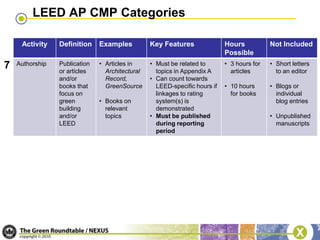
LEED AP CMP Categories7
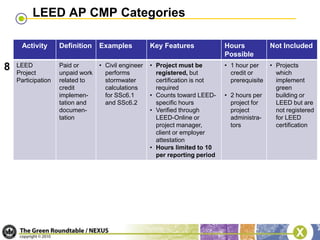
LEED AP CMP Categories8

Webinar: Become a LEED AP and Maintain Your Credential

  • 1.
    Become a LEEDAP & Maintain Your Credential
  • 2.
    Who are we?Continuouslyimproving the built environment
  • 3.
    Green Roundtable CoursesLEEDGreen Associate Exam Prep
  • 4.
    LEED & GreenProject Management- 8 AIA Sustainable Design CE, GBCI LEED-Specific CEU for BD+C, ID+C and O+M
  • 5.
    Energy Modeling forLEED Certification- 16 AIA Sustainable Design CE, GBCI LEED-Specific CEU for BD+C
  • 6.
    Green Building CaseStudy- 1.5 AIA Sustainable Design CE, GBCI CE
  • 7.
    Rhode Island Centerfor Biotechnology & Life Sciences
  • 8.
    Mass Audubon WellfleetBay SanctuaryWhat is the LEED AP with Specialty?
  • 9.
    Why go forthe LEED AP credential?Recognition
  • 10.
    Why go forthe LEED AP credential?Trust
  • 11.
    Why go forthe LEED AP credential?Knowledge
  • 12.
    Changes to APCredentialingIn June 2009, a new three-level LEED-AP tiered system was introduced:Tier I—LEED Green Associate
  • 13.
  • 14.
    Tier III—LEED APFellowThere are now eligibility requirements for all levels of the exam in addition to credentialing maintenance requirements.
  • 15.
  • 16.
    LEED AP withSpecialtyTier II—LEED AP:Extraordinary depth of knowledge in green building practices and specialization in a particular field:
  • 17.
  • 18.
  • 19.
  • 20.
  • 21.
  • 22.
    Must pass 2exams- Green Associate (2 hrs, 100 mult. choice questions) and AP (2 hrs, 100 mult. choice questions)
  • 23.
    Biennial educational maintenancerequirement of 30 hoursLEED AP Exam RequirementsEligibility requirements for taking LEED AP exam:Documented work on at least one LEED project within the last 3 years, with verification in the form of a letter of attestation from a supervisor, client, or project manager
  • 24.
    Submit to applicationauditLEED AP Exam Requirements For exam eligibility, GBCI considers involvement on a LEED project to mean- that the candidate can demonstrate how they have contributed to the registered project through active participation and on-going responsibility, and can show how they have been exposed to the LEED process.
  • 25.
    LEED AP ExamLEEDAP candidates must pass both the Green Associate and the LEED AP sections of the exam to earn the LEED AP credential. You are allowed three attempts per section during the one-year application period.
  • 26.
    LEED Green AssociateExamThe Green Associate exam tests:Knowledge of what LEED is
  • 27.
    Knowledge of administrativeprocesses, including registration, certification, CIRs, etc.
  • 28.
  • 29.
    Potential strategies forachieving sustainability goals
  • 30.
    How to beinvolved with and support other LEED project team membersLEED AP ExamThe LEED APs exam tests:Knowledge and skills necessary to participate in the design process, to support and encourage integrated design, and to streamline the LEED application and certification process
  • 31.
    Understanding of greenbuilding practices and principles, and familiarity with LEED requirements and reference standardsMaintaining Your AP Credential
  • 32.
    Maintaining Your LEEDAP Credential: LEED APs without SpecialtyLEED APs without specialty (those who passed exam prior to July 1, 2009) who enroll in the CMP system follow a different CMP compliance path than LEED Green Associates and LEED APs who have taken one of the new specialty exams.For LEED APs without specialty, GBCI provides an enrollment window between Fall 2009 and October 27, 2011.Enrolling in the CMP allows these LEED APs to use the new LEED AP with specialty credential aligned with the exam they initially took.
  • 33.
    LEED APs withoutSpecialtyEnrollment is through “My Credentials” on www.gbci.org.
  • 34.
    Select “Enroll inthe LEED AP with Specialty Credential.”
  • 35.
    The 2-year CMPreporting period begins on the CMP enrollment date and ends 2 years minus 1 day from the start date.LEED APs without SpecialtyDuring the enrollment period, LEED APs without specialty must either pass the new specialty exam (registering before October 27, 2011)
  • 36.
    OR complete prescriptiveCMP requirements during the initial 2-year reporting period.
  • 37.
    If enrolling throughretesting, only the specialty exam is required.
  • 38.
    After passing theexam, LEED APs must complete continuing education in order to maintain their specialty credential.LEED APs without SpecialtyLEED APs without specialty who do not enroll in the CMP are not required to do any credentialing maintenance or to pay any fees.LEED APs without specialty who do not enroll in the CMP or those who enroll and don’t maintain the specialty credential-
  • 39.
    will continue tobe listed as LEED APs without specialty in the LEED Professional Directory,
  • 40.
    will hold thecredential in perpetuity, and
  • 41.
    can continue touse LEED AP without specialty title and logo (as of 3/2011).LEED APs without SpecialtyIf LEED APs without specialty want to get their specialty designation after their enrollment period ends, they must take both parts of the exam.
  • 42.
    Maintaining Your LEEDAP CredentialAll LEED APs must earn 30 hours (minimum of 6 must be LEED-specific) of continuing education (CE) during the 2-year period following the date they are awarded their credential.CE must be related to green building, green technology and/or LEED.Requirements are prescriptivefor all LEED Green Associates and LEED APs.
  • 43.
    LEED AP PrescriptiveRequirementsRequirements amount to only 24 hours. The 6additional CE hours can be earned in any category
  • 44.
    LEED AP PrescriptiveRequirementsIf LEED APs without specialty who enrolled through prescriptive credential maintenance decide they want to take the exam instead, their prescriptive credential maintenance requirements change to non-prescriptive and are prorated based on the amount of time between their enrollment date and their exam date.
  • 45.
    Maintaining Your LEEDAP Credential for Newly Accredited LEED ProfessionalsFor those who passed the GA or specialty AP exam before August 3, 2009, the reporting period ends August 2, 2011.For those who passed the GA or specialty AP exam after August 3, 2009, the reporting period beings on the exam date and ends 2 years minus 1 day from the state date.
  • 46.
    Newly Accredited LEEDProfessionalsIf LEED APs with specialty maintain their credential by retesting, they must register for the exam between 12 months after the start date and 3 months from the end of the reporting period (months 13-21).LEED APs with specialty who retest do not have to complete continuing education in that initial two-year period.If LEED APs wait until 24 months after their exam date and their credential expires, they must retake both parts of the exam to become a LEED AP with specialty.
  • 47.
    Newly Accredited LEEDProfessionalsIf LEED APs with specialty enroll and don’t fulfill the requirements or if the CE hours are not reported to GBCI, the LEED AP with specialty credential expires and the individual is removed from the LEED Professional Directory.
  • 48.
    The individual thenbecomes a LEED AP without specialty.Maintaining Your LEED AP CredentialThere is a $50 biennial CMP renewal fee. If this fee isn’t paid in the 30 days following the end of the reporting periods, the credential expires. This fee is waived for LEED APs without specialty who enroll in the new CMP system within their enrollment period.When enrolling, you must also sign the Disciplinary and Exam Appeals Policy and agree to credential maintenance.
  • 49.
    Maintaining Your LEEDAP Credential LEED APs who have more than one specialty must maintain each of them. One will be designated as the primary specialty; all others will be secondary specialty(ies).LEED APs who passed more than one of the “old” exams (NC, CI or EBOM) must complete hours of CE for each specialty; 6 of these hours must be LEED-specific for each specialty.
  • 50.
  • 51.
    Maintaining Your LEEDAP CredentialLEED APs who passed one of the “old” exams and one of the new exams (BD+C, ID+C or O+M) must complete 30 hours of CE in their primary specialty (6 LEED-specific) and only 6 additional LEED-specific hours for their secondary specialty(ies).The primary specialty corresponds to the BD+C, ID+C, O+M track, and the new specialty exam will become the secondary specialty(ies).
  • 52.
    Maintaining Your LEEDAP CredentialIf the primary and secondary specialty(ies) are not earned at the same time, the CMP requirement for the secondary specialty is prorated for the reporting period in which it was earned; the reporting period stays the same.
  • 53.
  • 54.
    Obtaining the CEHoursAll professional development/continuing education courses submitted must be approved by an Education Reviewing Body (ERB) in order to be accepted by GBCI.
  • 55.
    Self-study programs andcollege and university courses do not have to be approved by an ERB.LEED-specific hours can be earned through ERB- or GBCI-approved activities, project participation and/or authorship.
  • 56.
    Obtaining the CEHoursIn addition to being ERB-approved, 75% or more or LEED-specific continuing education must be directly related to:The current versions of the ratings systems and reference guides (credits, intents, referenced standards and requirements) OR
  • 57.
  • 58.
  • 59.
    LEED-specific continuing educationmust also directly support the maintenance of LEED professionals’ applied knowledge of LEED in a manner that relates to their credentialObtaining the CE Hourshttps://www.usgbc.org/CourseCatalog/CourseCatalog.aspx
  • 60.
    Obtaining the CEHoursCE hours are calculated differently depending on the activity delivery method:Professional development/continuing education coursesLive presentationsSelf-study programs, including readingCollege and university coursesCertificates, professional licenses and credentialsCommittee and volunteer workAuthorshipLEED project participation
  • 61.
    Obtaining the CEHoursLEED APs should only report activities that:Address topics outlined for each specialty in the CMP Guide Appendix A. There are 7 categories for each specialty and numerous subcategories within those. Obtaining the CE HoursLEED APs should only report activities that:Are selected by LEED APs for their own professional development to supplement knowledge in sustainable building, working with an integrated design team or specific specialties
  • 62.
    Do not endorseor promote any companies or products
  • 63.
  • 64.
    Follow current greenbuilding practices and provide accurate and relevant program contentLEED AP CMP Categories1
  • 65.
    LEED AP CMPCategories2
  • 66.
    LEED AP CMPCategories3
  • 67.
    LEED AP CMPCategories4
  • 68.
    LEED AP CMPCategories5
  • 69.
    LEED AP CMPCategories6
  • 70.
    LEED AP CMPCategories7
  • 71.
    LEED AP CMPCategories8

Editor's Notes

  • #10 CMP reporting period starting and end dates are NOT altered by renewing credential before expiration date.
  • #13 The candidate can work in a variety of fashions that are linked to the project such as in an on-going, full-time role with the LEED Project team in multiple phases of the project including managing or leading the project design or construction team, or facility management teams by providing installation, supervision, auditing, consulting, managing or other leadership roles with the project team. This list is not meant to be exhaustive, but is meant to provide guidance for candidates with their application.
  • #17 CMP reporting period starting and end dates are NOT altered by renewing credential before expiration date.
  • #22 If the credential expires, the LEED AP is removed from the professional directory and cannot use the credential or the logo
  • #24 If primary and secondary specialty are not earned at the same time, CMP requirement for second specialty is prorated for the reporting period in which it was earned.
  • #25 If primary and secondary specialty are not earned at the same time, CMP requirement for second specialty is prorated for the reporting period in which it was earned.
  • #27 CMP reporting period starting and end dates are NOT altered by renewing credential before expiration date.
  • #28 If primary and secondary specialty are not earned at the same time, CMP requirement for second specialty is prorated for the reporting period in which it was earned.
  • #30 If primary and secondary specialty are not earned at the same time, CMP requirement for second specialty is prorated for the reporting period in which it was earned.
  • #31 If primary and secondary specialty are not earned at the same time, CMP requirement for second specialty is prorated for the reporting period in which it was earned.
  • #32 If primary and secondary specialty are not earned at the same time, CMP requirement for second specialty is prorated for the reporting period in which it was earned.
  • #33 If primary and secondary specialty are not earned at the same time, CMP requirement for second specialty is prorated for the reporting period in which it was earned.
  • #34 CMP reporting period starting and end dates are NOT altered by renewing credential before expiration date.
  • #35 CMP reporting period starting and end dates are NOT altered by renewing credential before expiration date.
  • #39 CMP reporting period starting and end dates are NOT altered by renewing credential before expiration date.
  • #49 CMP reporting period starting and end dates are NOT altered by renewing credential before expiration date.
  • #54 CMP reporting period starting and end dates are NOT altered by renewing credential before expiration date.
  • #71 Work on a registered project
  • #72 Work on a registered project