BASIC
The searchalgorithms in this section have no
additional information on the goal node other
than the one provided in the problem
definition.
The plans to reach the goal state from the
start state differ only by the order and/or
length of actions.
Uninformed search is also called Blind
search.
1
2.
CONTI…
Each of thesealgorithms will have:
A problem graph, containing the start node S and the
goal node G.
A strategy, describing the manner in which the
graph will be traversed to get to G .
A fringe, which is a data structure used to store all
the possible states (nodes) that you can go from the
current states.
A tree, that results while traversing to the goal node.
A solution plan, which the sequence of nodes from S
to G.
2
3.
BRUTE-FORCE SEARCH
STRATEGIES
Theyare most simple, as they do not need any
domain-specific knowledge. They work fine with
small number of possible states.
Requirements −
State description
A set of valid operators
Initial state
Goal state description
3
4.
BREADTH-FIRST SEARCH
Startsfrom the root node, explores the neighboring
nodes first and moves towards the next level
neighbors.
Generates one tree at a time until the solution is
found.
Can be implemented using FIFO queue data
structure.
Provides shortest path to the solution.
If branching factor
b = Average number of child nodes for a given node
d = depth
Then, number of nodes at level d = bd
4
5.
CONTI…
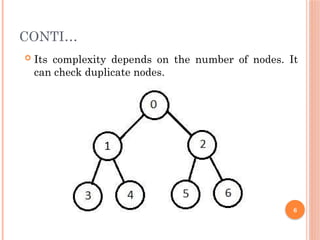
Total noof nodes created in worst case is b + b2
+ b3
+
… + bd
.
Breadth-first search is the most common search
strategy for traversing a tree or graph. This
algorithm searches breadth-wise in a tree or graph,
so it is called breadth-first search.
BFS algorithm starts searching from the root node of
the tree and expands all successor node at the
current level before moving to nodes of next level.
5
CONTI…
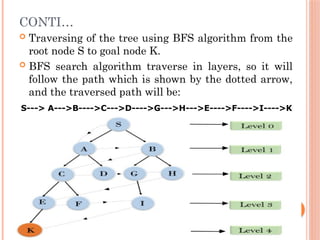
Traversing ofthe tree using BFS algorithm from the
root node S to goal node K.
BFS search algorithm traverse in layers, so it will
follow the path which is shown by the dotted arrow,
and the traversed path will be:
7
S---> A--->B---->C--->D---->G--->H--->E---->F---->I---->K
8.
CONTI…
Advantages
BFS willprovide a solution if any solution exists.
If there are more than one solutions for a given
problem, then BFS will provide the minimal solution
which requires the least number of steps.
Disadvantages
Since each level of nodes is saved for creating next
one, it consumes a lot of memory space. Space
requirement to store nodes is exponential.
BFS needs lots of time if the solution is far away
from the root node.
8
9.
DEPTH-FIRST SEARCH
Itis implemented in recursion with LIFO stack data
structure.
It creates the same set of nodes as Breadth-First
method, only in the different order.
As the nodes on the single path are stored in each
iteration from root to leaf node, the space
requirement to store nodes is linear.
With branching factor b and depth as m, the storage
space is bm.
9
10.
CONTI…
The solutionto this issue is to choose a cut-off depth.
If the ideal cut-off is d, and if chosen cut-off is lesser
than d, then this algorithm may fail.
If chosen cut-off is more than d, then execution time
increases.
10
11.
CONTI…
Depth-first searchis a recursive algorithm for
traversing a tree or graph data structure.
It is called the depth-first search because it starts
from the root node and follows each path to its
greatest depth node before moving to the next path.
DFS uses a stack data structure for its
implementation.
The process of the DFS algorithm is similar to the
BFS algorithm.
11
CONTI…
Advantage
DFS requiresvery less memory as it only needs to
store a stack of the nodes on the path from root node
to the current node.
It takes less time to reach to the goal node than BFS
algorithm (if it traverses in the right path).
Disadvantage
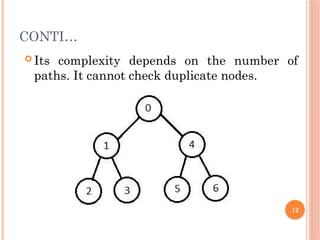
There is the possibility that many states keep re-
occurring, and there is no guarantee of finding the
solution.
DFS algorithm goes for deep down searching and
sometime it may go to the infinite loop.
13
14.
CONTI…
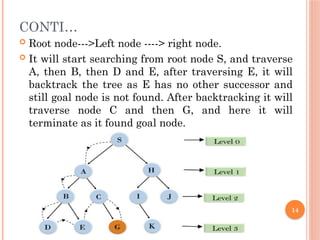
Root node--->Leftnode ----> right node.
It will start searching from root node S, and traverse
A, then B, then D and E, after traversing E, it will
backtrack the tree as E has no other successor and
still goal node is not found. After backtracking it will
traverse node C and then G, and here it will
terminate as it found goal node.
14
15.
BIDIRECTIONAL SEARCH
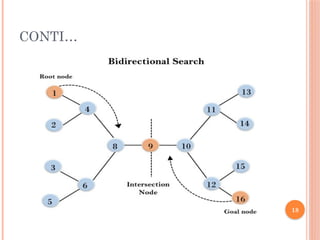
Itsearches forward from initial state and backward
from goal state till both meet to identify a common
state.
The path from initial state is concatenated with the
inverse path from the goal state. Each search is done
only up to half of the total path.
Bidirectional search algorithm runs two
simultaneous searches, one form initial state called
as forward-search and other from goal node called as
backward-search, to find the goal node. 15
16.
CONTI…
Bidirectional searchreplaces one single search graph
with two small subgraphs in which one starts the
search from an initial vertex and other starts from
goal vertex.
The search stops when these two graphs intersect
each other.
16
17.
CONTI…
Advantages
Bidirectional searchis fast.
Bidirectional search requires less memory
Disadvantages
Implementation of the bidirectional search tree is
difficult.
In bidirectional search, one should know the goal
state in advance. 17
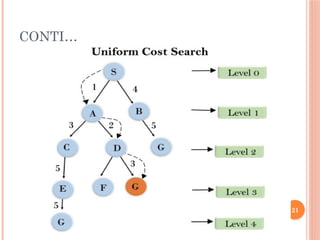
UNIFORM COST SEARCH
Sorting is done in increasing cost of the path to a
node. It always expands the least cost node.
It is identical to Breadth First search if each
transition has the same cost.
It explores paths in the increasing order of cost.
Uniform-cost search is a searching algorithm used
for traversing a weighted tree or graph. This
algorithm comes into play when a different cost is
available for each edge.
19
20.
CONTI…
The primarygoal of the uniform-cost search is to find
a path to the goal node which has the lowest
cumulative cost.
Uniform-cost search expands nodes according to
their path costs form the root node.
It can be used to solve any graph/tree where the
optimal cost is in demand. A uniform-cost search
algorithm is implemented by the priority queue.
It gives maximum priority to the lowest cumulative
cost. Uniform cost search is equivalent to BFS
algorithm if the path cost of all edges is the same.
20
CONTI…
Advantages
Uniform costsearch is optimal because at every state
the path with the least cost is chosen.
Disadvantages
It does not care about the number of steps involve in
searching and only concerned about path cost.
Due to which this algorithm may be stuck in an
infinite loop.
22
23.
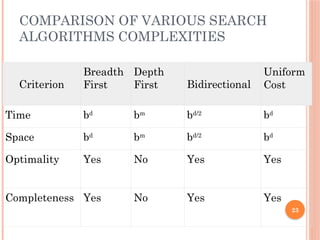
COMPARISON OF VARIOUSSEARCH
ALGORITHMS COMPLEXITIES
23
Criterion
Breadth
First
Depth
First Bidirectional
Uniform
Cost
Time bd
bm
bd/2
bd
Space bd
bm
bd/2
bd
Optimality Yes No Yes Yes
Completeness Yes No Yes Yes