UPresearch.LoneStar.edu/Truax-recon
Librarian Lesson:
Primary Sources, Chicago, &
Other Quietly Great Things
Prof. Truax | History
Librarian (Digital Resource Professional): Elaine M. Patton
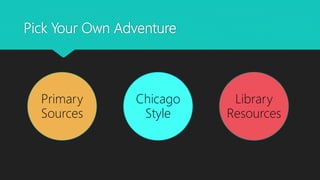
Pick Your Own Adventure
Chicago
Style
Primary
Sources
Library
Resources
Chicago Manual of Style
We’re not in MLA anymore, Toto.
Quick Facts
• Paper structure
• MLA comparisons
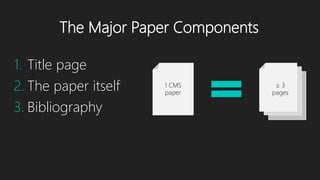
The Major Paper Components
1. Title page
2. The paper itself
3. Bibliography
1 CMS
paper
≥ 3
pages
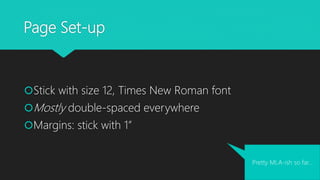
Page Set-up
Stick with size 12, Times New Roman font
Mostly double-spaced everywhere
Margins: stick with 1”
Pretty MLA-ish so far…
A Subtle Difference:
Page numbering starts with your actual paper
Title page is page 0, basically
Different!
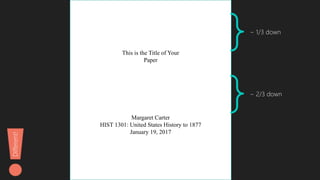
This is the Title of Your
Paper
Margaret Carter
HIST 1301: United States History to 1877
January 19, 2017
~ 1/3 down
~ 2/3 down
Different!
The Paper Itself
The usual:
Left-justified (as opposed to centered)
Tab/indent new paragraphs
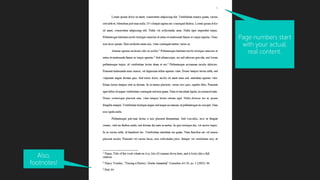
Page numbers start
with your actual,
real content.
Also,
footnotes!
Citations
Notes and Bibliography
system
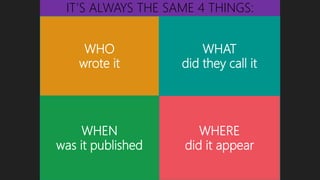
IT’S ALWAYS THE SAME 4 THINGS:
WHO
wrote it
WHAT
did they call it
WHEN
was it published
WHERE
did it appear
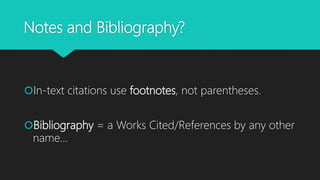
Notes and Bibliography?
In-text citations use footnotes, not parentheses.
Bibliography = a Works Cited/References by any other
name…
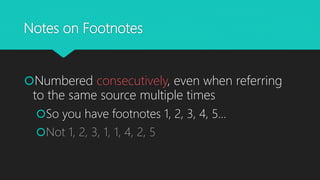
Notes on Footnotes
Numbered consecutively, even when referring
to the same source multiple times
So you have footnotes 1, 2, 3, 4, 5…
Not 1, 2, 3, 1, 1, 4, 2, 5
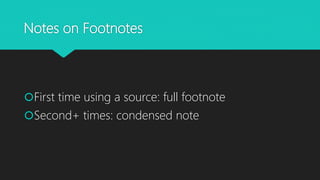
Notes on Footnotes
First time using a source: full footnote
Second+ times: condensed note
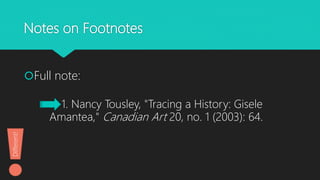
Notes on Footnotes
Full note:
1. Nancy Tousley, "Tracing a History: Gisele
Amantea," Canadian Art 20, no. 1 (2003): 64.
Different!
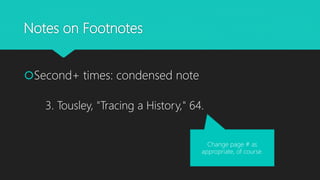
Notes on Footnotes
Second+ times: condensed note
3. Tousley, "Tracing a History," 64.
Change page # as
appropriate, of course.
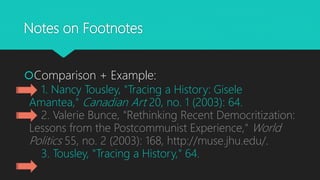
Notes on Footnotes
Comparison + Example:
1. Nancy Tousley, "Tracing a History: Gisele
Amantea," Canadian Art 20, no. 1 (2003): 64.
2. Valerie Bunce, "Rethinking Recent Democritization:
Lessons from the Postcommunist Experience," World
Politics 55, no. 2 (2003): 168, http://muse.jhu.edu/.
3. Tousley, "Tracing a History," 64.
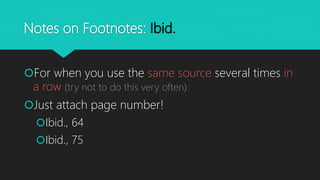
Notes on Footnotes: Ibid.
For when you use the same source several times in
a row (try not to do this very often)
Just attach page number!
Ibid., 64
Ibid., 75
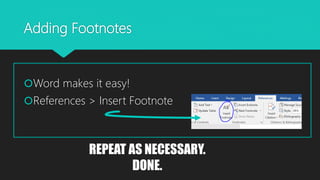
Adding Footnotes
Word makes it easy!
References > Insert Footnote
REPEAT AS NECESSARY.
DONE.
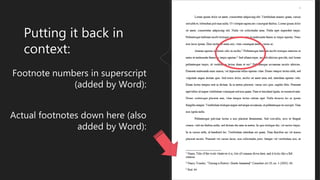
Putting it back in
context:
Footnote numbers in superscript
(added by Word):
Actual footnotes down here (also
added by Word):
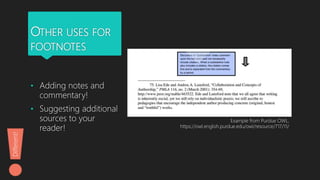
OTHER USES FOR
FOOTNOTES
• Adding notes and
commentary!
• Suggesting additional
sources to your
reader!
Example from Purdue OWL,
https://owl.english.purdue.edu/owl/resource/717/11/
Different!
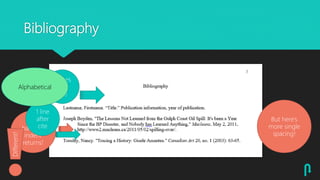
Bibliography Deja Vu
It will feel just like your
footnotes, but different.
Also MLA-ish, but different.
Bibliography
The
hanging
indent
returns!
But here’s
more single
spacing!
2 lines
after
title
1 line
after
cite
Different!
Alphabetical
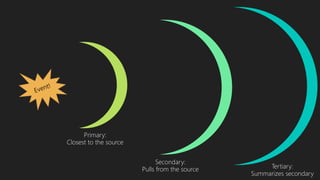
Primary Sources
Grade-A Prime Steak Sources.
Primary:
Closest to the source
Secondary:
Pulls from the source Tertiary:
Summarizes secondary
Frame of Reference Matters!
Fictional novels = primary source when analyzing the
literature
A lab research report (original findings) is a primary
source for that subject
An interview with Neil DeGrasse Tyson:
Secondary with regards to Pluto
Primary with regards to Tyson himself
Where to Find
Databases:
ProQuest Historical
Newspapers
New York Times
History Study Center
The Internet (yay public
domain!)
[topic] primary source
[topic] newspaper
[topic] diary
[topic] eyewitness
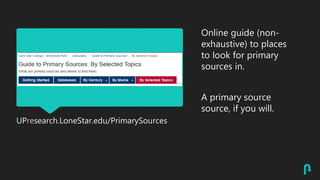
UPresearch.LoneStar.edu/PrimarySources
Online guide (non-
exhaustive) to places
to look for primary
sources in.
A primary source
source, if you will.
Library Resources
Beyond the books.
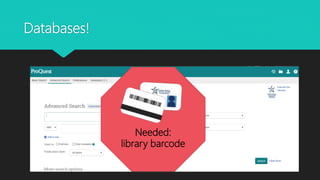
Databases!
Needed:
library barcode
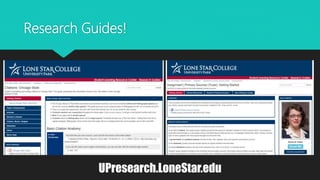
Research Guides!
UPresearch.LoneStar.edu
Your librarian!
Other librarians!
Remote access to live help:
• Call
• Text
• Email
• Chat
7 days/week!

Librarian lesson for HIST 1301

Editor's Notes

  • #7 …and within your paper…
  • #10 This a typical Chicago cover page. Officially, Chicago accepts a title on the first page of the paper as well, but check with your professor.
  • #14 No matter what citation style you’re using or how unfamiliar it might seem, it still boils down to looking for these same 4 elements in each work you’re using. (And then at least be internally consistent with yourself, even if you’re not spot-on perfect for the citation style.)
  • #21 What the heck is ibid.? Latin: Ibidem, “in the same place”