Dr. Prerna Singh
Junior Resident 3rd year
Department of Pharmacology
JNMCH, AMU
Newer Antidiabetic Agents
INTRODUCTION
Diabetes mellitus refers to a group of metabolic
disorders that share a common phenotype of
hyperglycemia
-Harrison’s Principles of internal medicine
4types-
Type 1- IDDM
Type 2 -NIDDM
Type 3- Other specific types
Type 4 – Gestational DM
Insulin was the first peptide
hormone discovered.
Frederick Banting and Charles Herbert
Best, working in the laboratory of J.J.R.
Macleod at the University of Toronto,
were the first to isolate insulin from dog
pancreas in 1921.
NDA
Aleglitazar
Phase 3
Ranolazine
Oral insulin
GPR 40 agonist
Phase 2
Glucokinase activator
PTB1B inhibitor
Phase 1
GPR 119 agonist
New insulins
• Detemir
• Degludec
• Neutral protamine lispro
• Hexyl insulin monoconjugate – HIM 2
• Oral insulin spray formulation
• Inhaled insulin :
• Exubera
• Aferezza
New insulins
Detemir:
• Long acting: DOA <24 Hour
• Onset: 1-2 hour
• Less frequent hypoglycemia
• Minimum weight gain
Degludec :
• Long acting DOA>24 hour; 3times a week
New insulins
Neutral protamine lispro:
• Intermediate acting
• Reported more weight gain and hypoglycemia
HIM-2:
• In phase 3 trails
• Oral insulin
• Enhanced stability and resistance to intestinal degradation
New insulins
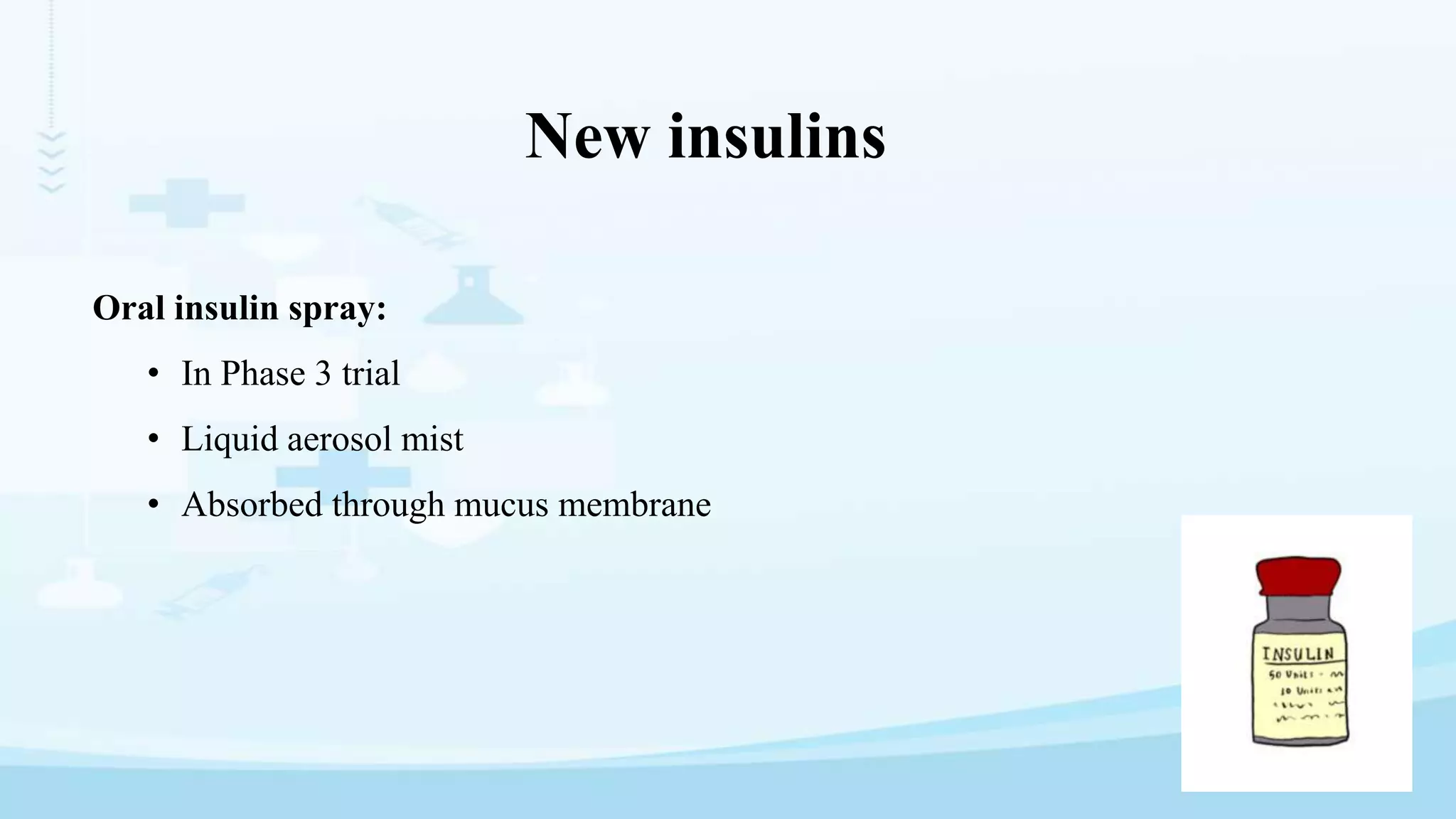
Oral insulin spray:
• In Phase 3 trial
• Liquid aerosol mist
• Absorbed through mucus membrane
New insulins
Bioavailability – 20%
Patient training is important
Exubera:
• Withdrawn in 2007 because of pulmonary fibrosis and risk of lung cancer
Afrezza:
• Approved In 2014
• Rapid acting inhaled insulin
• Not suitable for ketoacidosis
Side effect: Hypoglycemia, cough, throat pain and irritation
New insulin delivery system
• Pen device
• Insulin pump
• Continuous SC insulin infusion
New drugs
Incretin based therapy:
GLP1 analogue- Exenatide, Albiglutide, Liraglutide, Semaglutide
DPP4 inhibitor- Sitagliptin, Vildagliptin, Saxagliptin, Alogliptin
Amylin mimetics: Pramlintide
Dual PPAR agonists: Saroglitazar
SGLT 2 inhibitors: Dapagliflozin, Canagliflozin, Empagliflozin
Bromocriptine
Colesevelam
Incretin based therapy
• Incretin: GI hormone
• Released after meal; increase insulin biosynthesis and release
• Examples: GLP1,GIP
• Metabolized by DPP IV- short half life
• DPP IV resistant GLP1 agonist are useful for therapy
• DPP IV inhibitor are useful for therapy
• Increase glucose dependent insulin secretion
• Control PP
• Show good efficacy as monotherapy but are not first line agents
• Used as adjuvant
Incretin mimetics
Exenatide (5-10mcg BD), Liraglutide (0.6-1.8mg OD), Albiglutide (30-50 mg weekly), Semaglutide
(oral)
Mechanism of action:
• Act on GLP1 receptor (GPCR)
• Activate cAMP-PKA pathway and also signaling via PKC & PI3K
• Increase insulin synthesis and release
• In CNS (GLP1 receptor) - food intake affected, Gastric emptying, nausea
GLP1 agonist
Side effect
• Nausea
• Anorexia – weight loss
• Pancreatitis
• Only injectables –SC (except semaglutide-2019)
• No risk of hypoglycemia
• Liraglutide: black box warning- risk of thyroid carcinoma
• Exenatide: avoid in pancreatitis predisposed patients
GLP1 agonist
• Inhibit metabolism of incretins (GLP1, GIP)
• DPP IV enzyme is responsible for metabolism of incretins which increase insulin
release.
• No effect on weight
• Increase risk of heart failure with saxagliptin and Alogliptin
DPP IV inhibitors
Sitagliptin (100mg OD), Vildagliptin (50 mg OD/BD), Saxagliptin (5mg/day), Linagliptin (5mg/day),
Alogliptin (25mg/day)
DPP IV inhibitors
Anagliptin- phase 3 trials
Dutogliptin - phase 3 trials
• Approved in 2005
• Act on amylin receptor in hind brain
 Inhibit glucagon secretion
 Delay gastric emptying
 Decrease appetite
• Subcutaneously before meals
• Used in both T1 and T2 DM
• Added to decrease insulin requirement
• Should not be mixed in same syringe - different pH
• Risk of hypoglycemia with insulin
• Pregnancy category C
Amylin mimetics
Pramlintide (T1: 15-0 mcg/day; T2: 60-120 mcg/day)
Dual PPAR (α+γ agonists)
 α- improve lipid profile
 γ – improve insulin sensitivity
• Saroglitazar – approved for diabetic dyslipidemia
• Aleglitazar- in phase 2 trail
• Tesaglitazar- renal toxicity – discontinued
• Muraglitazar - MI, stroke – discontinued
• Inhibit glucose reabsorption thereby increasing glucose excretion
• Urinary tract infection
• Sodium loss in urine – decrease BP by 2-4 mm Hg
• Low risk of hypoglycaemia
• Increase risk of fracture – affect PTH, vitamin D
SGLT 2 inhibitors
Dapagliflozin (8-10mg/day), Canagliflozin (100-300mg/day), Empagliflozin (10-25mg/day)
SGLT 2 inhibitors
Remogliflozin – in phase 2 clinical trials
Tofogliflozin – in phase 3 clinical trials
Bromocriptine
(1.6 - 4.8 mg)
• Approved in 2009 for diabetes
• D2 agonist
• Effects on blood glucose and may reflect an action in the CNS
Side effects:
• Nausea, vomiting
• Fatigue, headache
• Dizziness
• Orthostatic hypotension
Colesevelam
• Approved for Type 2 diabetes as an adjunct to diet and exercise
Mechanism: not established
Reduce intestinal glucose absorption
Dose: 625-mg tablets are available
3 tablets twice daily before lunch and dinner
OR
6 tablets prior to the patient’s largest meal
Newer targets
• PTP-1b inhibitor
• Glycogen synthase kinase 3 inhibitor
• Glucokinase activator
• Fructose 1-6, bis phosphatase inhibitor
• Glycogen phosphorylase inhibitor
• β2 agonist
• Anti CD3 monoclonal antibody- otelixizumab
• Vaccine: recombinant human glutamic acid decarboxylase 65 (rhGAD65)- phase 3
Future
 Pancreatic transplant
 Artificial pancreas
Newer antidiabetic agents

Newer antidiabetic agents

  • 1.
    Dr. Prerna Singh JuniorResident 3rd year Department of Pharmacology JNMCH, AMU Newer Antidiabetic Agents
  • 2.
    INTRODUCTION Diabetes mellitus refersto a group of metabolic disorders that share a common phenotype of hyperglycemia -Harrison’s Principles of internal medicine 4types- Type 1- IDDM Type 2 -NIDDM Type 3- Other specific types Type 4 – Gestational DM Insulin was the first peptide hormone discovered. Frederick Banting and Charles Herbert Best, working in the laboratory of J.J.R. Macleod at the University of Toronto, were the first to isolate insulin from dog pancreas in 1921.
  • 5.
    NDA Aleglitazar Phase 3 Ranolazine Oral insulin GPR40 agonist Phase 2 Glucokinase activator PTB1B inhibitor Phase 1 GPR 119 agonist
  • 6.
    New insulins • Detemir •Degludec • Neutral protamine lispro • Hexyl insulin monoconjugate – HIM 2 • Oral insulin spray formulation • Inhaled insulin : • Exubera • Aferezza
  • 7.
    New insulins Detemir: • Longacting: DOA <24 Hour • Onset: 1-2 hour • Less frequent hypoglycemia • Minimum weight gain Degludec : • Long acting DOA>24 hour; 3times a week
  • 8.
    New insulins Neutral protaminelispro: • Intermediate acting • Reported more weight gain and hypoglycemia HIM-2: • In phase 3 trails • Oral insulin • Enhanced stability and resistance to intestinal degradation
  • 9.
    New insulins Oral insulinspray: • In Phase 3 trial • Liquid aerosol mist • Absorbed through mucus membrane
  • 10.
    New insulins Bioavailability –20% Patient training is important Exubera: • Withdrawn in 2007 because of pulmonary fibrosis and risk of lung cancer Afrezza: • Approved In 2014 • Rapid acting inhaled insulin • Not suitable for ketoacidosis Side effect: Hypoglycemia, cough, throat pain and irritation
  • 11.
    New insulin deliverysystem • Pen device • Insulin pump • Continuous SC insulin infusion
  • 12.
    New drugs Incretin basedtherapy: GLP1 analogue- Exenatide, Albiglutide, Liraglutide, Semaglutide DPP4 inhibitor- Sitagliptin, Vildagliptin, Saxagliptin, Alogliptin Amylin mimetics: Pramlintide Dual PPAR agonists: Saroglitazar SGLT 2 inhibitors: Dapagliflozin, Canagliflozin, Empagliflozin Bromocriptine Colesevelam
  • 13.
    Incretin based therapy •Incretin: GI hormone • Released after meal; increase insulin biosynthesis and release • Examples: GLP1,GIP • Metabolized by DPP IV- short half life • DPP IV resistant GLP1 agonist are useful for therapy • DPP IV inhibitor are useful for therapy
  • 14.
    • Increase glucosedependent insulin secretion • Control PP • Show good efficacy as monotherapy but are not first line agents • Used as adjuvant Incretin mimetics Exenatide (5-10mcg BD), Liraglutide (0.6-1.8mg OD), Albiglutide (30-50 mg weekly), Semaglutide (oral)
  • 15.
    Mechanism of action: •Act on GLP1 receptor (GPCR) • Activate cAMP-PKA pathway and also signaling via PKC & PI3K • Increase insulin synthesis and release • In CNS (GLP1 receptor) - food intake affected, Gastric emptying, nausea GLP1 agonist
  • 16.
    Side effect • Nausea •Anorexia – weight loss • Pancreatitis • Only injectables –SC (except semaglutide-2019) • No risk of hypoglycemia • Liraglutide: black box warning- risk of thyroid carcinoma • Exenatide: avoid in pancreatitis predisposed patients GLP1 agonist
  • 17.
    • Inhibit metabolismof incretins (GLP1, GIP) • DPP IV enzyme is responsible for metabolism of incretins which increase insulin release. • No effect on weight • Increase risk of heart failure with saxagliptin and Alogliptin DPP IV inhibitors Sitagliptin (100mg OD), Vildagliptin (50 mg OD/BD), Saxagliptin (5mg/day), Linagliptin (5mg/day), Alogliptin (25mg/day)
  • 18.
    DPP IV inhibitors Anagliptin-phase 3 trials Dutogliptin - phase 3 trials
  • 19.
    • Approved in2005 • Act on amylin receptor in hind brain  Inhibit glucagon secretion  Delay gastric emptying  Decrease appetite • Subcutaneously before meals • Used in both T1 and T2 DM • Added to decrease insulin requirement • Should not be mixed in same syringe - different pH • Risk of hypoglycemia with insulin • Pregnancy category C Amylin mimetics Pramlintide (T1: 15-0 mcg/day; T2: 60-120 mcg/day)
  • 20.
    Dual PPAR (α+γagonists)  α- improve lipid profile  γ – improve insulin sensitivity • Saroglitazar – approved for diabetic dyslipidemia • Aleglitazar- in phase 2 trail • Tesaglitazar- renal toxicity – discontinued • Muraglitazar - MI, stroke – discontinued
  • 21.
    • Inhibit glucosereabsorption thereby increasing glucose excretion • Urinary tract infection • Sodium loss in urine – decrease BP by 2-4 mm Hg • Low risk of hypoglycaemia • Increase risk of fracture – affect PTH, vitamin D SGLT 2 inhibitors Dapagliflozin (8-10mg/day), Canagliflozin (100-300mg/day), Empagliflozin (10-25mg/day)
  • 22.
    SGLT 2 inhibitors Remogliflozin– in phase 2 clinical trials Tofogliflozin – in phase 3 clinical trials
  • 23.
    Bromocriptine (1.6 - 4.8mg) • Approved in 2009 for diabetes • D2 agonist • Effects on blood glucose and may reflect an action in the CNS Side effects: • Nausea, vomiting • Fatigue, headache • Dizziness • Orthostatic hypotension
  • 24.
    Colesevelam • Approved forType 2 diabetes as an adjunct to diet and exercise Mechanism: not established Reduce intestinal glucose absorption Dose: 625-mg tablets are available 3 tablets twice daily before lunch and dinner OR 6 tablets prior to the patient’s largest meal
  • 25.
    Newer targets • PTP-1binhibitor • Glycogen synthase kinase 3 inhibitor • Glucokinase activator • Fructose 1-6, bis phosphatase inhibitor • Glycogen phosphorylase inhibitor • β2 agonist • Anti CD3 monoclonal antibody- otelixizumab • Vaccine: recombinant human glutamic acid decarboxylase 65 (rhGAD65)- phase 3
  • 26.