EVALUTION BEFORE LAUNCH
COMPANY EVALUTION PRODUCT EVALUTION MARKET EVALUTION
 Readiness
 Supporting fast and growth
 Facilitate increased demand
 Adequate staffing/supply
line/processes in place to hand
in increased demand.
 protocol for handling customer
inquiries and needs in a
customer service department.
•Has the product been thoroughly
tested?
•Does it deliver consistent results?
•If your product is a niche
product, is there enough of a
market to support the product?
•Does the available market have
a place for your product?
PROBLEM DISCOVERY
PROBLEM DEFINATION
EXPLORATORY RESEARCH
SECONDARY
HISTORICAL DATA
OBSERVATION
SURVEY
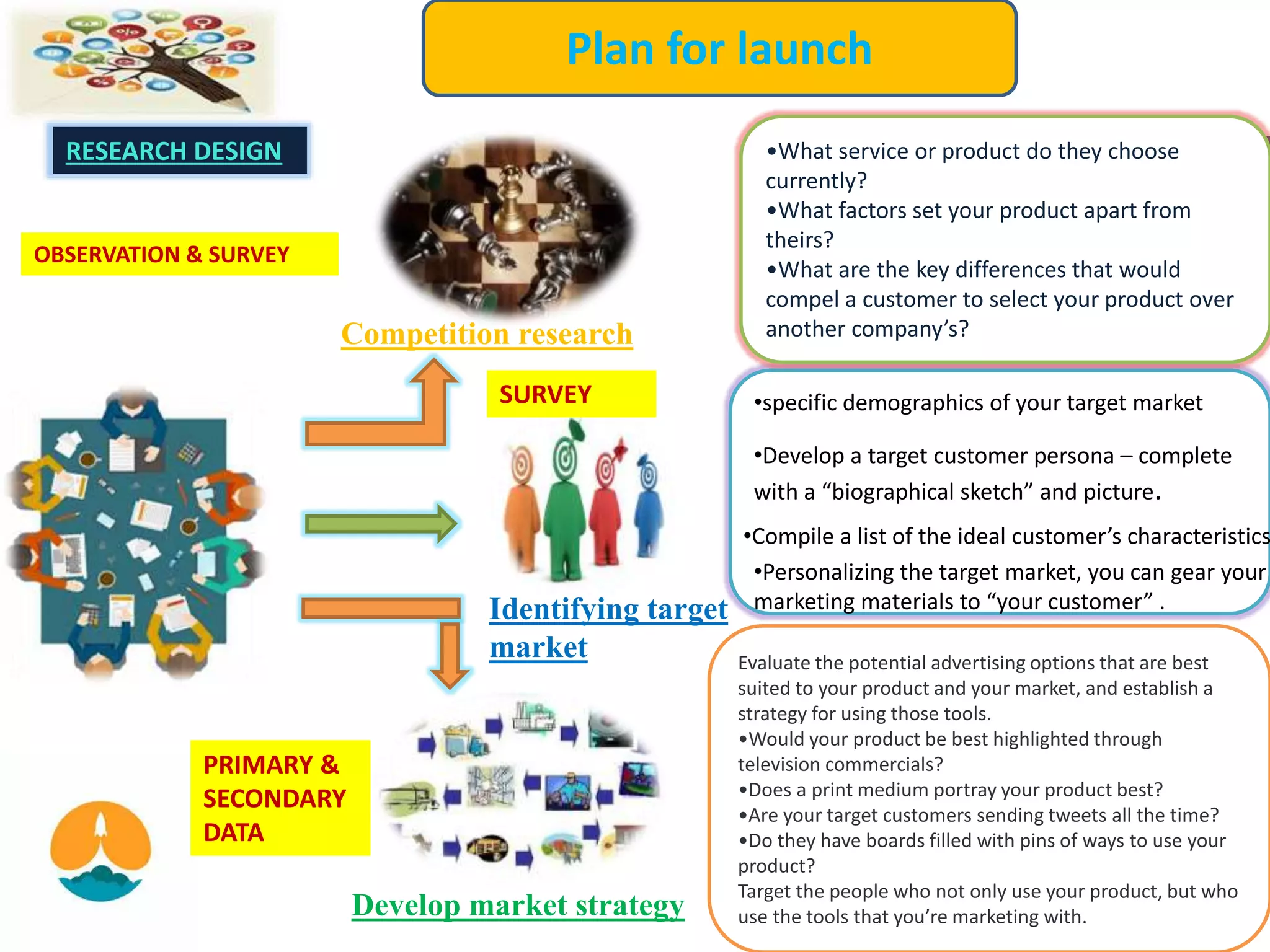
Plan for launch
Competition research
Identifying target
market
Develop market strategy
•What service or product do they choose
currently?
•What factors set your product apart from
theirs?
•What are the key differences that would
compel a customer to select your product over
another company’s?
•Develop a target customer persona – complete
with a “biographical sketch” and picture.
•specific demographics of your target market .
•Personalizing the target market, you can gear your
marketing materials to “your customer” .
•Compile a list of the ideal customer’s characteristics
Evaluate the potential advertising options that are best
suited to your product and your market, and establish a
strategy for using those tools.
•Would your product be best highlighted through
television commercials?
•Does a print medium portray your product best?
•Are your target customers sending tweets all the time?
•Do they have boards filled with pins of ways to use your
product?
Target the people who not only use your product, but who
use the tools that you’re marketing with.
OBSERVATION & SURVEY
SURVEY
PRIMARY &
SECONDARY
DATA
RESEARCH DESIGN
.
.
..
BE SOCIAL
PROVIDE PRODUCT
INFORMATION LEAKS
EXECUTING THE LAUNCH
START PROMOTING
EARLY
Expert reviews have
credence
DON’T DESPAIR
BE CREATIVE
Use people with a
vested interest
PRE-LAUNCHING TRAILS
ARE IMPORTANT
START PROMOTING EARLY
• start telling people about your new product before actual launch date.
• Start promoting the product several weeks before the actual launch – and start
helping your target market to recognize the name and product.
• Name recognition is key to getting customers to try your product – make sure that
your product name is in front of the market place before the product is available.
PRE LAUNCH TRAILS
• Before the launch of your product, let key people use and subsequently, write about
your product.
• Offering your product to bloggers, editors, journalists and others who have a following
and audience is a fantastic way to generate interest and excitement in your product.
• Having actual users give testimonials about the exciting new product about to be
released will increase customer willingness to be on the lookout for your launch.
BE CREATIVE
•During the lead-in time to the product launch, release videos or commercials that
are unique in nature or that make people laugh.
•Take a poll of your target audience and correlate the responses into an infographic
or survey response that lets potential customers see the need for your product.
•Consider an industry related release campaign to capitalize on the days leading up
to your launch.
Expert reviews have credence
•Expert users give credibility to the claims of your product as being
new/revolutionary/improved, etc.
•By providing potential customers with a quote from experts who have used the
product, you are solidifying the validity of your product claims.
PRODUCT INFORMATION LEAK
•Planned ‘leaks’ of information brings excitement and interest.
•A few well-placed pictures of the product – even a portion of the product – will begin
to create a buzz of excitement.
•A set of launch campaign ads that feature ‘coming soon’ highlights will increase a
customer’s interest in the product.
•Highlight a few unique features that set your product apart from the competition to
get people talking about your product before the launch.
Use people with a vested interest
•Distribute products to the investors who have committed funds to
launching the new product.
•By having a vested interest in the success of the product, they will be highly
motivated to promote the product to their circle of influence.
•Using investors to promote the product is a win-win: the product gets
attention and generates excitement and the investors are helping to ensure
that they get an ROI (return on investment).
BE SOCIAL
•Social media has forever changed the way that customers relate – to each other and
to the global community.
• Harness the power of the social media by using it to generate conversations about
the product launch.
•Explore connections that may exist solely in an online capacity – and develop
meaningful interactions with new social circles that may be interested in your product.
•Instead of focusing on social media numbers, focus on the depth of interactions that
you can generate.
• Provide compelling content about your product and then start conversations about it.
• As the social circle widens and expands, more and more people will begin to talk
about the product, who will then in turn tell others, and so forth – starting a grass-
roots movement to help launch your campaign.
DON’T DESPAIR
•Unless your company is one of the massive organizations dominating the
marketplace, your product launch may not even cause a ripple in the mainstream
media.
•This does not spell doom for your product! Your launch date should simply be the
date that your new product is available in the marketplace – fanfare is not necessary.
In addition, not getting covered by every news media organization isn’t the end of
your launch – so unless your new product is cutting edge and revolutionary
•Look for solid content from the smaller media outlets, and build your marketing
strategy around other outlets.
Maintain a steady supply of topics to reporters/journalists about the product itself.
Detail customer uses of the product – including reports from some of the initial users
of the product.
Describe the changes that the product brings to the market.
As people become more aware of your product, make sure that they
have easy access to not only your product, but to more information about
the product as well.
Offer free trials, videos, product demos – all specifically
geared to inform the public about the new product offering
Ask customers to tell you about their experience with the
new product – good or bad – and then use those results in
further advertising.
keeping track of which media tools were the most successful in
converting potential customers into sales will give an indicator of
where your efforts should be spent.
Dropping the ineffectual methods and replacing them with renewed
efforts in the productive methods will help not only generate income
by identifying new customers; it will maximize the customer
awareness.
AFTER THE LAUNCH
CAUSAL RESEARCH
AKSHATH
BHARATH
JYOTSNA
SURESH
HARAN
ANYQUERIESPLEASE

new product launch and required business research

  • 3.
    EVALUTION BEFORE LAUNCH COMPANYEVALUTION PRODUCT EVALUTION MARKET EVALUTION  Readiness  Supporting fast and growth  Facilitate increased demand  Adequate staffing/supply line/processes in place to hand in increased demand.  protocol for handling customer inquiries and needs in a customer service department. •Has the product been thoroughly tested? •Does it deliver consistent results? •If your product is a niche product, is there enough of a market to support the product? •Does the available market have a place for your product? PROBLEM DISCOVERY PROBLEM DEFINATION EXPLORATORY RESEARCH SECONDARY HISTORICAL DATA OBSERVATION SURVEY
  • 4.
    Plan for launch Competitionresearch Identifying target market Develop market strategy •What service or product do they choose currently? •What factors set your product apart from theirs? •What are the key differences that would compel a customer to select your product over another company’s? •Develop a target customer persona – complete with a “biographical sketch” and picture. •specific demographics of your target market . •Personalizing the target market, you can gear your marketing materials to “your customer” . •Compile a list of the ideal customer’s characteristics Evaluate the potential advertising options that are best suited to your product and your market, and establish a strategy for using those tools. •Would your product be best highlighted through television commercials? •Does a print medium portray your product best? •Are your target customers sending tweets all the time? •Do they have boards filled with pins of ways to use your product? Target the people who not only use your product, but who use the tools that you’re marketing with. OBSERVATION & SURVEY SURVEY PRIMARY & SECONDARY DATA RESEARCH DESIGN
  • 5.
    . . .. BE SOCIAL PROVIDE PRODUCT INFORMATIONLEAKS EXECUTING THE LAUNCH START PROMOTING EARLY Expert reviews have credence DON’T DESPAIR BE CREATIVE Use people with a vested interest PRE-LAUNCHING TRAILS ARE IMPORTANT
  • 6.
    START PROMOTING EARLY •start telling people about your new product before actual launch date. • Start promoting the product several weeks before the actual launch – and start helping your target market to recognize the name and product. • Name recognition is key to getting customers to try your product – make sure that your product name is in front of the market place before the product is available. PRE LAUNCH TRAILS • Before the launch of your product, let key people use and subsequently, write about your product. • Offering your product to bloggers, editors, journalists and others who have a following and audience is a fantastic way to generate interest and excitement in your product. • Having actual users give testimonials about the exciting new product about to be released will increase customer willingness to be on the lookout for your launch. BE CREATIVE •During the lead-in time to the product launch, release videos or commercials that are unique in nature or that make people laugh. •Take a poll of your target audience and correlate the responses into an infographic or survey response that lets potential customers see the need for your product. •Consider an industry related release campaign to capitalize on the days leading up to your launch.
  • 7.
    Expert reviews havecredence •Expert users give credibility to the claims of your product as being new/revolutionary/improved, etc. •By providing potential customers with a quote from experts who have used the product, you are solidifying the validity of your product claims. PRODUCT INFORMATION LEAK •Planned ‘leaks’ of information brings excitement and interest. •A few well-placed pictures of the product – even a portion of the product – will begin to create a buzz of excitement. •A set of launch campaign ads that feature ‘coming soon’ highlights will increase a customer’s interest in the product. •Highlight a few unique features that set your product apart from the competition to get people talking about your product before the launch. Use people with a vested interest •Distribute products to the investors who have committed funds to launching the new product. •By having a vested interest in the success of the product, they will be highly motivated to promote the product to their circle of influence. •Using investors to promote the product is a win-win: the product gets attention and generates excitement and the investors are helping to ensure that they get an ROI (return on investment).
  • 8.
    BE SOCIAL •Social mediahas forever changed the way that customers relate – to each other and to the global community. • Harness the power of the social media by using it to generate conversations about the product launch. •Explore connections that may exist solely in an online capacity – and develop meaningful interactions with new social circles that may be interested in your product. •Instead of focusing on social media numbers, focus on the depth of interactions that you can generate. • Provide compelling content about your product and then start conversations about it. • As the social circle widens and expands, more and more people will begin to talk about the product, who will then in turn tell others, and so forth – starting a grass- roots movement to help launch your campaign. DON’T DESPAIR •Unless your company is one of the massive organizations dominating the marketplace, your product launch may not even cause a ripple in the mainstream media. •This does not spell doom for your product! Your launch date should simply be the date that your new product is available in the marketplace – fanfare is not necessary. In addition, not getting covered by every news media organization isn’t the end of your launch – so unless your new product is cutting edge and revolutionary •Look for solid content from the smaller media outlets, and build your marketing strategy around other outlets.
  • 9.
    Maintain a steadysupply of topics to reporters/journalists about the product itself. Detail customer uses of the product – including reports from some of the initial users of the product. Describe the changes that the product brings to the market. As people become more aware of your product, make sure that they have easy access to not only your product, but to more information about the product as well. Offer free trials, videos, product demos – all specifically geared to inform the public about the new product offering Ask customers to tell you about their experience with the new product – good or bad – and then use those results in further advertising. keeping track of which media tools were the most successful in converting potential customers into sales will give an indicator of where your efforts should be spent. Dropping the ineffectual methods and replacing them with renewed efforts in the productive methods will help not only generate income by identifying new customers; it will maximize the customer awareness. AFTER THE LAUNCH CAUSAL RESEARCH
  • 10.