Paper for the National Conference on OPPORTUNITIES & CHALLENGES IN MANAGING THE MILLENIAL GENERATION – INDIVIDUAL, ORGANIZATIONAL & SOCIAL PERSPECTIVES At VISHWAKARMA INSTITUTE OF MANAGEMENT “ A New Paradigm for Management Education” Authors Ramesh Jog  (Corp consultant, Mentor and Research student at UoP) Anand Joshi  (Managing Director, NobleTek PLM Solutions) Rajendra Sidhaye  (CEO, Effectiveness Plus Plus) Sameer Prabhu  (VP & Head R&D, Giesecke & Devrient)
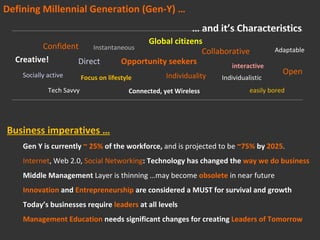
Defining Millennial Generation (Gen-Y) … Individuality Confident Collaborative Open Opportunity seekers Connected, yet Wireless Socially active Adaptable Instantaneous Focus on lifestyle interactive easily bored …  and it’s Characteristics Direct Business imperatives … Gen Y is currently  ~ 25%  of the workforce,  and is projected to be  ~75%  by  2025 . Internet , Web 2.0,  Social Networking : Technology has changed the  way we do business Middle Management  Layer is thinning …may become  obsolete   in near future Innovation  and  Entrepreneurship  are considered a MUST for survival and growth Today’s businesses require  leaders  at all levels Management Education  needs significant changes for creating  Leaders of Tomorrow Global citizens Creative! Individualistic Tech Savvy
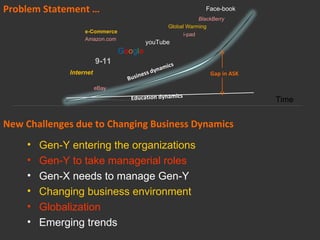
Problem Statement … New Challenges due to Changing Business Dynamics Gen-Y entering the organizations Gen-Y to take managerial roles Gen-X needs to manage Gen-Y Changing business environment Globalization Emerging trends Time  Business dynamics Education dynamics Gap in ASK eBay 9-11 Internet G o o g l e i-pad Amazon.com Global Warming youTube Face-book e-Commerce BlackBerry
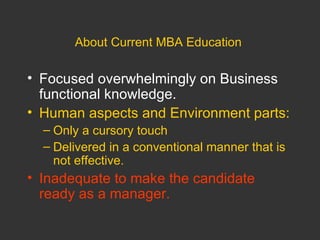
About Current MBA Education   Focused overwhelmingly on Business functional knowledge. Human aspects and Environment parts: Only a cursory touch  Delivered in a conventional manner that is not effective. Inadequate to make the candidate ready as a manager.
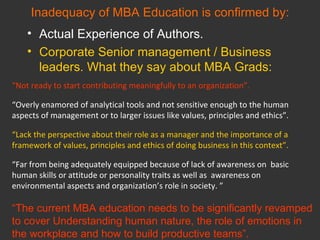
Inadequacy of MBA Education is confirmed by: Actual Experience of Authors. Corporate Senior management / Business leaders. What they say about MBA Grads: “ Not ready to start contributing meaningfully to an organization”. “ Overly enamored of analytical tools and not sensitive enough to the human aspects of management or to larger issues like values, principles and ethics”. “ Lack the perspective about their role as a manager and the importance of a framework of values, principles and ethics of doing business in this context”. “ Far from being adequately equipped because of lack of awareness on  basic human skills or attitude or personality traits as well as  awareness on environmental aspects and organization’s role in society. ” “ The current MBA education needs to be significantly revamped to cover Understanding human nature, the role of emotions in the workplace and how to build productive teams”.
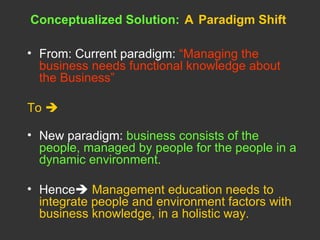
Conceptualized Solution:   A   Paradigm Shift   From: Current paradigm:  “Managing the business needs functional knowledge about the Business” To   New paradigm:   business consists of the people, managed by people for the people in a dynamic environment. Hence    Management education needs to integrate people and environment factors with business knowledge, in a holistic way.
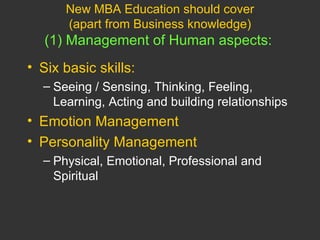
New MBA Education should cover (apart from Business knowledge) (1) Management of Human aspects:   Six basic skills: Seeing / Sensing, Thinking, Feeling, Learning, Acting and building relationships Emotion Management Personality Management Physical, Emotional, Professional and Spiritual
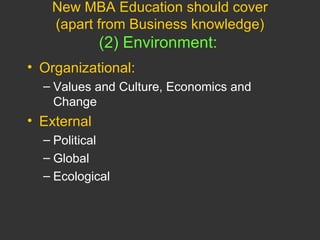
New MBA Education should cover (apart from Business knowledge) (2) Environment:   Organizational: Values and Culture, Economics and Change External Political Global Ecological
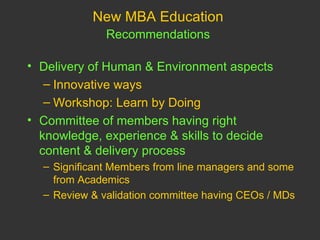
New MBA Education  Recommendations   Delivery of Human & Environment aspects Innovative ways Workshop: Learn by Doing Committee of members having right knowledge, experience & skills to decide content & delivery process Significant Members from line managers and some from Academics Review & validation committee having CEOs / MDs

New Paradigm In Management Education V1.3

  • 1.
    Paper for theNational Conference on OPPORTUNITIES & CHALLENGES IN MANAGING THE MILLENIAL GENERATION – INDIVIDUAL, ORGANIZATIONAL & SOCIAL PERSPECTIVES At VISHWAKARMA INSTITUTE OF MANAGEMENT “ A New Paradigm for Management Education” Authors Ramesh Jog (Corp consultant, Mentor and Research student at UoP) Anand Joshi (Managing Director, NobleTek PLM Solutions) Rajendra Sidhaye (CEO, Effectiveness Plus Plus) Sameer Prabhu (VP & Head R&D, Giesecke & Devrient)
  • 2.
    Defining Millennial Generation(Gen-Y) … Individuality Confident Collaborative Open Opportunity seekers Connected, yet Wireless Socially active Adaptable Instantaneous Focus on lifestyle interactive easily bored … and it’s Characteristics Direct Business imperatives … Gen Y is currently ~ 25% of the workforce, and is projected to be ~75% by 2025 . Internet , Web 2.0, Social Networking : Technology has changed the way we do business Middle Management Layer is thinning …may become obsolete in near future Innovation and Entrepreneurship are considered a MUST for survival and growth Today’s businesses require leaders at all levels Management Education needs significant changes for creating Leaders of Tomorrow Global citizens Creative! Individualistic Tech Savvy
  • 3.
    Problem Statement …New Challenges due to Changing Business Dynamics Gen-Y entering the organizations Gen-Y to take managerial roles Gen-X needs to manage Gen-Y Changing business environment Globalization Emerging trends Time Business dynamics Education dynamics Gap in ASK eBay 9-11 Internet G o o g l e i-pad Amazon.com Global Warming youTube Face-book e-Commerce BlackBerry
  • 4.
    About Current MBAEducation Focused overwhelmingly on Business functional knowledge. Human aspects and Environment parts: Only a cursory touch Delivered in a conventional manner that is not effective. Inadequate to make the candidate ready as a manager.
  • 5.
    Inadequacy of MBAEducation is confirmed by: Actual Experience of Authors. Corporate Senior management / Business leaders. What they say about MBA Grads: “ Not ready to start contributing meaningfully to an organization”. “ Overly enamored of analytical tools and not sensitive enough to the human aspects of management or to larger issues like values, principles and ethics”. “ Lack the perspective about their role as a manager and the importance of a framework of values, principles and ethics of doing business in this context”. “ Far from being adequately equipped because of lack of awareness on basic human skills or attitude or personality traits as well as awareness on environmental aspects and organization’s role in society. ” “ The current MBA education needs to be significantly revamped to cover Understanding human nature, the role of emotions in the workplace and how to build productive teams”.
  • 6.
    Conceptualized Solution: A Paradigm Shift From: Current paradigm: “Managing the business needs functional knowledge about the Business” To  New paradigm: business consists of the people, managed by people for the people in a dynamic environment. Hence  Management education needs to integrate people and environment factors with business knowledge, in a holistic way.
  • 7.
    New MBA Educationshould cover (apart from Business knowledge) (1) Management of Human aspects: Six basic skills: Seeing / Sensing, Thinking, Feeling, Learning, Acting and building relationships Emotion Management Personality Management Physical, Emotional, Professional and Spiritual
  • 8.
    New MBA Educationshould cover (apart from Business knowledge) (2) Environment: Organizational: Values and Culture, Economics and Change External Political Global Ecological
  • 9.
    New MBA Education Recommendations Delivery of Human & Environment aspects Innovative ways Workshop: Learn by Doing Committee of members having right knowledge, experience & skills to decide content & delivery process Significant Members from line managers and some from Academics Review & validation committee having CEOs / MDs

Editor's Notes

  • #2 Last line “Organizational and external environment “ The text in “golden” color . Can this be seen? Presentation first page need not have summary like Abstract. Removed.
  • #5 Bullet 1 A functional knowledge decided a few decades ago based on dynamics then prevailing or a phrase similar We can cover this while presenting. But are we saying that they don’t update the functional knowledge content of syllabus also? Can it be an over-statement? Manager : Can we replace by phrase like “ Take a lead in business operations “ or “contribute in organizations performance in short time “ Why? Management education needs to produce an effective manager.
  • #6 “ Significantly changed “ replaces “significantly improved “ Because we are talking of a paradigm and not improvement Ok. Done. In fact used stronger word: ‘revamped’ 
  • #7 Bullet 1 A functional knowledge decided a few decades ago based on dynamics then prevailing or a phrase similar We can cover this while presenting. But are we saying that they don’t update the functional knowledge content of syllabus also? Can it be an over-statement? Manager : Can we replace by phrase like “ Take a lead in business operations “ or “contribute in organizations performance in short time “ Why? Management education needs to produce an effective manager.
  • #8 Bullet 1 A functional knowledge decided a few decades ago based on dynamics then prevailing or a phrase similar We can cover this while presenting. But are we saying that they don’t update the functional knowledge content of syllabus also? Can it be an over-statement? Manager : Can we replace by phrase like “ Take a lead in business operations “ or “contribute in organizations performance in short time “ Why? Management education needs to produce an effective manager.
  • #9 Bullet 1 A functional knowledge decided a few decades ago based on dynamics then prevailing or a phrase similar We can cover this while presenting. But are we saying that they don’t update the functional knowledge content of syllabus also? Can it be an over-statement? Manager : Can we replace by phrase like “ Take a lead in business operations “ or “contribute in organizations performance in short time “ Why? Management education needs to produce an effective manager.
  • #10 Bullet 1 A functional knowledge decided a few decades ago based on dynamics then prevailing or a phrase similar We can cover this while presenting. But are we saying that they don’t update the functional knowledge content of syllabus also? Can it be an over-statement? Manager : Can we replace by phrase like “ Take a lead in business operations “ or “contribute in organizations performance in short time “ Why? Management education needs to produce an effective manager.