THREE HEADWINDS IMPACTING
THE FUTURE OF MBA PROGRAMS:
AN AUSTRALIAN PERSPECTIVE
Nick Barter & Evan Douglas
Griffith Business School
Griffith University
Queensland, Australia
Overview
 What is the problem for MBA providers?
◦ Declining demand due to declining value proposition

 Three strong headwinds we are sailing against
◦ The social imperative of Sustainability

◦ The increasing digital literacy of our clientele
◦ Unmet thirst for meeting client’s needs

 What should be done about these to ensure the survival of
MBA providers?
 What are we doing currently on these fronts at Griffith?
The problem facing MBA providers
 Declining student numbers
◦ Expensive tuition fees

◦ Ambiguous evidence that MBA is a good investment
◦ Rise of alternative sources of business information
- Coursera, Wikipedia, and googled information
- Business experience with more savvy co-workers
◦ The decline of relevancy of MBA course content for
- Sustainable development
- Practical application
- Self-employment
◦ Increasing time poverty of our customers
- Unwilling to absorb material on a ‘just-in-case’ basis
The ‘path-dependence’ problem
 We arrived here via an historical path
◦ MBA was invented to qualify ‘business administrators’
◦ Based on 19th century scientific management philosophy
- Profit maximization was the sole goal
◦ 1959 Gordon & Howell (and Pierson) reports were critical
- Need for softer side => business ethics, leadership
◦ 1988 Porter & McKibbin investigation of MBA curricula
◦ 2002 Mintzberg & Gosling, Pfeffer & Fong papers critical

◦ Global Financial Crisis – MBA graduates implicated
◦ Criticism continues to present day
- We are not teaching what managers want to know
- Nor delivering in their preferred format for learning
Headwind #1: Sustainability
 Sustainability is not just nice, it is necessary now
◦ Profit maximization is no longer appropriate

◦ Corporate Social Responsibility is now expected

 Sustainable development is about enabling economic
growth and human progress
◦ The environment does not exist as a sphere separate from
human actions, ambitions, and needs
◦ Rather than being a challenge to business, sustainable
development is a core requirement for business strategy.

 Consequently the challenge of sustainability is actually a
business growth challenge
◦ We must seek business growth within a context of ensuring
inclusiveness, reduced inequality and human progress.
Incorporating Sustainability
 Shifting social mores now require and expect CSR
◦ Investors now preferring ‘sustainable’ companies

◦ Employment in ‘sustainable’ firms and organisations
◦ Consumers increasingly preferring ‘sustainable’ firms.
◦ Suppliers preferring to be associated with ‘sustainable’ firms

 Candidates will choose programs that better equip them for
employment and career advancement in CSR companies
 Sustainability must become thematic in MBA programs
◦ No longer take short-horizon profit-maximizing focus
◦ Incorporate social and environmental issues into decisions
◦ Integrate longer-horizon CSR focus into all courses
Headwind #2: The Digital Revolution
 Universities are no longer the store of knowledge
 Digitally-stored knowledge can be accessed
◦ More quickly – waste less time
- We read faster than we speak
- Avoid travel time (and annoyances)
◦ More relevant to immediate needs
- Avoid required courses not considered relevant to needs

- Just-in-time rather than just-in-case
◦ More inexpensively
- Little or no monetary cost

 But there is an enormous volume of information available
◦ Where to start, which path to follow?
Our role is ‘Packaging’ knowledge
 Sifting
◦ Through the mountain of business information, opinion, data
and case studies, including recent research that may be
difficult reading for aspiring managers

 Selecting
◦ Choosing which elements are most important for our courses
and which elements can be taken as already understood
◦ Translating research findings into common parlance such that
they are appropriate to business practice

 Sequencing
◦ Putting these in an order of delivery that is most conducive to
learning and retention of the information by aspiring managers
MBA delivery modes
 Full-time face-to-face cohort
◦ Traditional format in classroom, weekly classes

◦ Student have minimal management experience
- Little or no prior business knowledge

 Part-time face-to-face cohort
◦ Week-night classes for students who work full-time
- Have greater knowledge of business practice

 Executive mode,
◦ Monthly distributed-block classes on weekends
- Candidates have the most knowledge of business practice


And a greater need to customize knowledge …
Delivering the Package
 The ‘Body of Knowledge’ (BOK) must be accessible on-line
◦ Supplied in ‘chunks’ not monoliths or monologues

◦ Use multi-media – Talking heads; YouTube; Websites, etc

 Treated as ‘prior reading’ before class sessions
 Reduce face-to-face time to ½ of previous time
◦ I.e. Adopt ‘blended learning’ format – both OL and F2F

 Use F2F sessions for application of BOK to specific
management decision problems
◦ Including those brought forward by class members
◦ Capture these on video for later viewing

 Supplement with on-line chats, collaborate workshops
◦ Synchronous and non-synchronous communication
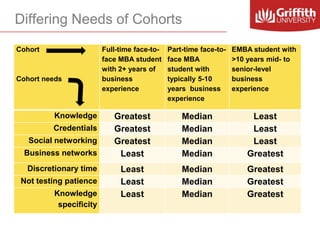
Differing Needs of Cohorts
Cohort

Cohort needs

Knowledge
Credentials
Social networking
Business networks
Discretionary time
Not testing patience

Knowledge
specificity

Full-time face-toface MBA student
with 2+ years of
business
experience

Part-time face-toface MBA
student with
typically 5-10
years business
experience

EMBA student with
>10 years mid- to
senior-level
business
experience

Greatest
Greatest
Greatest
Least

Median
Median
Median
Median

Least
Least
Least
Greatest

Least
Least
Least

Median
Median
Median

Greatest
Greatest
Greatest
Headwind #3: Incentivizing Academics
 Academics are creatures of habit, and many are nearing
retirement age
◦ Reluctant to change teaching material or teaching methods
◦ Opportunity cost of time spent revising teaching materials

 Performance incentives in business schools are related to
research grants and publications in high-status journals
◦ Teaching quality must simply surpass minimal standards

 Also little incentive to spend time listening to business
people and their views on the curriculum
◦ Business views are often disparate, mutually conflicting
◦ Bureaucratic internal process to change curriculum
◦ Rewards for changing curriculum are distant, if at all
What is the solution to this?
 Increased incentives needed to make course material:
◦ More practical and applicable to business decision making

◦ More digitally accessible and more efficiently delivered

 A different performance metric for MBA teachers?
◦ AACSB Academically Qualified – Professional Teachers

◦ Exclude from ‘Research Active’ denominator
◦ Encourage and support consulting income for these
◦ Awards for currency and digitalisation of teaching materials

 A greater proportion of ‘Professionally Qualified’ teachers
◦ Business Practitioners who are highly respected in their
subject areas
- Guest presentations by CEOs, Entrepreneurs, etc.
The MBA as a stand-alone
award, outside the University?
Currently MBA programs are charged their ‘fair
share’ of University overheads
◦ Library
◦ Car parks

◦ Cafeterias
◦ Computer Laboratories
◦ Large lecture theatres
◦ Marketing efforts geared to attracting undergraduate and
international students
◦ 40% of salaries provided for research activity

 Most of these are of little benefit to MBA students…
What is Griffith University doing?
 Re-developed all MBA courses on theme of Sustainability,
Responsibility, and Asia-Pacific Focus.

 Digitised all MBA course material for on-line delivery,
concurrent with face-to-face delivery on campus in 2014
 ‘Chunked’ all course materials into 10-20 minute slide
presentations with voice-overs
 Provided links to relevant YouTube and TEDtalk videos
 Provided links to websites and digitised reading materials
 Set up asynchronous chat rooms for student-to-student
interaction with professor oversight
 Set up periodic synchronous ‘Collaborate’ sessions for virtual
face-to-face meetings and discussion of specific topics
Conclusion
 MBA providers within Business Schools within Australian
Universities are facing declining enrolments (generally)
◦ Griffith MBA enrolments are now rising, against the trend

 MBA programs need to revise course material to reflect the
sustainable development paradigm
 Hard copies of textbooks and course materials are obsolete
◦ All course materials need to be provided on-line (and free)

 Contact time for F2F classes needs to be reduced by half
◦ With prior reading & viewing of course materials

◦ Use F2f time to apply and synergise course materials

 Incentivise MBA instructors to update, digitise and apply
course materials to business decision problems.

Three headwinds impacting the future of MBA programs: An Australian Perspective

  • 1.
    THREE HEADWINDS IMPACTING THEFUTURE OF MBA PROGRAMS: AN AUSTRALIAN PERSPECTIVE Nick Barter & Evan Douglas Griffith Business School Griffith University Queensland, Australia
  • 2.
    Overview  What isthe problem for MBA providers? ◦ Declining demand due to declining value proposition  Three strong headwinds we are sailing against ◦ The social imperative of Sustainability ◦ The increasing digital literacy of our clientele ◦ Unmet thirst for meeting client’s needs  What should be done about these to ensure the survival of MBA providers?  What are we doing currently on these fronts at Griffith?
  • 3.
    The problem facingMBA providers  Declining student numbers ◦ Expensive tuition fees ◦ Ambiguous evidence that MBA is a good investment ◦ Rise of alternative sources of business information - Coursera, Wikipedia, and googled information - Business experience with more savvy co-workers ◦ The decline of relevancy of MBA course content for - Sustainable development - Practical application - Self-employment ◦ Increasing time poverty of our customers - Unwilling to absorb material on a ‘just-in-case’ basis
  • 4.
    The ‘path-dependence’ problem We arrived here via an historical path ◦ MBA was invented to qualify ‘business administrators’ ◦ Based on 19th century scientific management philosophy - Profit maximization was the sole goal ◦ 1959 Gordon & Howell (and Pierson) reports were critical - Need for softer side => business ethics, leadership ◦ 1988 Porter & McKibbin investigation of MBA curricula ◦ 2002 Mintzberg & Gosling, Pfeffer & Fong papers critical ◦ Global Financial Crisis – MBA graduates implicated ◦ Criticism continues to present day - We are not teaching what managers want to know - Nor delivering in their preferred format for learning
  • 5.
    Headwind #1: Sustainability Sustainability is not just nice, it is necessary now ◦ Profit maximization is no longer appropriate ◦ Corporate Social Responsibility is now expected  Sustainable development is about enabling economic growth and human progress ◦ The environment does not exist as a sphere separate from human actions, ambitions, and needs ◦ Rather than being a challenge to business, sustainable development is a core requirement for business strategy.  Consequently the challenge of sustainability is actually a business growth challenge ◦ We must seek business growth within a context of ensuring inclusiveness, reduced inequality and human progress.
  • 6.
    Incorporating Sustainability  Shiftingsocial mores now require and expect CSR ◦ Investors now preferring ‘sustainable’ companies ◦ Employment in ‘sustainable’ firms and organisations ◦ Consumers increasingly preferring ‘sustainable’ firms. ◦ Suppliers preferring to be associated with ‘sustainable’ firms  Candidates will choose programs that better equip them for employment and career advancement in CSR companies  Sustainability must become thematic in MBA programs ◦ No longer take short-horizon profit-maximizing focus ◦ Incorporate social and environmental issues into decisions ◦ Integrate longer-horizon CSR focus into all courses
  • 7.
    Headwind #2: TheDigital Revolution  Universities are no longer the store of knowledge  Digitally-stored knowledge can be accessed ◦ More quickly – waste less time - We read faster than we speak - Avoid travel time (and annoyances) ◦ More relevant to immediate needs - Avoid required courses not considered relevant to needs - Just-in-time rather than just-in-case ◦ More inexpensively - Little or no monetary cost  But there is an enormous volume of information available ◦ Where to start, which path to follow?
  • 8.
    Our role is‘Packaging’ knowledge  Sifting ◦ Through the mountain of business information, opinion, data and case studies, including recent research that may be difficult reading for aspiring managers  Selecting ◦ Choosing which elements are most important for our courses and which elements can be taken as already understood ◦ Translating research findings into common parlance such that they are appropriate to business practice  Sequencing ◦ Putting these in an order of delivery that is most conducive to learning and retention of the information by aspiring managers
  • 9.
    MBA delivery modes Full-time face-to-face cohort ◦ Traditional format in classroom, weekly classes ◦ Student have minimal management experience - Little or no prior business knowledge  Part-time face-to-face cohort ◦ Week-night classes for students who work full-time - Have greater knowledge of business practice  Executive mode, ◦ Monthly distributed-block classes on weekends - Candidates have the most knowledge of business practice  And a greater need to customize knowledge …
  • 10.
    Delivering the Package The ‘Body of Knowledge’ (BOK) must be accessible on-line ◦ Supplied in ‘chunks’ not monoliths or monologues ◦ Use multi-media – Talking heads; YouTube; Websites, etc  Treated as ‘prior reading’ before class sessions  Reduce face-to-face time to ½ of previous time ◦ I.e. Adopt ‘blended learning’ format – both OL and F2F  Use F2F sessions for application of BOK to specific management decision problems ◦ Including those brought forward by class members ◦ Capture these on video for later viewing  Supplement with on-line chats, collaborate workshops ◦ Synchronous and non-synchronous communication
  • 11.
    Differing Needs ofCohorts Cohort Cohort needs Knowledge Credentials Social networking Business networks Discretionary time Not testing patience Knowledge specificity Full-time face-toface MBA student with 2+ years of business experience Part-time face-toface MBA student with typically 5-10 years business experience EMBA student with >10 years mid- to senior-level business experience Greatest Greatest Greatest Least Median Median Median Median Least Least Least Greatest Least Least Least Median Median Median Greatest Greatest Greatest
  • 12.
    Headwind #3: IncentivizingAcademics  Academics are creatures of habit, and many are nearing retirement age ◦ Reluctant to change teaching material or teaching methods ◦ Opportunity cost of time spent revising teaching materials  Performance incentives in business schools are related to research grants and publications in high-status journals ◦ Teaching quality must simply surpass minimal standards  Also little incentive to spend time listening to business people and their views on the curriculum ◦ Business views are often disparate, mutually conflicting ◦ Bureaucratic internal process to change curriculum ◦ Rewards for changing curriculum are distant, if at all
  • 13.
    What is thesolution to this?  Increased incentives needed to make course material: ◦ More practical and applicable to business decision making ◦ More digitally accessible and more efficiently delivered  A different performance metric for MBA teachers? ◦ AACSB Academically Qualified – Professional Teachers ◦ Exclude from ‘Research Active’ denominator ◦ Encourage and support consulting income for these ◦ Awards for currency and digitalisation of teaching materials  A greater proportion of ‘Professionally Qualified’ teachers ◦ Business Practitioners who are highly respected in their subject areas - Guest presentations by CEOs, Entrepreneurs, etc.
  • 14.
    The MBA asa stand-alone award, outside the University? Currently MBA programs are charged their ‘fair share’ of University overheads ◦ Library ◦ Car parks ◦ Cafeterias ◦ Computer Laboratories ◦ Large lecture theatres ◦ Marketing efforts geared to attracting undergraduate and international students ◦ 40% of salaries provided for research activity  Most of these are of little benefit to MBA students…
  • 15.
    What is GriffithUniversity doing?  Re-developed all MBA courses on theme of Sustainability, Responsibility, and Asia-Pacific Focus.  Digitised all MBA course material for on-line delivery, concurrent with face-to-face delivery on campus in 2014  ‘Chunked’ all course materials into 10-20 minute slide presentations with voice-overs  Provided links to relevant YouTube and TEDtalk videos  Provided links to websites and digitised reading materials  Set up asynchronous chat rooms for student-to-student interaction with professor oversight  Set up periodic synchronous ‘Collaborate’ sessions for virtual face-to-face meetings and discussion of specific topics
  • 16.
    Conclusion  MBA providerswithin Business Schools within Australian Universities are facing declining enrolments (generally) ◦ Griffith MBA enrolments are now rising, against the trend  MBA programs need to revise course material to reflect the sustainable development paradigm  Hard copies of textbooks and course materials are obsolete ◦ All course materials need to be provided on-line (and free)  Contact time for F2F classes needs to be reduced by half ◦ With prior reading & viewing of course materials ◦ Use F2f time to apply and synergise course materials  Incentivise MBA instructors to update, digitise and apply course materials to business decision problems.