New Media  as a Teaching Asset
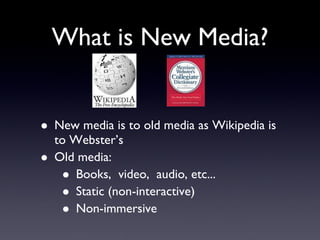
What is New Media? New media is to old media as Wikipedia is to Webster’s Old media: Books,  video,  audio, etc... Static (non-interactive) Non-immersive
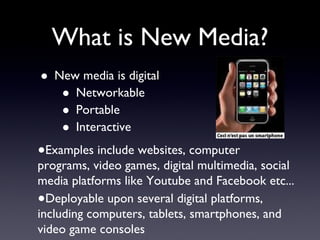
What is New Media? New media is digital Networkable Portable Interactive Examples include websites, computer programs, video games, digital multimedia, social media platforms like Youtube and Facebook etc... Deployable upon several digital platforms, including computers, tablets, smartphones, and video game consoles
New Media Use it!
New Media is Multi-Platform Computers Tablets Online delivered content Easy translation to old media platforms Smartboards
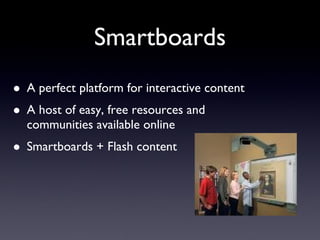
Smartboards A perfect platform for interactive content  A host of easy, free resources and communities available online Smartboards + Flash content
The Great Education/Social Media Debate Just about everybody has a facebook Social media is intended as just that: Social Facebook has inherent features (groups, bulletins, etc...) that can be useful without being invasive. Content filter sites like StumbleUpon can be set to search for educational content
A Paradigm Shift Two new fundamentals of education
A Paradigm Shift One: Innovation requires economic consideration
A Paradigm Shift Two: Retention is meaningless in the age of Google
Teaching Students to Teach Themselves Information and data is everywhere The ability to process large quantities of information for relevance is far more valuable today than rote memorization. Not all students learn the same; Digital content can be tailored seamlessly to fit individual student’s learning patterns.
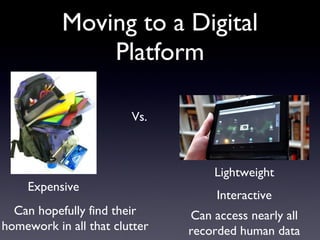
Moving to a Digital Platform Vs. Lightweight Interactive Can access nearly all recorded human data Expensive Can hopefully find their homework in all that clutter
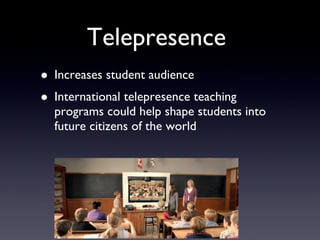
Telepresence  Increases student audience International telepresence teaching programs could help shape students into future citizens of the world
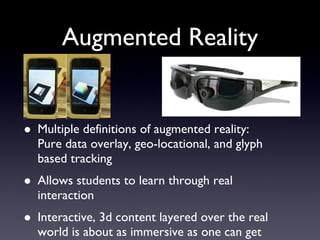
Augmented Reality Multiple definitions of augmented reality: Pure data overlay, geo-locational, and glyph based tracking Allows students to learn through real interaction Interactive, 3d content layered over the real world is about as immersive as one can get
Taking the Next Step in Applying Multiple Intelligence EEG technology has come into the consumer price range, and new products like the Epoc Emotiv have open APIs for development We can actually see what learning mediums activate the students brains Educational content should be polymorphic, and adaptable to each students aptitudes.
Games as a Teaching Tool Video games are a very immersive platform Playing video games has been proven to increase cognitive and reasoning abilities High engagement = Easier learning Educational games have found a very wide market (i.e. Sid Meier’s Civilization series, Age of Mythology, WolfQuest) Not applicable to all topics
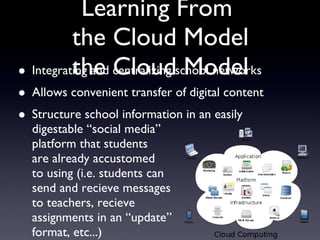
Learning From  the Cloud Model the Cloud Model Integrating and centralizing school networks Allows convenient transfer of digital content Structure school information in an easily digestable “social media”  platform that students  are already accustomed  to using (i.e. students can  send and recieve messages  to teachers, recieve  assignments in an “update”  format, etc...)
In Summation... Use Google, teach Google New media platforms give us new tools to create highly immersive, engaging educational content, much of which is available for free online New technologies are changing the way that we learn, and we have to adapt with them Economics is the new language of Education, and technology can help keep the costs of modernization affordable.

New Media as a Teaching Asset

  • 1.
    New Media as a Teaching Asset
  • 2.
    What is NewMedia? New media is to old media as Wikipedia is to Webster’s Old media: Books, video, audio, etc... Static (non-interactive) Non-immersive
  • 3.
    What is NewMedia? New media is digital Networkable Portable Interactive Examples include websites, computer programs, video games, digital multimedia, social media platforms like Youtube and Facebook etc... Deployable upon several digital platforms, including computers, tablets, smartphones, and video game consoles
  • 4.
  • 5.
    New Media isMulti-Platform Computers Tablets Online delivered content Easy translation to old media platforms Smartboards
  • 6.
    Smartboards A perfectplatform for interactive content A host of easy, free resources and communities available online Smartboards + Flash content
  • 7.
    The Great Education/SocialMedia Debate Just about everybody has a facebook Social media is intended as just that: Social Facebook has inherent features (groups, bulletins, etc...) that can be useful without being invasive. Content filter sites like StumbleUpon can be set to search for educational content
  • 8.
    A Paradigm ShiftTwo new fundamentals of education
  • 9.
    A Paradigm ShiftOne: Innovation requires economic consideration
  • 10.
    A Paradigm ShiftTwo: Retention is meaningless in the age of Google
  • 11.
    Teaching Students toTeach Themselves Information and data is everywhere The ability to process large quantities of information for relevance is far more valuable today than rote memorization. Not all students learn the same; Digital content can be tailored seamlessly to fit individual student’s learning patterns.
  • 12.
    Moving to aDigital Platform Vs. Lightweight Interactive Can access nearly all recorded human data Expensive Can hopefully find their homework in all that clutter
  • 13.
    Telepresence Increasesstudent audience International telepresence teaching programs could help shape students into future citizens of the world
  • 14.
    Augmented Reality Multipledefinitions of augmented reality: Pure data overlay, geo-locational, and glyph based tracking Allows students to learn through real interaction Interactive, 3d content layered over the real world is about as immersive as one can get
  • 15.
    Taking the NextStep in Applying Multiple Intelligence EEG technology has come into the consumer price range, and new products like the Epoc Emotiv have open APIs for development We can actually see what learning mediums activate the students brains Educational content should be polymorphic, and adaptable to each students aptitudes.
  • 16.
    Games as aTeaching Tool Video games are a very immersive platform Playing video games has been proven to increase cognitive and reasoning abilities High engagement = Easier learning Educational games have found a very wide market (i.e. Sid Meier’s Civilization series, Age of Mythology, WolfQuest) Not applicable to all topics
  • 17.
    Learning From the Cloud Model the Cloud Model Integrating and centralizing school networks Allows convenient transfer of digital content Structure school information in an easily digestable “social media” platform that students are already accustomed to using (i.e. students can send and recieve messages to teachers, recieve assignments in an “update” format, etc...)
  • 18.
    In Summation... UseGoogle, teach Google New media platforms give us new tools to create highly immersive, engaging educational content, much of which is available for free online New technologies are changing the way that we learn, and we have to adapt with them Economics is the new language of Education, and technology can help keep the costs of modernization affordable.