Teng Ma
Sara Spicer
Sydney Barnett
Panu Choopojcharoen
LES GRIS
Grey is the new green
Mission
As we experience life in a casual world, busy from
day to day, constantly running around, Les Gris finds it
imperative to offer clothing to fit and mold around
these demands. We strive for our label to never by lazy
or overtime consuming, but offers pieces with design at
heart, and sustainability in mind.
Vision
It is our hope to expand from California and make a
company that is able to offer comfortable and sustainable
clothing to the masses in the U.S, and support finding new
ways to make our clothing, production, and distribution les
hazardous to the world.
Value
We value the earth and constantly are looking
for new ways to reduce the negative impact we
cause, while also considering design key to inspiring
others to do the same.
Target Market Overview
Market Analysis
Market Size
20%
15%
2
4.84%8.04%
Loungewear
$26417.50mn
Sportswear
$81674.30mn
20%
15%
• U.S apparel market is the
biggest apparel market in the
world
• 2013 total retail value is
$328,747.60 mn
Market Share
• Increase and decrease
synchronously
• Continuing expansion after
2010
Unique Characteristics
• The most rapid growing market
(Sportswear)
• Provide ease for activities to the
wearer
• The merge of Loungewear and
sportswear
Wearer Information for Sportswear
Market Trend
• Continuing growth trend in retail value
after 2009
• Sportswear section’s retail value
increased dramatically since 2010
• Lifestyle shifting
Competitive Landscape
Price High
Price Low
Athletic
Intimates/
Loungewear
• Competitors from both loungewear
section and sportswear section, and fast
fashion
• Muji, Victoria’s Secret, H&M, Ralph
Lauren and NIKE are selected for top
competitors by evaluating their market
share and accessibility, target
consumer, market position and price.
Sustainability Evaluation
High
Sustainability
Low
Sustainability
Price High
Price Low
Evaluating Factors
• Materials
• Manufacturing
• Packaging
• Product Disposable
NIKE
• Focus on R&D of inventing new
sustainable materials
-e.g. Fly knit, turn recycled polyester into high
performance gear
• Manufacturing list transparency
• Waterless dying facilities to reduce
water consumption
• Reuse-A-Shoe Program
MUJI
• Minimalism as the brand core value,
sustainable lifestyle brand
• Recycled materials, excellent quality
control to minimalize production process
• Participation in UN global impact
Current Sourcing Practices
• 191 Suppliers of women’s loungewear from 20
countries
• Top suppliers are located in Bangladesh, China,
India, and US.
• Bangladesh is known for exporting the most
loungewear products to the US.
Current Sourcing Practice
• The US companies that offer sustainable apparel
products have their own domestic suppliers and
manufacturers.
• Recover and SustainU provide recycled knitwear at
the very affordable prices. A single T-shirt can cost
from $12 to $18 at retail price.
• Since loungewear is considered knitwear, these
companies indicate that it is possible to create
sustainable loungewear within the US.
Current Distribution Channels
• Most luxury and high-end department
stores have their own loungewear or
sleepwear categories.
• Notable brands that high-end
department stores carry are UGG
Australia, Splendid,Oscar de la Renta
Sleepwear, Style&Co.
• Fast fashion brands also offer loungewear
products both in-store and online, such as
Uniqlo, H&M, Victoria’s Secret
Factors Driving the Future Growth
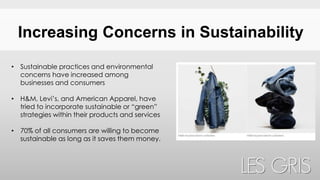
Increasing Concerns in Sustainability
• Sustainable practices and environmental
concerns have increased among
businesses and consumers
• H&M, Levi’s, and American Apparel, have
tried to incorporate sustainable or “green”
strategies within their products and services
• 70% of all consumers are willing to become
sustainable as long as it saves them money.
Emerging Trends in Loungewear
• The concept of combining luxury and comfort together
has been one of a major fashion trend since 2010.
• Many designers started to gain inspiration from pajamas
and created garments suitable for both indoor and
outdoor activities.
• Today’s consumer has started to incorporate casual looks
into the workplace, including pajamas and loose outfits
worn outside of their own houses.
Target Consumer
Age
• Target consumer
Millennial generation
Both Men and Women
Age group 18-24 and 25-35
• Average green consumer
12% being 14-24
23% being 25-34
Income
• College age and graduate students (18-24) may have
some income below 10k a year, most are still living
off of their parents, or student loans.
• Most 24-30 year olds are looking to establish a
career and find themselves in the 30k-40k salaries.
• While consumers above 30 have a consistent job or
are working their way up at this point making from
50K-75
• With Les Gris being located in California, we
averaged the annual income to be a little of 50k per
year
Demographic
• The sustainable/millennial generation is generally
raised in upper middle class where they are
exposed to more disposable income.
• They are just getting out of college, working to
establish a career, or within a consistent career,
therefore putting them in more of the middle
class.
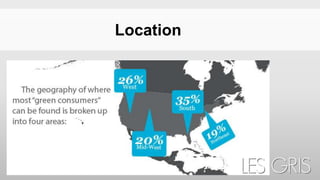
Location
Education
Current Garment Lifecycle
Product Development & Sourcing
Inspiration and Concept
Products
• 40% Men
• 40% women
• 20% Unisex
Color and Materials
Jersey Knit (Union Made)
Fabric Content: Blended and
Synthetic
- 65% Recycled Cotton
- 35% Recycled Polyester
(from plastic bottles)
Made in USA
RPET Fine Cotton Fleece 30/1
combed ring spun
Fabric Content: Blended and
Synthetic
- 50% Organic Cotton
- 50% Recycled Polyester
(from plastic bottles)
Made in USA
Color Scheme
Sourcing
• Made in USA
• Professional team and specialization in knitwear
• Sustainable Products that meet Les Gris’ needs
e.g. recycled fabric, high quality producing, acceptable price
• Private Label, Customer Apparel and other
services
• Good Customer Services
Impact Measurement
Waste minimization
• Reduce the amount of waste from post-consumer wastes such as
plastic bottles, cotton fabric, polyester fabric, and etc.
• Reduce the amount of natural resources used in manufacturing,
such as energy, water, oil.
• Reduce the amount of pollution (soil, air, and water) resulted from
various manufacturing
Customer Engagement
Function
Care Instructions
• With Les Gris’ choice to eliminate the use of waterless dye from the
clothing, the company does encourage alternatives to washing
machines that use large amounts of water
• Machine Wash Warm
• Gentle Dry (Tumble Dry Low)
• Gentle Ironing (Low-Heat)
• High-Temperature Laundering is permissible
• No dry clean
• No bleach
Disposal
Good or Acceptable Condition
• Donating to a charity
• Selling to a consignment shop
• Garage Sale
• Giving to other people (Unisex line’s benefits)
• Recycling via crafting
Poor Condition
• special process in material recycling
• separate the blended fabric into polyester and cotton ,
• and convert into Lyocell and PET, via chemical recycling
Branding & Messaging
Branding
• Recyclable materials
• Thanks card for
consumer education
Cost
Product Cost
Packaging Cost
Thank You!

Les gris ppt

  • 1.
    Teng Ma Sara Spicer SydneyBarnett Panu Choopojcharoen LES GRIS Grey is the new green
  • 2.
    Mission As we experiencelife in a casual world, busy from day to day, constantly running around, Les Gris finds it imperative to offer clothing to fit and mold around these demands. We strive for our label to never by lazy or overtime consuming, but offers pieces with design at heart, and sustainability in mind.
  • 3.
    Vision It is ourhope to expand from California and make a company that is able to offer comfortable and sustainable clothing to the masses in the U.S, and support finding new ways to make our clothing, production, and distribution les hazardous to the world.
  • 4.
    Value We value theearth and constantly are looking for new ways to reduce the negative impact we cause, while also considering design key to inspiring others to do the same.
  • 5.
  • 6.
  • 7.
    Market Size 20% 15% 2 4.84%8.04% Loungewear $26417.50mn Sportswear $81674.30mn 20% 15% • U.Sapparel market is the biggest apparel market in the world • 2013 total retail value is $328,747.60 mn
  • 8.
    Market Share • Increaseand decrease synchronously • Continuing expansion after 2010
  • 9.
    Unique Characteristics • Themost rapid growing market (Sportswear) • Provide ease for activities to the wearer • The merge of Loungewear and sportswear Wearer Information for Sportswear
  • 10.
    Market Trend • Continuinggrowth trend in retail value after 2009 • Sportswear section’s retail value increased dramatically since 2010 • Lifestyle shifting
  • 11.
    Competitive Landscape Price High PriceLow Athletic Intimates/ Loungewear • Competitors from both loungewear section and sportswear section, and fast fashion • Muji, Victoria’s Secret, H&M, Ralph Lauren and NIKE are selected for top competitors by evaluating their market share and accessibility, target consumer, market position and price.
  • 12.
    Sustainability Evaluation High Sustainability Low Sustainability Price High PriceLow Evaluating Factors • Materials • Manufacturing • Packaging • Product Disposable
  • 13.
    NIKE • Focus onR&D of inventing new sustainable materials -e.g. Fly knit, turn recycled polyester into high performance gear • Manufacturing list transparency • Waterless dying facilities to reduce water consumption • Reuse-A-Shoe Program
  • 14.
    MUJI • Minimalism asthe brand core value, sustainable lifestyle brand • Recycled materials, excellent quality control to minimalize production process • Participation in UN global impact
  • 15.
    Current Sourcing Practices •191 Suppliers of women’s loungewear from 20 countries • Top suppliers are located in Bangladesh, China, India, and US. • Bangladesh is known for exporting the most loungewear products to the US.
  • 16.
    Current Sourcing Practice •The US companies that offer sustainable apparel products have their own domestic suppliers and manufacturers. • Recover and SustainU provide recycled knitwear at the very affordable prices. A single T-shirt can cost from $12 to $18 at retail price. • Since loungewear is considered knitwear, these companies indicate that it is possible to create sustainable loungewear within the US.
  • 17.
    Current Distribution Channels •Most luxury and high-end department stores have their own loungewear or sleepwear categories. • Notable brands that high-end department stores carry are UGG Australia, Splendid,Oscar de la Renta Sleepwear, Style&Co. • Fast fashion brands also offer loungewear products both in-store and online, such as Uniqlo, H&M, Victoria’s Secret
  • 18.
    Factors Driving theFuture Growth
  • 19.
    Increasing Concerns inSustainability • Sustainable practices and environmental concerns have increased among businesses and consumers • H&M, Levi’s, and American Apparel, have tried to incorporate sustainable or “green” strategies within their products and services • 70% of all consumers are willing to become sustainable as long as it saves them money.
  • 20.
    Emerging Trends inLoungewear • The concept of combining luxury and comfort together has been one of a major fashion trend since 2010. • Many designers started to gain inspiration from pajamas and created garments suitable for both indoor and outdoor activities. • Today’s consumer has started to incorporate casual looks into the workplace, including pajamas and loose outfits worn outside of their own houses.
  • 21.
  • 22.
    Age • Target consumer Millennialgeneration Both Men and Women Age group 18-24 and 25-35 • Average green consumer 12% being 14-24 23% being 25-34
  • 23.
    Income • College ageand graduate students (18-24) may have some income below 10k a year, most are still living off of their parents, or student loans. • Most 24-30 year olds are looking to establish a career and find themselves in the 30k-40k salaries. • While consumers above 30 have a consistent job or are working their way up at this point making from 50K-75 • With Les Gris being located in California, we averaged the annual income to be a little of 50k per year
  • 24.
    Demographic • The sustainable/millennialgeneration is generally raised in upper middle class where they are exposed to more disposable income. • They are just getting out of college, working to establish a career, or within a consistent career, therefore putting them in more of the middle class.
  • 25.
  • 26.
  • 27.
  • 28.
  • 29.
  • 30.
  • 31.
  • 32.
    Products • 40% Men •40% women • 20% Unisex
  • 33.
    Color and Materials JerseyKnit (Union Made) Fabric Content: Blended and Synthetic - 65% Recycled Cotton - 35% Recycled Polyester (from plastic bottles) Made in USA RPET Fine Cotton Fleece 30/1 combed ring spun Fabric Content: Blended and Synthetic - 50% Organic Cotton - 50% Recycled Polyester (from plastic bottles) Made in USA Color Scheme
  • 34.
    Sourcing • Made inUSA • Professional team and specialization in knitwear • Sustainable Products that meet Les Gris’ needs e.g. recycled fabric, high quality producing, acceptable price • Private Label, Customer Apparel and other services • Good Customer Services
  • 35.
    Impact Measurement Waste minimization •Reduce the amount of waste from post-consumer wastes such as plastic bottles, cotton fabric, polyester fabric, and etc. • Reduce the amount of natural resources used in manufacturing, such as energy, water, oil. • Reduce the amount of pollution (soil, air, and water) resulted from various manufacturing
  • 36.
  • 37.
  • 38.
    Care Instructions • WithLes Gris’ choice to eliminate the use of waterless dye from the clothing, the company does encourage alternatives to washing machines that use large amounts of water • Machine Wash Warm • Gentle Dry (Tumble Dry Low) • Gentle Ironing (Low-Heat) • High-Temperature Laundering is permissible • No dry clean • No bleach
  • 39.
    Disposal Good or AcceptableCondition • Donating to a charity • Selling to a consignment shop • Garage Sale • Giving to other people (Unisex line’s benefits) • Recycling via crafting Poor Condition • special process in material recycling • separate the blended fabric into polyester and cotton , • and convert into Lyocell and PET, via chemical recycling
  • 40.
  • 41.
    Branding • Recyclable materials •Thanks card for consumer education
  • 42.
  • 43.
  • 44.
  • 45.