DISCOVERY
To discover someth ing' s
To show something that are neither showed before.
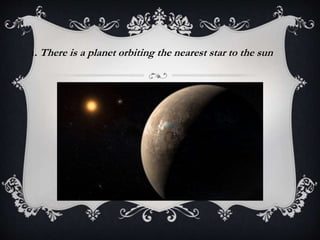
1. There is a planet orbiting the nearest star to the sun
In August, astronomers announced they'd
detected a planet 1.3 times the mass of the Earth
orbiting Proximal Centauri, just 4.2 light years
away. The planet, called Proximal b, sits in the so-
called Goldilocks zone of the faint red dwarf
star, where the average surface temperature of
the planet is not too hot, nor too cold, to harbor
liquid water.
It's been a bumper few years for "exoplanets" –
planets orbiting distant stars – but we will never
find a closer one than this.
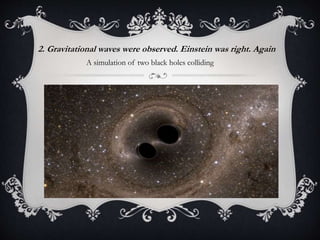
2. Gravitational waves were observed. Einstein was right. Again
A simulation of two black holes colliding
This was the biggest scientific discovery of the year.
In February, scientists from LIGO (Laser
Interferometer Gravitational-wave
Observatory) detected the tiny ripples in the fabric of
space-timecaused by the collision of two unbelievably
massive black holes, more than a billion years ago.
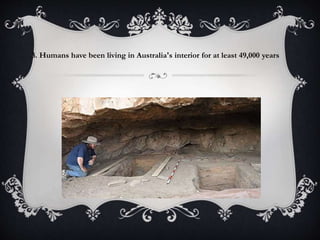
3. Humans have been living in Australia's interior for at least 49,000 years
A chance discovery of a desert rock shelter in the Flinders Ranges has
pushed back the established age for human inhabitation of inland Australia
by more than 10,000 years.
"A man getting out of the car to go to the toilet led to the discovery of one
of the most important sites in Australian pre-history," archaeologist Giles
Hamm told the ABC.
Earlier in 2016, archaeologists from ANU and Sydney Uni announced the
discovery of the world's oldest hafted axe, uncovered in the Kimberley and
dating from between 46,000 and 49,000 years ago.
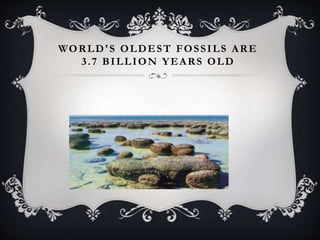
WORLD'S OLDEST FOSSILS ARE
3.7 BILLION YEARS OLD
Australian scientists found the world's oldest fossils in Greenland, a
discovery that could help astrobiologists look for signs of life on Mars.
The fossilised remains of stromatolites formed 3.7 billion years ago
were uncovered by a team led by University of Wollongong
researcher Allen Nutman.
Stromatolites, which are still growing in places like Shark Bay in Western
Australia, are layers of single-celled microbial lifeforms.
SUBMITTED TO
PRINCIPLE ,SIR
EDITED
JAWAD ALI YOUSAFZAI
New discovery

New discovery

  • 3.
  • 4.
    To discover something' s To show something that are neither showed before.
  • 5.
    1. There isa planet orbiting the nearest star to the sun
  • 6.
    In August, astronomersannounced they'd detected a planet 1.3 times the mass of the Earth orbiting Proximal Centauri, just 4.2 light years away. The planet, called Proximal b, sits in the so- called Goldilocks zone of the faint red dwarf star, where the average surface temperature of the planet is not too hot, nor too cold, to harbor liquid water. It's been a bumper few years for "exoplanets" – planets orbiting distant stars – but we will never find a closer one than this.
  • 7.
    2. Gravitational waveswere observed. Einstein was right. Again A simulation of two black holes colliding
  • 8.
    This was thebiggest scientific discovery of the year. In February, scientists from LIGO (Laser Interferometer Gravitational-wave Observatory) detected the tiny ripples in the fabric of space-timecaused by the collision of two unbelievably massive black holes, more than a billion years ago.
  • 9.
    3. Humans havebeen living in Australia's interior for at least 49,000 years
  • 10.
    A chance discoveryof a desert rock shelter in the Flinders Ranges has pushed back the established age for human inhabitation of inland Australia by more than 10,000 years. "A man getting out of the car to go to the toilet led to the discovery of one of the most important sites in Australian pre-history," archaeologist Giles Hamm told the ABC. Earlier in 2016, archaeologists from ANU and Sydney Uni announced the discovery of the world's oldest hafted axe, uncovered in the Kimberley and dating from between 46,000 and 49,000 years ago.
  • 11.
    WORLD'S OLDEST FOSSILSARE 3.7 BILLION YEARS OLD
  • 12.
    Australian scientists foundthe world's oldest fossils in Greenland, a discovery that could help astrobiologists look for signs of life on Mars. The fossilised remains of stromatolites formed 3.7 billion years ago were uncovered by a team led by University of Wollongong researcher Allen Nutman. Stromatolites, which are still growing in places like Shark Bay in Western Australia, are layers of single-celled microbial lifeforms.
  • 13.
  • 14.