Friday – March 6, 2015
6 CITYPLACE DR, SUITE 900│ ST. LOUIS, MISSOURI 63141│ 314.983.1200
1520 S. FIFTH ST., SUITE 309 │ ST. CHARLES, MISSOURI 63303 │ 636.255.3000
2220 S. STATE ROUTE 157, STE. 300 │ GLEN CARBON, ILLINOIS 62034 │ 618.654.3100
Ron Steinkamp
314.983.1238
rsteinkamp@bswllc.com
Public Sector Risk Briefing
• Introductions
• Definition of Occupational Fraud
• Fraud Categories
• 2014 ACFE Fraud Survey Results
• Red Flags of Fraud
• 7 Keys to Fraud Prevention
• Fraud Prevention Self Assessment
© 2015 All Rights Reserved Brown Smith Wallace LLC
Fraud Prevention Discussion
• Name
• Organization
• Title
• What do you hope to learn today?
© 2015 All Rights Reserved Brown Smith Wallace LLC
Introductions
© 2015 All Rights Reserved Brown Smith Wallace LLC
Definition of Occupational Fraud
The use of one’s occupation for personal enrichment
through the deliberate misuse or application of the
employing organization’s resources or assets.
© 2015 All Rights Reserved Brown Smith Wallace LLC
Fraud Categories
• Asset Misappropriation
• Corruption
• Financial Statement
© 2015 All Rights Reserved Brown Smith Wallace LLC
Fraud Categories – Asset Misappropriation
• Public official or employee steals or misuses an
organization’s assets/resources.
• What are some examples you can think of?
 Skimming cash receipts.
 Falsifying voids and refunds.
 Tampering with checks.
 Overstating expenses.
 Creating a ghost employee.
 Creating a fictitious vendor and false invoice.
 Borrowing City property and equipment.
© 2015 All Rights Reserved Brown Smith Wallace LLC
Fraud Categories – Corruption
• Public official or employee’s use of influence in a
way that violates duty to the organization for the
purpose of obtaining benefit for self or someone
else.
• What are some examples you can think of?
 Conflicts of interest.
 Illegal gratuities.
 Bribery.
© 2015 All Rights Reserved Brown Smith Wallace LLC
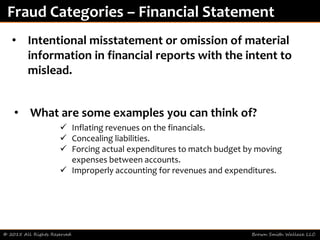
Fraud Categories – Financial Statement
• Intentional misstatement or omission of material
information in financial reports with the intent to
mislead.
• What are some examples you can think of?
 Inflating revenues on the financials.
 Concealing liabilities.
 Forcing actual expenditures to match budget by moving
expenses between accounts.
 Improperly accounting for revenues and expenditures.
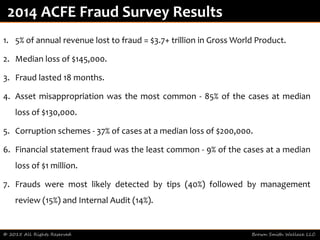
1. 5% of annual revenue lost to fraud = $3.7+ trillion in Gross World Product.
2. Median loss of $145,000.
3. Fraud lasted 18 months.
4. Asset misappropriation was the most common - 85% of the cases at median
loss of $130,000.
5. Corruption schemes - 37% of cases at a median loss of $200,000.
6. Financial statement fraud was the least common - 9% of the cases at a median
loss of $1 million.
7. Frauds were most likely detected by tips (40%) followed by management
review (15%) and Internal Audit (14%).
© 2015 All Rights Reserved Brown Smith Wallace LLC
2014 ACFE Fraud Survey Results
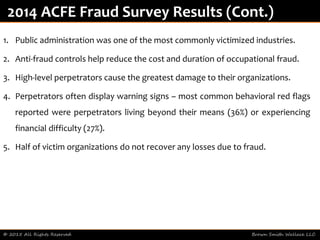
1. Public administration was one of the most commonly victimized industries.
2. Anti-fraud controls help reduce the cost and duration of occupational fraud.
3. High-level perpetrators cause the greatest damage to their organizations.
4. Perpetrators often display warning signs – most common behavioral red flags
reported were perpetrators living beyond their means (36%) or experiencing
financial difficulty (27%).
5. Half of victim organizations do not recover any losses due to fraud.
© 2015 All Rights Reserved Brown Smith Wallace LLC
2014 ACFE Fraud Survey Results (Cont.)
© 2015 All Rights Reserved Brown Smith Wallace LLC
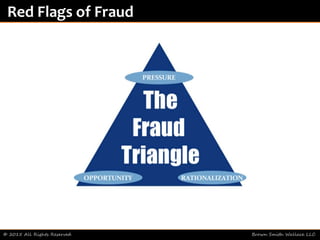
Red Flags of Fraud
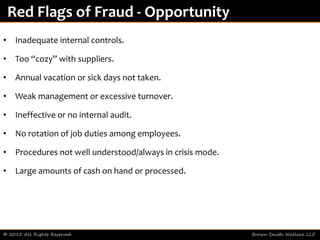
• Inadequate internal controls.
• Too “cozy” with suppliers.
• Annual vacation or sick days not taken.
• Weak management or excessive turnover.
• Ineffective or no internal audit.
• No rotation of job duties among employees.
• Procedures not well understood/always in crisis mode.
• Large amounts of cash on hand or processed.
© 2015 All Rights Reserved Brown Smith Wallace LLC
Red Flags of Fraud - Opportunity
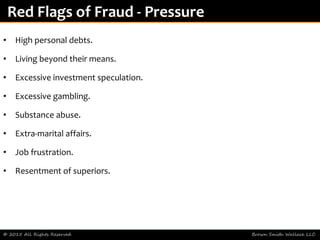
• High personal debts.
• Living beyond their means.
• Excessive investment speculation.
• Excessive gambling.
• Substance abuse.
• Extra-marital affairs.
• Job frustration.
• Resentment of superiors.
© 2015 All Rights Reserved Brown Smith Wallace LLC
Red Flags of Fraud - Pressure
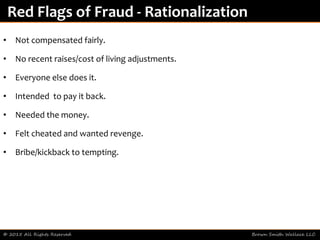
• Not compensated fairly.
• No recent raises/cost of living adjustments.
• Everyone else does it.
• Intended to pay it back.
• Needed the money.
• Felt cheated and wanted revenge.
• Bribe/kickback to tempting.
© 2015 All Rights Reserved Brown Smith Wallace LLC
Red Flags of Fraud - Rationalization
© 2015 All Rights Reserved Brown Smith Wallace LLC
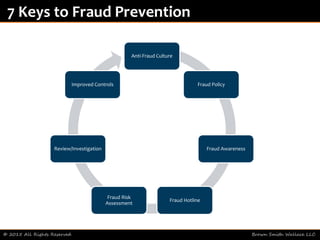
7 Keys to Fraud Prevention
Anti-Fraud Culture
Fraud Policy
Fraud Awareness
Fraud Hotline
Fraud Risk
Assessment
Review/Investigation
Improved Controls
• Set the tone at the top – lead by example.
• Create a positive workplace environment.
• Hire and promote appropriate employees.
• Formalized code of conduct.
• Discipline.
• Strong oversight/governance process:
 Public Officials/Board/Council
 Management
 Internal Auditor
© 2015 All Rights Reserved Brown Smith Wallace LLC
1. Anti-Fraud Culture
• Demonstrate commitment to fighting fraud.
• Apply to all public officials, management, employees, consultants, vendors,
contractors, etc.
• Should include:
 Statement of organization’s position on fraud
 Scope of the policy – who does it apply to
 Management’s responsibility for prevention and detection of fraud
 Definition of fraud
 Actions constituting fraud
 Fraud reporting process/procedures
 Fraud investigation process/procedures
 Unit responsible for administration of the policy and investigating fraud allegations
 Statement on anonymity/confidentiality
 Consequences
© 2015 All Rights Reserved Brown Smith Wallace LLC
2. Fraud Policy
• Reviewed and updated regularly.
• Signed off and agreed to by Board/Council/Top Elected Official.
© 2015 All Rights Reserved Brown Smith Wallace LLC
2. Fraud Policy (Continued)
• All new employees should be trained at time of hiring on the Code of Conduct
and Fraud Policy.
• Training should include:
 Duty to communicate certain matters.
 Discussion of types of matters to be communicated along with examples.
 How to communicate matters.
 Affirmation from senior management regarding employee expectations
and communication responsibilities.
• Refresher training periodically.
© 2015 All Rights Reserved Brown Smith Wallace LLC
3. Fraud Awareness
• Enable employees, vendors, customers and others to communicate concerns
about known or suspected wrongdoing.
• Telephone, email, internet.
• Anonymous.
• Adequately publicized.
• Internal or External.
• Complaint monitoring and investigation/resolution.
© 2015 All Rights Reserved Brown Smith Wallace LLC
4. Fraud Hotline
• Conduct an annual fraud risk assessment.
 Identify critical activities/processes to assess.
 Identify potential fraud schemes.
 Assess likelihood and significance of each scheme.
 Map existing anti-fraud controls to potential fraud schemes.
 Test operating effectiveness of anti-fraud controls.
 Identify any control gaps and/or deficiencies
• Mitigate fraud risks.
 Make changes to activities/processes = transfer or eliminate risks.
 Improve anti-fraud controls
• Monitor fraud risks.
 Develop data analytics to monitor fraud risks.
 Utilize Internal Audit to conduct audits of risk activities/processes.
© 2015 All Rights Reserved Brown Smith Wallace LLC
5. Fraud Risk Assessment
• All concerns/suspicions of wrongdoing should be promptly reviewed and
determination made whether a fraud investigation is warranted.
• Develop a policy for fraud reviews and investigations that specifies:
 Who is responsible for the review/investigation.
 Roles of Legal Counsel, Human Resources, Internal Audit, others.
 Process for conducting the review/investigation.
 Documentation requirements.
 Reporting requirements.
 When to involve law enforcement.
© 2015 All Rights Reserved Brown Smith Wallace LLC
6. Review/Investigation
• Gather sufficient information and perform procedures necessary to determine:
 Whether fraud has occurred.
 Loss or exposure associated with the fraud.
 Who was involved and how it happened.
• Must prepare, document and preserve evidence sufficient for potential legal
proceedings.
• Include experts = Certified Fraud Examiner (CFE).
© 2015 All Rights Reserved Brown Smith Wallace LLC
6. Review/Investigation (Cont.)
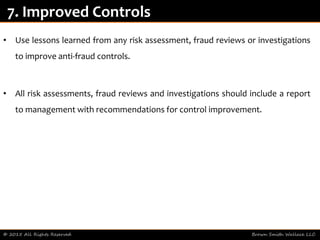
• Use lessons learned from any risk assessment, fraud reviews or investigations
to improve anti-fraud controls.
• All risk assessments, fraud reviews and investigations should include a report
to management with recommendations for control improvement.
© 2015 All Rights Reserved Brown Smith Wallace LLC
7. Improved Controls
© 2015 All Rights Reserved Brown Smith Wallace LLC
Fraud Self Assessment
© 2015 All Rights Reserved Brown Smith Wallace LLC
Questions/Answers

Fraud Prevention - St. Louis - March 6, 2015

  • 1.
    Friday – March6, 2015 6 CITYPLACE DR, SUITE 900│ ST. LOUIS, MISSOURI 63141│ 314.983.1200 1520 S. FIFTH ST., SUITE 309 │ ST. CHARLES, MISSOURI 63303 │ 636.255.3000 2220 S. STATE ROUTE 157, STE. 300 │ GLEN CARBON, ILLINOIS 62034 │ 618.654.3100 Ron Steinkamp 314.983.1238 rsteinkamp@bswllc.com Public Sector Risk Briefing
  • 2.
    • Introductions • Definitionof Occupational Fraud • Fraud Categories • 2014 ACFE Fraud Survey Results • Red Flags of Fraud • 7 Keys to Fraud Prevention • Fraud Prevention Self Assessment © 2015 All Rights Reserved Brown Smith Wallace LLC Fraud Prevention Discussion
  • 3.
    • Name • Organization •Title • What do you hope to learn today? © 2015 All Rights Reserved Brown Smith Wallace LLC Introductions
  • 4.
    © 2015 AllRights Reserved Brown Smith Wallace LLC Definition of Occupational Fraud The use of one’s occupation for personal enrichment through the deliberate misuse or application of the employing organization’s resources or assets.
  • 5.
    © 2015 AllRights Reserved Brown Smith Wallace LLC Fraud Categories • Asset Misappropriation • Corruption • Financial Statement
  • 6.
    © 2015 AllRights Reserved Brown Smith Wallace LLC Fraud Categories – Asset Misappropriation • Public official or employee steals or misuses an organization’s assets/resources. • What are some examples you can think of?  Skimming cash receipts.  Falsifying voids and refunds.  Tampering with checks.  Overstating expenses.  Creating a ghost employee.  Creating a fictitious vendor and false invoice.  Borrowing City property and equipment.
  • 7.
    © 2015 AllRights Reserved Brown Smith Wallace LLC Fraud Categories – Corruption • Public official or employee’s use of influence in a way that violates duty to the organization for the purpose of obtaining benefit for self or someone else. • What are some examples you can think of?  Conflicts of interest.  Illegal gratuities.  Bribery.
  • 8.
    © 2015 AllRights Reserved Brown Smith Wallace LLC Fraud Categories – Financial Statement • Intentional misstatement or omission of material information in financial reports with the intent to mislead. • What are some examples you can think of?  Inflating revenues on the financials.  Concealing liabilities.  Forcing actual expenditures to match budget by moving expenses between accounts.  Improperly accounting for revenues and expenditures.
  • 9.
    1. 5% ofannual revenue lost to fraud = $3.7+ trillion in Gross World Product. 2. Median loss of $145,000. 3. Fraud lasted 18 months. 4. Asset misappropriation was the most common - 85% of the cases at median loss of $130,000. 5. Corruption schemes - 37% of cases at a median loss of $200,000. 6. Financial statement fraud was the least common - 9% of the cases at a median loss of $1 million. 7. Frauds were most likely detected by tips (40%) followed by management review (15%) and Internal Audit (14%). © 2015 All Rights Reserved Brown Smith Wallace LLC 2014 ACFE Fraud Survey Results
  • 10.
    1. Public administrationwas one of the most commonly victimized industries. 2. Anti-fraud controls help reduce the cost and duration of occupational fraud. 3. High-level perpetrators cause the greatest damage to their organizations. 4. Perpetrators often display warning signs – most common behavioral red flags reported were perpetrators living beyond their means (36%) or experiencing financial difficulty (27%). 5. Half of victim organizations do not recover any losses due to fraud. © 2015 All Rights Reserved Brown Smith Wallace LLC 2014 ACFE Fraud Survey Results (Cont.)
  • 11.
    © 2015 AllRights Reserved Brown Smith Wallace LLC Red Flags of Fraud
  • 12.
    • Inadequate internalcontrols. • Too “cozy” with suppliers. • Annual vacation or sick days not taken. • Weak management or excessive turnover. • Ineffective or no internal audit. • No rotation of job duties among employees. • Procedures not well understood/always in crisis mode. • Large amounts of cash on hand or processed. © 2015 All Rights Reserved Brown Smith Wallace LLC Red Flags of Fraud - Opportunity
  • 13.
    • High personaldebts. • Living beyond their means. • Excessive investment speculation. • Excessive gambling. • Substance abuse. • Extra-marital affairs. • Job frustration. • Resentment of superiors. © 2015 All Rights Reserved Brown Smith Wallace LLC Red Flags of Fraud - Pressure
  • 14.
    • Not compensatedfairly. • No recent raises/cost of living adjustments. • Everyone else does it. • Intended to pay it back. • Needed the money. • Felt cheated and wanted revenge. • Bribe/kickback to tempting. © 2015 All Rights Reserved Brown Smith Wallace LLC Red Flags of Fraud - Rationalization
  • 15.
    © 2015 AllRights Reserved Brown Smith Wallace LLC 7 Keys to Fraud Prevention Anti-Fraud Culture Fraud Policy Fraud Awareness Fraud Hotline Fraud Risk Assessment Review/Investigation Improved Controls
  • 16.
    • Set thetone at the top – lead by example. • Create a positive workplace environment. • Hire and promote appropriate employees. • Formalized code of conduct. • Discipline. • Strong oversight/governance process:  Public Officials/Board/Council  Management  Internal Auditor © 2015 All Rights Reserved Brown Smith Wallace LLC 1. Anti-Fraud Culture
  • 17.
    • Demonstrate commitmentto fighting fraud. • Apply to all public officials, management, employees, consultants, vendors, contractors, etc. • Should include:  Statement of organization’s position on fraud  Scope of the policy – who does it apply to  Management’s responsibility for prevention and detection of fraud  Definition of fraud  Actions constituting fraud  Fraud reporting process/procedures  Fraud investigation process/procedures  Unit responsible for administration of the policy and investigating fraud allegations  Statement on anonymity/confidentiality  Consequences © 2015 All Rights Reserved Brown Smith Wallace LLC 2. Fraud Policy
  • 18.
    • Reviewed andupdated regularly. • Signed off and agreed to by Board/Council/Top Elected Official. © 2015 All Rights Reserved Brown Smith Wallace LLC 2. Fraud Policy (Continued)
  • 19.
    • All newemployees should be trained at time of hiring on the Code of Conduct and Fraud Policy. • Training should include:  Duty to communicate certain matters.  Discussion of types of matters to be communicated along with examples.  How to communicate matters.  Affirmation from senior management regarding employee expectations and communication responsibilities. • Refresher training periodically. © 2015 All Rights Reserved Brown Smith Wallace LLC 3. Fraud Awareness
  • 20.
    • Enable employees,vendors, customers and others to communicate concerns about known or suspected wrongdoing. • Telephone, email, internet. • Anonymous. • Adequately publicized. • Internal or External. • Complaint monitoring and investigation/resolution. © 2015 All Rights Reserved Brown Smith Wallace LLC 4. Fraud Hotline
  • 21.
    • Conduct anannual fraud risk assessment.  Identify critical activities/processes to assess.  Identify potential fraud schemes.  Assess likelihood and significance of each scheme.  Map existing anti-fraud controls to potential fraud schemes.  Test operating effectiveness of anti-fraud controls.  Identify any control gaps and/or deficiencies • Mitigate fraud risks.  Make changes to activities/processes = transfer or eliminate risks.  Improve anti-fraud controls • Monitor fraud risks.  Develop data analytics to monitor fraud risks.  Utilize Internal Audit to conduct audits of risk activities/processes. © 2015 All Rights Reserved Brown Smith Wallace LLC 5. Fraud Risk Assessment
  • 22.
    • All concerns/suspicionsof wrongdoing should be promptly reviewed and determination made whether a fraud investigation is warranted. • Develop a policy for fraud reviews and investigations that specifies:  Who is responsible for the review/investigation.  Roles of Legal Counsel, Human Resources, Internal Audit, others.  Process for conducting the review/investigation.  Documentation requirements.  Reporting requirements.  When to involve law enforcement. © 2015 All Rights Reserved Brown Smith Wallace LLC 6. Review/Investigation
  • 23.
    • Gather sufficientinformation and perform procedures necessary to determine:  Whether fraud has occurred.  Loss or exposure associated with the fraud.  Who was involved and how it happened. • Must prepare, document and preserve evidence sufficient for potential legal proceedings. • Include experts = Certified Fraud Examiner (CFE). © 2015 All Rights Reserved Brown Smith Wallace LLC 6. Review/Investigation (Cont.)
  • 24.
    • Use lessonslearned from any risk assessment, fraud reviews or investigations to improve anti-fraud controls. • All risk assessments, fraud reviews and investigations should include a report to management with recommendations for control improvement. © 2015 All Rights Reserved Brown Smith Wallace LLC 7. Improved Controls
  • 25.
    © 2015 AllRights Reserved Brown Smith Wallace LLC Fraud Self Assessment
  • 26.
    © 2015 AllRights Reserved Brown Smith Wallace LLC Questions/Answers

Editor's Notes

  • #3 This is not a presentation, it is a discussion amongst peers. The goal of this discussion is to share ideas with each other. It would benefit us all to share our experiences with each other during this forum.
  • #4 Please share a little about yourself with the group.