Hello 2000…..………2002…………..2004……………..2006……..…..2007…… 2008.. I am a professional network and community advisor and multi-domain ‘facilitator’. In other words, I help groups of people do the things that they want and/or need to do.
Here’s the plan Networking: why, what Quick timeline: past, present Present: humans: social everything? Quick diversion via KnowledgeBoard: did and learnt The four Ps Humans and personalities Not so implicit messages in technology Quick timeline: future Tools to make it better Future
Why do we network? Learn something new Learn more about something they know Share stuff about what they know Give something back to the organisation Build their status in a community Meet like-minded people Help to make positive change Organise things:  e.g. global teams Local groups Event teams From work with VSO, Feb 2008
So networks need to… Offer us learning opportunities Help us give something back Respect our time Provide us with interesting people to meet Help us make the connections we want to make Link us to the rights organisations effectively Respect our personalities Provide the managers with a suitable space to do all the above
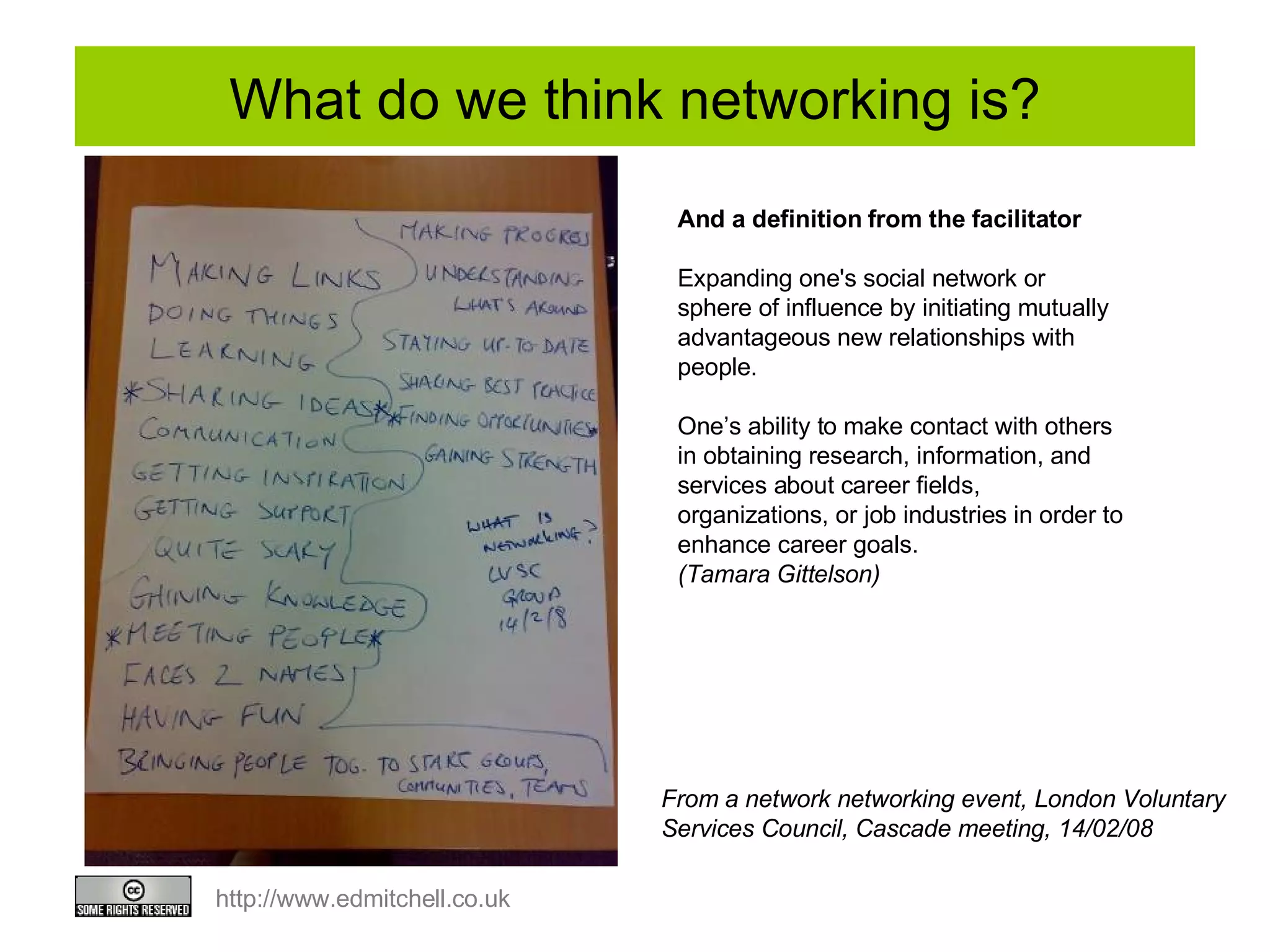
What do we think networking is? And a definition from the facilitator Expanding one's social network or sphere of influence by initiating mutually advantageous new relationships with people. One’s ability to make contact with others in obtaining research, information, and services about career fields, organizations, or job industries in order to enhance career goals.  (Tamara Gittelson) From a network networking event, London Voluntary Services Council, Cascade meeting, 14/02/08
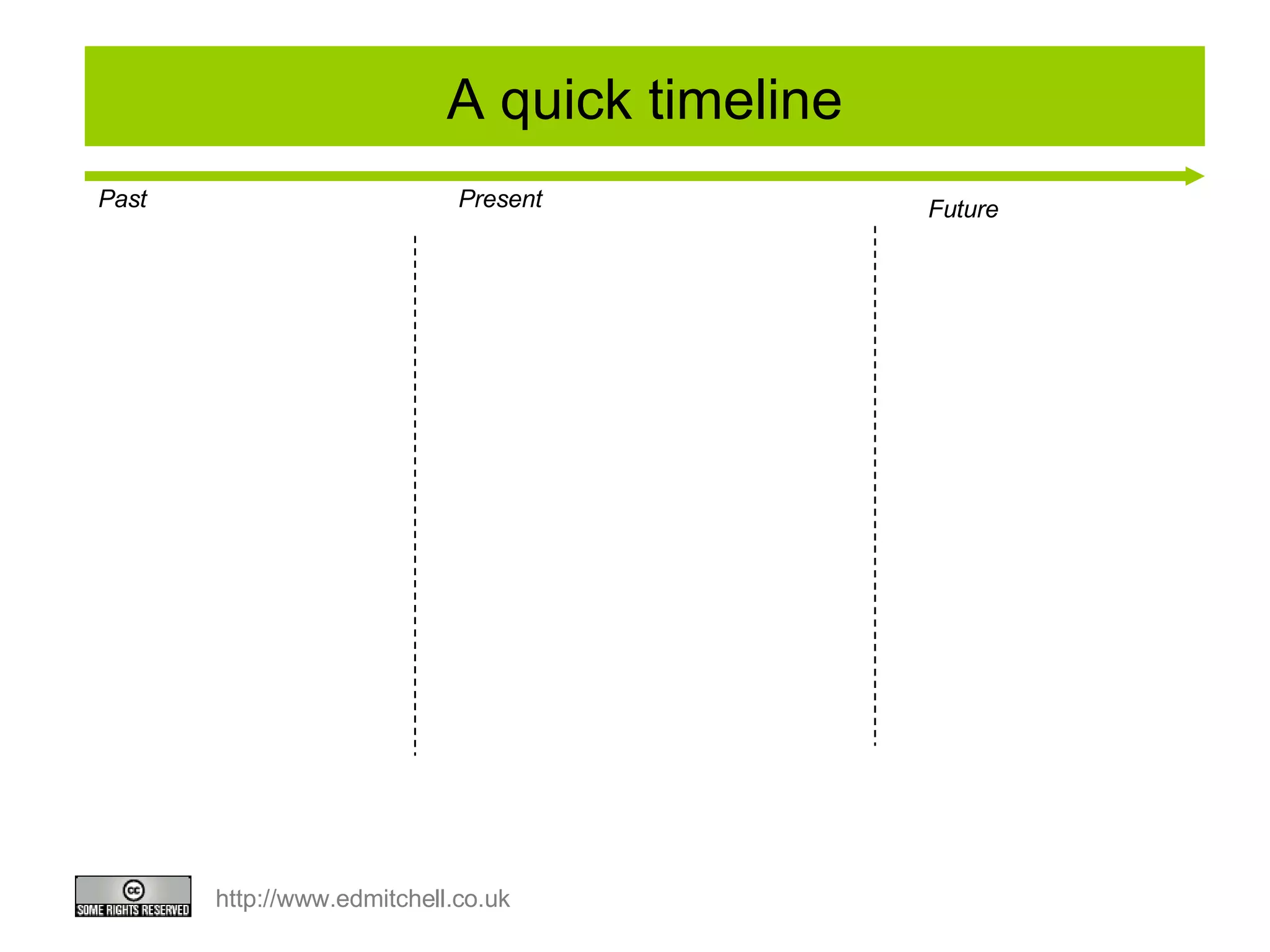
A quick timeline Past Present Future
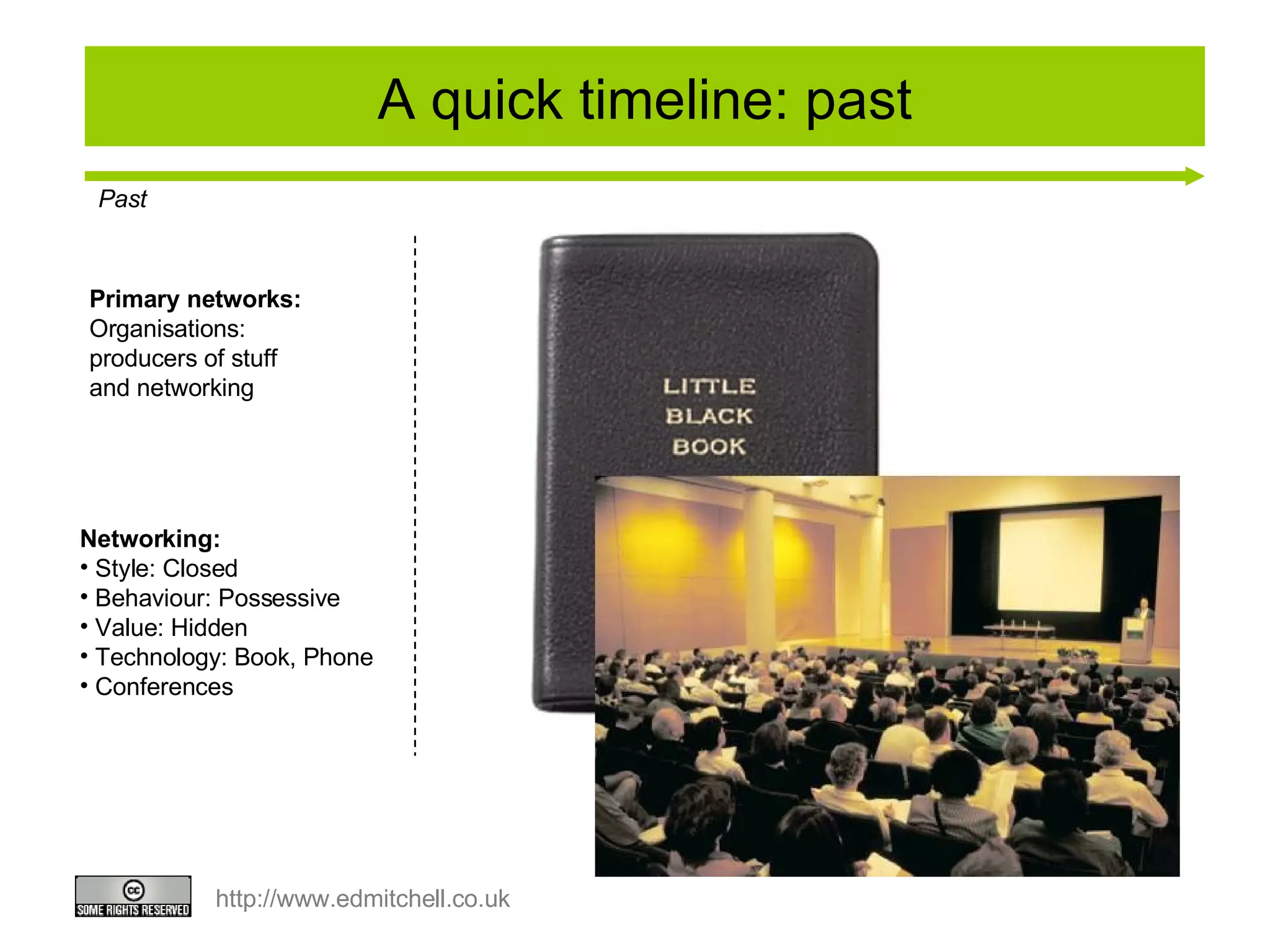
A quick timeline: past Primary networks:  Organisations:  producers of stuff and networking Networking:  Style: Closed Behaviour: Possessive Value: Hidden Technology: Book, Phone Conferences Past
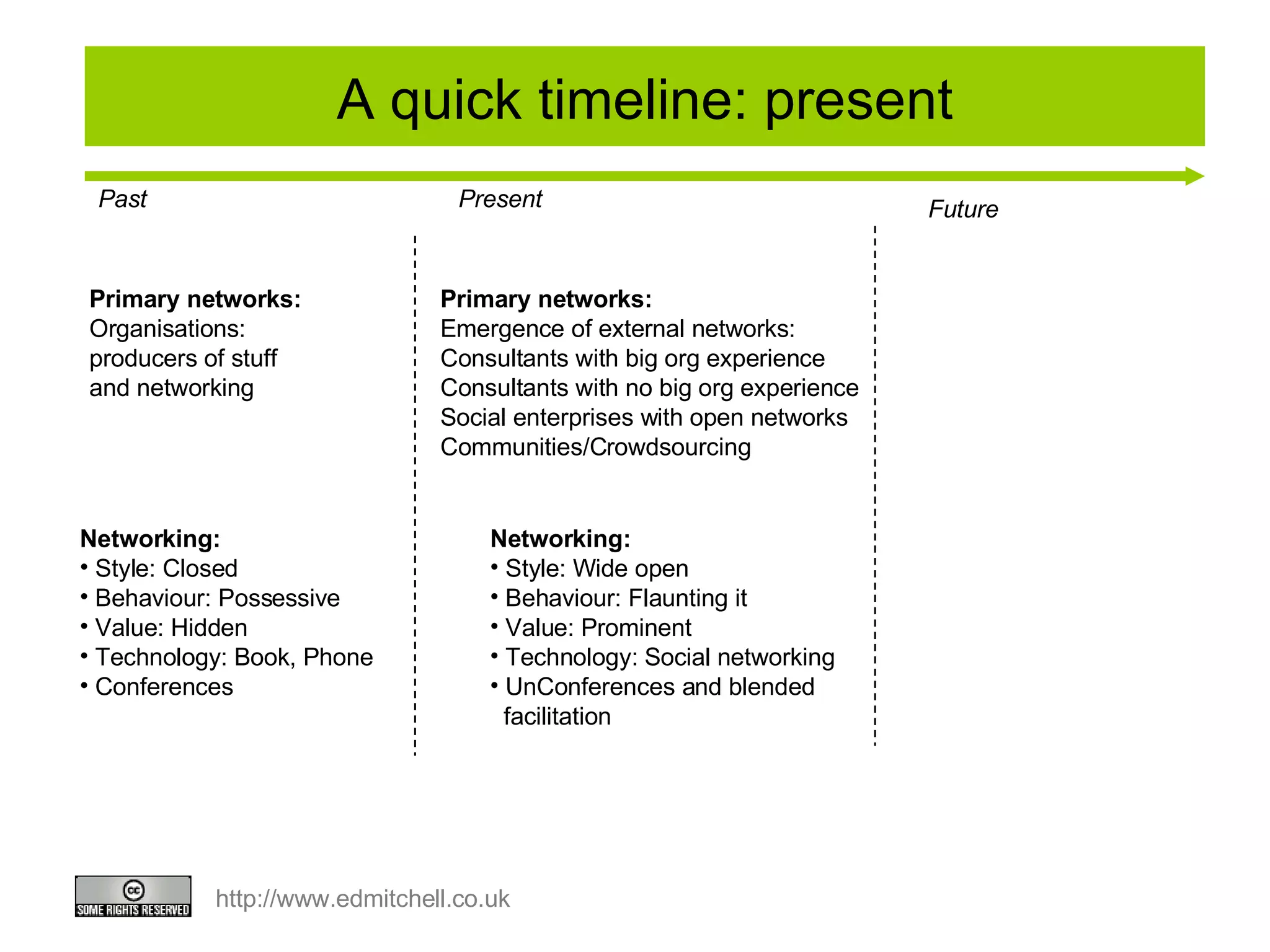
A quick timeline: present Primary networks:  Organisations:  producers of stuff and networking Networking:  Style: Closed Behaviour: Possessive Value: Hidden Technology: Book, Phone Conferences Primary networks: Emergence of external networks: Consultants with big org experience Consultants with no big org experience Social enterprises with open networks Communities/Crowdsourcing Networking:  Style: Wide open Behaviour: Flaunting it Value: Prominent Technology: Social networking UnConferences and blended facilitation Past Present Future
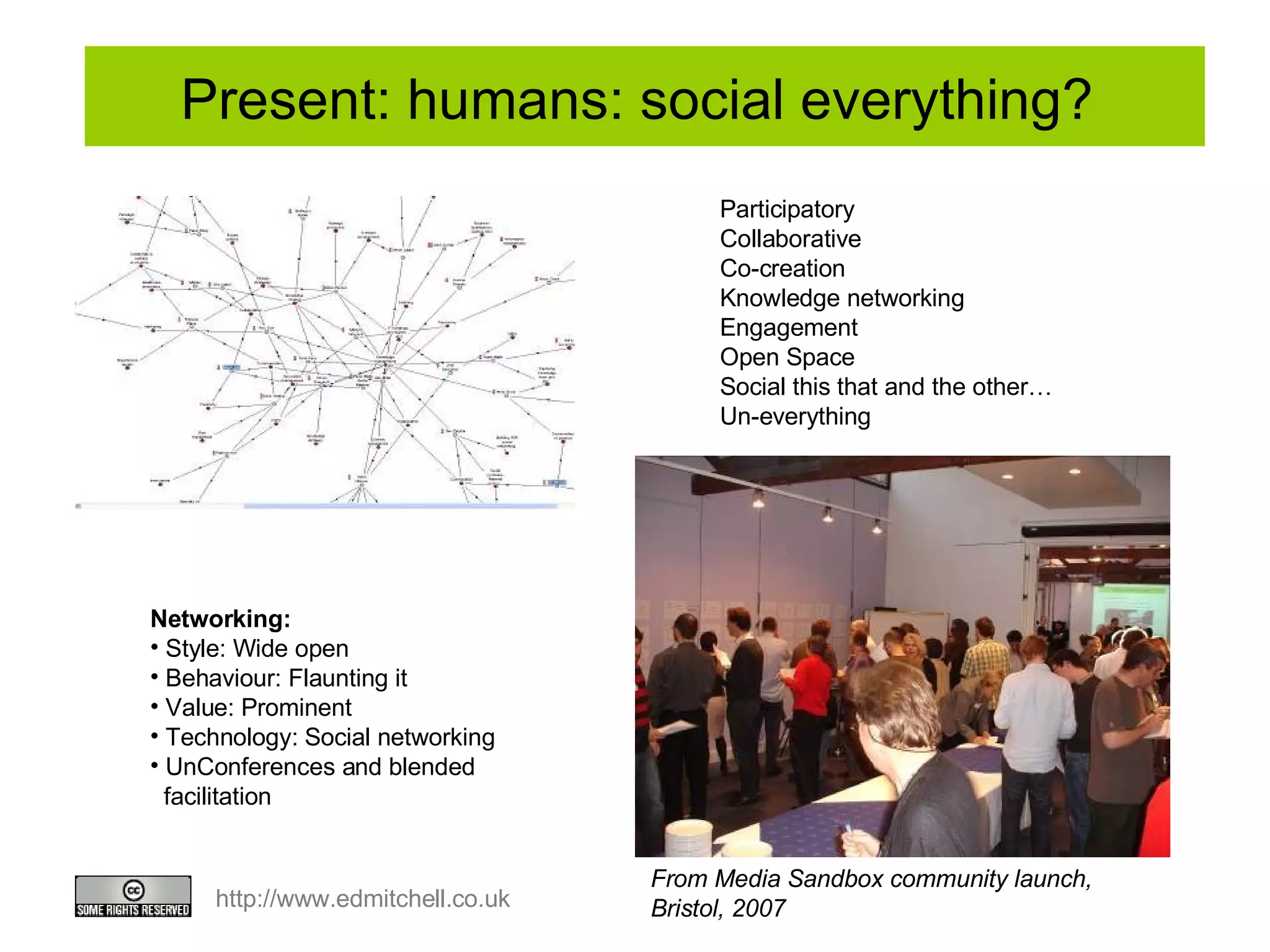
Present: humans: social everything?  Networking:  Style: Wide open Behaviour: Flaunting it Value: Prominent Technology: Social networking UnConferences and blended facilitation Participatory Collaborative Co-creation Knowledge networking Engagement Open Space Social this that and the other…  Un-everything From Media Sandbox community launch,  Bristol, 2007
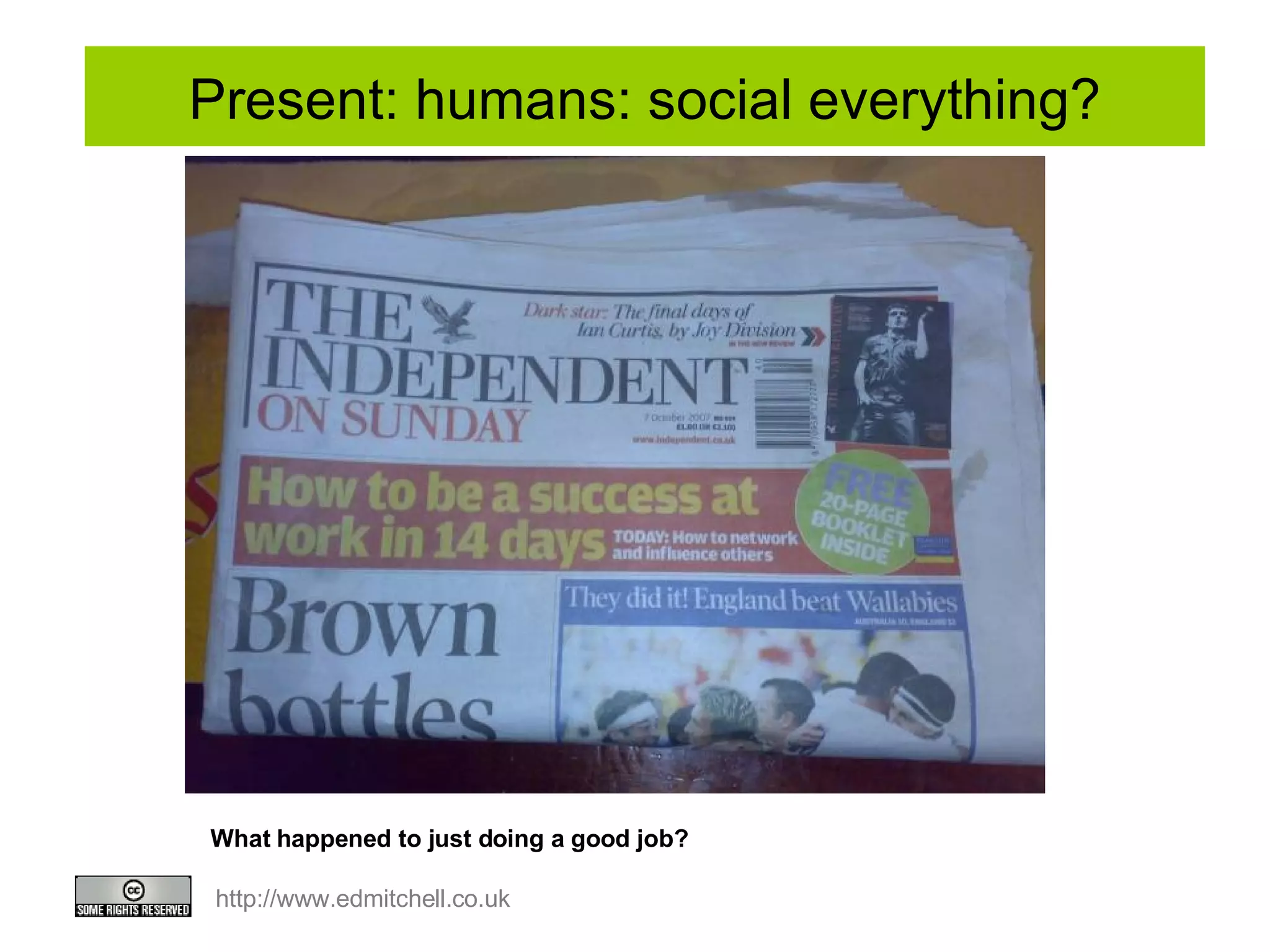
Present: humans: social everything? What happened to just doing a good job?
Present: humans: social everything?
Present: humans: social everything? Participatory Collaborative Co-creation Knowledge networking Speed networking Open Space Social this that and the other…  Un-everything Network experts Know everyone …
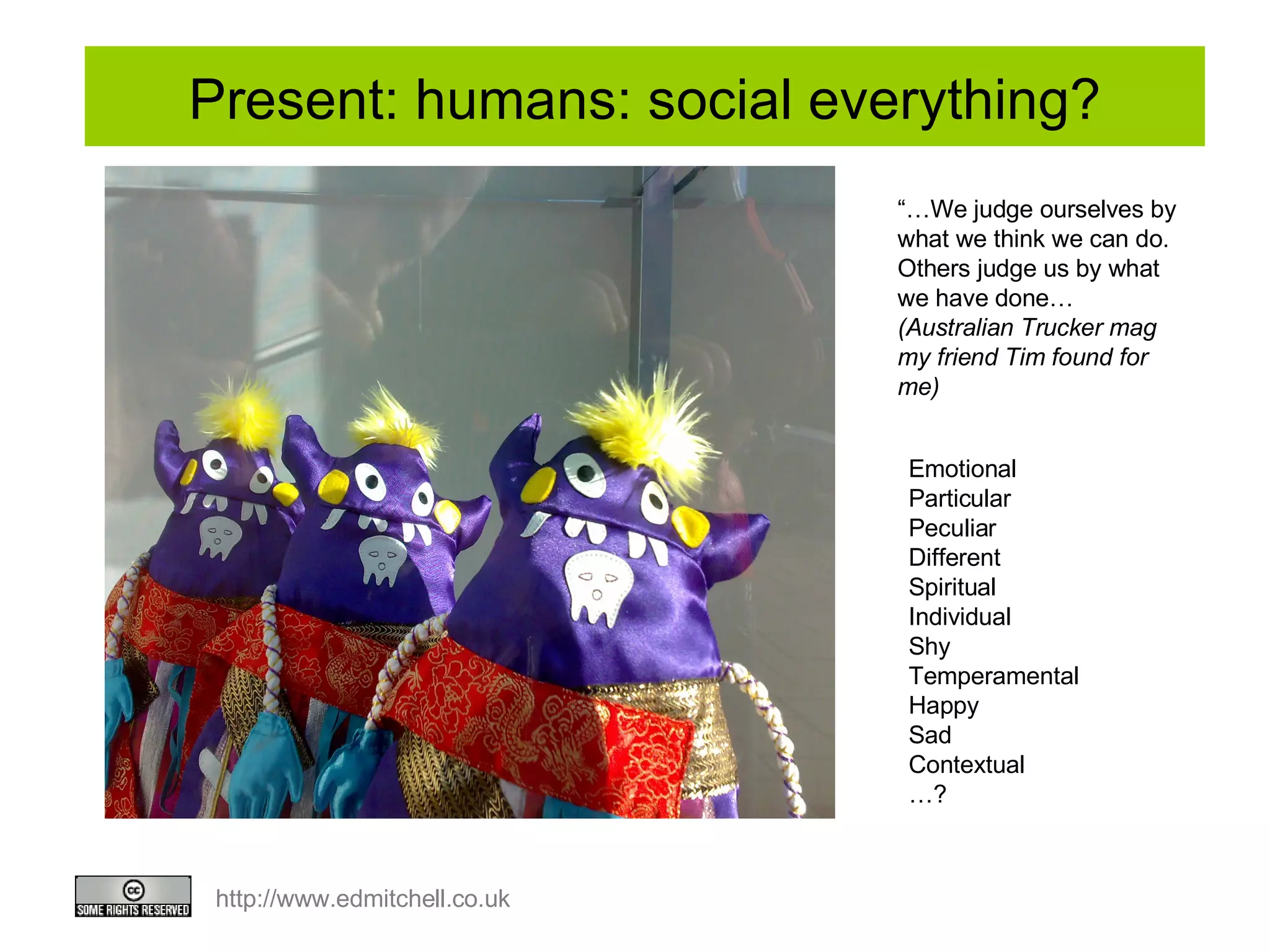
Present: humans: social everything? Emotional Particular Peculiar Different Spiritual  Individual  Shy Temperamental Happy  Sad Contextual … ?  “… We judge ourselves by what we think we can do. Others judge us by what we have done… (Australian Trucker mag my friend Tim found for me)
What did we do on KnowledgeBoard?  Facilities to attract: Published content Commenting Q & A Conversations Facilitated environment Publishing articles  and encouraging discussion Hosting interest groups  and encouraging discussion Sending newsletters  and encouraging discussion Measuring …  the discussion Social structures to build trust: Co-creation of shared space Events (physical and virtual) Realise-able results from input …  Touch points along the relationship Workshops at conferences and our own conferences 3 x Community books Research partnerships and papers
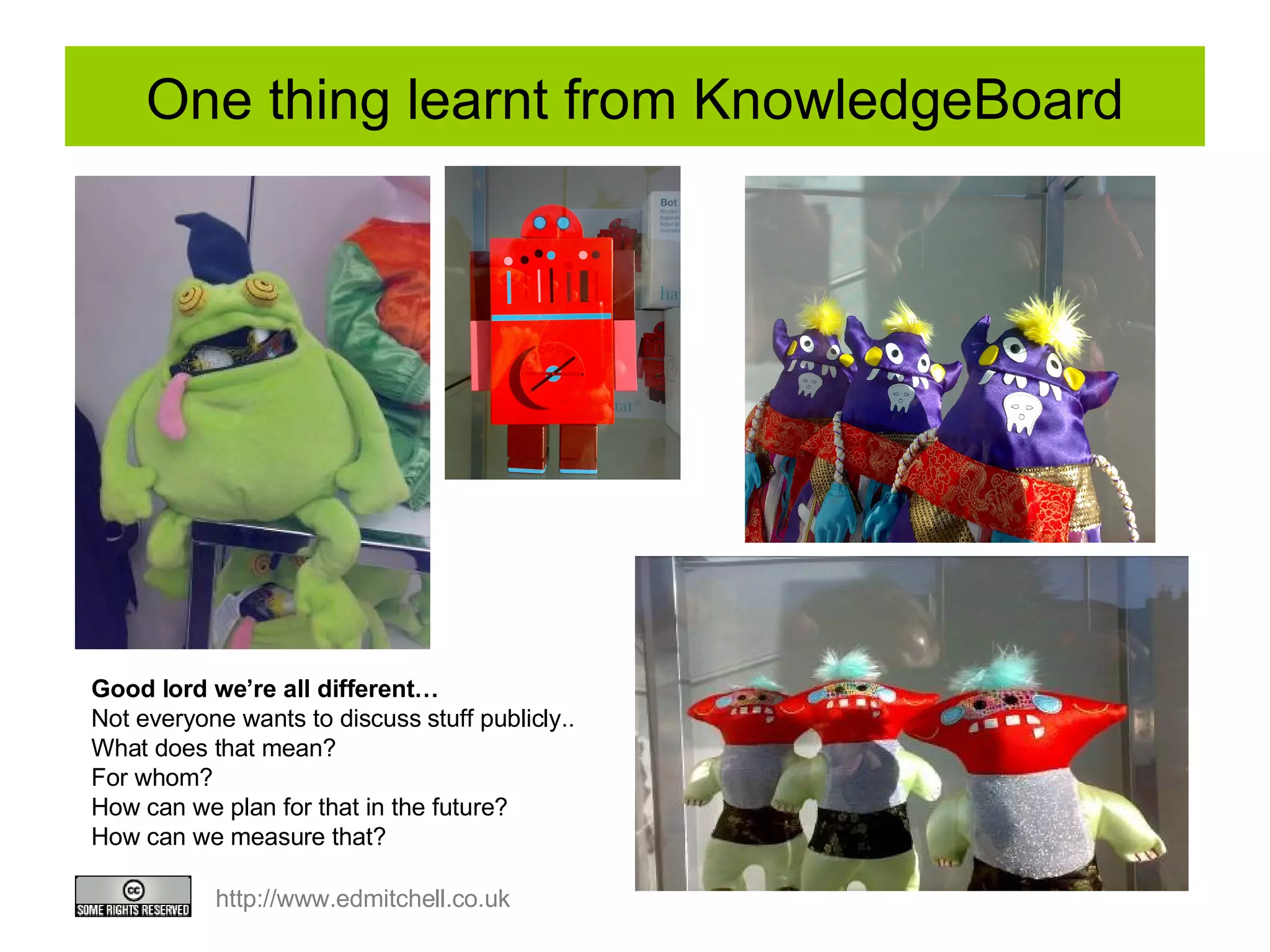
One thing learnt from KnowledgeBoard Good lord we’re all different… Not everyone wants to discuss stuff publicly.. What does that mean? For whom?  How can we plan for that in the future?  How can we measure that?
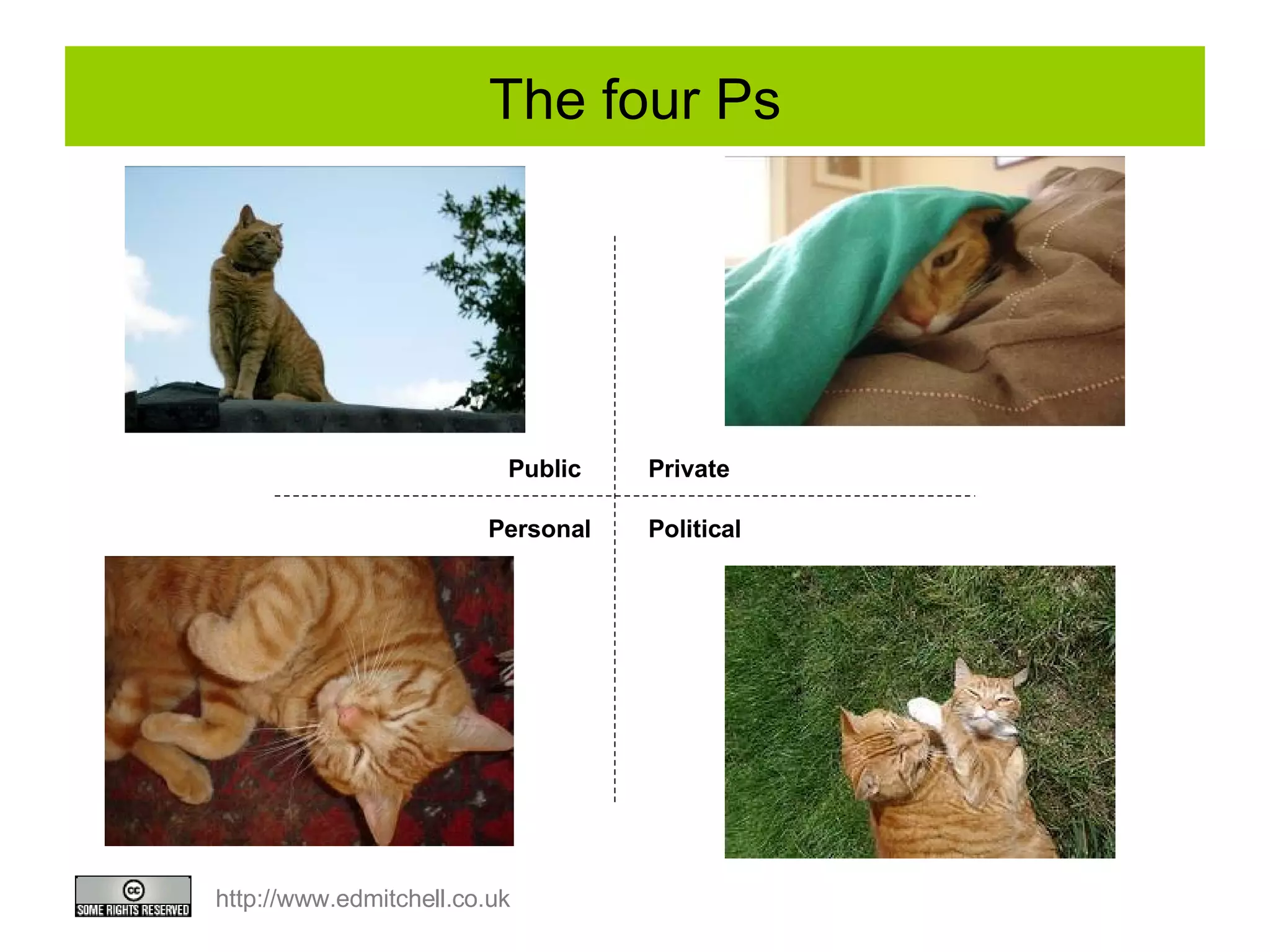
The four Ps Public Personal Private Political
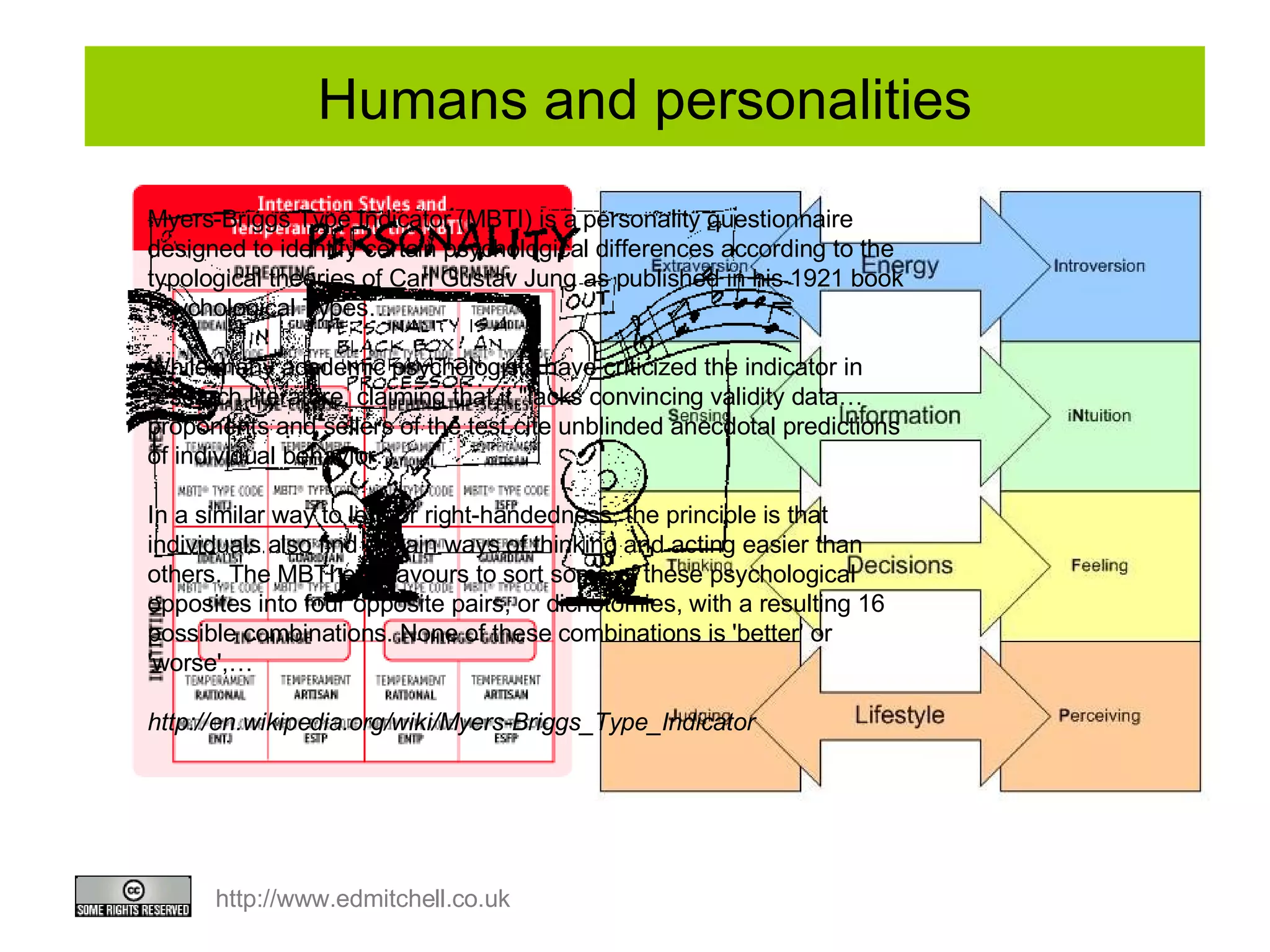
Myers-Briggs Type Indicator (MBTI) is a personality questionnaire designed to identify certain psychological differences according to the typological theories of Carl Gustav Jung as published in his 1921 book Psychological Types… While many academic psychologists have criticized the indicator in research literature, claiming that it "lacks convincing validity data…  proponents and sellers of the test cite unblinded anecdotal predictions of individual behavior… In a similar way to left- or right-handedness, the principle is that individuals also find certain ways of thinking and acting easier than others. The MBTI endeavours to sort some of these psychological opposites into four opposite pairs, or dichotomies, with a resulting 16 possible combinations. None of these combinations is 'better' or 'worse',… http://en.wikipedia.org/wiki/Myers-Briggs_Type_Indicator Humans and personalities
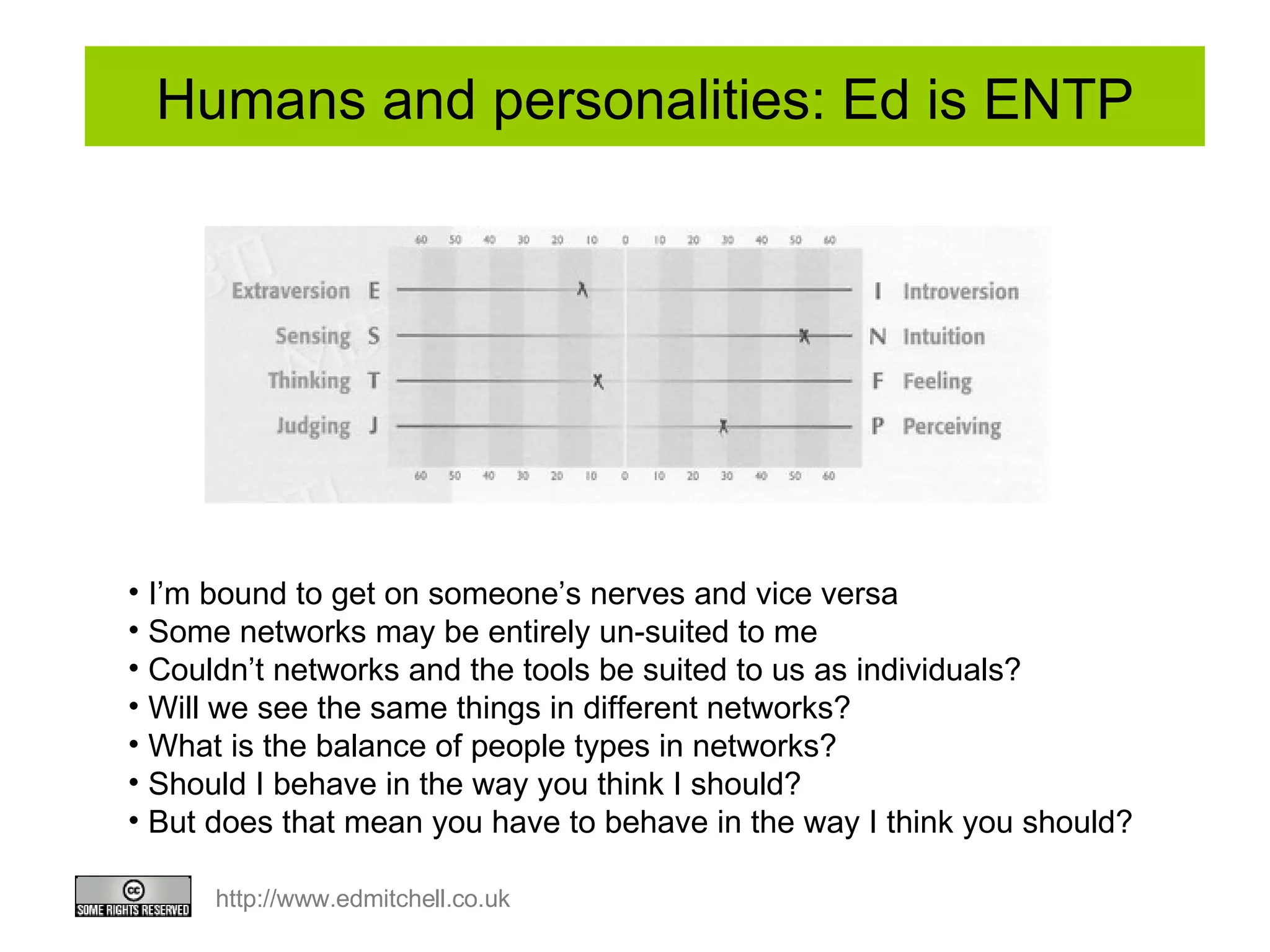
Humans and personalities: Ed is ENTP I’m bound to get on someone’s nerves and vice versa Some networks may be entirely un-suited to me  Couldn’t networks and the tools be suited to us as individuals?  Will we see the same things in different networks?  What is the balance of people types in networks?  Should I behave in the way you think I should?  But does that mean you have to behave in the way I think you should?
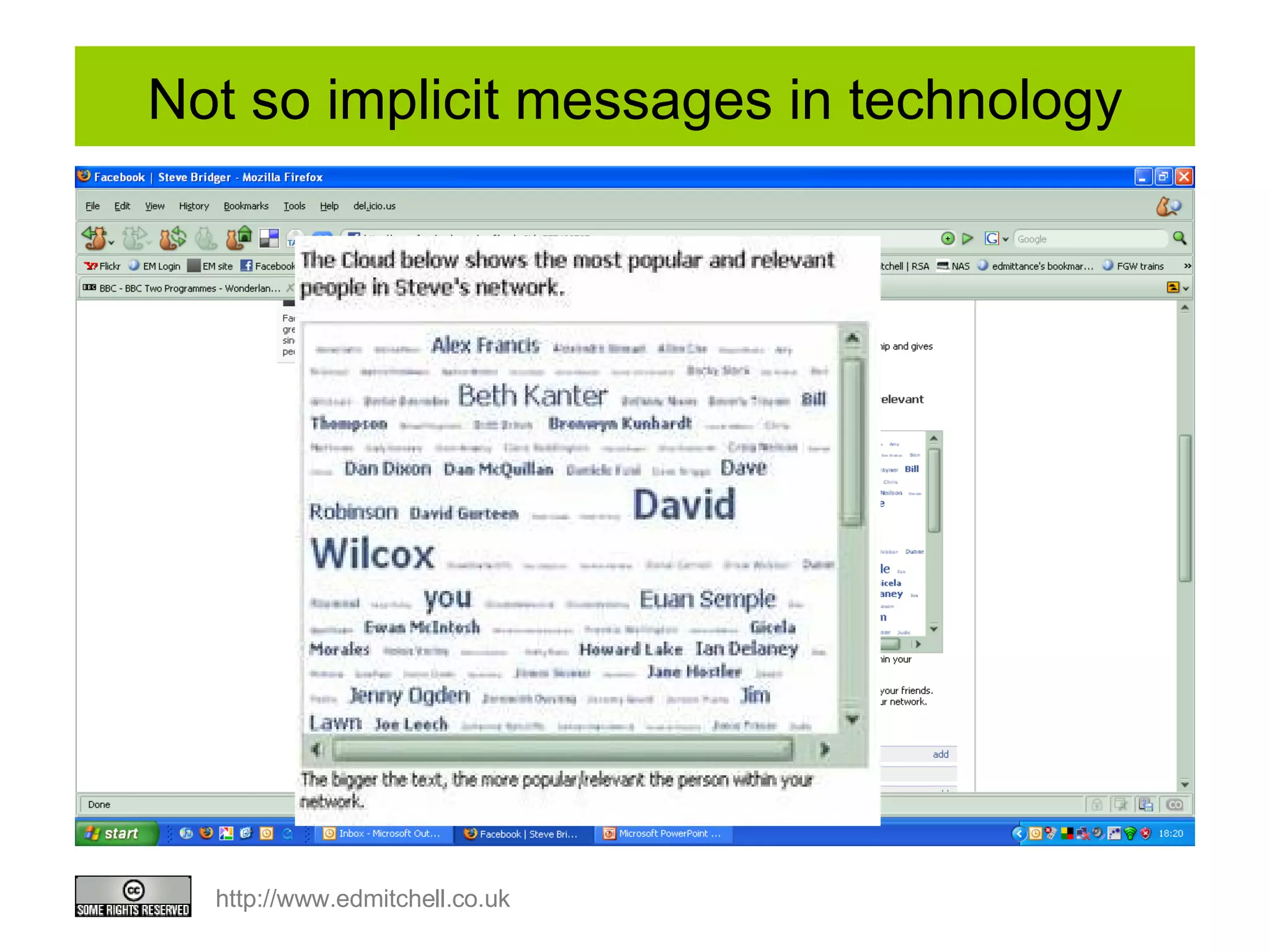
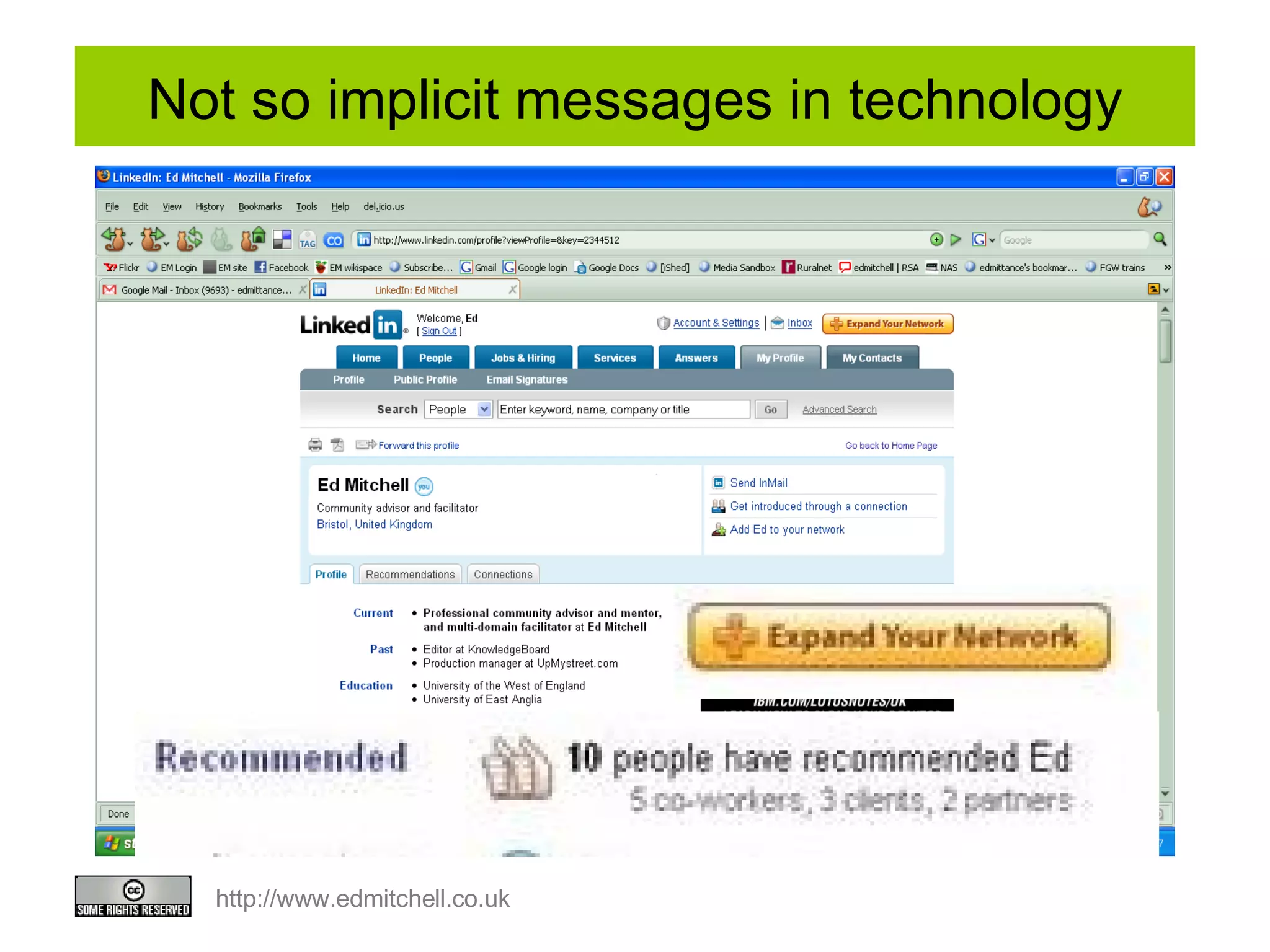
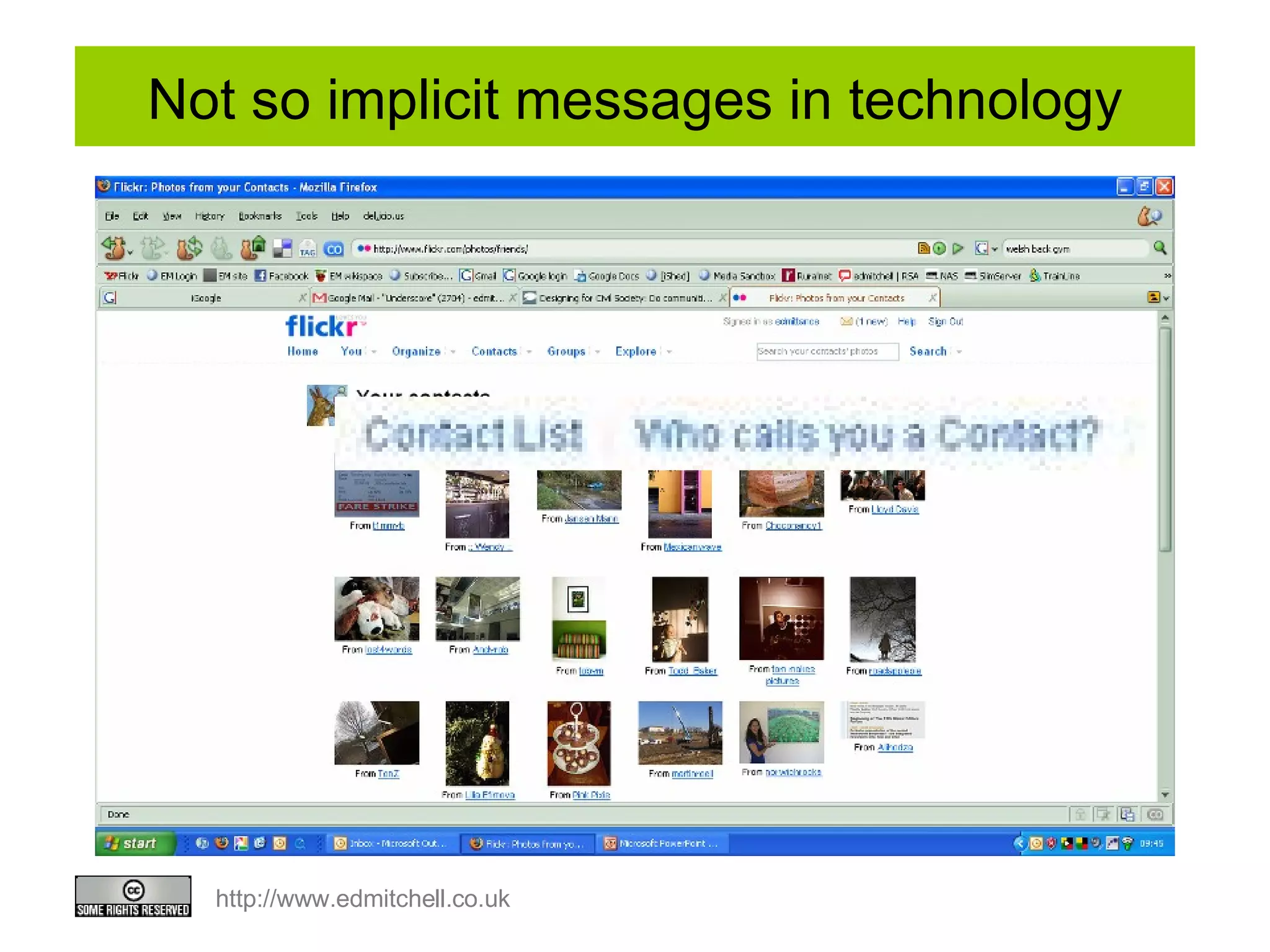
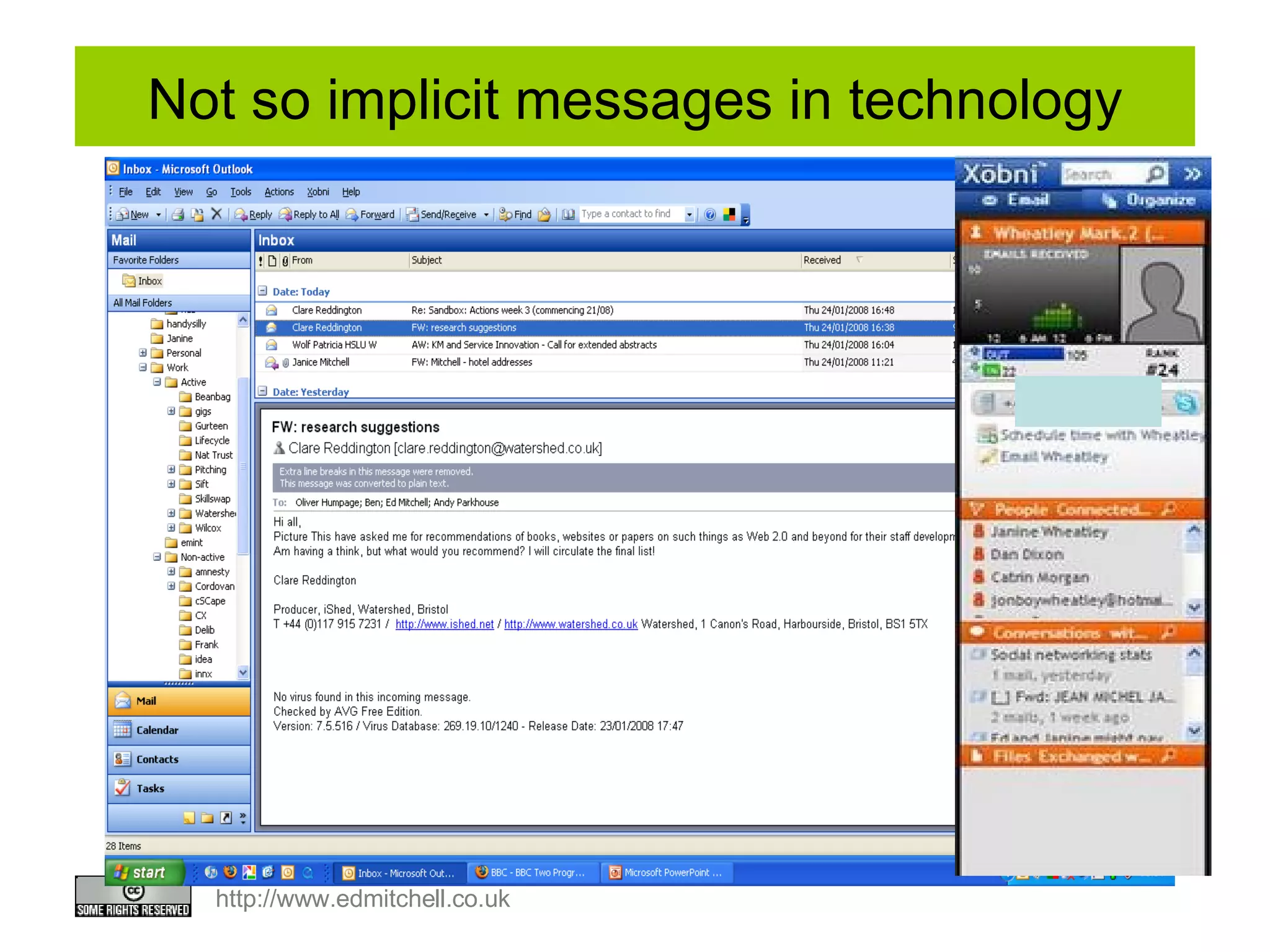
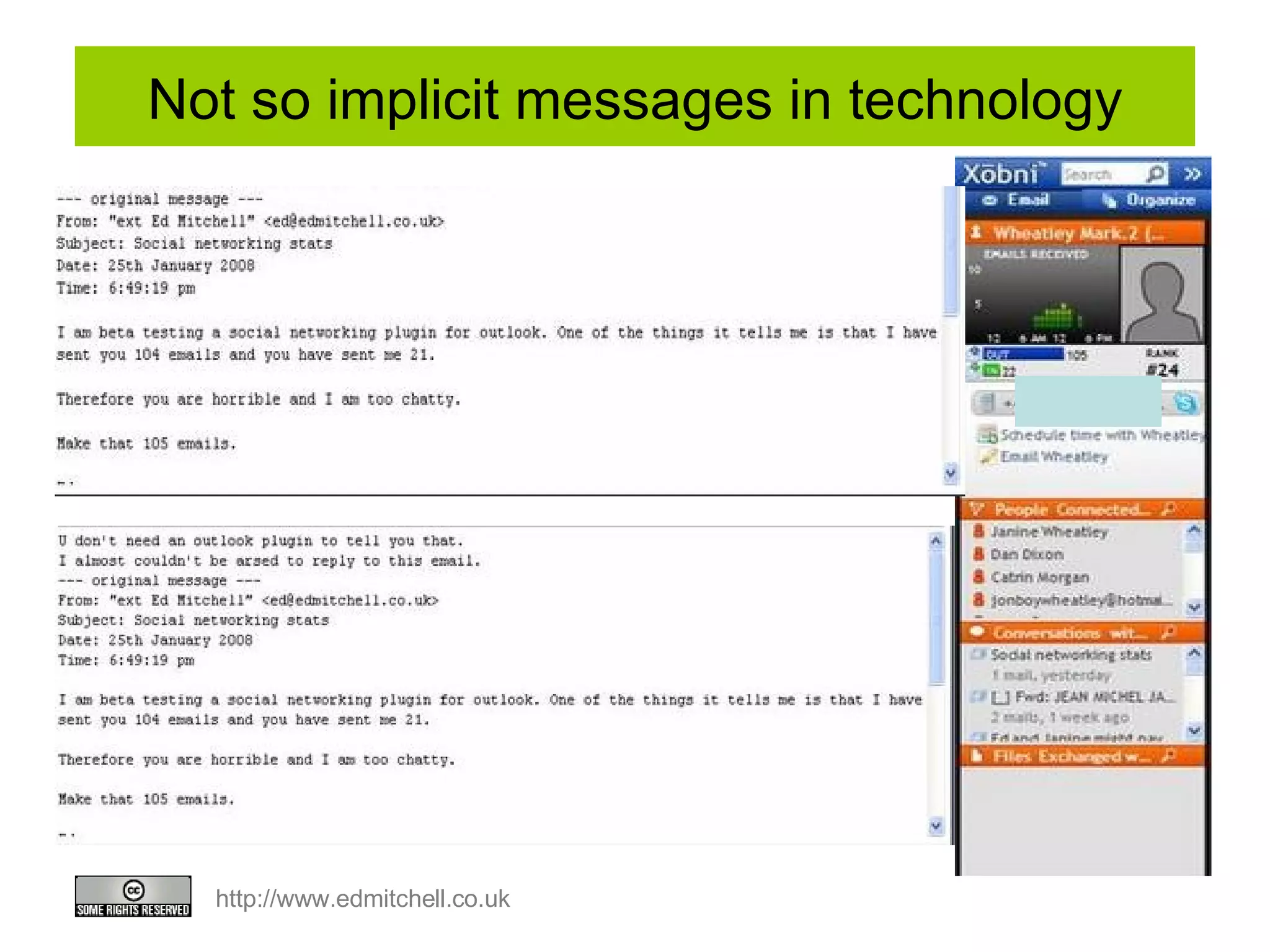
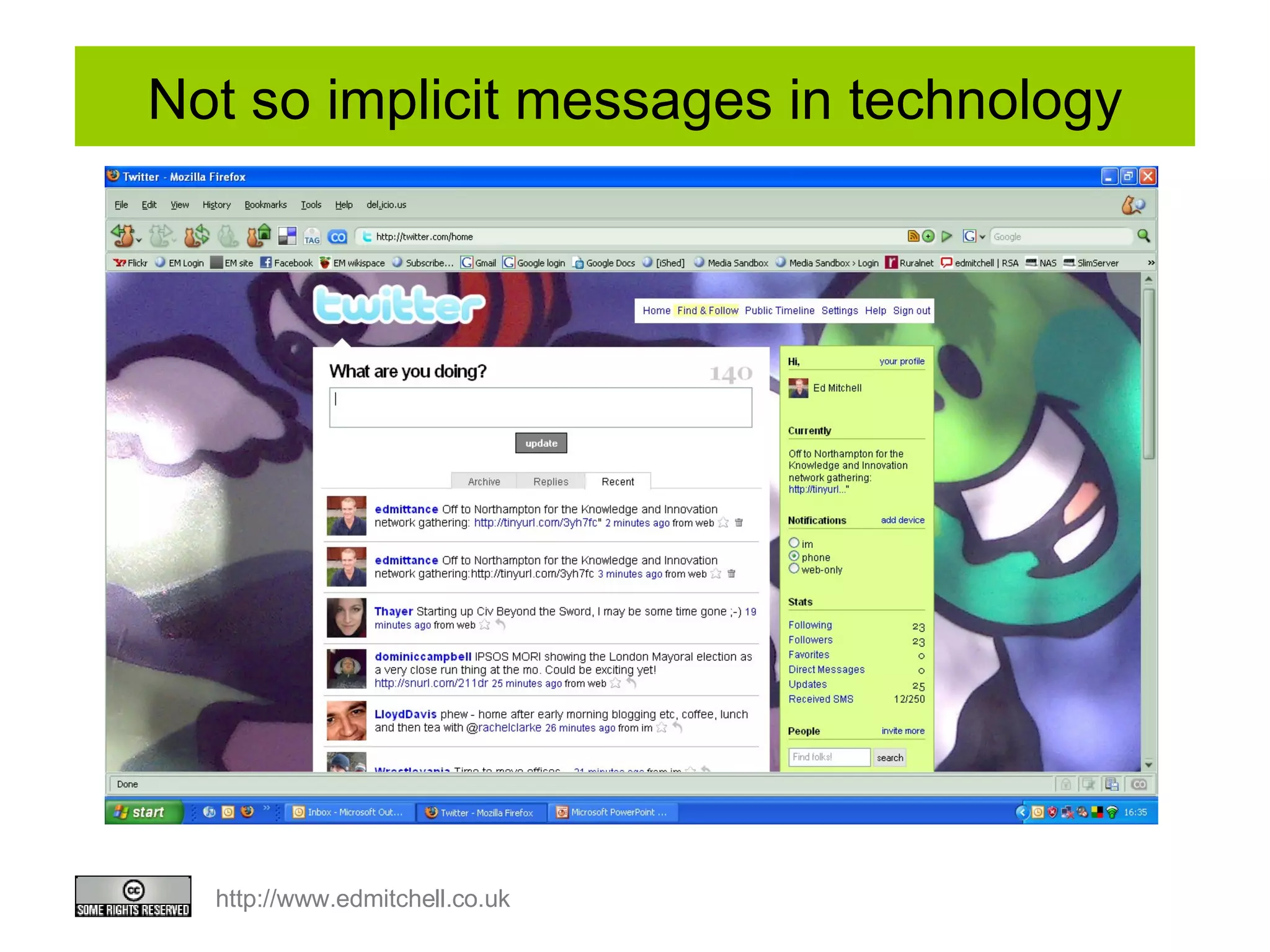
Not so implicit messages in technology
Personalities being sold to In response to the intel ad:  “ More Computing Power Means More You” “… Would I really want to have be more me? A glance at my personality spectrum reveals swathes of my selfhood where there’s already quite enough, thank you – and some aspects, such as the egotism, suspicion, self-pity, pointless regret and maundering envy, that might do with toning down. Would anyone else want to have more me? I suspect my wife would declare ‘Enough husband’…” (Enough, John Naish) http://www.amazon.co.uk/Enough-John-Naish/dp/0340935901/
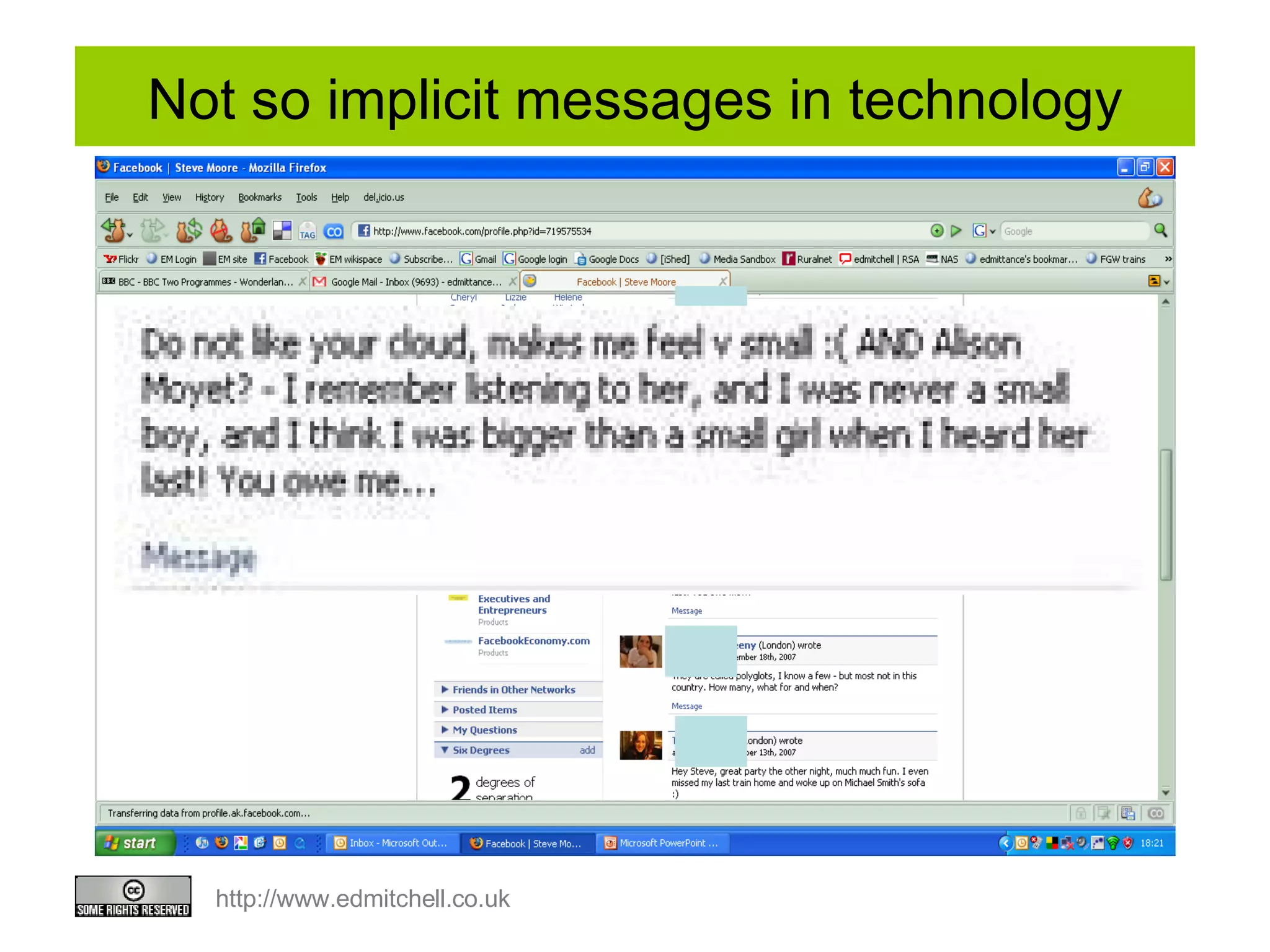
Not so implicit messages in technology
Not so implicit messages in technology… http://thayer18.livejournal.com/10610.html “… Twitter is not a popularity contest. Step away from your ego... Last night I cut down the amount of people I follow. I do this about once a month, after adding people throughout the month. It's something I've always done, and interestingly, every time I do it - it's something that has always caused some grumpiness from a few of those who I stop following… … If I follow over 80, in particular when I get close to 100, I find it very hard to track my real life close friends - you know, the ones I know personally, go drinking with etc. So I chop back a bit…”
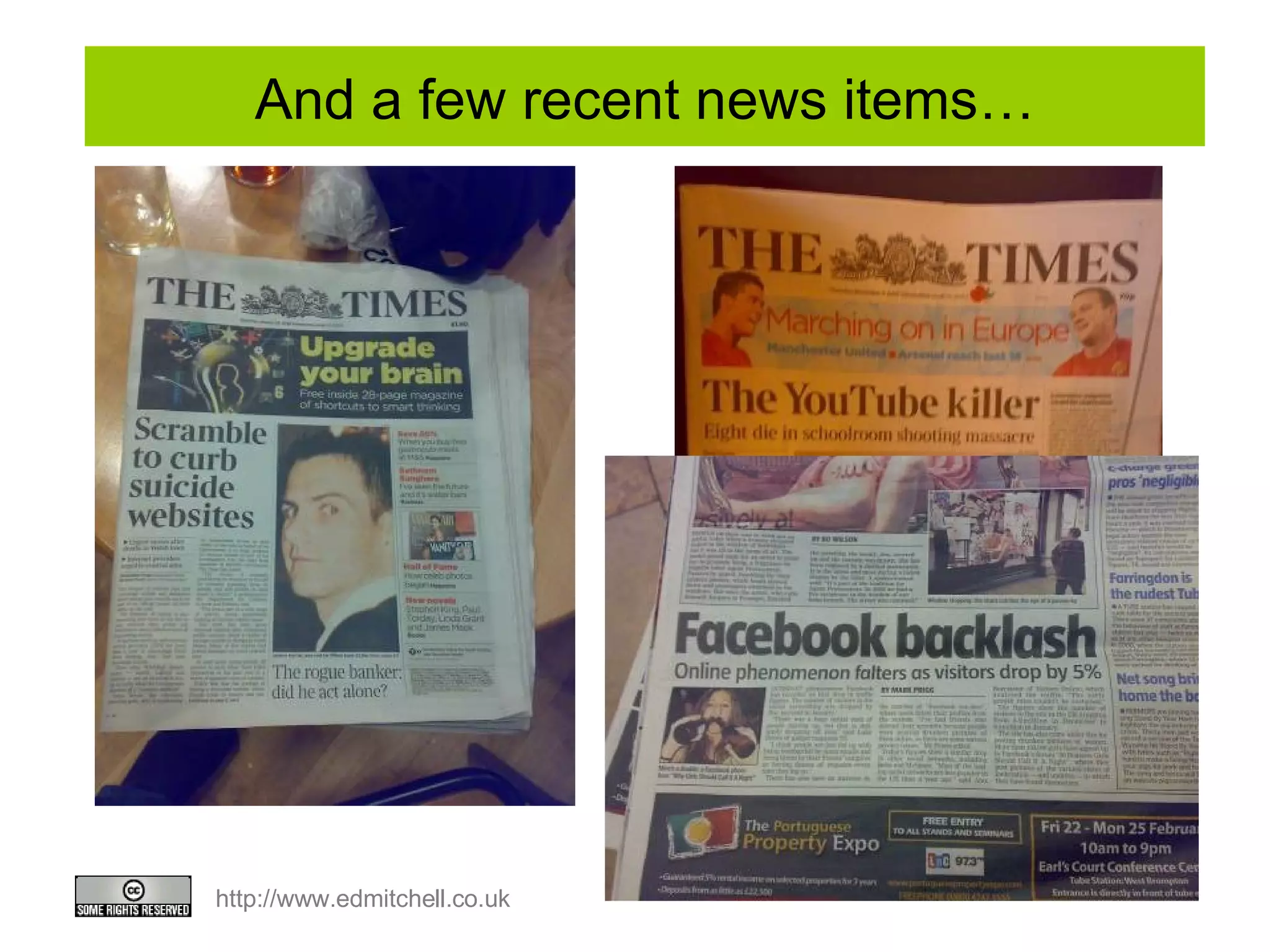
And a few recent news items…
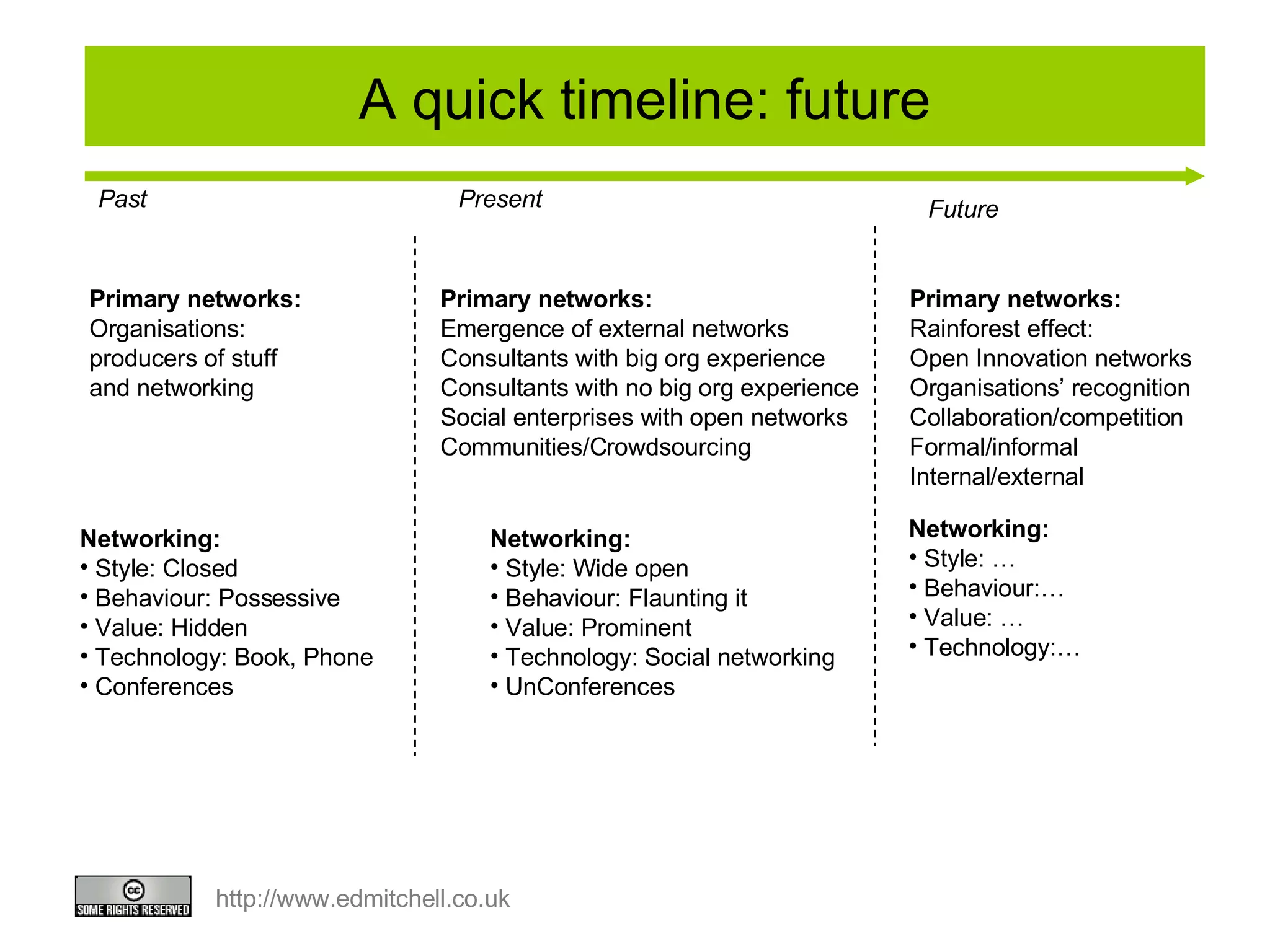
A quick timeline: future Primary networks:  Organisations:  producers of stuff and networking Networking:  Style: Closed Behaviour: Possessive Value: Hidden Technology: Book, Phone Conferences Primary networks: Emergence of external networks Consultants with big org experience Consultants with no big org experience Social enterprises with open networks Communities/Crowdsourcing Networking:  Style: Wide open Behaviour: Flaunting it Value: Prominent Technology: Social networking UnConferences Past Present Future Networking:  Style: … Behaviour:… Value: … Technology:…  Primary networks: Rainforest effect: Open Innovation networks Organisations’ recognition Collaboration/competition Formal/informal Internal/external
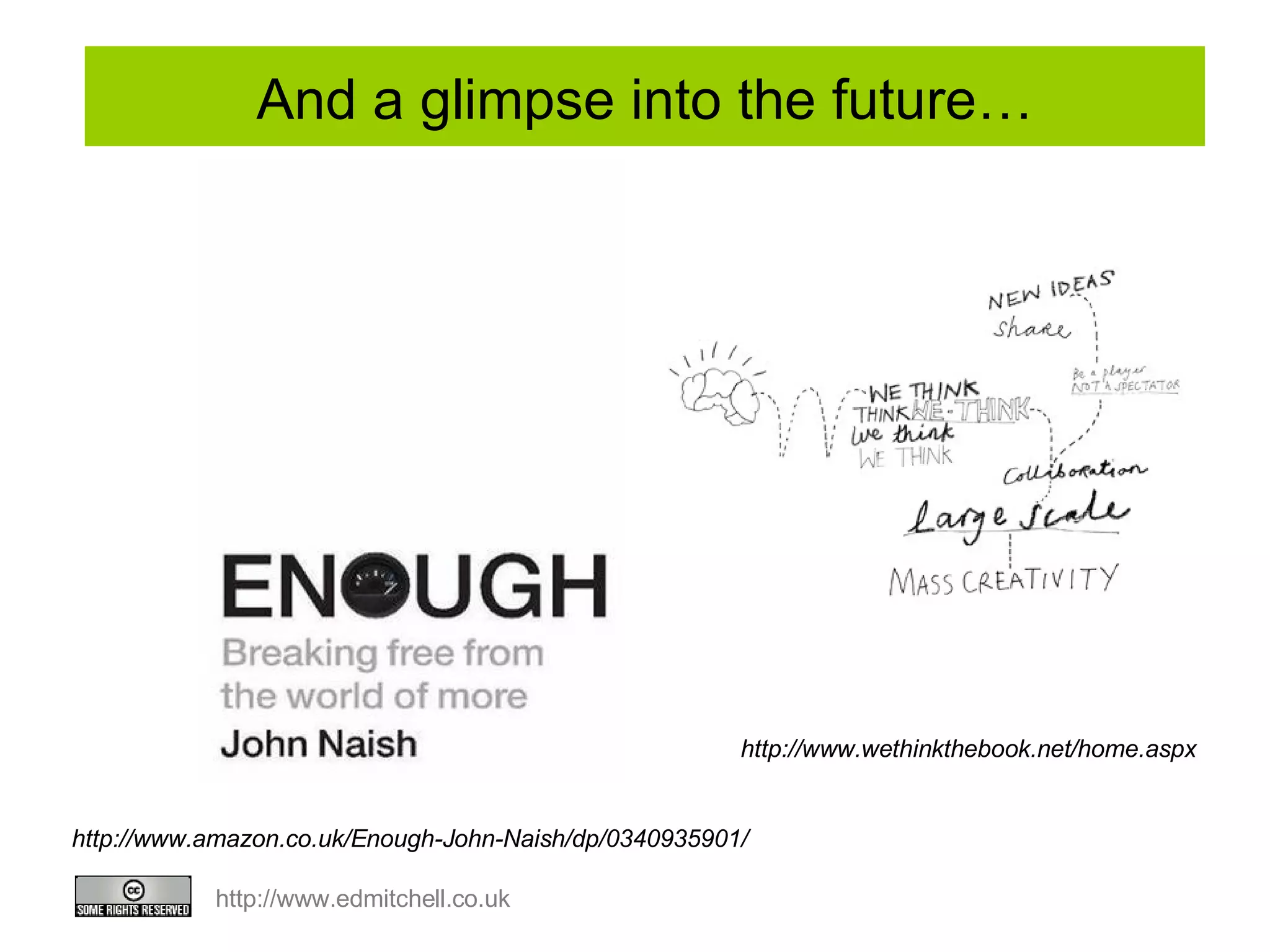
And a glimpse into the future… http://www.amazon.co.uk/Enough-John-Naish/dp/0340935901/ http://www.wethinkthebook.net/home.aspx
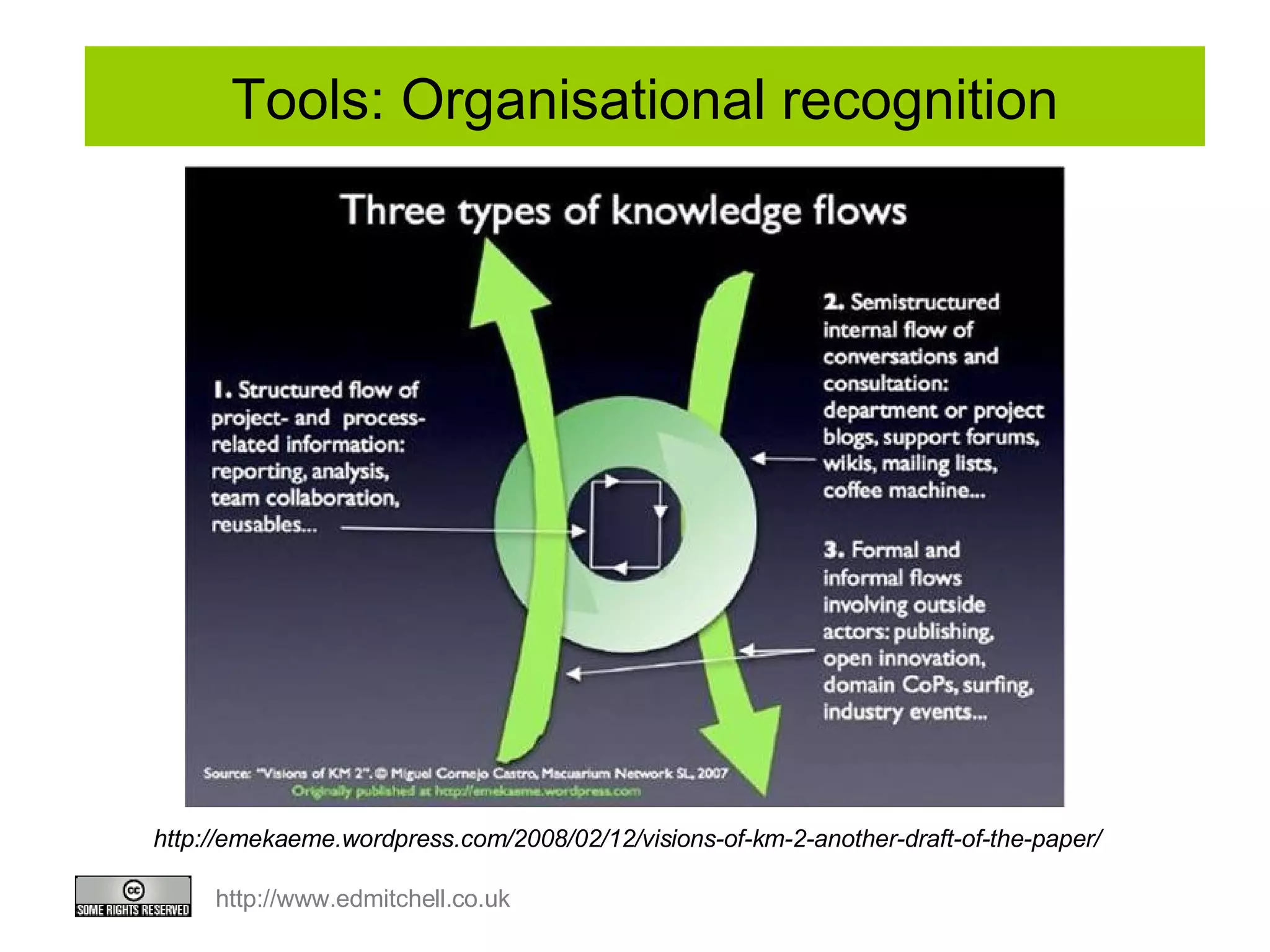
Tools: Organisational recognition http://emekaeme.wordpress.com/2008/02/12/visions-of-km-2-another-draft-of-the-paper/
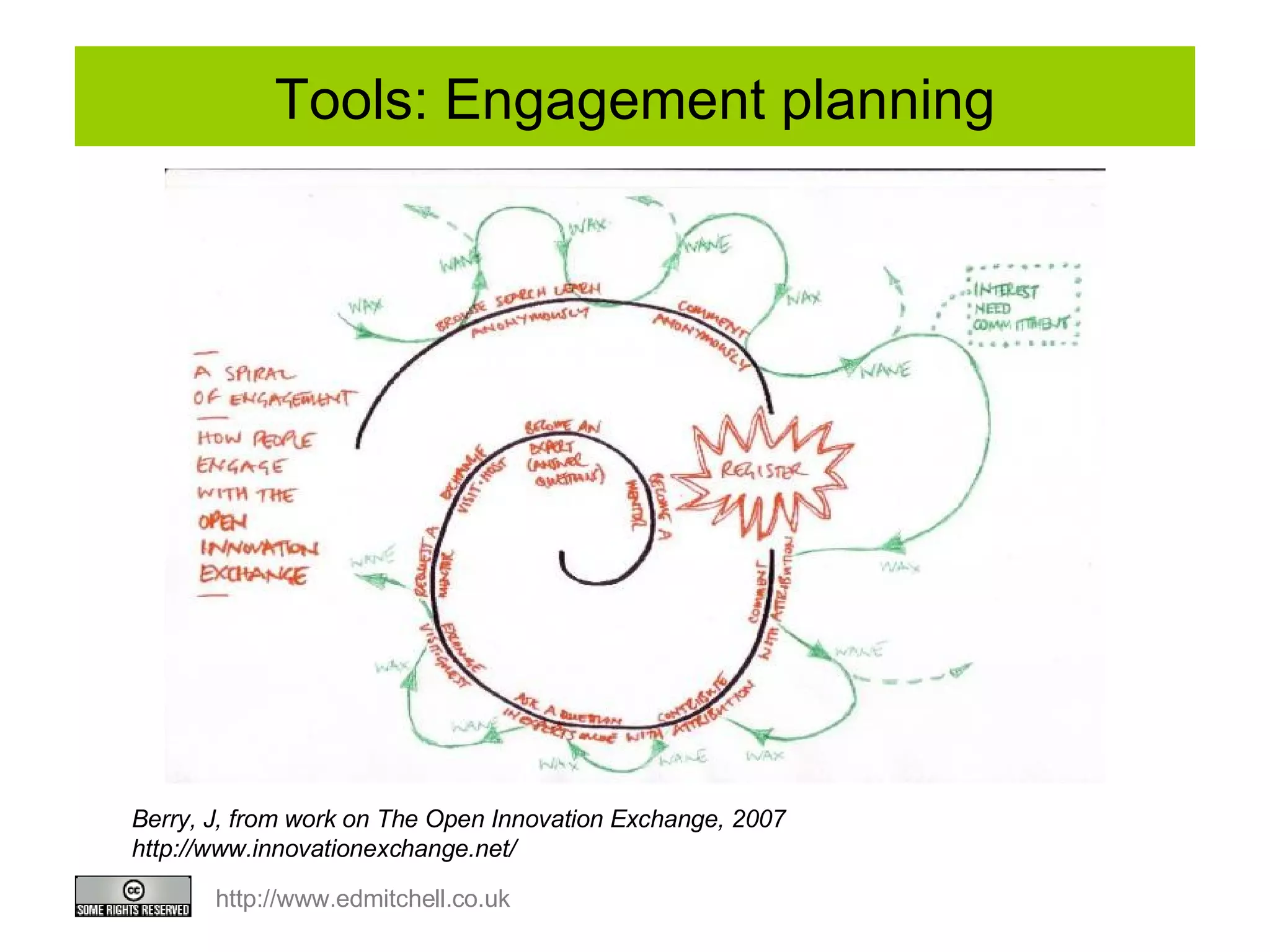
Tools: Engagement planning Berry, J, from work on The Open Innovation Exchange, 2007 http://www.innovationexchange.net/
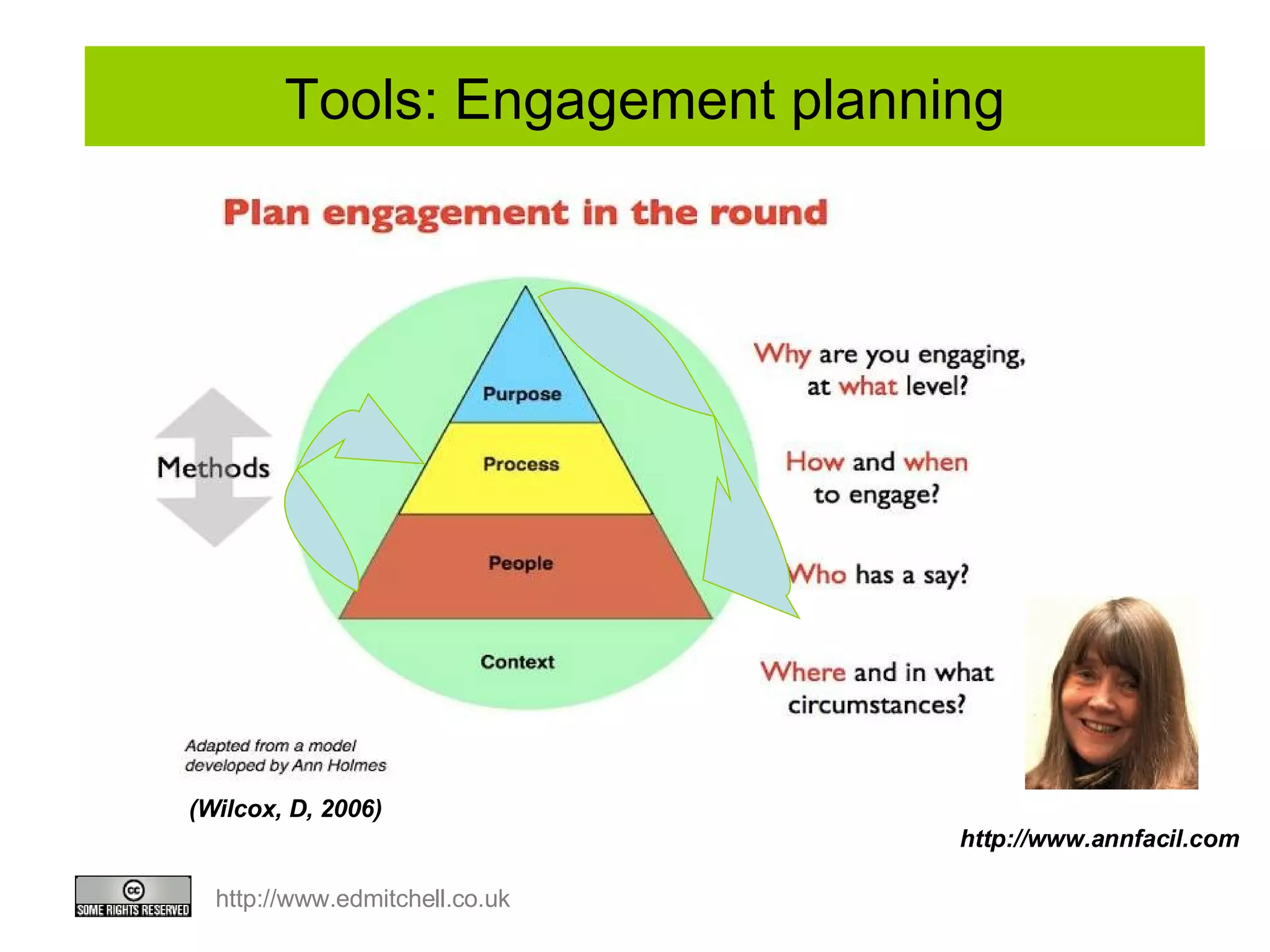
Tools: Engagement planning (Wilcox, D, 2006) http://www.annfacil.com
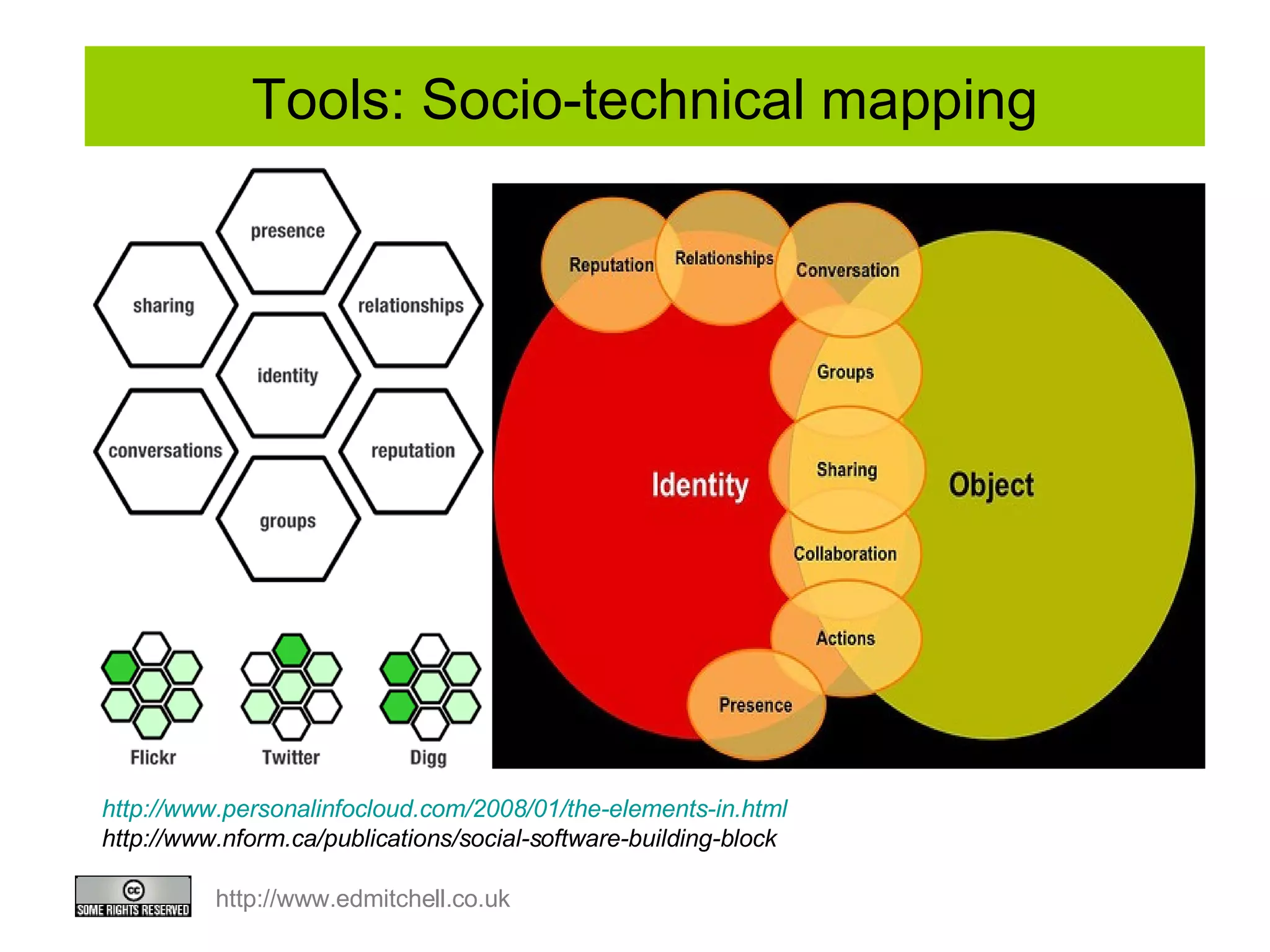
Tools: Socio-technical mapping http://www.personalinfocloud.com/2008/01/the-elements-in.html http://www.nform.ca/publications/social-software-building-block
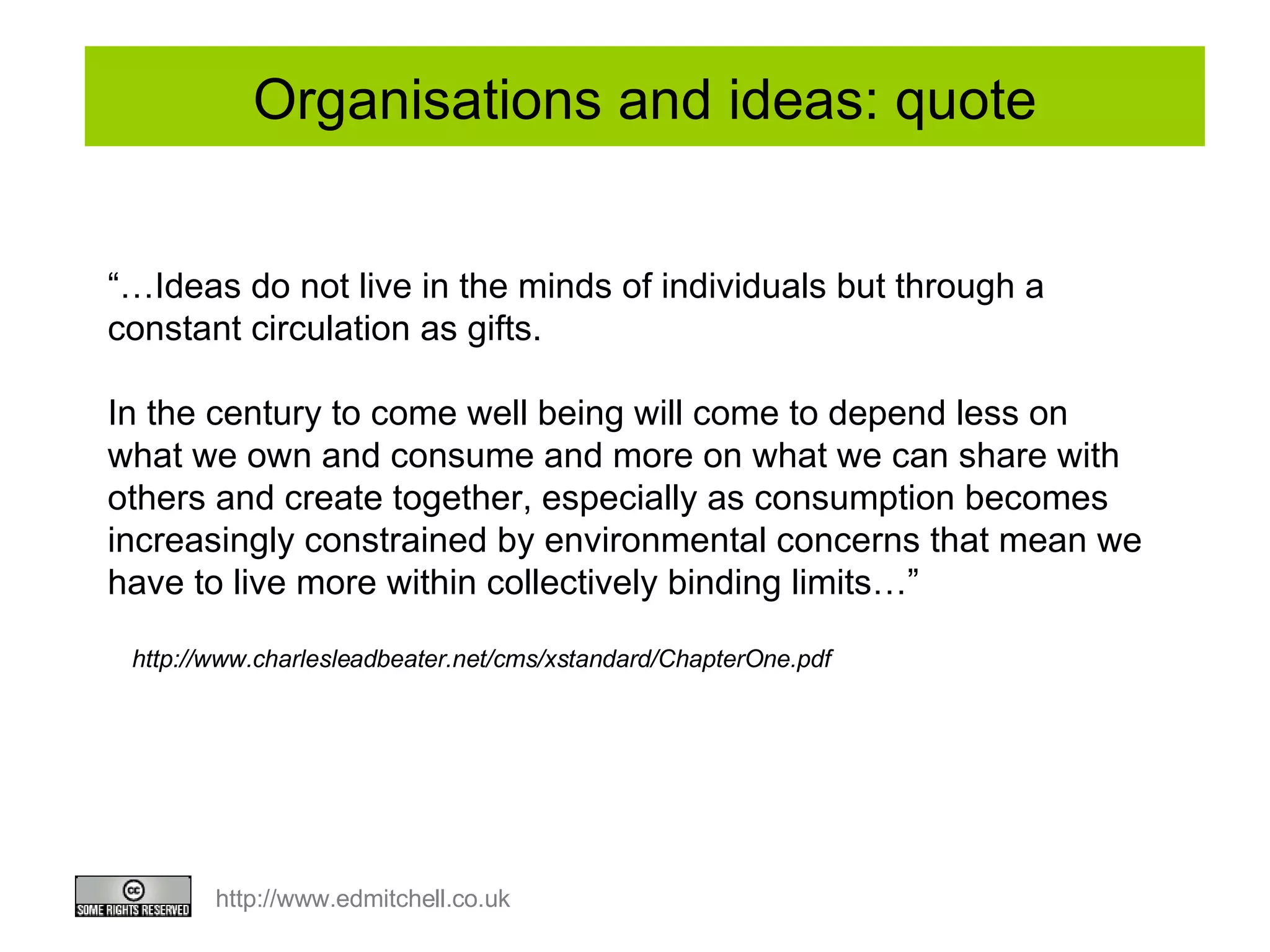
Organisations and ideas: quote “… Ideas do not live in the minds of individuals but through a constant circulation as gifts.  In the century to come well being will come to depend less on what we own and consume and more on what we can share with others and create together, especially as consumption becomes increasingly constrained by environmental concerns that mean we have to live more within collectively binding limits…” http://www.charlesleadbeater.net/cms/xstandard/ChapterOne.pdf
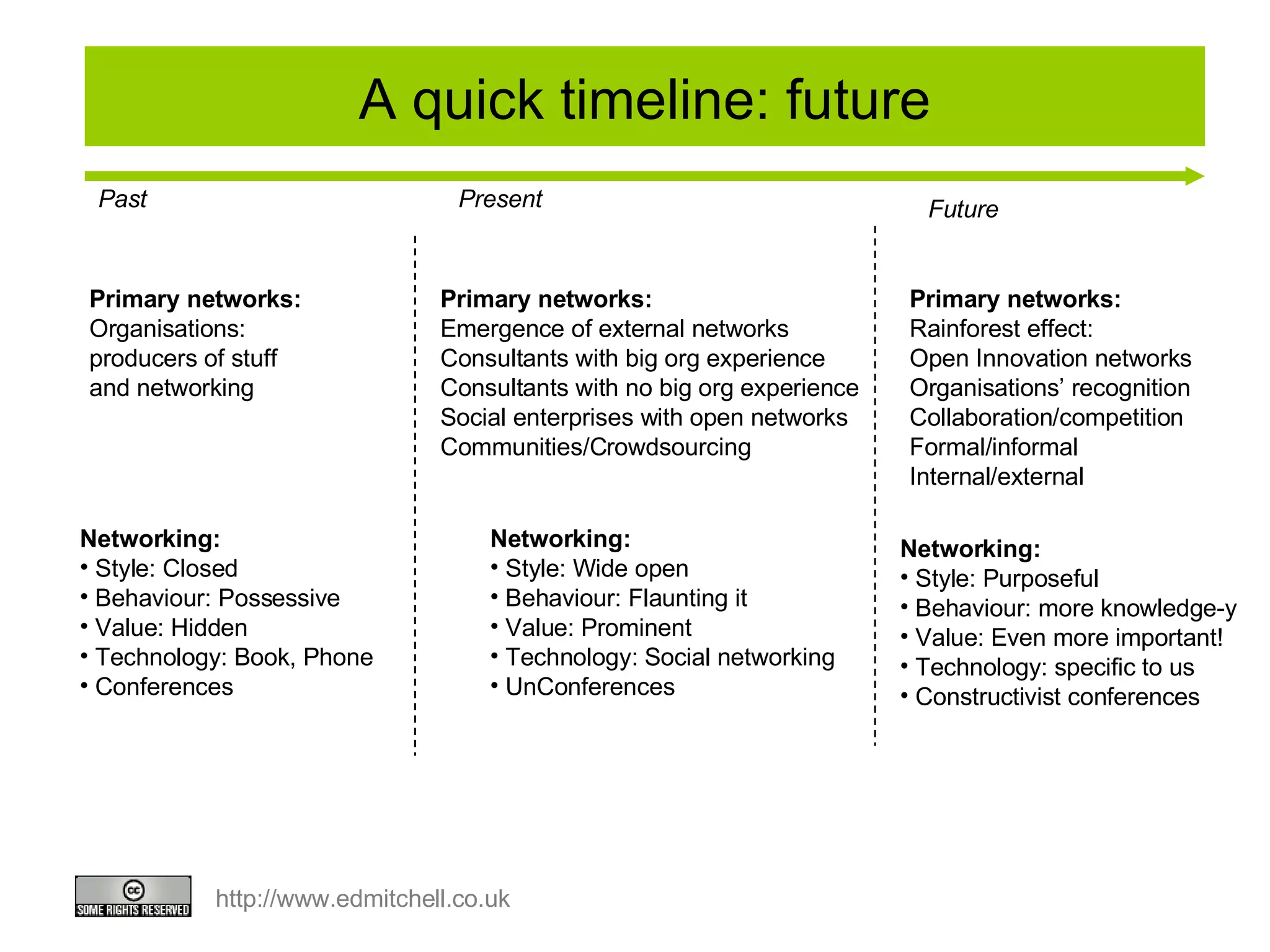
A quick timeline: future Primary networks:  Organisations:  producers of stuff and networking Networking:  Style: Closed Behaviour: Possessive Value: Hidden Technology: Book, Phone Conferences Primary networks: Emergence of external networks Consultants with big org experience Consultants with no big org experience Social enterprises with open networks Communities/Crowdsourcing Networking:  Style: Wide open Behaviour: Flaunting it Value: Prominent Technology: Social networking UnConferences Past Present Future Networking:  Style: Purposeful Behaviour: more knowledge-y Value: Even more important! Technology: specific to us Constructivist conferences Primary networks: Rainforest effect: Open Innovation networks Organisations’ recognition Collaboration/competition Formal/informal Internal/external
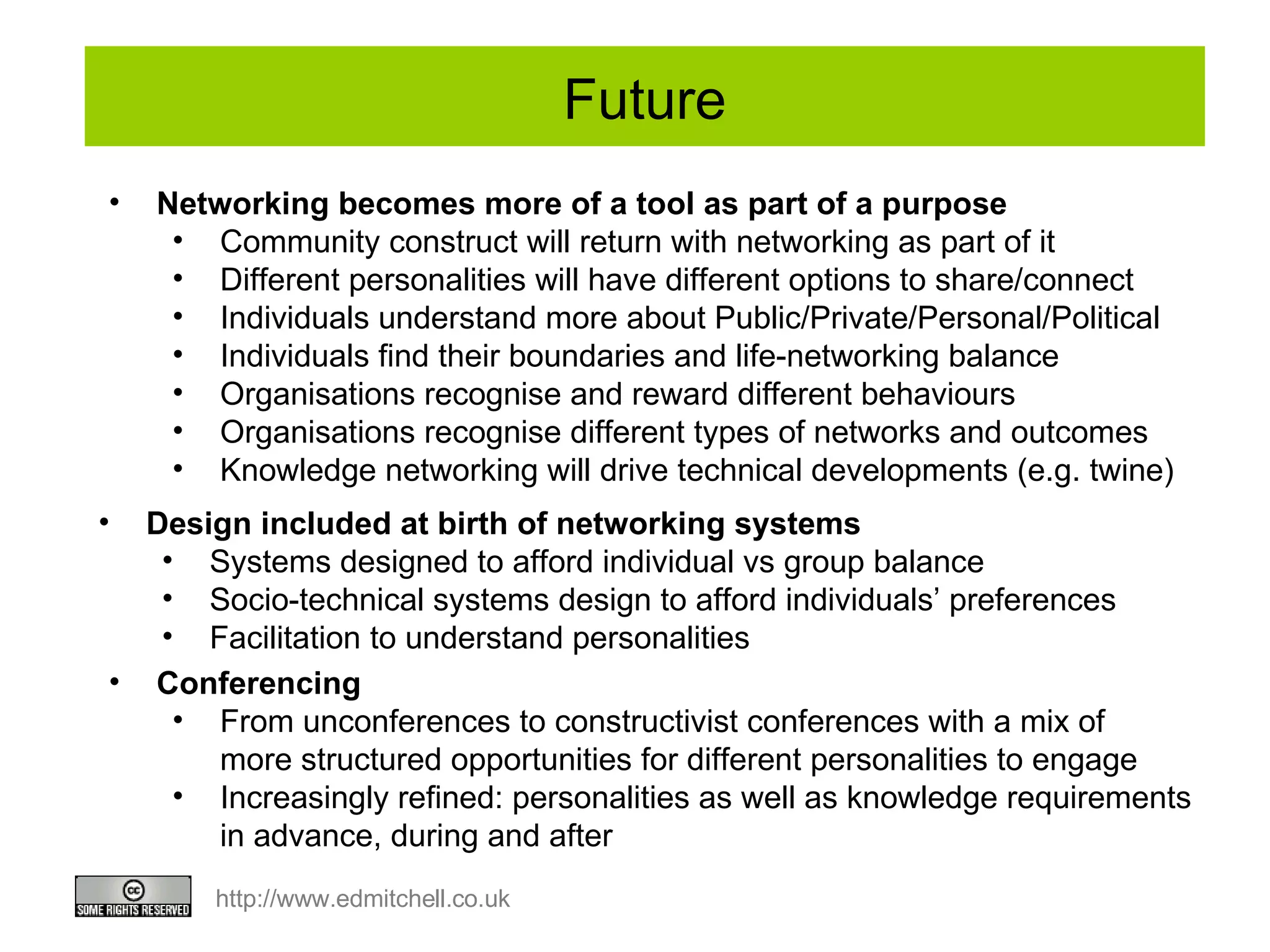
Future Design included at birth of networking systems Systems designed to afford individual vs group balance Socio-technical systems design to afford individuals’ preferences  Facilitation to understand personalities Networking becomes more of a tool as part of a purpose Community construct will return with networking as part of it Different personalities will have different options to share/connect Individuals understand more about Public/Private/Personal/Political Individuals find their boundaries and life-networking balance Organisations recognise and reward different behaviours Organisations recognise different types of networks and outcomes Knowledge networking will drive technical developments (e.g. twine) Conferencing From unconferences to constructivist conferences with a mix of  more structured opportunities for different personalities to engage Increasingly refined: personalities as well as knowledge requirements in advance, during and after
Thanks [email_address] 07974 737 254
Links  http://del.icio.us/edmittance/socialnetworks http ://deli.icio.us/edmittance/socialnetworking http://deli.icio.us/edmittance/facilitation http://del.icio.us/edmittance/collaboration http://del.icio.us/edmittance/engagement http://www.myersbriggstypeindicator.co.uk/mbti_dichotomies.htm http ://www.win.net/insightsys/ALPHABET.HTM http ://en.wikipedia.org/wiki/Myers-Briggs_Type_Indicator http://www.interweave-consulting.com/pictures/MBTI-Mousepad.gif http://www.annfacil.com/ http://www.personalinfocloud.com/2008/01/the-elements-in.html http://www.nform.ca/publications/social-software-building-block http://www.innovationexchange.net/ http:// emekaeme.wordpress.com

Networking; past present and future; and the importance of personality

  • 1.
    Hello 2000…..………2002…………..2004……………..2006……..…..2007…… 2008..I am a professional network and community advisor and multi-domain ‘facilitator’. In other words, I help groups of people do the things that they want and/or need to do.
  • 2.
    Here’s the planNetworking: why, what Quick timeline: past, present Present: humans: social everything? Quick diversion via KnowledgeBoard: did and learnt The four Ps Humans and personalities Not so implicit messages in technology Quick timeline: future Tools to make it better Future
  • 3.
    Why do wenetwork? Learn something new Learn more about something they know Share stuff about what they know Give something back to the organisation Build their status in a community Meet like-minded people Help to make positive change Organise things: e.g. global teams Local groups Event teams From work with VSO, Feb 2008
  • 4.
    So networks needto… Offer us learning opportunities Help us give something back Respect our time Provide us with interesting people to meet Help us make the connections we want to make Link us to the rights organisations effectively Respect our personalities Provide the managers with a suitable space to do all the above
  • 5.
    What do wethink networking is? And a definition from the facilitator Expanding one's social network or sphere of influence by initiating mutually advantageous new relationships with people. One’s ability to make contact with others in obtaining research, information, and services about career fields, organizations, or job industries in order to enhance career goals. (Tamara Gittelson) From a network networking event, London Voluntary Services Council, Cascade meeting, 14/02/08
  • 6.
    A quick timelinePast Present Future
  • 7.
    A quick timeline:past Primary networks: Organisations: producers of stuff and networking Networking: Style: Closed Behaviour: Possessive Value: Hidden Technology: Book, Phone Conferences Past
  • 8.
    A quick timeline:present Primary networks: Organisations: producers of stuff and networking Networking: Style: Closed Behaviour: Possessive Value: Hidden Technology: Book, Phone Conferences Primary networks: Emergence of external networks: Consultants with big org experience Consultants with no big org experience Social enterprises with open networks Communities/Crowdsourcing Networking: Style: Wide open Behaviour: Flaunting it Value: Prominent Technology: Social networking UnConferences and blended facilitation Past Present Future
  • 9.
    Present: humans: socialeverything? Networking: Style: Wide open Behaviour: Flaunting it Value: Prominent Technology: Social networking UnConferences and blended facilitation Participatory Collaborative Co-creation Knowledge networking Engagement Open Space Social this that and the other… Un-everything From Media Sandbox community launch, Bristol, 2007
  • 10.
    Present: humans: socialeverything? What happened to just doing a good job?
  • 11.
  • 12.
    Present: humans: socialeverything? Participatory Collaborative Co-creation Knowledge networking Speed networking Open Space Social this that and the other… Un-everything Network experts Know everyone …
  • 13.
    Present: humans: socialeverything? Emotional Particular Peculiar Different Spiritual Individual Shy Temperamental Happy Sad Contextual … ? “… We judge ourselves by what we think we can do. Others judge us by what we have done… (Australian Trucker mag my friend Tim found for me)
  • 14.
    What did wedo on KnowledgeBoard? Facilities to attract: Published content Commenting Q & A Conversations Facilitated environment Publishing articles and encouraging discussion Hosting interest groups and encouraging discussion Sending newsletters and encouraging discussion Measuring … the discussion Social structures to build trust: Co-creation of shared space Events (physical and virtual) Realise-able results from input … Touch points along the relationship Workshops at conferences and our own conferences 3 x Community books Research partnerships and papers
  • 15.
    One thing learntfrom KnowledgeBoard Good lord we’re all different… Not everyone wants to discuss stuff publicly.. What does that mean? For whom? How can we plan for that in the future? How can we measure that?
  • 16.
    The four PsPublic Personal Private Political
  • 17.
    Myers-Briggs Type Indicator(MBTI) is a personality questionnaire designed to identify certain psychological differences according to the typological theories of Carl Gustav Jung as published in his 1921 book Psychological Types… While many academic psychologists have criticized the indicator in research literature, claiming that it "lacks convincing validity data… proponents and sellers of the test cite unblinded anecdotal predictions of individual behavior… In a similar way to left- or right-handedness, the principle is that individuals also find certain ways of thinking and acting easier than others. The MBTI endeavours to sort some of these psychological opposites into four opposite pairs, or dichotomies, with a resulting 16 possible combinations. None of these combinations is 'better' or 'worse',… http://en.wikipedia.org/wiki/Myers-Briggs_Type_Indicator Humans and personalities
  • 18.
    Humans and personalities:Ed is ENTP I’m bound to get on someone’s nerves and vice versa Some networks may be entirely un-suited to me Couldn’t networks and the tools be suited to us as individuals? Will we see the same things in different networks? What is the balance of people types in networks? Should I behave in the way you think I should? But does that mean you have to behave in the way I think you should?
  • 19.
    Not so implicitmessages in technology
  • 20.
    Not so implicitmessages in technology
  • 21.
    Not so implicitmessages in technology
  • 22.
    Not so implicitmessages in technology
  • 23.
    Not so implicitmessages in technology
  • 24.
    Not so implicitmessages in technology
  • 25.
    Personalities being soldto In response to the intel ad: “ More Computing Power Means More You” “… Would I really want to have be more me? A glance at my personality spectrum reveals swathes of my selfhood where there’s already quite enough, thank you – and some aspects, such as the egotism, suspicion, self-pity, pointless regret and maundering envy, that might do with toning down. Would anyone else want to have more me? I suspect my wife would declare ‘Enough husband’…” (Enough, John Naish) http://www.amazon.co.uk/Enough-John-Naish/dp/0340935901/
  • 26.
    Not so implicitmessages in technology
  • 27.
    Not so implicitmessages in technology… http://thayer18.livejournal.com/10610.html “… Twitter is not a popularity contest. Step away from your ego... Last night I cut down the amount of people I follow. I do this about once a month, after adding people throughout the month. It's something I've always done, and interestingly, every time I do it - it's something that has always caused some grumpiness from a few of those who I stop following… … If I follow over 80, in particular when I get close to 100, I find it very hard to track my real life close friends - you know, the ones I know personally, go drinking with etc. So I chop back a bit…”
  • 28.
    And a fewrecent news items…
  • 29.
    A quick timeline:future Primary networks: Organisations: producers of stuff and networking Networking: Style: Closed Behaviour: Possessive Value: Hidden Technology: Book, Phone Conferences Primary networks: Emergence of external networks Consultants with big org experience Consultants with no big org experience Social enterprises with open networks Communities/Crowdsourcing Networking: Style: Wide open Behaviour: Flaunting it Value: Prominent Technology: Social networking UnConferences Past Present Future Networking: Style: … Behaviour:… Value: … Technology:… Primary networks: Rainforest effect: Open Innovation networks Organisations’ recognition Collaboration/competition Formal/informal Internal/external
  • 30.
    And a glimpseinto the future… http://www.amazon.co.uk/Enough-John-Naish/dp/0340935901/ http://www.wethinkthebook.net/home.aspx
  • 31.
    Tools: Organisational recognitionhttp://emekaeme.wordpress.com/2008/02/12/visions-of-km-2-another-draft-of-the-paper/
  • 32.
    Tools: Engagement planningBerry, J, from work on The Open Innovation Exchange, 2007 http://www.innovationexchange.net/
  • 33.
    Tools: Engagement planning(Wilcox, D, 2006) http://www.annfacil.com
  • 34.
    Tools: Socio-technical mappinghttp://www.personalinfocloud.com/2008/01/the-elements-in.html http://www.nform.ca/publications/social-software-building-block
  • 35.
    Organisations and ideas:quote “… Ideas do not live in the minds of individuals but through a constant circulation as gifts. In the century to come well being will come to depend less on what we own and consume and more on what we can share with others and create together, especially as consumption becomes increasingly constrained by environmental concerns that mean we have to live more within collectively binding limits…” http://www.charlesleadbeater.net/cms/xstandard/ChapterOne.pdf
  • 36.
    A quick timeline:future Primary networks: Organisations: producers of stuff and networking Networking: Style: Closed Behaviour: Possessive Value: Hidden Technology: Book, Phone Conferences Primary networks: Emergence of external networks Consultants with big org experience Consultants with no big org experience Social enterprises with open networks Communities/Crowdsourcing Networking: Style: Wide open Behaviour: Flaunting it Value: Prominent Technology: Social networking UnConferences Past Present Future Networking: Style: Purposeful Behaviour: more knowledge-y Value: Even more important! Technology: specific to us Constructivist conferences Primary networks: Rainforest effect: Open Innovation networks Organisations’ recognition Collaboration/competition Formal/informal Internal/external
  • 37.
    Future Design includedat birth of networking systems Systems designed to afford individual vs group balance Socio-technical systems design to afford individuals’ preferences Facilitation to understand personalities Networking becomes more of a tool as part of a purpose Community construct will return with networking as part of it Different personalities will have different options to share/connect Individuals understand more about Public/Private/Personal/Political Individuals find their boundaries and life-networking balance Organisations recognise and reward different behaviours Organisations recognise different types of networks and outcomes Knowledge networking will drive technical developments (e.g. twine) Conferencing From unconferences to constructivist conferences with a mix of more structured opportunities for different personalities to engage Increasingly refined: personalities as well as knowledge requirements in advance, during and after
  • 38.
  • 39.
    Links http://del.icio.us/edmittance/socialnetworkshttp ://deli.icio.us/edmittance/socialnetworking http://deli.icio.us/edmittance/facilitation http://del.icio.us/edmittance/collaboration http://del.icio.us/edmittance/engagement http://www.myersbriggstypeindicator.co.uk/mbti_dichotomies.htm http ://www.win.net/insightsys/ALPHABET.HTM http ://en.wikipedia.org/wiki/Myers-Briggs_Type_Indicator http://www.interweave-consulting.com/pictures/MBTI-Mousepad.gif http://www.annfacil.com/ http://www.personalinfocloud.com/2008/01/the-elements-in.html http://www.nform.ca/publications/social-software-building-block http://www.innovationexchange.net/ http:// emekaeme.wordpress.com