



Network organisations andCross-Organisational LearningHRM3011Dr Rea Prouska – Middlesex University Business SchoolDr Maria Kapsali – Imperial College Business School1
Learning objectivesCritically examine what is meant by ‘organisational learning’ and ‘the learning organisation’.Explore what is meant by ‘network organisations’, how these form and operate.Critically analyse the way in which ‘cross-organisational learning’ takes place.2
ThinkOrganisational LearningThe Learning Organisation3
The importance of learning in organisationsWhat is the importance of learning in organisations?http://www.youtube.com/watch?v=lUP4WcfNyAA4
Organisational Learning‘Organisational learning’ – based on observations of individual and collective learning processes in an organisation.5
Organisational LearningOrganisational learning is more than just the sum of individual learning
Members learn together when individual’s learning impacts on and interrelates with others and begin to change the way things are done
Increase in collective competence
How individual learning feeds into organisational learning is just beginning to be addressed
Viewing the organisation as a process or a living organism helps6
The Learning OrganisationCan be defined as ‘an organisation which facilitates the learning of all its members and continually transforms itself’ (Pedlar, Boydell and Burgoyne, 1987)
‘Learning is not restricted to discrete hunks of training activity, either fragmented or systematic, but is one where it has become a continuous process, and where on the job learning has become a way of life’ (Barhamet al., 1988: 50).7
principles and characteristics of a learning organisationIt can learn as much, if not more, from failure as from success.Rejects the adage ‘if it isn't broke, don’t fix it’ as it constantly scrutinises the way things are done.Assumes that managers and workers closest to the design, manufacturing, distribution and sale of the product often know more about these activities than their superiors.Seeks to move knowledge from one part of the organisationto another.It encourages people at all levels of the organisation to learn regularly and rigorously from their workIt has systems for capturing and learning information and moving it where it is neededIt is able to transform itself continuouslySpends a lot of energy looking outside its own boundariesfor knowledge.8
Discuss“Learning organisations are dreams which can never come true”.  Discuss why you agree or disagree with this statement.9
Difficulties with the learning organisation conceptEffective implementation of the learning organisation concept requires the resolution of: Meaning (or definition)Management (or practical operational advice)Measurement (tools for assessment)10
Network organisations11
Cross-organisational learningThrough alliances and networks, organisations can learn and internalise new skills (Hyder and Abraha, 2004), particularly those hard to obtain and internalise by other means (Doz and Hamel, 1998:5).However, strategic alliances cannot easily replace the internal development of organisational capabilities (Chan and Wong, 1994). Why?12
Processes of cross-organisational learning (1)Experience: a firm’s independent experiment and acquisition of knowledge through trial and error (Osland and Yaprak, 1995). 13
Processes of cross-organisational learning (2)Imitation: an attempt to learn about the strategies, technologies and functional activities of other firms and to internalise this second-hand experience (Osland and Yaprak, 1995).Open imitation: one partner agrees to let the other partner use, for example, a particular technology under specified conditions (Hyder and Abraha, 2004). Secret imitation: the owner of the resource has no intention of letting the partner imitate (Hyder and Abraha, 2004). 14
Processes of cross-organisational learning (3)Grafting: organisations increase their store of knowledge by formally acquiring another firm or by developing a long-term alliance with another organisation that possesses information not previously available within the organisation (Osland and Abraha, 2004).  Grafting is often faster than learning by experience and more complete than learning through imitation. 15
Processes of cross-organisational learning (4)Synergism: firms collaborate to produce new knowledge.  Through collaboration partners can develop innovations that may not have been possible through independent efforts (Osland and Abraha, 2004).16
Knowledge transferThe replication of knowledge in alliances requires both firms to implement managerial processes to transfer and receive knowledge (Wang and Nicholas , 2005). Wang and Nicholas (2005) distinguish learning into collective and competitive:Collective learning occurs in cases where partners learn to work together and mutually acquire knowledge.Competitive learning occurs when partners strive to out-learn each other.17
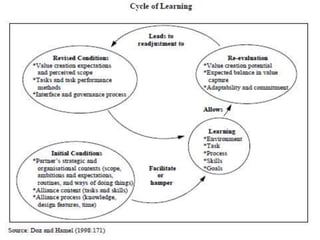
Relationship between partnersCritical to a long-lasting cross-organisational learning process is the relationship between the partners. Many relationships never evolve, while most enter a deep crisis within the first three years The key to longevity of contracting relationships is learning and adjustment, first to each other, then to changed circumstances.Successful alliances and networks go through cycles of learning, re-evaluation, and readjustment over time. As the partnership evolves, partners re-evaluate the potential of the alliance to create value, the expected balance and equity of value capture among them, and their ability and commitment to adjust to the existing conditions of the alliance. 18
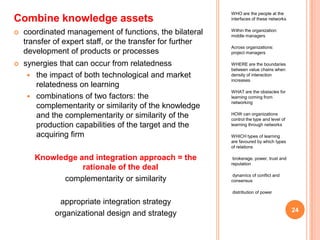
19
Factors affecting the outcome of cross-organisational learning initiativesIdeas?20
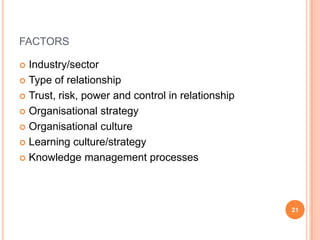
factorsIndustry/sectorType of relationshipTrust, risk, power and control in relationshipOrganisational strategyOrganisational cultureLearning culture/strategyKnowledge management processes21

Network organisations and cross organisational learning

  • 1.
    Network organisations andCross-OrganisationalLearningHRM3011Dr Rea Prouska – Middlesex University Business SchoolDr Maria Kapsali – Imperial College Business School1
  • 2.
    Learning objectivesCritically examinewhat is meant by ‘organisational learning’ and ‘the learning organisation’.Explore what is meant by ‘network organisations’, how these form and operate.Critically analyse the way in which ‘cross-organisational learning’ takes place.2
  • 3.
  • 4.
    The importance oflearning in organisationsWhat is the importance of learning in organisations?http://www.youtube.com/watch?v=lUP4WcfNyAA4
  • 5.
    Organisational Learning‘Organisational learning’– based on observations of individual and collective learning processes in an organisation.5
  • 6.
    Organisational LearningOrganisational learningis more than just the sum of individual learning
  • 7.
    Members learn togetherwhen individual’s learning impacts on and interrelates with others and begin to change the way things are done
  • 8.
  • 9.
    How individual learningfeeds into organisational learning is just beginning to be addressed
  • 10.
    Viewing the organisationas a process or a living organism helps6
  • 11.
    The Learning OrganisationCanbe defined as ‘an organisation which facilitates the learning of all its members and continually transforms itself’ (Pedlar, Boydell and Burgoyne, 1987)
  • 12.
    ‘Learning is notrestricted to discrete hunks of training activity, either fragmented or systematic, but is one where it has become a continuous process, and where on the job learning has become a way of life’ (Barhamet al., 1988: 50).7
  • 13.
    principles and characteristicsof a learning organisationIt can learn as much, if not more, from failure as from success.Rejects the adage ‘if it isn't broke, don’t fix it’ as it constantly scrutinises the way things are done.Assumes that managers and workers closest to the design, manufacturing, distribution and sale of the product often know more about these activities than their superiors.Seeks to move knowledge from one part of the organisationto another.It encourages people at all levels of the organisation to learn regularly and rigorously from their workIt has systems for capturing and learning information and moving it where it is neededIt is able to transform itself continuouslySpends a lot of energy looking outside its own boundariesfor knowledge.8
  • 14.
    Discuss“Learning organisations aredreams which can never come true”. Discuss why you agree or disagree with this statement.9
  • 15.
    Difficulties with thelearning organisation conceptEffective implementation of the learning organisation concept requires the resolution of: Meaning (or definition)Management (or practical operational advice)Measurement (tools for assessment)10
  • 16.
  • 17.
    Cross-organisational learningThrough alliancesand networks, organisations can learn and internalise new skills (Hyder and Abraha, 2004), particularly those hard to obtain and internalise by other means (Doz and Hamel, 1998:5).However, strategic alliances cannot easily replace the internal development of organisational capabilities (Chan and Wong, 1994). Why?12
  • 18.
    Processes of cross-organisationallearning (1)Experience: a firm’s independent experiment and acquisition of knowledge through trial and error (Osland and Yaprak, 1995). 13
  • 19.
    Processes of cross-organisationallearning (2)Imitation: an attempt to learn about the strategies, technologies and functional activities of other firms and to internalise this second-hand experience (Osland and Yaprak, 1995).Open imitation: one partner agrees to let the other partner use, for example, a particular technology under specified conditions (Hyder and Abraha, 2004). Secret imitation: the owner of the resource has no intention of letting the partner imitate (Hyder and Abraha, 2004). 14
  • 20.
    Processes of cross-organisationallearning (3)Grafting: organisations increase their store of knowledge by formally acquiring another firm or by developing a long-term alliance with another organisation that possesses information not previously available within the organisation (Osland and Abraha, 2004). Grafting is often faster than learning by experience and more complete than learning through imitation. 15
  • 21.
    Processes of cross-organisationallearning (4)Synergism: firms collaborate to produce new knowledge. Through collaboration partners can develop innovations that may not have been possible through independent efforts (Osland and Abraha, 2004).16
  • 22.
    Knowledge transferThe replicationof knowledge in alliances requires both firms to implement managerial processes to transfer and receive knowledge (Wang and Nicholas , 2005). Wang and Nicholas (2005) distinguish learning into collective and competitive:Collective learning occurs in cases where partners learn to work together and mutually acquire knowledge.Competitive learning occurs when partners strive to out-learn each other.17
  • 23.
    Relationship between partnersCriticalto a long-lasting cross-organisational learning process is the relationship between the partners. Many relationships never evolve, while most enter a deep crisis within the first three years The key to longevity of contracting relationships is learning and adjustment, first to each other, then to changed circumstances.Successful alliances and networks go through cycles of learning, re-evaluation, and readjustment over time. As the partnership evolves, partners re-evaluate the potential of the alliance to create value, the expected balance and equity of value capture among them, and their ability and commitment to adjust to the existing conditions of the alliance. 18
  • 24.
  • 25.
    Factors affecting theoutcome of cross-organisational learning initiativesIdeas?20
  • 26.
    factorsIndustry/sectorType of relationshipTrust,risk, power and control in relationshipOrganisational strategyOrganisational cultureLearning culture/strategyKnowledge management processes21