Network Class Addressesin IPv4
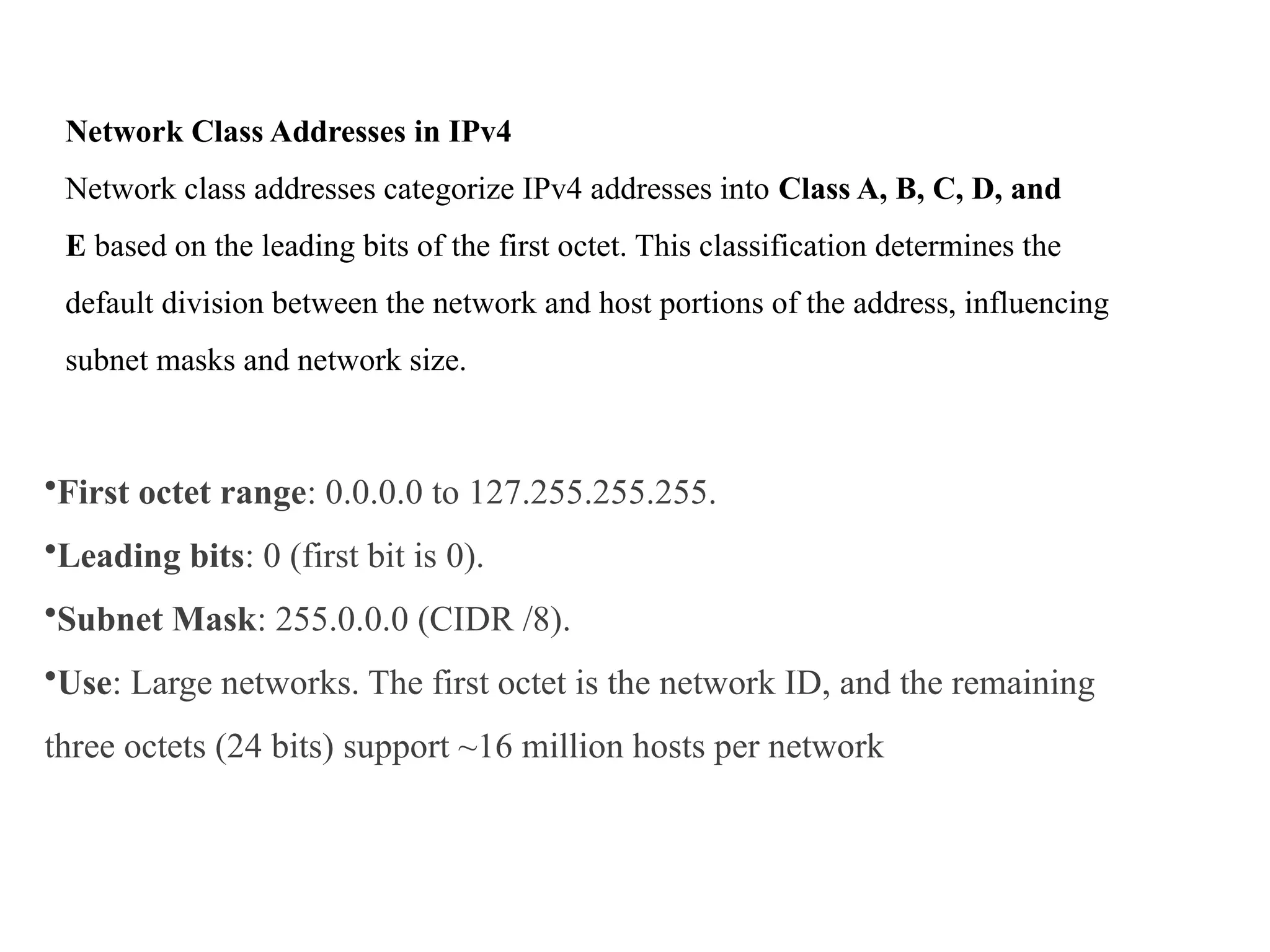
Network class addresses categorize IPv4 addresses into Class A, B, C, D, and
E based on the leading bits of the first octet. This classification determines the
default division between the network and host portions of the address, influencing
subnet masks and network size.
•First octet range: 0.0.0.0 to 127.255.255.255.
•Leading bits: 0 (first bit is 0).
•Subnet Mask: 255.0.0.0 (CIDR /8).
•Use: Large networks. The first octet is the network ID, and the remaining
three octets (24 bits) support ~16 million hosts per network
2.
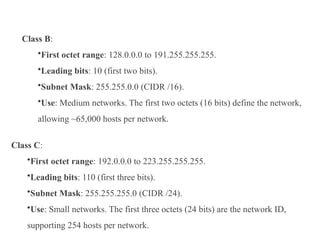
Class B:
•First octetrange: 128.0.0.0 to 191.255.255.255.
•Leading bits: 10 (first two bits).
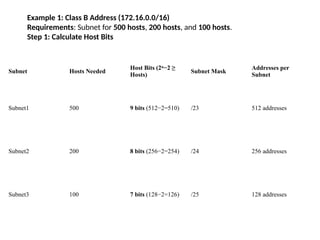
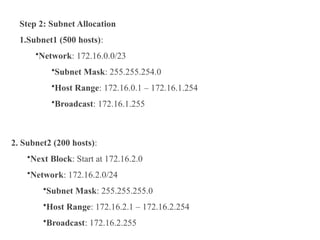
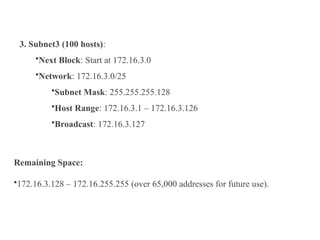
•Subnet Mask: 255.255.0.0 (CIDR /16).
•Use: Medium networks. The first two octets (16 bits) define the network,
allowing ~65,000 hosts per network.
Class C:
•First octet range: 192.0.0.0 to 223.255.255.255.
•Leading bits: 110 (first three bits).
•Subnet Mask: 255.255.255.0 (CIDR /24).
•Use: Small networks. The first three octets (24 bits) are the network ID,
supporting 254 hosts per network.
3.
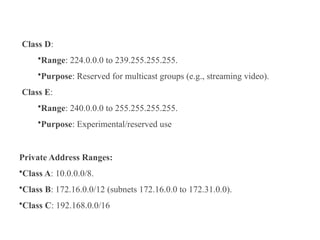
Class D:
•Range: 224.0.0.0to 239.255.255.255.
•Purpose: Reserved for multicast groups (e.g., streaming video).
Class E:
•Range: 240.0.0.0 to 255.255.255.255.
•Purpose: Experimental/reserved use
Private Address Ranges:
•Class A: 10.0.0.0/8.
•Class B: 172.16.0.0/12 (subnets 172.16.0.0 to 172.31.0.0).
•Class C: 192.168.0.0/16
4.
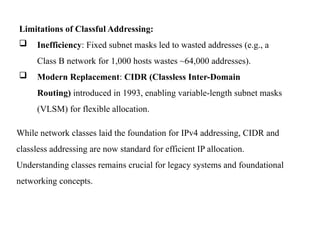
Limitations of ClassfulAddressing:
Inefficiency: Fixed subnet masks led to wasted addresses (e.g., a
Class B network for 1,000 hosts wastes ~64,000 addresses).
Modern Replacement: CIDR (Classless Inter-Domain
Routing) introduced in 1993, enabling variable-length subnet masks
(VLSM) for flexible allocation.
While network classes laid the foundation for IPv4 addressing, CIDR and
classless addressing are now standard for efficient IP allocation.
Understanding classes remains crucial for legacy systems and foundational
networking concepts.
5.
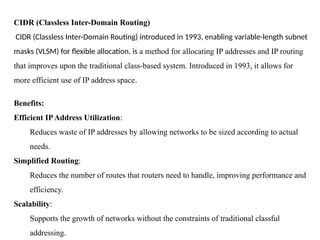
CIDR (Classless Inter-DomainRouting)
CIDR (Classless Inter-Domain Routing) introduced in 1993, enabling variable-length subnet
masks (VLSM) for flexible allocation. is a method for allocating IP addresses and IP routing
that improves upon the traditional class-based system. Introduced in 1993, it allows for
more efficient use of IP address space.
Benefits:
Efficient IPAddress Utilization:
Reduces waste of IP addresses by allowing networks to be sized according to actual
needs.
Simplified Routing:
Reduces the number of routes that routers need to handle, improving performance and
efficiency.
Scalability:
Supports the growth of networks without the constraints of traditional classful
addressing.
6.
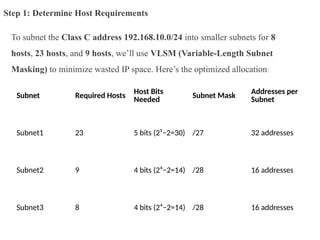
To subnet theClass C address 192.168.10.0/24 into smaller subnets for 8
hosts, 23 hosts, and 9 hosts, we’ll use VLSM (Variable-Length Subnet
Masking) to minimize wasted IP space. Here’s the optimized allocation:
Subnet Required Hosts
Host Bits
Needed Subnet Mask
Addresses per
Subnet
Subnet1 23 5 bits (2⁵−2=30) /27 32 addresses
Subnet2 9 4 bits (2⁴−2=14) /28 16 addresses
Subnet3 8 4 bits (2⁴−2=14) /28 16 addresses
Step 1: Determine Host Requirements