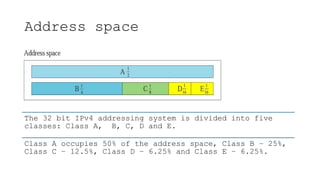
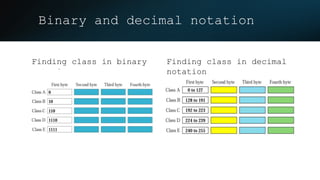
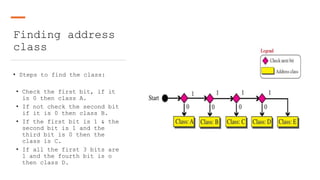
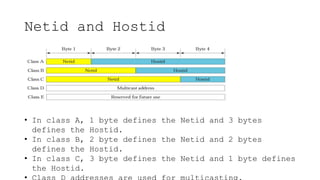
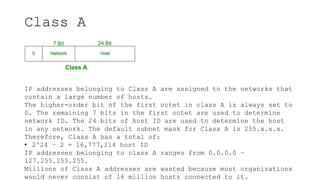
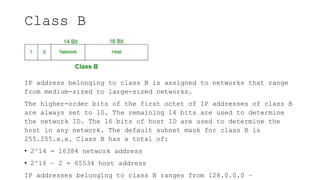
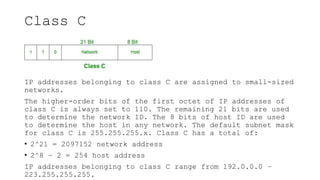
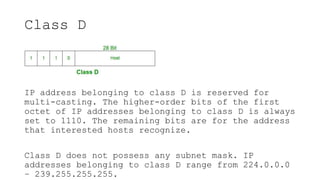
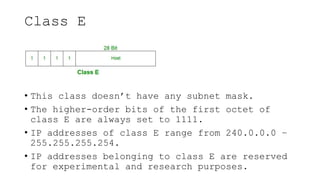
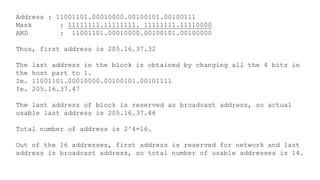
The document explains the classification of IPv4 addressing into five classes: A, B, C, D, and E, detailing their usage, address ranges, and subnet masks. Class A is for large networks, Class B for medium networks, Class C for small networks, Class D for multicasting, and Class E for experimental purposes. It also provides an example of classifying an IP address and calculating the usable addresses within a subnet.