
Network intrusion
detection/prevention systems
NIDS (detecton system)
• realtime attack detection
• passive (watchers) / active (measurement)
systems
• via analysis
– protocol analysis
– graph analysis
– anomaly detection
• analysis of direct network traffic
– complete / light
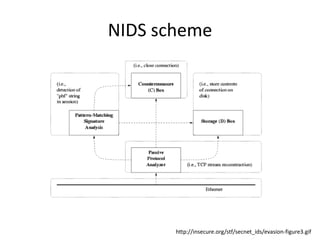
NIDS scheme
http://insecure.org/stf/secnet_ids/evasion-figure3.gif
Traffic analysis
• analyzing behaviour, not just packets
• difficulties
– NIDS can be run from different part of network
– bad packets
– reordering issues
• sensor placement
– inline
– passive
• spanning port
• network tap
• load balancer
http://csrc.nist.gov/publications/drafts/800-94-rev1/draft_sp800-94-rev1.pdf
Signature-based analysis
• pattern matching
• “patterns of malicious traffic”
• very elementary (basically grepping)
+ huge community for rule generation
+ great for low level analysis (rules are very specific)
+ not taking too much resources
- lower performance with big ruleset
- slight attack variation can beat the rule
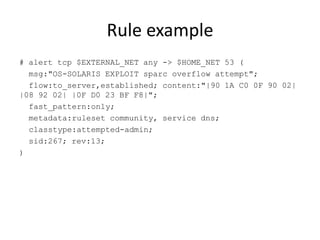
Rule example
# alert tcp $EXTERNAL_NET any -> $HOME_NET 53 (
msg:"OS-SOLARIS EXPLOIT sparc overflow attempt";
flow:to_server,established; content:"|90 1A C0 0F 90 02|
|08 92 02| |0F D0 23 BF F8|";
fast_pattern:only;
metadata:ruleset community, service dns;
classtype:attempted-admin;
sid:267; rev:13;
)
Protocol-based analysis
• reviewing network data
• strictly based on layer headers
• knowledge of expected values
+ better possibility for scalability
+ generic, able to catch zero-day exploits
- protocol headers preprocessor need resources
- rules can get extremely difficult to write/understand
- provide low information, admin has to investigate
Types of detected events
• transport layer attack
• network layer attack
• unexpected services (tunnel, backdoor etc.)
• policy violations (forbidden protocols, ports
etc.)
note: detection with accuracy
Types of attack
• evasion/insertion attacks
– bad IP headers
– bad IP options
– direct frame addressing
• IP packets fragmentation
– set up delay for dropping stored packets
• TCP layer problems
– sync between NIDS and end system
Prevention
• passive
– ending TCP stream
• inline
– inline firewalling
– throttling bandwith usage
– altering malicious content
• passive and inline
– running third party script
– reconfiguring other network devices
Toolset
• SNORT
– opensource
– windows / linux
– lots of plugins
• OSSIM (security information and event
management)
• Sguil (network security monitor)
SNORT
• started as sniffer in 1998
• sniffer, packet logger, and NIDS
• most used open-source NIDS right now
• loads of add-ons
• big and stable community (regular community
rule releases)
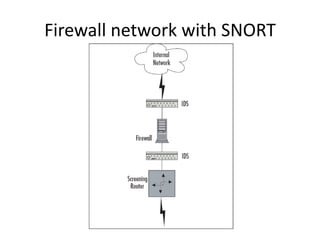
Firewall network with SNORT
SNORT add-ons
• DumbPig
– bad rule grammar detection
• OfficeCat
– search for vurneabilities in Microsoft Office docs
• SnoGE
– reporting tool parsing your logs and visualising them as
points at Google Maps
• Oinkmaster
– tool for creating and managing rules
• iBlock
– daemon grepping alert file and blocking offending hosts
http://www.snort.org/snort-downloads/additional-downloads
Q&A

Network Intrusion Detection Systems #1

  • 1.
  • 2.
    NIDS (detecton system) •realtime attack detection • passive (watchers) / active (measurement) systems • via analysis – protocol analysis – graph analysis – anomaly detection • analysis of direct network traffic – complete / light
  • 3.
  • 4.
    Traffic analysis • analyzingbehaviour, not just packets • difficulties – NIDS can be run from different part of network – bad packets – reordering issues • sensor placement – inline – passive • spanning port • network tap • load balancer
  • 5.
  • 6.
  • 7.
    Signature-based analysis • patternmatching • “patterns of malicious traffic” • very elementary (basically grepping) + huge community for rule generation + great for low level analysis (rules are very specific) + not taking too much resources - lower performance with big ruleset - slight attack variation can beat the rule
  • 8.
    Rule example # alerttcp $EXTERNAL_NET any -> $HOME_NET 53 ( msg:"OS-SOLARIS EXPLOIT sparc overflow attempt"; flow:to_server,established; content:"|90 1A C0 0F 90 02| |08 92 02| |0F D0 23 BF F8|"; fast_pattern:only; metadata:ruleset community, service dns; classtype:attempted-admin; sid:267; rev:13; )
  • 9.
    Protocol-based analysis • reviewingnetwork data • strictly based on layer headers • knowledge of expected values + better possibility for scalability + generic, able to catch zero-day exploits - protocol headers preprocessor need resources - rules can get extremely difficult to write/understand - provide low information, admin has to investigate
  • 10.
    Types of detectedevents • transport layer attack • network layer attack • unexpected services (tunnel, backdoor etc.) • policy violations (forbidden protocols, ports etc.) note: detection with accuracy
  • 11.
    Types of attack •evasion/insertion attacks – bad IP headers – bad IP options – direct frame addressing • IP packets fragmentation – set up delay for dropping stored packets • TCP layer problems – sync between NIDS and end system
  • 12.
    Prevention • passive – endingTCP stream • inline – inline firewalling – throttling bandwith usage – altering malicious content • passive and inline – running third party script – reconfiguring other network devices
  • 13.
    Toolset • SNORT – opensource –windows / linux – lots of plugins • OSSIM (security information and event management) • Sguil (network security monitor)
  • 14.
    SNORT • started assniffer in 1998 • sniffer, packet logger, and NIDS • most used open-source NIDS right now • loads of add-ons • big and stable community (regular community rule releases)
  • 15.
  • 16.
    SNORT add-ons • DumbPig –bad rule grammar detection • OfficeCat – search for vurneabilities in Microsoft Office docs • SnoGE – reporting tool parsing your logs and visualising them as points at Google Maps • Oinkmaster – tool for creating and managing rules • iBlock – daemon grepping alert file and blocking offending hosts http://www.snort.org/snort-downloads/additional-downloads
  • 17.