PacketCloud: an Open Platform
for Elastic In-network Services
Yang Chen1, Bingyang Liu2, Yu Chen1, Ang Li1,
Xiaowei Yang1, Jun Bi2
1Duke University 2Tsinghua University
ychen@cs.duke.edu
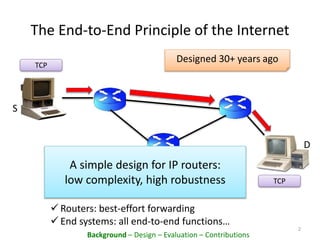
The End-to-End Principle of the Internet
 Routers: best-effort forwarding
 End systems: all end-to-end functions…
TCP
TCP
A simple design for IP routers:
low complexity, high robustness
2
S
D
Designed 30+ years ago
Background – Design – Evaluation – Contributions
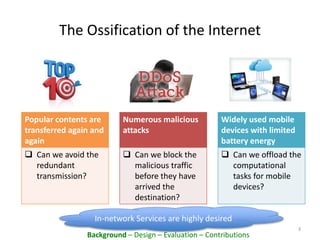
The Ossification of the Internet
3
In-network Services are highly desired
Background – Design – Evaluation – Contributions
Popular contents are
transferred again and
again
 Can we avoid the
redundant
transmission?
Numerous malicious
attacks
 Can we block the
malicious traffic
before they have
arrived the
destination?
Widely used mobile
devices with limited
battery energy
 Can we offload the
computational
tasks for mobile
devices?
In-network Services: Today’s Practice
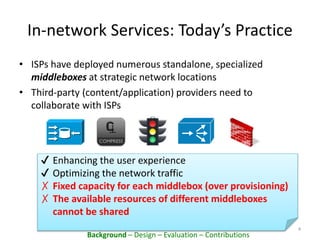
• ISPs have deployed numerous standalone, specialized
middleboxes at strategic network locations
• Third-party (content/application) providers need to
collaborate with ISPs
4
✔ Enhancing the user experience
✔ Optimizing the network traffic
✗ Fixed capacity for each middlebox (over provisioning)
✗ The available resources of different middleboxes
cannot be shared
Background – Design – Evaluation – Contributions
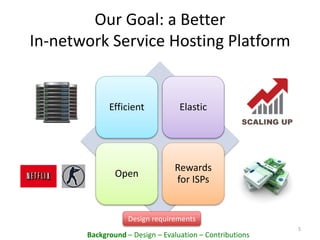
Efficient Elastic
Open
Rewards
for ISPs
Our Goal: a Better
In-network Service Hosting Platform
5
Background – Design – Evaluation – Contributions
Design requirements
Related Work
• CoMb: consolidation of middleboxes [Sekar et al.,
NSDI’12]
– Supporting only trusted/reliable services
– Not open to third-party providers
– Vulnerable to unexpected service crash and malicious
attacks
• APLOMB: outsourcing to public clouds [Sherry et
al., SIGCOMM’12]
– Unwanted interdomain traffic
– Data ownership problems
6
Background – Design – Evaluation – Contributions
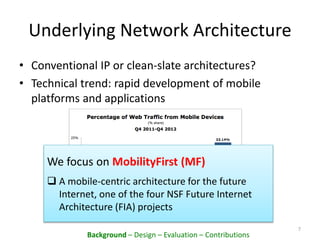
Underlying Network Architecture
• Conventional IP or clean-slate architectures?
• Technical trend: rapid development of mobile
platforms and applications
7
We focus on MobilityFirst (MF)
 A mobile-centric architecture for the future
Internet, one of the four NSF Future Internet
Architecture (FIA) projects
Background – Design – Evaluation – Contributions
MF: Prominent Features
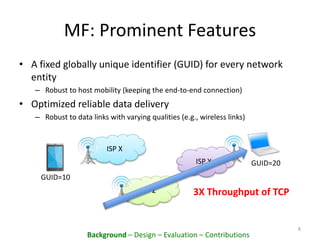
• A fixed globally unique identifier (GUID) for every network
entity
– Robust to host mobility (keeping the end-to-end connection)
• Optimized reliable data delivery
– Robust to data links with varying qualities (e.g., wireless links)
8
ISP X
ISP Y
ISP Z
GUID=10
3X Throughput of TCP
GUID=20
Background – Design – Evaluation – Contributions
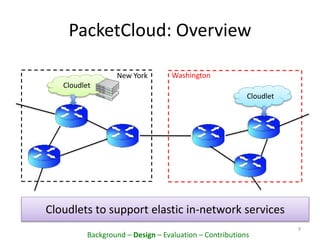
PacketCloud: Overview
Cloudlet
Cloudlet
New York Washington
Cloudlets to support elastic in-network services
9
Background – Design – Evaluation – Contributions
Inside a Cloudlet
CPU (cores) Mem (GB) Disk (GB) BW (Gbps)
N1 7/1 1/1 250/50 5/5
N2 4/4 0/2 50/200 9/1
… … … … …
10
Reserved / Available
Resource Table (time slot: [t0, t1])
……
Serv 2
Serv 1
Cloudlet
Controller
DEMUX Rules
Background – Design – Evaluation – Contributions
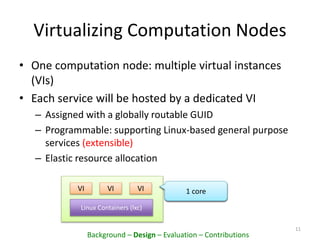
Virtualizing Computation Nodes
• One computation node: multiple virtual instances
(VIs)
• Each service will be hosted by a dedicated VI
– Assigned with a globally routable GUID
– Programmable: supporting Linux-based general purpose
services (extensible)
– Elastic resource allocation
11
VI VI VI
Linux Containers (lxc)
Background – Design – Evaluation – Contributions
3 cores1 core
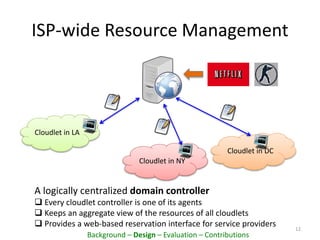
Cloudlet in NY
ISP-wide Resource Management
12
Cloudlet in LA
Cloudlet in DC
A logically centralized domain controller
 Every cloudlet controller is one of its agents
 Keeps an aggregate view of the resources of all cloudlets
 Provides a web-based reservation interface for service providers
Background – Design – Evaluation – Contributions
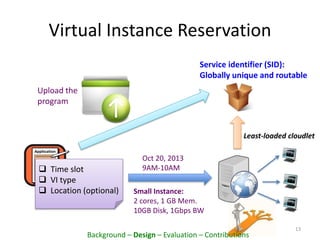
Virtual Instance Reservation
13
 Time slot
 VI type
 Location (optional)
Oct 20, 2013
9AM-10AM
Small Instance:
2 cores, 1 GB Mem.
10GB Disk, 1Gbps BW
Least-loaded cloudlet
Service identifier (SID):
Globally unique and routable
Upload the
program
Background – Design – Evaluation – Contributions
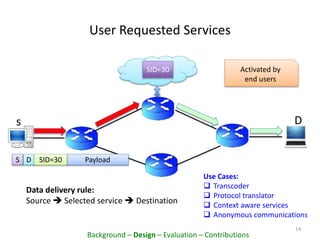
User Requested Services
14
S D PayloadSID=30
SID=30
Data delivery rule:
Source  Selected service  Destination
s D
Use Cases:
 Transcoder
 Protocol translator
 Context aware services
 Anonymous communications
Activated by
end users
Background – Design – Evaluation – Contributions
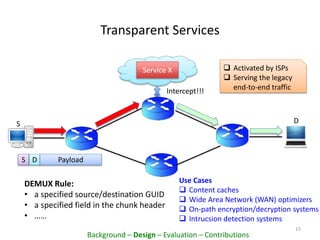
Transparent Services
15
S D Payload
Service X
Intercept!!!
DEMUX Rule:
• a specified source/destination GUID
• a specified field in the chunk header
• ……
 Activated by ISPs
 Serving the legacy
end-to-end traffic
Use Cases
 Content caches
 Wide Area Network (WAN) optimizers
 On-path encryption/decryption systems
 Intrucsion detection systems
Background – Design – Evaluation – Contributions
S D
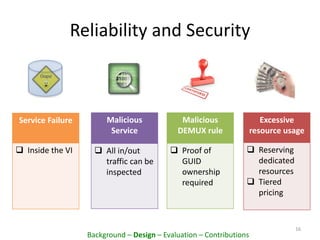
Reliability and Security
16
Background – Design – Evaluation – Contributions
Service Failure
 Inside the VI
Malicious
Service
 All in/out
traffic can be
inspected
Malicious
DEMUX rule
 Proof of
GUID
ownership
required
Excessive
resource usage
 Reserving
dedicated
resources
 Tiered
pricing
A Proof-of-concept Prototype
• Service-aware MF software router
– Based on the latest MF prototype (using Click Modular
Router)
– Guiding the MF routers to identify and discover
PacketCloud services
• Implemented services
– Protocol translator (user requested)
– WAN optimizer (transparent)
– Intrusion detection system (transparent)
– Secure communication module (transparent)
– (more are coming…)
17
Background – Design – Evaluation – Contributions
Test and Evaluation
• Tested in both wired/wireless environments
• Evaluation results
– Scalability
– Delay Penalty
18
Background – Design – Evaluation – Contributions
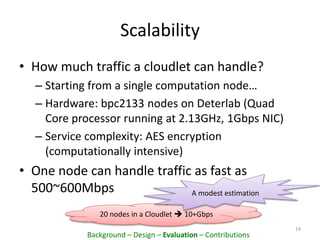
Scalability
• How much traffic a cloudlet can handle?
– Starting from a single computation node…
– Hardware: bpc2133 nodes on Deterlab (Quad
Core processor running at 2.13GHz, 1Gbps NIC)
– Service complexity: AES encryption
(computationally intensive)
• One node can handle traffic as fast as
500~600Mbps
19
20 nodes in a Cloudlet  10+Gbps
A modest estimation
Background – Design – Evaluation – Contributions
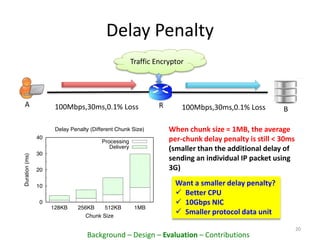
Delay Penalty
20
100Mbps,30ms,0.1% LossA R B
Traffic Encryptor
100Mbps,30ms,0.1% Loss
Background – Design – Evaluation – Contributions
When chunk size = 1MB, the average
per-chunk delay penalty is still < 30ms
(smaller than the additional delay of
sending an individual IP packet using
3G)
Want a smaller delay penalty?
 Better CPU
 10Gbps NIC
 Smaller protocol data unit
Contributions
• A “cloud-like” platform to host in-network
services
– Elastic services: scaling up/down according to
traffic demand
– Efficient resource sharing
– Open to third-party providers
– Viable economic rewards for ISPs
• A number of viable use cases
• A proof-of-concept prototype and evaluation
21
Background – Design – Evaluation – Contributions
Future Works
• Cloudlet deployment strategy
– Network topology, user behavior, and resource
availability
• Economic Models
– Financial links among different Internet entities,
i.e., users, ISPs, and third-party providers
22
Background – Design – Evaluation – Contributions
Acknowledgements
• Feixong Zhang, Kiran Nagaraja, and Dipankar
Raychaudhuri (Rutgers University)
• Qiang Cao, Xin Wu, Theophilus A. Benson
(Duke University)
23

PacketCloud: an Open Platform for Elastic In-network Services.

  • 1.
    PacketCloud: an OpenPlatform for Elastic In-network Services Yang Chen1, Bingyang Liu2, Yu Chen1, Ang Li1, Xiaowei Yang1, Jun Bi2 1Duke University 2Tsinghua University ychen@cs.duke.edu
  • 2.
    The End-to-End Principleof the Internet  Routers: best-effort forwarding  End systems: all end-to-end functions… TCP TCP A simple design for IP routers: low complexity, high robustness 2 S D Designed 30+ years ago Background – Design – Evaluation – Contributions
  • 3.
    The Ossification ofthe Internet 3 In-network Services are highly desired Background – Design – Evaluation – Contributions Popular contents are transferred again and again  Can we avoid the redundant transmission? Numerous malicious attacks  Can we block the malicious traffic before they have arrived the destination? Widely used mobile devices with limited battery energy  Can we offload the computational tasks for mobile devices?
  • 4.
    In-network Services: Today’sPractice • ISPs have deployed numerous standalone, specialized middleboxes at strategic network locations • Third-party (content/application) providers need to collaborate with ISPs 4 ✔ Enhancing the user experience ✔ Optimizing the network traffic ✗ Fixed capacity for each middlebox (over provisioning) ✗ The available resources of different middleboxes cannot be shared Background – Design – Evaluation – Contributions
  • 5.
    Efficient Elastic Open Rewards for ISPs OurGoal: a Better In-network Service Hosting Platform 5 Background – Design – Evaluation – Contributions Design requirements
  • 6.
    Related Work • CoMb:consolidation of middleboxes [Sekar et al., NSDI’12] – Supporting only trusted/reliable services – Not open to third-party providers – Vulnerable to unexpected service crash and malicious attacks • APLOMB: outsourcing to public clouds [Sherry et al., SIGCOMM’12] – Unwanted interdomain traffic – Data ownership problems 6 Background – Design – Evaluation – Contributions
  • 7.
    Underlying Network Architecture •Conventional IP or clean-slate architectures? • Technical trend: rapid development of mobile platforms and applications 7 We focus on MobilityFirst (MF)  A mobile-centric architecture for the future Internet, one of the four NSF Future Internet Architecture (FIA) projects Background – Design – Evaluation – Contributions
  • 8.
    MF: Prominent Features •A fixed globally unique identifier (GUID) for every network entity – Robust to host mobility (keeping the end-to-end connection) • Optimized reliable data delivery – Robust to data links with varying qualities (e.g., wireless links) 8 ISP X ISP Y ISP Z GUID=10 3X Throughput of TCP GUID=20 Background – Design – Evaluation – Contributions
  • 9.
    PacketCloud: Overview Cloudlet Cloudlet New YorkWashington Cloudlets to support elastic in-network services 9 Background – Design – Evaluation – Contributions
  • 10.
    Inside a Cloudlet CPU(cores) Mem (GB) Disk (GB) BW (Gbps) N1 7/1 1/1 250/50 5/5 N2 4/4 0/2 50/200 9/1 … … … … … 10 Reserved / Available Resource Table (time slot: [t0, t1]) …… Serv 2 Serv 1 Cloudlet Controller DEMUX Rules Background – Design – Evaluation – Contributions
  • 11.
    Virtualizing Computation Nodes •One computation node: multiple virtual instances (VIs) • Each service will be hosted by a dedicated VI – Assigned with a globally routable GUID – Programmable: supporting Linux-based general purpose services (extensible) – Elastic resource allocation 11 VI VI VI Linux Containers (lxc) Background – Design – Evaluation – Contributions 3 cores1 core
  • 12.
    Cloudlet in NY ISP-wideResource Management 12 Cloudlet in LA Cloudlet in DC A logically centralized domain controller  Every cloudlet controller is one of its agents  Keeps an aggregate view of the resources of all cloudlets  Provides a web-based reservation interface for service providers Background – Design – Evaluation – Contributions
  • 13.
    Virtual Instance Reservation 13 Time slot  VI type  Location (optional) Oct 20, 2013 9AM-10AM Small Instance: 2 cores, 1 GB Mem. 10GB Disk, 1Gbps BW Least-loaded cloudlet Service identifier (SID): Globally unique and routable Upload the program Background – Design – Evaluation – Contributions
  • 14.
    User Requested Services 14 SD PayloadSID=30 SID=30 Data delivery rule: Source  Selected service  Destination s D Use Cases:  Transcoder  Protocol translator  Context aware services  Anonymous communications Activated by end users Background – Design – Evaluation – Contributions
  • 15.
    Transparent Services 15 S DPayload Service X Intercept!!! DEMUX Rule: • a specified source/destination GUID • a specified field in the chunk header • ……  Activated by ISPs  Serving the legacy end-to-end traffic Use Cases  Content caches  Wide Area Network (WAN) optimizers  On-path encryption/decryption systems  Intrucsion detection systems Background – Design – Evaluation – Contributions S D
  • 16.
    Reliability and Security 16 Background– Design – Evaluation – Contributions Service Failure  Inside the VI Malicious Service  All in/out traffic can be inspected Malicious DEMUX rule  Proof of GUID ownership required Excessive resource usage  Reserving dedicated resources  Tiered pricing
  • 17.
    A Proof-of-concept Prototype •Service-aware MF software router – Based on the latest MF prototype (using Click Modular Router) – Guiding the MF routers to identify and discover PacketCloud services • Implemented services – Protocol translator (user requested) – WAN optimizer (transparent) – Intrusion detection system (transparent) – Secure communication module (transparent) – (more are coming…) 17 Background – Design – Evaluation – Contributions
  • 18.
    Test and Evaluation •Tested in both wired/wireless environments • Evaluation results – Scalability – Delay Penalty 18 Background – Design – Evaluation – Contributions
  • 19.
    Scalability • How muchtraffic a cloudlet can handle? – Starting from a single computation node… – Hardware: bpc2133 nodes on Deterlab (Quad Core processor running at 2.13GHz, 1Gbps NIC) – Service complexity: AES encryption (computationally intensive) • One node can handle traffic as fast as 500~600Mbps 19 20 nodes in a Cloudlet  10+Gbps A modest estimation Background – Design – Evaluation – Contributions
  • 20.
    Delay Penalty 20 100Mbps,30ms,0.1% LossAR B Traffic Encryptor 100Mbps,30ms,0.1% Loss Background – Design – Evaluation – Contributions When chunk size = 1MB, the average per-chunk delay penalty is still < 30ms (smaller than the additional delay of sending an individual IP packet using 3G) Want a smaller delay penalty?  Better CPU  10Gbps NIC  Smaller protocol data unit
  • 21.
    Contributions • A “cloud-like”platform to host in-network services – Elastic services: scaling up/down according to traffic demand – Efficient resource sharing – Open to third-party providers – Viable economic rewards for ISPs • A number of viable use cases • A proof-of-concept prototype and evaluation 21 Background – Design – Evaluation – Contributions
  • 22.
    Future Works • Cloudletdeployment strategy – Network topology, user behavior, and resource availability • Economic Models – Financial links among different Internet entities, i.e., users, ISPs, and third-party providers 22 Background – Design – Evaluation – Contributions
  • 23.
    Acknowledgements • Feixong Zhang,Kiran Nagaraja, and Dipankar Raychaudhuri (Rutgers University) • Qiang Cao, Xin Wu, Theophilus A. Benson (Duke University) 23