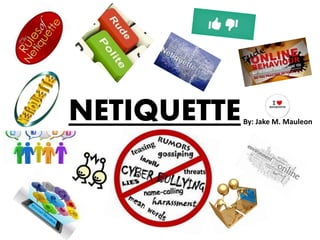
NETIQUETTEBy: Jake M. Mauleon
NETIQUETTE
• Refers to etiquette on the
internet.
• Good netiquette is based on
respect for other net users.
• It is avoiding online actions that
will annoy or frustrate other
people.
Be concise and to
the point
Use proper
spelling, grammar
& punctuation
Do not write in
CAPITALS
Read the email
before you send it
Do not use reply to
all
Do not copy a
message or
attachment
without
permission
Do not use email
to discuss
confidential
information
Avoid long
sentences
Do not forward
virus hoaxes and
chain letters
Copyright
• A set of rights granted to the author or creator
of a work, to restrict others’ ability to copy,
redistribute and reshape the content.
• Rights are frequently owned by the companies
who sponsor the work rather than the creators
themselves and can be bought and sold on the
market.
Fair Use
• Refers to the limitation and to the exclusive
right granted by copyright law to the author of
a creative work.
• Examples of fair use include commentary,
search engines, criticism, news reporting,
research, teaching, library archiving and
scholarship.
Plagiarism
• The act of taking another person's ideas,
writings, inventions, and similar intellectual
products as one's own without knowledge,
consent and/or accreditation.

Netiquette

  • 1.
  • 2.
    NETIQUETTE • Refers toetiquette on the internet. • Good netiquette is based on respect for other net users. • It is avoiding online actions that will annoy or frustrate other people.
  • 3.
    Be concise andto the point
  • 4.
  • 5.
    Do not writein CAPITALS
  • 6.
  • 7.
    Do not usereply to all
  • 8.
    Do not copya message or attachment without permission
  • 9.
    Do not useemail to discuss confidential information
  • 10.
  • 11.
    Do not forward virushoaxes and chain letters
  • 12.
    Copyright • A setof rights granted to the author or creator of a work, to restrict others’ ability to copy, redistribute and reshape the content. • Rights are frequently owned by the companies who sponsor the work rather than the creators themselves and can be bought and sold on the market.
  • 13.
    Fair Use • Refersto the limitation and to the exclusive right granted by copyright law to the author of a creative work. • Examples of fair use include commentary, search engines, criticism, news reporting, research, teaching, library archiving and scholarship.
  • 14.
    Plagiarism • The actof taking another person's ideas, writings, inventions, and similar intellectual products as one's own without knowledge, consent and/or accreditation.