› Netiquette
› Copyright
› Fair Use
› Plagiarism
› Safety on the web
› Safety on your computer
 Netiquette is a set of guidelines to
encourage proper activity online.
 These guidelines or rules are needed to
prevent inappropriate interactions
online.
 Netiquette is useful for all internet users.
 The golden rule
 Have same behaviors online as in person
 Know where you are in cyberspace
 Respect others time and privacy
 Make yourself look good online
 Share expert knowledge
 Do not abuse internet power
 Copyright protects the author’s rights to
their original work.
 This protection is available for both
published and unpublished work.
 Items that are protected by copyright
include but are not limited to literacy,
dramatic, musical, and artistic.
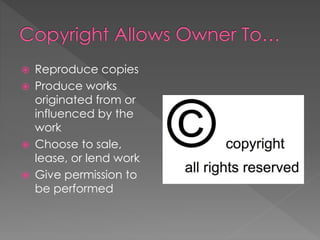
 Reproduce copies
 Produce works
originated from or
influenced by the
work
 Choose to sale,
lease, or lend work
 Give permission to
be performed
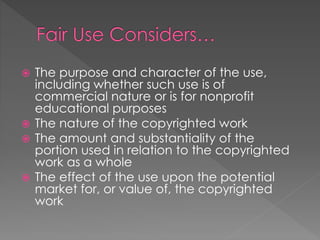
 The purpose and character of the use,
including whether such use is of
commercial nature or is for nonprofit
educational purposes
 The nature of the copyrighted work
 The amount and substantiality of the
portion used in relation to the copyrighted
work as a whole
 The effect of the use upon the potential
market for, or value of, the copyrighted
work
 Plagiarism means to steal someone’s
ideas without giving proper credit.
 The expression of work is considered
intellectual property.
 Stealing another’s intellectual property is
against the U.S. law.
 Turning in someone else's work as your own
 Copying words or ideas from someone else
without giving credit
 Failing to put a quotation in quotation marks
 Giving incorrect information about the source
of a quotation
 Changing words but copying the sentence
structure of a source without giving credit
 Copying so many words or ideas from a source
that it makes up the majority of your work,
whether you give credit or not (see our section
on "fair use" rules)
 Cyber bullying
 Exposure to
inappropriate
material
 Online predators
 Revealing too much
personal information
 Children are at high
risk when internet use
is not under adult
supervision.
 Avoid Chat rooms
 Do not reveal too much person information
 Be aware of secure websites
 Keep computer in family room (for children)
 NEVER met someone in person that was
met online
 Use appropriate internet blocking resources
 Choose strong passwords
 Use secure connections
 Avoid pop-ups
 Visit secure websites
 Install
firewall/protective
software
 Backup important
information
 Stay informed
 Basic Internet Safety. (n.d.). Basic Internet Safety.
Retrieved June 3, 2014, from
http://www.netsmartz.org/internetsafety
 Copyright Basics. (2012, January 1). . Retrieved June 3,
2014, from http://www.copyright.gov/circs/circ01.pdf
 Shea, V. (2004, January 1). THE CORE RULES OF NETIQUETTE.
The Core Rules of Netiquette. Retrieved June 3, 2014, from
http://www.albion.com/netiquette/corerules.html
 Top Ten Safe Computing Tips. (n.d.). Information Systems &
Technology. Retrieved June 3, 2014, from
http://ist.mit.edu/security/tips
 U.S. Copyright Office - Fair Use. (n.d.). U.S. Copyright Office
- Fair Use. Retrieved June 3, 2014, from
http://www.copyright.gov/fls/fl102.html
 What is Plagiarism? (n.d.) Retrieved June 2, 2014, from
http://plagiarism.org/citing-sources/whats-a-citation

Digital citizenship Presentation

  • 2.
    › Netiquette › Copyright ›Fair Use › Plagiarism › Safety on the web › Safety on your computer
  • 3.
     Netiquette isa set of guidelines to encourage proper activity online.  These guidelines or rules are needed to prevent inappropriate interactions online.  Netiquette is useful for all internet users.
  • 4.
     The goldenrule  Have same behaviors online as in person  Know where you are in cyberspace  Respect others time and privacy  Make yourself look good online  Share expert knowledge  Do not abuse internet power
  • 5.
     Copyright protectsthe author’s rights to their original work.  This protection is available for both published and unpublished work.  Items that are protected by copyright include but are not limited to literacy, dramatic, musical, and artistic.
  • 6.
     Reproduce copies Produce works originated from or influenced by the work  Choose to sale, lease, or lend work  Give permission to be performed
  • 7.
     The purposeand character of the use, including whether such use is of commercial nature or is for nonprofit educational purposes  The nature of the copyrighted work  The amount and substantiality of the portion used in relation to the copyrighted work as a whole  The effect of the use upon the potential market for, or value of, the copyrighted work
  • 8.
     Plagiarism meansto steal someone’s ideas without giving proper credit.  The expression of work is considered intellectual property.  Stealing another’s intellectual property is against the U.S. law.
  • 9.
     Turning insomeone else's work as your own  Copying words or ideas from someone else without giving credit  Failing to put a quotation in quotation marks  Giving incorrect information about the source of a quotation  Changing words but copying the sentence structure of a source without giving credit  Copying so many words or ideas from a source that it makes up the majority of your work, whether you give credit or not (see our section on "fair use" rules)
  • 10.
     Cyber bullying Exposure to inappropriate material  Online predators  Revealing too much personal information  Children are at high risk when internet use is not under adult supervision.
  • 11.
     Avoid Chatrooms  Do not reveal too much person information  Be aware of secure websites  Keep computer in family room (for children)  NEVER met someone in person that was met online  Use appropriate internet blocking resources  Choose strong passwords  Use secure connections
  • 12.
     Avoid pop-ups Visit secure websites  Install firewall/protective software  Backup important information  Stay informed
  • 13.
     Basic InternetSafety. (n.d.). Basic Internet Safety. Retrieved June 3, 2014, from http://www.netsmartz.org/internetsafety  Copyright Basics. (2012, January 1). . Retrieved June 3, 2014, from http://www.copyright.gov/circs/circ01.pdf  Shea, V. (2004, January 1). THE CORE RULES OF NETIQUETTE. The Core Rules of Netiquette. Retrieved June 3, 2014, from http://www.albion.com/netiquette/corerules.html  Top Ten Safe Computing Tips. (n.d.). Information Systems & Technology. Retrieved June 3, 2014, from http://ist.mit.edu/security/tips  U.S. Copyright Office - Fair Use. (n.d.). U.S. Copyright Office - Fair Use. Retrieved June 3, 2014, from http://www.copyright.gov/fls/fl102.html  What is Plagiarism? (n.d.) Retrieved June 2, 2014, from http://plagiarism.org/citing-sources/whats-a-citation