Page 1 of 20
Critical Aspect of Globalization: A Case study on Netflix
History of the Company
• Netflix has come a long way since its inception in 1997 as a DVD-by-mail rental service.
• Today, it is a streaming giant with millions of subscribers worldwide and a massive library
of original content.
• Join us on a journey through the ups and downs, the successes and failures, and the
innovations that have made Netflix a household name.
For millions, Netflix is the de-facto place for movie and TV streaming. According to sites
like fortune.com, its services alone constitute about 15% of the world's internet bandwidth!
Not bad for a company that started by posting DVDs by snail mail. Here we explore the company's
origins and track some of the important milestones in history.
Who started Netflix?
Netflix was founded in August of 1997 by two serial entrepreneurs, Marc Randolph, and Reed
Hastings. The company began in Scotts Valley, California, and has become one of the world's
leading internet entertainment platforms.
When it first opened, Netflix was purely a movie rental service. Users ordered movies on
the Netflix website and received DVDs in the post. When they were finished with them, they
would post them back to Netflix in the envelopes provided. At the time, this was seen as a boon to
those who did not have a video rental store nearby (remember those?).
Today, Netflix streams movies and has more than 151 million paid subscribers in over 190
countries worldwide. It offers a wide range of TV series, documentaries, and feature films across
various genres and languages, including original productions.
Page 2 of 20
Reed Hastings co-founded Netflix in 1997. He was an entrepreneur who, in 1991, founded Pure
Software, which made tools for software developers. After a 1995 IPO and several acquisitions,
Pure was acquired by Rational Software in 1997.
Hastings received a BA from Bowdoin College in 1983 and an MSCS in artificial
intelligence from Stanford University in 1988. Between Bowdoin and Stanford, he served in the
Peace Corps as a high school math teacher in Swaziland. Today, he is an active educational
philanthropist, serving on the California State Board of Education and the board of several
educational organizations.
Marc Randolph is a veteran Silicon Valley entrepreneur, advisor, and investor. As co-founder and
founding CEO of Netflix, he laid much of the groundwork for a service that’s grown to 150 million
subscribers and fundamentally altered how the world experiences media.
He also served on the Netflix board of directors until retiring from the company in 2003."
www.marcrandolph.com. Randolph graduated from university with a degree in Geology and
would go on to found and run various mail-order and direct-to-customer companies
before Netflix.
Throughout Randolph's career, he founded no fewer than six successful startups, including
the magazine Macworld, and has mentored hundreds of early-stage entrepreneurs.
When and where was Netflix founded?
As mentioned, Netflix was founded in 1997 in Scotts Valley, California. It was initially a rent-by-
mail DVD service that used a pay-per-rental model.
Users would browse and order the films they wanted on their website, put in an order,
and Netflix would post them to their door. After renters finished the DVDs, they would post them
back.
Rentals cost around $4 each, plus a $2 postage charge. After significant growth, Netflix switched
to a subscriber-based model.
Page 3 of 20
With this model, users could keep the DVDs for as long as they liked but could only rent a new
movie after returning their existing one.
Netflix's mail-order rental model would directly challenge the market dominance of brick-and-
mortar rental giants like Blockbuster. Blockbuster could ultimately not compete with the move to
online streaming and rentals and filed for bankruptcy in 2010.
But this never needed to happen. Years earlier, Blockbuster had the opportunity to partner
with Netflix or buy the company out. "In 2000, Netflix CEO and co-founder Reed Hastings
approached Blockbuster about a partnership. Unfortunately for Blockbuster, their CEO just smiled
and laughed at him.
Blockbuster even had a chance to purchase Netflix for $50 million. Netflix currently has a Market
Cap of [$209.74B] (July 2020) and a share price of $476.89, while Blockbuster is out of business."
www.rewindandcapture.com.
Why Netflix is called Netflix?
You could probably work this one out for yourself. But in case you are still stumped, the
name Netflix is a combination of "Net" (as in the abbreviation for "internet" and "Flix" (a variation
of "flick," the common abbreviation for a movie or film). Pretty straight forward, really.
How was Netflix founded?
When Netflix was founded, Randolph was a marketing director for Hasting's company Pure Atria.
He was also the co-founder of Micro Warehouse (a computer mail-order company). Hasting would
sell Pure Atria to the Rational Software Corporation in 1997 for $700 million.
By all accounts, the pair came up with the idea for Netflix during a commute between their Santa
Cruz home and Pure Atria's HQ in Sunnyvale. Hastings would supply the seed capital and
invest $2.5 million into the startup in cash. Inspired by Amazon's e-commerce model, the pair
explored similar portable items they could use to sell over the internet.
Page 4 of 20
After initially considering and rejecting VHS cassettes, they settled on DVDs as the perfect
product. They tested their idea by posting a DVD to their homes in Santa Cruz, and when it arrived
in excellent condition, they decided the time was right to break into the market with their
revolutionary model.
Netflix launched in April of 1998 as one of the world's first online DVD rental companies. They
had only a few staff and just fewer than 1000 titles.
What are some of the key milestones in Netflix's history?
Here is a brief timeline of some of the critical milestones in the company's history (courtesy, in
part, of Netflix.com)
It all kicks off in 1997
Reed Hastings and software executive Marc Randolph co-found Netflix to offer online movie
rentals.
Netflix launched its DVD rental and sales service in 1998
Netflix launches the first DVD rental and sales site, Netflix.com.
Their subscriber-based business model launched in 1999
Netflix debuts a subscription service, offering unlimited DVD rentals for one low monthly price.
2000 unveils subscriber personalization
Netflix introduced a personalized movie recommendation system, which uses members’ ratings to
predict choices for all Netflix members.
Page 5 of 20
Netflix went public in 2002
With a membership count of 600,000 in the US, Netflix makes its initial public offering (on the
NASDAQ, under the ticker “NFLX”). The stock is initially offered for $15 a share, with an initial
offering of 5,500,000 shares.
The company ends the year with around 857,000 registered Netflix accounts. Since
then, Netflix has consistently been one of the best-performing stocks in the S&P 500.
The company celebrated 1 million accounts in 2003
This year, Netflix hit a new record for the number of members, with more than 1 million. The
company also issues a patent with the U.S. Patent and Trademark Office for its subscription rental
service and other extensions. Co-founder Marc Randolph stepped down as a board member and
left Netflix in 2003.
2004 sees a doubling in the number of Netflix accounts
This year, Netflix's member base surpassed 2 million. At the same time, Netflix faces one of its
first encounters with the legal system when they are sued for false advertising concerning claims
of "unlimited rentals" with "one-day delivery."
The claimant accused Netflix of failing to deliver on these two marketing promises in the San
Fransisco Superior Court, claiming that the company's 3-at-a-time plan precluded unlimited rentals
and there was no way to ensure the one-day delivery using "snail mail."
Netflix denied any wrongdoing, and both parties eventually agreed on a settlement.
• By 2005, Netflix has doubled its subscriber base again the number of Netflix members has
raised to 4.2 million. Netflix accounts hit a record 5 million in 2006.
Netflix sees huge growth in member numbers, reaching 6, 3 million subscribers by year's end. The
company also launched its "Netflix Prize", promising a whopping $1 million to the first person, or
team, who can achieve a set accuracy goal in recommending movies based on personal preferences.
Page 6 of 20
Netflix also released around 100 million anonymous movie ratings, using a system that rates films
from one to five stars. This is the largest set of such data released to date. Video streaming was
introduced in 2007.
Netflix introduced a streaming service called "Watch Now," allowing members to instantly watch
television shows and movies on their computers. This was a huge shift in the company's business
model.
Initially, the service launched with just 1,000 titles and only worked on PCs and Internet
Explorer. It also offered a limit on the number of hours of free streaming (with a maximum of 18
free hours a month) based on the user's subscription plan.
Netflix was also careful to say that they felt DVDs would be around for a long time. Despite these
limitations, it was soon apparent that streaming was the future of entertainment.
By the end of 2007, Netflix had 7.5 million registered subscribers -- up almost 20% from the
previous year. Netflix teams up with various consumer electronics companies in 2008
Netflix partners with consumer electronics companies to allow streaming on the Xbox 360, Blu-
ray disc players, and TV set-top boxes. The year ends with around 9.4 million subscribers. Netflix
was added to play station and smart TVs in 2009
Netflix partners with more consumer electronics companies to allow streaming on PS3, Internet-
connected TVs, and other devices. Its member base also expands to an amazing 12 million
accounts by the end of the year.
The "Netflix Prize" also finds a winner this year. "Bellkor's Pragmatic Chaos" team comprises
seven researchers from four countries. Running for over three years, the contest has attracted tens
of thousands of contestants from more than 180 countries worldwide.
Netflix connects to Apple devices and expands into Canada in 2010
At this point, Netflix is available on the Apple iPad, iPhone, iPod Touch, Nintendo Wii, and other
Internet-connected devices. Netflix launches its service in Canada.
Page 7 of 20
The year ends with more than 20 million subscribers on the books. This year also marked where
the number of customer’s primarily streaming shows outpaced those renting, leading hasting to
declare in an October earnings call that, "By every measure, we are now primarily a streaming
company that also offers DVD-by-mail."
The Qwikster debacle of 2011
Buoyed by the success of its streaming service, Netflix decided to split its streaming and DVD
rental service into two separate services, forcing customers who wanted to use both to open a
second account. Instead of paying $10 monthly for DVD rentals and unlimited on-demand
streaming, customers who wished to use both services would have to pay for two packages, starting
at $7.99 each or $15.98 for the pair.
Within a few months, Netflix had lost 600,000 subscribers in the US, and the company's stock had
lost half its value. Despite this, Hastings announced that the separation would continue in October,
and the DVD service would be called Qwikster. A month later, facing a shareholder and customer
revolt, Hastings abruptly changed course and abandoned plans for Qwikster, although the DVD
and streaming plans would remain separate.
The debacle was a rare blunder for Netflix, which in the future would be deemed much smarter
owing to how it raised prices (slowly and stealthily). This year also saw the launch of Amazon
Instant Video, which made available 5,000 movies and TV shows for Amazon Prime members in
a move to compete with Netflix directly.
The UK and Nordic countries were taken by storm in 2012
Netflix has become available in Europe, including the United Kingdom, Ireland, and the Nordic
Countries. Netflix wins its first Primetime Emmy Engineering Award. They also premiere their
first original stand-up special, "Bill Burr: You People Are All the Same." Netflix also hits 25
million subscribers.
Page 8 of 20
Netflix became an award-winning service in 2013
Netflix received 31 primetime Emmy nominations, including outstanding drama series, comedy
series, and documentary or nonfiction specials for “House of Cards,” “Orange Is the New Black,”
and “The Square,” respectively. Netflix was the first internet TV network nominated for the
Primetime Emmy.
Netflix also releases another popular original programming like "Hemlock Grove" and "Arrested
Development" while unveiling the ‘Profiles’ feature, allowing users to create different profiles for
different users and moods.
By year's end, the company has more than 40 million subscribers.
2014 sees Netflix's continued expansion into Europe
In 2014, Netflix launched in 6 new countries in Europe (Austria, Belgium, France, Germany,
Luxembourg, and Switzerland), and won 7 Creative Emmy Awards. Netflix now has more than 50
million members globally.
Netflix expanded into Australasia in 2015
Netflix launched in Australia, New Zealand, and Japan, with continued expansion across Europe
in Italy, Spain, and Portugal. The first Netflix original feature film “Beasts of No Nation” is
released.
Netflix also premieres its first non-English original series with the Mexican comedy "Club de
Cuervos." At the same time, Amazon "Transparent" became the first show produced by Amazon
Studios to win a major award. Netflix was no longer the only streaming game in town.2016 is a
big year for Netflix
Netflix expanded to another 130 countries around the world, bringing its reach to a total
of 190 countries. It also offers programming in 21 languages. They also unveil their ‘Download’
feature, which allows members to download TV shows and movies for offline
viewing. Netflix continues to expand its collection of original international shows, with its first
Page 9 of 20
French series, "Marseille," its first Brazilian series, "3%," and its first non-English language
original film, the Spanish drama "7 Años."
2017 is another killer year for the company
This is another good year for Netflix. They win their first Academy Award for Best Documentary
Short Subject for "The White Helmets."
At the same time, subscriber numbers reach an astounding 100 million globally. Netflix also
expands its international collection with the top-rated series "La Casa De Papel" (from Spain),
"Suburra: Blood on Rome" (from Italy), and "Dark" (from Germany).
The year ends with a minor controversy, as Netflix "calls out" users who watch the same film
multiple times. While done in jest, it also made users aware that the company monitored their
watching habits and sparked privacy concerns.
This year, Amazon also began to make sports-related content acquisitions, acquiring non-exclusive
rights to stream portions of the NFL's "Thursday Night Football" games in a $50 million deal.
Things got better and better for Netflix in 2018
This year, Netflix won more Academy Awards for its original content, including Best
Documentary Feature for "Icarus."
2018 also sees Netflix's acquisition of the book publisher Millarworld, founded by the legendary
comic book creator Mark Millar, to adapt company properties into films and TV shows.
In March, Netflix employees launched a phone playing the original series "Star Trek:
Discovery" into space. This stunt was to celebrate the service now available in more than 190
countries worldwide.
Netflix also became the most nominated service at this year's Primetime and Creative Arts Emmy
Awards, receiving a fantastic 112 nominations. The company ties with the veteran HBO for most
Page 10 of 20
wins, taking home 23 accolades for their series, including "GLOW," "Godless," "Queer Eye," and
"Seven Seconds."
However, Amazon was coming up close behind as the streaming service announced it had secured
the UK rights to broadcast live Premier League football matches and purchased the global
television adaptation rights to The Lord of the Rings, which will air on Prime Video.
2019 sees more awards coming Netflix's way
In 2019, Netflix won four Academy Awards for Best Director, Best Foreign Language Film and
Best Cinematography for "ROMA” and Best Documentary Short Subject for "Period. End of
Sentence." They also acquired the intellectual property rights for StoryBots, an Emmy, Annie, and
Parents’ Choice award-winning children’s media brand created by Gregg and Evan
Spiridellis. Netflix also released "Klaus," its first-ever original animated feature film.
2019 also sees the release of "Inside Bill's Brain", a three-part documentary covering the life and
times of the man behind Microsoft. It is an instant hit. Netflix and Tesla also confirm that the
streaming service will soon be available on Tesla screens.
Netflix unveils its first international original films from the Middle East ("Jinn") and Thailand
("The Stranded"). This year, Netflix won 27 Primetime and Creative Arts Emmy Awards for series
including "Black Mirror: Bandersnatch," "Ozark," "Queer Eye," and "When They See us."
However, not everything is rosy for the company. Inspired by their success, several other
companies begin to get in on the act by starting or expanding their streaming services.
Disney, AT&T, and Apple launched their own Netflix alternatives in 2019. When Disney+
debuted the following year, it meant the end of Disney blockbusters, such as the Star Wars films,
being available on other streaming services.
Will 2020 be another bumper year for Netflix?
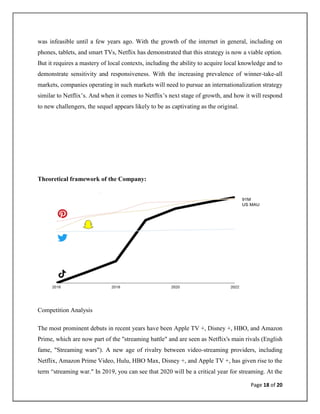
Netflix's subscriber base has grown to over 180 million, with 70 million from the United States
alone.
Page 11 of 20
What does the future have in store for Netflix?
Many experts believe that the future could look less rosy for Netflix. This is partly because of the
explosion in other streaming services launched to challenge Netflix's seeming dominance. Netflix,
to its credit, appears to have predicted the impending threat several years ago, as it acknowledged
that major media conglomerates would start to pull their content from Netflix to add to their
services.
"This is why, in 2018, Netflix spent $12 billion building its library of original films and series, an
88% uptick from 2017. And spending on original content this year is expected to reach $15 billion.
The strategy was to backfill its library with original content to gain and retain subscribers,"
according to Forbes.
Based on this, it seems Netflix will continue to focus on its content in the future rather than relying
on potential streaming competitors not pulling their content from the platform.
Another option is for Netflix to move to an advertisement-based system. However, up to this point,
the company has been staunchly opposed to this.
Netflix has weathered many storms before, and it would be foolish to believe it is not agile enough
to do so going forward.
WHAT IS GLOBALIZATION?
Globalization is the increase in the flow of goods, services, capital, people, and ideas across
international boundaries, according to the online course Global Business.
“We live in an age of globalization,” says Harvard Business School Professor Forest Reinhardt,
who teaches Global Business. “That is, national economies are ever more tightly connected with
one another than ever before.”
Page 12 of 20
Whether you’re looking to learn more about your international company or thinking of expanding
your business into other countries, you need a strong foundation in the basics of globalization in
business. Here’s a primer on what it means to be an international business, factors to consider
when approaching the global business landscape, and how to build your knowledge.
WHAT DOES IT MEAN TO BE AN INTERNATIONAL BUSINESS?
An international business is any company that operates and produces or sells goods between two
or more countries. There are three ways a business can be considered international:
1. It produces goods domestically and sells domestically and internationally.
2. It produces goods in a different country but sells domestically.
3. It produces goods in a different country and sells domestically and internationally.
If your business falls into one of these categories, there are two types of international business
models to consider: transnational and multinational.
Transnational corporations have offices in multiple countries, each responsible for a different
facet of the organization. For instance, marketing may be based in London, research and
development in Bogota, and software development in New York.
An example of a successful transnational corporation is Nestlé, which splits business operations
for each of its brands by region. There are over 100 Nestlé offices worldwide with distinct
responsibilities. For instance, the Nestlé Research Center is located in Switzerland, which acts as
the hub that oversees each brand-specific research and development center, of which there are 23.
All Nestlé offices operate under the company’s headquarters in Switzerland.
Multinational corporations also have offices in multiple countries, but unlike transnational
corporations, each is a microcosm of the larger organization. This means each office has, for
example, its own leadership, marketing, sales, research and development, technology, and human
resources teams. An example of a multinational corporation is PepsiCo, which has 32 offices
across 24 countries.
Page 13 of 20
If you’re considering which international business model to implement for your growing company,
know that each has its pros and cons. Transnational corporations typically have the benefit of
everyone on a specific team being located in the same office, although this may change with
the rise of remote work. Being in the same office can decrease miscommunication and reinforce
the idea that each office is an integral part of the larger company. Multinational companies may
not beget this same mindset, but they benefit from having someone from every team present in
each office. This can enable them to collaborate and tailor efforts to the audience in their specific
location without juggling time differences and language barriers to collaborate with other teams.
There’s no one-size-fits-all approach to globalization; only you can decide what works best for
your business.
FACTS OF GLOBAL BUSINESS TO CONSIDER
Globalization doesn’t just refer to the location of a firm’s offices and customers—it also
encompasses the nuances and economic factors of conducting business internationally and existing
in a global economy. Even if your company operates domestically, globalization can influence the
way you do business. Here are a few factors to consider when thinking about how global business
impacts your organization:
• Politics and laws: International politics can color relationships between nations and regulate
what products are allowed in and out of their borders. Keeping up with current events can help
you prepare for the business impacts of shifts in policy and foreign affairs.
• The environment: There’s no global issue more pressing than climate change.
Unfortunately, globalization can contribute significantly to its negative effects due to increased
transportation of materials and products, business travel, and the number of factories. If you’re
engaging in global business, keep sustainability in mind to avoid contributing to climate change.
• Macroeconomics: Principles of macroeconomics can allow you to compare countries’
financial health on a one-to-one basis and draw connections between trends. Some metrics to
know include:
o Gross domestic product (GDP)
o Unemployment rate
Page 14 of 20
o Inflation rate
o Degree of income inequality
o Currency exchange rate
• Human rights: Because laws dictating human rights—including labor laws—differ from
country to country, operating as a global business requires research and critical thought to
ensure you’re not exploiting people for labor, even if it’s technically legal. Ethics are required
for making decisions that may cost your business money at the expense of protecting human
rights.
• Cultural differences and language barriers: Operating a global business requires knowing
and respecting other cultures. Without understanding the areas you do business in, you could
unintentionally offend someone and harm your working relationships. In the case of language
barriers, this may require you to hire translators and multilingual employees to bridge the gap.
Case study: How Netflix Expanded to 190 Countries in 7 Years
by Louis Brennan October 12, 2018, Updated October 12, 2018
Netflix’s global growth is a big factor in the company’s success. By 2017 it was operating in over
190 countries, and today close to 73 million of its some 130 million subscribers are outside the
U.S. In the second quarter of 2018, its international streaming revenues exceeded domestic
streaming revenues for the first time. This is a remarkable achievement for a company that was
only in the U.S. before 2010, and in only 50 countries by 2015.
Other U.S. internet companies have scaled internationally, of course (Facebook and Google are
two obvious examples). But Netflix’s globalization strategy, and many of the challenges it’s had
to overcome, are unique. Netflix must secure content deals region by region, and sometimes
country by country. It also must face a diverse set of national regulatory restrictions, such as those
Page 15 of 20
that limit what content can be made available in local markets. International subscribers, many of
whom are not fluent in English, often prefer local-language programming. And many potential
subscribers, accustomed to free content, remain hesitant to pay for streaming services at all.
Furthermore, strong competition in streaming already exists in many countries. In France and
India, for example, homegrown leaders offer local-language video content, thus depriving Netflix
of first-mover advantage. In some countries, like Germany and India, rivals such as Amazon Prime
were already established. Yet the majority of Prime subscribers are in the U.S., and Netflix has
managed to make inroads into even those markets where Prime arrived first. Now Netflix, with its
global reach, has more subscribers worldwide than all other pure streaming services combined.
Netflix’s success can be attributed to two strategic moves — a three-stage expansion process into
new markets and the ways it worked with those markets — which other companies looking to
expand globally can use too.
Netflix did not try to enter all markets at once. Rather, it carefully selected its initial adjacent
markets in terms of geography and psychic distance, or perceived differences between markets.
For example, its earliest international expansion, in 2010, was to Canada, which is geographically
close to and shares many similarities with the United States. Netflix was thus able to develop its
internationalization capabilities in locations where the challenges of “foreignness” were less acute.
In doing so, the company learned how to expand and enhance its core capabilities beyond its home
market.
In that sense, the first phase of its globalization process was consistent with the traditional model
of expansion. But from the experience and learning it gained in that process, Netflix developed the
capabilities to expand into a diverse set of markets within a few years — the second phase of the
process.
This second phase, involving a faster and more-extensive international expansion, saw Netflix
extend its footprint to some 50 countries, drawing on the lessons it learned in the first phase in
order to operate in a wider variety of markets. The choice of those markets was influenced by their
degree of attractiveness, such as from shared similarities, the presence of affluent consumers, and
the availability of broadband internet. The second phase helped Netflix continue learning about
Page 16 of 20
internationalization and partnering with local stakeholders while also growing its revenue. Since
this phase involved expanding into more-distant markets, it was supported by investments in
content geared toward the preferences of those geographies, as well as technological investments
in big data and analytics.
The third phase, during which a much-accelerated pace of entry brought Netflix to 190 countries,
used everything it had learned from the first two phases. It had gained expertise in the content
people prefer, the marketing they respond to, and how the company needed to organize itself. Now
Netflix focused on adding more languages (including for subtitles), optimizing its personalization
algorithms for a global library of content, and expanding its support for a range of device,
operation, and payment partnerships. Six months after entering Poland and Turkey in 2016, for
example, Netflix added the local languages to its user interface, subtitles, and dubbing. As with
the markets it had entered earlier, the company launched a service targeted at early adopters, and
then iterated quickly to add features to attract a wider audience.
Recognizing that in some parts of the world, particularly emerging and developing economies,
mobile is the primary way most people access the internet, Netflix also began placing a greater
emphasis on improving its mobile experience, including sign-ups, credentials and authentication,
the user interface, and streaming efficiency for cellular networks. It has been developing
relationships with device makers, mobile and TV operators, and internet service providers as well.
Netflix has worked with, and responded to, the new markets it’s entered. The company has
partnered with key local companies to forge win-win relationships. In some cases, it has joined
with cell phone and cable operators to make its content available as part of their existing video-
on-demand offerings. For example, when Vodafone launched a TV service for its customers in
Ireland, it included a dedicated Netflix button on its remote controls. More recently, Netflix
announced deals with Telefonica in Spain and Latin America and with KDDI in Japan.
And while Netflix believes that “great storytelling transcends borders,” in the words of Ted
Sarandos, Netflix’s chief content officer, the company has responded to customer preferences for
local content: Currently it’s producing original content in 17 different markets. Importantly,
Netflix sees such content production as not just local-for-local, but also local-for-global. In other
Page 17 of 20
words, it aims to have content attract an audience not only locally, where it is produced, but also
more widely. As such, Netflix potentially reaps the benefits of investing in local content all around
the world.
To address the protracted process of signing content deals with major studios on a regional or local
basis, it has increasingly pursued global licensing deals so that it can provide content across all of
its markets at once. Netflix has also begun to source regionally produced content, providing a win-
win for these producers, whose local content can find a global audience.
The company is also applying its deep customer insight to international markets, using that
knowledge to create content that appeals to a wide range of customer segments. Despite its very
rapid internationalization, Netflix implemented in all markets the same customer-centric model of
operations that had been key to its success in the United States. It experiments with customer usage
data to determine which offerings work best. Because it operates in so many countries, Netflix is
able to try different approaches in different markets. As the number of its international subscribers
grows, the performance of its predictive algorithms continues to improve.
Netflix has demonstrated that developing country-specific knowledge is critical for success in local
markets. This knowledge needs to be both broad and deep, extending across political, institutional,
regulatory, technical, cultural, customer, and competitor domains. Understanding local cultures
ensured that Netflix could be sensitive to and respond to their differences. This enhanced its
credibility and helped it forge smooth relationships with key stakeholders.
Taken together, the elements of Netflix’s expansion strategy constitute a new approach that I
call exponential globalization. It’s a carefully orchestrated cycle of expansion, executed at
increasing speed, to an increasing number of countries and customers. The approach has helped
the company expand far more quickly than competitors. Going forward, Netflix will face
increasing competition not only from other global players such as Amazon Prime but also from
new entrants and regional or local players. In that regard, it will have to continue to expand its
blending of global and regional content.
For a variety of market and technological factors, including the absence of high-speed broadband
and a very low level of internet penetration in many parts of the world, exponential globalization
Page 18 of 20
was infeasible until a few years ago. With the growth of the internet in general, including on
phones, tablets, and smart TVs, Netflix has demonstrated that this strategy is now a viable option.
But it requires a mastery of local contexts, including the ability to acquire local knowledge and to
demonstrate sensitivity and responsiveness. With the increasing prevalence of winner-take-all
markets, companies operating in such markets will need to pursue an internationalization strategy
similar to Netflix’s. And when it comes to Netflix’s next stage of growth, and how it will respond
to new challengers, the sequel appears likely to be as captivating as the original.
Theoretical framework of the Company:
Competition Analysis
The most prominent debuts in recent years have been Apple TV +, Disney +, HBO, and Amazon
Prime, which are now part of the "streaming battle" and are seen as Netflix's main rivals (English
fame, "Streaming wars"). A new age of rivalry between video-streaming providers, including
Netflix, Amazon Prime Video, Hulu, HBO Max, Disney +, and Apple TV +, has given rise to the
term “streaming war." In 2019, you can see that 2020 will be a critical year for streaming. At the
Page 19 of 20
time when Disney and. Apple TV + were just coming out, new platforms HBO,Max, Peacock and
Quibi were preparing for their debuts and Hulu streaming, Amazon Prime Video and overall.
Netflix would face the biggest competition.
Summary
Netflix’s global growth is a big factor in the company’s success. It operates in over 190 countries,
and its international streaming revenues now exceed its domestic revenues. But only eight years
ago Netflix was only in the U.S. How did it expand so quickly? First, it didn’t enter all markets at
once. It started slowly, in countries that were similar to its U.S. home market. Using what it learned
in these markets, it expanded to a few dozen countries by 2015, and then continued learning and
growing from there. Second, it adapted to local cultures and preferences, using that knowledge to
appeal to customers all over the world, both with its content offerings and with the partnerships it
formed with local stakeholders. Netflix’s strategy constitutes a new approach to growth that the
author calls exponential globalization, and it’s one that other companies can use too.
Page 20 of 20

HRM FINAL (MSBA-023R23-3) Sid.pdf

  • 1.
    Page 1 of20 Critical Aspect of Globalization: A Case study on Netflix History of the Company • Netflix has come a long way since its inception in 1997 as a DVD-by-mail rental service. • Today, it is a streaming giant with millions of subscribers worldwide and a massive library of original content. • Join us on a journey through the ups and downs, the successes and failures, and the innovations that have made Netflix a household name. For millions, Netflix is the de-facto place for movie and TV streaming. According to sites like fortune.com, its services alone constitute about 15% of the world's internet bandwidth! Not bad for a company that started by posting DVDs by snail mail. Here we explore the company's origins and track some of the important milestones in history. Who started Netflix? Netflix was founded in August of 1997 by two serial entrepreneurs, Marc Randolph, and Reed Hastings. The company began in Scotts Valley, California, and has become one of the world's leading internet entertainment platforms. When it first opened, Netflix was purely a movie rental service. Users ordered movies on the Netflix website and received DVDs in the post. When they were finished with them, they would post them back to Netflix in the envelopes provided. At the time, this was seen as a boon to those who did not have a video rental store nearby (remember those?). Today, Netflix streams movies and has more than 151 million paid subscribers in over 190 countries worldwide. It offers a wide range of TV series, documentaries, and feature films across various genres and languages, including original productions.
  • 2.
    Page 2 of20 Reed Hastings co-founded Netflix in 1997. He was an entrepreneur who, in 1991, founded Pure Software, which made tools for software developers. After a 1995 IPO and several acquisitions, Pure was acquired by Rational Software in 1997. Hastings received a BA from Bowdoin College in 1983 and an MSCS in artificial intelligence from Stanford University in 1988. Between Bowdoin and Stanford, he served in the Peace Corps as a high school math teacher in Swaziland. Today, he is an active educational philanthropist, serving on the California State Board of Education and the board of several educational organizations. Marc Randolph is a veteran Silicon Valley entrepreneur, advisor, and investor. As co-founder and founding CEO of Netflix, he laid much of the groundwork for a service that’s grown to 150 million subscribers and fundamentally altered how the world experiences media. He also served on the Netflix board of directors until retiring from the company in 2003." www.marcrandolph.com. Randolph graduated from university with a degree in Geology and would go on to found and run various mail-order and direct-to-customer companies before Netflix. Throughout Randolph's career, he founded no fewer than six successful startups, including the magazine Macworld, and has mentored hundreds of early-stage entrepreneurs. When and where was Netflix founded? As mentioned, Netflix was founded in 1997 in Scotts Valley, California. It was initially a rent-by- mail DVD service that used a pay-per-rental model. Users would browse and order the films they wanted on their website, put in an order, and Netflix would post them to their door. After renters finished the DVDs, they would post them back. Rentals cost around $4 each, plus a $2 postage charge. After significant growth, Netflix switched to a subscriber-based model.
  • 3.
    Page 3 of20 With this model, users could keep the DVDs for as long as they liked but could only rent a new movie after returning their existing one. Netflix's mail-order rental model would directly challenge the market dominance of brick-and- mortar rental giants like Blockbuster. Blockbuster could ultimately not compete with the move to online streaming and rentals and filed for bankruptcy in 2010. But this never needed to happen. Years earlier, Blockbuster had the opportunity to partner with Netflix or buy the company out. "In 2000, Netflix CEO and co-founder Reed Hastings approached Blockbuster about a partnership. Unfortunately for Blockbuster, their CEO just smiled and laughed at him. Blockbuster even had a chance to purchase Netflix for $50 million. Netflix currently has a Market Cap of [$209.74B] (July 2020) and a share price of $476.89, while Blockbuster is out of business." www.rewindandcapture.com. Why Netflix is called Netflix? You could probably work this one out for yourself. But in case you are still stumped, the name Netflix is a combination of "Net" (as in the abbreviation for "internet" and "Flix" (a variation of "flick," the common abbreviation for a movie or film). Pretty straight forward, really. How was Netflix founded? When Netflix was founded, Randolph was a marketing director for Hasting's company Pure Atria. He was also the co-founder of Micro Warehouse (a computer mail-order company). Hasting would sell Pure Atria to the Rational Software Corporation in 1997 for $700 million. By all accounts, the pair came up with the idea for Netflix during a commute between their Santa Cruz home and Pure Atria's HQ in Sunnyvale. Hastings would supply the seed capital and invest $2.5 million into the startup in cash. Inspired by Amazon's e-commerce model, the pair explored similar portable items they could use to sell over the internet.
  • 4.
    Page 4 of20 After initially considering and rejecting VHS cassettes, they settled on DVDs as the perfect product. They tested their idea by posting a DVD to their homes in Santa Cruz, and when it arrived in excellent condition, they decided the time was right to break into the market with their revolutionary model. Netflix launched in April of 1998 as one of the world's first online DVD rental companies. They had only a few staff and just fewer than 1000 titles. What are some of the key milestones in Netflix's history? Here is a brief timeline of some of the critical milestones in the company's history (courtesy, in part, of Netflix.com) It all kicks off in 1997 Reed Hastings and software executive Marc Randolph co-found Netflix to offer online movie rentals. Netflix launched its DVD rental and sales service in 1998 Netflix launches the first DVD rental and sales site, Netflix.com. Their subscriber-based business model launched in 1999 Netflix debuts a subscription service, offering unlimited DVD rentals for one low monthly price. 2000 unveils subscriber personalization Netflix introduced a personalized movie recommendation system, which uses members’ ratings to predict choices for all Netflix members.
  • 5.
    Page 5 of20 Netflix went public in 2002 With a membership count of 600,000 in the US, Netflix makes its initial public offering (on the NASDAQ, under the ticker “NFLX”). The stock is initially offered for $15 a share, with an initial offering of 5,500,000 shares. The company ends the year with around 857,000 registered Netflix accounts. Since then, Netflix has consistently been one of the best-performing stocks in the S&P 500. The company celebrated 1 million accounts in 2003 This year, Netflix hit a new record for the number of members, with more than 1 million. The company also issues a patent with the U.S. Patent and Trademark Office for its subscription rental service and other extensions. Co-founder Marc Randolph stepped down as a board member and left Netflix in 2003. 2004 sees a doubling in the number of Netflix accounts This year, Netflix's member base surpassed 2 million. At the same time, Netflix faces one of its first encounters with the legal system when they are sued for false advertising concerning claims of "unlimited rentals" with "one-day delivery." The claimant accused Netflix of failing to deliver on these two marketing promises in the San Fransisco Superior Court, claiming that the company's 3-at-a-time plan precluded unlimited rentals and there was no way to ensure the one-day delivery using "snail mail." Netflix denied any wrongdoing, and both parties eventually agreed on a settlement. • By 2005, Netflix has doubled its subscriber base again the number of Netflix members has raised to 4.2 million. Netflix accounts hit a record 5 million in 2006. Netflix sees huge growth in member numbers, reaching 6, 3 million subscribers by year's end. The company also launched its "Netflix Prize", promising a whopping $1 million to the first person, or team, who can achieve a set accuracy goal in recommending movies based on personal preferences.
  • 6.
    Page 6 of20 Netflix also released around 100 million anonymous movie ratings, using a system that rates films from one to five stars. This is the largest set of such data released to date. Video streaming was introduced in 2007. Netflix introduced a streaming service called "Watch Now," allowing members to instantly watch television shows and movies on their computers. This was a huge shift in the company's business model. Initially, the service launched with just 1,000 titles and only worked on PCs and Internet Explorer. It also offered a limit on the number of hours of free streaming (with a maximum of 18 free hours a month) based on the user's subscription plan. Netflix was also careful to say that they felt DVDs would be around for a long time. Despite these limitations, it was soon apparent that streaming was the future of entertainment. By the end of 2007, Netflix had 7.5 million registered subscribers -- up almost 20% from the previous year. Netflix teams up with various consumer electronics companies in 2008 Netflix partners with consumer electronics companies to allow streaming on the Xbox 360, Blu- ray disc players, and TV set-top boxes. The year ends with around 9.4 million subscribers. Netflix was added to play station and smart TVs in 2009 Netflix partners with more consumer electronics companies to allow streaming on PS3, Internet- connected TVs, and other devices. Its member base also expands to an amazing 12 million accounts by the end of the year. The "Netflix Prize" also finds a winner this year. "Bellkor's Pragmatic Chaos" team comprises seven researchers from four countries. Running for over three years, the contest has attracted tens of thousands of contestants from more than 180 countries worldwide. Netflix connects to Apple devices and expands into Canada in 2010 At this point, Netflix is available on the Apple iPad, iPhone, iPod Touch, Nintendo Wii, and other Internet-connected devices. Netflix launches its service in Canada.
  • 7.
    Page 7 of20 The year ends with more than 20 million subscribers on the books. This year also marked where the number of customer’s primarily streaming shows outpaced those renting, leading hasting to declare in an October earnings call that, "By every measure, we are now primarily a streaming company that also offers DVD-by-mail." The Qwikster debacle of 2011 Buoyed by the success of its streaming service, Netflix decided to split its streaming and DVD rental service into two separate services, forcing customers who wanted to use both to open a second account. Instead of paying $10 monthly for DVD rentals and unlimited on-demand streaming, customers who wished to use both services would have to pay for two packages, starting at $7.99 each or $15.98 for the pair. Within a few months, Netflix had lost 600,000 subscribers in the US, and the company's stock had lost half its value. Despite this, Hastings announced that the separation would continue in October, and the DVD service would be called Qwikster. A month later, facing a shareholder and customer revolt, Hastings abruptly changed course and abandoned plans for Qwikster, although the DVD and streaming plans would remain separate. The debacle was a rare blunder for Netflix, which in the future would be deemed much smarter owing to how it raised prices (slowly and stealthily). This year also saw the launch of Amazon Instant Video, which made available 5,000 movies and TV shows for Amazon Prime members in a move to compete with Netflix directly. The UK and Nordic countries were taken by storm in 2012 Netflix has become available in Europe, including the United Kingdom, Ireland, and the Nordic Countries. Netflix wins its first Primetime Emmy Engineering Award. They also premiere their first original stand-up special, "Bill Burr: You People Are All the Same." Netflix also hits 25 million subscribers.
  • 8.
    Page 8 of20 Netflix became an award-winning service in 2013 Netflix received 31 primetime Emmy nominations, including outstanding drama series, comedy series, and documentary or nonfiction specials for “House of Cards,” “Orange Is the New Black,” and “The Square,” respectively. Netflix was the first internet TV network nominated for the Primetime Emmy. Netflix also releases another popular original programming like "Hemlock Grove" and "Arrested Development" while unveiling the ‘Profiles’ feature, allowing users to create different profiles for different users and moods. By year's end, the company has more than 40 million subscribers. 2014 sees Netflix's continued expansion into Europe In 2014, Netflix launched in 6 new countries in Europe (Austria, Belgium, France, Germany, Luxembourg, and Switzerland), and won 7 Creative Emmy Awards. Netflix now has more than 50 million members globally. Netflix expanded into Australasia in 2015 Netflix launched in Australia, New Zealand, and Japan, with continued expansion across Europe in Italy, Spain, and Portugal. The first Netflix original feature film “Beasts of No Nation” is released. Netflix also premieres its first non-English original series with the Mexican comedy "Club de Cuervos." At the same time, Amazon "Transparent" became the first show produced by Amazon Studios to win a major award. Netflix was no longer the only streaming game in town.2016 is a big year for Netflix Netflix expanded to another 130 countries around the world, bringing its reach to a total of 190 countries. It also offers programming in 21 languages. They also unveil their ‘Download’ feature, which allows members to download TV shows and movies for offline viewing. Netflix continues to expand its collection of original international shows, with its first
  • 9.
    Page 9 of20 French series, "Marseille," its first Brazilian series, "3%," and its first non-English language original film, the Spanish drama "7 Años." 2017 is another killer year for the company This is another good year for Netflix. They win their first Academy Award for Best Documentary Short Subject for "The White Helmets." At the same time, subscriber numbers reach an astounding 100 million globally. Netflix also expands its international collection with the top-rated series "La Casa De Papel" (from Spain), "Suburra: Blood on Rome" (from Italy), and "Dark" (from Germany). The year ends with a minor controversy, as Netflix "calls out" users who watch the same film multiple times. While done in jest, it also made users aware that the company monitored their watching habits and sparked privacy concerns. This year, Amazon also began to make sports-related content acquisitions, acquiring non-exclusive rights to stream portions of the NFL's "Thursday Night Football" games in a $50 million deal. Things got better and better for Netflix in 2018 This year, Netflix won more Academy Awards for its original content, including Best Documentary Feature for "Icarus." 2018 also sees Netflix's acquisition of the book publisher Millarworld, founded by the legendary comic book creator Mark Millar, to adapt company properties into films and TV shows. In March, Netflix employees launched a phone playing the original series "Star Trek: Discovery" into space. This stunt was to celebrate the service now available in more than 190 countries worldwide. Netflix also became the most nominated service at this year's Primetime and Creative Arts Emmy Awards, receiving a fantastic 112 nominations. The company ties with the veteran HBO for most
  • 10.
    Page 10 of20 wins, taking home 23 accolades for their series, including "GLOW," "Godless," "Queer Eye," and "Seven Seconds." However, Amazon was coming up close behind as the streaming service announced it had secured the UK rights to broadcast live Premier League football matches and purchased the global television adaptation rights to The Lord of the Rings, which will air on Prime Video. 2019 sees more awards coming Netflix's way In 2019, Netflix won four Academy Awards for Best Director, Best Foreign Language Film and Best Cinematography for "ROMA” and Best Documentary Short Subject for "Period. End of Sentence." They also acquired the intellectual property rights for StoryBots, an Emmy, Annie, and Parents’ Choice award-winning children’s media brand created by Gregg and Evan Spiridellis. Netflix also released "Klaus," its first-ever original animated feature film. 2019 also sees the release of "Inside Bill's Brain", a three-part documentary covering the life and times of the man behind Microsoft. It is an instant hit. Netflix and Tesla also confirm that the streaming service will soon be available on Tesla screens. Netflix unveils its first international original films from the Middle East ("Jinn") and Thailand ("The Stranded"). This year, Netflix won 27 Primetime and Creative Arts Emmy Awards for series including "Black Mirror: Bandersnatch," "Ozark," "Queer Eye," and "When They See us." However, not everything is rosy for the company. Inspired by their success, several other companies begin to get in on the act by starting or expanding their streaming services. Disney, AT&T, and Apple launched their own Netflix alternatives in 2019. When Disney+ debuted the following year, it meant the end of Disney blockbusters, such as the Star Wars films, being available on other streaming services. Will 2020 be another bumper year for Netflix? Netflix's subscriber base has grown to over 180 million, with 70 million from the United States alone.
  • 11.
    Page 11 of20 What does the future have in store for Netflix? Many experts believe that the future could look less rosy for Netflix. This is partly because of the explosion in other streaming services launched to challenge Netflix's seeming dominance. Netflix, to its credit, appears to have predicted the impending threat several years ago, as it acknowledged that major media conglomerates would start to pull their content from Netflix to add to their services. "This is why, in 2018, Netflix spent $12 billion building its library of original films and series, an 88% uptick from 2017. And spending on original content this year is expected to reach $15 billion. The strategy was to backfill its library with original content to gain and retain subscribers," according to Forbes. Based on this, it seems Netflix will continue to focus on its content in the future rather than relying on potential streaming competitors not pulling their content from the platform. Another option is for Netflix to move to an advertisement-based system. However, up to this point, the company has been staunchly opposed to this. Netflix has weathered many storms before, and it would be foolish to believe it is not agile enough to do so going forward. WHAT IS GLOBALIZATION? Globalization is the increase in the flow of goods, services, capital, people, and ideas across international boundaries, according to the online course Global Business. “We live in an age of globalization,” says Harvard Business School Professor Forest Reinhardt, who teaches Global Business. “That is, national economies are ever more tightly connected with one another than ever before.”
  • 12.
    Page 12 of20 Whether you’re looking to learn more about your international company or thinking of expanding your business into other countries, you need a strong foundation in the basics of globalization in business. Here’s a primer on what it means to be an international business, factors to consider when approaching the global business landscape, and how to build your knowledge. WHAT DOES IT MEAN TO BE AN INTERNATIONAL BUSINESS? An international business is any company that operates and produces or sells goods between two or more countries. There are three ways a business can be considered international: 1. It produces goods domestically and sells domestically and internationally. 2. It produces goods in a different country but sells domestically. 3. It produces goods in a different country and sells domestically and internationally. If your business falls into one of these categories, there are two types of international business models to consider: transnational and multinational. Transnational corporations have offices in multiple countries, each responsible for a different facet of the organization. For instance, marketing may be based in London, research and development in Bogota, and software development in New York. An example of a successful transnational corporation is Nestlé, which splits business operations for each of its brands by region. There are over 100 Nestlé offices worldwide with distinct responsibilities. For instance, the Nestlé Research Center is located in Switzerland, which acts as the hub that oversees each brand-specific research and development center, of which there are 23. All Nestlé offices operate under the company’s headquarters in Switzerland. Multinational corporations also have offices in multiple countries, but unlike transnational corporations, each is a microcosm of the larger organization. This means each office has, for example, its own leadership, marketing, sales, research and development, technology, and human resources teams. An example of a multinational corporation is PepsiCo, which has 32 offices across 24 countries.
  • 13.
    Page 13 of20 If you’re considering which international business model to implement for your growing company, know that each has its pros and cons. Transnational corporations typically have the benefit of everyone on a specific team being located in the same office, although this may change with the rise of remote work. Being in the same office can decrease miscommunication and reinforce the idea that each office is an integral part of the larger company. Multinational companies may not beget this same mindset, but they benefit from having someone from every team present in each office. This can enable them to collaborate and tailor efforts to the audience in their specific location without juggling time differences and language barriers to collaborate with other teams. There’s no one-size-fits-all approach to globalization; only you can decide what works best for your business. FACTS OF GLOBAL BUSINESS TO CONSIDER Globalization doesn’t just refer to the location of a firm’s offices and customers—it also encompasses the nuances and economic factors of conducting business internationally and existing in a global economy. Even if your company operates domestically, globalization can influence the way you do business. Here are a few factors to consider when thinking about how global business impacts your organization: • Politics and laws: International politics can color relationships between nations and regulate what products are allowed in and out of their borders. Keeping up with current events can help you prepare for the business impacts of shifts in policy and foreign affairs. • The environment: There’s no global issue more pressing than climate change. Unfortunately, globalization can contribute significantly to its negative effects due to increased transportation of materials and products, business travel, and the number of factories. If you’re engaging in global business, keep sustainability in mind to avoid contributing to climate change. • Macroeconomics: Principles of macroeconomics can allow you to compare countries’ financial health on a one-to-one basis and draw connections between trends. Some metrics to know include: o Gross domestic product (GDP) o Unemployment rate
  • 14.
    Page 14 of20 o Inflation rate o Degree of income inequality o Currency exchange rate • Human rights: Because laws dictating human rights—including labor laws—differ from country to country, operating as a global business requires research and critical thought to ensure you’re not exploiting people for labor, even if it’s technically legal. Ethics are required for making decisions that may cost your business money at the expense of protecting human rights. • Cultural differences and language barriers: Operating a global business requires knowing and respecting other cultures. Without understanding the areas you do business in, you could unintentionally offend someone and harm your working relationships. In the case of language barriers, this may require you to hire translators and multilingual employees to bridge the gap. Case study: How Netflix Expanded to 190 Countries in 7 Years by Louis Brennan October 12, 2018, Updated October 12, 2018 Netflix’s global growth is a big factor in the company’s success. By 2017 it was operating in over 190 countries, and today close to 73 million of its some 130 million subscribers are outside the U.S. In the second quarter of 2018, its international streaming revenues exceeded domestic streaming revenues for the first time. This is a remarkable achievement for a company that was only in the U.S. before 2010, and in only 50 countries by 2015. Other U.S. internet companies have scaled internationally, of course (Facebook and Google are two obvious examples). But Netflix’s globalization strategy, and many of the challenges it’s had to overcome, are unique. Netflix must secure content deals region by region, and sometimes country by country. It also must face a diverse set of national regulatory restrictions, such as those
  • 15.
    Page 15 of20 that limit what content can be made available in local markets. International subscribers, many of whom are not fluent in English, often prefer local-language programming. And many potential subscribers, accustomed to free content, remain hesitant to pay for streaming services at all. Furthermore, strong competition in streaming already exists in many countries. In France and India, for example, homegrown leaders offer local-language video content, thus depriving Netflix of first-mover advantage. In some countries, like Germany and India, rivals such as Amazon Prime were already established. Yet the majority of Prime subscribers are in the U.S., and Netflix has managed to make inroads into even those markets where Prime arrived first. Now Netflix, with its global reach, has more subscribers worldwide than all other pure streaming services combined. Netflix’s success can be attributed to two strategic moves — a three-stage expansion process into new markets and the ways it worked with those markets — which other companies looking to expand globally can use too. Netflix did not try to enter all markets at once. Rather, it carefully selected its initial adjacent markets in terms of geography and psychic distance, or perceived differences between markets. For example, its earliest international expansion, in 2010, was to Canada, which is geographically close to and shares many similarities with the United States. Netflix was thus able to develop its internationalization capabilities in locations where the challenges of “foreignness” were less acute. In doing so, the company learned how to expand and enhance its core capabilities beyond its home market. In that sense, the first phase of its globalization process was consistent with the traditional model of expansion. But from the experience and learning it gained in that process, Netflix developed the capabilities to expand into a diverse set of markets within a few years — the second phase of the process. This second phase, involving a faster and more-extensive international expansion, saw Netflix extend its footprint to some 50 countries, drawing on the lessons it learned in the first phase in order to operate in a wider variety of markets. The choice of those markets was influenced by their degree of attractiveness, such as from shared similarities, the presence of affluent consumers, and the availability of broadband internet. The second phase helped Netflix continue learning about
  • 16.
    Page 16 of20 internationalization and partnering with local stakeholders while also growing its revenue. Since this phase involved expanding into more-distant markets, it was supported by investments in content geared toward the preferences of those geographies, as well as technological investments in big data and analytics. The third phase, during which a much-accelerated pace of entry brought Netflix to 190 countries, used everything it had learned from the first two phases. It had gained expertise in the content people prefer, the marketing they respond to, and how the company needed to organize itself. Now Netflix focused on adding more languages (including for subtitles), optimizing its personalization algorithms for a global library of content, and expanding its support for a range of device, operation, and payment partnerships. Six months after entering Poland and Turkey in 2016, for example, Netflix added the local languages to its user interface, subtitles, and dubbing. As with the markets it had entered earlier, the company launched a service targeted at early adopters, and then iterated quickly to add features to attract a wider audience. Recognizing that in some parts of the world, particularly emerging and developing economies, mobile is the primary way most people access the internet, Netflix also began placing a greater emphasis on improving its mobile experience, including sign-ups, credentials and authentication, the user interface, and streaming efficiency for cellular networks. It has been developing relationships with device makers, mobile and TV operators, and internet service providers as well. Netflix has worked with, and responded to, the new markets it’s entered. The company has partnered with key local companies to forge win-win relationships. In some cases, it has joined with cell phone and cable operators to make its content available as part of their existing video- on-demand offerings. For example, when Vodafone launched a TV service for its customers in Ireland, it included a dedicated Netflix button on its remote controls. More recently, Netflix announced deals with Telefonica in Spain and Latin America and with KDDI in Japan. And while Netflix believes that “great storytelling transcends borders,” in the words of Ted Sarandos, Netflix’s chief content officer, the company has responded to customer preferences for local content: Currently it’s producing original content in 17 different markets. Importantly, Netflix sees such content production as not just local-for-local, but also local-for-global. In other
  • 17.
    Page 17 of20 words, it aims to have content attract an audience not only locally, where it is produced, but also more widely. As such, Netflix potentially reaps the benefits of investing in local content all around the world. To address the protracted process of signing content deals with major studios on a regional or local basis, it has increasingly pursued global licensing deals so that it can provide content across all of its markets at once. Netflix has also begun to source regionally produced content, providing a win- win for these producers, whose local content can find a global audience. The company is also applying its deep customer insight to international markets, using that knowledge to create content that appeals to a wide range of customer segments. Despite its very rapid internationalization, Netflix implemented in all markets the same customer-centric model of operations that had been key to its success in the United States. It experiments with customer usage data to determine which offerings work best. Because it operates in so many countries, Netflix is able to try different approaches in different markets. As the number of its international subscribers grows, the performance of its predictive algorithms continues to improve. Netflix has demonstrated that developing country-specific knowledge is critical for success in local markets. This knowledge needs to be both broad and deep, extending across political, institutional, regulatory, technical, cultural, customer, and competitor domains. Understanding local cultures ensured that Netflix could be sensitive to and respond to their differences. This enhanced its credibility and helped it forge smooth relationships with key stakeholders. Taken together, the elements of Netflix’s expansion strategy constitute a new approach that I call exponential globalization. It’s a carefully orchestrated cycle of expansion, executed at increasing speed, to an increasing number of countries and customers. The approach has helped the company expand far more quickly than competitors. Going forward, Netflix will face increasing competition not only from other global players such as Amazon Prime but also from new entrants and regional or local players. In that regard, it will have to continue to expand its blending of global and regional content. For a variety of market and technological factors, including the absence of high-speed broadband and a very low level of internet penetration in many parts of the world, exponential globalization
  • 18.
    Page 18 of20 was infeasible until a few years ago. With the growth of the internet in general, including on phones, tablets, and smart TVs, Netflix has demonstrated that this strategy is now a viable option. But it requires a mastery of local contexts, including the ability to acquire local knowledge and to demonstrate sensitivity and responsiveness. With the increasing prevalence of winner-take-all markets, companies operating in such markets will need to pursue an internationalization strategy similar to Netflix’s. And when it comes to Netflix’s next stage of growth, and how it will respond to new challengers, the sequel appears likely to be as captivating as the original. Theoretical framework of the Company: Competition Analysis The most prominent debuts in recent years have been Apple TV +, Disney +, HBO, and Amazon Prime, which are now part of the "streaming battle" and are seen as Netflix's main rivals (English fame, "Streaming wars"). A new age of rivalry between video-streaming providers, including Netflix, Amazon Prime Video, Hulu, HBO Max, Disney +, and Apple TV +, has given rise to the term “streaming war." In 2019, you can see that 2020 will be a critical year for streaming. At the
  • 19.
    Page 19 of20 time when Disney and. Apple TV + were just coming out, new platforms HBO,Max, Peacock and Quibi were preparing for their debuts and Hulu streaming, Amazon Prime Video and overall. Netflix would face the biggest competition. Summary Netflix’s global growth is a big factor in the company’s success. It operates in over 190 countries, and its international streaming revenues now exceed its domestic revenues. But only eight years ago Netflix was only in the U.S. How did it expand so quickly? First, it didn’t enter all markets at once. It started slowly, in countries that were similar to its U.S. home market. Using what it learned in these markets, it expanded to a few dozen countries by 2015, and then continued learning and growing from there. Second, it adapted to local cultures and preferences, using that knowledge to appeal to customers all over the world, both with its content offerings and with the partnerships it formed with local stakeholders. Netflix’s strategy constitutes a new approach to growth that the author calls exponential globalization, and it’s one that other companies can use too.
  • 20.