Case Study:
Development of Netflix
How Netflix started as a small DVD rental service, and changed its course
to become the most successful online streaming platform we know today.
Based on the article “Netflix in 2011” by Harvard Business Review.
Group Members:
Harsh Kumar Chourasia (17312011)
Parth Kohli (17312019)
Rishav Anand (17312021)
Savish Bedi (17312024)
Srijan Kumar Dubey (17312029)
Netflix’s Gamble in 2011
“The no fun-to-watch part is the damage that Netflix’s abrupt price increase has
had on subscriber numbers. Subscriber growth ground to a halt in the third
quarter, after the increase was announced in July. The company expects its
physical DVD service to lose 3m - about a fifth - of its subscribers.”
- Financial Times, October 2011
The gamble: phasing out DVD rentals and replacing it with an online streaming
platform. Earlier, the streaming platform was a $2 add-on to the monthly plan, but
in 2011, Netflix announced that it would be offered as a separate service for
$8/month.
The challenge: will Netflix remain as successful with the revamped business
model?
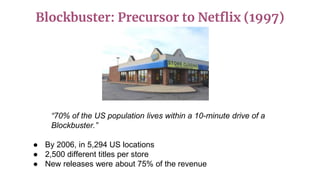
Blockbuster: Precursor to Netflix (1997)
“70% of the US population lives within a 10-minute drive of a
Blockbuster.”
● By 2006, in 5,294 US locations
● 2,500 different titles per store
● New releases were about 75% of the revenue
Business Model of Blockbuster
● Aimed to maximise the number of days that a movie is out for rent
● $3-$4 per rental, ranging from 2-7 days
● “Late fee” were 10% of the revenue (later at the expense of customer
dissatisfaction).
● Revenue-sharing model: Paid $5 to the studio for the copy, rented it 10 times,
sold the copy for an average of $8, and shared 30% of the revenue with the
studio.
● Purchase model: Paid $15 to the studio for the copy, rented it 10 times, and
resold the copy for an average of $8.
Early Days...
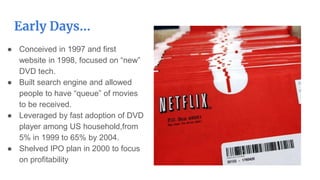
● Conceived in 1997 and first
website in 1998, focused on “new”
DVD tech.
● Built search engine and allowed
people to have “queue” of movies
to be received.
● Leveraged by fast adoption of DVD
player among US household,from
5% in 1999 to 65% by 2004.
● Shelved IPO plan in 2000 to focus
on profitability
Prepaid Based Subscription Service
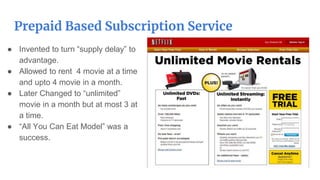
● Invented to turn “supply delay” to
advantage.
● Allowed to rent 4 movie at a time
and upto 4 movie in a month.
● Later Changed to “unlimited”
movie in a month but at most 3 at
a time.
● “All You Can Eat Model” was a
success.
Developing The Proprietary Recommendation
System
● A big factor in Netflix Success .
● Differentiated from traditional Players.
● Key to inventory management was “filter “ between output
of Recommended System and results shown to
Customers.
● Demerit Was new releases were not recommended.
Building Movie Library
● Problems - No Direct relationship with major studios.
● Min discount from movie distributors, High Up-front costs.
● Netflix Hired “TED SARANDOS” as chief content officer, Video City .
● Rather than paying $ 18-20 per dvd, Studios will reduce unit up-front price in
return of fee based on total no of rental of given tital’s.
● New relationship helped satisfying customers seeking broader range of
entertainment .
● National Inventory was made that helped getting right amount of product in
right location. (overstocking and understocking were monitored through
queues online)
● Satisfying demand of an area with ⅓ or ⅕ of inventory needed.
Distribution and Delivery
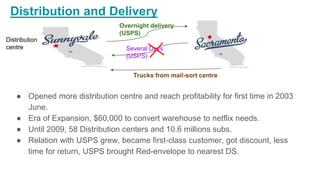
● Opened more distribution centre and reach profitability for first time in 2003
June.
● Era of Expansion, $60,000 to convert warehouse to netflix needs.
● Until 2009, 58 Distribution centers and 10.6 millions subs.
● Relation with USPS grew, became first-class customer, got discount, less
time for return, USPS brought Red-envelope to nearest DS.
Distribution
centre
Overnight delivery
(USPS)
Several Days
(USPS)
Trucks from mail-sort centre
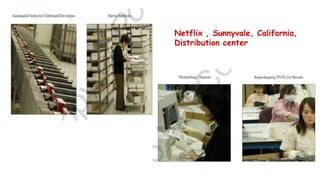
Netflix , Sunnyvale, California,
Distribution center
Growing Content Acquisition
● If rental demand is less than forecast, it is tax on netflix economy.
● Netflix became best source of less-known films.
● Small studios began doing Partnership , earn 60-70 % earning from netflix.
● “Hotel Rwanda” is 4th most rented movie on netflix, which is difficult
film for market with low viewership.
● In 2006 , Netflix Started acquiring distribution rights of movies through
“Red Envelope Entertainment” Production.
● Aim of Red Envelope Entertainment was to bring better movies in DVD
format.
● Became Highest-quality source of Independent Films.
Customer Retention and Scope of Improvement and
Innovation
● Customer acquisition was a major expense for Netflix.
● Retention of existing and reclaiming of old customers is a major scope of
improvement.
● Earlier customer had to go to the salesman over a phone for unsubscribing
the service.
● Instead of making the service difficult to leave to, hasting make the service
easier to return to, by making the process online.
Big question! Why did it work?
● Netflix gave personalized
recommendation to users
● So, even if a customer left the
Netflix, the data will not be
deleted.
● If a customer returned, everything
in place to start with.
● This increased the number of
returned customers.
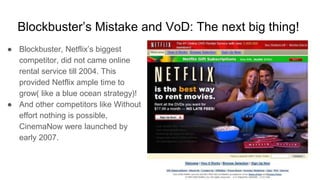
Blockbuster’s Mistake and VoD: The next big thing!
● Blockbuster, Netflix’s biggest
competitor, did not came online
rental service till 2004. This
provided Netflix ample time to
grow( like a blue ocean strategy)!
● And other competitors like Without
effort nothing is possible,
CinemaNow were launched by
early 2007.
The transition to streaming video at Netflix
● Netflix purpose - best home video
viewing.
● Launched as an adjunct to
company’s core DVD’s by mail
offering.
● “View Instantly” option at minimal
cost.
● No advantage over startups like
Vongo & MovieLink.
● Content, user personalisation, TV
attachment, streaming infrastructure.
Great Content
● Streaming content need to be licensed.
● 1Bil$ deal (5 - year) Paramount, LionsGate, MGM
● Double-edge sword.
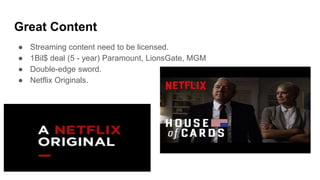
● Netflix Originals.
Major Netflix Streaming Innovations:
● Personalization and user experience
● TV attachment and device penetration.
● Streaming Infrastructure
“I think it is healthy to have smart people make a
negative argument about Netflix. It sharpens our
thinking.”
Reed Hastings, Founder and CEO of Netflix
Netflix - Case Study

Netflix - Case Study

  • 1.
    Case Study: Development ofNetflix How Netflix started as a small DVD rental service, and changed its course to become the most successful online streaming platform we know today. Based on the article “Netflix in 2011” by Harvard Business Review. Group Members: Harsh Kumar Chourasia (17312011) Parth Kohli (17312019) Rishav Anand (17312021) Savish Bedi (17312024) Srijan Kumar Dubey (17312029)
  • 3.
    Netflix’s Gamble in2011 “The no fun-to-watch part is the damage that Netflix’s abrupt price increase has had on subscriber numbers. Subscriber growth ground to a halt in the third quarter, after the increase was announced in July. The company expects its physical DVD service to lose 3m - about a fifth - of its subscribers.” - Financial Times, October 2011 The gamble: phasing out DVD rentals and replacing it with an online streaming platform. Earlier, the streaming platform was a $2 add-on to the monthly plan, but in 2011, Netflix announced that it would be offered as a separate service for $8/month. The challenge: will Netflix remain as successful with the revamped business model?
  • 4.
    Blockbuster: Precursor toNetflix (1997) “70% of the US population lives within a 10-minute drive of a Blockbuster.” ● By 2006, in 5,294 US locations ● 2,500 different titles per store ● New releases were about 75% of the revenue
  • 5.
    Business Model ofBlockbuster ● Aimed to maximise the number of days that a movie is out for rent ● $3-$4 per rental, ranging from 2-7 days ● “Late fee” were 10% of the revenue (later at the expense of customer dissatisfaction). ● Revenue-sharing model: Paid $5 to the studio for the copy, rented it 10 times, sold the copy for an average of $8, and shared 30% of the revenue with the studio. ● Purchase model: Paid $15 to the studio for the copy, rented it 10 times, and resold the copy for an average of $8.
  • 6.
    Early Days... ● Conceivedin 1997 and first website in 1998, focused on “new” DVD tech. ● Built search engine and allowed people to have “queue” of movies to be received. ● Leveraged by fast adoption of DVD player among US household,from 5% in 1999 to 65% by 2004. ● Shelved IPO plan in 2000 to focus on profitability
  • 7.
    Prepaid Based SubscriptionService ● Invented to turn “supply delay” to advantage. ● Allowed to rent 4 movie at a time and upto 4 movie in a month. ● Later Changed to “unlimited” movie in a month but at most 3 at a time. ● “All You Can Eat Model” was a success.
  • 8.
    Developing The ProprietaryRecommendation System ● A big factor in Netflix Success . ● Differentiated from traditional Players. ● Key to inventory management was “filter “ between output of Recommended System and results shown to Customers. ● Demerit Was new releases were not recommended.
  • 9.
    Building Movie Library ●Problems - No Direct relationship with major studios. ● Min discount from movie distributors, High Up-front costs. ● Netflix Hired “TED SARANDOS” as chief content officer, Video City . ● Rather than paying $ 18-20 per dvd, Studios will reduce unit up-front price in return of fee based on total no of rental of given tital’s. ● New relationship helped satisfying customers seeking broader range of entertainment . ● National Inventory was made that helped getting right amount of product in right location. (overstocking and understocking were monitored through queues online) ● Satisfying demand of an area with ⅓ or ⅕ of inventory needed.
  • 10.
    Distribution and Delivery ●Opened more distribution centre and reach profitability for first time in 2003 June. ● Era of Expansion, $60,000 to convert warehouse to netflix needs. ● Until 2009, 58 Distribution centers and 10.6 millions subs. ● Relation with USPS grew, became first-class customer, got discount, less time for return, USPS brought Red-envelope to nearest DS. Distribution centre Overnight delivery (USPS) Several Days (USPS) Trucks from mail-sort centre
  • 11.
    Netflix , Sunnyvale,California, Distribution center
  • 12.
    Growing Content Acquisition ●If rental demand is less than forecast, it is tax on netflix economy. ● Netflix became best source of less-known films. ● Small studios began doing Partnership , earn 60-70 % earning from netflix. ● “Hotel Rwanda” is 4th most rented movie on netflix, which is difficult film for market with low viewership. ● In 2006 , Netflix Started acquiring distribution rights of movies through “Red Envelope Entertainment” Production. ● Aim of Red Envelope Entertainment was to bring better movies in DVD format. ● Became Highest-quality source of Independent Films.
  • 13.
    Customer Retention andScope of Improvement and Innovation ● Customer acquisition was a major expense for Netflix. ● Retention of existing and reclaiming of old customers is a major scope of improvement. ● Earlier customer had to go to the salesman over a phone for unsubscribing the service. ● Instead of making the service difficult to leave to, hasting make the service easier to return to, by making the process online.
  • 14.
    Big question! Whydid it work? ● Netflix gave personalized recommendation to users ● So, even if a customer left the Netflix, the data will not be deleted. ● If a customer returned, everything in place to start with. ● This increased the number of returned customers.
  • 15.
    Blockbuster’s Mistake andVoD: The next big thing! ● Blockbuster, Netflix’s biggest competitor, did not came online rental service till 2004. This provided Netflix ample time to grow( like a blue ocean strategy)! ● And other competitors like Without effort nothing is possible, CinemaNow were launched by early 2007.
  • 16.
    The transition tostreaming video at Netflix ● Netflix purpose - best home video viewing. ● Launched as an adjunct to company’s core DVD’s by mail offering. ● “View Instantly” option at minimal cost. ● No advantage over startups like Vongo & MovieLink. ● Content, user personalisation, TV attachment, streaming infrastructure.
  • 17.
    Great Content ● Streamingcontent need to be licensed. ● 1Bil$ deal (5 - year) Paramount, LionsGate, MGM ● Double-edge sword. ● Netflix Originals.
  • 18.
    Major Netflix StreamingInnovations: ● Personalization and user experience ● TV attachment and device penetration. ● Streaming Infrastructure “I think it is healthy to have smart people make a negative argument about Netflix. It sharpens our thinking.” Reed Hastings, Founder and CEO of Netflix

Editor's Notes

  • #10 Paying 20% more and getting two times of copies. Helped in reducing cost of new releases,
  • #11 Trucks Facilitated supply chain