By
Andrew Bourget
 Brian Seibert
What is Net Neutrality?
   Net neutrality essentially
    levels the playing field for
    commercial websites,
    ensuring that a small
    online bookstore can still
    receive visitors, even if
    sites such as
    Amazon.com or
    Barnes&Noble.com are
    statistically more popular.
    http://www.wisegeek.com/what-is-net-
    neutrality.htm
Its Origins
   Control of this idea started with
    the idea that information could
    be passed within a wire.
   The Internet was not legally
    available for commercial use. It
    became available in the late
    1980’s
   In the late 90’s to early 2000’s
    company's began to put a price
    on the speed at which you are
    connected to the world wide
    web
For Neutrality
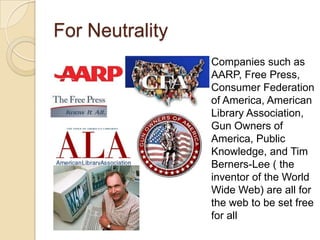
                 Companies such as
                 AARP, Free Press,
                 Consumer Federation
                 of America, American
                 Library Association,
                 Gun Owners of
                 America, Public
                 Knowledge, and Tim
                 Berners-Lee ( the
                 inventor of the World
                 Wide Web) are all for
                 the web to be set free
                 for all
Against Neutrality
Companies who
oppose this Net
Neutrality are AT&T,
Verizon, Time Warner
Cable, Alcatel, 3M,
Citizens Against
Government Waste,
and Hands Off the
Internet. They all
disagree with the net
being free to all who
so desire this.
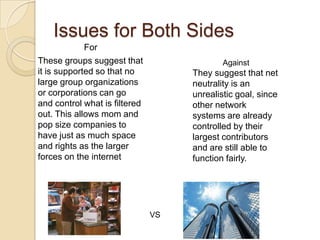
Issues for Both Sides
             For
These groups suggest that                   Against
it is supported so that no          They suggest that net
large group organizations           neutrality is an
or corporations can go              unrealistic goal, since
and control what is filtered        other network
out. This allows mom and            systems are already
pop size companies to               controlled by their
have just as much space             largest contributors
and rights as the larger            and are still able to
forces on the internet              function fairly.


                               VS
Scales
        Pro’s of Net Neutrality        Con’s Of Net Neutrality
 -Provides A competitive              - Privacy invasion and
 market                                 Censorship
 -With competition, services          - Can not sabotage
 become better to out due the           other rivals and block
 others                                 their content
                                      - Show that other sites
 -Eliminate Monopoly's from
                                        and companies still
 the internet
                                        show today their
 -Eliminate illegal activities          competition with out
 from the internet
http://www.buzzle.com/articles/net-
                                        any issues
neutrality-pros-and-cons.html
Republicans                               Democrat's
Against Net Neutrality as                For Net Neutrality as a
a party                                  party


Have voted in favor of                   Have voted in favor of
this in the past couple                  this to keep the web
bills that have gone                     open to all users who
through the house                        search through their
                                         internet providers


             http://www.savetheinterne
             t.com/blog/11/03/10/hous
             e-goes-nuts-over-net-
             neutrality
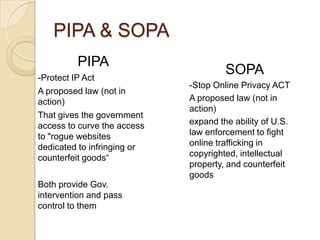
PIPA & SOPA
         PIPA
-Protect IP Act
                                      SOPA
                             -Stop Online Privacy ACT
A proposed law (not in
action)                      A proposed law (not in
                             action)
That gives the government
access to curve the access   expand the ability of U.S.
to "rogue websites           law enforcement to fight
dedicated to infringing or   online trafficking in
counterfeit goods“           copyrighted, intellectual
                             property, and counterfeit
                             goods
Both provide Gov.
intervention and pass
control to them
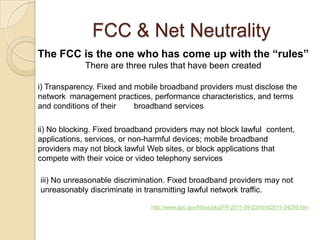
FCC & Net Neutrality
The FCC is the one who has come up with the “rules”
             There are three rules that have been created

i) Transparency. Fixed and mobile broadband providers must disclose the
network management practices, performance characteristics, and terms
and conditions of their    broadband services

ii) No blocking. Fixed broadband providers may not block lawful content,
applications, services, or non-harmful devices; mobile broadband
providers may not block lawful Web sites, or block applications that
compete with their voice or video telephony services

iii) No unreasonable discrimination. Fixed broadband providers may not
unreasonably discriminate in transmitting lawful network traffic.

                               http://www.gpo.gov/fdsys/pkg/FR-2011-09-23/html/2011-24259.htm
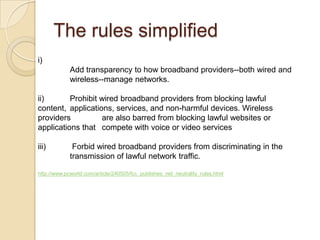
The rules simplified
i)
             Add transparency to how broadband providers--both wired and
             wireless--manage networks.

ii)       Prohibit wired broadband providers from blocking lawful
content, applications, services, and non-harmful devices. Wireless
providers          are also barred from blocking lawful websites or
applications that compete with voice or video services

iii)          Forbid wired broadband providers from discriminating in the
             transmission of lawful network traffic.

http://www.pcworld.com/article/240505/fcc_publishes_net_neutrality_rules.html
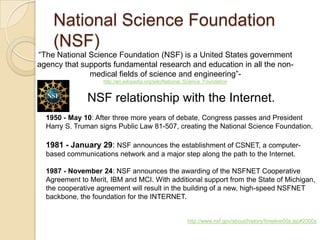
National Science Foundation
    (NSF)
“The National Science Foundation (NSF) is a United States government
agency that supports fundamental research and education in all the non-
              medical fields of science and engineering”-
                   http://en.wikipedia.org/wiki/National_Science_Foundation


              NSF relationship with the Internet.
  1950 - May 10: After three more years of debate, Congress passes and President
  Harry S. Truman signs Public Law 81-507, creating the National Science Foundation.

  1981 - January 29: NSF announces the establishment of CSNET, a computer-
  based communications network and a major step along the path to the Internet.

  1987 - November 24: NSF announces the awarding of the NSFNET Cooperative
  Agreement to Merit, IBM and MCI. With additional support from the State of Michigan,
  the cooperative agreement will result in the building of a new, high-speed NSFNET
  backbone, the foundation for the INTERNET.


                                                        http://www.nsf.gov/about/history/timeline00s.jsp#2000s
HTML-5
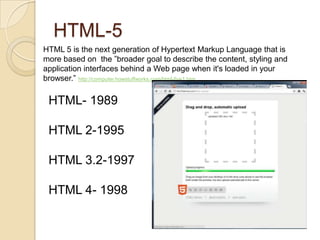
HTML 5 is the next generation of Hypertext Markup Language that is
more based on the ”broader goal to describe the content, styling and
application interfaces behind a Web page when it's loaded in your
browser.” http://computer.howstuffworks.com/html-five1.htm

 HTML- 1989

 HTML 2-1995

 HTML 3.2-1997

 HTML 4- 1998
Internet 2

    In the simplest form Internet 2 is the newest form of connected
      networks that will have faster speeds and more bandwidth.

“The Internet2 Network is a dynamic, innovative and cost-effective
hybrid optical and packet network designed to deliver to the research
and education community next-generation production services as well
as a development platform for new networking ideas and protocols.
With a community-owned infrastructure, the Internet2 Network provides
the scalability member institutions need to efficiently manage resources
and meet bandwidth-intensive requirements ranging from collaborative
applications like videoconferencing to global-scale distributed research,
from grid-based data analysis to social networking.
http://www.internet2.edu/network/
“Peering”
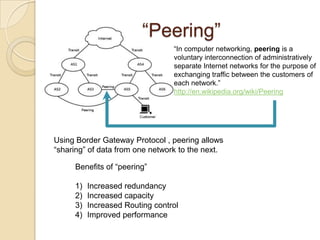
                                 “In computer networking, peering is a
                                 voluntary interconnection of administratively
                                 separate Internet networks for the purpose of
                                 exchanging traffic between the customers of
                                 each network.”
                                 http://en.wikipedia.org/wiki/Peering


Using Border Gateway Protocol , peering allows
“sharing” of data from one network to the next.

     Benefits of “peering”

     1)   Increased redundancy
     2)   Increased capacity
     3)   Increased Routing control
     4)   Improved performance
Public “peering” & Private
  “peering”
Public Peering is         Private peering is the
the shared                same idea as public
connections of            peering (connections
multiple networks at      of multiple networks at
                     VS
network access            access points) but are
points or exchange        different in that they
points where              usually are between 2
information and           large networks who
connection is             have agreed to “work
shared freely,            together” for each
usually with no or        others benefit.
little cost ($).
Net Neutrality & its Effect on
               E-Commerce
“Pro” for net Neutrality           “Cons” for net Neutrality

•Doesn’t allow             •Providers loose possible
providers to charge        revenue source.
to use parts of
internet                   •Grey area activities will
                           possible become illegal.
•Cleanses the              (music downloading,
internet of illegal        movies, ect)
activity.
                           •Increased competition
•Protects
                           might possible lead to
copyrighted material
                           “price wars”
Our Position
We believe that the government should step in to create laws and
“police” the internet for acts that are blatantly illegal and wrong. We
do however feel that should be the end of government mandating as
we feel the internet should be “free” in the sense of how people stay
connected or use the internets resources. In relation to the FCC’s
rules, we feel they are creating a good groundwork to fight the
emerging illegal content that is appearing on the internet that creates
a unlevel playing field for established companies working outside the
internet. Specifically we believe rule ii is “right on the money” in how it
blocks internet providers to block the internet in ways that might
“compete with their voice or video telephony services”.
Sources
http://www.wisegeek.com/what-is-net-
neutrality.htm

http://www.buzzle.com/articles/net-neutrality-pros-
and-cons.html

http://www.savetheinternet.com/blog/11/03/10/hou
se-goes-nuts-over-net-neutrality

http://www.gpo.gov/fdsys/pkg/FR-2011-09-
23/html/2011-24259.htm

http://www.pcworld.com/article/240505/fcc_publis
hes_net_neutrality_rules.html

http://en.wikipedia.org/wiki/National_Science_Fou
ndation

http://computer.howstuffworks.com/html-five1.htm

http://www.internet2.edu/network/

http://en.wikipedia.org/wiki/Peering

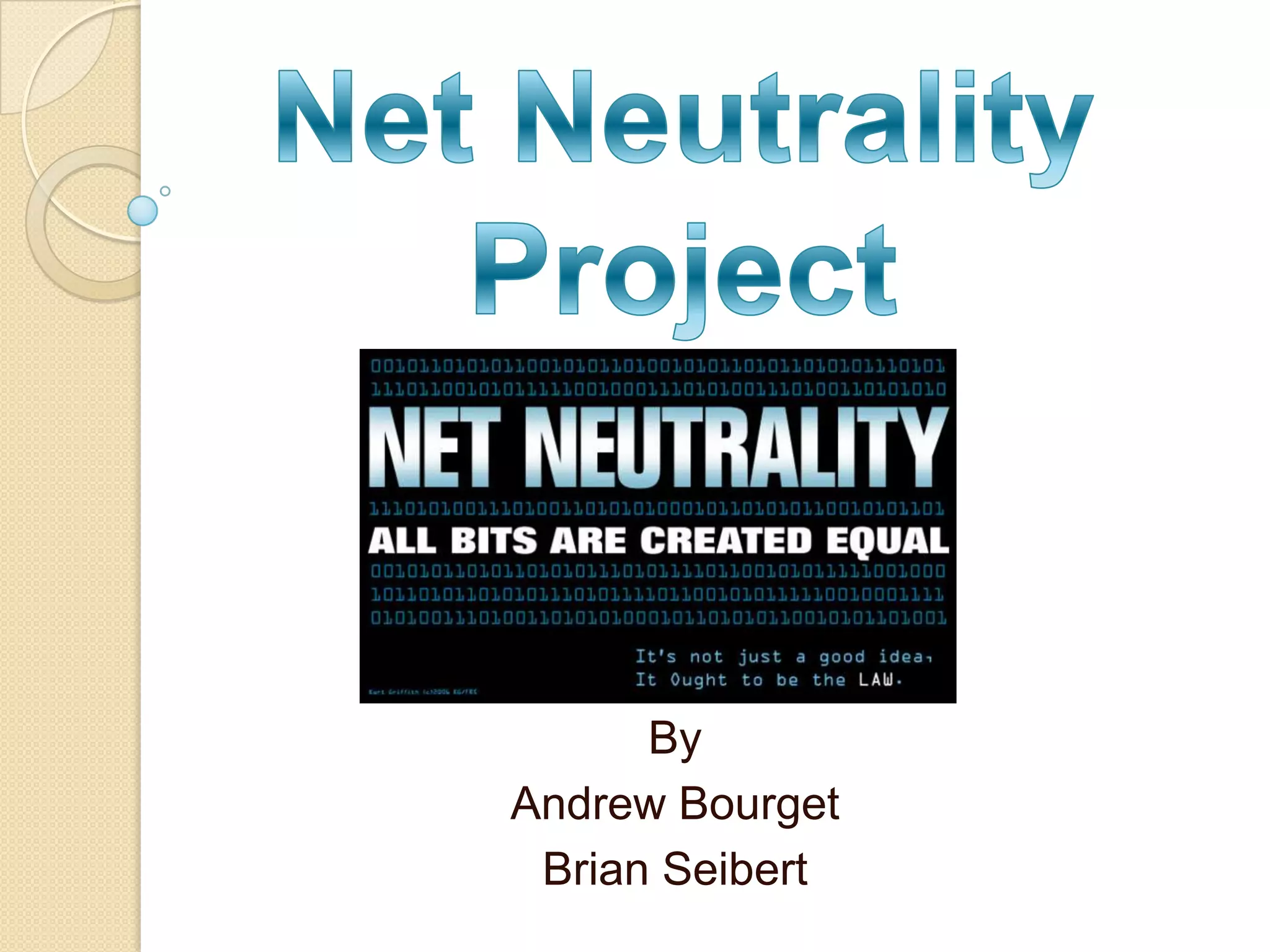
Net nutrality

  • 1.
  • 2.
    What is NetNeutrality?  Net neutrality essentially levels the playing field for commercial websites, ensuring that a small online bookstore can still receive visitors, even if sites such as Amazon.com or Barnes&Noble.com are statistically more popular. http://www.wisegeek.com/what-is-net- neutrality.htm
  • 3.
    Its Origins  Control of this idea started with the idea that information could be passed within a wire.  The Internet was not legally available for commercial use. It became available in the late 1980’s  In the late 90’s to early 2000’s company's began to put a price on the speed at which you are connected to the world wide web
  • 4.
    For Neutrality Companies such as AARP, Free Press, Consumer Federation of America, American Library Association, Gun Owners of America, Public Knowledge, and Tim Berners-Lee ( the inventor of the World Wide Web) are all for the web to be set free for all
  • 5.
    Against Neutrality Companies who opposethis Net Neutrality are AT&T, Verizon, Time Warner Cable, Alcatel, 3M, Citizens Against Government Waste, and Hands Off the Internet. They all disagree with the net being free to all who so desire this.
  • 6.
    Issues for BothSides For These groups suggest that Against it is supported so that no They suggest that net large group organizations neutrality is an or corporations can go unrealistic goal, since and control what is filtered other network out. This allows mom and systems are already pop size companies to controlled by their have just as much space largest contributors and rights as the larger and are still able to forces on the internet function fairly. VS
  • 7.
    Scales Pro’s of Net Neutrality Con’s Of Net Neutrality -Provides A competitive - Privacy invasion and market Censorship -With competition, services - Can not sabotage become better to out due the other rivals and block others their content - Show that other sites -Eliminate Monopoly's from and companies still the internet show today their -Eliminate illegal activities competition with out from the internet http://www.buzzle.com/articles/net- any issues neutrality-pros-and-cons.html
  • 8.
    Republicans Democrat's Against Net Neutrality as For Net Neutrality as a a party party Have voted in favor of Have voted in favor of this in the past couple this to keep the web bills that have gone open to all users who through the house search through their internet providers http://www.savetheinterne t.com/blog/11/03/10/hous e-goes-nuts-over-net- neutrality
  • 9.
    PIPA & SOPA PIPA -Protect IP Act SOPA -Stop Online Privacy ACT A proposed law (not in action) A proposed law (not in action) That gives the government access to curve the access expand the ability of U.S. to "rogue websites law enforcement to fight dedicated to infringing or online trafficking in counterfeit goods“ copyrighted, intellectual property, and counterfeit goods Both provide Gov. intervention and pass control to them
  • 10.
    FCC & NetNeutrality The FCC is the one who has come up with the “rules” There are three rules that have been created i) Transparency. Fixed and mobile broadband providers must disclose the network management practices, performance characteristics, and terms and conditions of their broadband services ii) No blocking. Fixed broadband providers may not block lawful content, applications, services, or non-harmful devices; mobile broadband providers may not block lawful Web sites, or block applications that compete with their voice or video telephony services iii) No unreasonable discrimination. Fixed broadband providers may not unreasonably discriminate in transmitting lawful network traffic. http://www.gpo.gov/fdsys/pkg/FR-2011-09-23/html/2011-24259.htm
  • 11.
    The rules simplified i) Add transparency to how broadband providers--both wired and wireless--manage networks. ii) Prohibit wired broadband providers from blocking lawful content, applications, services, and non-harmful devices. Wireless providers are also barred from blocking lawful websites or applications that compete with voice or video services iii) Forbid wired broadband providers from discriminating in the transmission of lawful network traffic. http://www.pcworld.com/article/240505/fcc_publishes_net_neutrality_rules.html
  • 12.
    National Science Foundation (NSF) “The National Science Foundation (NSF) is a United States government agency that supports fundamental research and education in all the non- medical fields of science and engineering”- http://en.wikipedia.org/wiki/National_Science_Foundation NSF relationship with the Internet. 1950 - May 10: After three more years of debate, Congress passes and President Harry S. Truman signs Public Law 81-507, creating the National Science Foundation. 1981 - January 29: NSF announces the establishment of CSNET, a computer- based communications network and a major step along the path to the Internet. 1987 - November 24: NSF announces the awarding of the NSFNET Cooperative Agreement to Merit, IBM and MCI. With additional support from the State of Michigan, the cooperative agreement will result in the building of a new, high-speed NSFNET backbone, the foundation for the INTERNET. http://www.nsf.gov/about/history/timeline00s.jsp#2000s
  • 13.
    HTML-5 HTML 5 isthe next generation of Hypertext Markup Language that is more based on the ”broader goal to describe the content, styling and application interfaces behind a Web page when it's loaded in your browser.” http://computer.howstuffworks.com/html-five1.htm HTML- 1989 HTML 2-1995 HTML 3.2-1997 HTML 4- 1998
  • 14.
    Internet 2 In the simplest form Internet 2 is the newest form of connected networks that will have faster speeds and more bandwidth. “The Internet2 Network is a dynamic, innovative and cost-effective hybrid optical and packet network designed to deliver to the research and education community next-generation production services as well as a development platform for new networking ideas and protocols. With a community-owned infrastructure, the Internet2 Network provides the scalability member institutions need to efficiently manage resources and meet bandwidth-intensive requirements ranging from collaborative applications like videoconferencing to global-scale distributed research, from grid-based data analysis to social networking. http://www.internet2.edu/network/
  • 15.
    “Peering” “In computer networking, peering is a voluntary interconnection of administratively separate Internet networks for the purpose of exchanging traffic between the customers of each network.” http://en.wikipedia.org/wiki/Peering Using Border Gateway Protocol , peering allows “sharing” of data from one network to the next. Benefits of “peering” 1) Increased redundancy 2) Increased capacity 3) Increased Routing control 4) Improved performance
  • 16.
    Public “peering” &Private “peering” Public Peering is Private peering is the the shared same idea as public connections of peering (connections multiple networks at of multiple networks at VS network access access points) but are points or exchange different in that they points where usually are between 2 information and large networks who connection is have agreed to “work shared freely, together” for each usually with no or others benefit. little cost ($).
  • 17.
    Net Neutrality &its Effect on E-Commerce “Pro” for net Neutrality “Cons” for net Neutrality •Doesn’t allow •Providers loose possible providers to charge revenue source. to use parts of internet •Grey area activities will possible become illegal. •Cleanses the (music downloading, internet of illegal movies, ect) activity. •Increased competition •Protects might possible lead to copyrighted material “price wars”
  • 18.
    Our Position We believethat the government should step in to create laws and “police” the internet for acts that are blatantly illegal and wrong. We do however feel that should be the end of government mandating as we feel the internet should be “free” in the sense of how people stay connected or use the internets resources. In relation to the FCC’s rules, we feel they are creating a good groundwork to fight the emerging illegal content that is appearing on the internet that creates a unlevel playing field for established companies working outside the internet. Specifically we believe rule ii is “right on the money” in how it blocks internet providers to block the internet in ways that might “compete with their voice or video telephony services”.
  • 19.