Chapter 7
Generic Class
Agenda
• Introduction
• Types of Generic Class
• Wildcards as Type Arguments
• Constraints in Generic Types and Functions
• Examples
What all Generic?
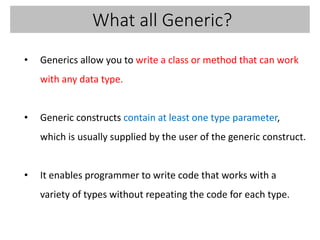
• Generics allow you to write a class or method that can work
with any data type.
• Generic constructs contain at least one type parameter,
which is usually supplied by the user of the generic construct.
• It enables programmer to write code that works with a
variety of types without repeating the code for each type.
What all Generic?
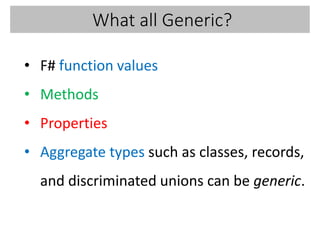
• F# function values
• Methods
• Properties
• Aggregate types such as classes, records,
and discriminated unions can be generic.
Syntax & Example: Method
// Explicitly generic method.
[ static ] member object-identifer.method-name<type-parameters>
parameter-list [ return-type ] = method-body
let printFun<'T> x y =
printfn "%A, %A" x y
printFun<float> 10.0 20.0
You can also make a function generic by using the single quotation mark
let printFun (x: 'a) (y: 'a) =
printfn "%A %A" x y
printFun 10.0 20.0
Example :2Example :1
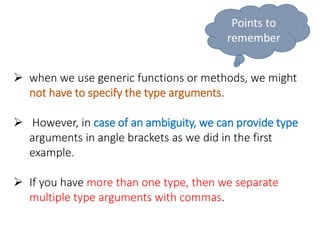
 when we use generic functions or methods, we might
not have to specify the type arguments.
 However, in case of an ambiguity, we can provide type
arguments in angle brackets as we did in the first
example.
 If you have more than one type, then we separate
multiple type arguments with commas.
Points to
remember
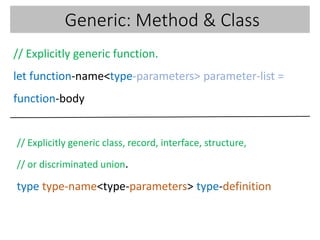
Generic: Method & Class
// Explicitly generic function.
let function-name<type-parameters> parameter-list =
function-body
// Explicitly generic class, record, interface, structure,
// or discriminated union.
type type-name<type-parameters> type-definition
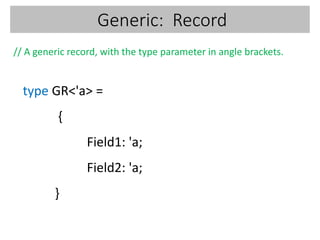
Generic: Record
// A generic record, with the type parameter in angle brackets.
type GR<'a> =
{
Field1: 'a;
Field2: 'a;
}
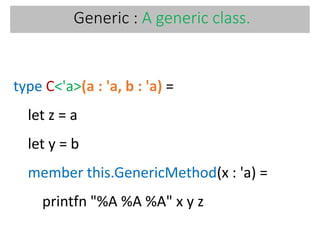
Generic : A generic class.
type C<'a>(a : 'a, b : 'a) =
let z = a
let y = b
member this.GenericMethod(x : 'a) =
printfn "%A %A %A" x y z
Generic : A generic class.
type genericClass<'a> (x: 'a) =
do printfn "%A" x
let gr = new genericClass<string>(“MITWPU")
let gs = genericClass( seq { for i in 1 .. 10 -> (i, i*i) } )
"MITWPU"
seq [(1, 1); (2, 4); (3, 9); (4, 16); ...]
O/P

.Net F# Generic class

  • 1.
  • 2.
    Agenda • Introduction • Typesof Generic Class • Wildcards as Type Arguments • Constraints in Generic Types and Functions • Examples
  • 3.
    What all Generic? •Generics allow you to write a class or method that can work with any data type. • Generic constructs contain at least one type parameter, which is usually supplied by the user of the generic construct. • It enables programmer to write code that works with a variety of types without repeating the code for each type.
  • 4.
    What all Generic? •F# function values • Methods • Properties • Aggregate types such as classes, records, and discriminated unions can be generic.
  • 5.
    Syntax & Example:Method // Explicitly generic method. [ static ] member object-identifer.method-name<type-parameters> parameter-list [ return-type ] = method-body let printFun<'T> x y = printfn "%A, %A" x y printFun<float> 10.0 20.0 You can also make a function generic by using the single quotation mark let printFun (x: 'a) (y: 'a) = printfn "%A %A" x y printFun 10.0 20.0 Example :2Example :1
  • 6.
     when weuse generic functions or methods, we might not have to specify the type arguments.  However, in case of an ambiguity, we can provide type arguments in angle brackets as we did in the first example.  If you have more than one type, then we separate multiple type arguments with commas. Points to remember
  • 7.
    Generic: Method &Class // Explicitly generic function. let function-name<type-parameters> parameter-list = function-body // Explicitly generic class, record, interface, structure, // or discriminated union. type type-name<type-parameters> type-definition
  • 8.
    Generic: Record // Ageneric record, with the type parameter in angle brackets. type GR<'a> = { Field1: 'a; Field2: 'a; }
  • 9.
    Generic : Ageneric class. type C<'a>(a : 'a, b : 'a) = let z = a let y = b member this.GenericMethod(x : 'a) = printfn "%A %A %A" x y z
  • 10.
    Generic : Ageneric class. type genericClass<'a> (x: 'a) = do printfn "%A" x let gr = new genericClass<string>(“MITWPU") let gs = genericClass( seq { for i in 1 .. 10 -> (i, i*i) } ) "MITWPU" seq [(1, 1); (2, 4); (3, 9); (4, 16); ...] O/P