GENERICS
:Haunshila
Generics?
 Generics are one of the most powerful feature of
swift.
 Generic code enables you to write flexible,
reusable functions and types that can work with any
type, subject to requirements that you define.
 For example, Swift’s Array and Dictionary types are
both generic collections. Means they can hold array
of Int values or String values or any type.
Type Parameters
The placeholder type T is an example of a type
parameter.
Type parameters specify and name a placeholder
type, and are written immediately after the function’s
name, between a pair of matching angle brackets
(such as <T>).
You can provide more than one type parameter by
writing multiple type parameter names within the
angle brackets, separated by commas.
Why Generics will be showstopper?
The generic version of the function uses a
placeholder type name (called T, in this case) instead
of an actualtype name (such as Int, String, or Double).
 The generic function’s name (swapTwoValues) is
followed by the placeholder type name (T) inside
angle brackets (<T>). The brackets tell Swift that T is a
placeholder type name within the swapTwoValues
function definition. Because T is a placeholder, Swift
does not look for an actual type called T.
Type Parameters
 The generic version of the function uses a
placeholder type name (called T, in this case) instead
of an actualtype name (such as Int, String, or Double).
 The generic function’s name (swapTwoValues) is
followed by the placeholder type name (T) inside
angle brackets (<T>). The brackets tell Swift that T is a
placeholder type name within the swapTwoValues
function definition. Because T is a placeholder, Swift
does not look for an actual type called T.
You can provide more than one type parameter by
writing multiple type parameter names within the
angle brackets, separated by commas.
Naming of Type Parameters
It is traditional to use the single-character name T for
the type parameter. However, you can use any valid
identifier as the type parameter name.
If you are defining more complex generic functions,
or generic types with multiple parameters, it is useful to
provide more descriptive type parameter names. For
example, Swift’s Dictionary type has two type
parameters—one for its keys and one for its values.
Always give type parameters UpperCamelCase
names (such as T and Key) to indicate that they are a
placeholder for a type, not a value.
Generic Types
In addition to generic functions, Swift enables you to
define your own generic types. These are custom
classes, structures, and enumerations that can work
with any type, in a similar way to Array and Dictionary.
Below is example of “how to write generic
collection type called Stack”.
struct Stack<T> {
var items = [T]()
mutating func push(item: T) { //mutating, because
they need to modify (or mutate) the structure’s items
array
items.append(item)
}
mutating func pop() -> T { return items.removeLast()
}
}
Extending a Generic Type
When you extend a generic type, the type
parameter list from the original type definition is
available within the body of the extension, and the
original type parameter names are used to refer to
the type parameters from the original definition.
For example:
extension Stack { // extends the generic Stack type to
add a read-only computed property called topItem
var topItem: T? {
return items.isEmpty ? nil : items[items.count - 1]
}
}
Type Constraints
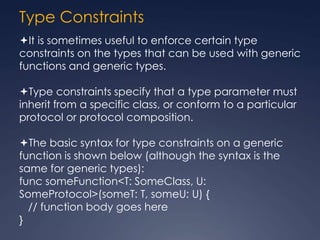
It is sometimes useful to enforce certain type
constraints on the types that can be used with generic
functions and generic types.
Type constraints specify that a type parameter must
inherit from a specific class, or conform to a particular
protocol or protocol composition.
The basic syntax for type constraints on a generic
function is shown below (although the syntax is the
same for generic types):
func someFunction<T: SomeClass, U:
SomeProtocol>(someT: T, someU: U) {
// function body goes here
}
Associated Types
An associated type gives a placeholder name (or
alias) to a type that is used as part of the protocol.
The actual type to use for that associated type is not
specified until the protocol is adopted.
Associated types are specified with the “typealias”
keyword.
Where Clauses: A where clause enables you to
require that an associated type conforms to a certain
protocol, and/or that certain type parameters and
associated types be the same.
You write a where clause by placing the where
keyword immediately after the list of type parameters,
followed by one or more constraints for associated
types, and/or one or more equality relationships
between types and associated types.
 END 

Swift Generics

  • 1.
  • 2.
    Generics?  Generics areone of the most powerful feature of swift.  Generic code enables you to write flexible, reusable functions and types that can work with any type, subject to requirements that you define.  For example, Swift’s Array and Dictionary types are both generic collections. Means they can hold array of Int values or String values or any type.
  • 3.
    Type Parameters The placeholdertype T is an example of a type parameter. Type parameters specify and name a placeholder type, and are written immediately after the function’s name, between a pair of matching angle brackets (such as <T>). You can provide more than one type parameter by writing multiple type parameter names within the angle brackets, separated by commas.
  • 4.
    Why Generics willbe showstopper? The generic version of the function uses a placeholder type name (called T, in this case) instead of an actualtype name (such as Int, String, or Double).  The generic function’s name (swapTwoValues) is followed by the placeholder type name (T) inside angle brackets (<T>). The brackets tell Swift that T is a placeholder type name within the swapTwoValues function definition. Because T is a placeholder, Swift does not look for an actual type called T.
  • 5.
    Type Parameters  Thegeneric version of the function uses a placeholder type name (called T, in this case) instead of an actualtype name (such as Int, String, or Double).  The generic function’s name (swapTwoValues) is followed by the placeholder type name (T) inside angle brackets (<T>). The brackets tell Swift that T is a placeholder type name within the swapTwoValues function definition. Because T is a placeholder, Swift does not look for an actual type called T. You can provide more than one type parameter by writing multiple type parameter names within the angle brackets, separated by commas.
  • 6.
    Naming of TypeParameters It is traditional to use the single-character name T for the type parameter. However, you can use any valid identifier as the type parameter name. If you are defining more complex generic functions, or generic types with multiple parameters, it is useful to provide more descriptive type parameter names. For example, Swift’s Dictionary type has two type parameters—one for its keys and one for its values. Always give type parameters UpperCamelCase names (such as T and Key) to indicate that they are a placeholder for a type, not a value.
  • 7.
    Generic Types In additionto generic functions, Swift enables you to define your own generic types. These are custom classes, structures, and enumerations that can work with any type, in a similar way to Array and Dictionary. Below is example of “how to write generic collection type called Stack”. struct Stack<T> { var items = [T]() mutating func push(item: T) { //mutating, because they need to modify (or mutate) the structure’s items array items.append(item) } mutating func pop() -> T { return items.removeLast() } }
  • 8.
    Extending a GenericType When you extend a generic type, the type parameter list from the original type definition is available within the body of the extension, and the original type parameter names are used to refer to the type parameters from the original definition. For example: extension Stack { // extends the generic Stack type to add a read-only computed property called topItem var topItem: T? { return items.isEmpty ? nil : items[items.count - 1] } }
  • 9.
    Type Constraints It issometimes useful to enforce certain type constraints on the types that can be used with generic functions and generic types. Type constraints specify that a type parameter must inherit from a specific class, or conform to a particular protocol or protocol composition. The basic syntax for type constraints on a generic function is shown below (although the syntax is the same for generic types): func someFunction<T: SomeClass, U: SomeProtocol>(someT: T, someU: U) { // function body goes here }
  • 10.
    Associated Types An associatedtype gives a placeholder name (or alias) to a type that is used as part of the protocol. The actual type to use for that associated type is not specified until the protocol is adopted. Associated types are specified with the “typealias” keyword. Where Clauses: A where clause enables you to require that an associated type conforms to a certain protocol, and/or that certain type parameters and associated types be the same. You write a where clause by placing the where keyword immediately after the list of type parameters, followed by one or more constraints for associated types, and/or one or more equality relationships between types and associated types.
  • 11.