
Java Generics
(Under The Hood Of The Compiler)
By: Harmeet Singh (Taara)
(Java EE Developer)
harmeetsingh.0013@gmail.com
http://harmeetsingh13.blogspot.in
skype: harmeetsingh0013
Contact: Via mail or Skype
Contents
1. Generic Type.
2. WildCards in Generics.
3. Unchecked Warnings.
4. Heap Pollution.
5. Type Eraser.
6. Bridge method.
7. Type Erasure of A Parameterized Type.
8. Type Erasure of A Type Parameter.
9. Type Erasure of A Generic Method.
10.Reficiation.
11.Reifilable Type.
Acknowledgement
● Special Thanks to “Angelika Langer” (Trainer & Author
and Mentor). Everything about generics in this
presentation is get from “Angelika Langer” Generics
FAQ.
info@angelikaLanger.com
Generic Type
● Type Parameter: Is a placeholder that will later be replace but a type
argument.
● A parameterized or generic type is an instantiation of a generic type with
actual argument.
● Define Generics:
class Pair<S,T>{
private S first;
private T second;
-----------------
}
Generic Type
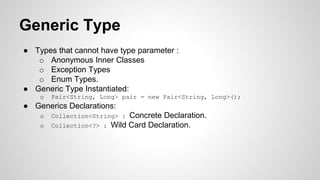
● Types that cannot have type parameter :
o Anonymous Inner Classes
o Exception Types
o Enum Types.
● Generic Type Instantiated:
o Pair<String, Long> pair = new Pair<String, Long>();
● Generics Declarations:
o Collection<String> : Concrete Declaration.
o Collection<?> : Wild Card Declaration.
WildCard in Generics
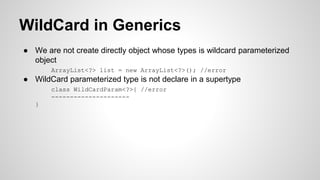
● We are not create directly object whose types is wildcard parameterized
object
ArrayList<?> list = new ArrayList<?>(); //error
● WildCard parameterized type is not declare in a supertype
class WildCardParam<?>{ //error
---------------------
}
WildCards In Generics
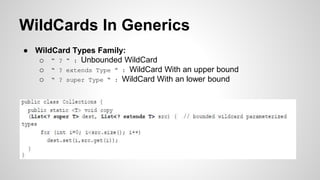
● WildCard Types Family:
o “ ? “ : Unbounded WildCard
o “ ? extends Type ” : WildCard With an upper bound
o “ ? super Type “ : WildCard With an lower bound
WildCards in Generics
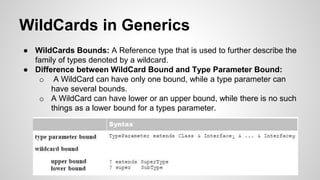
● WildCards Bounds: A Reference type that is used to further describe the
family of types denoted by a wildcard.
● Difference between WildCard Bound and Type Parameter Bound:
o A WildCard can have only one bound, while a type parameter can
have several bounds.
o A WildCard can have lower or an upper bound, while there is no such
things as a lower bound for a types parameter.
WildCards In Generics
● Does “extends” always means Inheritance ? : extends is an overloaded
keyword in java. it has different meanings, depending on the context it
appears. The extends keyword appear in four different locations :
o In the Definition of Class.
o In the Definition of Interface.
o In the Definition of Type Parameter bounds.
o In the Definition of WildCards Bounds.
Unchecked Warnings
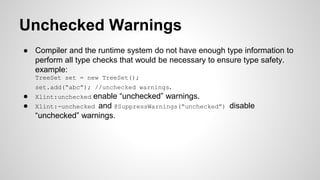
● Compiler and the runtime system do not have enough type information to
perform all type checks that would be necessary to ensure type safety.
example:
TreeSet set = new TreeSet();
set.add(“abc”); //unchecked warnings.
● Xlint:unchecked enable “unchecked” warnings.
● Xlint:-unchecked and @SuppressWarnings(“unchecked”) disable
“unchecked” warnings.
Heap Pollution
● A Situation where a variable of parameterized types refer to an Object that
is not of that parameterized type.
● Reason of Heap Pollution Occur :-
1. Mixing Raw and Parameterized Type.
2. Unwise Casting.
3. Separate Compilation.
Type Erasure
● How Compiler Translate Java Generics:
○ Compiler translate generic type or method(in any language, not just
java) has in principle two choice.
■ Code Specialization : The compiler generates a new
representation of a generic type of method.
■ Code Sharing : The compiler generates code for only one
representation of a generic type or method and maps all the
instantiations of the generic type of method to the unique
representation , perform type check and type conversion where
needed.
Type Erasure
● What is Type Erasure ?
o The compiler generates only one byte code representation of a
generic type or method and maps all the instantiations of the generic
type or method to the unique representation.
● The type Erasure process can be imagined as a translation from generic
Java Source code back into regular Java Code.
● The Steps performed during type erasure :
o Eliding Type Parameter : When the Compiler finds the definition of a
generic type or method, it removes all occurrences of the type
parameters and replaces them by their leftmost, or type Object if no
bounds specified. Ex: <T> var; into Object var;
Type Erasure
● The Steps performed during type erasure :
o Eliding Type argument: When the compiler finds a parameterized
type, i.e an instantiation of a generic types, then it removes the type
arguments. Like : List<String>, Set<Long> and Map<String, ?> are
translated to List, Set and Map respectively.
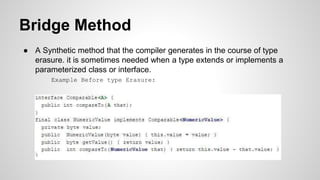
Bridge Method
● A Synthetic method that the compiler generates in the course of type
erasure. it is sometimes needed when a type extends or implements a
parameterized class or interface.
Example Before type Erasure:
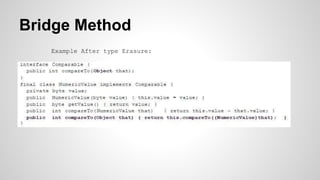
Bridge Method
Example After type Erasure:
● Side Effect of type erasure is that two methods have identical signature
before type erasure and different signature after type erasure.
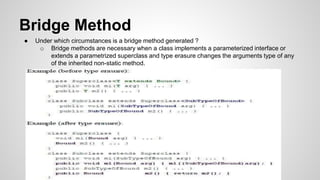
Bridge Method
● Under which circumstances is a bridge method generated ?
o Bridge methods are necessary when a class implements a parameterized interface or
extends a parametrized superclass and type erasure changes the arguments type of any
of the inherited non-static method.
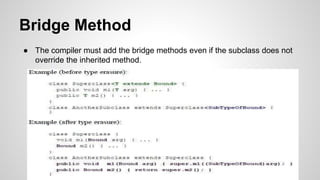
Bridge Method
● The compiler must add the bridge methods even if the subclass does not
override the inherited method.
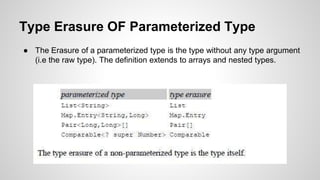
Type Erasure OF Parameterized Type
● The Erasure of a parameterized type is the type without any type argument
(i.e the raw type). The definition extends to arrays and nested types.
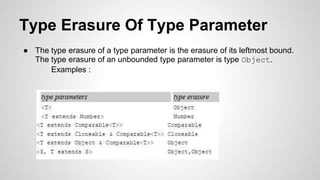
Type Erasure Of Type Parameter
● The type erasure of a type parameter is the erasure of its leftmost bound.
The type erasure of an unbounded type parameter is type Object.
Examples :
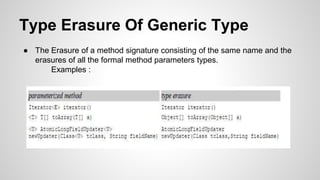
Type Erasure Of Generic Type
● The Erasure of a method signature consisting of the same name and the
erasures of all the formal method parameters types.
Examples :
Reficiation
● Representing type parameters and arguments of generic types and
method at runtime. Reficiation is the opposite of type Erasure.
Reifiable
● A type whose type information is fully available at run time, that is, a type that does not lose
information in the course of type erasure.
● The following types are reifiable:
o primitive types
o non-generic (or non-parameterized) reference types
o unbounded wildcard instantiations
o raw types
o arrays of any of the above
● The non-reifiable types, which lose type information as a side effect of type erasure, are:
o instantiations of a generic type with at least one concrete type argument
o instantiations of a generic type with at least one bounded wildcard as type argument
● Reifiable types are permitted in some places where non-reifiable types are disallowed.
o as type in an instanceof expression
o as component type of an array
References
● http://www.angelikalanger.com/GenericsFA
Q/JavaGenericsFAQ.html

Java generics(Under The Hood Of The Compiler) by Harmeet singh

  • 1.
    Java Generics (Under TheHood Of The Compiler) By: Harmeet Singh (Taara) (Java EE Developer) harmeetsingh.0013@gmail.com http://harmeetsingh13.blogspot.in skype: harmeetsingh0013 Contact: Via mail or Skype
  • 2.
    Contents 1. Generic Type. 2.WildCards in Generics. 3. Unchecked Warnings. 4. Heap Pollution. 5. Type Eraser. 6. Bridge method. 7. Type Erasure of A Parameterized Type. 8. Type Erasure of A Type Parameter. 9. Type Erasure of A Generic Method. 10.Reficiation. 11.Reifilable Type.
  • 3.
    Acknowledgement ● Special Thanksto “Angelika Langer” (Trainer & Author and Mentor). Everything about generics in this presentation is get from “Angelika Langer” Generics FAQ. info@angelikaLanger.com
  • 4.
    Generic Type ● TypeParameter: Is a placeholder that will later be replace but a type argument. ● A parameterized or generic type is an instantiation of a generic type with actual argument. ● Define Generics: class Pair<S,T>{ private S first; private T second; ----------------- }
  • 5.
    Generic Type ● Typesthat cannot have type parameter : o Anonymous Inner Classes o Exception Types o Enum Types. ● Generic Type Instantiated: o Pair<String, Long> pair = new Pair<String, Long>(); ● Generics Declarations: o Collection<String> : Concrete Declaration. o Collection<?> : Wild Card Declaration.
  • 6.
    WildCard in Generics ●We are not create directly object whose types is wildcard parameterized object ArrayList<?> list = new ArrayList<?>(); //error ● WildCard parameterized type is not declare in a supertype class WildCardParam<?>{ //error --------------------- }
  • 7.
    WildCards In Generics ●WildCard Types Family: o “ ? “ : Unbounded WildCard o “ ? extends Type ” : WildCard With an upper bound o “ ? super Type “ : WildCard With an lower bound
  • 8.
    WildCards in Generics ●WildCards Bounds: A Reference type that is used to further describe the family of types denoted by a wildcard. ● Difference between WildCard Bound and Type Parameter Bound: o A WildCard can have only one bound, while a type parameter can have several bounds. o A WildCard can have lower or an upper bound, while there is no such things as a lower bound for a types parameter.
  • 9.
    WildCards In Generics ●Does “extends” always means Inheritance ? : extends is an overloaded keyword in java. it has different meanings, depending on the context it appears. The extends keyword appear in four different locations : o In the Definition of Class. o In the Definition of Interface. o In the Definition of Type Parameter bounds. o In the Definition of WildCards Bounds.
  • 10.
    Unchecked Warnings ● Compilerand the runtime system do not have enough type information to perform all type checks that would be necessary to ensure type safety. example: TreeSet set = new TreeSet(); set.add(“abc”); //unchecked warnings. ● Xlint:unchecked enable “unchecked” warnings. ● Xlint:-unchecked and @SuppressWarnings(“unchecked”) disable “unchecked” warnings.
  • 11.
    Heap Pollution ● ASituation where a variable of parameterized types refer to an Object that is not of that parameterized type. ● Reason of Heap Pollution Occur :- 1. Mixing Raw and Parameterized Type. 2. Unwise Casting. 3. Separate Compilation.
  • 12.
    Type Erasure ● HowCompiler Translate Java Generics: ○ Compiler translate generic type or method(in any language, not just java) has in principle two choice. ■ Code Specialization : The compiler generates a new representation of a generic type of method. ■ Code Sharing : The compiler generates code for only one representation of a generic type or method and maps all the instantiations of the generic type of method to the unique representation , perform type check and type conversion where needed.
  • 13.
    Type Erasure ● Whatis Type Erasure ? o The compiler generates only one byte code representation of a generic type or method and maps all the instantiations of the generic type or method to the unique representation. ● The type Erasure process can be imagined as a translation from generic Java Source code back into regular Java Code. ● The Steps performed during type erasure : o Eliding Type Parameter : When the Compiler finds the definition of a generic type or method, it removes all occurrences of the type parameters and replaces them by their leftmost, or type Object if no bounds specified. Ex: <T> var; into Object var;
  • 14.
    Type Erasure ● TheSteps performed during type erasure : o Eliding Type argument: When the compiler finds a parameterized type, i.e an instantiation of a generic types, then it removes the type arguments. Like : List<String>, Set<Long> and Map<String, ?> are translated to List, Set and Map respectively.
  • 15.
    Bridge Method ● ASynthetic method that the compiler generates in the course of type erasure. it is sometimes needed when a type extends or implements a parameterized class or interface. Example Before type Erasure:
  • 16.
    Bridge Method Example Aftertype Erasure: ● Side Effect of type erasure is that two methods have identical signature before type erasure and different signature after type erasure.
  • 17.
    Bridge Method ● Underwhich circumstances is a bridge method generated ? o Bridge methods are necessary when a class implements a parameterized interface or extends a parametrized superclass and type erasure changes the arguments type of any of the inherited non-static method.
  • 18.
    Bridge Method ● Thecompiler must add the bridge methods even if the subclass does not override the inherited method.
  • 19.
    Type Erasure OFParameterized Type ● The Erasure of a parameterized type is the type without any type argument (i.e the raw type). The definition extends to arrays and nested types.
  • 20.
    Type Erasure OfType Parameter ● The type erasure of a type parameter is the erasure of its leftmost bound. The type erasure of an unbounded type parameter is type Object. Examples :
  • 21.
    Type Erasure OfGeneric Type ● The Erasure of a method signature consisting of the same name and the erasures of all the formal method parameters types. Examples :
  • 22.
    Reficiation ● Representing typeparameters and arguments of generic types and method at runtime. Reficiation is the opposite of type Erasure.
  • 23.
    Reifiable ● A typewhose type information is fully available at run time, that is, a type that does not lose information in the course of type erasure. ● The following types are reifiable: o primitive types o non-generic (or non-parameterized) reference types o unbounded wildcard instantiations o raw types o arrays of any of the above ● The non-reifiable types, which lose type information as a side effect of type erasure, are: o instantiations of a generic type with at least one concrete type argument o instantiations of a generic type with at least one bounded wildcard as type argument ● Reifiable types are permitted in some places where non-reifiable types are disallowed. o as type in an instanceof expression o as component type of an array
  • 24.