


What’s brewing at
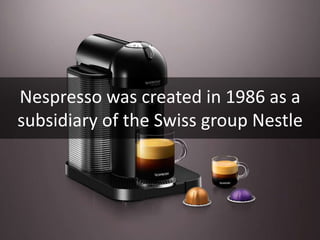
Nespresso was created in 1986 as a
subsidiary of the Swiss group Nestle
Nespresso machines brew espresso
and coffee from coffee capsules, or
pods in bar machines.
Nespresso manufactures both coffee
machines and capsules, with majority
of its revenue coming from the latter
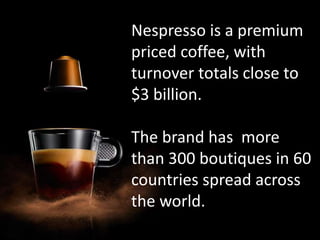
Nespresso is a premium
priced coffee, with
turnover totals close to
$3 billion.
The brand has more
than 300 boutiques in 60
countries spread across
the world.
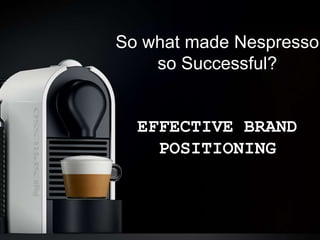
So what made Nespresso
so Successful?
EFFECTIVE BRAND
POSITIONING
Nespresso owes its global success to
its unique positioning in the high-
end coffee market. The Nespresso
system is based on several criteria:
• Practically designed coffee machines
• High quality coffee
• Excellent Service
• Strong & Original Communication
Brand positioning is the act of designing a
company’s offering and image to occupy a
distinctive place in the minds of consumers
Brand positioning has three
aspects
1. Choosing a competitive
frame of reference
2. Identifying optimal POPs
and PODs
3. Creating a Brand Mantra
Competitive frame of reference defines
which other brands a brand competes
with and is closely linked to target
market decisions
Competitive Frame of Reference
• Nespresso’s unique and original
brand positioning has allowed it to
keep its competition Tassimo
(Mondelez), Senseo (Sara Lee)
and Nespresso compatible
capsules at bay.
• However the company faces stiff
competition from Jacobs Douwe
Egberts, which is currently the
number one coffee company in the
world with a turnover of $4 billion.
Competitive Frame of Reference
Points of difference are attributes or
benefits that consumers strongly
associate with a brand, positively
evaluate and believe they could not find
to the same extent with a competitive
brand
Points of Difference (PODs)
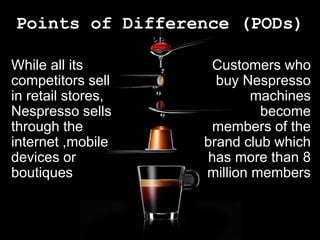
While all its
competitors sell
in retail stores,
Nespresso sells
through the
internet ,mobile
devices or
boutiques
Customers who
buy Nespresso
machines
become
members of the
brand club which
has more than 8
million members
Nespresso creates a sense of belonging
to a privileged community that
reinforces the brand’s positioning
Points of Difference (PODs)
The brand has located fully automated
distributors called Nespresso Cube in
prominent airports across Europe.
Points of Parity are attribute or benefit
associations that are not necessarily
unique to the brand but may in fact be
shared with other brands. These types
of associations come in three basic
forms: category, correlational and
competitive
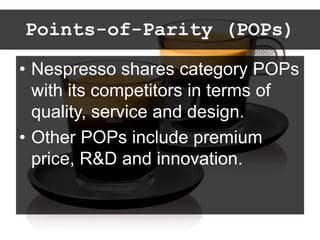
Points-of-Parity (POPs)
• Nespresso shares category POPs
with its competitors in terms of
quality, service and design.
• Other POPs include premium
price, R&D and innovation.
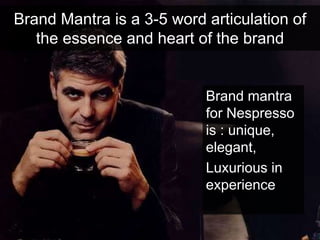
Brand Mantra is a 3-5 word articulation of
the essence and heart of the brand
Brand mantra
for Nespresso
is : unique,
elegant,
Luxurious in
experience
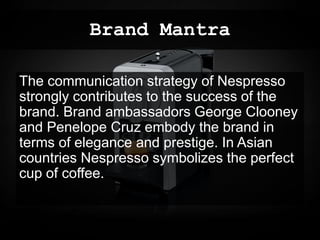
Brand Mantra
The communication strategy of Nespresso
strongly contributes to the success of the
brand. Brand ambassadors George Clooney
and Penelope Cruz embody the brand in
terms of elegance and prestige. In Asian
countries Nespresso symbolizes the perfect
cup of coffee.
Advertisements
Competition from JDE
The mini case raises the question, if
Nespresso can resist competition from JDE.
Owing to its unique nature, elegance, and
premium positioning Nespresso has a loyal
user base and a cult following, which will
allow the company to ward off any
competition from JDE.
SUMMARY
The chapter discusses the process of
developing and establishing brand position
with focus on competitive frame of
reference, POPs, PODs and Brand Mantra.
The mini-case on Nespresso supplements
the theory with relevant examples and
cases.
DISCLAIMER
Created by Karthik Prasad , BITS Pilani Goa,
during a Marketing Internship by Prof. Sameer
Mathur, IIM Lucknow.

Nespresso - Crafting the Brand Positioning

  • 1.
  • 2.
    Nespresso was createdin 1986 as a subsidiary of the Swiss group Nestle
  • 3.
    Nespresso machines brewespresso and coffee from coffee capsules, or pods in bar machines. Nespresso manufactures both coffee machines and capsules, with majority of its revenue coming from the latter
  • 4.
    Nespresso is apremium priced coffee, with turnover totals close to $3 billion. The brand has more than 300 boutiques in 60 countries spread across the world.
  • 5.
    So what madeNespresso so Successful? EFFECTIVE BRAND POSITIONING
  • 6.
    Nespresso owes itsglobal success to its unique positioning in the high- end coffee market. The Nespresso system is based on several criteria: • Practically designed coffee machines • High quality coffee • Excellent Service • Strong & Original Communication
  • 7.
    Brand positioning isthe act of designing a company’s offering and image to occupy a distinctive place in the minds of consumers Brand positioning has three aspects 1. Choosing a competitive frame of reference 2. Identifying optimal POPs and PODs 3. Creating a Brand Mantra
  • 8.
    Competitive frame ofreference defines which other brands a brand competes with and is closely linked to target market decisions
  • 9.
    Competitive Frame ofReference • Nespresso’s unique and original brand positioning has allowed it to keep its competition Tassimo (Mondelez), Senseo (Sara Lee) and Nespresso compatible capsules at bay.
  • 10.
    • However thecompany faces stiff competition from Jacobs Douwe Egberts, which is currently the number one coffee company in the world with a turnover of $4 billion. Competitive Frame of Reference
  • 11.
    Points of differenceare attributes or benefits that consumers strongly associate with a brand, positively evaluate and believe they could not find to the same extent with a competitive brand
  • 12.
    Points of Difference(PODs) While all its competitors sell in retail stores, Nespresso sells through the internet ,mobile devices or boutiques Customers who buy Nespresso machines become members of the brand club which has more than 8 million members
  • 13.
    Nespresso creates asense of belonging to a privileged community that reinforces the brand’s positioning Points of Difference (PODs) The brand has located fully automated distributors called Nespresso Cube in prominent airports across Europe.
  • 14.
    Points of Parityare attribute or benefit associations that are not necessarily unique to the brand but may in fact be shared with other brands. These types of associations come in three basic forms: category, correlational and competitive
  • 15.
    Points-of-Parity (POPs) • Nespressoshares category POPs with its competitors in terms of quality, service and design. • Other POPs include premium price, R&D and innovation.
  • 16.
    Brand Mantra isa 3-5 word articulation of the essence and heart of the brand Brand mantra for Nespresso is : unique, elegant, Luxurious in experience
  • 17.
    Brand Mantra The communicationstrategy of Nespresso strongly contributes to the success of the brand. Brand ambassadors George Clooney and Penelope Cruz embody the brand in terms of elegance and prestige. In Asian countries Nespresso symbolizes the perfect cup of coffee.
  • 18.
  • 19.
    Competition from JDE Themini case raises the question, if Nespresso can resist competition from JDE. Owing to its unique nature, elegance, and premium positioning Nespresso has a loyal user base and a cult following, which will allow the company to ward off any competition from JDE.
  • 20.
    SUMMARY The chapter discussesthe process of developing and establishing brand position with focus on competitive frame of reference, POPs, PODs and Brand Mantra. The mini-case on Nespresso supplements the theory with relevant examples and cases.
  • 21.
    DISCLAIMER Created by KarthikPrasad , BITS Pilani Goa, during a Marketing Internship by Prof. Sameer Mathur, IIM Lucknow.