Nerve Root Pathophysiology
Richard C Rooney, MD, FACS
rrooney@seattlespinegroup.com
Symptomatology-Different physiological events
• Pain
• Nerve root dysfunction
Mechanisms
• 2 mechanisms at tissue level
• Mechanical deformation of the nerve roots
» Mixter, NEJM ’34
» Bailey, J Nerv Ment Dis ’11
» Goldthwait, Boston Med Surg J ’11
» Sachs, J Nerv Ment Dis ‘00
• Effect of nucleus pulposus on nerve root
» Olmarker, Spine ‘93
Mechanical Effects
• Peripheral nerves and nerve roots are different
• Peripheral nerves have greater connective tissue content so
they are more resistant to deformation
» Gelfan, Am J Physiol ’56
» Sharpless, NIH workshop, ‘75
Experimental nerve root compression
• Pig cauda equina nerve root compression model
» Olmarker, Spine ’91 & Acta Orthop Scan ‘91
– Occlusion pressure ≈ venous stasis pressure
» Sunderland, J Neurol Neurosurg Psych ‘76
– ↓blood flow ↓ nutrition ↓ function
– Occlusion(ischemia) leads to increase vascular permeability, edema,
and fibrosis
» Rydevik, Scan J Plastic Rec Surg ’76 & ‘77
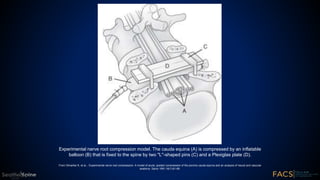
Experimental nerve root compression model. The cauda equina (A) is compressed by an inflatable
balloon (B) that is fixed to the spine by two "L"-shaped pins (C) and a Plexiglas plate (D).
From Olmarker K, et al., Experimental nerve root compression. A model of acute, graded compression of the porcine cauda equina and an analysis of neural and vascular
anatomy. Spine 1991;16(1):61-69.
Experimental nerve root compression
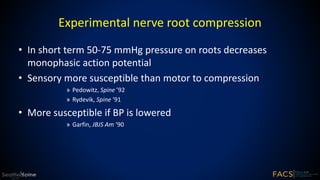
• In short term 50-75 mmHg pressure on roots decreases
monophasic action potential
• Sensory more susceptible than motor to compression
» Pedowitz, Spine ’92
» Rydevik, Spine ‘91
• More susceptible if BP is lowered
» Garfin, JBJS Am ‘90
Rate of onset
• Rapid onset
– induces more edema
» Olmarker, Spine ’89
– decreases methylglucose transport
» Olmarker, J Spinal Dis ’90
– and decreases impulse propagation more than slow onset
» Olmarker, Spine ‘90
• Reasons and mechanisms of difference are unclear but shear and creep
are implicated
Multiple levels of compression
• Substance P (neurotransmitter) increases in compression…no
good studies…may be adaptation
» Cornefjord, Spine ‘95
Experimental-Clinical correlation
• 75mm2 cross sectional area correlates with increased root
pressure in cadavers which correlates with CT scans in
symptomatic patients
» Schonstrom, Spine ’84 & ‘85
Mechanical deformation and pain
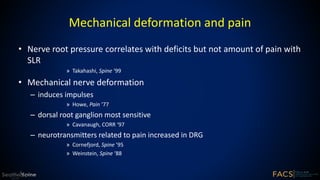
• Nerve root pressure correlates with deficits but not amount of pain with
SLR
» Takahashi, Spine ‘99
• Mechanical nerve deformation
– induces impulses
» Howe, Pain ‘77
– dorsal root ganglion most sensitive
» Cavanaugh, CORR ‘97
– neurotransmitters related to pain increased in DRG
» Cornefjord, Spine ’95
» Weinstein, Spine ‘88
Neuropathology and pain
• Apoptosis or necrosis
• Mild ischemia producing demyelination (apoptosis of schwann
cells) generally not painful
» Powell, Lab Invest ’86
» Myers, Anesthesiology ‘93
• Severe ischemia producing necrosis of schwann cells and
wallerian degeneration results in hyperalgesia
Neuropathology and pain
• Cytokine driven process of wallerian degeneration is the link
between nerve injury and pain
– Degree and extent of wallerian degeneration relates directly to
magnitude and duration of hyperalgesia
» Myers, Anesthesiology ’93
» Stoll, J Periph Nerv Syst ’02
» Myers, Cytokines and Pain ’99
» Myers, J Neurol Sci ’96
Biological effects of disc tissue
• HNP inflammatory effect and injury to Schwann cells
» Rydevik, Acta Orthop Scan ’83
» McCarron, Spine ’87
» Olmarker, Spine ’96 & ’97
» Kayama, Spine ‘96
• HNP leads to intraneural edema and decreased intraneural blood flow
by 2 hours
» Byrod, Eur Spine J ’98 & J Orthop Res ’02
» Yabuki, Spine ‘98
• Histologic change of nerve roots by 3 hours
Biological effects of disc tissue
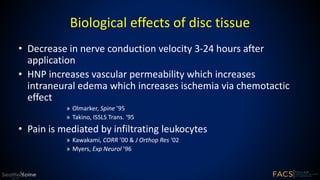
• Decrease in nerve conduction velocity 3-24 hours after
application
• HNP increases vascular permeability which increases
intraneural edema which increases ischemia via chemotactic
effect
» Olmarker, Spine ’95
» Takino, ISSLS Trans. ‘95
• Pain is mediated by infiltrating leukocytes
» Kawakami, CORR ’00 & J Orthop Res ‘02
» Myers, Exp Neurol ’96
Nucleus pulposus and sciatic pain
• Displacement does not cause pain but displacement of nerve
root with an associated HNP does cause pain
» Olmarker, Pain ‘98
• Touching nerve root is not painful but touching nerve root
exposed to NP is painful
» Kuslich, Orthop Clin North Am ’91
Nucleus pulposus and sciatic pain
• Vascular impairment of the nerve tissue with a resultant
nutritional deficit that results in ischemia of the nerve seems
to be the likely pain mechanism
– Induced by both biological and mechanical factors
Mechanisms and transport routes
• HNP → inflammation
» Olmarker, Spine ’93 & ’95
» Takino, ISSLS Trans ’95
» Kawakami, CORR ’00
» Kang, Spine ’96
» Delcanto, J Neurol Sci ’75
» Hahn, Acta Neuropath ’80
» Bisla, CORR ’76
» Bobechko, JBJS ’65
» Gertzbein, Orthop Clin North Am ’75 & CORR ’77
» LaRocca, Orthop Clin North Am ’71
» Naylor, Ann Roy Col Surg ‘62
Seven days after the application of nucleus pulposus. Myelinated nerve fiber with prominent
vesicular swelling of a Schmidt-Lanterman incisure. Note the mononuclear cell (black M) in close
contact with the nerve fiber. A, Well-preserved axon; white M, myelin sheath; S, outer Schwann
cell cytoplasm. Arrowheads indicate myelin sheath layers outside the Schmidt-Lanterman
incisure.
Olmarker K, et al: Ultrastructural changes in spinal nerve roots induced by autologous nucleus pulposus. Spine 1996.
Components of the NP of discs
• Proteoglycans, collagen, cells
» Bayliss, The Lumbar Spine and Back Pain ’92
» Eyre, New Perspectives on Low Back Pain ‘88
• Proteoglycans have been implicated as having direct irritating effect on
nerve tissue
» Naylor, Ann Royal Col Surg ’62
» Marshall, Lancet ’73 & CORR ‘77
• Cells- killed(frozen) do not induce any change in nerve conduction
velocity
» Olmarker, Spine ’97
» Kayama, Spine ‘98
Cytokines as mediators of nerve dysfunction and
pain
• TNF
– Regulatory proinflammatory cytokine
– Has specific biologic effects
– Up regulates and acts synergistically with other cytokines (IL-1B, IL-6)
» Chao, Brain Behav Immun ’95
» Gadient, Neurosci Letters ’90
» Bluthe, Eur J Pharmacol ’91
» McHale, J Immun ’99
» Siwik, Circ Res ’00
» McGee, Immunology ‘95
TNF as mediator of nerve dysfunction and pain
• Immediately after nerve injury, TNF is released and up
regulated by
– Schwann cells
– endothelial cells
– fibroblasts
– mast cells.
» Wagner, Neuroscience ‘96
TNF as mediator of nerve dysfunction and pain
• Also produced by chondrocytes and disc cells
» Olmarker, Spine ’98
» Satomi, Jap J Exp Med ’81
» Bachwich, Am J Patho ’86
» Robbins, J Immunology ’87
» Sayers, J Immunology ’87
TNF as mediator of nerve dysfunction and pain
• The local production of TNF is the stimulus that attracts macrophages to
injury site which up regulates pro-inflammatory cytokines to the injured
tissue
» Stoll, J Peripher Nerv Syst ‘02
• Several studies have shown that blocking TNFα results in reduced or
delayed neuropathologic change and reduced hyperalgesia
» Myers, Exp Neurol ’96
» Sommer, Pain ‘98
TNF as mediator of nerve dysfunction and pain
• TNF induces axonal and myelin injury similar to NP application
» Wagner, Neuroreport ’96
» Igarashi, Spine ’00
» Liberski, Acta Neurobiol Exp ’94
» Madigan, Neurol Research ’96
» Redford, Brain ’95
» Selmaj, Ann NY Acad Sci ’88
» Stoll, J Neuroinnumol ‘93
– Intravascular coagulation
» Nawroth, J Exp Med ’88
» van der Poll, Blood ’96
» Watts, British J Cancer ‘96
– Increased vascular permeability
» Watts, British J Cancer ‘96
TNF as mediator of nerve dysfunction and pain
• TNF is neurotoxic
» Madigan, Neurol Res ’96
» Selmaj, Ann NY Acad Sci ’88
» Viviani, Toxicol Appl Pharmacol ’98
» Wuthrich, Am J Pathol ‘90
– Induces painful behavioral changes
» Wagner, Neuroreport ’96
» Sommer, Neurosci Lett ‘97
– Ectopic nerve activity
» Igarashi, Spine ’00
» Sorkin, Neuroscience ‘97
TNF as mediator of nerve dysfunction and pain
• TNF is sequestered in membrane bound form and is activated
after shedding by certain enzymes
– MMP-9, MMP-2 which are up regulated immediately after a nerve
injury
» Shubayev, Brain Res ‘00
• TNF is also in disc cells
TNF mechanism of action
• TNF induces an activation of endothelial adhesion molecules (ICAM and
VCAM) which adhere circulating immune cells to vessel walls
» McHale, J Immunol ’99
» Mattila, Scand J Immunol ’92
» Pober, Ciba Found Symp ‘87
• TNF induces vascular permeability which allows WBC’s to migrate to
endoneurial space where axons are located
» Creange, Eur Cytokine Network ’97
» Munro, Am J Pathol ’89
» Oku, J Biochem ‘87
TNF mechanism of action
• The cells release TNF
– Myelin injury
– Accumulation of Na channels
– Induction of allodynia
» Kagan, Science ’92
» Baldwin, Proc Natl Acad Science USA ’96
» Wei, Am J Physi Renal Phys ‘’03
• Na channels allow K+ and Na+ which results in spontaneous discharge
and discharge of ectopic impulses following mechanical stimulation
• TNF can cause spontaneous electrical activity in A-delta and C-
nociceptors
» Sorkin, Neuroscience ‘97
TNF mechanism of action
• These discharges regardless of whether they came from pain fiber or
another sensory fiber are interpreted by the brain as pain
» Woolf, Acta Neurochir Suppl ’93
» Attal, Acta Neurol Scand Suppl ’99
» Zimmermann, Eur J Pharmacol ’01
» Wall, Br Med Bulletin ‘91
• This mechanism may relate to the sensitization of nerve roots to
mechanical stimuli
TNF mechanism of action
• TNF disintegrates the myelin sheath
» Wagner, Neuroreport ’96
» Creange, Eur Cytokine Network ’97
» Selmaj, Ann Neurol ’88 & ’91
» Villarroya, J Neuroimmunology ‘96
– So does nucleus pulposus
» Olmarker, Spine ’96
» Kayama, Spine ‘96
Questions?
Thank you
rrooney@seattlespinegroup.com
Confidential

Nerve root pathophysiology

  • 1.
    Nerve Root Pathophysiology RichardC Rooney, MD, FACS rrooney@seattlespinegroup.com
  • 2.
  • 3.
    Mechanisms • 2 mechanismsat tissue level • Mechanical deformation of the nerve roots » Mixter, NEJM ’34 » Bailey, J Nerv Ment Dis ’11 » Goldthwait, Boston Med Surg J ’11 » Sachs, J Nerv Ment Dis ‘00 • Effect of nucleus pulposus on nerve root » Olmarker, Spine ‘93
  • 4.
    Mechanical Effects • Peripheralnerves and nerve roots are different • Peripheral nerves have greater connective tissue content so they are more resistant to deformation » Gelfan, Am J Physiol ’56 » Sharpless, NIH workshop, ‘75
  • 5.
    Experimental nerve rootcompression • Pig cauda equina nerve root compression model » Olmarker, Spine ’91 & Acta Orthop Scan ‘91 – Occlusion pressure ≈ venous stasis pressure » Sunderland, J Neurol Neurosurg Psych ‘76 – ↓blood flow ↓ nutrition ↓ function – Occlusion(ischemia) leads to increase vascular permeability, edema, and fibrosis » Rydevik, Scan J Plastic Rec Surg ’76 & ‘77
  • 6.
    Experimental nerve rootcompression model. The cauda equina (A) is compressed by an inflatable balloon (B) that is fixed to the spine by two "L"-shaped pins (C) and a Plexiglas plate (D). From Olmarker K, et al., Experimental nerve root compression. A model of acute, graded compression of the porcine cauda equina and an analysis of neural and vascular anatomy. Spine 1991;16(1):61-69.
  • 7.
    Experimental nerve rootcompression • In short term 50-75 mmHg pressure on roots decreases monophasic action potential • Sensory more susceptible than motor to compression » Pedowitz, Spine ’92 » Rydevik, Spine ‘91 • More susceptible if BP is lowered » Garfin, JBJS Am ‘90
  • 8.
    Rate of onset •Rapid onset – induces more edema » Olmarker, Spine ’89 – decreases methylglucose transport » Olmarker, J Spinal Dis ’90 – and decreases impulse propagation more than slow onset » Olmarker, Spine ‘90 • Reasons and mechanisms of difference are unclear but shear and creep are implicated
  • 9.
    Multiple levels ofcompression • Substance P (neurotransmitter) increases in compression…no good studies…may be adaptation » Cornefjord, Spine ‘95
  • 10.
    Experimental-Clinical correlation • 75mm2cross sectional area correlates with increased root pressure in cadavers which correlates with CT scans in symptomatic patients » Schonstrom, Spine ’84 & ‘85
  • 11.
    Mechanical deformation andpain • Nerve root pressure correlates with deficits but not amount of pain with SLR » Takahashi, Spine ‘99 • Mechanical nerve deformation – induces impulses » Howe, Pain ‘77 – dorsal root ganglion most sensitive » Cavanaugh, CORR ‘97 – neurotransmitters related to pain increased in DRG » Cornefjord, Spine ’95 » Weinstein, Spine ‘88
  • 12.
    Neuropathology and pain •Apoptosis or necrosis • Mild ischemia producing demyelination (apoptosis of schwann cells) generally not painful » Powell, Lab Invest ’86 » Myers, Anesthesiology ‘93 • Severe ischemia producing necrosis of schwann cells and wallerian degeneration results in hyperalgesia
  • 13.
    Neuropathology and pain •Cytokine driven process of wallerian degeneration is the link between nerve injury and pain – Degree and extent of wallerian degeneration relates directly to magnitude and duration of hyperalgesia » Myers, Anesthesiology ’93 » Stoll, J Periph Nerv Syst ’02 » Myers, Cytokines and Pain ’99 » Myers, J Neurol Sci ’96
  • 14.
    Biological effects ofdisc tissue • HNP inflammatory effect and injury to Schwann cells » Rydevik, Acta Orthop Scan ’83 » McCarron, Spine ’87 » Olmarker, Spine ’96 & ’97 » Kayama, Spine ‘96 • HNP leads to intraneural edema and decreased intraneural blood flow by 2 hours » Byrod, Eur Spine J ’98 & J Orthop Res ’02 » Yabuki, Spine ‘98 • Histologic change of nerve roots by 3 hours
  • 15.
    Biological effects ofdisc tissue • Decrease in nerve conduction velocity 3-24 hours after application • HNP increases vascular permeability which increases intraneural edema which increases ischemia via chemotactic effect » Olmarker, Spine ’95 » Takino, ISSLS Trans. ‘95 • Pain is mediated by infiltrating leukocytes » Kawakami, CORR ’00 & J Orthop Res ‘02 » Myers, Exp Neurol ’96
  • 16.
    Nucleus pulposus andsciatic pain • Displacement does not cause pain but displacement of nerve root with an associated HNP does cause pain » Olmarker, Pain ‘98 • Touching nerve root is not painful but touching nerve root exposed to NP is painful » Kuslich, Orthop Clin North Am ’91
  • 17.
    Nucleus pulposus andsciatic pain • Vascular impairment of the nerve tissue with a resultant nutritional deficit that results in ischemia of the nerve seems to be the likely pain mechanism – Induced by both biological and mechanical factors
  • 18.
    Mechanisms and transportroutes • HNP → inflammation » Olmarker, Spine ’93 & ’95 » Takino, ISSLS Trans ’95 » Kawakami, CORR ’00 » Kang, Spine ’96 » Delcanto, J Neurol Sci ’75 » Hahn, Acta Neuropath ’80 » Bisla, CORR ’76 » Bobechko, JBJS ’65 » Gertzbein, Orthop Clin North Am ’75 & CORR ’77 » LaRocca, Orthop Clin North Am ’71 » Naylor, Ann Roy Col Surg ‘62
  • 19.
    Seven days afterthe application of nucleus pulposus. Myelinated nerve fiber with prominent vesicular swelling of a Schmidt-Lanterman incisure. Note the mononuclear cell (black M) in close contact with the nerve fiber. A, Well-preserved axon; white M, myelin sheath; S, outer Schwann cell cytoplasm. Arrowheads indicate myelin sheath layers outside the Schmidt-Lanterman incisure. Olmarker K, et al: Ultrastructural changes in spinal nerve roots induced by autologous nucleus pulposus. Spine 1996.
  • 20.
    Components of theNP of discs • Proteoglycans, collagen, cells » Bayliss, The Lumbar Spine and Back Pain ’92 » Eyre, New Perspectives on Low Back Pain ‘88 • Proteoglycans have been implicated as having direct irritating effect on nerve tissue » Naylor, Ann Royal Col Surg ’62 » Marshall, Lancet ’73 & CORR ‘77 • Cells- killed(frozen) do not induce any change in nerve conduction velocity » Olmarker, Spine ’97 » Kayama, Spine ‘98
  • 21.
    Cytokines as mediatorsof nerve dysfunction and pain • TNF – Regulatory proinflammatory cytokine – Has specific biologic effects – Up regulates and acts synergistically with other cytokines (IL-1B, IL-6) » Chao, Brain Behav Immun ’95 » Gadient, Neurosci Letters ’90 » Bluthe, Eur J Pharmacol ’91 » McHale, J Immun ’99 » Siwik, Circ Res ’00 » McGee, Immunology ‘95
  • 22.
    TNF as mediatorof nerve dysfunction and pain • Immediately after nerve injury, TNF is released and up regulated by – Schwann cells – endothelial cells – fibroblasts – mast cells. » Wagner, Neuroscience ‘96
  • 23.
    TNF as mediatorof nerve dysfunction and pain • Also produced by chondrocytes and disc cells » Olmarker, Spine ’98 » Satomi, Jap J Exp Med ’81 » Bachwich, Am J Patho ’86 » Robbins, J Immunology ’87 » Sayers, J Immunology ’87
  • 24.
    TNF as mediatorof nerve dysfunction and pain • The local production of TNF is the stimulus that attracts macrophages to injury site which up regulates pro-inflammatory cytokines to the injured tissue » Stoll, J Peripher Nerv Syst ‘02 • Several studies have shown that blocking TNFα results in reduced or delayed neuropathologic change and reduced hyperalgesia » Myers, Exp Neurol ’96 » Sommer, Pain ‘98
  • 25.
    TNF as mediatorof nerve dysfunction and pain • TNF induces axonal and myelin injury similar to NP application » Wagner, Neuroreport ’96 » Igarashi, Spine ’00 » Liberski, Acta Neurobiol Exp ’94 » Madigan, Neurol Research ’96 » Redford, Brain ’95 » Selmaj, Ann NY Acad Sci ’88 » Stoll, J Neuroinnumol ‘93 – Intravascular coagulation » Nawroth, J Exp Med ’88 » van der Poll, Blood ’96 » Watts, British J Cancer ‘96 – Increased vascular permeability » Watts, British J Cancer ‘96
  • 26.
    TNF as mediatorof nerve dysfunction and pain • TNF is neurotoxic » Madigan, Neurol Res ’96 » Selmaj, Ann NY Acad Sci ’88 » Viviani, Toxicol Appl Pharmacol ’98 » Wuthrich, Am J Pathol ‘90 – Induces painful behavioral changes » Wagner, Neuroreport ’96 » Sommer, Neurosci Lett ‘97 – Ectopic nerve activity » Igarashi, Spine ’00 » Sorkin, Neuroscience ‘97
  • 27.
    TNF as mediatorof nerve dysfunction and pain • TNF is sequestered in membrane bound form and is activated after shedding by certain enzymes – MMP-9, MMP-2 which are up regulated immediately after a nerve injury » Shubayev, Brain Res ‘00 • TNF is also in disc cells
  • 28.
    TNF mechanism ofaction • TNF induces an activation of endothelial adhesion molecules (ICAM and VCAM) which adhere circulating immune cells to vessel walls » McHale, J Immunol ’99 » Mattila, Scand J Immunol ’92 » Pober, Ciba Found Symp ‘87 • TNF induces vascular permeability which allows WBC’s to migrate to endoneurial space where axons are located » Creange, Eur Cytokine Network ’97 » Munro, Am J Pathol ’89 » Oku, J Biochem ‘87
  • 29.
    TNF mechanism ofaction • The cells release TNF – Myelin injury – Accumulation of Na channels – Induction of allodynia » Kagan, Science ’92 » Baldwin, Proc Natl Acad Science USA ’96 » Wei, Am J Physi Renal Phys ‘’03 • Na channels allow K+ and Na+ which results in spontaneous discharge and discharge of ectopic impulses following mechanical stimulation • TNF can cause spontaneous electrical activity in A-delta and C- nociceptors » Sorkin, Neuroscience ‘97
  • 30.
    TNF mechanism ofaction • These discharges regardless of whether they came from pain fiber or another sensory fiber are interpreted by the brain as pain » Woolf, Acta Neurochir Suppl ’93 » Attal, Acta Neurol Scand Suppl ’99 » Zimmermann, Eur J Pharmacol ’01 » Wall, Br Med Bulletin ‘91 • This mechanism may relate to the sensitization of nerve roots to mechanical stimuli
  • 31.
    TNF mechanism ofaction • TNF disintegrates the myelin sheath » Wagner, Neuroreport ’96 » Creange, Eur Cytokine Network ’97 » Selmaj, Ann Neurol ’88 & ’91 » Villarroya, J Neuroimmunology ‘96 – So does nucleus pulposus » Olmarker, Spine ’96 » Kayama, Spine ‘96
  • 33.